Elevator Modernization vs. Full Replacement: Which Is Better?
Direct Answer: Elevator modernization is generally the better choice when the existing structure and shaft are sound and the system needs updated controls, safety features, or energy efficiency — but full replacement becomes the smarter investment when the cab, mechanical components, and overall system are beyond cost-effective repair or when a building’s traffic demands have fundamentally changed.
Deciding between elevator modernization and full replacement is one of the most consequential capital decisions a building owner or property manager in Florida can face. The right path depends on equipment age, code compliance status, total cost of ownership, tenant expectations, and long-term building strategy. This guide breaks down every factor so decision-makers can choose with confidence — and explains why working with a certified independent provider like Axxiom Elevator Florida matters when evaluating your options.
What Is Elevator Modernization?

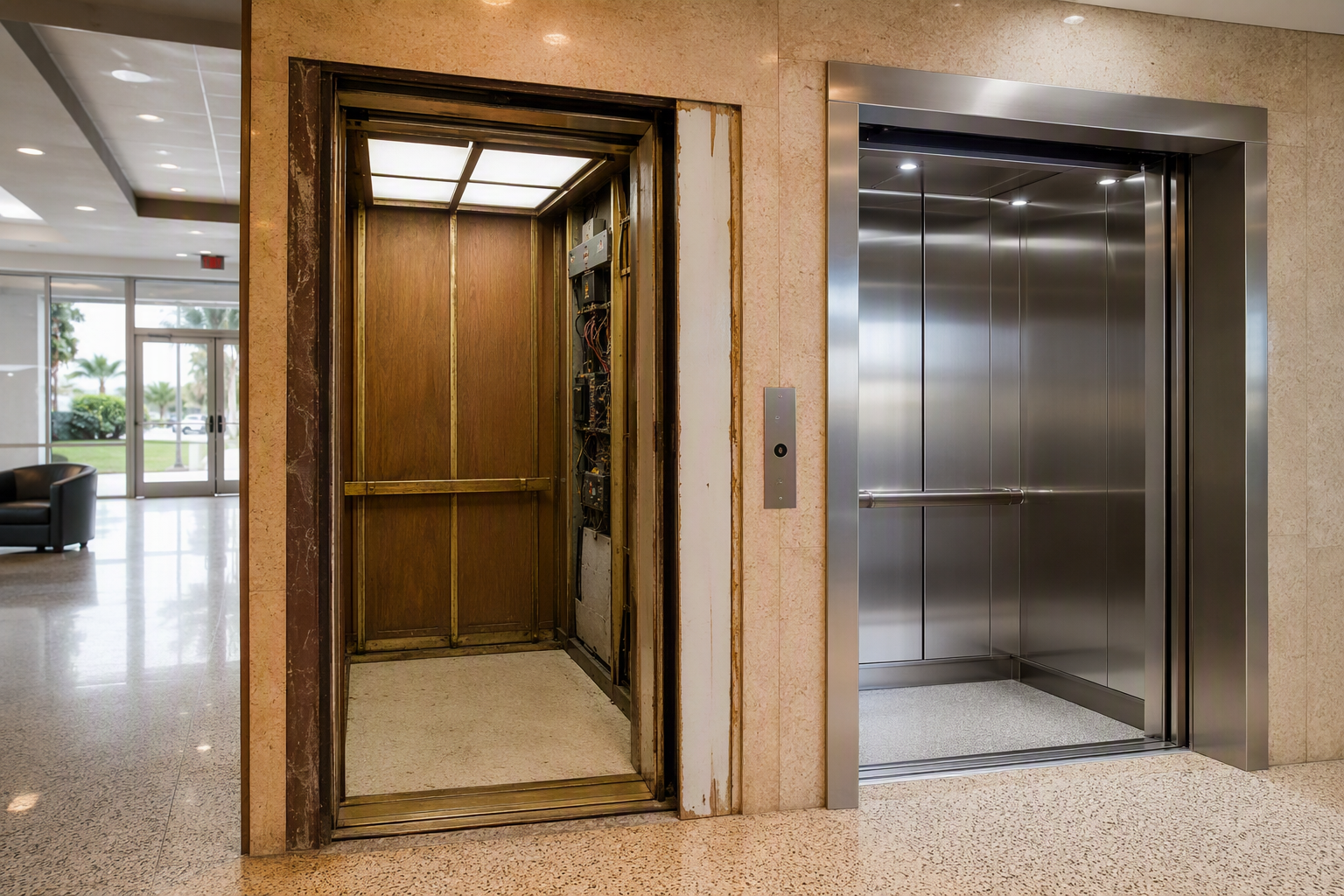
Elevator modernization — sometimes called a “mod” or “retrofit” — replaces specific components of an existing elevator system while retaining the hoistway, cab shell, and structural infrastructure. A modernization project might address any combination of the following:
- Control system and software upgrades
- Drive and motor replacement
- Door operator and safety edge upgrades
- Interior cab finishes and lighting
- Destination dispatch systems
- Emergency communication and alarm systems
- Hydraulic unit and fluid replacement (for hydraulic elevators)
- Code-required safety devices under ASME A17.1 Safety Code for Elevators and Escalators
Modernization preserves existing infrastructure, which significantly reduces both project cost and building disruption compared to tearing out and rebuilding the entire system.
What Does Full Elevator Replacement Involve?
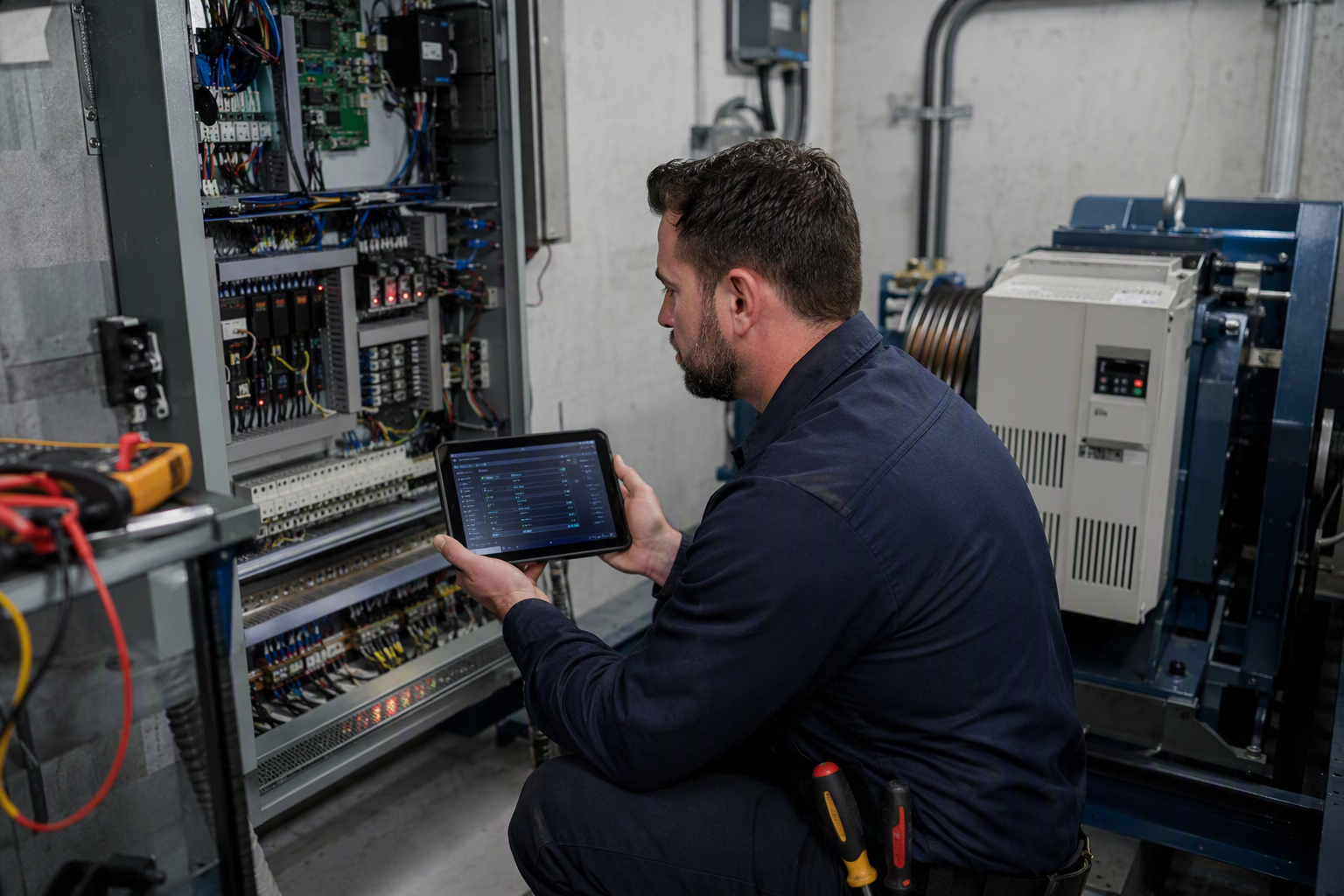
Full replacement means removing every component — controls, drive, machine, cab, guide rails, counterweights, and often the hoistway equipment — and installing a new system from the ground up. Full replacement is more disruptive, requires longer downtime, and carries a substantially higher price tag. However, it delivers a factory-new system with a full manufacturer warranty and decades of expected service life.
Full replacement is also an opportunity to switch elevator types — for example, transitioning from a hydraulic system to a machine-room-less (MRL) traction elevator to save mechanical room space and improve energy performance.
How Do Modernization and Full Replacement Compare in Cost?
| Factor | Modernization | Full Replacement |
|---|---|---|
| Relative upfront cost | Lower — existing structure is retained | Higher — all components replaced |
| Construction disruption | Moderate; hoistway stays intact | Significant; full hoistway work possible |
| Elevator downtime | Weeks, depending on scope | Months, depending on building type |
| Expected system lifespan added | Additional years of extended service | Full new lifecycle (decades) |
| Code compliance outcome | Triggered upgrades must meet current code | Full code compliance from installation |
| Warranty coverage | Component-level warranties | Comprehensive manufacturer warranty |
| ROI timeline | Shorter payback period | Longer payback; higher long-term value |
| Environmental impact | Less waste — existing parts reused | Greater material waste and disposal |
Note: Specific cost figures vary widely based on elevator type, building height, scope of work, and local permitting. Axxiom Elevator Florida provides free assessments to help building owners obtain accurate project estimates.
What Are the Pros and Cons of Elevator Modernization?
| Pros of Modernization | Cons of Modernization |
|---|---|
| Lower upfront capital expenditure | Underlying structural issues may remain |
| Shorter construction and downtime window | May require follow-up projects as more components age |
| Immediate safety and compliance improvements | Does not reset the full equipment lifecycle |
| Energy efficiency gains through modern drives | Not all legacy systems are compatible with modern controls |
| Improved ride quality and tenant satisfaction | Mixing old and new components can complicate maintenance |
| Preserves existing cab structure | Cab aesthetics may still look dated without a full interior renovation |
What Are the Pros and Cons of Full Elevator Replacement?
| Pros of Full Replacement | Cons of Full Replacement |
|---|---|
| Brand-new system with full manufacturer warranty | Significantly higher upfront cost |
| Decades of expected new service life | Extended elevator downtime during installation |
| Full code compliance from day one | Greater building disruption and temporary access challenges |
| Opportunity to upgrade elevator type (e.g., hydraulic to MRL) | Longer planning and permitting timeline |
| Consistent parts sourcing and simplified maintenance | Higher environmental impact from demolition and disposal |
| Optimal for buildings undergoing major renovation | May be cost-prohibitive for smaller buildings |
How Does Code Compliance Factor Into the Decision?
Code compliance is a critical driver of both modernization and replacement decisions in Florida. Elevator safety is governed at the federal level by standards including the ASME A17.1 Safety Code for Elevators and Escalators, which is updated on a regular edition cycle. Florida adopts and enforces these standards through the Florida Building Code and the Florida Department of Business and Professional Regulation (DBPR).
When a modernization project is undertaken, Florida code requires that certain triggered upgrades be brought into compliance with the current edition of the applicable standard — even if those components were not originally part of the project scope. This means a modernization can unexpectedly expand in scope to address non-compliant legacy components.
Accessibility requirements under the Americans with Disabilities Act (ADA) also apply to elevator alterations. When a building alters an elevator, the altered elements must meet current ADA Standards for Accessible Design to the extent technically feasible.
Workplace safety during elevator service and installation work is subject to OSHA regulations, which govern the safety practices of service technicians on the job site.
Understanding exactly which code triggers apply to a given project scope requires an expert review — which is precisely what Axxiom Elevator Florida provides during a free building assessment.
What Is the Typical Timeline for Each Option?
| Phase | Modernization Timeline | Full Replacement Timeline |
|---|---|---|
| Assessment and planning | Days to a few weeks | Weeks to months |
| Permitting and approvals | Weeks (scope-dependent) | Weeks to months |
| Equipment procurement | Shorter lead times (targeted components) | Longer lead times (full system) |
| Installation and elevator downtime | Days to several weeks | Weeks to several months |
| Inspection and final approval | Days after project completion | Days after project completion |
For multi-elevator buildings, phased scheduling can reduce tenant impact in either scenario. Axxiom Elevator Florida works with property managers to develop project timelines that minimize disruption to building operations.
When Should a Building Choose Modernization Over Replacement?
Modernization is generally the preferred path when:
- The elevator hoistway and cab structure are in sound physical condition
- The primary issues are outdated controls, drive systems, or safety devices
- The building’s traffic patterns and usage demands have not significantly changed
- Budget constraints favor a lower upfront capital expenditure
- The building is not undergoing a broader major renovation
- Energy efficiency improvements are the primary goal
- The elevator is mid-lifecycle and has remaining structural value
When Should a Building Choose Full Replacement Over Modernization?
Full replacement becomes the more appropriate choice when:
- The elevator is at or beyond its expected design service life
- Major structural components — rails, hoistway, machine — are compromised
- Repair and maintenance costs are consistently high and rising
- The building is planning a major renovation or change of use
- Modernization would trigger so many code upgrades that cost savings disappear
- Building traffic demands have grown significantly beyond the original system design
- The property owner wants the long-term certainty of a full manufacturer warranty
How Do You Evaluate ROI for Elevator Modernization vs. Replacement?
Return on investment for either path should be evaluated across multiple dimensions — not just upfront cost. A rigorous ROI analysis should account for:
- Avoided maintenance costs: Modern components and new systems require less reactive maintenance than aging equipment.
- Energy savings: Modern variable-frequency drives (VFDs) and LED lighting reduce operating costs compared to older systems.
- Tenant satisfaction and retention: Elevator reliability and ride quality directly affect tenant experience in commercial and residential buildings.
- Code compliance risk avoidance: Non-compliant elevators expose building owners to liability and potential shutdown orders from state inspectors.
- Property value: Updated elevator systems contribute positively to building appraisals and competitive positioning in the Florida real estate market.
- Downtime costs: Extended elevator outage during full replacement may have a real economic cost for high-traffic buildings.
Axxiom Elevator Florida helps building owners model these factors during a free assessment to support a well-informed capital decision.
What Equipment Components Are Typically Addressed in a Modernization?
A comprehensive modernization can touch many systems. Common components addressed include:
- Controllers and logic systems: Older relay-based systems are replaced with modern solid-state programmable logic controllers (PLCs)
- Drive systems: AC drives with VFDs improve ride quality and energy efficiency
- Door operators and safety edges: Updated to meet current ASME A17.1 requirements for door protection
- Emergency lighting and communication: Code-mandated upgrades for emergency phone and alarm systems
- Hydraulic units: For hydraulic elevators, power units and environmentally safe biodegradable fluid options
- Position indicators and fixtures: Updated hall and car operating panels
- Cab interiors: Flooring, wall panels, ceilings, and lighting
Does Modernization Trigger a Full ADA Compliance Review?
This is one of the most frequently misunderstood aspects of elevator modernization. Under the ADA, when a building undertakes an alteration to a facility, the altered areas must be made accessible to the extent technically feasible. An elevator alteration that modifies cab interiors, controls, or door systems can trigger an obligation to bring those specific elements into compliance with the ADA Standards for Accessible Design — including requirements for control height, braille designations, door width, and emergency communication systems. A full ADA audit of existing conditions prior to beginning any modernization scope is a best practice that Axxiom Elevator Florida recommends as part of every pre-project assessment.
How Does an Independent Elevator Company Compare to an OEM for This Decision?
Original equipment manufacturers (OEMs) have a financial incentive to recommend replacement of proprietary components with their own new products. An independent elevator service company evaluates options without that bias. Independent providers can source components from multiple manufacturers, assess whether modernization is genuinely the better value, and recommend full replacement only when that path is objectively justified.
Axxiom Elevator Florida is an independent, certified elevator service company serving building owners, property managers, and facility directors throughout Florida. Axxiom’s team performs unbiased assessments of existing elevator systems — evaluating equipment condition, code compliance gaps, operational performance, and long-term maintenance costs — to provide a clear, evidence-based recommendation on whether modernization or full replacement is the right strategy for each specific building.
What Steps Should a Building Owner Take Before Making This Decision?
- Commission a professional elevator assessment: Have a qualified elevator professional inspect the existing system’s mechanical condition, control system, safety devices, and structural components.
- Review maintenance and callback history: Compile records of service calls, breakdowns, parts replacements, and recurring issues to identify systemic problems.
- Identify code compliance gaps: Cross-reference the existing system against the current edition of ASME A17.1 and Florida Building Code requirements to understand what upgrades are mandatory regardless of project scope.
- Assess ADA compliance status: Review cab, controls, and communication systems against ADA Standards for Accessible Design.
- Define building goals and budget parameters: Clarify whether the priority is minimizing upfront cost, maximizing service life, improving energy efficiency, or a combination of objectives.
- Obtain competitive proposals: Gather formal proposals from qualified independent providers that clearly define scope, timeline, warranties, and code compliance outcomes.
- Evaluate total cost of ownership — not just installation cost: Factor in projected maintenance, energy, and compliance costs over the expected service life of each option.
- Consult with a Florida-licensed elevator contractor: Confirm all proposed work will be permitted and inspected in accordance with Florida statutes.
What Questions Should You Ask Any Elevator Contractor Before Signing a Contract?
- Will this modernization scope trigger additional code-required upgrades beyond the listed items?
- What is the expected remaining service life of the system after modernization?
- What warranties are provided on modernized components, and who backs them?
- How will ADA compliance be addressed as part of this project?
- What is the permitting and inspection process in this jurisdiction?
- Who is responsible if additional issues are discovered once work begins?
- What is your experience working with this elevator type and manufacturer?
- Can you provide references from similar modernization or replacement projects in Florida?
Why Does Equipment Age Matter When Choosing Between Modernization and Replacement?
Equipment age is one of the most reliable indicators of whether modernization or replacement delivers better long-term value. As elevator systems age, the cumulative cost of maintaining aging components — combined with parts obsolescence, longer repair lead times, and increasing callback frequency — often makes continued patching economically irrational. However, age alone is not the deciding factor. An elevator that has been well-maintained and operates in a stable, low-demand environment may still be an excellent modernization candidate. Conversely, a younger system that was poorly specified for its application or inadequately maintained may require more intervention than a straightforward modernization can cost-effectively deliver. A professional condition assessment is always the starting point.
Is 2026 a Good Time to Modernize or Replace Elevators in Florida?
In 2026, Florida building owners face a convergence of factors that make proactive elevator investment strategically sound: ongoing updates to the ASME A17.1 Safety Code for Elevators and Escalators, continued enforcement of ADA accessibility standards, and a competitive Florida real estate market where building systems are closely scrutinized by tenants and investors alike. Deferring a necessary modernization or replacement does not eliminate the expense — it typically increases it, as continued breakdowns escalate maintenance costs and deferred compliance corrections become more complex and expensive over time. The most cost-effective moment to act is before forced downtime or regulatory action creates urgency.
Get a Free Elevator Assessment from Axxiom Elevator Florida
Determining whether elevator modernization or full replacement is the right path for your building requires a professional, unbiased evaluation — not a manufacturer’s sales pitch. Axxiom Elevator Florida is an independent certified elevator service company serving property owners and managers throughout Florida. Axxiom’s team assesses existing elevator systems, identifies code compliance gaps, and provides clear recommendations backed by technical expertise — with no obligation to any specific manufacturer or product line.
Contact Axxiom Elevator Florida for a free elevator assessment:
Need elevator service you can rely on? Axxiom Elevator Florida is ready to help.