How to Evaluate Elevator Service Companies Before Signing a Maintenance Contract in Florida: Complete FAQ Guide
Choosing the wrong elevator service provider costs building owners far more than a higher monthly fee — it can mean failed state inspections, ADA violations, equipment downtime, and liability exposure. This FAQ hub answers every critical question Florida property managers, building owners, and facility directors ask when vetting elevator maintenance companies, from license verification to contract red flags to local compliance requirements.
Why does choosing the right elevator maintenance company matter so much in Florida?
The right elevator maintenance company directly affects your building’s legal compliance, occupant safety, and long-term equipment reliability under Florida’s strict elevator regulations.
Florida operates under one of the more rigorous state elevator safety frameworks in the country. The Florida Department of Business and Professional Regulation (DBPR) enforces mandatory periodic inspections, and buildings found out of compliance can face shutdown orders, fines, and significant legal liability. A maintenance provider who misses inspection deadlines, defers necessary repairs, or lacks proper licensure puts the property owner — not just the contractor — at risk.
Beyond compliance, elevator downtime in a multi-tenant residential or commercial building directly affects tenant satisfaction, lease renewals, and property valuation. Selecting a qualified, locally accountable provider like Axxiom Elevator Florida, which serves property owners in Pompano Beach and Sarasota, ensures that both regulatory obligations and day-to-day reliability are managed proactively.
What licenses must an elevator service company hold in Florida?
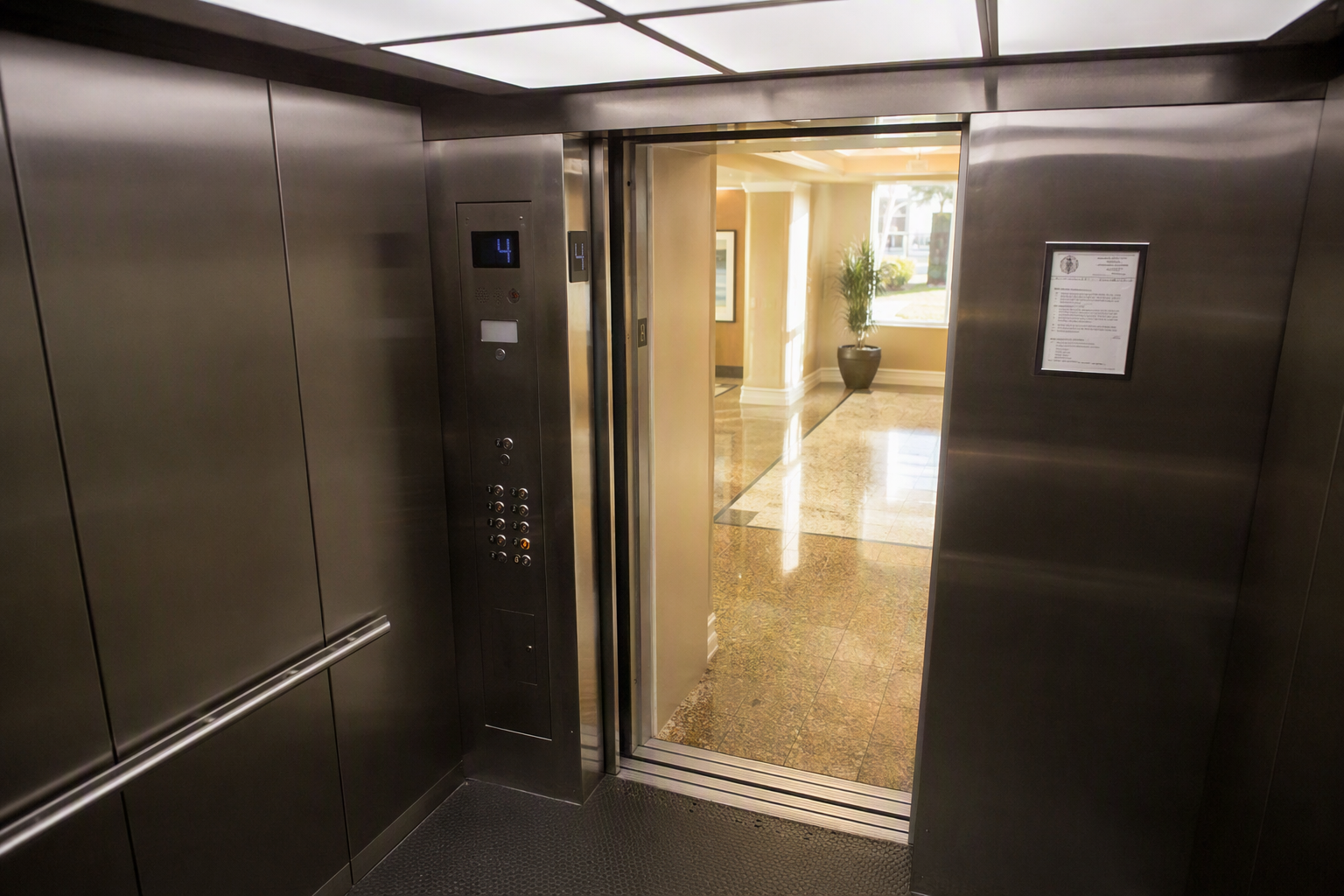
Florida requires elevator contractors to hold a valid Certificate of Competency issued by the DBPR, and any company performing maintenance, repair, or installation work must employ licensed elevator mechanics.
Before signing any contract, property owners should ask for the company’s state license number and verify it directly through the DBPR’s online license verification portal. An unlicensed company cannot legally obtain permits, perform code-required repairs, or certify equipment to state inspectors — meaning any work they perform may be invalid for compliance purposes.
Additionally, elevator mechanics performing fieldwork must hold individual licensure or work under the direct supervision of a licensed contractor. Always request proof of both company-level and technician-level credentials before execution of any agreement.
How do ASME A17.1 standards apply to elevator maintenance contracts in Florida?
The ASME A17.1 Safety Code for Elevators and Escalators is the foundational technical standard Florida adopts for elevator construction, maintenance, and inspection, and any qualified contractor must demonstrate thorough familiarity with it.
ASME A17.1 specifies the minimum requirements for periodic testing, maintenance intervals, component performance, and safety device operation. Florida’s rules reference ASME A17.1 as the governing technical standard, meaning a maintenance contract that does not align with these requirements is structurally deficient from a compliance standpoint.
When interviewing contractors, ask specifically which edition of ASME A17.1 their maintenance procedures follow and how they stay current with code updates. As of 2026, contractors should be working from current or recent code editions and be able to explain how their maintenance checklists map to code-mandated tasks. A provider unable to answer this question fluently is a significant red flag.
What should a comprehensive elevator maintenance contract include?
A comprehensive elevator maintenance contract must clearly define the scope of covered services, excluded components, parts and labor terms, inspection scheduling, documentation practices, and contract termination provisions.
The following elements should appear in writing before any contract is signed:
- Scope of maintenance: Specify which components are covered — motor, controller, door operators, safeties, buffers, guide rails, and pit equipment — and which are explicitly excluded.
- Parts coverage: Distinguish between labor-only contracts, parts-and-labor contracts, and full-coverage agreements. Understand whether parts are billed at cost or marked up.
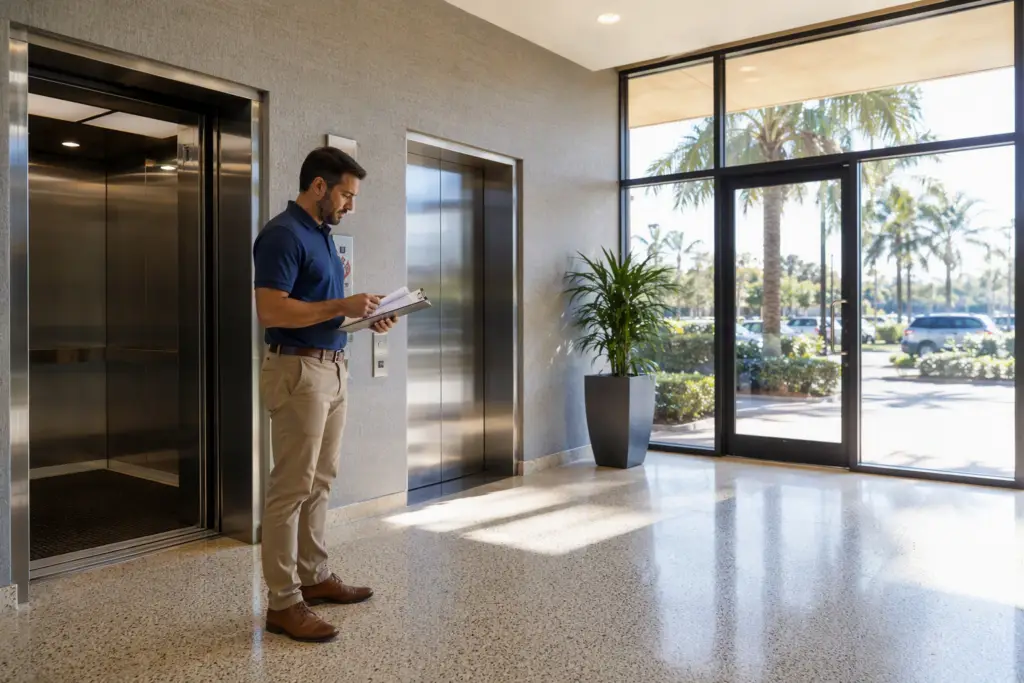
- Inspection coordination: Confirm the contractor will coordinate, prepare for, and accompany state and third-party inspectors.
- Violation response: Define how quickly the contractor will address state-issued violations or correction orders.
- Documentation: Require written maintenance logs, test records, and violation correction documentation be provided to the building owner.
- Termination clauses: Review notice periods, early termination fees, and automatic renewal provisions carefully.
Contracts that are vague about scope — using language like “routine maintenance as needed” without specificity — are designed to limit the contractor’s obligation while maximizing their fee security. Demand specificity.
What questions should building owners ask a potential elevator contractor before signing?
Building owners should ask about state licensure, ASME A17.1 compliance practices, local service coverage, parts sourcing, documentation procedures, and how the contractor handles state inspection violations.
The following ordered list represents a structured due diligence interview process:
- Request the company’s Florida elevator contractor license number and verify it with DBPR.
- Ask which edition of ASME A17.1 their maintenance procedures reference.
- Ask how they document maintenance visits and whether logs are provided to the building owner.
- Request references from comparable properties in your market — residential high-rise, commercial, or healthcare, as appropriate.
- Ask whether technicians are employed directly or subcontracted.
- Request a sample maintenance contract and review it before any in-person meetings.
- Ask how they handle state-issued correction orders and what their process is for coordinating with DBPR inspectors.
- Clarify parts sourcing: OEM parts, aftermarket, or refurbished, and how warranty implications are handled.
- Ask whether they carry general liability insurance and workers’ compensation, and request certificates.
- Confirm their physical service coverage in your specific market — Pompano Beach, Sarasota, or elsewhere in Florida.
How do full-service and basic maintenance contracts differ, and which is right for my building?
Full-service contracts cover parts, labor, and emergency calls under a fixed fee, while basic contracts cover only labor for scheduled visits and bill parts and emergency calls separately — the right choice depends on equipment age, budget structure, and risk tolerance.
| Feature | Basic / Labor-Only | Parts & Labor | Full-Service / Comprehensive |
|---|---|---|---|
| Scheduled maintenance visits | Included | Included | Included |
| Replacement parts | Billed separately | Included (with limits) | Included |
| Emergency callback labor | Billed separately | Billed separately | Included |
| Major component replacement | Billed separately | Often excluded | May be excluded — verify |
| State inspection preparation | Varies | Varies | Typically included |
| Best suited for | New equipment under OEM warranty | Mid-age equipment, predictable budgets | Older equipment, high-traffic buildings |
| Budget predictability | Low | Medium | High |
For older equipment — particularly units more than fifteen to twenty years old — full-service contracts tend to provide better long-term financial predictability, even if the monthly fee is higher. For newer equipment under manufacturer warranty, a labor-only agreement may be sufficient in the near term. A qualified contractor should walk building owners through this analysis honestly rather than defaulting to the highest-tier contract as a sales default.
How often are Florida elevators required to be inspected, and how does a maintenance company fit into that process?
Florida law requires periodic safety inspections by state-licensed inspectors, and a qualified maintenance company plays a direct role in preparing equipment, coordinating inspector access, and resolving any violations issued.
The specific inspection intervals and procedures are governed by Florida Statutes and align with the ASME A17.1 Safety Code for Elevators and Escalators testing requirements. Inspections typically include safety device testing, governor and buffer tests at defined intervals, and review of maintenance records. A maintenance contractor who cannot produce organized, up-to-date records during an inspection creates unnecessary exposure for the building owner.
Before selecting a provider, ask how they document maintenance activities and whether those records are formatted in a way that satisfies state inspector requirements. Contractors who keep records only in proprietary internal systems without sharing them with the building owner are limiting the owner’s ability to independently verify compliance.
What ADA compliance responsibilities does an elevator maintenance company carry?
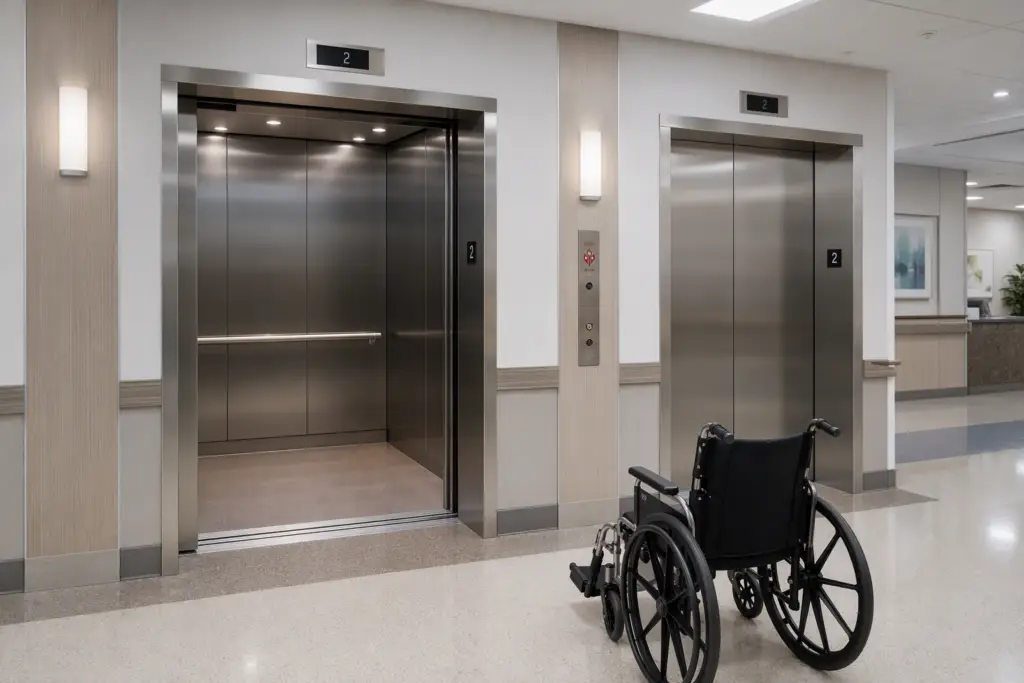
While ADA design compliance is primarily an architectural and ownership responsibility, a maintenance contractor must ensure that accessibility features — including control panel heights, door timing, and audible/visual signals — remain functional and code-conforming.
The Americans with Disabilities Act (ADA) establishes requirements for elevator accessibility in public accommodations and commercial facilities. These include requirements for control button placement, audible floor announcements, Braille signage, and door reopening device sensitivity. During maintenance visits, technicians should inspect and document the operational status of all accessibility features.
When evaluating a contractor, ask whether their maintenance checklist includes ADA-related operational checks — not just mechanical and safety items. A provider who treats ADA compliance as outside their scope is leaving the building owner exposed to federal complaint and litigation risk.
What insurance coverage should an elevator maintenance company carry?
At minimum, an elevator maintenance contractor should carry general liability insurance, workers’ compensation insurance, and, for larger contracts, umbrella coverage — and should provide current certificates of insurance before any work begins.
Uninsured or underinsured contractors expose the building owner to direct liability for worksite injuries, property damage, and third-party claims. Before contract execution, request certificates of insurance naming the building owner or management company as an additional insured on the general liability policy. Verify that the workers’ compensation policy covers all technicians who will service the property, including any subcontracted labor.
Do not accept verbal assurances of coverage. Request the certificates directly from the insurer — not from the contractor — if there is any doubt about authenticity.
How should building owners evaluate a contractor’s local service coverage in Florida?
Local service coverage matters because contractors without nearby technicians and parts inventory cannot reliably meet service demands, especially during peak failure periods like summer heat in Florida markets.
For properties in markets like Pompano Beach and Sarasota, working with a contractor that has established local operations — rather than one dispatching from a distant regional hub — is a material factor in service reliability. Ask specifically where the nearest technician is based, where parts inventory is stocked, and how many properties they currently service in your county.
Axxiom Elevator Florida maintains active service operations in both Pompano Beach and Sarasota, which means property owners in those markets are served by technicians who know local building stock, have relationships with county and state inspection offices, and can physically respond without extended travel delays.
What are the most common red flags in elevator maintenance contracts?
The most common red flags include vague scope language, automatic multi-year renewal clauses, exclusions that cover most repair scenarios, and the absence of documentation obligations.
Watch for these specific warning signs when reviewing any proposed agreement:
- Evergreen renewal clauses: Contracts that auto-renew for one to three years with minimal notice requirements lock building owners into poor service relationships.
- “Catastrophic failure” exclusions: Contracts that exclude major component replacements often define “major” so broadly that nearly any significant repair falls outside coverage.
- No documentation requirement: If the contract does not obligate the contractor to provide written maintenance records to the owner, there is no accountability mechanism.
- Unlicensed subcontracting language: Some contracts permit the primary contractor to subcontract work without restriction — verify that any subcontracted work must meet the same licensure requirements.
- Ambiguous “as needed” maintenance language: This language gives the contractor discretion to defer maintenance tasks indefinitely without contractual consequence.
How do I compare multiple elevator service proposals objectively?
Compare proposals using a structured matrix that evaluates scope, exclusions, parts terms, documentation requirements, insurance, licensure, and local coverage rather than comparing monthly fees alone.
Monthly fee comparisons without scope normalization are meaningless — a lower-fee contract with broad exclusions will cost far more over a contract term than a higher-fee comprehensive agreement. When requesting proposals, provide each contractor with identical written specifications so that bids are apples-to-apples. Ask each respondent to explicitly state what is and is not included, rather than allowing them to frame their own scope narrative.
Prioritize contractors who respond to your RFP with specificity, transparency, and willingness to explain their maintenance methodology in technical terms. Vague proposals suggest vague execution.
What role does elevator age and equipment type play in selecting a maintenance provider?
Older hydraulic and traction elevator systems require contractors with specific experience in legacy equipment and parts sourcing, while newer digital-control systems require technicians with current diagnostic training.
Florida’s building stock includes a wide range of elevator vintages — from legacy hydraulic units in mid-century commercial buildings to modern machine-room-less (MRL) traction systems in newer residential towers. A contractor who primarily services one equipment type may lack the depth to service the other effectively.
When evaluating providers, ask for specific experience with your equipment manufacturer and model. Ask how they source parts for older systems where OEM support may be limited. This is a particularly relevant question in markets like Pompano Beach and Sarasota, where building stock spans several decades of elevator technology.
How should safety record and inspection history factor into contractor evaluation?
A contractor’s history of inspection outcomes — including violation rates and correction timelines on properties they maintain — is one of the most reliable indicators of service quality and should be requested as part of due diligence.
Ask prospective contractors to provide references from current clients in your market and to share, with client permission, recent state inspection reports from comparable properties. A well-run maintenance program produces clean inspection records; chronic violations, deferred corrections, or inspection failures on a contractor’s portfolio are direct evidence of inadequate service delivery.
Florida’s DBPR maintains public records on elevator inspections and violations. Property owners can use these records to independently verify claims contractors make about their compliance performance.
What OSHA requirements apply to elevator maintenance work in Florida?
Elevator maintenance technicians are subject to OSHA standards governing confined spaces, lockout/tagout procedures, and electrical safety, and contractors must demonstrate active safety compliance programs.
OSHA standards for construction and general industry apply to technicians working in pits, machine rooms, and hoistways. Proper lockout/tagout (LOTO) procedures are required when servicing electrical and mechanical components. Contractors without documented safety programs or with OSHA citation histories represent safety and liability risks to the building owner, since worksite injuries on your property can create co-liability scenarios.
When evaluating contractors, ask for their OSHA recordable incident rate history and their documented safety training program for technicians. Reputable providers should be forthcoming with this information.
How long should an elevator maintenance contract term be, and what exit provisions are reasonable?
Contract terms of one to three years are standard in the industry, but building owners should negotiate exit provisions that allow termination for cause — including inspection failures, documentation gaps, or unresolved violations — without financial penalty.
Multi-year contracts benefit contractors by providing revenue security; they benefit building owners only when paired with strong performance standards and enforceable termination rights. A contract that locks a building owner in for three years with only a thirty-day termination-for-convenience window and a substantial early termination fee creates a captive relationship that removes the contractor’s incentive to perform.
Negotiate specific performance metrics — such as response time to state violation correction orders, maintenance documentation delivery timelines, and inspection pass rates — as conditions that, if not met, trigger the right to terminate without penalty. Contractors confident in their service quality should accept these terms.
What documentation should a building owner receive from their elevator maintenance contractor?
Building owners are entitled to written maintenance logs for every service visit, test records required by ASME A17.1, copies of state inspection certificates, and written records of any violation correction work performed.
Documentation is not merely administrative — it is the property owner’s primary evidence of compliance in the event of an incident, insurance claim, or regulatory audit. Maintenance logs should include the date of service, technician identity, work performed, components inspected, and any deficiencies noted with recommended corrective action.
Contractors who resist providing comprehensive documentation — or who claim proprietary ownership over maintenance records generated on your equipment — are prioritizing their own leverage over your legitimate compliance needs. Ownership of maintenance records for your own equipment should be a non-negotiable contract provision.
How does working with a locally established company like Axxiom Elevator Florida differ from a national chain?
Locally established contractors offer more direct accountability, deeper familiarity with Florida-specific regulatory requirements, and closer relationships with regional inspection offices compared to large national chains that may prioritize volume over individual building relationships.
National elevator service companies serve large geographic territories and often route service calls through centralized dispatch systems, which can affect how well field technicians know individual buildings and their equipment quirks. Local accountability — where the company’s reputation depends on performance in a specific market — creates different incentives.
Axxiom Elevator Florida focuses specifically on Florida markets, including Pompano Beach and Sarasota, allowing for service delivery shaped by direct knowledge of the local regulatory environment, building stock, and client relationships rather than national standardized protocols that may not reflect Florida-specific nuances.
What should building owners do if they discover their current elevator contractor is not meeting contract obligations?
If a current contractor is failing to meet documented contract obligations, building owners should formally document deficiencies in writing, review termination provisions, file a complaint with DBPR if licensure violations are involved, and begin evaluating replacement providers before formally terminating.
The following steps represent a structured remediation process:
- Document all known deficiencies with dates, descriptions, and any related state inspection reports or correction orders.
- Send a formal written notice to the contractor identifying specific contract obligations not being met and requesting a written corrective action plan with deadlines.
- Review the contract’s termination for cause provisions and confirm what documentation is required to exercise them.
- If the contractor holds a state license and the deficiencies involve licensing violations, file a complaint with the Florida DBPR.
- Begin soliciting proposals from replacement providers — including local companies familiar with your equipment and market — before terminating, to minimize transition gaps.
- Upon transition, ensure all maintenance records, test certificates, and inspection documents are transferred from the outgoing contractor to the incoming provider and retained in building files.
How can building owners in Pompano Beach and Sarasota find qualified elevator contractors for competitive evaluation?
Building owners in Pompano Beach and Sarasota can find qualified elevator contractors through the DBPR’s licensed contractor database, referrals from property management associations, and direct outreach to established local providers with verifiable compliance records in those markets.
The Florida DBPR maintains a searchable database of licensed elevator contractors, which is the authoritative starting point for any evaluation. Beyond the database, local property management associations and building owners’ associations in Broward and Sarasota counties can provide referrals based on direct peer experience.
When building a competitive evaluation list, prioritize contractors who can demonstrate active portfolios in your specific market. Axxiom Elevator Florida serves both the Pompano Beach and Sarasota markets and welcomes inquiries from property owners who want to compare a locally accountable provider against larger regional or national options. A professional elevator assessment is the most direct way to understand current equipment condition and maintenance needs before committing to any long-term service agreement.
Ready to Evaluate Your Elevator Maintenance Options in Florida?
Choosing the right elevator service partner is one of the most consequential decisions a Florida building owner or property manager makes. Verify licensure, demand contract specificity, require documentation, and choose a provider with demonstrable local accountability in your market.
Contact Axxiom Elevator Florida for a free elevator assessment. Whether your property is in Pompano Beach, Sarasota, or the surrounding South and Southwest Florida region, Axxiom Elevator Florida brings Florida-specific regulatory knowledge and a commitment to transparent, documented service to every maintenance relationship.
Call Axxiom Elevator Florida today:
Need elevator service you can rely on? Axxiom Elevator Florida is ready to help.