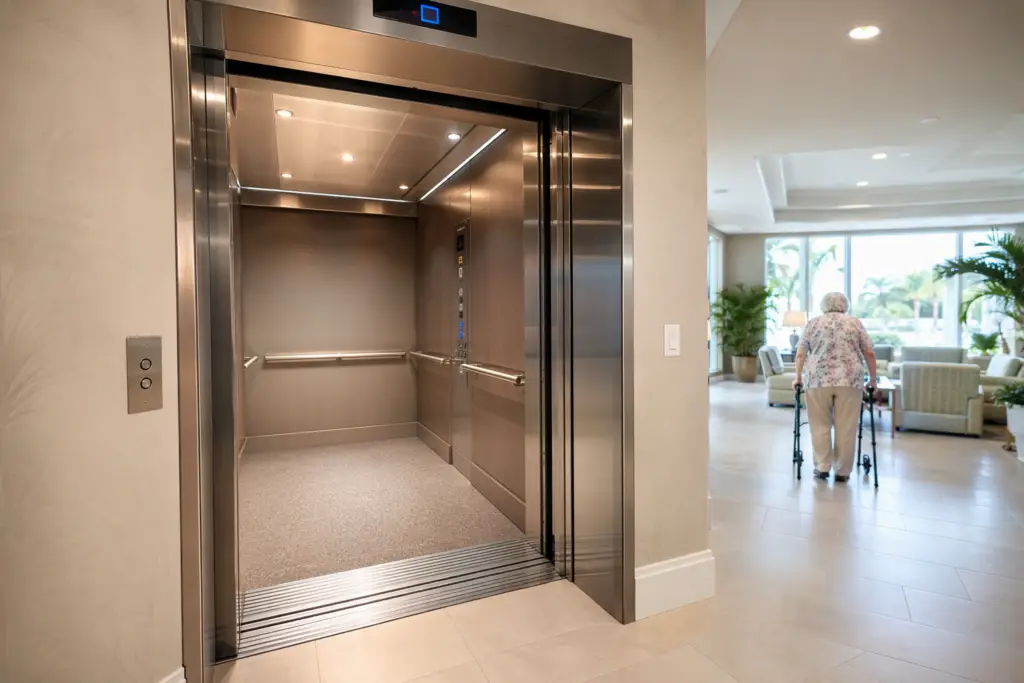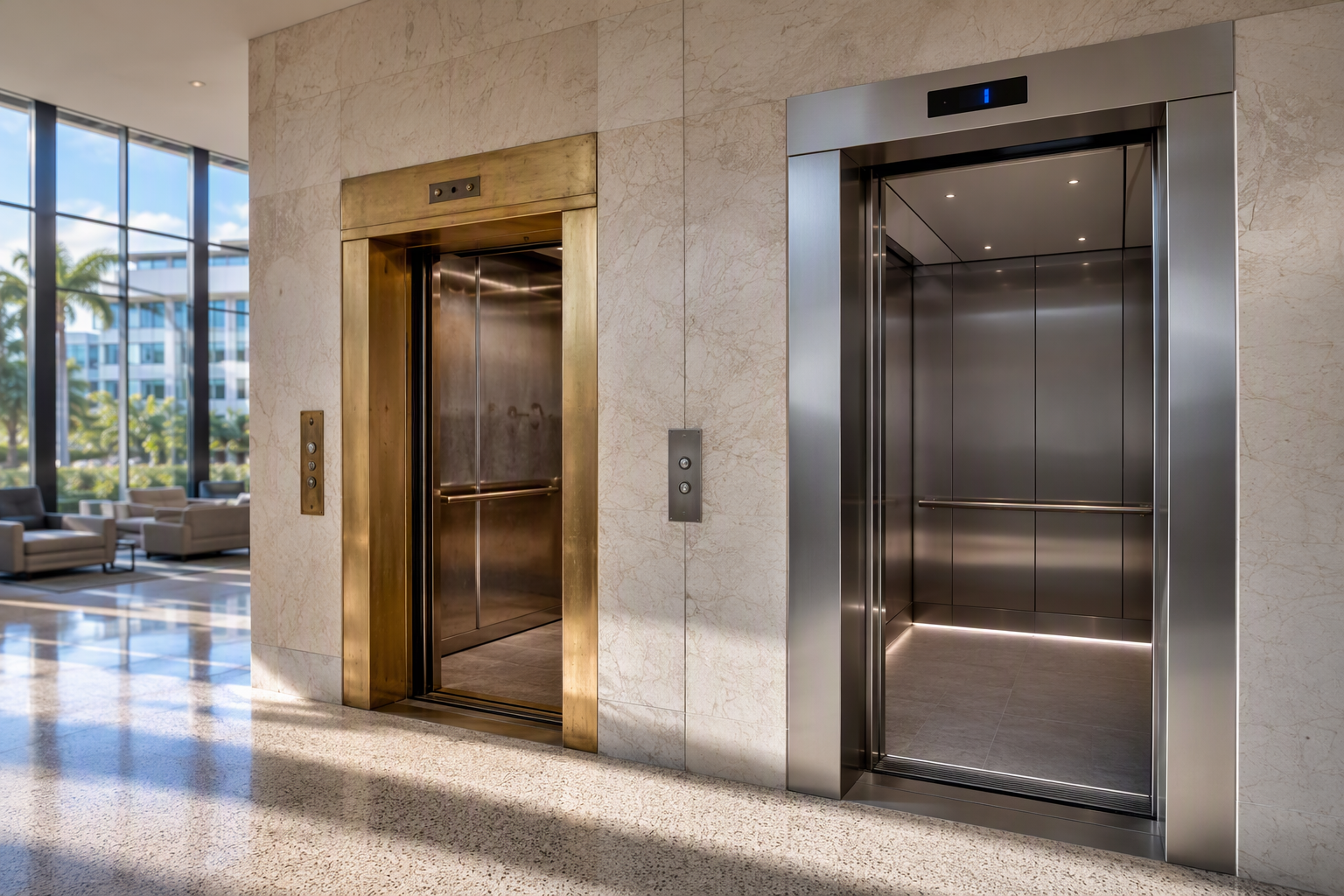
Deciding between repairing and replacing an aging commercial elevator in Sarasota is one of the most consequential capital decisions a building owner or property manager will make. The answer is not purely financial — code compliance, tenant experience, insurance exposure, and the Sarasota commercial real estate market all factor in. This guide walks through every dimension of that decision so building owners can enter the conversation with an elevator contractor fully informed.
What Are the Core Factors That Determine Repair vs. Replacement?
Before running any numbers, building owners should assess four baseline variables:
- Equipment age and condition. An elevator’s useful life varies by type, usage intensity, and maintenance history. A well-maintained traction elevator in a low-traffic professional building may remain serviceable well beyond one that has been deferred on maintenance in a high-rise residential tower.
- Compliance status. Florida adopted ASME A17.1-2019 (Safety Code for Elevators and Escalators), effective December 31, 2023, under Chapter 399, Florida Statutes (Elevator Safety Act) and Chapter 61C-5, Florida Administrative Code. Any elevator out of compliance with the current adopted code is a liability that affects both the repair and replacement calculus.
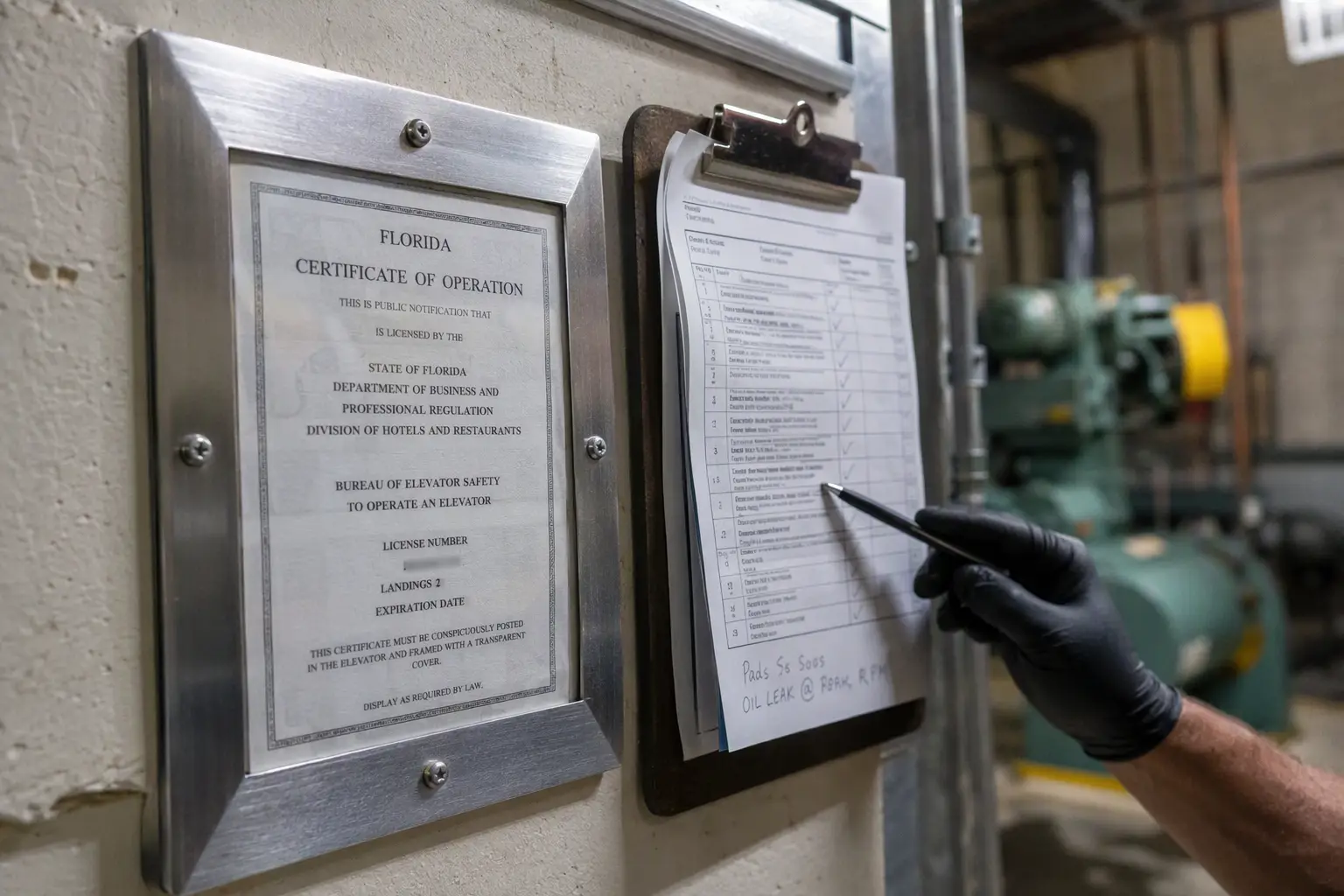
- Certificate of operation status. Under Florida law, a certificate of operation is valid for no more than two years. Operating on an expired certificate violates state law. If renewal requires corrective work, that cost must be factored into the repair side of the ledger.
- The 50% Rule of Thumb. A widely used guideline in the elevator industry holds that when the estimated cost of repairs approaches or exceeds roughly half the cost of a complete modernization, replacement typically delivers better long-term value. This is a planning heuristic, not a binding standard — consult a qualified elevator contractor for a site-specific assessment.
How Do Repair and Replacement Costs Compare for a Sarasota Commercial Elevator?
Costs vary significantly based on elevator type, number of stops, equipment brand, and local labor market conditions. Because Axxiom Elevator Florida does not publish fixed price lists and because verified third-party cost data for the Sarasota submarket is not available from a citable public source, the table below uses qualitative cost tiers rather than invented figures. A licensed elevator contractor assessment is the only reliable way to obtain actual numbers for a specific building.
| Cost Category | Targeted Repair | Partial Modernization | Full Replacement |
|---|---|---|---|
| Scope | Single failed component (e.g., controller board, door operator, motor) | Control system, cab interior, and door systems — mechanical left in place | All mechanical, electrical, structural, and interior components |
| Relative cost | Lowest upfront | Mid-range | Highest upfront |
| Useful life added | Short-term; does not extend overall equipment life significantly | Moderate; extends life of the mechanical plant | Full new lifecycle |
| Downtime | Days to weeks | Weeks to a few months | Several months; may require hoistway modifications |
| Permit required in Florida? | Depends on scope — alteration triggers permit requirement | Yes — alteration permit required under Chapter 399 | Yes — installation permit required under Chapter 399 |
| ADA compliance upgrade included? | No, unless specifically added | Partial — cab and controls can be upgraded | Yes — new installation must meet current ADA standards |
| Energy efficiency | No improvement | Moderate improvement with modern controls | Maximum improvement with regenerative drives |
What Is the ROI Difference Between Repairing and Replacing?
| ROI Factor | Repair / Targeted Fix | Full Replacement / Modernization |
|---|---|---|
| Immediate cash outlay | Lower | Higher |
| Recurring repair likelihood | High — aging components fail in sequence | Low for the first several years of new lifecycle |
| Maintenance contract cost | Higher for aging equipment | Lower for new or modernized equipment |
| Tenant retention impact | Risk of complaints and lease non-renewals from repeated outages | Positive — modern elevator is a marketable building amenity |
| Property valuation effect | Minimal to neutral | Can support higher NOI and cap-rate improvements |
| Insurance risk | Aging equipment may increase liability exposure | New compliant equipment reduces exposure |
| Financing options | Generally must be expensed | May qualify for capital improvement financing or lease structures |
How Does Florida’s Regulatory Framework Affect the Repair vs. Replace Decision?
Florida’s elevator regulatory environment — administered by the Florida Department of Business and Professional Regulation (DBPR), Division of Hotels and Restaurants, Bureau of Elevator Safety — imposes specific obligations that directly influence which path makes financial sense.
- Annual inspection obligation. Florida requires every covered elevator to be inspected annually by a certified elevator inspector, with limited exceptions. One notable exception: an elevator (not an escalator or dumbwaiter) that serves only two adjacent floors and is covered by a service maintenance contract is exempt from the annual inspection requirement while that contract remains in effect.
- Certificate of operation. A Florida certificate of operation is valid for no more than two years. It can only be renewed following a current satisfactory inspection. Operating on an expired certificate violates state law. Any repair or modernization scope must result in a conveyance that can pass inspection and secure renewal.
- Permit requirement for alterations. Florida law requires a state permit — applied for by a registered elevator company — before a conveyance is installed or altered. This means even significant repairs that constitute an “alteration” under the adopted code require a permit. Building owners should confirm with their contractor whether planned work triggers this requirement.
- Registered elevator companies and technicians. All installation and repair work in Florida must be performed by a registered elevator company. Florida certified elevator technicians must hold a state-issued certificate of competency. Confirm that any contractor working in a Sarasota building meets these requirements.
- Owner responsibility. Once a certificate of operation is issued, the elevator owner is responsible for safe operation, proper maintenance, inspection, and correction of code deficiencies. Deferring repairs that are flagged in an inspection report is a compliance and liability risk.
- Posted certificate requirement. The certificate of operation must be posted in a conspicuous location in the elevator in a frame with a transparent cover. Any lapses discovered during a state or local inspection can trigger enforcement action.
- Adopted code edition. Florida adopted ASME A17.1-2019 effective December 31, 2023. Elevators installed or significantly altered must conform to this edition. Understanding which requirements apply to existing equipment versus new installations informs whether a repair is sufficient or a full replacement triggers code upgrades that shift the cost equation.
What Are the Pros and Cons of Repairing an Aging Sarasota Commercial Elevator?
| Pros of Repair | Cons of Repair |
|---|---|
| Lower immediate capital outlay | Does not address underlying aging of mechanical plant |
| Shorter downtime for targeted fixes | Parts availability for older equipment can be limited or discontinued |
| Can address a single urgent compliance deficiency | Repeated repairs accumulate — often exceeds replacement cost over 5–10 years |
| Preserves existing hoistway configuration | Does not improve energy efficiency or tenant experience |
| May satisfy inspection requirements in the short term | ADA compliance gaps may remain unaddressed |
What Are the Pros and Cons of Full Elevator Replacement in a Sarasota Commercial Building?
| Pros of Replacement | Cons of Replacement |
|---|---|
| Full new equipment lifecycle with manufacturer warranty | Highest upfront capital cost |
| Current ASME A17.1-2019 and ADA compliance from day one | Significant building downtime — weeks to months depending on scope |
| Lower ongoing maintenance costs | May require hoistway modifications — structural costs beyond elevator contract |
| Modern energy efficiency, reducing operating costs | Tenant disruption during construction period |
| Improved reliability reduces service call frequency | Permitting and inspection timeline under Florida Chapter 399 |
| Positive impact on building marketability and valuation | Longer planning horizon required |
How Do I Evaluate Whether My Elevator Can Be Repaired or Must Be Replaced?
Building owners and property managers can use this step-by-step process to structure an objective assessment before engaging contractors for bids.
- Pull the inspection history. Retrieve all annual inspection reports and any notices of violation issued by the Florida DBPR Bureau of Elevator Safety or the local authority having jurisdiction. Look for recurring deficiencies — these indicate systemic problems rather than isolated failures.
- Verify the certificate of operation status. Confirm the certificate is current, posted correctly, and not approaching expiration. Identify what work, if any, is required to renew it.
- Document the repair history and costs. Compile all invoices for repairs and service calls over the past five years. A pattern of escalating frequency and cost is a strong indicator that replacement will deliver better long-term value.
- Identify parts availability. Ask a registered elevator contractor to confirm whether replacement parts for the existing controller, motor, and door operator are still manufactured or available in supply chains. Discontinued parts shift the decision toward replacement.
- Commission a full condition assessment. Engage a Florida-registered elevator company — such as Axxiom Elevator Florida — to perform a formal condition assessment, separate from a standard maintenance visit. The assessment should cover the mechanical plant, electrical system, cab, doors, safety devices, and compliance status under ASME A17.1-2019.
- Request itemized bids for both paths. Obtain written bids for (a) targeted repairs sufficient to pass inspection and address immediate deficiencies, (b) partial modernization, and (c) full replacement. Compare total projected cost over a ten-year horizon, not just immediate outlay.
- Evaluate ADA compliance gaps. Review the elevator against ADA standards for accessible design. If significant non-compliance exists, factor in the cost of remediation — repairs alone may not address these gaps, while replacement achieves compliance as part of the scope.
- Model the impact on building financials. Work with a commercial real estate advisor to model how each option affects NOI, tenant retention, lease renewal rates, and property valuation in the Sarasota market.
What Are the Timeline Differences Between Elevator Repair and Replacement in Sarasota?
| Activity | Targeted Repair | Full Replacement |
|---|---|---|
| Condition assessment | 1–3 days | 1–3 days |
| Permitting (if alteration or installation triggered) | Variable — confirm with contractor | Required before work begins; timeline varies by scope and DBPR workload |
| Parts procurement | Days to weeks depending on parts availability for older equipment | Weeks to months — new equipment lead times apply |
| Installation / repair work | Days to a few weeks | Several weeks to months depending on hoistway modifications needed |
| Post-work inspection (certified inspector, no conflict of interest per Florida law) | Required before return to service if alteration triggered | Required before new conveyance is placed in service |
| Certificate of operation issued | Following satisfactory inspection | Following satisfactory inspection |
| Total building downtime estimate | Days to weeks | Weeks to several months |
Does ADA Compliance Factor Into the Repair vs. Replace Decision?
Yes — and it is frequently underweighted in initial cost comparisons. The Americans with Disabilities Act requires that commercial buildings accessible to the public provide accessible routes, including compliant elevators. Existing elevators altered after a certain threshold may trigger full ADA compliance for the altered elements. Building owners should verify with legal counsel and a qualified contractor whether planned repair scope constitutes an “alteration” that triggers ADA obligations.
A full replacement, by contrast, brings the entire installation into compliance with current ADA standards and ASME A17.1-2019 simultaneously. For older Sarasota commercial buildings with cab dimensions, control heights, or door widths that do not currently meet accessible design standards, the cost of ADA remediation as part of a replacement may be more economical than addressing it separately.
How Does Equipment Age Specifically Affect the Repair vs. Replace Calculation?
Equipment age matters less as a calendar number and more as a proxy for the following conditions, each of which should be evaluated directly:
- Control system generation. Relay-logic controllers — common in elevators installed before the widespread adoption of solid-state microprocessor controls — are increasingly difficult to service because relay components are no longer manufactured at scale. A relay-logic system in otherwise functional mechanical equipment is a strong case for at least a partial modernization of the control system.
- Motor and drive condition. Hydraulic elevator cylinders in underground configurations can corrode over time, creating both mechanical and environmental risk. Traction motors and sheaves have defined inspection intervals and wear thresholds under ASME A17.1-2019. A condition assessment will identify whether the drive system is approaching end of serviceable life.
- Safety device compliance. ASME A17.3 (Safety Code for Existing Elevators and Escalators) governs retrofit safety requirements for existing installations. Certified elevator inspectors evaluate whether safety devices meet the applicable edition requirements. Significant non-compliance on safety devices can make repair the more expensive path when the required upgrades are totaled.
- Door operator condition. Door system failures are among the most common causes of elevator outages and passenger incidents. Aging door operators, rollers, and tracks that require repeated service calls represent both a reliability risk and a cumulative cost that should be included in the repair-side total cost analysis.
What Questions Should I Ask an Elevator Contractor Before Deciding?
Building owners and property managers interviewing elevator contractors in Sarasota should ask the following questions before committing to either path:
- Is your company registered with the Florida DBPR as a registered elevator company, and are your technicians Florida-certified with a current certificate of competency?
- Will the proposed repair scope trigger an alteration permit under Chapter 399, Florida Statutes, and if so, what is the expected permitting timeline?
- What is the parts availability and lead time for the specific components in my elevator, and are any critical parts discontinued?
- Based on the condition assessment, what is your professional opinion on the remaining serviceable life of the mechanical plant if the proposed repairs are completed?
- What compliance gaps under ASME A17.1-2019 and ADA will remain unaddressed after the proposed repair scope?
- Can you provide a ten-year total cost projection for repair versus replacement, including projected maintenance contract costs, based on comparable equipment?
- If we proceed with full replacement, what hoistway modifications, if any, will be required, and what are the structural cost implications?
Axxiom Elevator Florida is a Florida-registered independent elevator service company serving Sarasota and surrounding areas. As an independent provider, Axxiom Elevator Florida is not tied to a specific equipment manufacturer, which allows for objective assessment of repair versus replacement options based on the building’s specific condition and compliance needs rather than equipment sales incentives.
Are There Financing or Incentive Options for Elevator Replacement in a Sarasota Commercial Building?
Elevator replacement is typically a capital improvement, which may qualify for treatment under Section 179 of the federal tax code or depreciation schedules — building owners should consult a qualified CPA or tax advisor for guidance specific to their situation. Some commercial lenders offer equipment financing or commercial improvement loans that can be structured around elevator replacement projects. Energy efficiency improvements associated with modern elevator drives may also qualify for utility rebate programs; building owners should check with Florida Power & Light or their local utility for current commercial rebate offerings.
Florida does not currently offer a state-administered incentive program specifically for elevator modernization as of 2026, based on publicly available DBPR guidance. Building owners should verify this directly with the DBPR and their local utility.
What Happens if I Defer Both Repair and Replacement and Continue Operating an Aging Elevator?
Deferral is not a neutral choice. Under Chapter 399, Florida Statutes, the certificate of operation holder — the building owner — is responsible for safe operation, proper maintenance, and correction of code deficiencies identified in inspection reports. Deferring required repairs:
- May result in the DBPR placing the elevator out of service, which creates immediate operational and tenant disruption in a Sarasota commercial building.
- Operating on an expired certificate of operation violates state law and exposes the owner to enforcement action.
- Elevator accidents must be reported to the state within five working days under Florida law. An accident on equipment with known deferred maintenance creates significant liability exposure.
- Insurance carriers may reduce or deny coverage for incidents involving equipment operating with documented deferred maintenance or compliance deficiencies.
Building owners who are weighing deferral as a cost-saving measure should quantify the liability and enforcement risk alongside the capital cost comparison.
Contact Axxiom Elevator Florida for a free elevator assessment at 954-970-0020.
Need elevator service you can rely on? Axxiom Elevator Florida is ready to help.