How to Troubleshoot Common Elevator Problems in Your Building Before Calling a Service Technician
Elevator downtime is costly and disruptive for building residents, tenants, and owners alike. While many issues require a licensed elevator mechanic to diagnose and repair safely, a structured pre-call checklist can identify simple causes — a tripped breaker, a door obstruction, an activated service switch — that a building manager or maintenance staff member can resolve without a service call. This guide, developed with the technical depth expected of certified elevator professionals, walks through the most common problems, their root causes, safe inspection steps, and the compliance boundaries that define when to stop troubleshooting and call a professional such as Axxiom Elevator Florida.
What should a building manager check first when an elevator stops working?
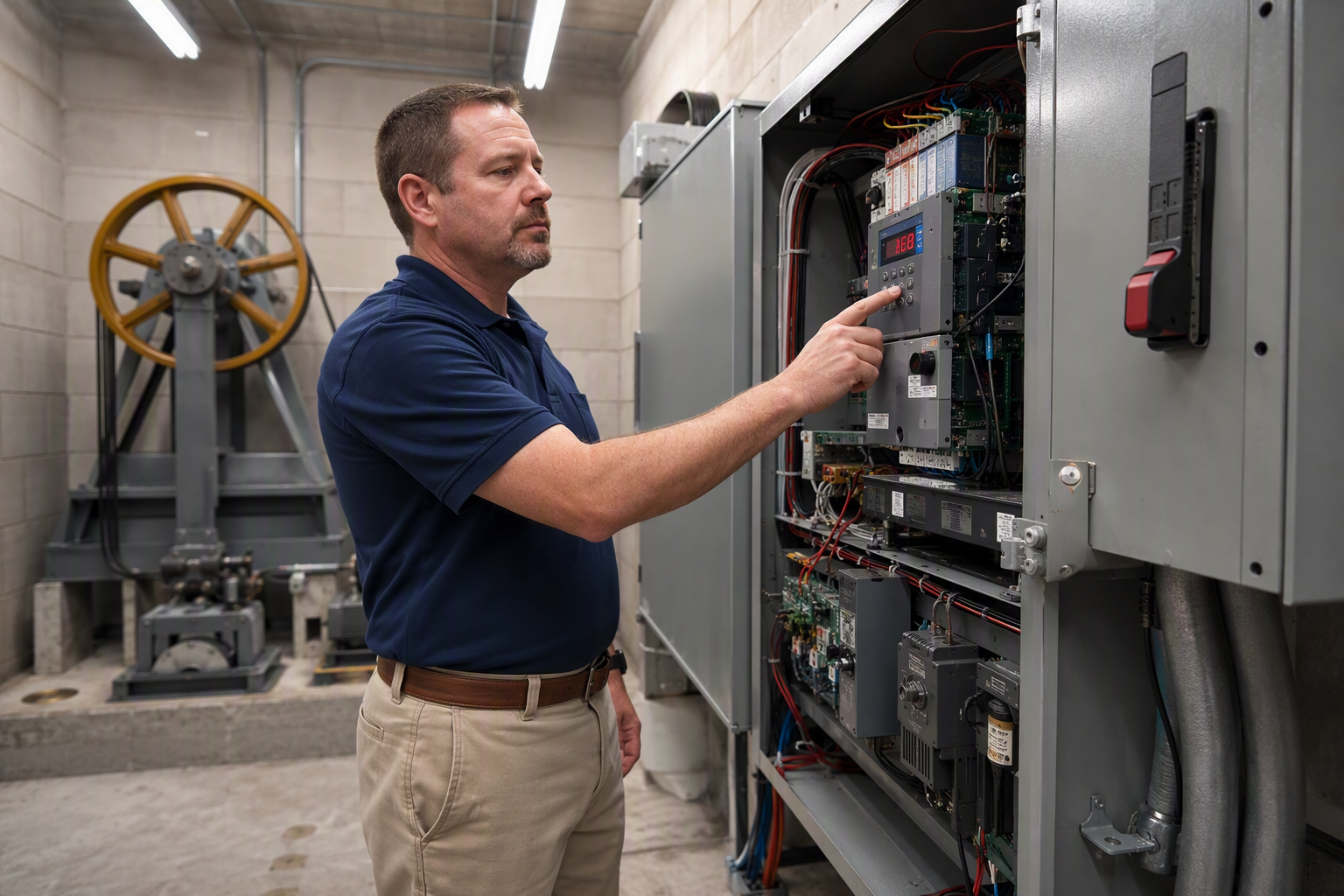
The first check should always be the main line disconnect in the machine room and the building’s electrical panel to confirm neither has tripped, because a power interruption is the single most common cause of a sudden elevator shutdown.
Before touching any mechanical component, ensure you have lawful access to the machine room as required by ASME A17.1 Safety Code for Elevators and Escalators, which mandates that machine rooms be kept locked and accessible only to authorized personnel. Once inside, look at the controller display panel — most modern controllers show an alphanumeric fault code that pinpoints the reason for shutdown. Write that code down; it is critical information for your technician.
Check the main line disconnect switch and building circuit breaker labeled for the elevator. A tripped breaker may indicate a momentary power surge or a legitimate electrical fault. Reset the breaker once only. If it trips again immediately, do not reset it a second time — this signals an active fault requiring professional diagnosis.
Why would an elevator door refuse to close or reopen continuously?
A door that will not close or keeps reopening is almost always caused by an obstruction in the door sill track, a misaligned door vane triggering the safety light curtain, or a failed door motor — all of which must be confirmed before resetting the elevator.
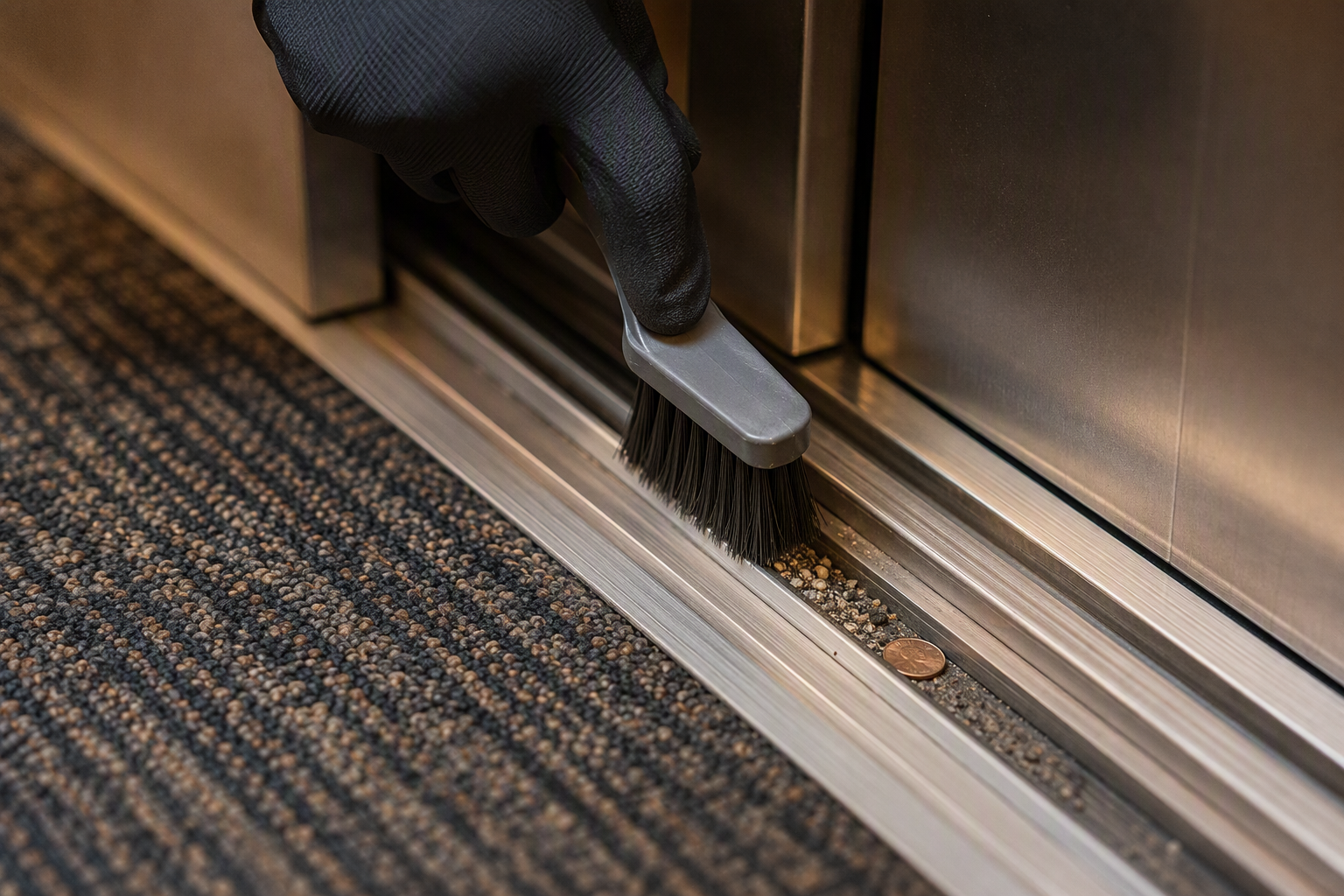
Inspect the door sill groove (the channel at the base of the door) for gravel, debris, a coin, or a piece of packaging material. This groove must be clear for the door to travel its full path and allow the interlock to engage. Clean it with a stiff brush if accessible and safe to do so.
Modern elevator doors use infrared light curtains or mechanical door edges as reopening devices. A smudged or misaligned sensor can fool the door controller into believing an obstruction is present. If the door tracks and sill are clear but the door still refuses to close, the sensor may need realignment — a task for a certified mechanic.
Under ASME A17.1, door reopening devices are a mandatory safety feature. Never attempt to disable or bypass a door sensor under any circumstances.
What does it mean when the elevator is in “fire service” mode and how is it reset?
Fire service mode (Phase I and Phase II) is a code-required function that parks the elevator at the main floor or a designated recall floor in response to a smoke detector signal, and it must be reset at the fire alarm panel before normal elevator operation can resume.
Florida high-rise buildings and commercial properties are governed by state fire code as well as ASME A17.1 requirements for fire service operation. If the building’s fire alarm system has detected or been inadvertently triggered by smoke, steam, or dust, the elevator(s) will recall automatically. Passengers will not be stranded — the car travels to the recall floor and opens its doors.
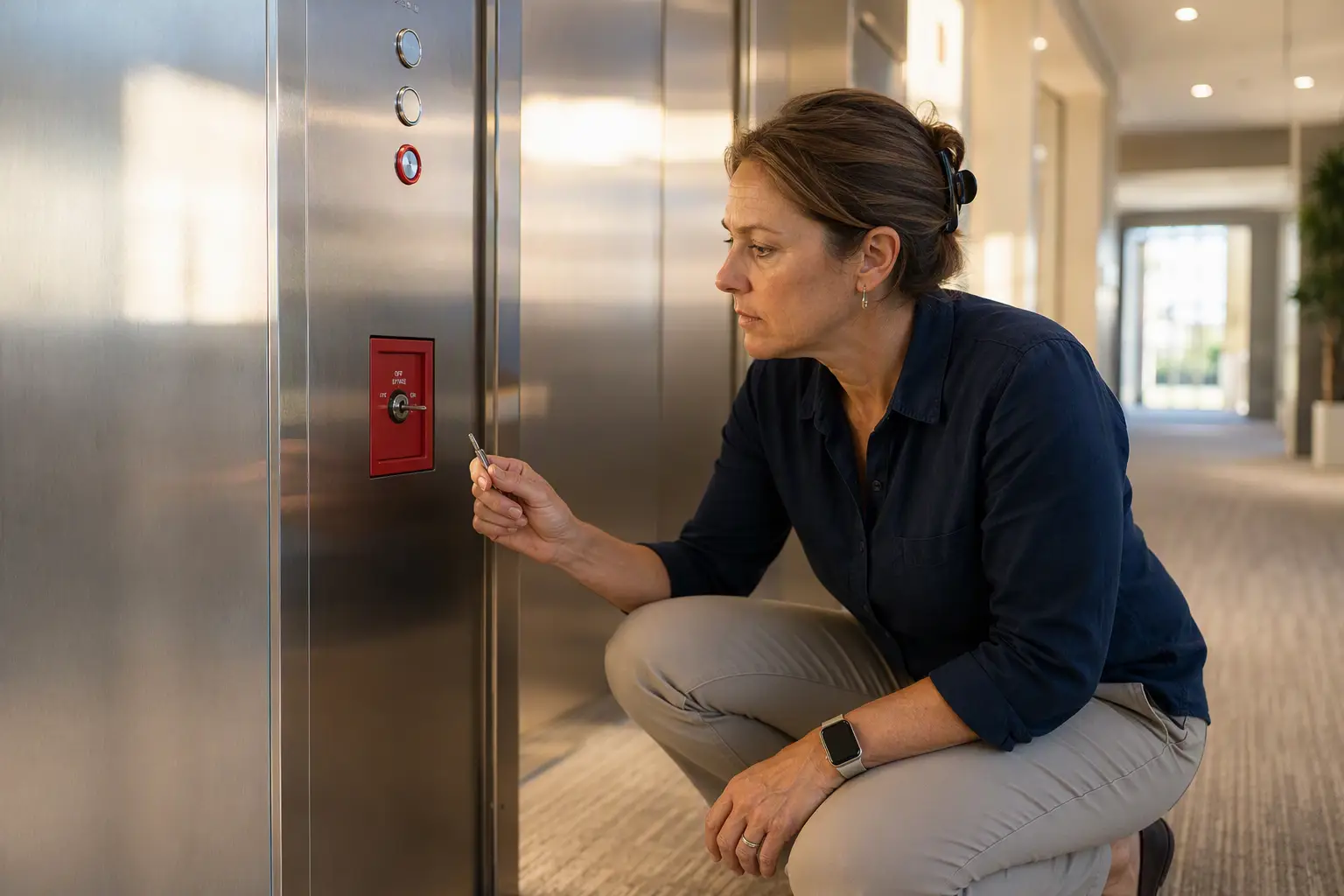
The reset procedure involves: (1) silencing and resetting the fire alarm panel with a licensed fire alarm professional or designated building staff member, and (2) inserting the Phase I fire service key into the hall-call station at the main floor to return the elevator to normal operation. If the alarm is recurring or the smoke detector nearest the elevator lobby is malfunctioning, contact both your fire alarm contractor and elevator service provider.
How can you tell if an elevator is stuck between floors and what immediate steps are required?
If an elevator is stuck between floors with passengers inside, the immediate priority is passenger communication and safety — building staff should use the in-car emergency phone or intercom to confirm passenger wellbeing and instruct occupants to remain calm and wait for trained rescue personnel.
- Use the elevator’s emergency communication system (required by ADA and ASME A17.1) to establish two-way contact with any trapped passengers.
- Call 911 if passengers report a medical emergency, heat distress, or if the elevator communication system is non-functional.
- Contact your elevator service company immediately for emergency extraction. Axxiom Elevator Florida serves building owners in Pompano Beach and Sarasota with elevator rescue coordination.
- Do NOT attempt to manually open hoistway doors from the landing without proper training and tools — doing so without a mechanical releasing device voids the interlock and can cause a fall hazard.
- Record the car position, floor indicator reading, and any fault codes visible on the controller for the responding technician.
Florida law prohibits untrained personnel from extracting passengers from a stalled elevator. Only licensed elevator mechanics and fire department personnel with proper training should perform a manual lowering or hoistway door release.
What should be done if the elevator is making unusual noises during operation?
Unusual noises — grinding, squealing, thumping, or rattling — typically indicate mechanical wear in the door operator, guide shoe liners, sheave, or drive system, and the elevator should be taken out of service until a technician can inspect it.
Document the noise: note when it occurs (during leveling, door operation, travel, or starting/stopping), its character (metallic grinding vs. rubbing), and whether it is consistent or intermittent. This information significantly speeds up diagnosis.
A squealing sound during door operation often points to worn door operator rollers or a dry door hanger. A thumping during travel may indicate a worn or broken guide shoe liner allowing the car to contact the rail. Grinding during leveling can signal issues with the drive machine or brake. None of these should be ignored — they typically worsen rapidly if the elevator continues to operate.
Why is the elevator not leveling properly with the floor?
Poor leveling — where the elevator floor does not align flush with the landing floor — is most commonly caused by a worn brake, a failing leveling sensor, or hydraulic fluid issues (in hydraulic elevators), and represents both a tripping hazard and an ADA accessibility violation.
The ADA Standards for Accessible Design specify that elevator floor surfaces must meet accessibility requirements, and a mis-leveled car creates a barrier for wheelchair users and a trip hazard for all passengers. Under Florida law, building owners have a duty of care to maintain accessible, safe vertical transportation.
For hydraulic elevators, poor leveling frequently results from internal cylinder bypass (fluid leaking past the piston seal) or worn packing in the cylinder. For traction elevators, worn brake shoes or a malfunctioning leveling vane/sensor are the primary culprits. This is not a DIY repair — take the elevator out of service and post it accordingly until inspected.
What does an elevator fault code on the controller mean and how should it be interpreted?
Elevator controller fault codes are manufacturer-specific alphanumeric messages displayed on the controller’s diagnostic screen that identify the subsystem — door, safety circuit, drive, communication — that caused the shutdown, and they should be recorded verbatim and provided to the service technician.
Common fault categories include door zone errors, safety string faults (indicating an open contact in the car or pit safety circuit), drive fault codes, and communication errors between the controller and the car operating panel. While interpreting these codes fully requires manufacturer documentation accessible to certified mechanics, building managers can narrow the diagnosis by noting the specific code.
Many modern microprocessor-based controllers from manufacturers such as MCE, Motion Control, and Magnetek log the last several faults with timestamps. A technician can retrieve this history during their visit. Providing codes proactively can reduce diagnostic time on site.
How do elevator pit conditions affect safe operation and what should building staff look for?
The elevator pit must be kept dry, clean, and free of unauthorized items as required by ASME A17.1, because water intrusion, debris accumulation, or stored materials can trigger safety switches and shut down the elevator or, more critically, create a fall or electrocution hazard for mechanics.
Building managers — not untrained maintenance staff — should visually inspect the pit access door from outside periodically. If standing water is visible, the elevator should be taken out of service immediately and a licensed elevator mechanic contacted. Even minor water accumulation can corrode safety components and trip the pit switch.
Do not allow contractors, cleaning crews, or storage to use the elevator pit for any purpose. Items stored in the pit can obstruct the pit ladder, buffer, or traveling cable, any of which creates a code violation detectable during the state-required periodic inspection.
What are the most common elevator problems and how do they compare in severity?
| Problem | Likely Cause | Safe for Building Staff to Address? | Code Reference | Severity if Left Unaddressed |
|---|---|---|---|---|
| Elevator won’t start | Tripped breaker, fire service active, door not latched | Partial (breaker check, fire service reset) | ASME A17.1 | Moderate — operational disruption |
| Door won’t close | Sill obstruction, sensor fault, door motor failure | Sill cleaning only | ASME A17.1 | Moderate — potential passenger entrapment |
| Car stuck between floors | Safety circuit open, drive fault, power loss | No — call technician immediately | ASME A17.1, ADA | High — passenger safety risk |
| Poor floor leveling | Worn brake, hydraulic bypass, sensor error | No — take out of service | ADA, ASME A17.1 | High — trip hazard, ADA violation |
| Unusual noises | Worn guide shoes, door rollers, mechanical wear | No — document and report | ASME A17.1 | Moderate-to-High — component failure risk |
| Elevator in fire service | Smoke detector activation, alarm system fault | Yes — reset fire alarm panel per protocol | ASME A17.1, Florida Fire Code | Low if addressed promptly |
| Slow travel speed | Drive parameter shift, worn drive belt, low hydraulic oil | No — requires technician | ASME A17.1 | Moderate — may indicate failing component |
| Lights out in cab | Burned bulb, failed emergency lighting, wiring fault | Bulb replacement only if trained | ASME A17.1 | Low-to-Moderate — ADA / life safety concern |
| Emergency phone inoperative | Line disconnection, system fault | No — regulatory violation, call technician | ASME A17.1, ADA | High — life safety code violation |
| Water in pit | Groundwater intrusion, plumbing leak | No — take out of service | ASME A17.1 | High — electrocution hazard |
When is it unsafe to attempt any troubleshooting and the elevator must be taken out of service immediately?
An elevator must be taken out of service without any troubleshooting attempt when there is water in the pit, visible smoke or burning smell, a reported injury, sparking or electrical arcing, or a passenger is confirmed trapped between floors.
Florida Statute and OSHA general duty clause requirements both impose obligations on building owners to maintain safe working environments. When any of the above conditions exist, the correct action is to place an “Out of Service” sign on every landing call button, contact emergency services if needed, and call a licensed elevator service company such as Axxiom Elevator Florida without attempting any reset or inspection.
How does independent service mode affect elevator operation and how is it deactivated?
Independent service mode temporarily removes an elevator from group dispatching and places it under manual control, typically activated when a key switch in the car operating panel is turned to the “Independent” or “Ind” position, and it is deactivated by returning that key switch to the normal position.
This mode is commonly activated unintentionally by cleaning staff, delivery personnel, or curious tenants who turn the key switch. When in independent service mode, the elevator will not respond to hall calls and will remain at whatever floor the last operator selected. Building staff should check the car operating panel key switch position before calling for service — this single check eliminates many unnecessary service calls.
What is the role of the elevator inspection certificate and what should building managers know about it?
Florida law requires that a valid, current elevator inspection certificate issued by the Florida Department of Business and Professional Regulation (DBPR) be posted inside the elevator cab, and building managers should verify this certificate has not expired as an expired certificate means the unit is legally required to be taken out of service.
Under Florida Statutes Chapter 399, all conveyances must be inspected periodically by a licensed elevator inspector. The inspection certificate in the cab displays the expiration date of the current inspection period. If this date has passed and no renewal certificate has been issued, the elevator is operating out of compliance regardless of its mechanical condition.
Axxiom Elevator Florida is familiar with DBPR inspection requirements in both Pompano Beach and Sarasota and can assist building owners in coordinating the inspection and correction of any cited deficiencies.
How should a building manager properly take an elevator out of service?
- Place a clearly visible “Elevator Out of Service” sign at every floor landing call button to prevent passengers from attempting to summon the unit.
- If the elevator is accessible, park it at the lobby level with doors open so passengers can see it is unavailable.
- Turn the main line disconnect to the OFF position in the machine room only if doing so is safe and you are authorized to enter — do not enter if water, smoke, or unusual odors are present.
- Log the time, observed symptoms, and any fault codes in writing.
- Contact your elevator service provider immediately. For buildings in Pompano Beach or Sarasota, contact Axxiom Elevator Florida at .
- Ensure ADA-required accessible routes are identified and communicated to building occupants, particularly for multi-story buildings with mobility-impaired residents or tenants.
What routine maintenance checks can building staff perform between professional service visits?
Between professional maintenance visits, building staff can safely perform visual-only checks: confirming the machine room is locked, dry, and at regulated temperature; verifying the inspection certificate is current; checking that pit access is secured; and confirming that landing door sills are clear of debris.
These visual checks require no tools and do not involve entering any restricted area beyond what staff are trained and authorized to access. They complement — but do not replace — the preventive maintenance program required by ASME A17.1 and performed by licensed elevator mechanics.
Building managers should maintain a log of these checks. A documented pattern — for example, a sill that accumulates debris rapidly, or a machine room that shows recurring humidity — provides actionable data for the service technician and may prevent a future failure.
What are the ADA requirements that affect elevator availability and what happens when an elevator is out of service?
Under the ADA, elevators in multi-story buildings that are required to be accessible must be maintained in operable condition, and a building owner’s failure to promptly repair an accessible elevator can constitute a violation of ADA Title III (public accommodations) or Title II (government entities).
The ADA does not specify a maximum allowable downtime for elevators, but the U.S. Department of Justice has consistently held that extended or repeated outages without timely repair action can expose building owners to complaint proceedings. For buildings in Florida serving the public, prompt repair is both a legal obligation and a practical risk management measure.
When an elevator is down, building managers should notify tenants or residents promptly, identify alternative accessible routes where they exist, and document the service call timeline to demonstrate good-faith repair efforts.
How do hydraulic elevators differ from traction elevators in common failure modes?
Hydraulic elevators most commonly fail due to hydraulic fluid leaks, cylinder seal wear causing slow descent or poor leveling, and power unit motor issues, whereas traction elevators more commonly experience brake wear, rope elongation, door operator failures, and drive system faults.
In Florida’s climate — particularly in coastal markets like Pompano Beach and Sarasota — hydraulic systems are susceptible to seal degradation accelerated by heat and humidity. Hydraulic oil can also absorb moisture over time, reducing its performance. Regular oil analysis and seal inspection are critical components of a preventive maintenance program for hydraulic systems.
Traction systems in Florida buildings must also account for humidity effects on rope lubrication and sheave wear. Machine-room-less (MRL) traction elevators have additional complexity because the drive machinery is located in the hoistway, making visual inspection more challenging without proper equipment.
What should building managers know about elevator safety device testing requirements?
Under ASME A17.1, elevators are subject to periodic testing of safety devices including the car safety, governor, buffers, and pressure relief valve (for hydraulic units), and these tests must be performed by or under the direct supervision of a licensed elevator mechanic — building staff cannot and should not attempt to conduct or simulate these tests.
In Florida, the DBPR enforces testing intervals for these Category tests as defined in ASME A17.1. Category 1 tests are typically required annually, while Category 5 tests (full-load, full-speed safety tests) are required on longer intervals. Failure to conduct required testing can result in the elevator being ordered out of service by the state inspector.
Building owners should maintain records of all completed tests with documentation from the performing mechanic. These records should be available for review during state inspections.
How should building managers communicate elevator problems to a service technician effectively?
Providing a service technician with the elevator’s model number and serial number (found on the controller nameplate), the exact fault code displayed, the time and frequency of the problem, and a factual description of any symptoms dramatically reduces diagnostic time and the likelihood of a return visit.
Avoid interpreting the problem — report only observable facts. For example, “The door closes halfway then reopens, fault code E-4 is displayed on the controller, and the sill was clear of debris when checked” is far more useful than “The door is broken.” The more precise the information provided, the more efficiently the responding technician from Axxiom Elevator Florida or any qualified service company can prepare the correct parts and tools before arriving on site.
What are the most common causes of nuisance elevator shutdowns that are not true mechanical failures?
Nuisance shutdowns — where the elevator stops but no mechanical fault exists — are most often caused by a landing door or car gate not fully latching, a debris-triggered pit switch, an activated stop switch in the pit or on top of the car, or a transient power quality event such as a voltage sag.
The safety circuit in an elevator is a series circuit: if any safety contact opens — a door interlock, a pit switch, an overspeed governor switch — the elevator stops and will not restart until all contacts are closed. A door that appears closed but whose interlock does not fully engage is a frequent culprit. Building staff can carefully check that each landing door is fully flush and latched. If any door appears misaligned or difficult to close, a technician should adjust the door before it degrades further.
Florida’s coastal properties also experience frequent lightning-related power quality events that can momentarily trip elevator drive systems. Installing a surge protection device on the elevator’s power supply is a recommended mitigation that a service company can evaluate.
How does the frequency of elevator maintenance affect the likelihood of unexpected breakdowns?
Elevators that receive regular preventive maintenance on intervals consistent with ASME A17.1 recommendations and the manufacturer’s service guidelines experience fewer unexpected failures because worn components are identified and replaced before they cause a shutdown or safety event.
Preventive maintenance (PM) typically encompasses lubrication of moving components, adjustment of door operators and interlocks, inspection of ropes or hydraulic hoses, testing of safety devices, and review of controller fault logs. The exact scope depends on the elevator type, usage, and age.
Buildings in high-traffic environments — such as commercial properties, healthcare facilities, or large residential complexes in Pompano Beach and Sarasota — benefit from more frequent maintenance intervals due to the elevated wear rate from heavy usage. Axxiom Elevator Florida can evaluate the appropriate maintenance schedule for a specific installation and help building owners remain in compliance with both state and federal requirements.
What is a building manager’s legal liability if an elevator problem is ignored and someone is injured?
Building owners who have documented knowledge of an elevator deficiency — through a complaint, a fault code, or a visible defect — and fail to take reasonable action to repair it or remove the unit from service face potential civil liability for negligence and may also face regulatory penalties under Florida Statutes Chapter 399.
The standard is one of reasonable care: a building owner is expected to maintain vertical transportation equipment in a safe operating condition, respond promptly to known problems, and ensure required inspections are current. Courts have consistently held that elevator maintenance records, service call logs, and inspection certificates are admissible evidence in personal injury proceedings.
Maintaining complete records of all service visits, complaints, and corrective actions is the most important risk management practice a building owner can adopt. Engaging a reputable elevator service company such as Axxiom Elevator Florida on a preventive maintenance contract creates a documented service history that demonstrates ongoing due diligence.
Ready to Resolve Your Elevator Issue or Schedule a Preventive Maintenance Assessment?
If your building’s elevator is showing any of the symptoms described in this guide — or if you simply want to ensure your equipment is compliant with Florida law and ASME A17.1 Safety Code for Elevators and Escalators requirements — the next step is a professional evaluation by qualified elevator mechanics.
Contact Axxiom Elevator Florida for a free elevator assessment. Serving commercial and residential building owners in Pompano Beach, FL and Sarasota, FL.
Call: