How Long Does It Take to Get a New Elevator Installed in a Commercial Building in Florida? A Complete FAQ
Understanding the full timeline from contract signing to a valid Florida certificate of operation is essential for any commercial building owner, developer, or property manager planning a new elevator installation. The process involves multiple regulatory checkpoints, code compliance requirements, and coordination between the registered elevator company, the building department, and state or local elevator inspection authorities. This FAQ hub answers the most critical questions — from permitting to final inspection — so projects in Pompano Beach, Sarasota, and across Florida can be planned with realistic expectations.
How long does a new commercial elevator installation take in Florida from contract to certificate of operation?
Most commercial elevator installations in Florida take between 4 and 12 months from contract execution to a valid certificate of operation, with the wide range driven by equipment lead times, permit processing, construction schedule, and inspection availability.
The timeline is not a single continuous construction period — it is a multi-phase regulatory and construction process. A straightforward hydraulic elevator in a low-rise commercial building may be completed and certificated closer to the four-to-six month mark. A high-rise traction elevator with machine room or machine-room-less (MRL) configuration, custom cab finishes, or complex structural coordination can take eight to twelve months or longer. Projects in Broward County — including Pompano Beach — are subject to oversight by the Broward County Building Code Division, while projects elsewhere in Florida go through the DBPR Bureau of Elevator Safety or another delegated local authority. Understanding each phase separately allows project teams to identify where delays are most likely to occur.
What are the main phases that determine the total installation timeline?
The installation timeline is governed by five sequential phases: design and contract finalization, state or local permit application, equipment manufacturing and delivery, physical installation, and final inspection leading to certificate of operation issuance.
Each phase carries its own minimum duration and can be delayed independently. Permit review periods for elevator work are separate from general building permit timelines and must be coordinated with the appropriate elevator authority. Equipment lead times for commercial traction elevators can range from weeks to several months depending on the manufacturer, cab configuration, and market demand at the time of order. Physical installation of the hoistway, machine room (if applicable), drive system, and cab typically takes four to twelve weeks depending on the number of stops and system complexity. After installation is complete, a pre-final walk-through is common, followed by the mandatory final inspection by a certified elevator inspector who has no conflict of interest with the permit holder or the building owner, as required under Chapter 399, Florida Statutes (the Florida Elevator Safety Act).
What permits are required before a new elevator can be installed in Florida?
Florida law requires a state elevator permit, applied for by a registered elevator company, before any conveyance is installed — and no work may begin until that permit is issued.
Under Chapter 399, Florida Statutes and the implementing rules in Chapter 61C-5, Florida Administrative Code, a state-issued installation permit is a prerequisite to any new elevator installation. The permit application must be submitted by a company registered with the DBPR as a licensed elevator contractor — an unlicensed company cannot legally file for or receive this permit. In counties or municipalities with delegated authority, such as Broward County, the local elevator authority processes the permit on behalf of the state. The application package typically includes engineered drawings, equipment specifications, and documentation showing compliance with the ASME A17.1/CSA B44 Safety Code for Elevators and Escalators — Florida adopted the 2019 edition effective December 31, 2023. Building permit applications for the hoistway structure itself run concurrently through the general building department but are a separate approval track.
How long does the Florida elevator permit review process take?
Permit review timelines vary by jurisdiction but commonly range from two to ten weeks, depending on the completeness of the submitted drawings, the reviewing authority’s queue, and whether any design revisions are required.
In jurisdictions where the DBPR Bureau of Elevator Safety reviews the application directly, processing times depend on plan submission completeness and staff workload. In Broward County, including Pompano Beach, the Broward County Building Code Division handles elevator plan review for installations under its jurisdiction. Submitting complete, code-compliant engineered drawings on the first attempt is the most reliable way to avoid revision cycles that can add weeks to the permit phase. Axxiom Elevator Florida’s project coordination process includes a pre-submission drawing review to help ensure permit packages are complete before filing, reducing back-and-forth with the reviewing authority.
Which Florida code edition governs new commercial elevator installations in 2026?
As of 2026, Florida requires new elevator installations to comply with the ASME A17.1/CSA B44, 2019 edition, which became Florida’s adopted elevator safety code effective December 31, 2023, under Chapter 61C-5, Florida Administrative Code.
The ASME A17.1 Safety Code for Elevators and Escalators establishes the technical requirements for design, construction, installation, operation, inspection, testing, maintenance, alteration, and demolition of elevators and related conveyances. Florida’s adoption of the 2019 edition means that any commercial elevator installed or substantially altered in the state must meet that edition’s requirements. The code covers a broad range of conveyance types, but Florida’s Chapter 61C-5 rules note certain exclusions for equipment types such as private residence elevators and marine elevators. Commercial building owners and their contractors must work from the 2019 edition to ensure that drive systems, safety devices, door operators, fire service recall, and emergency communication systems all meet current Florida standards.
What ADA requirements apply to new commercial elevator installations in Florida?
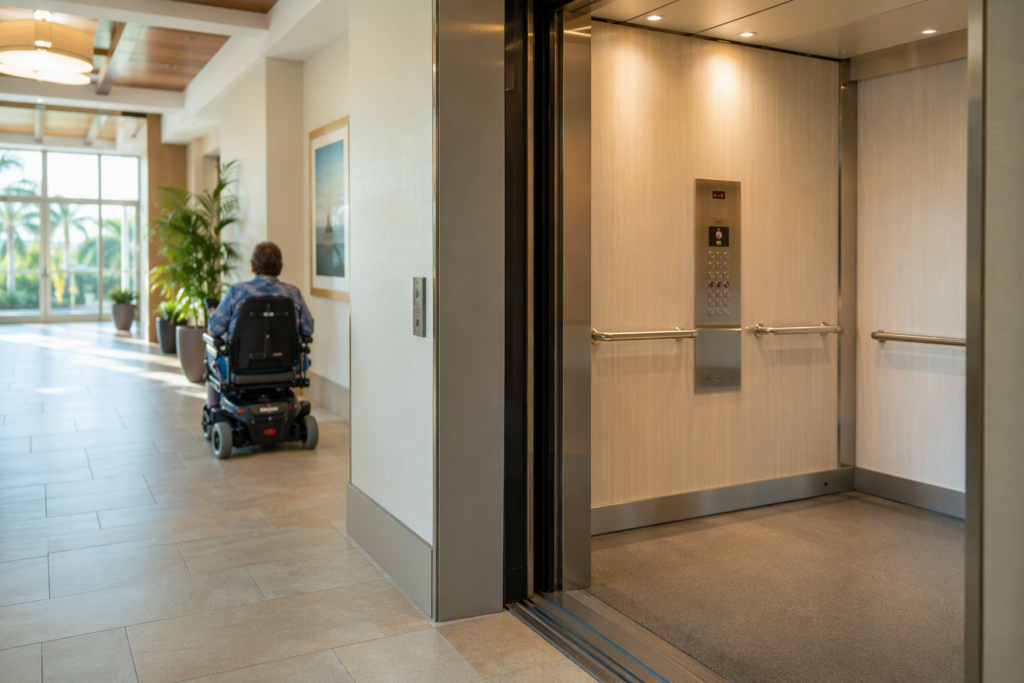
New commercial elevators in Florida must comply with the Americans with Disabilities Act (ADA) accessibility standards, which govern cab dimensions, door clear widths, control button heights, floor indicators, and emergency communication systems.
The ADA Standards for Accessible Design establish minimum requirements for passenger elevators in buildings covered by Title II (state and local government) or Title III (places of public accommodation and commercial facilities). For new construction, compliance is not optional — it is a baseline design requirement that must be incorporated into the elevator specification before the permit package is submitted. Key requirements include minimum car dimensions, door reopening devices, accessible controls, visual and audible floor indicators, and a two-way emergency communication system that does not require voice communication. ADA compliance documentation is typically reviewed as part of the overall building permit process, separate from the state elevator permit, though inspectors may flag ADA deficiencies during the elevator inspection as well.
What types of commercial elevators are most commonly installed in Florida, and how do their timelines differ?
Hydraulic and traction elevators are the two most common types in Florida commercial buildings, with hydraulic systems generally completing faster due to simpler hoistway requirements, while geared and gearless traction and machine-room-less systems involve longer manufacturing and installation windows.
| Elevator Type | Typical Building Application | Typical Installation Duration (After Permit) | Common Timeline Drivers |
|---|---|---|---|
| Hydraulic (In-Ground or Holeless) | Low-rise commercial, 2–5 stops | 4–8 weeks | Pit excavation, fluid line routing, piston delivery |
| Geared Traction | Mid-rise commercial, 4–12 stops | 8–14 weeks | Machine room construction, rail installation, counterweight assembly |
| Gearless Traction (High-Rise) | High-rise commercial, 10+ stops | 12–24 weeks | Custom equipment, structural coordination, multi-car coordination |
| Machine-Room-Less (MRL) Traction | Mid-rise, space-constrained sites | 8–16 weeks | Overhead clearance requirements, drive unit lead time |
| Limited-Use / Limited-Application (LULA) | Low-traffic commercial, ADA access | 4–8 weeks | Similar to hydraulic; ASME A17.1 LULA requirements apply |
These installation durations begin after permit issuance and assume the hoistway is substantially complete. Total project timelines — including permitting, equipment lead times, and final inspection — will be longer than the installation durations shown above.
What is the step-by-step process for getting a new elevator certificated in Florida?
Florida’s path from contract to certificate of operation follows a defined regulatory sequence that every registered elevator company and building owner must complete in order.
- Execute the installation contract with a company registered with the Florida DBPR as an elevator contractor — only registered companies may apply for the state elevator permit.
- Prepare and submit engineered construction drawings showing compliance with ASME A17.1-2019 and applicable Florida rules to the DBPR Bureau of Elevator Safety or the delegated local authority (e.g., Broward County Building Code Division for Pompano Beach projects).
- Obtain the state elevator installation permit before any field work begins — commencing installation without this permit violates Chapter 399, Florida Statutes.
- Coordinate hoistway and structural construction with the general contractor to ensure the elevator pit, hoistway, overhead clearance, and machine room (if applicable) meet ASME A17.1-2019 dimensional and structural requirements.
- Complete equipment delivery and installation, including drive system, guide rails, safety devices, door operators, cab enclosure, controls, and emergency communication system.
- Perform internal quality and code checks prior to requesting the final inspection, verifying that all ASME A17.1-2019 requirements and ADA standards are satisfied.
- Request the final inspection from a Florida certified elevator inspector who has no employment, association, or conflict of interest with the permit holder or the building owner, as required by state law.
- Pass the final inspection — if deficiencies are noted, correct them and schedule a re-inspection before the elevator may be placed in service.
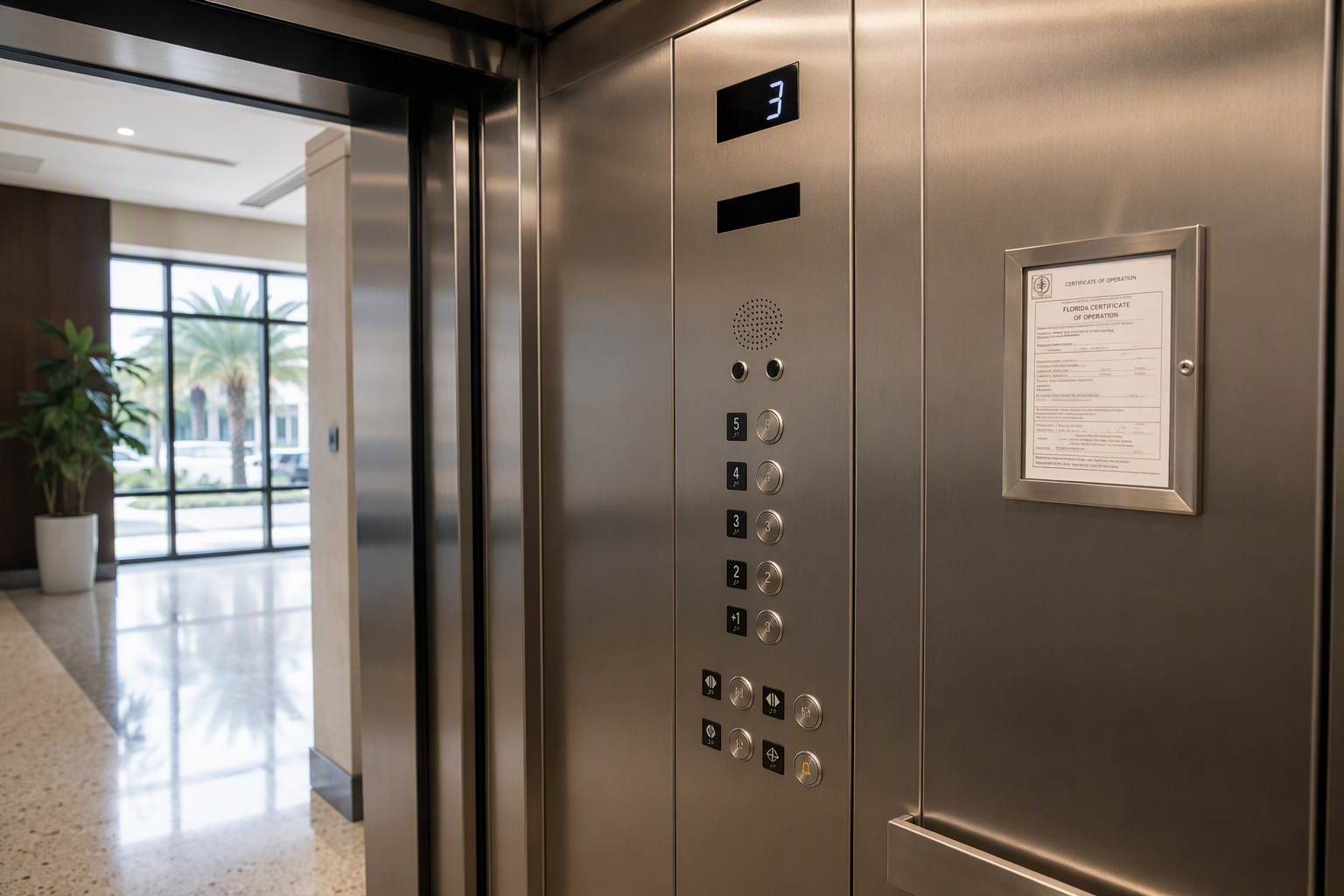
- Receive the Florida certificate of operation from the issuing authority and post it in a conspicuous location inside the elevator cab in a frame with a transparent cover, as required by Chapter 399.
- Establish a maintenance program to satisfy the elevator owner’s ongoing obligation under state law to maintain the conveyance in safe operating condition.
Who is authorized to install a new elevator in a Florida commercial building?
Only a company registered with the Florida DBPR as an elevator contractor may install a new conveyance, and the field work must be performed by or under the direct supervision of a certified elevator technician holding a valid Florida elevator certificate of competency.
Florida’s regulatory framework creates two distinct licensing categories for elevator work: the registered elevator company and the certified elevator technician. The company registration must be renewed annually, and the company must maintain general liability insurance. The elevator technician’s certificate of competency also expires after one year and is renewed with proof of eight hours of continuing education. This layered licensing structure ensures that both the entity performing the work and the individual technicians in the field meet minimum state-defined competency standards. Building owners who hire unlicensed contractors risk permit revocation, stop-work orders, and — critically — the inability to obtain a certificate of operation. Axxiom Elevator Florida maintains its required state registrations and employs certified elevator technicians to perform installations in Pompano Beach, Sarasota, and the surrounding Florida markets it serves.
What role does the local authority having jurisdiction (AHJ) play in Pompano Beach or Sarasota elevator installations?
The AHJ determines which entity reviews permit applications, conducts inspections, and issues certificates of operation locally — in Pompano Beach, the Broward County Building Code Division serves this role, while Sarasota-area projects typically go through the DBPR Bureau of Elevator Safety.
Florida’s elevator regulatory structure allows counties and municipalities to enter into contracts with the state to administer elevator law within their jurisdiction. In Broward County, which encompasses Pompano Beach, the Broward County Building Code Division enforces Chapter 399 through its own elevator inspectors. This means elevator permit applications, inspections, and certificate issuance for Pompano Beach commercial projects flow through Broward County rather than the state DBPR office directly. In the Sarasota market, project teams should confirm the applicable AHJ at the outset of the project, as local administration arrangements can affect permit processing windows and inspection scheduling. Axxiom Elevator Florida’s experience in both the Pompano Beach and Sarasota markets enables project teams to navigate these jurisdictional nuances without losing time to administrative misrouting.
What is a Florida certificate of operation and how long is it valid?
A Florida certificate of operation is the state-issued authorization to operate an elevator, is valid for no more than two years, and must be renewed only after a current satisfactory inspection — operating on an expired certificate violates state law.
Under Chapter 399, Florida Statutes, the certificate of operation is the final regulatory milestone that authorizes a new elevator to be placed in public service. It is not a one-time document — it must be renewed on a cycle tied to inspection results. The certificate must be physically posted inside the elevator cab in a frame with a transparent cover so that building users and inspectors can verify its validity. Once the certificate is issued, the legal responsibility for safe operation, proper maintenance, timely inspection, and correction of any code deficiencies shifts to the elevator owner. This ownership responsibility makes selecting a competent, registered elevator maintenance provider critical from day one of operation.
How does the final inspection work before a certificate of operation is issued?
Before a new commercial elevator can be placed in service in Florida, it must pass an inspection by a Florida certified elevator inspector who has no employment, association, or conflict of interest with the permit holder or the building owner.
This independence requirement is a specific provision of Florida elevator law and is designed to ensure that the final safety verification is objective. The inspector will verify compliance with ASME A17.1-2019 requirements, review the installation against the approved permit drawings, test safety devices and door operators, verify emergency communication functionality, confirm ADA-compliant controls, and check fire service recall operation. If the inspector identifies deficiencies, the elevator may not be placed in service until corrections are made and a satisfactory re-inspection is completed. Building teams should plan for the possibility of at least one correction cycle when setting project schedules — particularly for complex systems with many safety interlocks and electronic controls.
What factors most commonly cause delays in Florida commercial elevator installation projects?
The most frequent sources of delay are incomplete permit submissions requiring revision cycles, equipment manufacturing lead times, hoistway construction delays by the general contractor, inspection scheduling backlogs, and deficiencies discovered at final inspection that require correction before certification.
Equipment lead times are often the factor most underestimated during project planning. Custom cab interiors, non-standard door configurations, or specialized drive systems can extend equipment delivery windows significantly compared to standard catalog configurations. Hoistway readiness is another common bottleneck — elevator technicians cannot perform meaningful installation work until the pit, guide rail brackets, and overhead structural steel are in place. Communication breakdowns between the general contractor and the elevator contractor about hoistway milestone readiness can cause weeks of idle time. Finally, permit revision cycles caused by drawing deficiencies or non-compliant design details can delay the legal start of installation. Working with an experienced, registered elevator contractor who coordinates closely with the project team from the design phase forward reduces exposure to all of these delay categories.
What annual inspection and maintenance obligations apply after the certificate of operation is issued?
Once a certificate of operation is issued, Florida law requires every covered elevator to be inspected annually by a certified elevator inspector, with the certificate of operation renewable only when a current satisfactory inspection is on record.
Florida’s annual inspection requirement under Chapter 399, Florida Statutes applies broadly to commercial elevators. There is a narrow exemption: an elevator that is not an escalator or dumbwaiter, serves only two adjacent floors, and is covered by a service maintenance contract is exempt from the annual inspection while that contract remains in effect. For most commercial installations — which typically serve three or more floors — the annual inspection requirement applies in full. Beyond inspection, the elevator owner is legally responsible for ongoing maintenance and for correcting any code deficiencies identified during inspection. A proper preventive maintenance agreement with a registered elevator company is the most effective way to manage these obligations and protect the continuity of the certificate of operation. Axxiom Elevator Florida provides ongoing maintenance services for commercial elevators in the Pompano Beach and Sarasota markets.
What OSHA requirements affect commercial elevator installations in Florida?
OSHA regulations govern worker safety during elevator construction and maintenance activities, including requirements for personal fall protection, lockout/tagout procedures, and safe access to hoistways and pits.
OSHA standards applicable to construction sites — including those involving elevator installation — address fall protection for workers in open hoistways, electrical safety during equipment commissioning, and hazard communication. These requirements are enforced independently of the DBPR elevator permit process and are the responsibility of the elevator contractor and general contractor jointly on a shared worksite. Elevator installation crews working in an active construction site must coordinate fall protection and hoistway access controls with the general contractor’s site safety plan. OSHA compliance does not replace DBPR permit or inspection requirements — both sets of obligations run concurrently throughout the project.
How does building type or height affect the elevator installation timeline in Florida?
Building height, the number of stops, occupancy classification, and structural design all affect equipment selection, hoistway construction complexity, and the depth of engineering review required — with high-rise and mixed-use buildings typically requiring the longest timelines.
A two-story medical office building installing a hydraulic LULA elevator for ADA access faces a very different project scope than a twelve-story mixed-use tower installing three high-speed gearless traction elevators. The latter requires detailed traffic analysis to determine car quantity and speed ratings, structural coordination for machine room or overhead equipment loads, multi-car group dispatch programming, and potentially phased installation tied to the general construction schedule floor by floor. High-rise projects may also require phased permits or alteration permits as the building’s floor count is completed in stages. Recognizing this variability early allows project budgets and schedules to reflect realistic expectations rather than best-case assumptions.
What happens if an elevator is placed in service before a certificate of operation is issued?
Operating an elevator without a valid Florida certificate of operation violates Chapter 399, Florida Statutes, and exposes the building owner to enforcement action by the DBPR Bureau of Elevator Safety or the applicable local authority.
Florida elevator law does not allow a building owner or property manager to make informal use of a new elevator pending final inspection — even for construction personnel use during the final stages of a project. The certificate of operation is a legal prerequisite to public use, and any occupancy or operation before it is issued creates regulatory liability. Additionally, any elevator accident occurring on an uncertificated conveyance carries significant legal exposure beyond the regulatory penalties alone. Building owners and developers should build sufficient schedule contingency to accommodate final inspection and certification before any planned occupancy date. The certificate of operation holder is also required to report any elevator accident to the state within five working days of occurrence, underscoring the seriousness with which Florida treats elevator safety compliance.
Can a building owner speed up the Florida elevator permitting or inspection process?
The most reliable way to accelerate the permitting and inspection process is to submit a complete, code-compliant permit package on the first attempt and to coordinate inspection scheduling as soon as installation milestones are confirmed — there is no formal expedited review track specific to elevator permits under current Florida rules.
While some general building departments offer expedited plan review for additional fees, the elevator permit track through the DBPR or local AHJ follows its own review queue. The practical levers available to project teams are: engaging an experienced registered elevator contractor early in the design phase to ensure drawings are prepared to ASME A17.1-2019 standards from the outset; confirming hoistway readiness milestones with the general contractor well in advance of equipment delivery; and proactively coordinating with the certified inspector’s schedule rather than waiting until installation is fully complete. Axxiom Elevator Florida works with project teams throughout the Pompano Beach and Sarasota markets to manage these coordination points as part of its installation services.
What documentation should building owners retain after certificate of operation issuance?
Building owners should retain the original permit, approved construction drawings, the final inspection report, the certificate of operation, and all subsequent maintenance and inspection records for the life of the conveyance.
These records serve multiple purposes: they document initial code compliance for future alteration permit applications, provide the baseline against which inspectors measure changes, support insurance claims in the event of an incident, and demonstrate due diligence by the owner. The certificate of operation itself must be posted conspicuously inside the elevator cab in a frame with a transparent cover — a missing or expired certificate posted in the cab is an immediate inspection deficiency. Maintenance logs documenting routine service, safety tests, and corrective repairs should be kept organized and accessible to inspectors. Florida’s inspection cycle is tied to the certificate of operation renewal, and inspectors may request prior maintenance documentation as part of the renewal inspection process.
How should a commercial building owner evaluate and select a registered elevator contractor in Florida?
Building owners should verify that any elevator contractor holds a current Florida DBPR registration, that the company maintains required general liability insurance, that the technicians who will perform the work hold valid Florida elevator certificates of competency, and that the contractor has demonstrated experience with the specific elevator type and building configuration being installed.
Florida’s requirement that elevator contractors register annually with the DBPR and maintain general liability insurance provides a baseline verification point — a contractor unable to provide current registration documentation should not be considered. Beyond compliance credentials, building owners benefit from selecting a contractor with direct experience in the applicable local jurisdiction, since familiarity with the AHJ’s permit submission preferences and inspector expectations can meaningfully reduce administrative delays. References from comparable commercial installation projects, clarity on equipment manufacturer relationships, and a defined project coordination process are additional evaluation criteria. Axxiom Elevator Florida is a registered elevator company serving commercial clients in Pompano Beach and Sarasota, offering installation, maintenance, and compliance support under Florida’s regulatory framework.
What ongoing compliance obligations does the elevator owner have after the first certificate of operation is issued?
The elevator owner assumes permanent legal responsibility for safe operation, proper maintenance, timely annual inspection, correction of code deficiencies, posting of the current certificate, and reporting of any accidents to the state within five working days.
Florida law places the ongoing compliance burden squarely on the certificate of operation holder once the elevator is placed in service. This means that even if a third-party maintenance contractor performs the physical work, the building owner remains the legally accountable party if the elevator falls out of compliance. A well-structured maintenance agreement with a registered elevator company — one that includes documented preventive maintenance visits, safety test scheduling aligned with the inspection cycle, and prompt corrective repair response — is the most practical way to manage this ongoing obligation. Building owners should also ensure their maintenance agreements clearly assign responsibility for coordinating the annual inspection and renewal of the certificate of operation, so that compliance does not lapse due to administrative oversight.
Need elevator service you can rely on? Axxiom Elevator Florida is ready to help.