How Long Does It Take to Install a New Elevator in a Commercial Building in Florida? (Complete FAQ)
Installing a commercial elevator in Florida involves far more than the physical act of placing a cab, machine room, and hoistway together. State law under Chapter 399, Florida Statutes (Elevator Safety Act), requires registered elevator companies, pre-installation permits, certified inspector sign-off, and an active certificate of operation before a single passenger steps inside. Understanding each phase of that process — and where delays commonly arise — is essential for any commercial developer, property manager, or facilities director in Pompano Beach, Sarasota, or anywhere else in Florida.
The 20 questions below cover the full timeline, compliance requirements, equipment choices, and local authority considerations that govern commercial elevator installation in Florida as of 2026.
How Long Does a Commercial Elevator Installation Take in Florida, Start to Finish?
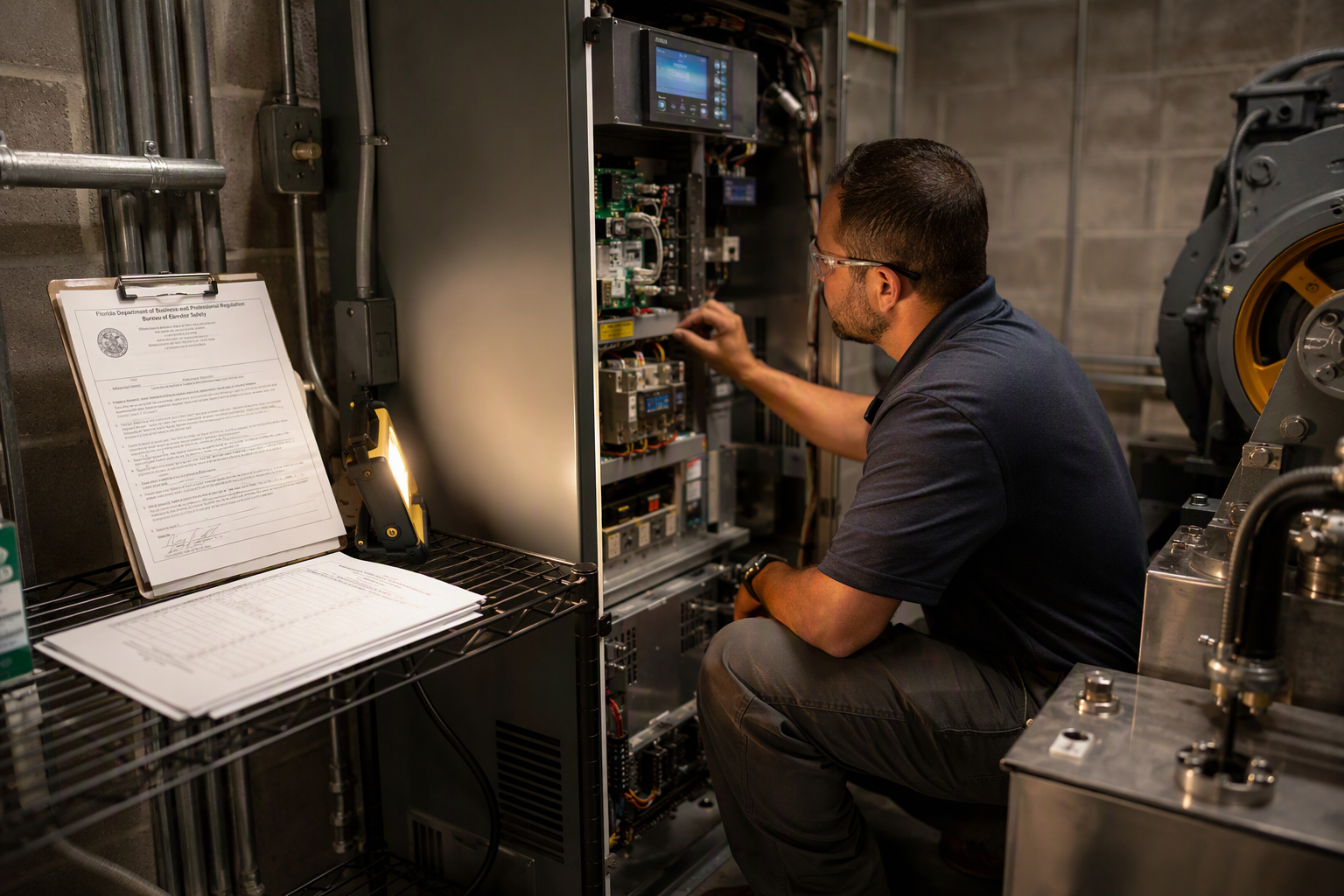
Direct Answer: The full process — from initial planning through state-issued certificate of operation — typically spans 4 to 12 months, with wide variation driven by permit review timelines, equipment lead times, and hoistway construction complexity.
The timeline can be broken into four broad phases: pre-construction planning and permitting (4–12 weeks), equipment procurement (8–20 weeks depending on elevator type and manufacturer), physical installation (6–16 weeks), and final inspection plus certificate issuance (2–6 weeks). These phases overlap in a well-managed project — for example, equipment is ordered during permitting — but delays in any single phase cascade downstream.
A straightforward two-stop hydraulic freight elevator in a new Pompano Beach warehouse may reach certificate of operation in under 5 months. A custom traction elevator serving 15 floors in a Sarasota mixed-use high-rise may take the full 12 months or longer, particularly if the hoistway must be constructed from scratch or if the local authority having jurisdiction (AHJ) has a backlog of plan reviews.
What Are the Distinct Phases of a Commercial Elevator Installation in Florida?
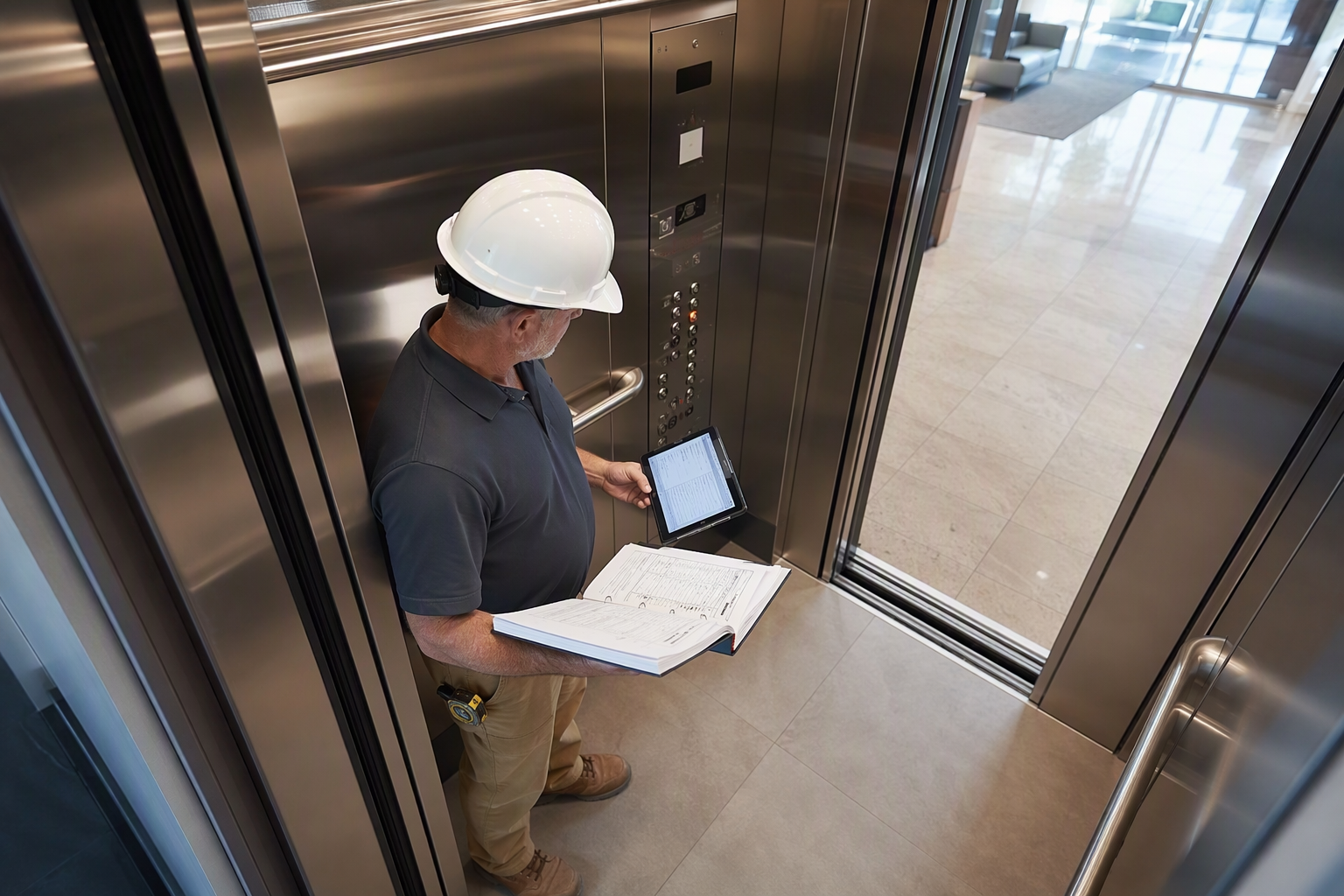
Direct Answer: A Florida commercial elevator installation moves through six sequential phases, each with its own regulatory checkpoints.
- Needs Assessment and Elevator Selection — Determine traffic demand, building height, ADA accessibility requirements under the Americans with Disabilities Act, machine room availability, and pit depth. This phase shapes every downstream decision.
- Engineering and Plan Development — Licensed engineers produce hoistway drawings, electrical schematics, and equipment specifications aligned with ASME A17.1/CSA B44-2019 Safety Code for Elevators and Escalators, the edition adopted by Florida effective December 31, 2023.
- Permit Application — Under Chapter 399, Florida Statutes, a registered elevator company must apply for a state permit before installation begins. In Pompano Beach, the Broward County Building Code Division enforces Chapter 399 through its own elevator inspectors. In Sarasota, coordination goes through DBPR’s Bureau of Elevator Safety directly.
- Equipment Procurement — After permit submission (and often before approval, for common equipment types), the registered contractor orders the cab, machine, controls, and hoistway components. Lead times vary significantly by manufacturer and elevator type.
- Physical Installation — Certified elevator technicians holding a Florida elevator certificate of competency perform all construction, installation, and wiring work. No unlicensed personnel may perform this work under Florida law.
- Final Inspection and Certificate of Operation — Before the elevator carries any passengers or loads, a certified elevator inspector with no conflict of interest with the permit holder or owner must inspect and approve the installation. The DBPR then issues a certificate of operation, which must be posted visibly inside the elevator cab in a frame with a transparent cover.
How Long Does the Florida Elevator Permit Process Take?
Direct Answer: Florida elevator permit review typically takes 3 to 8 weeks at the state level, though local authority review in jurisdictions like Broward County can add additional time depending on plan complexity and current backlog.
Under Chapter 399, Florida Statutes, only a registered elevator company may apply for the installation permit — the building owner or general contractor cannot submit on their own. The application must include engineering drawings prepared to ASME A17.1-2019 standards and applicable Florida Administrative Code requirements under Chapter 61C-5.
Incomplete submittals are the single most common cause of permit delays. Missing pit depth calculations, omitted electrical load schedules, or drawings that do not reference the correct 2019 ASME edition all generate correction requests that can add weeks. Working with a contractor like Axxiom Elevator Florida — which is familiar with the specific submittal expectations of both DBPR and Broward County’s elevator division — reduces that risk significantly.
What Types of Elevators Are Installed in Florida Commercial Buildings, and How Does Type Affect Timeline?
Direct Answer: The three most common commercial elevator types in Florida — hydraulic, traction (geared and gearless), and machine-room-less (MRL) traction — carry meaningfully different installation timelines and lead times.
| Elevator Type | Typical Use Case | Equipment Lead Time | Installation Duration | Key Code Considerations |
|---|---|---|---|---|
| Hydraulic (in-ground or hole-less) | Low-rise buildings, 2–6 stops | 8–14 weeks | 4–8 weeks | ASME A17.1-2019; environmental rules for underground cylinders |
| Geared Traction | Mid-rise, moderate traffic | 12–18 weeks | 8–14 weeks | ASME A17.1-2019; machine room required |
| Gearless Traction | High-rise, high-traffic commercial | 16–24 weeks | 12–20 weeks | ASME A17.1-2019; machine room, seismic if applicable |
| Machine-Room-Less (MRL) Traction | Mid-rise, space-constrained buildings | 12–18 weeks | 8–14 weeks | ASME A17.1-2019; overhead machine space requirements |
| Pneumatic Vacuum | Low-rise, residential-scale commercial | 6–10 weeks | 3–6 weeks | ASME A17.1-2019; limited to low-capacity applications |
Hydraulic elevators are the fastest to install in low-rise Florida commercial buildings and remain popular due to their relative simplicity and lower machine room overhead. However, gearless traction systems dominate taller Sarasota and Pompano Beach commercial towers where speed and energy performance are priorities, even though their procurement and installation windows are the longest.
What Florida Regulations Govern New Commercial Elevator Installations?
Direct Answer: New commercial elevator installations in Florida are governed primarily by Chapter 399, Florida Statutes (Elevator Safety Act) and Chapter 61C-5, Florida Administrative Code, administered by the DBPR Bureau of Elevator Safety, with ASME A17.1-2019 as the adopted technical standard.
Florida adopted the ASME A17.1/CSA B44, 2019 edition effective December 31, 2023, meaning all new commercial elevator installations must comply with that edition’s requirements for hoistway construction, car design, safety devices, electrical systems, and emergency operations. Deviation from the adopted edition requires a formal variance process through DBPR.
The Americans with Disabilities Act imposes independent federal accessibility requirements. New commercial construction must provide elevator access where applicable, and ADA-compliant cab dimensions, door widths, button placement, and Braille signage must be incorporated during installation — not retrofitted later at greater expense.
Workplace safety during the installation process falls under OSHA standards, which govern hoistway fall protection, confined space entry protocols, and electrical safety for the installing crew.
Who Is Legally Permitted to Install a Commercial Elevator in Florida?
Direct Answer: Under Florida law, all new commercial elevator installations must be performed by a company registered with the state as a registered elevator company, using certified elevator technicians who hold a current Florida elevator certificate of competency.
Chapter 399 is explicit: no person may install a conveyance unless they hold the appropriate state credentials. A certified elevator technician’s certificate of competency expires annually and requires renewal through the state registration process. Registered elevator companies must also maintain general liability insurance and renew their company registration each year.
This means a general contractor’s electricians or carpenters may perform preparatory hoistway construction work, but the elevator-specific mechanical, electrical, and safety device work must be handled exclusively by credentialed elevator personnel. Axxiom Elevator Florida operates as a registered elevator company and employs certified technicians who meet Florida’s annual registration and continuing education requirements.
What Inspections Are Required Before a New Commercial Elevator Can Open in Florida?
Direct Answer: Before a newly installed commercial elevator in Florida can be legally used, it must pass a final inspection by a certified elevator inspector who has no employment, association, or conflict of interest with the permit holder or the building owner.
This independence requirement is codified in Chapter 399, Florida Statutes, to prevent self-certification of deficient installations. The inspector reviews the completed installation against ASME A17.1-2019 requirements, verifies that all safety devices function correctly, confirms that hoistway clearances meet code, and validates the emergency communications system.
In Pompano Beach, the Broward County Building Code Division conducts these inspections through its own certified elevator inspectors. In Sarasota, inspections are coordinated through DBPR’s Bureau of Elevator Safety. Once the inspection yields a satisfactory result, DBPR issues the certificate of operation. That certificate must be posted in a conspicuous location inside the elevator cab in a frame with a transparent cover — failure to post it is a violation of state law.
How Long Is a Florida Certificate of Operation Valid After Installation?
Direct Answer: A Florida certificate of operation is valid for no more than two years, and it can only be renewed for a conveyance that has received a current satisfactory inspection.
Operating on an expired certificate of operation violates Florida law. The certificate of operation begins its validity clock from the date of issuance following the final installation inspection, not from the date of installation itself. Building owners and property managers should build certificate renewal into their facilities maintenance calendar well before the two-year mark, accounting for the time needed to schedule and complete a satisfactory inspection.
Additionally, Florida requires annual inspections for most commercial elevators covered by Chapter 399. The specific exemption from the annual inspection requirement applies only to elevators that are not escalators or dumbwaiters, serve only two adjacent floors, and are covered by an active service maintenance contract — a narrow category that does not apply to most multi-floor commercial buildings.
What Happens After Installation Is Complete — Who Is Responsible for the Elevator?
Direct Answer: Once a certificate of operation is issued, the building owner becomes legally responsible for the elevator’s safe operation, proper maintenance, inspection schedule, and correction of any identified code deficiencies.
This transfer of responsibility is fundamental to Florida elevator law. The registered elevator company delivers a code-compliant, inspected installation — but from that moment forward, the owner carries the obligation to keep it that way. That means maintaining an active service maintenance contract, scheduling timely annual inspections, posting a valid certificate of operation, and reporting any elevator accident to DBPR within 5 working days as required by Chapter 399.
Property managers in Pompano Beach and Sarasota working with Axxiom Elevator Florida can structure ongoing service maintenance contracts that satisfy Florida’s maintenance requirements and support timely inspection scheduling to avoid certificate lapses.
How Does Hoistway Construction Affect the Overall Installation Timeline?
Direct Answer: Hoistway construction is often the longest single variable in a commercial elevator timeline, particularly in existing buildings where structural modifications are required, and can add 3 to 6 months or more to the overall schedule.
New construction projects benefit from a hoistway that is built into the original structure — coordinated with the general contractor’s schedule from the foundation phase. Retrofit installations in existing Pompano Beach or Sarasota commercial buildings, however, require creating or modifying a hoistway shaft, which involves structural engineering, concrete or steel work, fireproofing, and general contractor coordination that sits entirely outside the elevator contractor’s scope.
The elevator installation itself cannot begin until the hoistway is structurally complete, plumb, and meets dimensional tolerances required by ASME A17.1-2019 for the specific elevator type. Even minor hoistway deviations discovered after equipment delivery can require significant remediation before installation can proceed. Pre-installation hoistway surveys conducted by experienced elevator contractors help identify and resolve these issues before equipment is ordered.
What Are the Most Common Causes of Delays in Florida Commercial Elevator Projects?
Direct Answer: The most common causes of delay are incomplete permit submittals, extended equipment lead times, hoistway construction deficiencies, and scheduling conflicts with the certified inspector required for final sign-off.
Each delay category has a different mitigation strategy:
- Permit submittal gaps: Eliminated by using a registered elevator company with documented experience submitting to DBPR and the applicable local AHJ (Broward County or Sarasota-area authorities).
- Equipment lead times: Mitigated by ordering equipment concurrently with permit submission for standard configurations, accepting that custom orders require longer lead-time buffers.
- Hoistway deficiencies: Reduced by conducting a formal hoistway survey before equipment is ordered, identifying tolerance issues and required remediation work in advance.
- Inspector availability: Managed by scheduling the final inspection appointment during the final weeks of installation rather than after installation is complete.
- Supply chain disruptions: Addressed through proactive communication with equipment manufacturers and the flexibility to source equivalent code-compliant components from multiple suppliers when necessary.
Does ADA Compliance Affect How Long a Commercial Elevator Installation Takes in Florida?
Direct Answer: ADA compliance requirements do not typically extend the physical installation timeline, but they must be designed into the project from the outset — retrofitting ADA features after installation is substantially more expensive and disruptive than incorporating them during initial design.
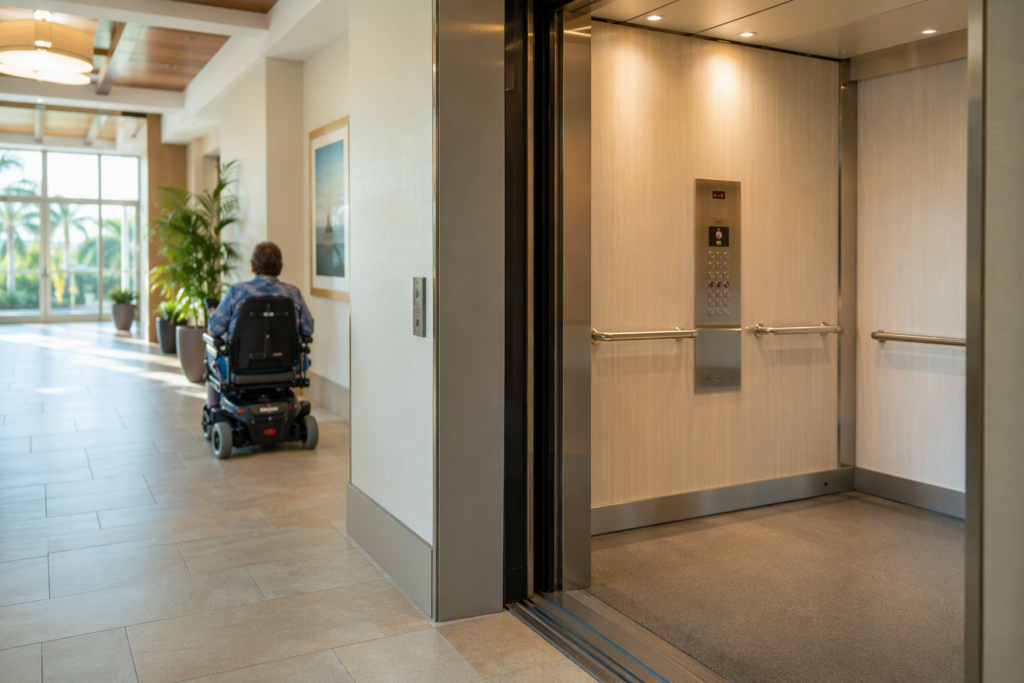
The Americans with Disabilities Act mandates specific requirements for commercial elevators in new construction and alterations, including minimum cab dimensions, clear door width, accessible controls at reachable heights, visual and audible floor indicators, and Braille and raised character signage. These requirements are incorporated into the engineering drawings during the plan development phase and must be verified during the final inspection.
Florida commercial buildings subject to ADA must also consider that ASME A17.1-2019 and ADA requirements overlap in some areas and diverge in others. Both sets of requirements are non-negotiable for commercial installations, and the design team must reconcile them before permit submission to avoid mid-installation corrections.
How Does a New Installation Differ From an Elevator Modernization in Terms of Timeline?
Direct Answer: A full new installation in an existing building typically takes longer than a modernization because it requires hoistway construction, whereas a modernization replaces components within an existing hoistway and can often be completed in 4 to 10 weeks for a single elevator.
Modernization projects — which involve replacing the controller, drive system, cab interior, doors, and safety devices while retaining the existing hoistway — still require a permit from DBPR under Chapter 399 and a final inspection before the elevator returns to service. However, they eliminate the hoistway construction phase entirely. For a Sarasota office building with an aging hydraulic elevator, a well-scoped modernization can restore code compliance and improve performance in a fraction of the time a full replacement would require.
The choice between new installation and modernization depends on the age and condition of the existing hoistway structure, the elevator’s current configuration relative to current traffic demands, and the cost differential between the two approaches over a projected lifecycle.
What Role Does the Local Authority Having Jurisdiction Play in Pompano Beach vs. Sarasota?
Direct Answer: In Pompano Beach, the Broward County Building Code Division enforces Chapter 399 through its own certified elevator inspectors, while Sarasota-area projects are coordinated through the DBPR Bureau of Elevator Safety at the state level, creating different procedural pathways for the same regulatory requirements.
Florida’s elevator law allows counties and municipalities to contract with the state to conduct inspections through their own certified inspectors rather than relying entirely on DBPR’s field staff. Broward County operates under this model, meaning that permit applications, plan reviews, and final inspections for Pompano Beach commercial elevators flow through the Broward County Building Code Division’s elevator program.
Understanding which authority has jurisdiction — and that authority’s specific submittal format preferences and review timelines — is a practical knowledge advantage that affects project scheduling. Axxiom Elevator Florida serves both Pompano Beach and Sarasota commercial markets and maintains working knowledge of both jurisdictions’ procedural expectations.
What ASME Code Edition Applies to New Florida Commercial Elevator Installations in 2026?
Direct Answer: Florida adopted the ASME A17.1/CSA B44, 2019 edition as the applicable technical standard for new elevator installations, effective December 31, 2023, and that edition governs all new commercial installations in 2026.
The ASME A17.1 Safety Code for Elevators and Escalators is the comprehensive technical standard covering design, construction, installation, operation, inspection, testing, maintenance, alteration, and repair of elevators and related conveyances. Florida’s adoption of the 2019 edition, codified in Chapter 61C-5, Florida Administrative Code, established the baseline technical requirements that all permitted new installations must meet.
The code addresses specific provisions for hydraulic elevator cylinder requirements, machine room design, fire service operation, emergency lighting, pit design, and a range of other technical parameters that engineering drawings must reflect to receive permit approval. Any installation designed to a prior ASME edition must be brought into conformance with the 2019 edition before a Florida permit will be issued under current rules.
What Should a Commercial Building Owner Do to Prepare for a New Elevator Installation?
Direct Answer: Building owners should begin by engaging a registered elevator company for a pre-installation assessment at least 3 to 6 months before the target installation start date to allow adequate time for planning, permitting, and procurement.
- Conduct a building assessment — Evaluate available hoistway space, pit depth feasibility, overhead clearance, machine room availability (or MRL suitability), electrical service capacity, and structural load capacity for the proposed elevator type.
- Define traffic and use requirements — Determine expected passenger volume, weight capacity requirements, speed requirements, and whether freight use is anticipated, since these parameters drive equipment selection.
- Verify ADA applicability — Confirm with the design team whether the project is classified as new construction or an alteration under the ADA, since the applicable accessibility requirements differ.
- Engage a registered elevator company early — Only a Florida-registered elevator company can apply for the installation permit. Bringing that contractor in during the design phase rather than after construction documents are complete avoids costly revisions.
- Coordinate with the general contractor — Align the hoistway construction schedule with the elevator contractor’s installation start date to prevent the elevator crew from arriving before the hoistway is ready.
- Budget for the full timeline — Account for all phases including permitting, lead time, installation, inspection, and certificate issuance in the project schedule, not just the physical installation weeks.
- Plan for ongoing maintenance — Once the certificate of operation is issued, the owner assumes responsibility. Establishing a service maintenance contract with the installing contractor before final acceptance simplifies the transition.
How Do Equipment Lead Times Affect the Commercial Elevator Installation Schedule in Florida?
Direct Answer: Equipment lead times — the time between order placement and equipment delivery to the job site — are frequently the longest single phase in a commercial elevator project and should be anticipated from the earliest planning stages.
Standard hydraulic elevator packages for low-rise commercial applications may be available within 8 to 14 weeks from established domestic manufacturers. Custom gearless traction systems for high-rise Sarasota towers, configured to specific speed, capacity, and finish specifications, can carry lead times of 20 weeks or longer. Supply chain conditions, manufacturer production schedules, and the degree of product customization all affect lead time.
Experienced elevator contractors order standard equipment at permit submission rather than waiting for permit approval, when the risk of substantive plan changes is low. This strategy, which requires close coordination between the registered elevator company and the manufacturer, can compress the overall project schedule by several weeks.
What Are the Ongoing Inspection and Maintenance Requirements After a New Commercial Elevator Is Commissioned in Florida?
Direct Answer: Florida requires annual inspections for most commercial elevators covered by Chapter 399, and the certificate of operation must be renewed with a satisfactory inspection result before the two-year validity period expires.
The annual inspection must be conducted by a certified elevator inspector. Florida certified elevator inspectors are required to maintain their qualified elevator inspector credential in good standing, register with the state annually, complete 8 hours of continuing education, and carry general liability insurance. These requirements ensure that the inspector conducting the annual review of a Pompano Beach or Sarasota commercial elevator is current on code changes and inspection techniques.
Beyond the state-mandated inspection, ASME A17.1-2019 includes provisions for periodic tests — including full-load tests, safety device tests, and brake tests — that must be performed at defined intervals as part of a comprehensive maintenance program. Building owners who rely on a service maintenance contract to meet Florida’s maintenance obligations should ensure that contract specifically addresses the testing intervals required by the adopted code edition.
How Does the Cost of a New Commercial Elevator Installation in Florida Compare to Modernization?
Direct Answer: While specific pricing varies by project scope, elevator type, and building conditions, new installations in existing buildings consistently carry higher total project costs than modernizations because they include hoistway construction, which is typically the most expensive single component.
Rather than quoting figures that depend heavily on site-specific variables, building owners are best served by obtaining scope-specific assessments from a registered elevator company. The assessment should distinguish between elevator equipment costs, hoistway construction costs, electrical service upgrade costs, and regulatory costs (permitting, inspection fees). A comprehensive assessment from Axxiom Elevator Florida provides a realistic budget framework before commitments are made to architects, general contractors, or lenders.
Total cost of ownership analysis — comparing new installation against extended modernization — should also account for energy consumption differences between hydraulic and traction systems, expected maintenance cost trajectories, and the regulatory compliance horizon of the existing equipment if a modernization is under consideration.
What Questions Should a Florida Commercial Building Owner Ask When Selecting an Elevator Installation Contractor?
Direct Answer: Florida building owners should verify that any prospective elevator contractor holds current state registration as a registered elevator company, employs certified elevator technicians with active certificates of competency, and carries required general liability insurance before signing any installation contract.
Beyond the baseline legal requirements, building owners evaluating contractors for Pompano Beach or Sarasota commercial elevator projects should ask:
- Has the contractor submitted and received permits from the relevant local authority (Broward County Building Code Division or DBPR directly for Sarasota) for projects of similar type and size?
- Can the contractor provide a realistic timeline that accounts for permitting, equipment lead times, hoistway preparation, installation, and inspection — not just the installation phase?
- Does the contractor offer an ongoing service maintenance contract that satisfies Florida’s maintenance requirements from the first day of certificate of operation?
- Is the contractor familiar with the ASME A17.1-2019 requirements adopted by Florida and the specific submittal requirements of the applicable AHJ?
Axxiom Elevator Florida operates as a registered elevator company in Florida’s commercial elevator market, serving Pompano Beach and Sarasota commercial properties with installations, modernizations, and ongoing maintenance programs designed to meet Florida’s regulatory framework.
What Happens If a Commercial Elevator Is Used Before a Certificate of Operation Is Issued in Florida?
Direct Answer: Using a commercial elevator before a Florida certificate of operation is issued — or operating on an expired certificate — is a violation of Chapter 399, Florida Statutes, and exposes the building owner to legal liability and regulatory enforcement action.
Chapter 399 is clear that a new conveyance must be inspected by a certified elevator inspector with no conflict of interest with the permit holder or owner before it is placed into use. Proceeding to occupancy before that inspection is complete and the certificate issued is not merely a paperwork technicality — it means passengers are riding in equipment that has not received the independent third-party verification required by Florida law.
In addition to regulatory enforcement, operating without a certificate of operation creates significant liability exposure for the building owner in the event of an incident. Property managers and developers should treat the certificate of operation as the final prerequisite to occupancy, not an administrative formality to catch up on after the building opens.
Summary: Florida Commercial Elevator Installation Timeline at a Glance
The table below consolidates the typical duration ranges for each phase of a Florida commercial elevator installation project as a reference for planning purposes.
| Phase | Typical Duration | Key Regulatory Touchpoint |
|---|---|---|
| Needs Assessment and Equipment Selection | 2–4 weeks | ADA compliance review; ASME A17.1-2019 equipment selection parameters |
| Engineering and Drawing Preparation | 3–6 weeks | ASME A17.1-2019; Florida Building Code coordination |
| Permit Application and Review | 3–8 weeks | Chapter 399, Florida Statutes; Chapter 61C-5, Florida Administrative Code; Broward County or DBPR AHJ |
| Equipment Procurement | 8–24 weeks (overlaps with permitting) | Ordered by registered elevator company; must comply with ASME A17.1-2019 |
| Hoistway Construction (if required) | 4–16 weeks (varies by building) | General contractor scope; must meet ASME A17.1-2019 dimensional tolerances |
| Physical Elevator Installation | 6–16 weeks | Performed by certified elevator technicians; Florida certificate of competency required |
| Final Inspection and Certificate of Operation | 2–6 weeks | Certified inspector, no conflict of interest; DBPR issues certificate; must be posted in cab |
Need elevator service you can rely on? Axxiom Elevator Florida is ready to help.