Elevator Capacity and Features for Warehouse and Industrial Buildings with Heavy Freight
Selecting the right freight elevator for a warehouse or industrial facility in Florida is not simply a matter of picking the heaviest-rated unit available. Capacity, platform size, door configuration, flooring, cab height, and drive system must all align with the specific loads, equipment, and workflows that move through the building every day. Getting these decisions wrong leads to equipment failure, code violations, and costly shutdowns. The guidance below covers every dimension of the decision — from initial load analysis through Florida permitting, inspection, and ongoing compliance.
What Elevator Capacity Does a Warehouse or Industrial Building Actually Need?
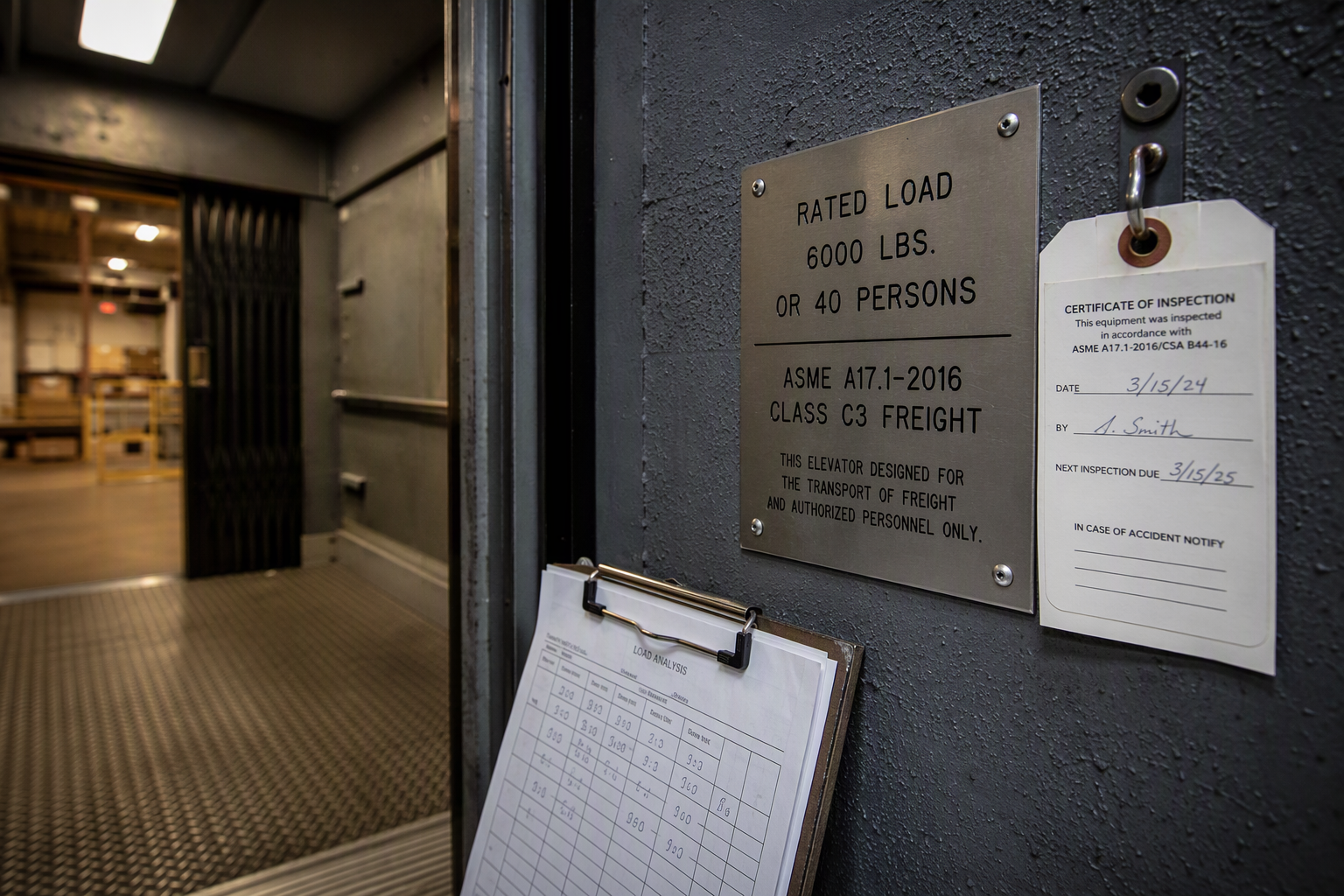
Capacity is the single most consequential specification in a freight elevator project. The right number comes from a structured load analysis, not a general rule of thumb.
Key factors that determine required capacity include:
- Maximum single load weight — the heaviest item or loaded pallet that will ever enter the cab, including the weight of the forklift or pallet jack moving it.
- Distributed load — how weight is spread across the platform, which affects structural and hydraulic design.
- Cycle frequency — high-cycle industrial environments require drive systems and buffers rated for continuous heavy use, not intermittent residential or light-commercial duty.
- Future growth — warehouses frequently expand operations; specifying capacity slightly above current peak loads avoids a costly replacement within a few years.
Common freight elevator capacity ranges encountered in industrial settings:
- 2,500–5,000 lbs — light industrial, parts storage, smaller distribution centers
- 5,000–10,000 lbs — mid-range manufacturing, wholesale distribution, food and beverage facilities
- 10,000–20,000+ lbs — heavy manufacturing, automotive, cold-storage, large-format logistics
Under ASME A17.1, freight elevators are classified by the type of loading they receive. Class designations — such as general freight loading, industrial truck loading, and motor vehicle loading — each carry specific structural and operational requirements that flow directly into the rated capacity and platform design. Specifying the correct class from the start prevents costly structural retrofits after installation.
What Platform Size and Cab Dimensions Are Required for Heavy Freight?
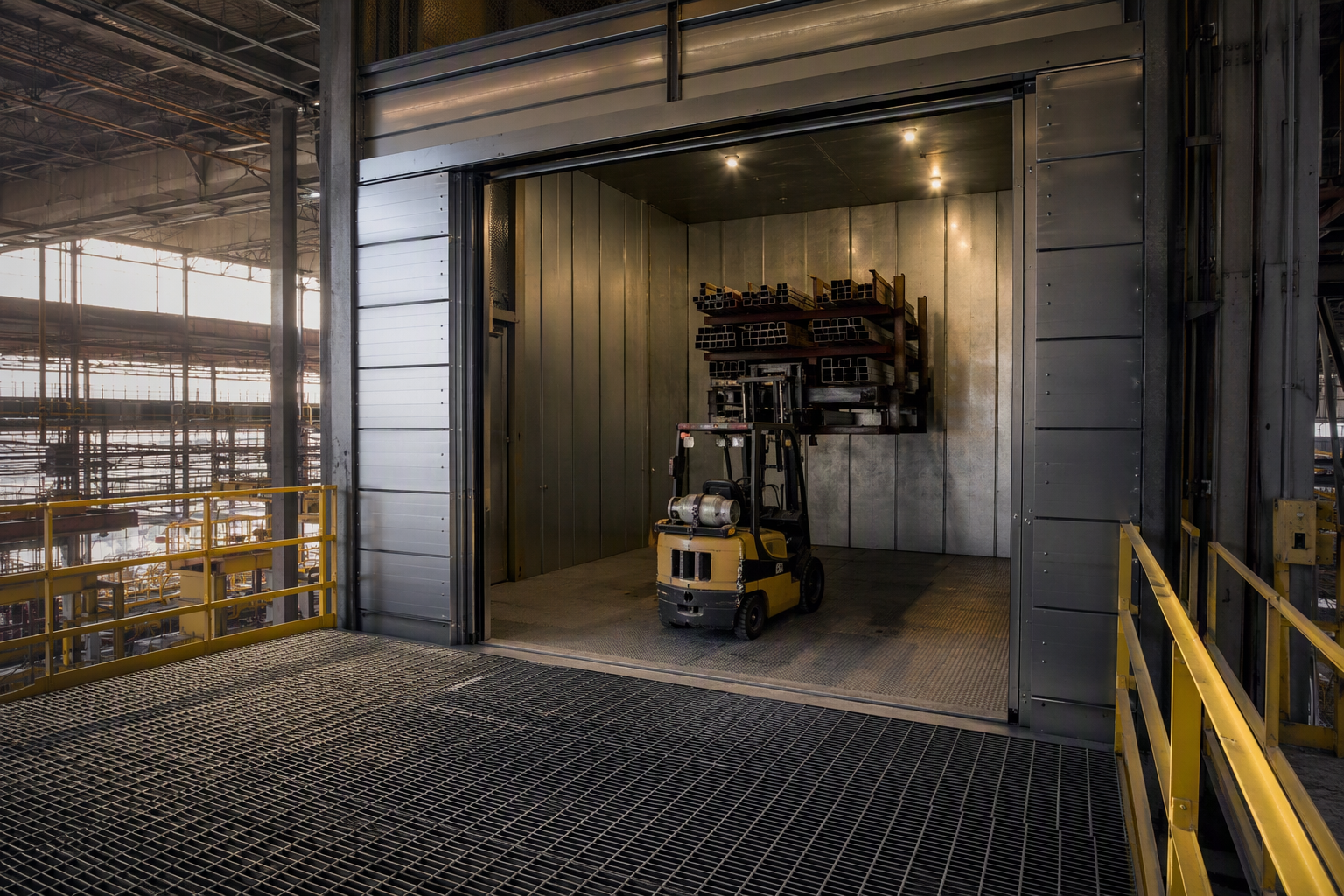
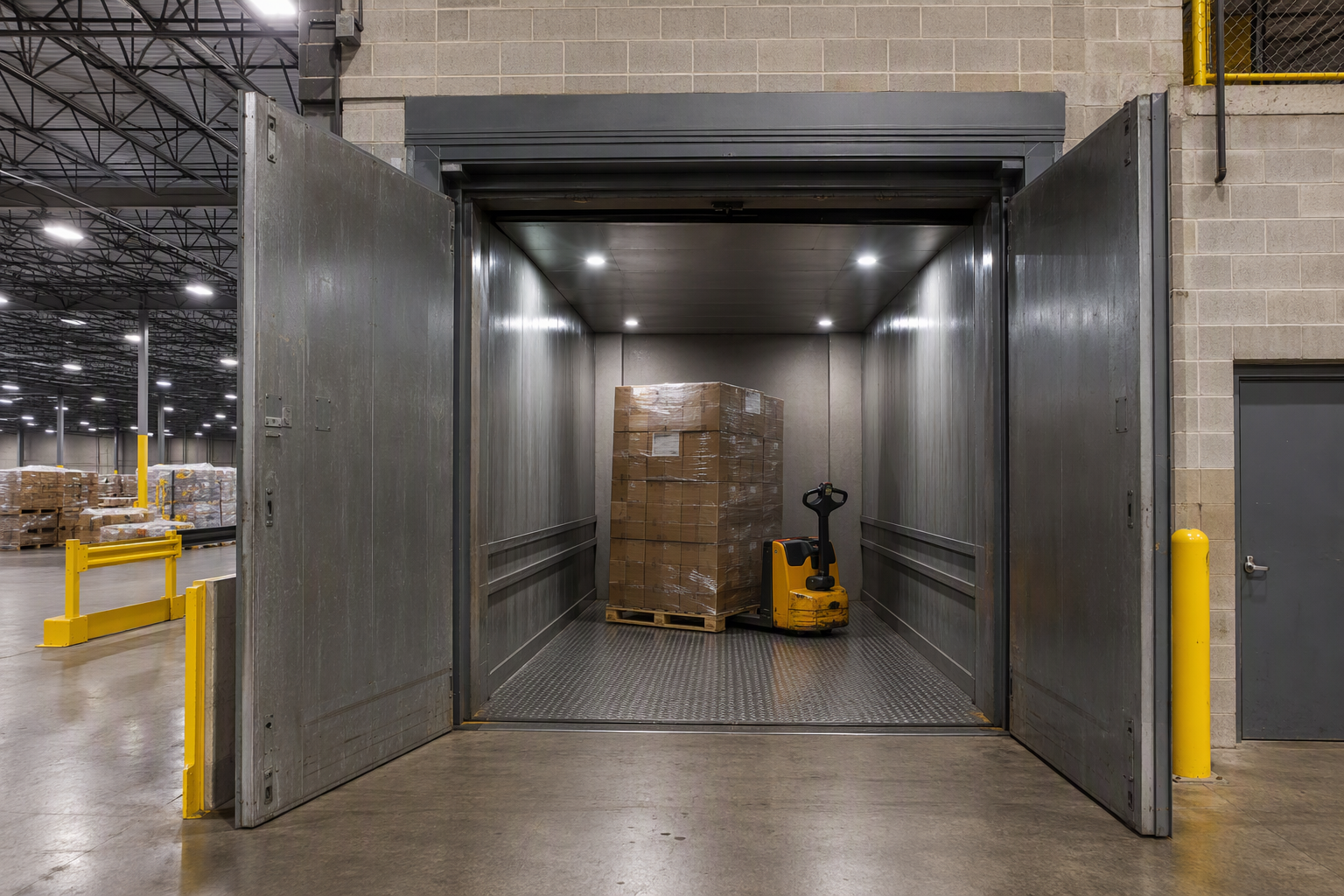
Platform dimensions must accommodate the largest unit load plus the transport equipment used to move it. A forklift-loaded elevator, for example, needs enough depth to allow the forklift to enter, deposit the load, and exit — or to carry both load and forklift simultaneously if that is the operational model.
Ceiling height is equally important. Standard commercial elevator cab heights are often insufficient for tall pallet stacks, racked goods, or tall industrial equipment. Industrial freight elevators frequently require interior cab heights of eight feet or more, and the door opening must match that dimension so tall loads pass through without tipping or obstruction.
Pass-through configurations — where the cab has openings on opposite sides — are common in warehouse layouts that use the elevator as a flow-through transfer point between production and shipping areas. This configuration requires careful coordination between the elevator specification and the facility’s floor plan during design.
What Door Types and Opening Widths Are Standard for Industrial Freight Elevators?
Door selection for a freight elevator directly affects throughput, safety, and durability. The primary options for heavy industrial use include:
- Biparting freight doors — the most common configuration for industrial applications; the top panel rises and the bottom panel lowers simultaneously, maximizing opening height and allowing tall or wide loads to pass without obstruction.
- Single-slide or two-speed doors — suitable where vertical clearance is limited or where pass-through is not required.
- Manual freight doors with power operators — in high-cycle environments, powered door operators reduce operator fatigue and improve cycle times.
Door opening widths for heavy freight applications are typically four to six feet or wider, depending on the class of load. The door, sill, and landing threshold must be able to withstand repeated impact from pallet jacks, forklifts, and heavy carts without deforming or misaligning — misalignment is a leading cause of freight elevator shutdowns in industrial facilities.
Which Drive System — Hydraulic or Traction — Is Best for a Warehouse Freight Elevator?
Both hydraulic and traction systems are used in freight elevator applications, and the best choice depends on travel height, load, and building structure.
- Hydraulic freight elevators are the dominant choice for low- to mid-rise warehouse applications, typically up to five or six floors. They support very high capacity ratings, do not require an overhead machine room above the shaft, and offer robust performance under the high-load, lower-speed demands typical of freight operations. Florida’s warm climate requires attention to hydraulic fluid temperature management and spill containment.
- Traction freight elevators are appropriate for taller facilities or when higher travel speeds are needed. Machine-room-less (MRL) traction configurations are available for facilities where a traditional overhead machine room is not practical.
Speed is a separate specification from drive type. Freight elevators in industrial settings typically operate at lower speeds than passenger units — ranging from roughly 25 to 150 feet per minute — because safety and load stability take priority over throughput speed.
What Cab Construction and Flooring Features Are Required for Heavy Industrial Use?
The cab interior of a freight elevator in a warehouse or industrial building must be engineered for punishment, not aesthetics. Key construction features include:
- Reinforced steel cab walls and sill plates — to resist impact from forklifts, pallet jacks, and heavy carts
- Heavy-duty structural floor — rated to handle concentrated point loads from forklift wheels and dense pallet stacking, not just evenly distributed weight
- Recessed floor-level entry — flush thresholds that eliminate lip hazards and allow easy forklift entry
- Corrosion-resistant finishes — especially important in Florida’s humid coastal environments, such as those serving facilities in Pompano Beach or Sarasota
- Non-slip floor surfaces — critical for operator safety when moving wet or oily loads
What Federal and Florida Compliance Requirements Apply to Freight Elevators?
A freight elevator in a Florida warehouse or industrial facility operates under a layered compliance framework:
ASME A17.1
Florida has adopted the ASME A17.1/CSA B44, 2019 edition as the state’s elevator safety code, effective December 31, 2023, under Chapter 61C-5, Florida Administrative Code. This standard governs design, construction, installation, operation, inspection, testing, maintenance, alteration, and repair of elevators — including freight elevators — throughout the state.
ADA
The Americans with Disabilities Act (ADA) applies to elevators in commercial facilities open to employees and the public. While a dedicated freight elevator used solely for goods transport may not trigger all passenger-elevator ADA requirements, any elevator accessible to employees — including warehouse workers with disabilities — must be assessed for ADA compliance. Facilities should verify ADA applicability with qualified legal and engineering counsel based on their specific use case.
OSHA
The Occupational Safety and Health Administration (OSHA) regulations govern the safe operation of material handling equipment, including powered industrial trucks and their interaction with freight elevators. Employers have an obligation to ensure freight elevators used in the course of employee work meet safe operating standards and that operators are properly trained.
Florida Chapter 399 and DBPR
Under Chapter 399, Florida Statutes (the Elevator Safety Act), administered by the Florida Department of Business and Professional Regulation (DBPR), Division of Hotels and Restaurants, Bureau of Elevator Safety:
- A state permit must be applied for by a registered elevator company before a freight elevator is installed or altered.
- Before a new conveyance is used, it must be inspected by a certified elevator inspector with no conflict of interest with the permit holder or owner.
- Every elevator covered by Chapter 399 must be inspected annually by a certified elevator inspector, or by a county or municipality operating under contract with the state.
- A Florida certificate of operation is valid for no more than two years and may be renewed only for a conveyance with a current satisfactory inspection.
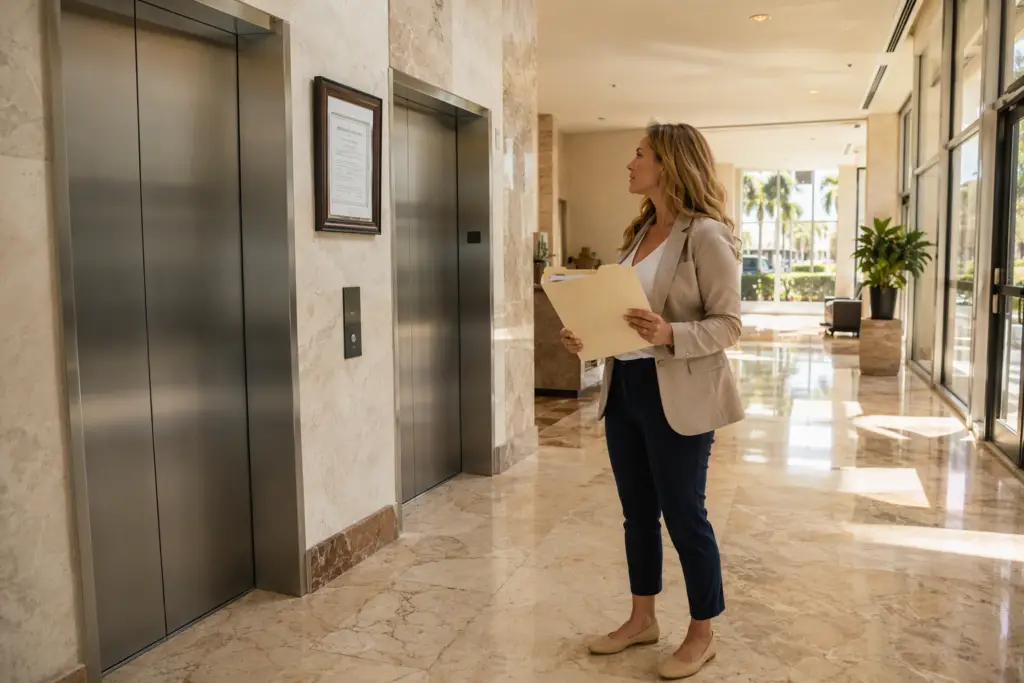
- The certificate of operation must be posted in a conspicuous location inside the elevator in a frame with a transparent cover.
- Operating on an expired certificate of operation violates Florida law.
- The certificate of operation holder must report any elevator accident to the state within five working days.
- All installation work must be performed by a Florida registered elevator company; technicians must hold a Florida elevator certificate of competency.
Local Authority Having Jurisdiction (AHJ)
Facilities in Pompano Beach fall under the jurisdiction of the Broward County Building Code Division, which enforces Florida’s elevator law through its own certified elevator inspectors. Facilities in Sarasota should confirm the applicable local AHJ through the relevant county or municipal building department, as local enforcement arrangements vary. Axxiom Elevator Florida works with clients in both markets to navigate local permitting and inspection requirements from the outset of every project.
What Is the Process for Getting a New Freight Elevator Permitted and Inspected in Florida?
The permitting and inspection process for a new freight elevator in Florida follows a defined sequence under Chapter 399:
- Engage a Florida registered elevator company — only a registered company may apply for the state permit. Axxiom Elevator Florida is a registered elevator company serving industrial clients in Pompano Beach, Sarasota, and across Florida.
- Submit permit application to DBPR — the registered company applies for a state installation permit before any work begins.
- Coordinate with the local AHJ — in Broward County, for example, the Broward County Building Code Division enforces Chapter 399 locally and must be engaged as part of the permitting process.
- Complete the installation — all work is performed by certified elevator technicians holding a Florida elevator certificate of competency.
- Schedule the pre-use inspection — a certified elevator inspector with no conflict of interest with the permit holder or the owner conducts the inspection before the elevator is placed in service.
- Obtain the certificate of operation — once a satisfactory inspection is on file, the certificate of operation is issued and posted inside the cab.
- Establish a maintenance program — the elevator owner becomes responsible for safe operation, maintenance, and correction of any code deficiencies from the moment the certificate is issued.
How Often Does a Freight Elevator in a Florida Warehouse Need to Be Inspected?
Under Chapter 399, Florida Statutes, every elevator covered by the law must be inspected annually by a certified elevator inspector. The certificate of operation issued after a satisfactory inspection is valid for no more than two years, and it can only be renewed if the elevator has a current satisfactory inspection on record. Allowing the certificate to lapse while the elevator remains in service is a violation of Florida law — a risk that carries regulatory and liability consequences for the facility owner.
High-cycle freight elevators in warehouse environments accumulate more wear per year than lightly used passenger elevators, making proactive maintenance between inspections especially important. Axxiom Elevator Florida recommends that industrial clients establish a structured preventive maintenance schedule aligned with their inspection calendar to minimize unplanned downtime.
What Safety Devices Are Required on a Heavy Freight Elevator?
ASME A17.1 mandates a range of safety devices on freight elevators, the specifics of which depend on the elevator class, drive type, and travel height. Devices commonly required on heavy freight elevators include:
- Safeties and buffers — mechanical devices that arrest the cab in the event of overspeeding or free-fall
- Overload protection — prevents the elevator from operating when loaded beyond its rated capacity
- Door interlocks — ensure the elevator cannot travel with hoistway or cab doors open
- Emergency lighting and communication — required for any situation where an operator could be trapped
- Pit lighting and stop switch — mandatory for maintenance and emergency access
- Oil spill containment — hydraulic units require containment systems; particularly scrutinized in Florida given environmental regulations
Questions Your Inspector Will Ask
When a certified elevator inspector arrives at a Florida warehouse for a freight elevator inspection — whether it is the pre-use inspection after a new installation or an annual inspection under Chapter 399 — the following are among the areas they will examine and questions they will need answered:
- Is the current certificate of operation posted in the cab in a frame with a transparent cover?
- Has the elevator been altered since the last inspection, and if so, was a new state permit obtained before the work began?
- Are maintenance records available, and do they show that deficiencies identified in the previous inspection were corrected?
- Is the rated capacity clearly posted in the cab, and does the facility have a procedure to prevent overloading?
- Are all door interlocks functioning correctly — do the cab doors and hoistway doors prevent travel when open?
- Is the emergency communication device operational and connected to a monitored location?
- For hydraulic units: is the hydraulic fluid at the correct level, is there evidence of leaks, and is oil spill containment in place?
- Are all required safety devices — safeties, buffers, overload protection — present and functioning?
- Is the pit clean, dry, and properly lit, and is the pit stop switch accessible?
- Has any elevator accident occurred since the last inspection, and if so, was it reported to DBPR within five working days?
Axxiom Elevator Florida offers pre-inspection walkthroughs for industrial clients to identify and correct potential deficiencies before the certified inspector arrives, reducing the risk of a failed inspection or required re-inspection.
What Maintenance Program Is Appropriate for a High-Use Industrial Freight Elevator?
A freight elevator in an active warehouse operates under significantly more demanding conditions than a passenger elevator in an office building. Maintenance intervals that are adequate for low-use applications will leave heavy industrial units vulnerable to premature component wear, unexpected failures, and costly emergency service calls.
A structured maintenance program for an industrial freight elevator should address:
- Regular inspection and lubrication of all mechanical components
- Door operator and interlock system checks — doors are the highest-maintenance component on most freight elevators
- Hydraulic fluid analysis and top-off for hydraulic units
- Safety device testing at intervals consistent with ASME A17.1 requirements
- Cab and sill inspection for impact damage
- Buffer and guide rail inspection
- Review and update of the maintenance log, which the inspector will request
How Should a Facility Owner Choose a Freight Elevator Contractor in Florida?
Under Chapter 399, Florida Statutes, only a Florida registered elevator company may apply for installation permits, and only certified elevator technicians holding a Florida elevator certificate of competency may perform installation, maintenance, or repair work. Verifying a contractor’s registration status with DBPR before signing any agreement is not optional — it is a legal requirement and a practical protection for the facility owner.
Beyond legal registration, industrial facility owners in Pompano Beach and Sarasota should look for a contractor with demonstrated experience specifying and servicing heavy freight elevator systems — not simply companies whose primary business is passenger elevator maintenance. The engineering decisions made during specification and installation have long-term consequences for safety, uptime, and total cost of ownership.
Axxiom Elevator Florida works with warehouse and industrial clients across Florida to develop freight elevator specifications, manage the permitting process, coordinate with local AHJs, and provide ongoing maintenance programs calibrated to the demands of industrial operations.
What Happens If a Freight Elevator Fails or Causes an Accident at a Florida Warehouse?
Under Florida law, the certificate of operation holder is responsible for reporting any elevator accident to the state within five working days of the incident. Beyond the reporting obligation, an accident triggers an inspection process and a review of whether the elevator was properly maintained and operating within its rated parameters.
Facilities that cannot demonstrate a current certificate of operation, a satisfactory recent inspection, and a documented maintenance history face significant regulatory and legal exposure following an incident. Maintaining complete, accurate records is not merely good practice — it is the owner’s statutory responsibility under Chapter 399.
Get Expert Guidance on Your Warehouse Freight Elevator
Specifying, permitting, installing, and maintaining a heavy freight elevator in a Florida warehouse or industrial building involves a layered set of decisions that affect safety, compliance, and operational uptime for the life of the equipment. Getting those decisions right from the start — and keeping the elevator in full compliance under Florida’s Chapter 399 framework — requires a partner with deep knowledge of both the engineering requirements and the Florida regulatory environment.
Contact Axxiom Elevator Florida for a free elevator assessment:
Axxiom Elevator Florida serves industrial and warehouse clients in Pompano Beach, Sarasota, and throughout Florida — from initial specification through annual inspection readiness and ongoing maintenance.
Need elevator service you can rely on? Axxiom Elevator Florida is ready to help.