A commercial elevator installation is one of the most heavily regulated construction activities in Florida. From the moment a permit application is submitted to the day a certificate of operation is issued, building owners and project managers face a multi-stage process involving plan review, equipment procurement, rough-in construction, final inspection, and state licensing requirements. The sections below answer every common question about that process in detail, with references to applicable federal codes and Florida-specific regulations.
How long does a commercial elevator installation take from permit to first use?
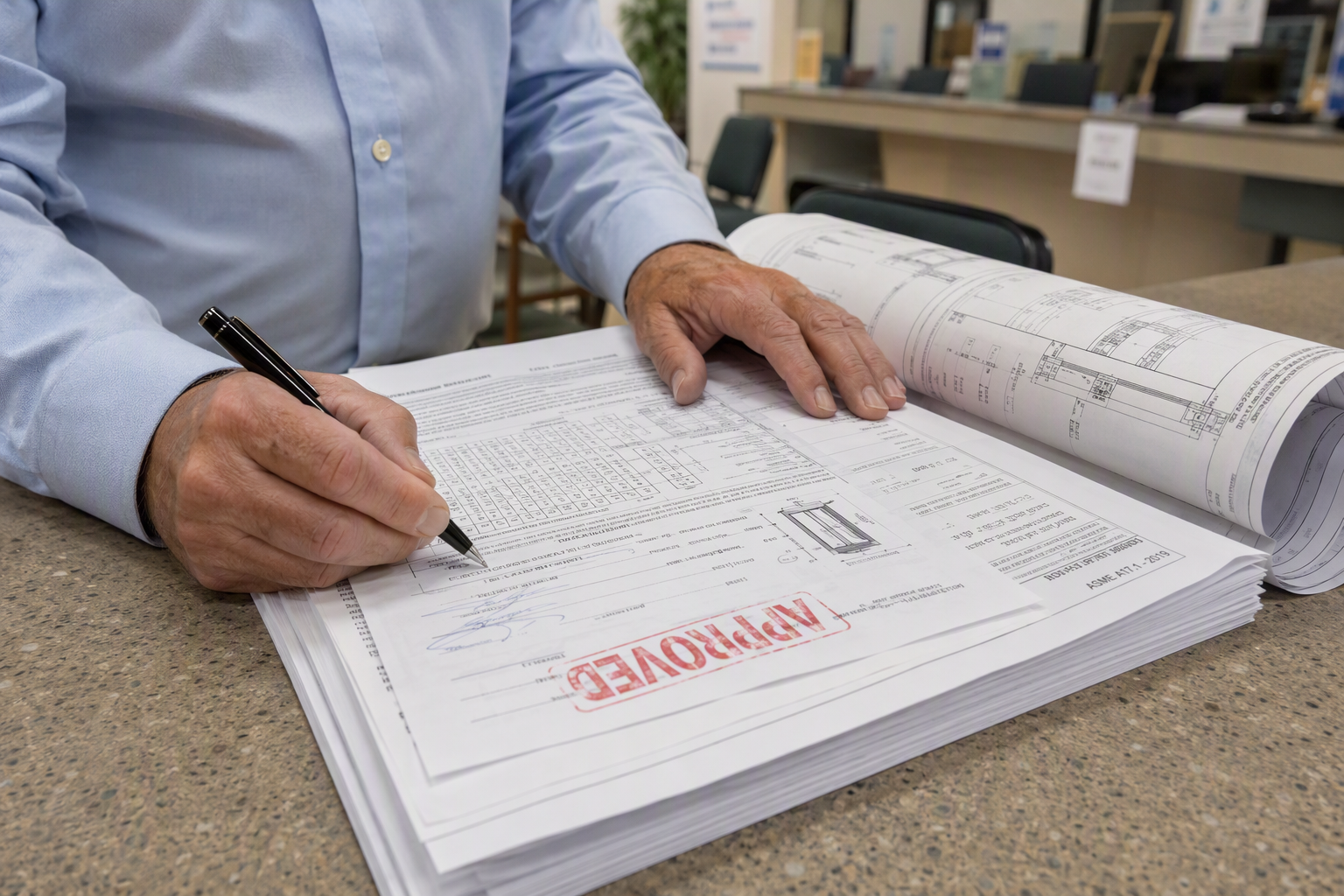
Most commercial elevator projects in Florida require between 6 and 18 months from permit application to first approved occupant use.
That range is wide because the timeline depends on multiple sequential phases. Plan review by the local building department can take anywhere from a few weeks in smaller jurisdictions to several months in high-volume markets such as Broward County (which includes Pompano Beach) or Sarasota County. Equipment procurement adds additional weeks or months depending on the elevator type and manufacturer backlog. Physical installation of a hydraulic elevator is generally faster than a traction elevator, but both must pass a Florida Department of Business and Professional Regulation (DBPR) inspection before any certificate of operation is issued. Projects with complete documentation, experienced contractors, and pre-coordinated inspection scheduling tend to land at the lower end of the range.
What permits are required before elevator installation can begin in Florida?
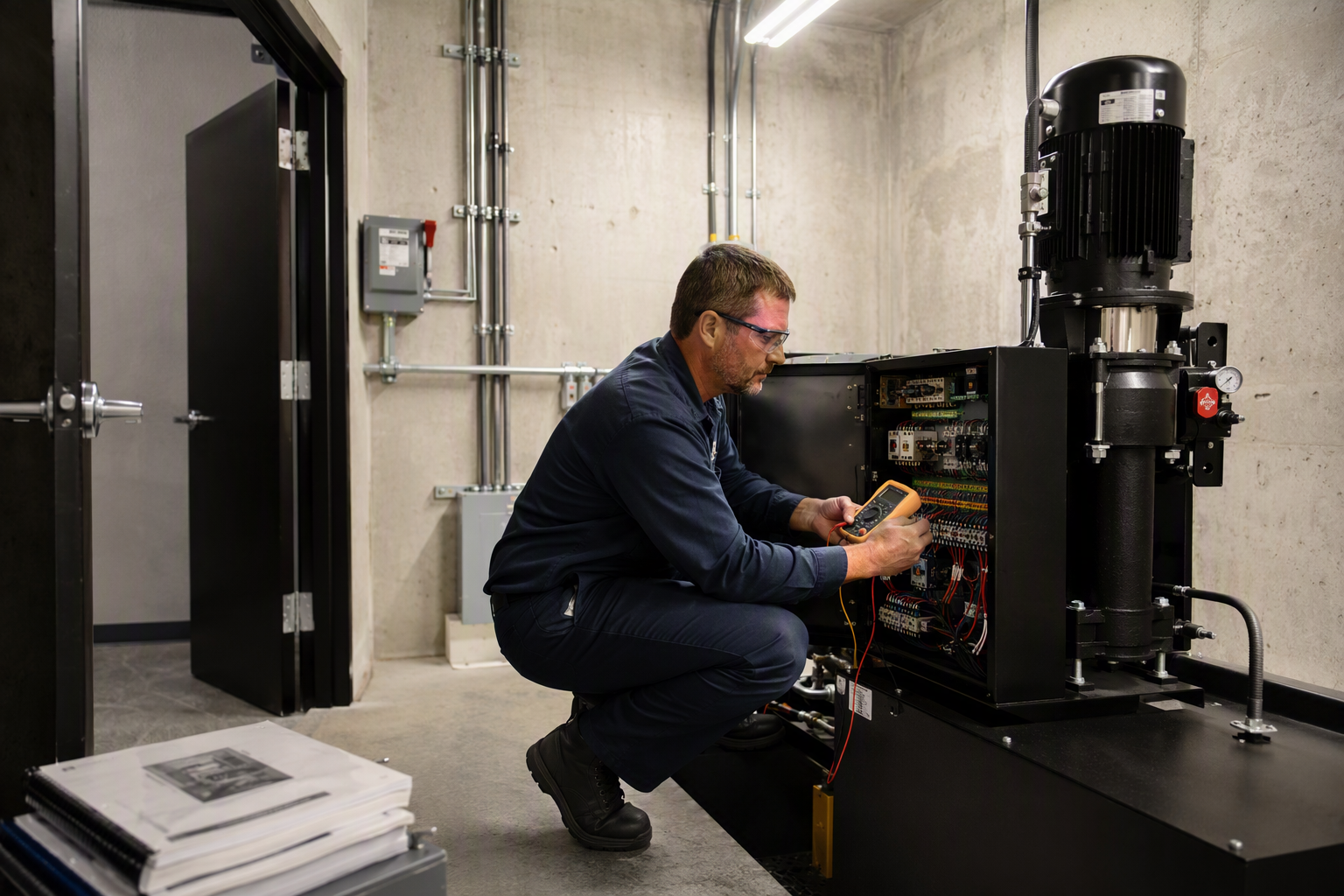
Florida requires both a local building permit and registration with the Florida Department of Business and Professional Regulation (DBPR) Elevator Safety Program before installation work begins.
The local building permit is pulled from the Authority Having Jurisdiction — the county or municipal building department where the project is located. In Pompano Beach, that is the City of Pompano Beach Building Services Division; in Sarasota, it is the Sarasota County Building and Development Services. Submitted documents typically include engineered drawings, specifications, and equipment data sheets that must comply with the ASME A17.1 Safety Code for Elevators and Escalators.
Concurrently, the elevator contractor must file a permit application with the DBPR Elevator Safety Program under Florida Statute Chapter 399, which governs elevators, escalators, and related equipment statewide. Work may not legally commence until both permits are active. The DBPR application requires identification of the licensed elevator contractor, equipment specifications, and the building address.
What are the major phases of a commercial elevator installation project?
A commercial elevator installation moves through seven distinct phases: planning and design, permit application, plan review and approval, equipment procurement, civil and structural rough-in, equipment installation and wiring, and final inspection and commissioning.
- Planning and design: An engineer of record prepares architectural and mechanical drawings. Shaft dimensions, pit depth, overhead clearance, machine room or machine-room-less (MRL) layout, and load calculations are finalized.
- Permit application: The licensed elevator contractor submits applications to both the local AHJ and DBPR. Incomplete submittals are a leading cause of delays.
- Plan review and approval: Reviewers at the AHJ and DBPR check drawings against current code requirements. Comments and revisions may extend this phase by weeks.
- Equipment procurement: After permit approval, elevator components are ordered. Standard hydraulic units may arrive in 8–14 weeks; custom traction systems can take longer depending on capacity, speed, and cab finish specifications.
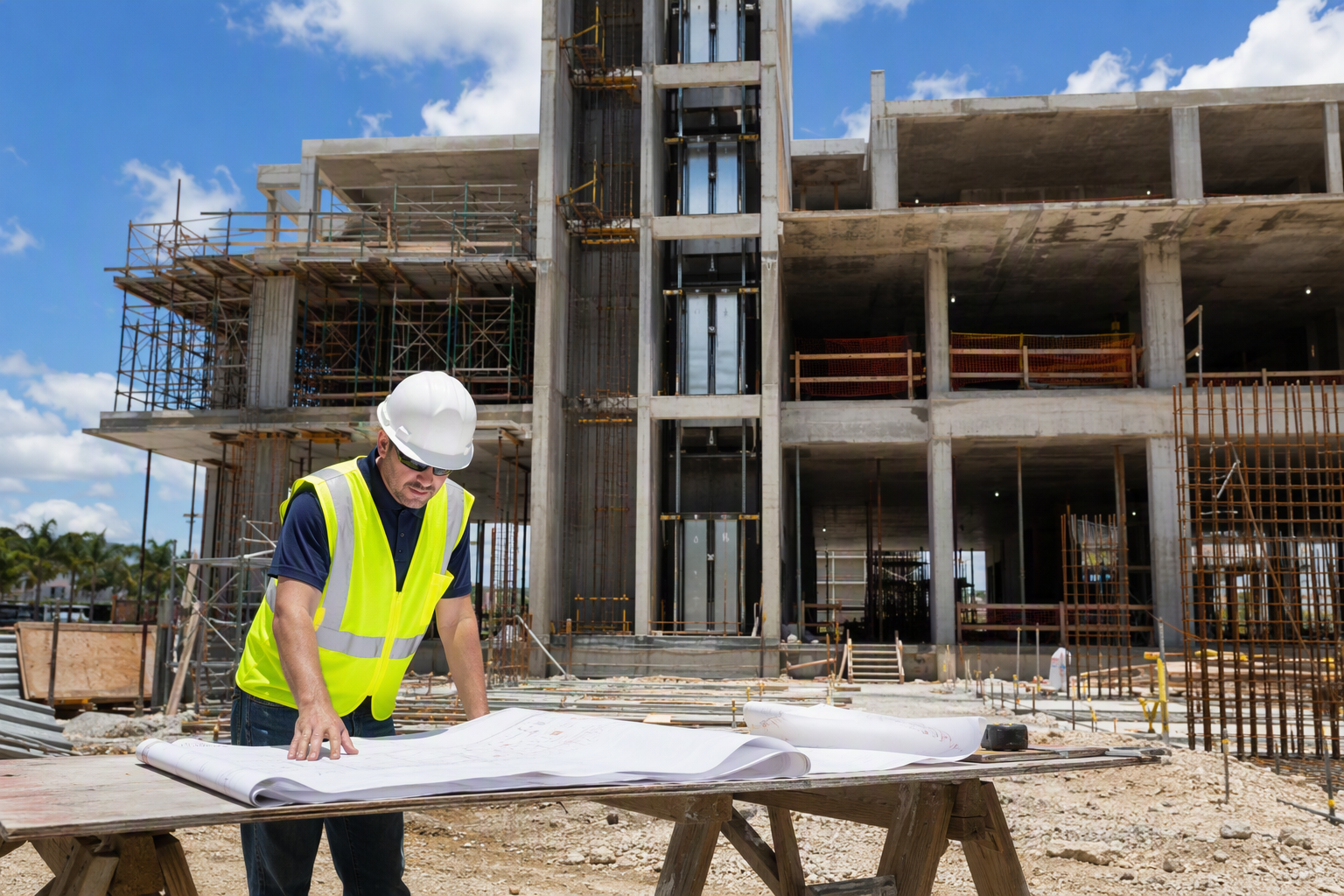
- Civil and structural rough-in: General contractors install the hoistway, pit, and any machine room. Elevator contractors coordinate rough-in dimensions with the general contractor.
- Equipment installation and wiring: Licensed elevator mechanics install rails, drive systems, cab components, control panels, and safety devices in accordance with ASME A17.1 and all applicable ADA accessibility requirements.
- Final inspection and commissioning: A DBPR-licensed elevator inspector performs a witnessing of acceptance tests. Upon passing, a certificate of operation is issued, and the elevator may be placed into service.
How does plan review affect the installation timeline?
Plan review is often the single most variable phase and can add anywhere from two weeks to four months to the overall timeline depending on the AHJ’s workload and the completeness of the submitted documents.
High-growth counties such as Broward and Sarasota experience periodic surges in construction permit volume, which extends review queues. Submitting a complete package on the first attempt — including all ASME-compliant drawings, equipment cut sheets, seismic certifications where applicable, and signed and sealed engineering documents — is the most reliable way to reduce review time. Resubmittals after correction notices each restart a review cycle.
What ASME and ADA codes govern a new commercial elevator installation?
New commercial elevator installations in Florida must conform to the ASME A17.1 Safety Code for Elevators and Escalators for mechanical and safety requirements and to the Americans with Disabilities Act accessibility standards for cab dimensions, controls, and signage.
ASME A17.1 establishes requirements for hoistway construction, car enclosures, safeties, buffers, door reopening devices, emergency lighting, and dozens of other components. Florida adopts ASME A17.1 by reference through the DBPR Elevator Safety Program, and the edition in effect for new permits is the edition specified by the DBPR at time of application; as of 2026, contractors and building owners should confirm the current adopted edition with DBPR.
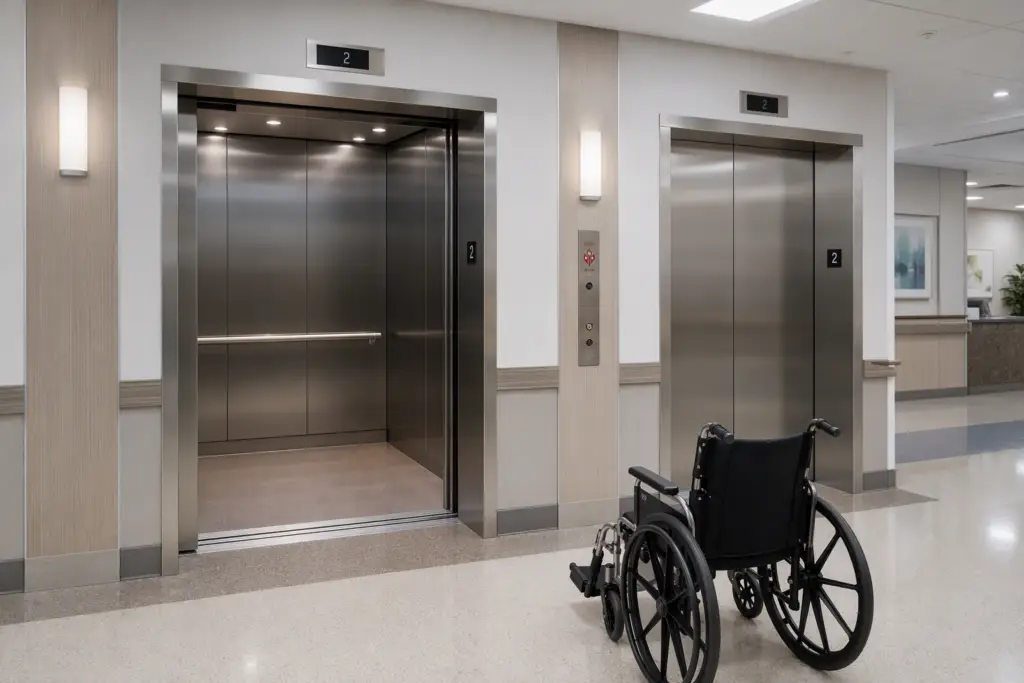
ADA Standards for Accessible Design require, among other things, minimum cab dimensions, a clear floor area, accessible control button height ranges, Braille and raised-character markings, audible signals, and two-way emergency communication systems. Any commercial building required to provide an accessible route under the ADA must ensure the elevator meets these standards before opening to the public. Questions about specific ADA requirements should be directed to a qualified accessibility consultant or to ADA.gov.
What types of elevators are most commonly installed in commercial buildings in Florida?
Hydraulic elevators and machine-room-less (MRL) traction elevators are the two most common choices for low-to-mid-rise commercial buildings in Florida.
| Elevator Type | Typical Rise | Machine Room Required | Typical Lead Time (Equipment) | Common Use Case |
|---|---|---|---|---|
| Hydraulic (conventional) | Up to ~6 floors | Yes (adjacent) | 8–14 weeks | Low-rise office, retail, medical |
| Hydraulic (holeless) | Up to ~4 floors | Yes (adjacent) | 8–14 weeks | Buildings with environmental restrictions on in-ground cylinders |
| Machine-Room-Less (MRL) Traction | Up to ~20 floors | No (overhead or hoistway-mounted) | 10–20 weeks | Mid-rise office, hotel, mixed-use |
| Geared Traction | Mid-rise | Yes (overhead) | 12–20 weeks | Older-design commercial buildings |
| Gearless Traction | High-rise | Yes (overhead) | 16–30+ weeks | High-rise commercial towers |
In Florida’s low-to-mid-rise commercial market — which characterizes much of Pompano Beach and Sarasota — hydraulic and MRL traction systems dominate new installations. The choice between them depends on building height, shaft dimensions, energy efficiency goals, pit depth constraints, and budget.
How does equipment procurement affect the overall project schedule?
Equipment lead time is a critical path item that often runs in parallel with plan review, and delays in ordering can push the entire project back by months.
Experienced elevator contractors place equipment orders as soon as permit approval is reasonably assured, sometimes before final approval if the project scope is well-defined, in order to compress the overall schedule. Custom cab finishes, non-standard capacities, and specific speed requirements can extend lead times well beyond standard catalog items. Building owners and project managers should work with their elevator contractor to confirm lead times early in design, particularly for projects with hard occupancy deadlines.
What inspections are required during and after elevator installation in Florida?
Florida law requires at minimum a final acceptance inspection by a DBPR-licensed elevator inspector, and many AHJs also require interim rough-in inspections during hoistway construction.
The DBPR Elevator Safety Program licenses elevator inspectors and sets minimum inspection requirements under Florida Statute Chapter 399. The acceptance inspection involves witnessed safety tests including governor and safety device tests, buffer tests, brake tests, door operation tests, and load tests as required by ASME A17.1. The elevator may not be placed into service until a certificate of operation is issued following a passed acceptance inspection. Annual periodic inspections are then required after the elevator enters service.
How soon after installation must a commercial elevator be inspected under Florida law?
An acceptance inspection must occur and a certificate of operation must be issued before a newly installed elevator can be used by building occupants — there is no grace period for operating without a valid certificate.
Florida Statute Chapter 399 prohibits operation of an elevator without a valid certificate of operation. Building owners who allow occupant use before inspection and certification are in violation of state law and may face penalties and liability exposure. After the certificate of operation is issued, periodic inspections are required on a recurring basis as specified by DBPR rules. Axxiom Elevator Florida assists building owners in Pompano Beach and Sarasota with scheduling and coordinating DBPR acceptance inspections to ensure no delays at the critical project closeout phase.
What are the ADA requirements that must be met before a commercial elevator opens for public use?
Before a commercial elevator opens to the public, it must comply with the ADA Standards for Accessible Design, including minimum cab dimensions, accessible control panel layouts, tactile markings, audible signals, and two-way emergency communication.
For new construction, ADA compliance is not optional — it is required by federal law for places of public accommodation and commercial facilities. Key requirements include a minimum inside clear floor area, control buttons at accessible heights, Braille and raised-character floor designations, hall lanterns and in-car position indicators, and a fully functional two-way emergency communication system. Failure to meet ADA requirements at final inspection can delay certificate of operation issuance. ADA compliance review should be integrated into design, not treated as a last-minute checklist.
What causes the most common delays in commercial elevator installation projects?
The most common causes of delay are incomplete permit submissions, plan review corrections, equipment procurement lead times, general contractor coordination failures, and scheduling gaps with DBPR inspectors.
Projects that experience multiple rounds of plan review corrections can lose months before installation even begins. Equipment that is not ordered promptly after permit approval creates downstream idle time for installation crews. Poor coordination between the general contractor and the elevator subcontractor on hoistway dimensions, pit depth, and electrical rough-in leads to expensive rework. Finally, DBPR inspection scheduling in high-activity construction markets can introduce additional waiting periods at project closeout. Engaging a knowledgeable elevator contractor early in the design phase addresses most of these risks proactively.
Does elevator installation require a licensed contractor in Florida?
Yes — Florida Statute Chapter 399 requires that elevator installation, alteration, service, and repair work be performed by or under the supervision of a licensed elevator contractor, and elevator mechanics performing the work must hold appropriate state licensure.
The DBPR regulates both elevator contractors (companies) and elevator mechanics (individuals) in Florida. Permits for new installations may only be pulled by licensed elevator contractors. Building owners should verify that any company they engage holds a current, active license with the DBPR Elevator Safety Program. Axxiom Elevator Florida is a certified elevator service company serving commercial clients in Pompano Beach and Sarasota, operating in compliance with Florida’s licensing requirements.
What is the role of the Authority Having Jurisdiction (AHJ) in the installation timeline?
The AHJ — typically the local city or county building department — controls plan review timelines, issues the local building permit, and may require its own inspections separate from those conducted by DBPR-licensed elevator inspectors.
In Florida, elevator projects often involve dual oversight: the local AHJ for building code compliance and the DBPR for elevator-specific safety compliance. Some AHJs defer entirely to DBPR-licensed inspectors for elevator work; others conduct their own inspections of structural elements such as the pit, hoistway walls, and machine room. Understanding the specific requirements of the Pompano Beach or Sarasota AHJ before submitting permits prevents surprises during inspections. An elevator contractor with active project experience in those markets understands each AHJ’s particular processes and preferences.
How much does it cost to install a new commercial elevator in Florida?
Commercial elevator installation costs vary widely based on elevator type, number of stops, cab size, finishes, site conditions, and local permit and inspection fees — building owners should obtain detailed quotes from licensed contractors early in the design process.
Cost factors include the equipment purchase price, freight and rigging, licensed labor for installation, electrical rough-in (often by a separate electrical contractor), hoistway construction by the general contractor, permit fees assessed by the AHJ, DBPR permit fees, and any third-party inspection fees. Custom cab finishes, glass walls, and non-standard configurations increase equipment costs. Building owners in Pompano Beach and Sarasota should request itemized proposals that clearly separate equipment, labor, permit fees, and any optional upgrades to allow meaningful comparisons between bidders.
What should building owners do to prepare for an elevator installation project?
Building owners should begin by engaging a licensed elevator contractor and a structural or MEP engineer early — ideally during schematic design — to establish shaft dimensions, electrical requirements, pit depth, overhead clearance, and machine room or MRL layout before construction documents are finalized.
- Engage a licensed elevator contractor for a preconstruction consultation to establish equipment type and rough dimensions.
- Coordinate with the structural engineer on pit dimensions, hoistway structural requirements, and beam loading for overhead traction systems.
- Confirm electrical service requirements (voltage, amperage, disconnect location) with the MEP engineer and electrical contractor.
- Verify ADA compliance requirements with the project architect and confirm cab dimensions, control heights, and signage requirements are incorporated into the construction documents.
- Contact both the local AHJ and DBPR early to understand current plan review timelines and any local amendments or requirements.
- Confirm equipment lead times with the elevator contractor before finalizing the project schedule.
- Build contingency time into the project schedule for plan review corrections, equipment delays, and inspection scheduling.
How long does the final DBPR inspection and certification process take?
Scheduling a DBPR acceptance inspection typically takes one to four weeks after the contractor notifies the program that installation is complete and ready for inspection, though actual timing depends on inspector availability and regional workload.
After the acceptance inspection, if the elevator passes all required tests, the certificate of operation can be issued promptly. If deficiencies are identified, the contractor must correct them and a follow-up inspection must be scheduled, adding additional time. Thorough pre-inspection walkthroughs by the elevator contractor help identify and resolve any code compliance issues before the official DBPR inspection, reducing the likelihood of a failed inspection. Axxiom Elevator Florida helps clients in the Pompano Beach and Sarasota markets navigate the inspection scheduling process to minimize closeout delays.
What ongoing compliance obligations does a building owner have after a new elevator is certified?
After the certificate of operation is issued, Florida building owners must maintain periodic inspections on the schedule required by DBPR, keep the elevator in safe operating condition, and display the certificate of operation in or near the elevator as required by law.
Florida Statute Chapter 399 requires periodic inspections by DBPR-licensed inspectors at intervals established by DBPR rules. Building owners are also responsible for maintaining a preventive maintenance program with a licensed elevator contractor. Failure to maintain current inspection certificates can result in mandatory shutdown orders and penalties. The ASME A17.3 Safety Code for Existing Elevators and Escalators provides the framework for maintenance and periodic testing requirements that apply to elevators already in service. A structured maintenance agreement with a qualified elevator service company is the most reliable way to remain continuously compliant.
Can an elevator be used during construction or testing before the certificate of operation is issued?
Elevators under installation may only be used for construction purposes by elevator mechanics and other authorized construction personnel under controlled conditions — they may never be used by building occupants or the general public until a valid certificate of operation has been issued.
Florida Statute Chapter 399 is explicit that operation without a valid certificate of operation is prohibited. During installation, the elevator contractor operates the equipment under their permit authority for testing, adjustment, and commissioning purposes. Access must be restricted to authorized personnel. Building owners and general contractors should ensure physical barriers, lockouts, and signage prevent unauthorized use during this phase.
What is the difference between the DBPR acceptance inspection and ongoing periodic inspections?
The acceptance inspection is a one-time event that authorizes first use of a newly installed elevator, while periodic inspections are recurring compliance events required throughout the elevator’s operational life to verify continued safe condition.
The acceptance inspection verifies that the installation was completed in full conformance with the permit drawings and ASME A17.1 requirements. Periodic inspections, governed by Florida Statute Chapter 399 and DBPR rules, focus on ongoing operational safety and may involve tests of safety devices, brakes, door operation, and other components. The ASME A17.3 standard addresses the maintenance and testing of elevators already in service. Building owners should understand that passing the acceptance inspection is the beginning of an ongoing compliance obligation, not the end of it.
How can a building owner in Pompano Beach or Sarasota find a qualified elevator contractor for a new installation?
Building owners should verify that any elevator contractor holds a current, active license with the Florida DBPR Elevator Safety Program and has documented project experience with the specific elevator type and building category relevant to their project.
The DBPR maintains a public license lookup tool that allows verification of contractor license status. Beyond licensure, building owners should review the contractor’s familiarity with local AHJ requirements, their process for coordinating DBPR permit applications, and their approach to managing equipment procurement timelines. References from completed commercial projects in the same market — Pompano Beach or Sarasota — provide meaningful insight into a contractor’s ability to manage the full process from permit to certificate of operation. Axxiom Elevator Florida serves commercial clients across both markets and is available to consult on new installation projects from the earliest planning stages.
Ready to Plan Your Commercial Elevator Installation?
Getting the permitting, procurement, and inspection sequence right from the start is the difference between a project that delivers on time and one that stalls for months. Contact Axxiom Elevator Florida for a free elevator assessment — whether your project is in Pompano Beach, Sarasota, or the surrounding areas, the team can help you understand the full timeline, code requirements, and steps needed to get your new elevator into service efficiently and in full compliance with Florida law.
Call Axxiom Elevator Florida today: