Quick Answer: Switching elevator service companies in Florida without violating your current maintenance contract requires a careful review of your exit clauses, required notice periods, and equipment ownership terms before signing with a new provider — failing to follow those steps can expose building owners to financial penalties and compliance gaps.
Florida building owners and property managers often find themselves locked into elevator maintenance agreements that no longer deliver value. Whether service quality has declined, response times have become unacceptable, or costs have escalated without clear justification, the desire to switch elevator service contractors is common — but the path to doing so cleanly requires careful preparation. This guide covers every major consideration: reading your contract, understanding Florida-specific compliance obligations, managing the transition, and selecting an independent service provider that puts the building owner first.
What Does a Typical Elevator Maintenance Contract in Florida Actually Include?

Most elevator maintenance agreements in Florida are structured as multi-year service contracts, often ranging from one to five years. They typically cover scheduled preventive maintenance visits, emergency callback service, labor for covered repairs, and parts — though the scope of parts coverage varies significantly between “full-service” and “oil-and-grease-only” agreements.
Key contractual elements that directly affect your ability to switch providers include:
- Auto-renewal clauses: Many contracts automatically renew for additional one- or multi-year terms unless written notice is given within a specific window — often 60 to 90 days before the renewal date. Missing this window can reset your commitment.
- Early termination fees: Some agreements impose a fee equal to the remaining months of contract value if the building owner terminates early without cause.
- Proprietary parts and equipment clauses: Certain manufacturers and their affiliated service providers install components — including controller boards, monitoring systems, and diagnostic tools — that are programmed or locked to their proprietary systems, making it difficult for an independent technician to service or diagnose the unit without those tools.
- Notice-of-cancellation requirements: Most contracts require formal written notice, often delivered via certified mail, rather than a simple email or phone call.
- Lien or equipment ownership provisions: Some contracts assert ownership or lien rights over parts installed during the agreement period, which can complicate a transition.
Before taking any action toward switching, obtain a complete copy of your current agreement and read every clause — not just the service scope section. If the language is ambiguous, consult a Florida-licensed attorney before sending any termination notice.
Is There a “For Cause” Exit Option in Elevator Service Contracts?
Yes. Most well-drafted commercial service contracts include a termination-for-cause provision that allows either party to exit the agreement if the other party materially breaches its obligations. For elevator contracts, common “cause” scenarios include:
- Repeated failure to perform scheduled maintenance visits within contractually agreed timeframes
- Documented safety deficiencies that the contractor failed to correct within a reasonable cure period
- Failure to maintain required licensure with the Occupational Safety and Health Administration (OSHA) or Florida state elevator inspection authorities
- Misrepresentation of work performed or parts replaced
To use a for-cause exit effectively, building owners should document every service failure in writing — dated emails, service logs, maintenance records, and inspection reports. Send a formal written cure notice to the contractor, specifying the breach and a reasonable time to correct it. If the breach is not cured, the termination-for-cause clause provides a legal basis to exit without paying early termination fees. Again, legal counsel is advisable before invoking this provision.
What Are Florida’s Elevator Compliance Requirements During a Contractor Transition?
Florida elevator compliance is governed by Chapter 399 of the Florida Statutes, which requires annual inspections by a licensed elevator inspector and mandates that elevators comply with applicable editions of the ASME A17.1 Safety Code for Elevators and Escalators. As of 2026, building owners must ensure that no gap in compliant maintenance coverage occurs during a contractor transition.
Critical compliance points to address during a switch:
- Verify that your new contractor holds a valid Florida elevator contractor license before the transition date.
- Ensure your Certificate of Inspection remains current. A lapse in maintenance coverage does not automatically void the certificate, but any failed inspection during a coverage gap is the building owner’s legal responsibility.
- If your elevator serves the public and is subject to Americans with Disabilities Act (ADA) requirements, ensure continuous operability — prolonged downtime during a transition can create ADA accessibility violations for covered facilities.
- Request a maintenance record transfer from the outgoing contractor. Florida law requires contractors to maintain service records, and building owners are entitled to copies.
Step-by-Step: How to Switch Elevator Service Companies in Florida Without Violating Your Contract
- Obtain and review your full maintenance agreement. Read every page, including addenda and exhibits. Note the contract end date, auto-renewal window, notice requirements, early termination fees, and any proprietary equipment clauses.
- Mark your notice deadline on a calendar. If your contract requires 90 days’ written notice before renewal, count backward from the renewal date and set a reminder at least two weeks before that deadline.
- Document any service deficiencies. Compile dates, descriptions, and any written communications related to missed visits, unresolved repairs, or safety concerns. This record is essential if a for-cause exit becomes necessary.
- Request an equipment assessment from a prospective new provider. Before committing, have a qualified independent contractor evaluate your elevator’s current condition, identify any proprietary components, and provide a written scope of what they can and cannot service.
- Send your cancellation notice in the required format. Use certified mail with return receipt, following the exact notice method specified in your contract. Keep a copy of the letter and the mailing receipt.
- Negotiate a transition date that avoids a service gap. Coordinate the end of your current contract with the start date of the new agreement so that your equipment is covered under a compliant maintenance program continuously.
- Transfer all maintenance records to the new provider. Provide service logs, inspection certificates, equipment manuals, wiring diagrams, and any open permit records so the incoming contractor can provide informed service from day one.
- Confirm the new contractor’s Florida licensure. Verify their elevator contractor license number with the Florida Department of Business and Professional Regulation (DBPR) before the transition date.
- Conduct a joint walkthrough. Schedule a walkthrough with the incoming contractor before the old contract expires so they can document the equipment’s baseline condition and identify any pre-existing issues.
- Retain copies of all documentation. Keep copies of the termination letter, new contract, inspection certificates, and maintenance logs in a secure location accessible to building management staff.
What Is the Risk of Proprietary Parts and Locked Controllers When Switching?
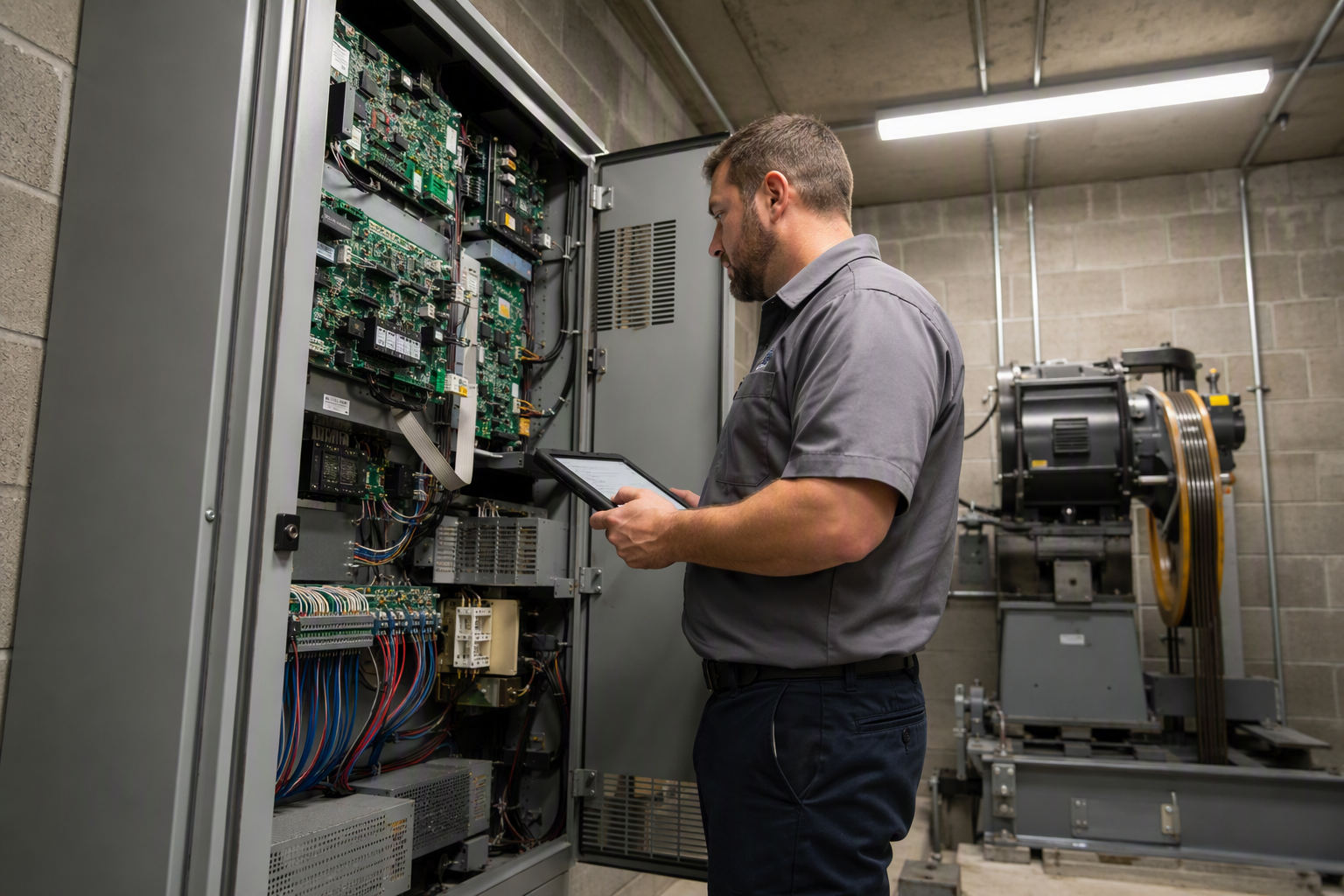
One of the most frequently overlooked complications when switching elevator service companies is the presence of proprietary technology. Certain large elevator manufacturers and their captive service subsidiaries install controller boards, monitoring modules, and remote diagnostic systems that are software-locked or require proprietary tools to interface with. When a building owner switches to an independent contractor, the incoming technician may be unable to access diagnostic menus, reset fault codes, or order compatible replacement parts without manufacturer authorization.
Before switching, ask these questions of any prospective new contractor:
- Can you service the specific controller and drive system currently installed in my elevator?
- Are there components that would need to be replaced with open-market equivalents for you to maintain this unit effectively?
- What is the estimated cost and timeline if any proprietary components need to be upgraded to serviceable alternatives?
An honest, experienced independent elevator service company will provide clear answers and a written assessment rather than vague assurances.
Elevator Maintenance Contract Comparison: Captive vs. Independent Service Providers
| Factor | Manufacturer-Captive Service Provider | Independent Service Provider |
|---|---|---|
| Parts Access | Exclusive access to OEM parts; may restrict independent competitors | Uses OEM-equivalent and open-market parts; broader sourcing options |
| Contract Flexibility | Often longer terms with stricter auto-renewal and termination clauses | Typically more negotiable terms and shorter initial commitments |
| Pricing Transparency | Bundled pricing can obscure labor vs. parts costs | Itemized proposals more common; easier to benchmark |
| Proprietary Lock-In Risk | High — installed components may be software-locked | Lower — typically uses serviceable, non-proprietary components |
| Code Compliance | Familiar with OEM specifications; compliance support strong for own equipment | Qualified independents maintain ASME A17.1 compliance across brands |
| Local Responsiveness | Varies; large national providers may dispatch from regional hubs | Often locally based with more direct accountability |
| Negotiation Leverage | Limited — standard agreements with less flexibility | Greater — scope, price, and terms are often negotiable |
| Long-Term Cost Trajectory | Annual escalator clauses common; costs tend to increase over time | Competitive market pressure helps control long-term costs |
What Should You Look for in a Replacement Elevator Service Company in Florida?
When evaluating a new elevator maintenance contractor in Florida, building owners should assess the following criteria before signing any agreement:
- Valid Florida elevator contractor license — verifiable through the DBPR.
- Demonstrated familiarity with your equipment brand and model — ask for references from buildings with comparable elevators.
- Clear, itemized contract language — a reputable contractor will specify exactly what is included in preventive maintenance, what repair scenarios are covered, and how emergency callbacks are handled.
- Transparent parts sourcing policy — the contractor should clearly disclose whether they use OEM or aftermarket parts and provide written disclosure when substitutions are made.
- Maintenance record practices — confirm they maintain detailed service logs and provide you with copies after every visit.
- Inspection coordination experience — the contractor should be familiar with Florida’s annual inspection process and able to assist in coordinating required inspections with licensed inspectors.
Axxiom Elevator Florida is a certified independent elevator service provider serving Florida building owners who want transparent, compliance-focused maintenance without manufacturer lock-in. Axxiom Elevator Florida works across multiple equipment brands and provides building owners with full documentation of every service visit.
What Happens to Your Inspection Certificate When You Switch Elevator Companies?
Your Florida Certificate of Inspection is issued following a successful annual inspection by a licensed elevator inspector — it is tied to the equipment, not to any particular service contractor. Switching maintenance providers does not invalidate an existing certificate. However, building owners should be aware that:
- If an inspection is due during the transition period, the incoming contractor must be in place and properly licensed to perform or coordinate the required maintenance that supports a passing inspection.
- The outgoing contractor is obligated to provide copies of maintenance records upon request; if they refuse, building owners may need to pursue this through legal channels.
- Any uncorrected violations noted in the previous inspection cycle remain the building owner’s responsibility regardless of who the current service contractor is.
How Long Does a Typical Elevator Service Contractor Transition Take?
The timeline for switching elevator service companies in Florida varies based on contract terms, equipment complexity, and the availability of the incoming contractor. A general timeline looks like this:
| Phase | Activity | Typical Duration |
|---|---|---|
| Phase 1 | Contract review and legal consultation | 1–3 weeks |
| Phase 2 | Prospective contractor assessments and proposal review | 2–4 weeks |
| Phase 3 | Cancellation notice period (per contract terms) | 30–90 days (contract-dependent) |
| Phase 4 | New contract negotiation and execution | 1–2 weeks |
| Phase 5 | Joint walkthrough and record transfer | 1–5 business days |
| Phase 6 | Active service under new contract | Ongoing |
Building owners who plan transitions during the auto-renewal notice window — rather than mid-contract — generally experience smoother, lower-cost transitions with no early termination exposure.
Can You Negotiate the Terms of Your Existing Elevator Contract Before the End Date?
Yes, and this is often an underutilized option. If a building owner raises documented service concerns with the current contractor and signals intent to switch, many contractors will negotiate revised terms, pricing reductions, or early release rather than lose the account entirely. This is particularly effective when:
- There is documented evidence of service failures that could support a for-cause claim
- The building owner is managing multiple properties and can offer or withdraw a larger account
- The contract is approaching its natural end date and the contractor wants to retain the business on adjusted terms
Any negotiated modification to the contract must be executed in writing and signed by authorized representatives of both parties. Verbal agreements are not enforceable in commercial service contract contexts.
What Are the Most Common Mistakes Building Owners Make When Switching Elevator Companies?
- Missing the auto-renewal notice window: This is the single most common error. Failing to send timely written notice locks the building into another full contract term.
- Not verifying the new contractor’s Florida license before signing: Engaging an unlicensed contractor creates liability for the building owner and can jeopardize inspections.
- Assuming email notification is sufficient: Most contracts specify certified mail. An email alone may not satisfy the contractual notice requirement.
- Failing to request maintenance records: Without a complete service history, the incoming contractor enters blind, which can lead to missed issues and inspection failures.
- Not assessing proprietary component risks beforehand: Discovering that the new contractor cannot service existing controller hardware after the transition creates costly downtime.
- Overlooking open permits or unresolved violations: These remain attached to the equipment and must be resolved regardless of who holds the service contract.
Pros and Cons of Switching Elevator Service Companies: At a Glance
| Pros of Switching | Cons / Risks to Manage |
|---|---|
| Opportunity to reduce maintenance costs through competitive proposals | Early termination fees if the contract is exited mid-term without cause |
| Potential for improved service quality and local accountability | Risk of a compliance gap if transition is not properly sequenced |
| Escape from proprietary lock-in and inflexible contract terms | Proprietary components may require costly upgrades for independent servicing |
| Greater transparency in maintenance records and parts usage | Loss of manufacturer warranty coverage in some scenarios |
| Access to contractors with multi-brand expertise | New contractor learning curve on unfamiliar equipment configurations |
Why Choose an Independent Certified Elevator Service Provider in Florida?
Independent elevator service companies operate without the structural incentives that push captive manufacturer subsidiaries toward upselling proprietary parts, extending contracts, or prioritizing equipment replacement over cost-effective repair. For Florida building owners, working with a qualified independent provider means:
- Contract terms that reflect the building owner’s needs rather than a national corporate template
- Maintenance recommendations based on actual equipment condition rather than replacement revenue targets
- Direct communication with local technicians who are accountable to the building management team
- Compliance with ASME A17.1 Safety Code for Elevators and Escalators requirements without dependence on a single manufacturer’s service infrastructure
Axxiom Elevator Florida is an independent, certified elevator service company serving Florida property owners and managers across a range of equipment types and building categories. Axxiom Elevator Florida provides transparent service agreements, detailed maintenance documentation, and compliance-focused support designed to keep elevators running safely and efficiently — without the lock-in risks associated with manufacturer-captive service arrangements.
Ready to Explore Your Options?
Contact Axxiom Elevator Florida for a free elevator assessment. A qualified team member will review your current equipment condition, discuss your existing contract situation, and provide a no-obligation proposal tailored to your building’s needs.
Call Axxiom Elevator Florida:
Need elevator service you can rely on? Axxiom Elevator Florida is ready to help.