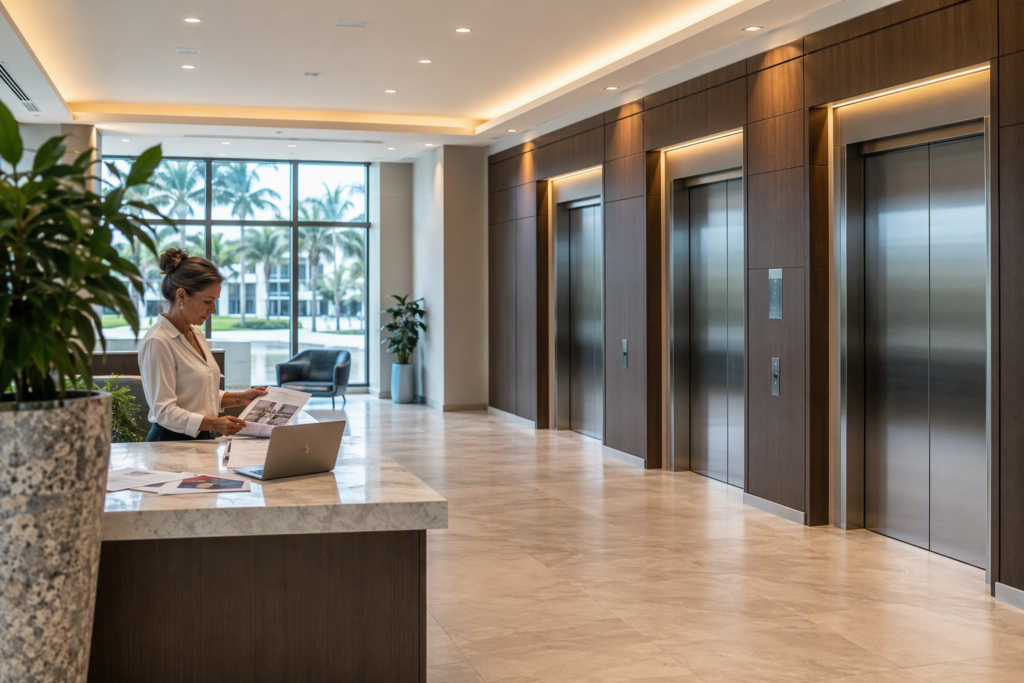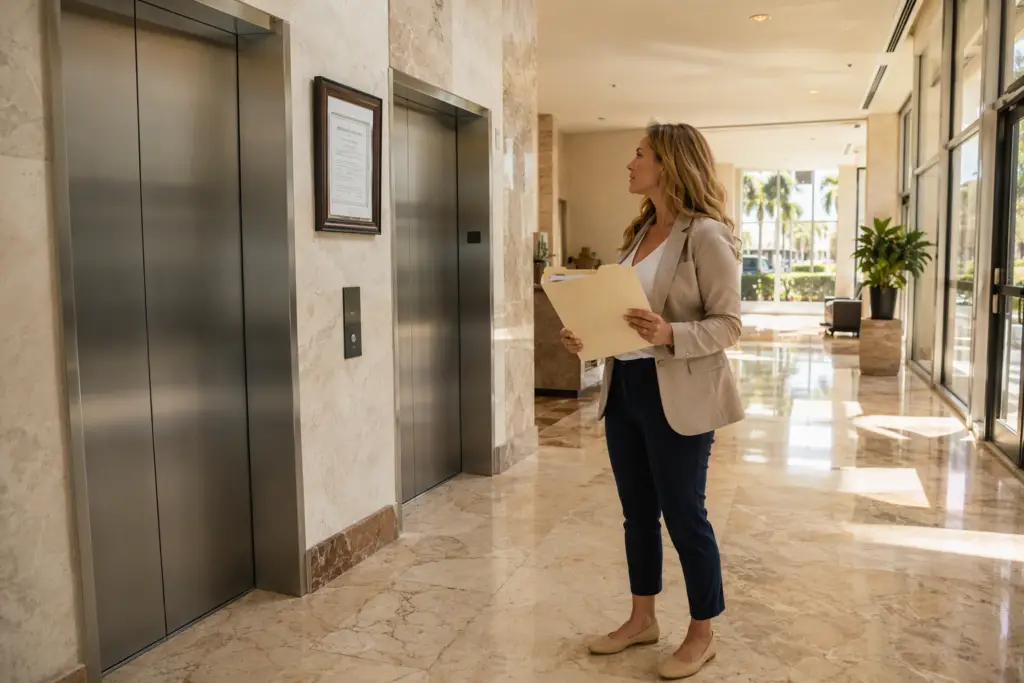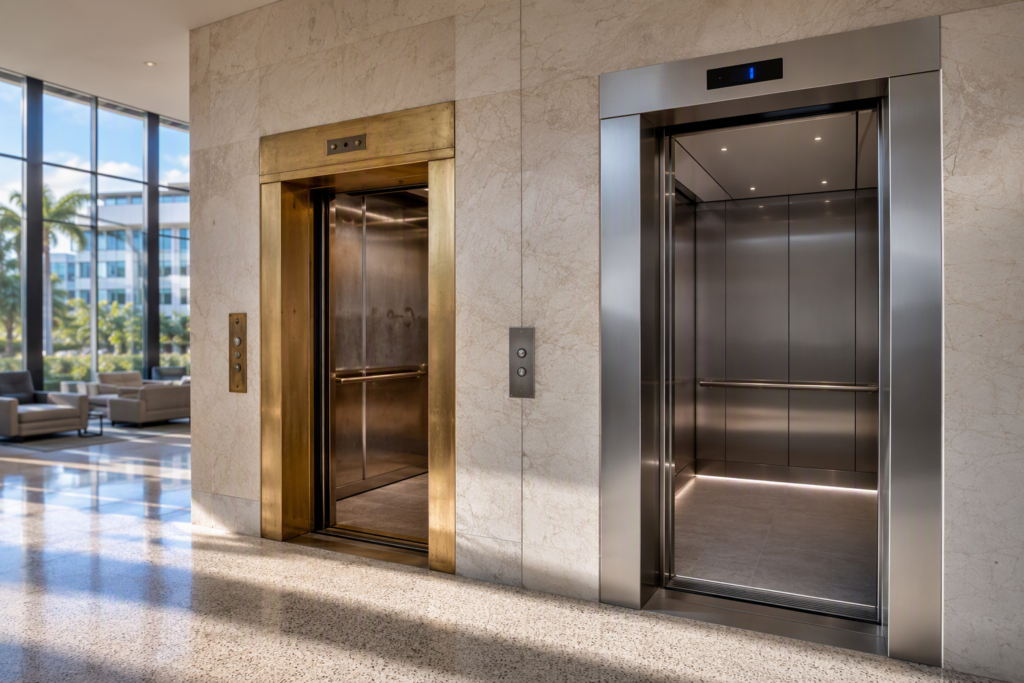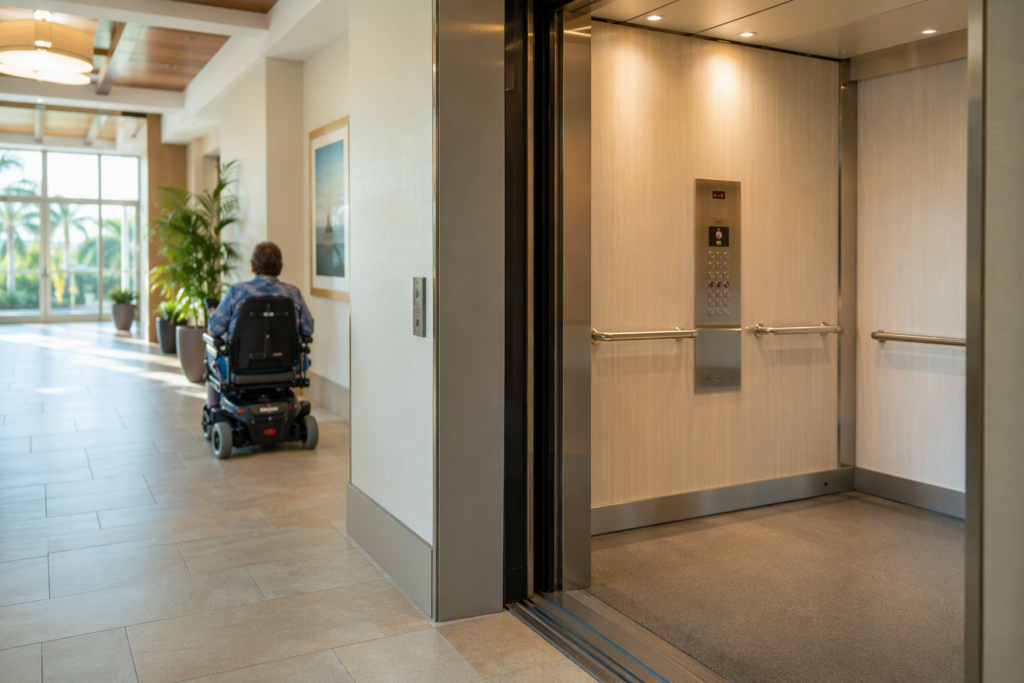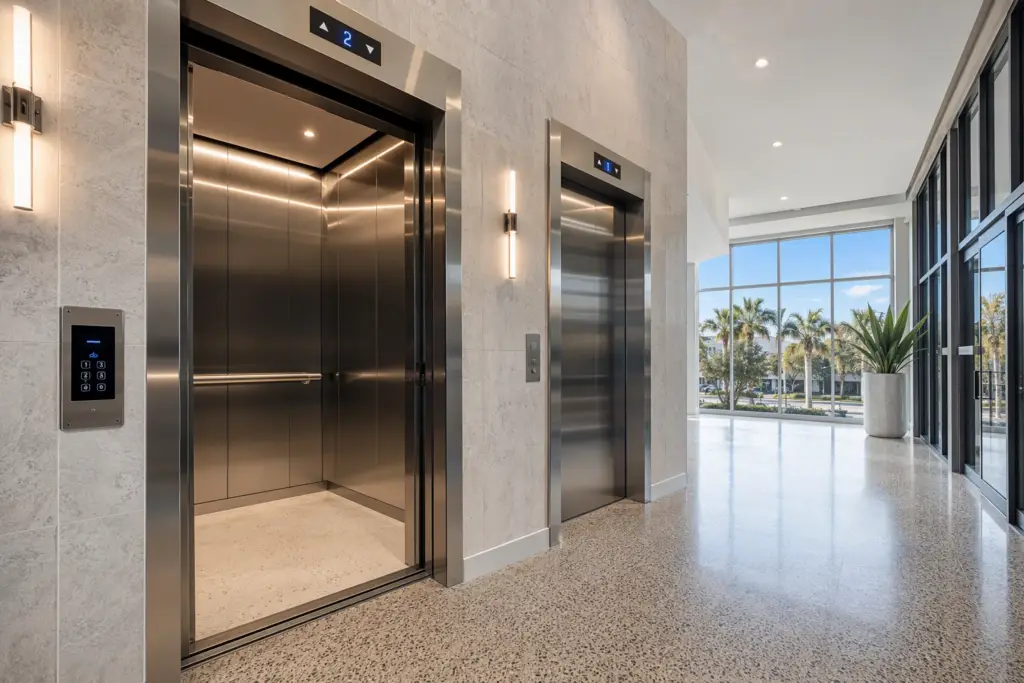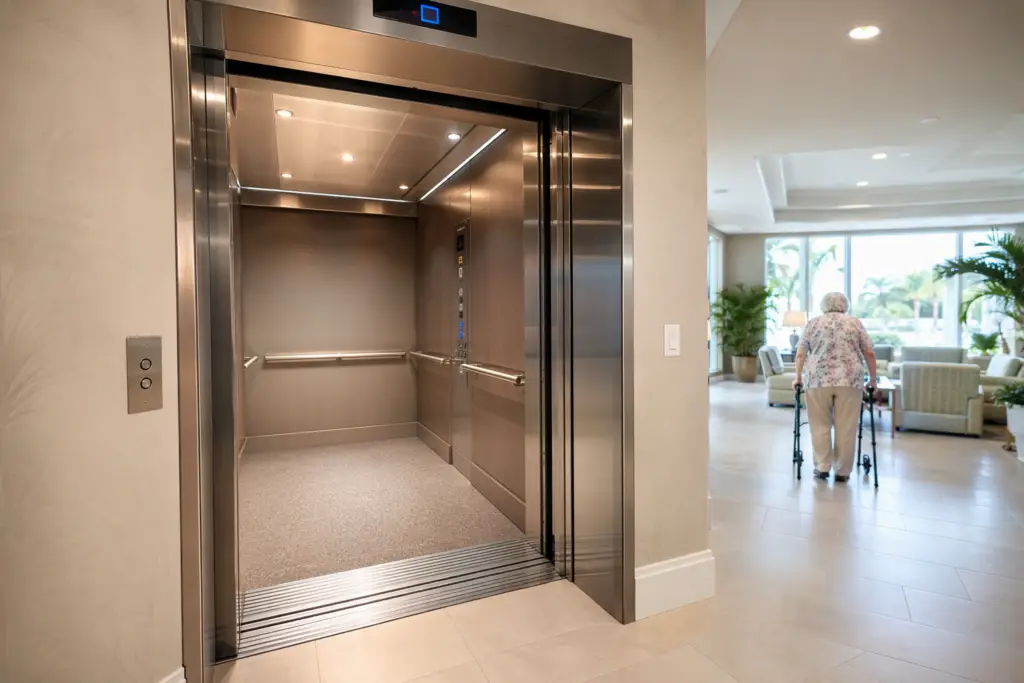
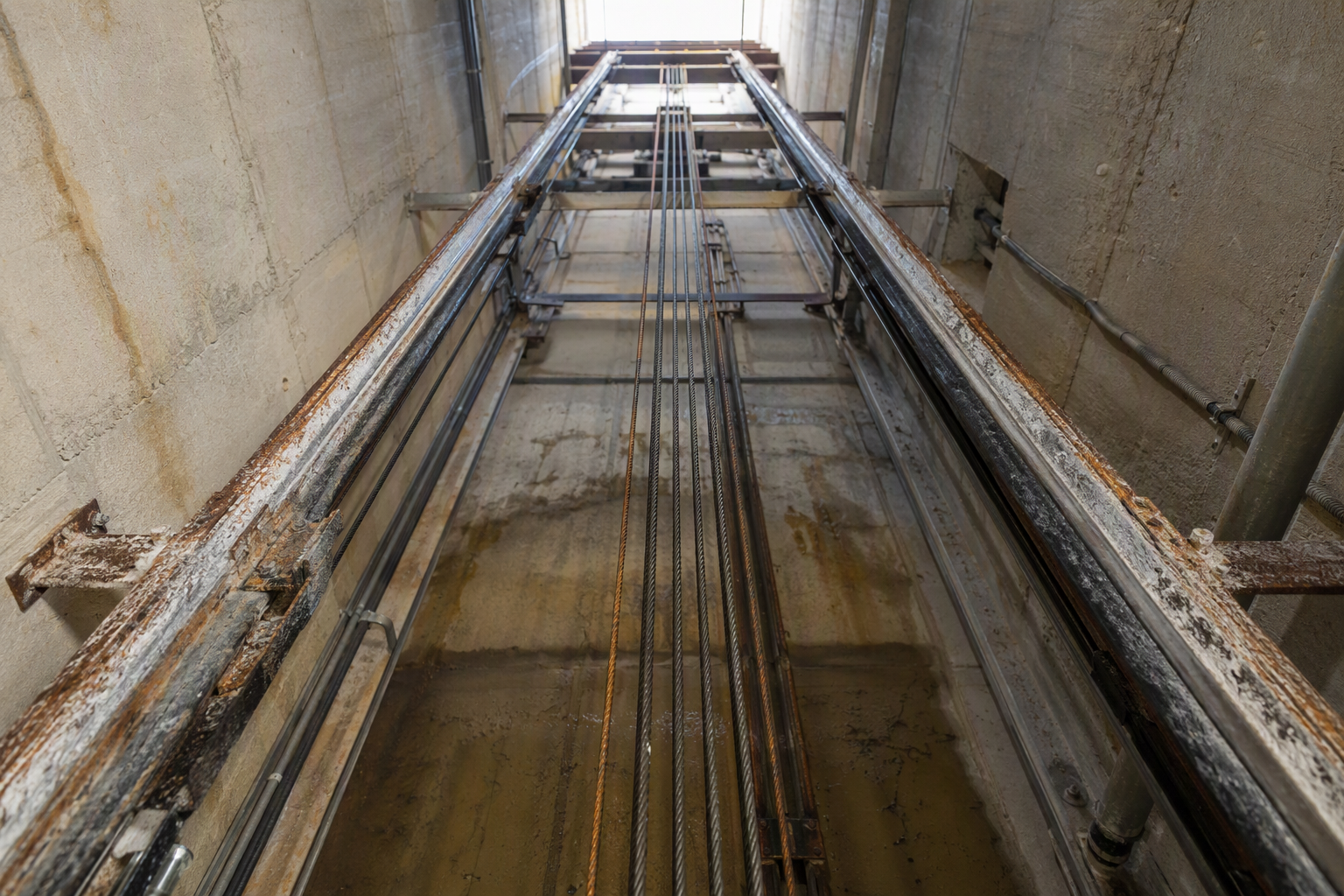
Florida’s coastal communities — including Pompano Beach on the Atlantic and Sarasota on the Gulf — present elevator owners and property managers with a maintenance environment unlike almost anywhere else in the country. Salt air, sustained high humidity, tropical storms, and intense heat cycles combine to degrade elevator components at an accelerated rate. Understanding which components fail first, what inspections are required, and how to stay compliant with Florida’s elevator regulatory framework is essential for every coastal building owner in 2026.
—
Why Does Florida’s Coastal Climate Create Unique Elevator Challenges?
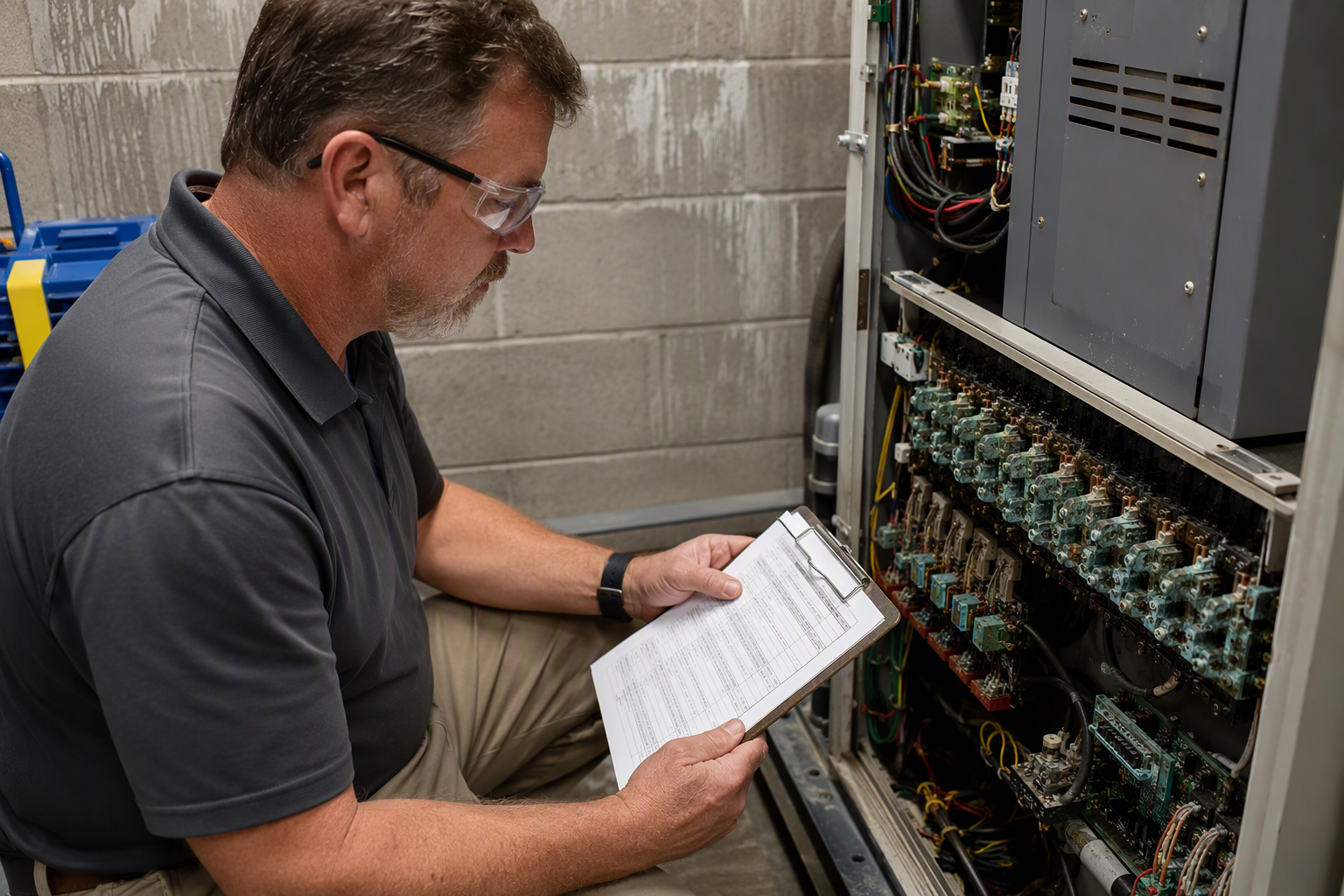
Salt air carries microscopic chloride particles that settle on exposed metal surfaces inside elevator shafts, machine rooms, and pit areas. Combined with Florida’s persistent humidity, these particles catalyze electrochemical corrosion at rates that can far outpace what the same equipment would experience in a dry, inland environment. Heat cycling — the daily expansion and contraction of metal components in Florida’s subtropical climate — further stresses seals, gaskets, and wiring insulation. Tropical weather events can drive moisture directly into shafts and machine rooms, compounding damage.
Buildings in Pompano Beach (Broward County) and Sarasota face different sub-climates: the Atlantic-facing exposure in Pompano Beach produces a direct salt-spray environment, while Sarasota’s Gulf-side location combines salt air with high seasonal humidity. Both scenarios demand elevated vigilance from building owners and their elevator service providers.
—
What Are the Most Common Elevator Maintenance Issues in Florida Coastal Buildings?
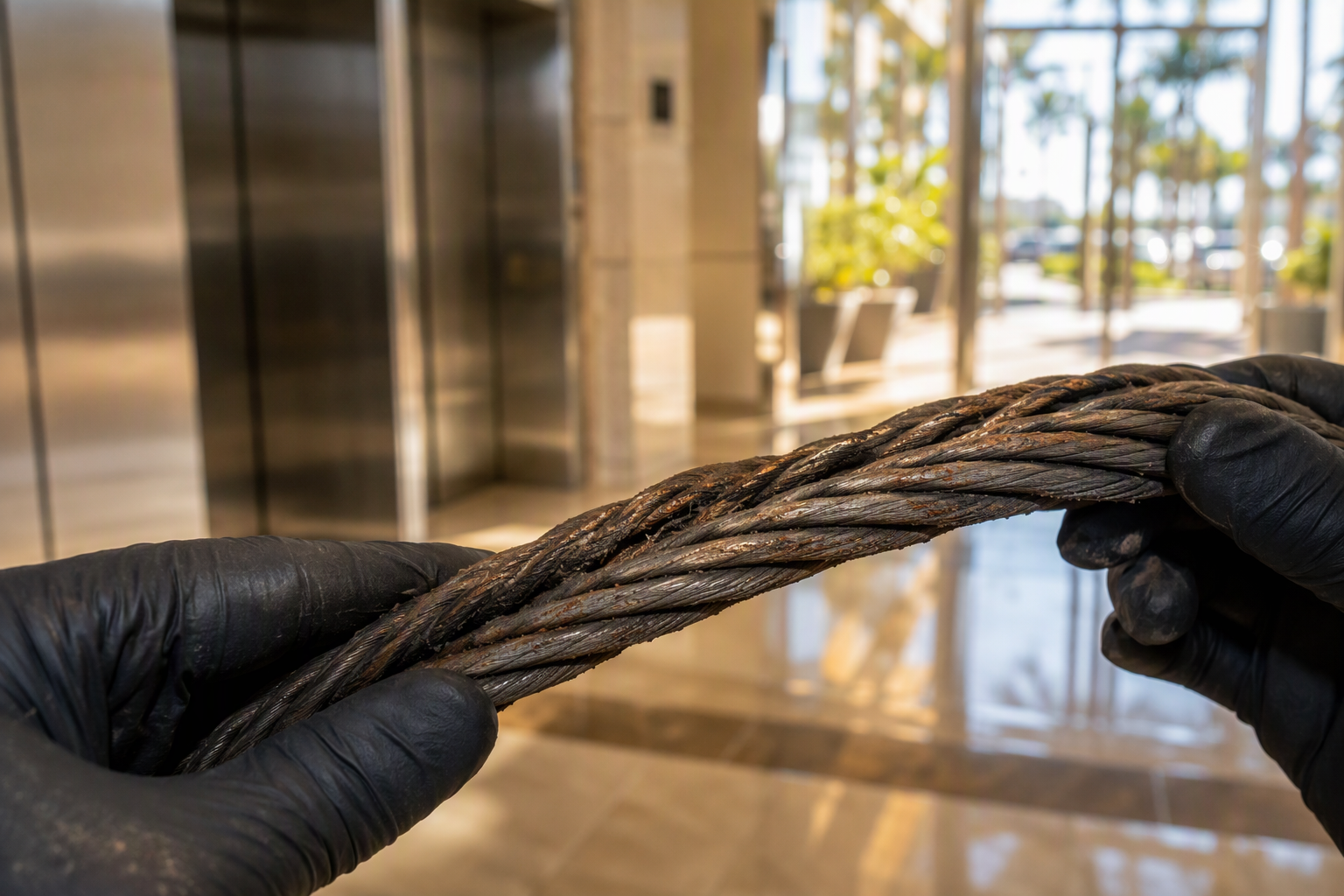
The following components are documented in elevator industry technical literature as the most vulnerable to coastal climate degradation. Owners in Pompano Beach and Sarasota should prioritize these areas during every scheduled maintenance visit and annual inspection cycle.
1. Wire Rope and Hoist Cables
Elevator wire ropes in coastal environments are subject to accelerated corrosion on both exterior strands and interior core fibers. Salt deposits wick lubricant away from wire rope, increasing friction and the rate of strand fatigue. Discoloration, pitting, and kinking are warning signs that require immediate evaluation against the retirement criteria in the ASME A17.1/CSA B44 Safety Code for Elevators and Escalators (2019 edition, adopted in Florida effective December 31, 2023).
2. Guide Rails and Rail Fasteners
Steel guide rails and their mounting brackets corrode when exposed to humid, salt-laden air in elevator shafts. Surface rust reduces lubrication effectiveness and can cause rough, vibrating rides — an early signal of deterioration. Rail alignment can also shift when fasteners corrode and loosen.
3. Door Operators, Tracks, and Sills
Door operators contain electric motors, encoders, and gearsets that are highly sensitive to moisture intrusion. Salt deposits on door tracks and sills increase friction, causing premature wear on rollers and gibs. Corroded or swollen sill grooves are a leading cause of door-related entrapments and nuisance service calls in coastal high-rises.
4. Electrical Panels, Controllers, and Wiring
Circuit boards, terminal strips, and wiring insulation in machine rooms and control cabinets degrade when exposed to humid air. Salt particulate can bridge circuit board traces, causing intermittent faults or controller failures. Machine rooms in coastal buildings should be climate-controlled and sealed to the extent practicable.
5. Hydraulic Systems (Cylinders, Valves, and Fluid)
Hydraulic elevator cylinders — especially older in-ground units — are vulnerable to external corrosion in Florida’s wet soil conditions, which are worsened by coastal water table proximity. Hydraulic fluid can absorb moisture over time, reducing viscosity consistency and accelerating internal corrosion of valve bodies and cylinders. The ASME A17.1-2019 code includes requirements for single-bottom hydraulic cylinders that building owners and service companies must address.
6. Pit Equipment: Buffers, Governors, and Drainage
Elevator pits in coastal Florida buildings are prone to water intrusion from groundwater, storm events, and humidity condensation. Standing water corrodes pit buffers, governor tension sheaves, compensation chains, and limit switches. Pit sump pumps and waterproofing measures are not optional — they are a functional necessity in this environment.
7. Overhead Machine Room Equipment
Gearboxes, sheaves, brakes, and drive units in overhead machine rooms experience accelerated bearing wear when airborne salt particulate contaminates lubricating grease. Regular lubrication replacement schedules — rather than simple top-off — are advisable in coastal settings.
—
Comparison Table: Coastal vs. Inland Elevator Maintenance Needs in Florida
| Component | Standard Inland Maintenance Focus | Coastal Florida Additional Focus | Risk if Neglected |
|---|---|---|---|
| Wire Rope / Cables | Lubrication, visual inspection | Corrosion assessment, accelerated replacement cycle | Cable failure, entrapment, safety code violation |
| Guide Rails | Alignment check, lubrication | Rust removal, fastener torque checks, coating inspection | Rough ride, rail misalignment, component damage |
| Door Systems | Adjustment, roller/gib inspection | Track cleaning, sill corrosion treatment, motor seal inspection | Entrapment, nuisance outages, ADA compliance risk |
| Electrical / Controls | Functional test, wiring check | Circuit board cleaning, moisture barrier integrity, enclosure sealing | Controller failure, intermittent faults, shutdown |
| Hydraulic System | Fluid level, leak inspection | Fluid moisture testing, cylinder corrosion assessment, valve body inspection | Cylinder failure, environmental contamination, code deficiency |
| Pit Equipment | Buffer inspection, cleanliness | Water intrusion monitoring, sump pump test, corrosion treatment | Equipment damage, inspection failure, safety hazard |
| Machine Room Equipment | Lubrication, brake adjustment | Grease replacement (not just top-off), bearing inspection, humidity control | Bearing seizure, brake degradation, unplanned downtime |
—
What Does Florida Law Require for Elevator Inspections in Coastal Buildings?
Under Chapter 399, Florida Statutes (Elevator Safety Act), and the implementing rules in Chapter 61C-5, Florida Administrative Code, every elevator covered by the statute must be inspected annually by a certified elevator inspector. Florida certificates of operation are valid for no more than two years, and an elevator operating on an expired certificate is in violation of state law. The certificate of operation must be posted in a conspicuous location inside the elevator in a frame with a transparent cover.
Once a certificate of operation is issued, the elevator owner bears responsibility for safe operation, proper maintenance, inspection, and correction of any code deficiencies. This responsibility is amplified in coastal environments, where accelerated deterioration can produce deficiencies between inspection cycles that may not have been present at the prior annual inspection.
In Pompano Beach specifically, the Broward County Building Code Division enforces Florida’s elevator law through its own certified elevator inspectors, operating under the authority of Chapter 399. Building owners in Pompano Beach should coordinate with both DBPR and the Broward County enforcement channel when addressing compliance issues.
In Sarasota, DBPR’s Bureau of Elevator Safety retains direct inspection authority. Building owners there should verify the inspection and certificate status of each conveyance annually and maintain records accordingly.
—
Comparison Table: Inspection Compliance Pathways in Florida Coastal Markets
| Factor | Pompano Beach (Broward County) | Sarasota |
|---|---|---|
| Primary Enforcement Authority | Broward County Building Code Division (Chapter 399 delegated) | DBPR Bureau of Elevator Safety |
| Inspection Frequency | Annual (certified elevator inspector required) | Annual (certified elevator inspector required) |
| Certificate of Operation Validity | Up to 2 years (must maintain satisfactory inspections) | Up to 2 years (must maintain satisfactory inspections) |
| Adopted Code (2026) | ASME A17.1-2019 (effective December 31, 2023) | ASME A17.1-2019 (effective December 31, 2023) |
| Certificate Posting Requirement | Conspicuous location, transparent-cover frame | Conspicuous location, transparent-cover frame |
| Accident Reporting | Within 5 working days to state | Within 5 working days to state |
| Coastal Risk Level | High — Atlantic-facing salt spray exposure | High — Gulf-side humidity and salt air exposure |
—
What Should Building Owners Do Immediately If They Suspect Corrosion Damage?
- Remove the elevator from service if a visual inspection reveals exposed wire strands, severely corroded guide rails, door system failure, or water in the pit at a level that compromises electrical or mechanical components.
- Contact a Florida-registered elevator company to conduct a detailed inspection — all maintenance and repair work in Florida must be performed by a company registered with DBPR and staffed by certified elevator technicians holding a valid Florida elevator certificate of competency.
- Document all observed conditions with photographs and written notes, including date and time, for the building’s maintenance log and for submission to the inspector of record.
- Review your certificate of operation to confirm it is current, posted correctly, and has not lapsed. Operating on an expired certificate is a violation of state law under Chapter 399.
- Report any accident involving the elevator to the state within five working days, as required by Chapter 399, Florida Statutes.
- Engage your elevator service provider to assess whether affected components fall under a repair or alteration permit requirement. In Florida, a state permit applied for by a registered elevator company is required before a conveyance is altered.
- Schedule a follow-up inspection by a certified elevator inspector once repairs are completed, before returning the unit to service.
—
How Does the ASME A17.1-2019 Code Apply to Coastal Elevator Maintenance in Florida?
Florida adopted the ASME A17.1/CSA B44, 2019 edition as its governing elevator safety code, effective December 31, 2023. This code establishes minimum design, installation, and maintenance requirements for elevators and escalators, including requirements for wire rope retirement, hydraulic cylinder integrity, safety device testing, and inspection intervals. In a coastal environment, building owners should work with their registered elevator company to understand which ASME A17.1-2019 maintenance provisions apply to each piece of equipment and how the coastal climate may accelerate the timeline to component retirement or replacement.
—
Is a Maintenance Contract Enough to Protect a Coastal Building’s Elevator?
A service maintenance contract is important for Florida compliance purposes — notably, an elevator that serves only two adjacent floors and is covered by a qualifying service maintenance contract may be exempt from the annual inspection requirement under Chapter 399. However, for multi-story coastal buildings, an active maintenance contract does not replace the annual inspection obligation. More critically, a standard maintenance contract written for general Florida conditions may not include the elevated frequency of component checks appropriate for a building within close proximity to the ocean or Gulf of Mexico. Building owners should review their contract scope against the specific coastal risk factors outlined in this guide and request that their provider adjust maintenance frequencies for the most corrosion-vulnerable components.
—
What Are the Pros and Cons of Independent vs. OEM Elevator Service in Coastal Florida?
| Factor | OEM / Brand-Affiliated Service | Independent Florida-Registered Provider (e.g., Axxiom Elevator Florida) |
|---|---|---|
| Parts Sourcing | May require brand-specific parts, potentially longer lead times | Multi-brand parts access; can source best-fit components for coastal conditions |
| Contract Flexibility | Often standardized national contract terms | Contract scope adjustable to coastal building-specific risk profile |
| Local Market Knowledge | Varies; may depend on regional office assignment | Florida-focused; familiar with DBPR, Broward County, and local AHJ processes |
| Regulatory Navigation | Generally experienced with code compliance | Specializes in Florida Chapter 399, ASME A17.1-2019, and local authority requirements |
| Corrosion-Specific Protocols | Standard national maintenance protocols may not be adapted | Can tailor inspection frequency and component focus for salt air / humidity environment |
| Certificate of Operation Management | Managed through contract; may vary by provider | Active tracking of Florida certificate validity and inspection scheduling |
—
How Often Should Coastal Florida Elevators Be Inspected Beyond the State Minimum?
Florida law requires annual inspection by a certified elevator inspector, and certificates of operation are valid for up to two years. In coastal buildings, however, relying solely on the statutory minimum is a risk management concern rather than a best practice. Elevator industry technical guidance consistently supports more frequent interim maintenance checks for equipment in high-corrosion environments. Building owners in Pompano Beach and Sarasota should discuss with their registered elevator service provider whether monthly or quarterly maintenance visits — with specific protocols for salt air and moisture exposure — are appropriate for the equipment inventory in their building.
—
What ADA Accessibility Obligations Apply When Elevators Are Out of Service for Coastal Repairs?
Under the Americans with Disabilities Act (ADA), buildings that are required to provide elevator access must maintain that access for people with disabilities. Extended elevator outages due to corrosion repairs can create ADA compliance exposure for building owners, particularly in multi-story commercial or public accommodation buildings where the elevator is the only accessible vertical means of travel. When scheduling major corrosion-related repairs, property managers should consult with their legal counsel regarding interim accessibility measures and communicate proactively with tenants and visitors.
—
What Role Does OSHA Play in Elevator Machine Room Safety in Florida Coastal Buildings?
The Occupational Safety and Health Administration (OSHA) standards apply to the working conditions of elevator technicians and building maintenance staff who access machine rooms, pits, and shafts. In coastal Florida buildings where corrosion, water intrusion, and humidity create elevated hazards in these spaces, building owners have a general duty obligation to maintain safe working environments. This includes ensuring adequate drainage in pits, preventing electrical hazards from moisture infiltration, and providing conditions that allow certified elevator technicians to perform work safely.
—
How Should Building Owners Evaluate an Elevator Service Provider for Coastal Conditions?
When selecting or evaluating an elevator service provider for a coastal Florida building, owners should verify the following:
- The company is registered with the Florida DBPR as a registered elevator company and maintains current general liability insurance, as required by Chapter 399.
- All technicians performing work hold a valid Florida elevator certificate of competency, renewed annually with proof of eight hours of continuing education.
- The company has documented maintenance protocols specific to high-humidity and salt air environments — not simply a standard national maintenance checklist.
- The company is familiar with the local authority having jurisdiction (AHJ): Broward County Building Code Division for Pompano Beach buildings, or DBPR directly for Sarasota.
- The company can assist with permit applications for alterations, since a state permit is required before any conveyance is altered in Florida.
Axxiom Elevator Florida is an independent, Florida-based elevator service provider that works with building owners in coastal markets including Pompano Beach and Sarasota. Operating under Florida’s regulatory framework — Chapter 399, Florida Statutes, ASME A17.1-2019, and the applicable local AHJ requirements — Axxiom Elevator Florida provides maintenance, inspection coordination, and repair services tailored to the demands of Florida’s coastal environment. As an independent provider, Axxiom Elevator Florida is not limited to a single equipment brand, which allows for more flexible parts sourcing and maintenance approaches suited to each building’s unique coastal exposure profile.
—
Summary: Key Takeaways for Coastal Florida Elevator Owners
| Priority | Action Item | Regulatory Anchor |
|---|---|---|
| 1 | Confirm certificate of operation is current and posted correctly | Chapter 399, Florida Statutes |
| 2 | Schedule annual inspection with a certified elevator inspector | Chapter 399, Florida Statutes; ASME A17.1-2019 |
| 3 | Implement coastal-specific maintenance protocols for wire rope, rails, doors, controls, hydraulics, and pit equipment | ASME A17.1-2019; owner responsibility under Chapter 399 |
| 4 | Ensure service provider is DBPR-registered with insured, certified technicians | Chapter 399, Florida Statutes |
| 5 | Obtain state permit before any alteration | Chapter 399, Florida Statutes |
| 6 | Report any accident to the state within 5 working days | Chapter 399, Florida Statutes |
| 7 | Review ADA accessibility obligations before scheduling extended outages | Americans with Disabilities Act |
—
Ready to Protect Your Coastal Florida Elevator Investment?
Salt air, humidity, and Florida’s regulatory requirements make elevator maintenance in Pompano Beach and Sarasota a specialized discipline. Don’t wait for a failed inspection or a corroded component to disrupt your building operations or put your certificate of operation at risk.
Contact Axxiom Elevator Florida for a free elevator assessment. Our team works with building owners across Florida’s coastal markets to identify corrosion risks, verify compliance with Chapter 399 and ASME A17.1-2019, and develop maintenance plans suited to your building’s coastal environment.
Call us today: 954-970-0020
Need elevator service you can rely on? Axxiom Elevator Florida is ready to help.