Elevator Modernization vs. Repair: How to Know Which Your Elevator Needs and Which Costs Less
Deciding between elevator modernization and repair is one of the most consequential—and often misunderstood—maintenance decisions a building owner or facility manager will face. The right choice depends on the age of the equipment, the frequency and cost of past repairs, current compliance status, and the long-term goals of the building. This FAQ hub covers every dimension of that decision, from technical criteria and Florida-specific regulatory requirements to cost benchmarks, timelines, and vendor selection guidance.
What is the difference between elevator repair and elevator modernization?
Repair restores a specific failing component to working condition, while modernization replaces major systems or the entire elevator with updated technology to extend useful life, improve performance, and meet current safety codes.
A repair might mean replacing a worn door operator, a burned-out motor contactor, or a faulty safety switch. Modernization—sometimes called a “mod”—typically involves replacing the controller, machine, hydraulic power unit, cab interior, and/or drive system as a coordinated package. The distinction matters because repairs address symptoms, whereas modernization addresses the root cause: aging infrastructure that has reached or exceeded its intended service life.
Florida building owners often encounter situations that fall in a gray zone—repeated repairs on a 25-year-old hydraulic unit, for example. In those cases, a structured assessment is required to determine whether continued repair spending is economically justified or whether modernization will pay for itself over a defined horizon.
How old does an elevator have to be before modernization makes more sense than repair?

As a general industry guideline, elevators older than 20–25 years are strong modernization candidates, particularly when repair frequency is increasing or original parts are becoming obsolete.
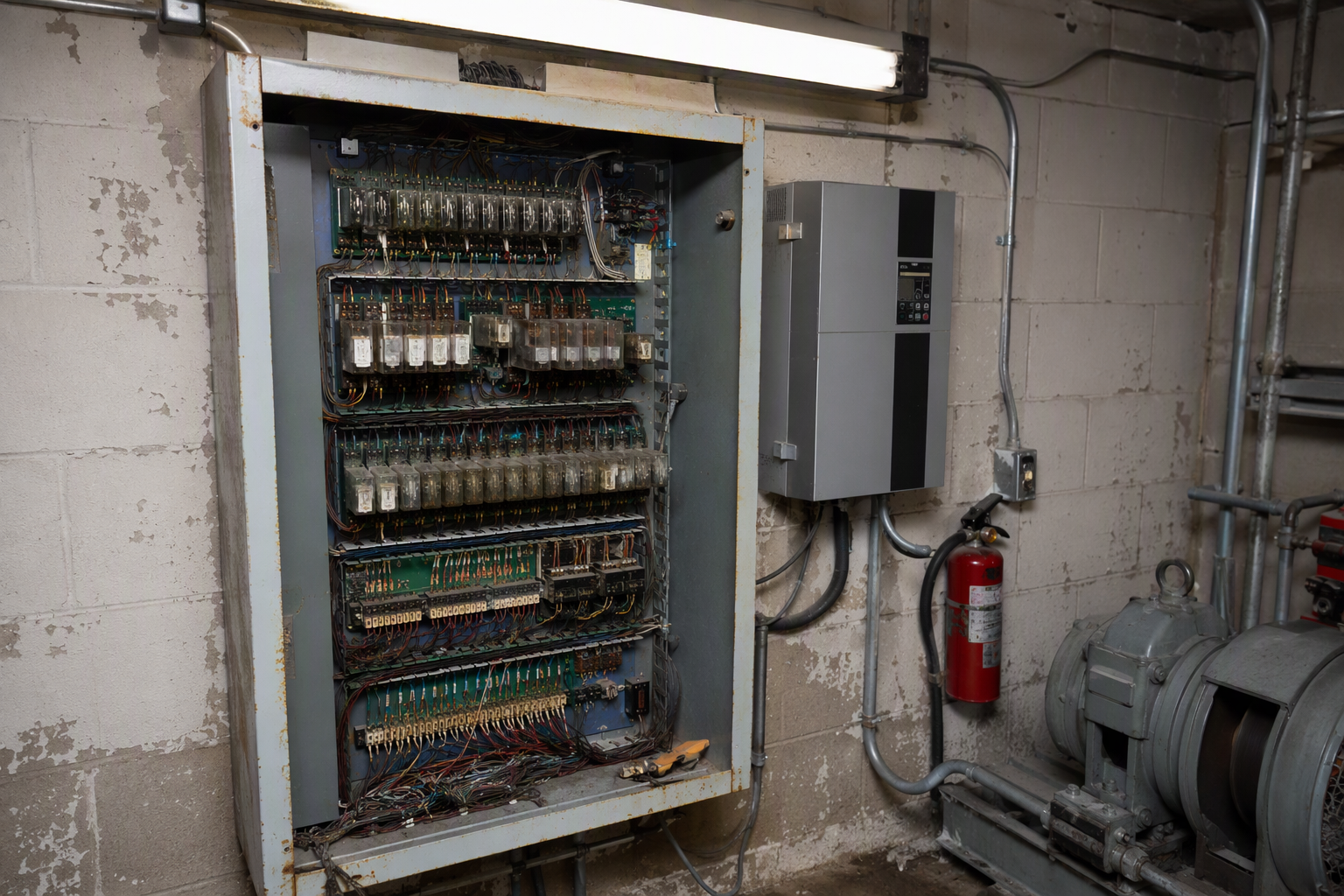
Age alone is not the only criterion, but it is a useful starting point. Older relay-logic controllers, for instance, are no longer manufactured by most original equipment manufacturers. When those boards fail, finding replacement parts requires specialty sourcing, which drives up both cost and downtime. Hydraulic units installed before environmental regulations on underground tanks were tightened may also require soil testing and tank remediation as part of any major repair—costs that can make modernization the more prudent option.
In Florida’s climate, humidity and salt air in coastal markets such as Pompano Beach accelerate corrosion of mechanical components and electrical systems. This environmental stress can shorten the effective service life of elevator equipment below national averages, making age thresholds that apply in drier or inland climates less reliable here.
What are the warning signs that an elevator needs modernization rather than another repair?
Key indicators include chronic breakdowns, escalating repair invoices over consecutive years, obsolete parts, failed or near-failed annual inspections, and persistent passenger complaints about leveling or door performance.
Building managers should watch for patterns rather than isolated incidents. A single door sensor replacement is a routine repair. Three door sensor replacements in 18 months, combined with a nuisance tripping history and a controller that predates digital diagnostics, tells a different story. Other red flags include:
- Hydraulic fluid leaks that recur despite resealing
- Inconsistent floor leveling causing a trip hazard
- Slow travel speeds relative to the building’s traffic demands
- Cab lighting, fixtures, and flooring that no longer meet the building’s safety or aesthetic standards
- Oil-hydraulic cylinders that may be subject to Florida Department of Business and Professional Regulation (DBPR) requirements for single-bottom cylinders
- Controllers using obsolete relay or solid-state technology with no available spare parts
What Florida regulations and codes govern elevator modernization?
Florida elevator modernizations must comply with the Florida Building Code (Elevator Safety Code provisions), DBPR elevator licensing requirements, and the ASME A17.1 Safety Code for Elevators and Escalators as adopted by the state.
Florida adopts and enforces the ASME A17.1 Safety Code for Elevators and Escalators through its state elevator program, administered by the DBPR Division of Hotels and Restaurants. When a modernization is performed, the scope of work triggers a permit, an inspection by a state-licensed elevator inspector, and a certificate of operation before the elevator may be returned to service. The extent of code upgrades required depends on the scope of the modernization—replacing the controller, for example, typically triggers a review of the entire safety circuit for compliance with the current edition of ASME A17.1.
The Americans with Disabilities Act (ADA) also applies to elevators in public accommodations and commercial facilities. A modernization project is an opportunity—and in some cases an obligation—to address ADA deficiencies such as inadequate cab dimensions, missing or non-compliant Braille signage, and door timing that does not accommodate mobility device users.
Work on elevators in Florida must be performed by a licensed elevator contractor under Florida Statutes Chapter 399. Building owners should verify contractor licensure through the DBPR before engaging any service provider.
How is the cost-effectiveness of modernization versus repair calculated?
Cost-effectiveness is typically calculated by comparing the net present value of continued repair spending against the total installed cost of modernization, factoring in downtime costs, energy savings, and reduced liability exposure.
A useful starting framework is the “repair-versus-replace” threshold: when annual repair spending approaches or exceeds a significant fraction of the estimated modernization cost, and the equipment is past its expected useful life, modernization becomes the financially rational choice. Energy costs are also a material factor—modern variable-frequency drive (VFD) systems and regenerative drives consume meaningfully less energy than older two-speed or hydraulic systems, and in Florida’s high-electricity-cost environment those savings compound over time.
Liability exposure is harder to quantify but real. An elevator that fails inspection or injures a passenger due to a leveling defect creates legal and insurance exposure that dwarfs any repair cost savings. Modernization resets the compliance clock and reduces that exposure.
What does a typical elevator modernization include?
A full modernization typically replaces the controller, drive system, machine or hydraulic power unit, door operators, safety devices, cab interior, and all associated wiring—though partial modernizations targeting specific subsystems are also common.
The scope of any modernization should be driven by the condition assessment, the permit requirements of the authority having jurisdiction (AHJ), and the building owner’s budget and goals. Common modernization packages include:
- Controller modernization: Replacing relay-logic or early solid-state controllers with a modern microprocessor-based controller, improving reliability, diagnostics, and code compliance
- Drive modernization: Upgrading to a variable-frequency drive for traction elevators, improving ride quality and reducing energy consumption
- Hydraulic unit modernization: Replacing the pump, motor, valve, and fluid reservoir on hydraulic elevators, often including an above-ground or enclosed tank to address environmental concerns
- Door operator and landing fixtures: Replacing worn door operators with high-speed, safety-edge-equipped operators and updating hall call and car operating panels
- Cab renovation: Updating cab walls, flooring, lighting, handrails, and emergency communication systems to current standards
How long does an elevator modernization take compared to a repair?
A targeted repair can often be completed in hours to a few days, while a full elevator modernization typically takes several weeks to a few months depending on equipment lead times, permit processing, and inspection scheduling.
Florida’s permit and inspection process through the DBPR adds a timeline dimension that building owners must plan for. Permit applications, plan review, field inspections, and final certification all require lead time. Partial modernizations—such as a controller-only replacement—generally have shorter timelines than full modernizations. Building owners in multi-story residential or commercial properties should plan for an extended period of elevator unavailability and communicate proactively with tenants or occupants.
Equipment lead times are a significant variable in 2026. Supply chain conditions affect the availability of major components such as controllers, VFD drives, and hydraulic power units, and building owners should factor in potential delays when planning project timelines.
What is a partial modernization and when is it appropriate?
A partial modernization replaces one or more major subsystems—most commonly the controller or hydraulic unit—without replacing the entire elevator, and is appropriate when the remaining systems are in sound condition and within their useful service life.
Partial modernizations allow building owners to address the highest-priority failure risk or compliance gap without the full cost of a comprehensive project. A common scenario in Florida is replacing a single-bottom hydraulic cylinder that poses an environmental or safety concern while retaining a relatively newer cab and door operator. However, partial modernizations must be designed carefully: replacing the controller alone may trigger ASME A17.1 requirements that apply to the entire safety circuit, meaning the savings from leaving other systems in place may be partially offset by required ancillary upgrades.
Axxiom Elevator Florida performs condition assessments that help building owners in Pompano Beach and Sarasota understand exactly which subsystems are driving risk and repair cost, enabling targeted modernization decisions rather than blanket replacements.
How do I evaluate competing modernization proposals from elevator contractors?
Evaluate proposals based on the scope of equipment being replaced, the brand and quality of components specified, the contractor’s Florida licensure, warranty terms, and the total cost of ownership rather than upfront price alone.
Not all modernization proposals are equivalent. A low-bid proposal may specify lower-grade components, omit required code upgrades, or understate the scope of work needed to obtain a certificate of operation. Key questions to ask any contractor include:
- What specific components are being replaced, and what brands are specified?
- Does the proposal include all permit fees, inspection fees, and any code-mandated upgrades triggered by the scope?
- What is the warranty on parts and labor, and who performs warranty service?
- Is the contractor licensed under Florida Statutes Chapter 399?
- What is the projected timeline from contract execution to certificate of operation?
Building owners should request an itemized scope of work and compare proposals on a line-by-line basis rather than by total price alone.
What are the ADA compliance considerations in an elevator modernization?
The ADA requires that elevators in public accommodations and commercial facilities meet accessibility standards, and a modernization project is an opportunity to remediate non-compliant features that may otherwise create legal exposure.
Common ADA deficiencies found in older Florida elevators include cab dimensions that are too small for wheelchair users, door reopening devices that do not include a door edge or safety shoe, control button heights that fall outside accessible reach ranges, and missing or incorrect Braille signage on hall call buttons and cab controls. The ADA Standards for Accessible Design set specific dimensional and operational requirements for each of these elements.
While a modernization project does not automatically require ADA remediation of every feature, building owners who are making a significant investment in their elevator systems are well advised to address known ADA deficiencies simultaneously to avoid a second mobilization cost and to reduce civil rights liability exposure.
What energy savings can a modernized elevator deliver?
Modern variable-frequency drives, LED cab lighting, and energy-efficient hydraulic power units can substantially reduce an elevator’s electricity consumption compared to older equipment, though the exact savings depend on building usage patterns and the equipment being replaced.
In Florida’s commercial electricity market, energy costs are a material operating expense. Older two-speed AC motor systems and older hydraulic power units run their motors at full current during every start cycle, regardless of load. Modern VFD traction systems modulate power delivery to match the actual demand, reducing peak draw. Some modern traction systems also include regenerative drives that return energy to the building’s electrical grid during descent with a loaded car or ascent with an empty car.
Building owners should request energy consumption estimates from the contractor as part of the modernization proposal and, where appropriate, verify those estimates against utility rate schedules to develop a payback analysis.
How does Florida’s climate affect elevator maintenance and modernization decisions?
Florida’s high humidity, salt air in coastal markets, and frequent lightning activity accelerate corrosion, component degradation, and control system failures, which can compress the effective service life of elevator equipment and strengthen the case for earlier modernization.
In markets like Pompano Beach, proximity to the ocean means that salt air infiltrates machine rooms and elevator pits, corroding steel components, electrical connectors, and hydraulic fittings at a faster rate than in inland locations. Building owners who conduct annual pit inspections often discover corrosion that would not be apparent from a cab-level assessment. Florida’s lightning season also poses a recurring threat to elevator controllers and solid-state components; surge protection and grounding systems that may have been adequate at installation can degrade over time, and a modernization project should include an assessment of electrical protection.
Axxiom Elevator Florida’s service teams operate in both Pompano Beach and Sarasota and understand the specific environmental challenges of Florida’s coastal and Gulf Coast markets.
What should building owners do immediately if their elevator fails inspection?
If an elevator fails a Florida DBPR inspection, the following steps should be taken in order:
- Remove the elevator from service immediately. Operating an elevator after a failed inspection can create significant liability and regulatory penalties under Florida law.
- Secure the elevator by placing it out of service at a floor landing with doors open or locked out of service, as appropriate for the failure mode, to prevent unauthorized use.
- Review the inspection report to identify all cited deficiencies and their code bases, noting whether any items are classified as immediately dangerous (Class I) or require correction within a defined period.
- Contact a licensed Florida elevator contractor to perform a technical review of the deficiencies and provide a corrective action plan.
- Obtain the required permits for any corrective work that the AHJ or DBPR classifies as alteration or repair work requiring a permit.
- Complete corrective work under the supervision of licensed elevator mechanics and in accordance with ASME A17.1 requirements.
- Schedule a re-inspection with the DBPR or the AHJ to obtain clearance to return the elevator to service.
- Retain all documentation—inspection reports, work orders, permits, and re-inspection results—in the building’s elevator maintenance file for compliance audit purposes.
How do modernization costs compare to cumulative repair costs over time?
When repair spending over a multi-year window is totaled alongside downtime costs and compliance risk, modernization frequently delivers a lower total cost over a 10–15 year horizon for elevators that are significantly past their expected useful life.
The following table provides a framework for comparing the two approaches across key evaluation criteria. Note that actual costs vary by building type, elevator configuration, and market conditions, and building owners should obtain site-specific proposals for any financial analysis.
| Evaluation Criterion | Continued Repair Strategy | Modernization Strategy |
|---|---|---|
| Upfront cost | Lower per incident | Higher single investment |
| Parts availability (20+ year equipment) | Declining; specialty sourcing required | Current production parts; widely available |
| Downtime frequency | Increasing as equipment ages | Significantly reduced post-modernization |
| Code compliance status | May require ancillary upgrades with each repair | Reset to current code edition |
| ADA compliance | Deficiencies persist unless separately addressed | Opportunity to remediate all deficiencies |
| Energy consumption | Unchanged; older system inefficiencies continue | Reduced with modern drive and lighting systems |
| Warranty coverage | Per-repair; typically 90 days to 1 year per component | Comprehensive; typically covers all replaced systems |
| Liability and inspection risk | Elevated for aging, frequently repaired equipment | Reduced; modern equipment meets current standards |
| Useful life added | Minimal; extends the life of individual components | Substantial; typically adds 20–25 years of service life |
| Environmental risk (hydraulic) | Ongoing risk from aging cylinders and fluid systems | Addressed through updated, compliant components |
Can a building owner get a condition assessment before committing to modernization?
Yes—a professional elevator condition assessment is strongly recommended before committing to any modernization project, as it provides a documented, objective basis for the repair-versus-modernize decision.
A thorough condition assessment evaluates the age and condition of all major subsystems, reviews the elevator’s maintenance and repair history, identifies any open code or ADA deficiencies, and provides a prioritized recommendation with estimated costs for both the repair and modernization paths. This assessment gives building owners the information they need to make a financially defensible decision and to evaluate contractor proposals on an informed basis.
Axxiom Elevator Florida offers free elevator assessments for building owners in Pompano Beach and Sarasota. An assessment from a certified elevator service provider is the most reliable starting point for any significant elevator decision.
What are the most common mistakes building owners make when deciding between repair and modernization?
The most common mistakes are evaluating cost on a per-incident basis rather than cumulatively, deferring the modernization decision until a crisis forces it, and selecting a contractor based on lowest price without verifying scope or licensure.
Per-incident cost analysis is misleading because it does not capture the compounding pattern of aging equipment. A building owner who approves a $4,000 repair without reviewing the prior 36 months of repair history may be making a financially poor decision if that $4,000 is the fourth major repair in that period. Tracking cumulative maintenance and repair expenditure by elevator—not just by invoice—is a practice that pays dividends in decision quality.
Deferred modernization decisions are also common and costly. When a modernization is forced by an emergency breakdown or a failed inspection, the building owner loses negotiating leverage with contractors, may face accelerated permit timelines, and has no opportunity to plan for tenant or occupant impact. Proactive assessment and scheduled modernization is almost always less expensive in total than reactive modernization.
How does the type of elevator—hydraulic versus traction—affect the modernization decision?
Hydraulic and traction elevators have different wear patterns, regulatory triggers, and modernization options, so the decision criteria are not identical for both types.
Hydraulic elevators, which are common in low-rise Florida buildings, have specific regulatory concerns related to the hydraulic cylinder, particularly single-bottom cylinders in non-PVC-lined pits that may pose environmental contamination risks. A hydraulic unit that shows signs of cylinder wear or fluid contamination may trigger regulatory action independent of any inspection cycle. Modern hydraulic units use above-ground or environmentally contained tank configurations and biodegradable fluids that reduce these risks.
Traction elevators in mid- and high-rise Florida buildings face different modernization triggers, typically centered on controller obsolescence, motor and sheave wear, and governor/safety device compliance. Gearless traction machines have longer service lives than geared machines but are not immune to bearing wear and rope degradation. The ASME A17.3 Safety Code for Existing Elevators and Escalators provides the retrofit code framework that applies when modernization work is triggered in existing installations.
What questions should a building owner ask a potential elevator modernization contractor?
Building owners should ask about contractor licensure under Florida law, the specific equipment brands and models being proposed, the permit and inspection process, warranty terms, project timeline, and references from comparable Florida modernization projects.
A qualified Florida elevator contractor should be able to answer all of these questions clearly and in writing. Vague answers about code compliance, warranty coverage, or the permit process are red flags. Building owners should also verify that the contractor maintains liability insurance appropriate for the scope of work and that its elevator mechanics are licensed under the requirements administered by the DBPR.
Asking for references from building owners who have completed similar modernizations in comparable Florida buildings—particularly in the same coastal or climate zone—is a useful way to evaluate contractor performance on projects that face the same environmental and regulatory context.
How does modernization affect a building’s property value and insurance?
A documented modernization can positively affect a building’s marketability, liability insurance premiums, and property appraisal by demonstrating updated, code-compliant vertical transportation infrastructure.
Commercial and multifamily property buyers and lenders increasingly conduct elevator due diligence as part of the transaction process. An elevator with a current certificate of operation, a recent modernization record, and a documented maintenance history is a materially different risk profile than one with an aging, frequently repaired system and open inspection deficiencies. Some property insurance carriers adjust premiums based on elevator condition and inspection status, though building owners should consult directly with their insurance broker to understand the specific impact on their coverage and premium.
How often should a modernized elevator be inspected and maintained?
Florida requires annual inspection of elevators by a licensed elevator inspector under the DBPR program, and a regular preventive maintenance program by a licensed elevator contractor is required to keep the equipment in safe operating condition and to maintain warranty coverage.
The ASME A17.1 Safety Code for Elevators and Escalators establishes inspection and test requirements, including periodic tests such as the five-year full-load safety test for traction elevators. These requirements do not change after modernization—a modernized elevator is subject to the same ongoing inspection and testing obligations as any other elevator in Florida.
Preventive maintenance programs should be tailored to the specific equipment installed, the building’s usage intensity, and the environmental conditions at the site. In Florida’s coastal markets, more frequent inspection of corrosion-prone components is advisable. Axxiom Elevator Florida provides ongoing maintenance services for elevator systems in Pompano Beach and Sarasota, helping building owners maintain their modernized equipment in peak operating condition and in compliance with all applicable Florida and federal requirements.
Need elevator service you can rely on? Axxiom Elevator Florida is ready to help.