How Long Does Elevator Repair Typically Take — And Will My Building Be Without an Elevator During the Work?
Elevator downtime is one of the most disruptive events a building owner or property manager can face. Whether the issue is a minor sensor fault or a major mechanical failure, understanding realistic repair timelines — and planning around them — makes all the difference. This FAQ hub covers everything building owners, HOA boards, and facility managers in Pompano Beach FL and Sarasota FL need to know about elevator repair duration, downtime management, compliance obligations, and how to choose the right service partner.
How Long Does a Typical Elevator Repair Take?
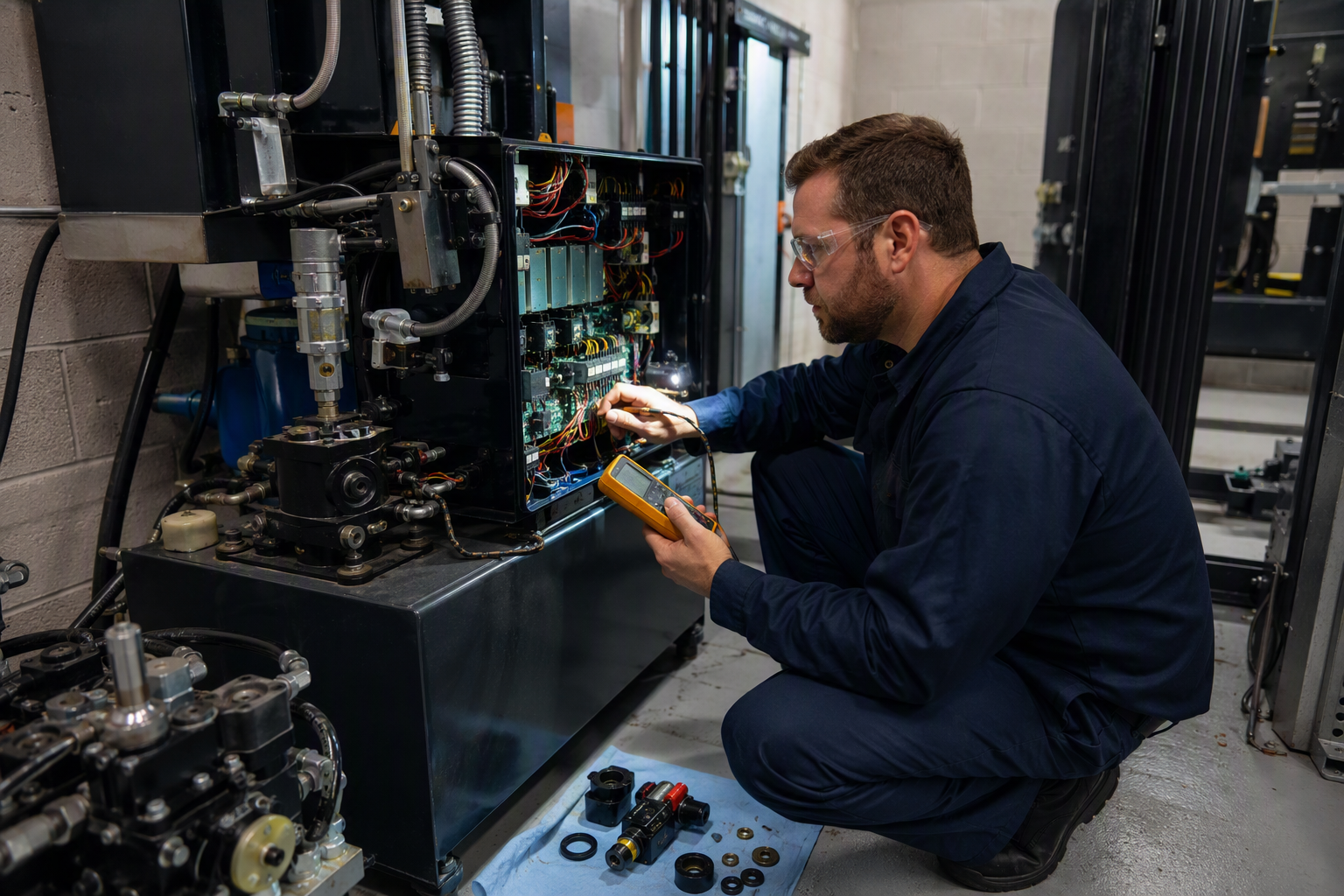
Most elevator repairs fall into one of three tiers: minor fixes resolved in a few hours, mid-range repairs completed in one to three days, and major overhauls that can stretch from one to several weeks.
The actual duration depends on several intersecting variables: the nature of the fault (electrical, mechanical, or hydraulic), the age and model of the equipment, the availability of replacement parts, and whether the work requires a Florida state inspection before the elevator can return to service. A tripped safety circuit or a door sensor misalignment may be corrected the same day. A failed hydraulic cylinder, a burned-out motor, or a full control modernization is an entirely different scope of work.
Parts availability is frequently the biggest timeline driver. Elevators manufactured more than 20 years ago may require sourced or fabricated components that are no longer stocked domestically, which can add days or weeks to an otherwise straightforward repair. Engaging a service provider — such as Axxiom Elevator Florida — that maintains regional parts inventory and has established supplier relationships can meaningfully compress that window.
Will My Building Be Without an Elevator While Repairs Are Underway?
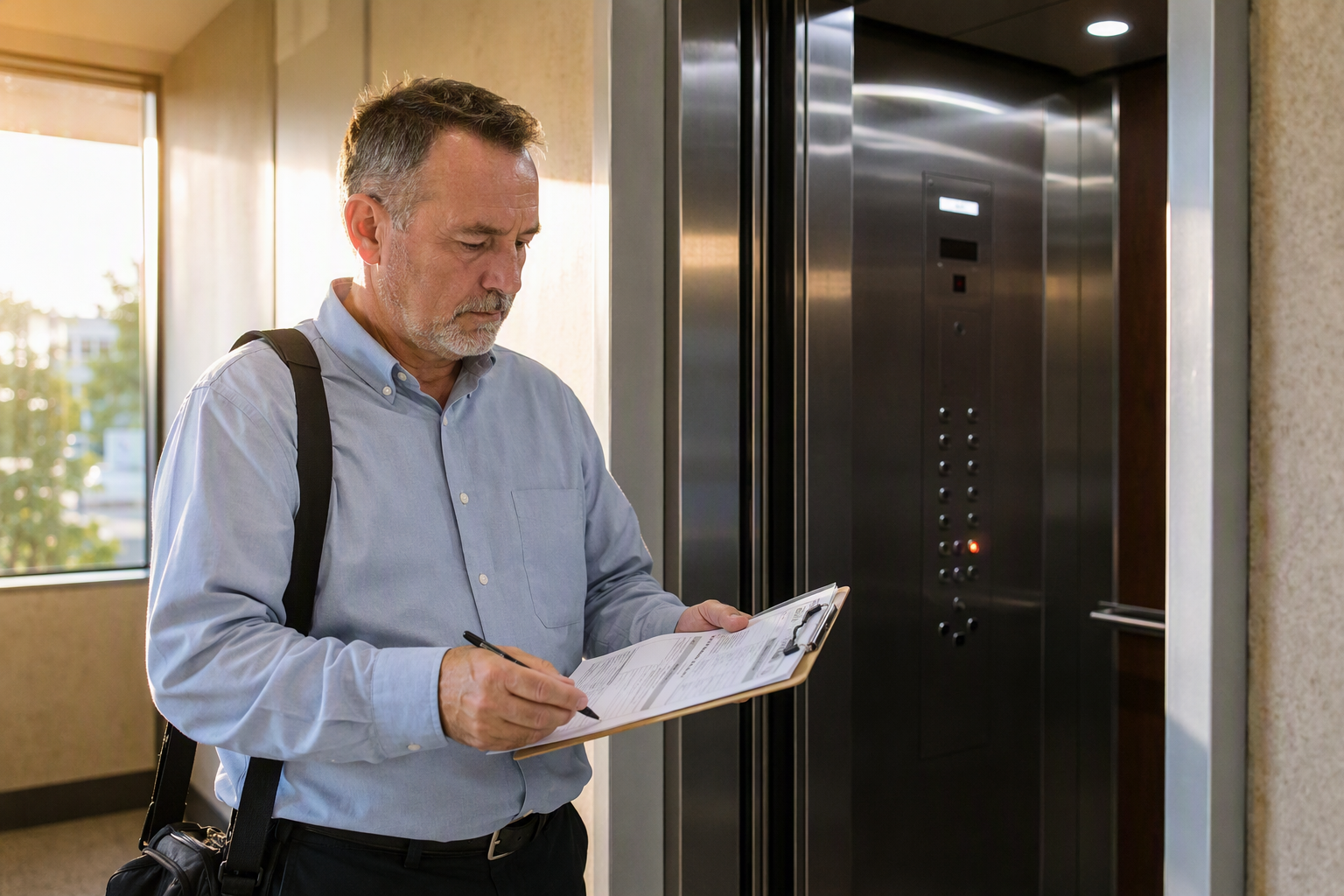
In virtually all cases, the elevator must be taken out of service during active repair work, because operating a compromised elevator is both a safety violation and a liability exposure.
Under the ASME A17.1 Safety Code for Elevators and Escalators, elevators with known safety-related defects must be removed from service until the defect is corrected and, where required, re-inspected by an authorized inspector. Florida enforces this requirement through the Florida Department of Business and Professional Regulation (DBPR), which oversees elevator safety statewide. Operating an elevator with an outstanding safety deficiency can result in fines, forced shutdown, and civil liability.
That said, planned maintenance and minor corrective work can sometimes be scheduled during off-peak hours — evenings, early mornings, or weekends — to reduce the impact on building occupants. For multi-elevator buildings, a competent service company will sequence the work so that at least one car remains operational at all times whenever code and safety conditions permit. Axxiom Elevator Florida routinely coordinates scheduling with property managers in Pompano Beach FL and Sarasota FL to minimize tenant disruption during repair and maintenance windows.
What Factors Most Affect Elevator Repair Duration?
The single greatest variable in repair duration is parts availability, followed closely by fault complexity, building access logistics, and permit or inspection requirements.
Here is a breakdown of the key factors:
- Fault type: Electrical faults, software errors, and door-related issues are typically faster to resolve than hydraulic or structural mechanical failures.
- Equipment age: Legacy systems manufactured before the widespread adoption of solid-state controls may require obsolete components that must be sourced, reconditioned, or custom-fabricated.
- Parts inventory: Service providers with regional warehouse stock can often begin the repair immediately rather than waiting on shipping lead times.
- Permit and inspection requirements: Certain repair categories in Florida require a permit to be pulled and a third-party or state inspection to be completed before the elevator is returned to service. Inspector scheduling can add days to the total downtime clock.
- Building access and coordination: High-rise buildings, buildings with restricted access hours, or facilities that require tenant notifications may add logistical time before and after the technical work itself.
- Scope creep: Diagnostics sometimes reveal secondary issues that were not visible before disassembly — a common occurrence in aging hydraulic systems.
What Are the Most Common Types of Elevator Repairs and How Long Do They Take?
Repair durations vary significantly by repair category, and understanding benchmarks helps property managers plan for contingencies.
| Repair Type | Typical Duration | Commonly Requires Inspection? | Elevator Out of Service? |
|---|---|---|---|
| Door sensor / safety edge adjustment | 1–4 hours | No (standard adjustment) | Yes, during work |
| Control board or PCB replacement | 4–8 hours | Sometimes | Yes |
| Hydraulic fluid leak repair | 1–3 days | Yes (in most Florida jurisdictions) | Yes |
| Hydraulic cylinder replacement | 3–10 days | Yes | Yes |
| Hoist cable / rope replacement | 1–3 days | Yes | Yes |
| Motor or drive replacement | 2–5 days | Yes | Yes |
| Full control modernization | 1–4 weeks | Yes | Yes |
| Safety device testing / recalibration | 2–6 hours | Yes (periodic statutory test) | Yes, during testing |
Durations above represent general industry ranges and will vary based on equipment, parts availability, and jurisdictional inspection scheduling. They are not guarantees of project completion time.
Does Florida Law Require an Inspection After Elevator Repairs?
Yes — Florida law requires that certain categories of elevator repair work be permitted and inspected by a licensed elevator inspector before the unit returns to service.
Florida Statutes Chapter 399 governs elevator safety and places regulatory oversight under the DBPR. The law requires that major repairs, alterations, and modernizations be performed under a permit, with a final inspection conducted either by a state elevator inspector or a licensed third-party inspection agency before the elevator is released for public use. Routine maintenance and minor adjustments that do not alter the safety system may not trigger permit requirements, but the line between “repair” and “alteration” is defined in rule and should be confirmed with a licensed elevator contractor.
The underlying technical standard is the ASME A17.1 Safety Code for Elevators and Escalators, which Florida adopts by reference with state-specific amendments. The 2026 code cycle continues to refine requirements around safety device testing intervals, modernization triggers, and inspection documentation.
What Should Building Management Do Immediately When an Elevator Fails?
Prompt, organized action after an elevator failure protects building occupants, limits liability, and helps the service technician diagnose the problem faster.
- Ensure all occupants are safe. Confirm no one is trapped inside the car. If a passenger is trapped, contact emergency services immediately — do not attempt to manually extract occupants without trained personnel.
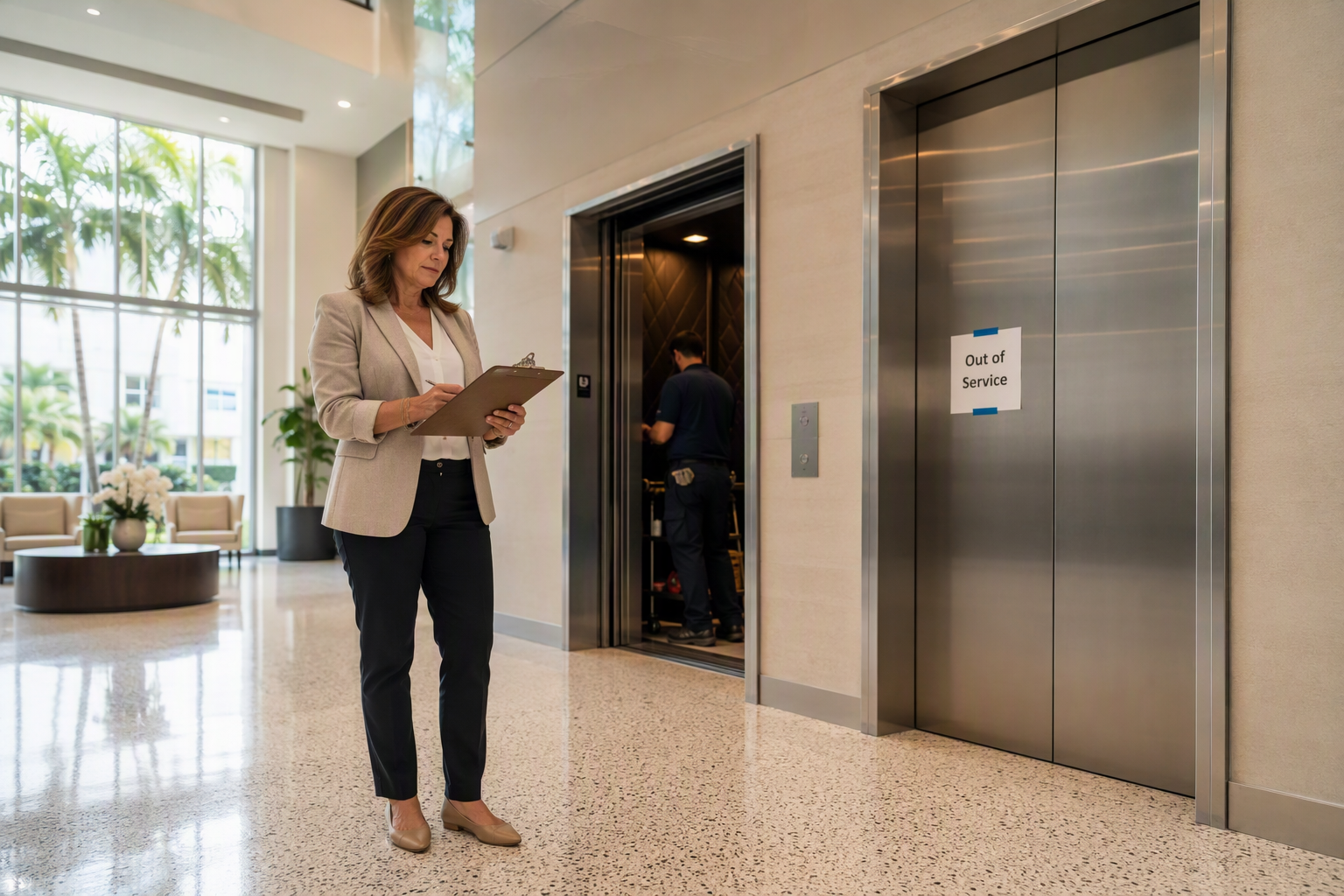
- Post “Out of Service” signage on all landing doors of the affected elevator to prevent unauthorized use attempts.
- Document the failure. Note the date, time, any error codes displayed on the hall or car operating panel, and a description of what the elevator was doing before the failure (unusual sounds, erratic leveling, etc.).
- Contact your licensed elevator service provider. Provide the model, serial number, and floor location of the unit along with your documentation. Axxiom Elevator Florida serves properties throughout Pompano Beach FL and Sarasota FL and can coordinate dispatch for diagnostic assessment.
- Notify building occupants and tenants of the outage and estimated timeline as soon as preliminary information is available from the technician.
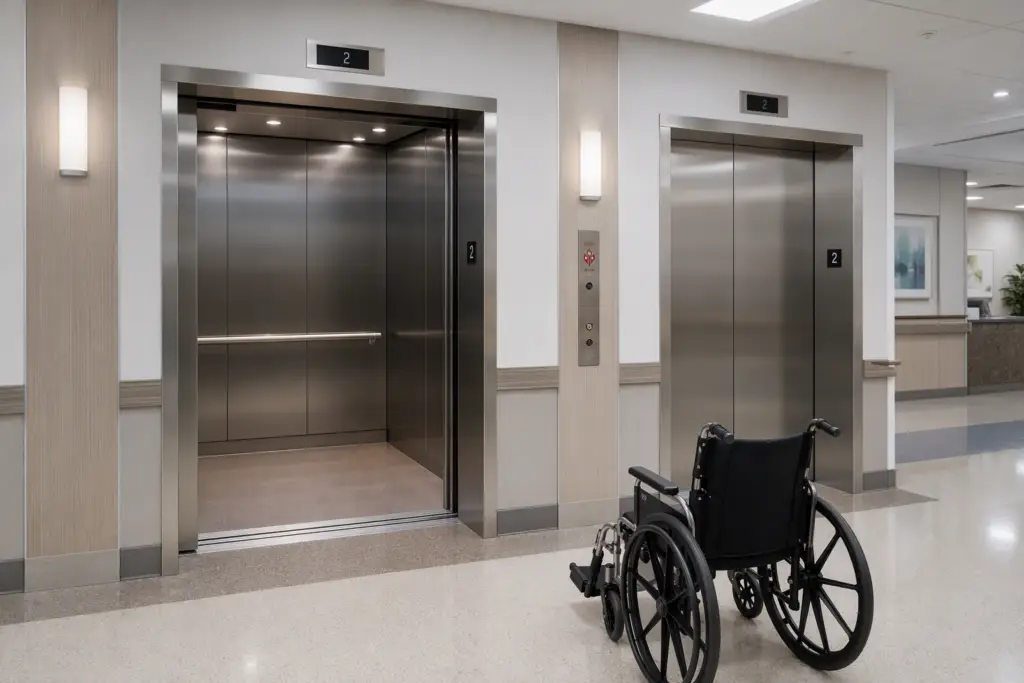
- Assess ADA accommodation obligations. If the elevator is the primary accessible means of vertical travel, consult your building’s ADA compliance plan. The Americans with Disabilities Act creates obligations around accessible route availability — building legal counsel should be consulted if the outage is prolonged.
- Confirm permit requirements with your service provider before any repair work begins, particularly for hydraulic systems, control components, or safety devices.
How Does Elevator Age Affect Repair Time and Frequency?
Older elevators — generally those more than 20 years old — experience longer repair durations and more frequent service calls due to parts obsolescence, cumulative wear on mechanical components, and the absence of modern diagnostic tools.
Electromechanical relay logic control systems, which were standard through much of the late 20th century, are no longer manufactured and require technicians to source components through specialty suppliers or rebuild existing boards. Hydraulic units installed before modern environmental containment rules may also require additional remediation steps when serviced — particularly in Florida, where groundwater protection regulations apply to hydraulic fluid handling.
For buildings in Pompano Beach FL and Sarasota FL with aging elevator stock, periodic condition assessments help property managers anticipate major repair needs before they become emergency shutdowns. A professional assessment from a company such as Axxiom Elevator Florida can identify components approaching end-of-life and allow capital planning on a realistic timeline rather than in crisis mode.
What Is the Difference Between an Elevator Repair and a Modernization?
A repair restores a specific failed component to working condition, while a modernization replaces major elevator systems — typically controls, drive, and sometimes structural components — to bring the unit up to current code standards and performance expectations.
The distinction matters for timeline planning because modernizations are fundamentally construction projects. A full control and drive modernization on a mid-rise traction elevator may take two to four weeks or longer, depending on equipment lead times and inspection scheduling. During that period, the elevator is fully out of service. Multi-elevator buildings can phase the work to maintain at least one operational car, but single-elevator buildings will face a complete outage for the duration.
Modernization is often cost-effective when the existing equipment is no longer supportable, when repeated emergency repairs are accumulating significant costs, or when the building’s insurance carrier or local authority having jurisdiction (AHJ) identifies compliance deficiencies that cannot be corrected through repair alone. The ASME A17.1 Safety Code for Elevators and Escalators specifies thresholds beyond which alterations trigger full code compliance upgrades.
How Can Building Owners Minimize Elevator Downtime During Repairs?
Proactive maintenance, advance parts identification, and choosing a service provider with established supply chains are the most effective strategies for reducing elevator downtime.
- Maintain a comprehensive maintenance agreement. Regular preventive maintenance catches deteriorating components before they fail catastrophically, replacing planned downtime of a few hours for a scheduled task with unplanned outages that can last days.
- Ensure your service provider knows your equipment. A technician already familiar with a specific elevator’s configuration can diagnose faults and stage parts faster than one encountering it for the first time.
- Keep equipment records current. Accurate model and serial number documentation, maintenance logs, and prior inspection reports allow the service company to pre-order likely parts before the technician arrives on site.
- Schedule non-emergency repairs proactively. When a diagnostic flags a component as degraded but not yet failed, scheduling replacement before failure allows the work to be done at a planned time with parts pre-staged.
- Plan for inspection lead times. In jurisdictions where inspections are required after certain repairs, inspector availability may be the critical-path item. A service partner with experience in Florida’s regulatory environment can help sequence permit applications and inspection requests to minimize waiting periods.
Are There ADA Obligations When an Elevator Is Out of Service?
Yes — when an elevator is the primary accessible route to upper floors, its extended unavailability may create obligations under the Americans with Disabilities Act, and building owners should have a plan in place before a failure occurs.
The ADA requires that places of public accommodation maintain accessible routes. While the ADA does not prohibit temporary elevator outages for maintenance or repair, a prolonged outage without alternative accessible accommodation may require the building to make program or service modifications — for example, relocating services to accessible floors, providing alternative assistance to individuals with disabilities, or posting clear notices about the outage and available alternatives.
Buildings subject to ADA Title III (commercial facilities and places of public accommodation) or Title II (state and local government facilities) should consult legal counsel on their specific obligations, particularly if an elevator repair is expected to extend beyond a few days.
What Role Does Preventive Maintenance Play in Reducing Repair Frequency?
Consistent preventive maintenance is the single most effective way to reduce both the frequency and severity of elevator failures, and Florida law requires periodic maintenance on all conveyances subject to Chapter 399.
Preventive maintenance tasks include lubrication of guide rails, ropes, and mechanical components; adjustment of door operators and safety edges; inspection of hydraulic fluid levels and system integrity; testing of safety devices and emergency systems; and review of controller diagnostics for fault codes. These tasks, performed on a documented schedule, allow technicians to identify components showing early signs of wear and address them before failure occurs.
The ASME A17.1 Safety Code for Elevators and Escalators provides maintenance checklists and testing intervals that serve as the baseline standard. Florida’s adoption of the code with state amendments defines the minimum requirements for maintenance program content.
What Happens if an Elevator Fails a Florida State Inspection?
When an elevator fails a Florida state inspection, it is removed from service immediately until all deficiencies are corrected and a passing re-inspection is completed.
The inspector issues a written deficiency report identifying each code violation and, in some cases, categorizing deficiencies by severity. Immediate hazards result in an immediate out-of-service order. Less critical items may be assigned a correction deadline. The building owner is responsible for engaging a licensed elevator contractor to address all deficiencies before requesting a re-inspection.
Attempting to return a failed elevator to service without a passing inspection in Florida is a violation of Chapter 399 and exposes building ownership to significant civil and regulatory liability. A well-structured maintenance program — and a service provider familiar with Florida’s inspection standards — significantly reduces the risk of failing an inspection in the first place.
How Do Hydraulic Elevators Compare to Traction Elevators in Terms of Repair Time?
Hydraulic and traction elevators have different failure modes and repair profiles, and understanding those differences helps building owners set realistic expectations.
Hydraulic elevators are common in low-rise Florida buildings and are generally more straightforward to service for routine issues, but hydraulic cylinder leaks and seal failures can be time-consuming and environmentally sensitive repairs. In Florida, hydraulic fluid releases near soil or groundwater require containment and may involve environmental reporting obligations, adding regulatory steps to what might otherwise be a straightforward component replacement.
Traction elevators — common in mid- and high-rise buildings — have more complex drive and control systems but typically have better parts availability for currently manufactured equipment. Rope replacements, brake adjustments, and drive unit repairs follow well-established procedures. However, older traction units with relay logic controls or proprietary microprocessor systems may present sourcing challenges similar to those described for aging hydraulic equipment.
What Questions Should Building Managers Ask an Elevator Repair Company Before Hiring?
Asking the right questions upfront protects the building owner’s interests and helps identify whether a service provider has the technical depth and local knowledge to handle Florida regulatory requirements.
- Is the company and its technicians licensed under Florida’s elevator contractor licensing requirements governed by the DBPR?
- Does the company have experience with the specific make and model of the building’s elevator equipment?
- Can the company pull permits and coordinate inspections with Florida’s authorized inspection agencies?
- Does the company maintain parts inventory locally, or will parts need to be ordered and shipped?
- How does the company document repairs, and will the building receive complete service records?
- What is the company’s process for managing scope changes discovered during a repair?
- Does the company offer preventive maintenance agreements that include priority scheduling for emergency service?
Axxiom Elevator Florida operates as a certified elevator service company in Pompano Beach FL and Sarasota FL, providing repair, maintenance, and modernization services with a working knowledge of Florida’s regulatory framework.
What Are the Safety Risks of Operating an Elevator With a Known Defect?
Operating an elevator with a known defect is a serious safety violation that exposes building ownership to regulatory penalties, civil liability, and — most critically — risk of injury to occupants.
Elevator safety devices exist in an interdependent system: a failed door interlock, a degraded overspeed governor, or a malfunctioning buffer can each contribute to incidents ranging from rough rides and leveling problems to uncontrolled descent. The ASME A17.1 Safety Code for Elevators and Escalators mandates that defective equipment be taken out of service, and the Occupational Safety and Health Administration (OSHA) provides additional guidance on workplace elevator safety obligations relevant to buildings with employee access.
From a liability standpoint, documented knowledge of a defect combined with continued operation is the most damaging fact pattern in elevator injury litigation. Taking the elevator out of service promptly when a defect is identified, and maintaining clear documentation of that decision, is both the legally defensible and ethically correct course of action.
How Does Weather in Florida Affect Elevator Repair Timelines?
Florida’s climate — particularly its heat, humidity, and hurricane season — creates elevator maintenance and repair conditions not commonly encountered in other states, and these environmental factors can influence both repair frequency and logistics.
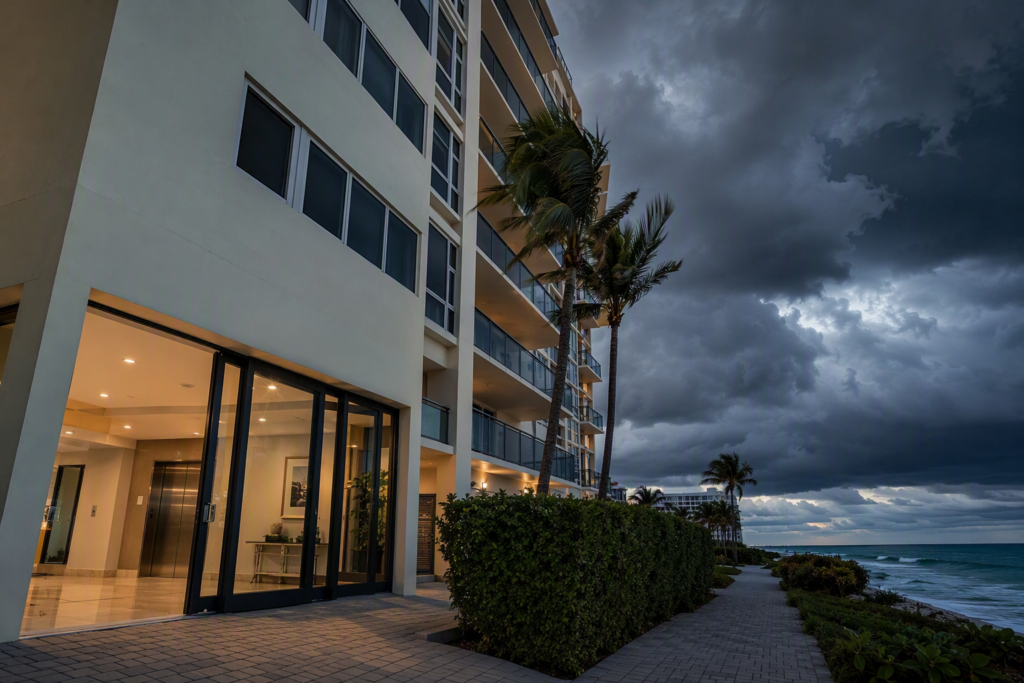
High ambient humidity accelerates corrosion on exposed mechanical components, particularly in coastal markets like Pompano Beach FL and Sarasota FL where salt air adds to the corrosive environment. Guide rails, door tracks, and rope hardware in buildings without climate-controlled machine rooms are especially susceptible. Hurricane preparedness also intersects with elevator operations: flooding of pits, power surges from storm activity, and equipment damage from water intrusion are all scenarios that require experienced local technicians who understand Florida-specific conditions.
Post-storm elevator inspections may be required by local AHJs before returning equipment to service following flooding or significant surge events, adding inspection lead time to the recovery process.
What Documentation Should Building Owners Maintain Related to Elevator Repairs?
Proper documentation protects building owners during inspections, insurance claims, and litigation, and is required by Florida law for permitted elevator work.
- Inspection certificates: Current state inspection certificates must be posted in the elevator or machine room as required by Florida Statutes Chapter 399.
- Maintenance logs: Dated records of all maintenance tasks performed, including technician identification and work scope.
- Repair records: Written documentation of all repair work, including the problem diagnosed, components replaced, parts used, and test results after repair.
- Permit documentation: Copies of all permits pulled for major repair or alteration work, along with final inspection sign-off documentation.
- Inspection reports: Full reports from all periodic state inspections, including any deficiency notices and subsequent correction verification.
A reputable service provider will supply comprehensive written documentation for all work performed. Building owners should retain these records for the life of the equipment and provide copies to subsequent owners or managers during property transitions.
When Is It More Cost-Effective to Modernize Rather Than Repair?
Modernization becomes more cost-effective than continued repair when recurring emergency repair costs approach or exceed the annualized cost of a modernization, when parts are no longer reliably available, or when the equipment cannot be brought into compliance with current code requirements through repair alone.
Building managers can use a straightforward framework: if the cumulative cost of repairs over a rolling 12-to-24-month period represents a significant fraction of a quoted modernization cost — and if the root cause is systemic aging rather than isolated component failure — modernization is likely the more prudent capital decision. Additionally, modernized equipment typically delivers improved energy efficiency, reduced maintenance frequency, and improved reliability that compounds the financial case over a 20-to-25-year useful life horizon.
Code considerations are also relevant. When major alterations under the ASME A17.1 Safety Code for Elevators and Escalators are triggered by the scope of repair work, the building may be required to bring the entire elevator into compliance with current code editions — at which point a structured modernization project often makes more sense than piecemeal repair-and-upgrade work.
How Should Building Owners Communicate With Tenants During an Elevator Outage?
Clear, proactive communication during an elevator outage reduces tenant complaints, manages expectations, and demonstrates professional building management — and it is also relevant to ADA obligations for accessible buildings.
- Post clear “Out of Service” notices on all affected elevator doors at the moment the unit is taken out of service, including an estimated return-to-service date if available.
- Send written notice to all tenants — particularly those on upper floors and those with mobility limitations — as soon as the outage is confirmed.
- Provide interim updates if the repair timeline changes, especially if it extends beyond the initial estimate.
- Identify and communicate any temporary accommodations available for residents or employees with disabilities, consistent with ADA guidance at ada.gov.
- Confirm and communicate the return-to-service date once the repair is complete and any required inspection has been passed.
Why Should Florida Building Owners Choose a Local Certified Elevator Service Company?
Local elevator service companies with Florida-specific regulatory knowledge, established supplier relationships, and familiarity with regional environmental conditions provide faster, more compliant service than out-of-area providers unfamiliar with Florida’s inspection and permitting landscape.
Florida’s elevator regulatory framework — administered through the DBPR under Chapter 399 — has state-specific amendments to the ASME A17.1 code, and navigating permit applications, inspection scheduling, and jurisdictional requirements requires active experience in the Florida market. A local provider also offers faster response when parts can be sourced from regional suppliers rather than shipped cross-country.
Axxiom Elevator Florida is a certified elevator service company serving the Pompano Beach FL and Sarasota FL markets, providing repair, modernization, and preventive maintenance services grounded in knowledge of Florida’s regulatory environment and the practical demands of Florida’s building stock.
Get a Professional Elevator Assessment Today
Whether your building is managing an active elevator failure, planning a modernization, or simply seeking a second opinion on your current maintenance program, professional assessment is the first step toward reliable, code-compliant elevator service.
Contact Axxiom Elevator Florida for a free elevator assessment. Serving Pompano Beach FL and Sarasota FL, Axxiom Elevator Florida provides certified elevator repair, maintenance, and modernization services with a working knowledge of Florida’s regulatory requirements.
Call us today: