How to Evaluate Whether Your Elevator Service Company Is Actually Performing the Maintenance They Are Billing You For
Elevator maintenance contracts represent a significant ongoing expense for building owners and property managers in Pompano Beach and Sarasota. Unfortunately, “ghost maintenance” — billing for visits or tasks that were never performed — is a documented problem in the elevator service industry. The questions and answers below provide a practical, technically grounded framework for holding your service provider accountable and protecting the safety of everyone who rides your elevator.
What documentation should a legitimate elevator service company provide after every maintenance visit?
A legitimate elevator service company must leave a written or electronic service record after every maintenance visit that identifies the technician, date, time on-site, specific tasks completed, parts replaced, and any deficiencies noted.
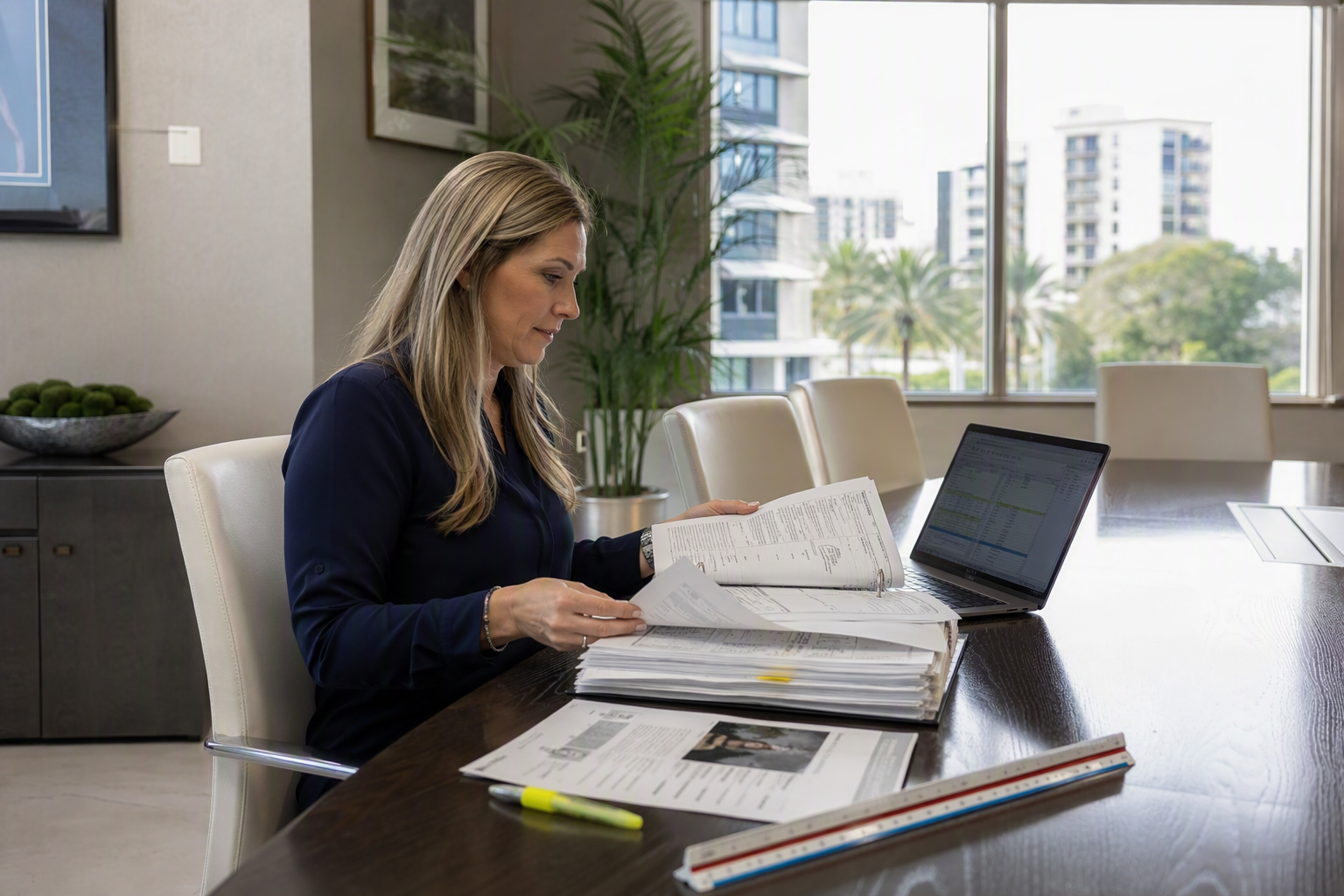
At minimum, each service ticket should reference the tasks outlined in your preventive maintenance contract. If the contract specifies lubrication of guide rails, adjustment of door operators, and testing of safety devices, each of those line items should appear on the service record with a pass/fail or completed notation. Vague entries such as “PM performed” with no task breakdown are a warning sign that meaningful work may not have occurred. Building owners in Florida should retain all service records because state inspectors and the Authority Having Jurisdiction (AHJ) may request them during periodic safety inspections.
What does Florida law require elevator service companies to document?
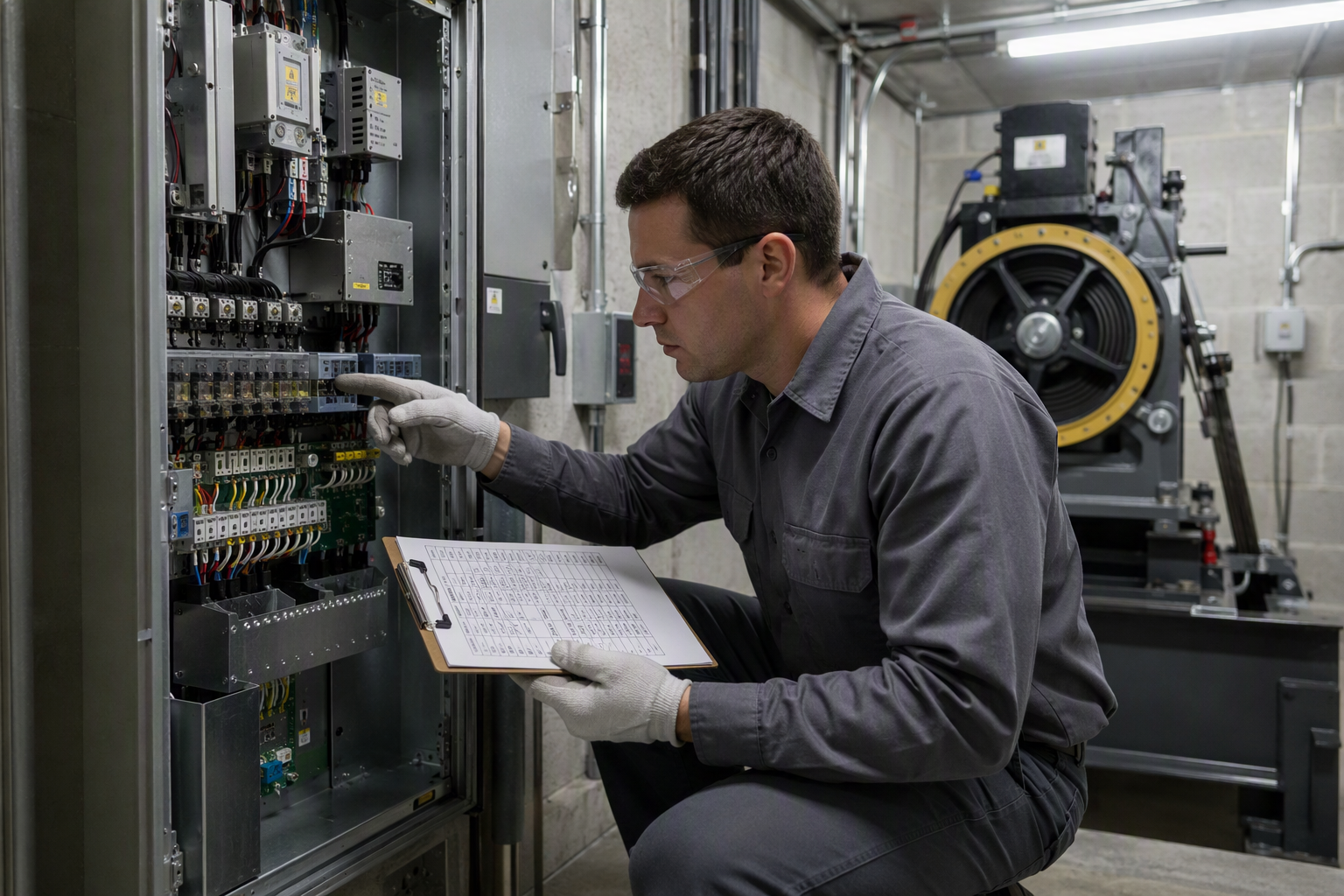
Florida’s elevator safety program, administered by the Florida Department of Business and Professional Regulation (DBPR) Bureau of Elevator Safety, requires that elevators undergo periodic inspections and that records of those inspections be maintained and available for review by the AHJ.
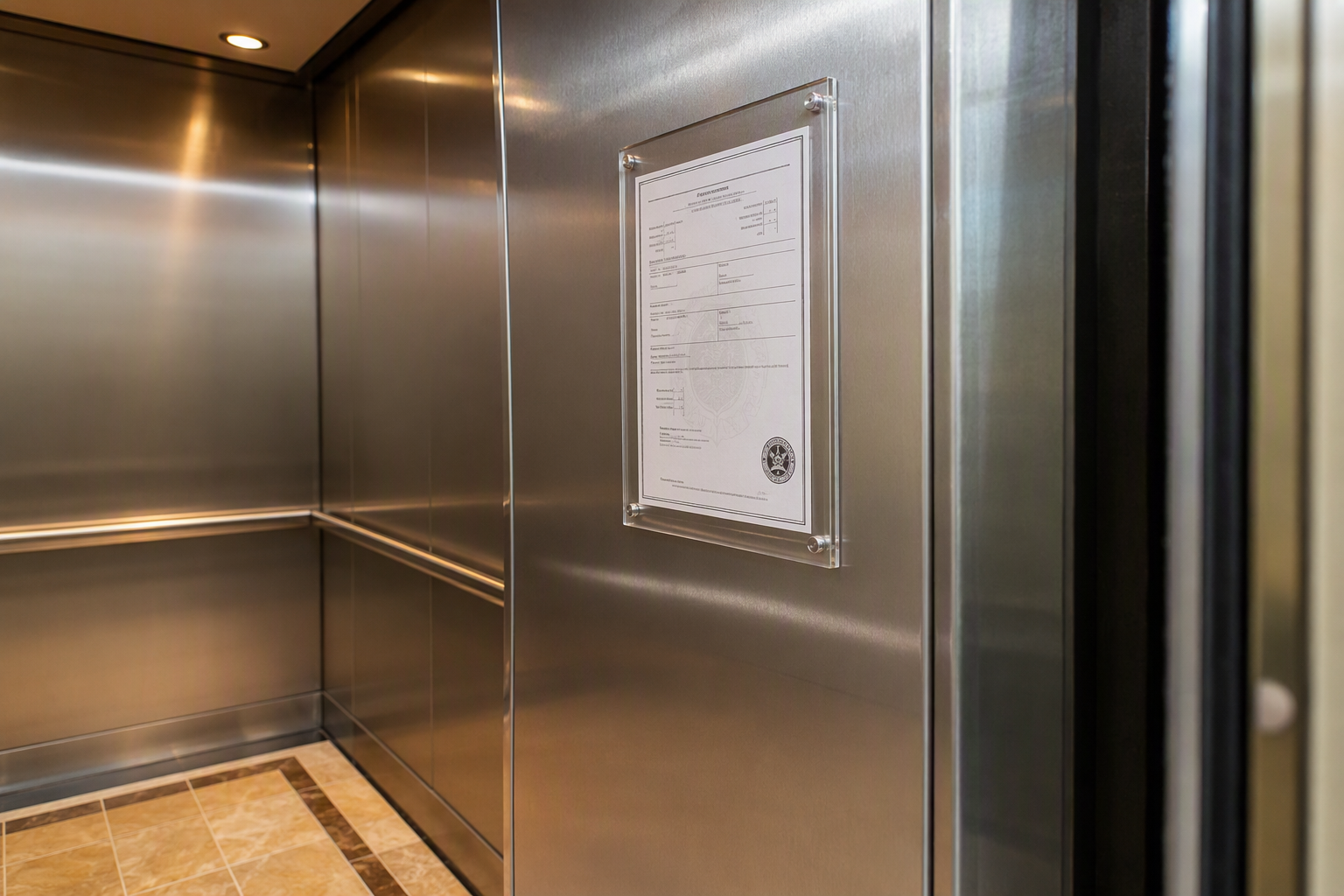
While maintenance visit logs are primarily a contractual obligation between building owner and service company, state inspection certificates must be posted in the elevator cab and renewed on a schedule determined by the DBPR. If your service company cannot produce a current, valid certificate of inspection when asked, that alone warrants immediate scrutiny. Building owners in Pompano Beach and Sarasota should verify their elevator’s certificate is current and prominently displayed, as required by Florida statute.
How does ASME A17.1 define required maintenance tasks, and why does it matter for billing verification?
ASME A17.1 Safety Code for Elevators and Escalators is the foundational standard governing elevator design, installation, inspection, and maintenance across the United States, including Florida, and it specifies categories of maintenance tasks that code-compliant service must address.
ASME A17.1 Section 8.6 establishes maintenance, repair, and replacement requirements, stating that the owner is responsible for ensuring maintenance is performed. The code does not merely require that a technician visit the building — it requires that specific functional components be examined and serviced. When evaluating a service company’s billing, building owners can use ASME A17.1 as a benchmark checklist: if billed tasks cannot be matched to recognizable code-required maintenance activities, that discrepancy deserves a written explanation from the service provider. Familiarity with ASME A17.1 puts building owners in a position of informed oversight rather than passive trust.
What are the most common maintenance tasks that are billed but frequently skipped?
Industry experience consistently points to a cluster of time-consuming tasks — machine room lubrication, safety device testing, door operator adjustment, and buffer inspection — as those most frequently documented on invoices but not physically completed.
These tasks are targeted precisely because they are labor-intensive, located in less-visible areas such as pits and machine rooms, and difficult for a non-specialist building owner to verify without entering restricted spaces. A credible service report should describe the actual condition found (e.g., “guide rail lubrication level — replenished,” “door close force tested at code-required limit”) rather than a simple checkbox. Condition-based language is the hallmark of work actually performed; generic checkboxes alone are not.
How often should a properly maintained elevator be visited by a service technician?
The frequency of routine maintenance visits depends on elevator type, usage intensity, age of equipment, and the terms of your service contract, but a well-maintained hydraulic or traction elevator in a mid-rise Florida building typically warrants at minimum quarterly preventive maintenance visits supplemented by emergency callback service.
High-traffic elevators in commercial or residential buildings with significant daily ridership may require monthly preventive maintenance visits to remain within safe operating tolerances. If your contract promises monthly visits but service records show visits occurring every two to three months, you are likely being underbilled in service and overbilled in fees. Compare the promised visit frequency in your contract against the date stamps on every service ticket for the past twelve months to identify any gaps.
What questions should a building owner ask during an unannounced or scheduled spot-check?
Building owners have the right to be present during maintenance visits and should periodically exercise that right, asking the technician to walk through the tasks being performed, explain what was found, and identify any deferred items.
Useful questions to ask during a spot-check include: What components are you lubricating today and why? What did the door-close force test read, and what is the allowable limit under ASME A17.1? Were there any components showing wear that should be tracked? Is anything in the pit or machine room that should be flagged for the next visit? A knowledgeable technician will answer these questions clearly and without hesitation. Evasive, vague, or dismissive responses to straightforward questions are a meaningful indicator of service quality.
How can elevator maintenance records be used to detect fraudulent billing?
Comparing service records against building access logs, security camera footage, and key issuance logs can reveal discrepancies between claimed visit times and actual technician presence, which is the most direct method of detecting fraudulent billing.
Many commercial buildings in Pompano Beach and Sarasota maintain electronic access control systems that log entry by card, fob, or key code. Cross-referencing these logs against the date and time on a service ticket is a straightforward audit step. If a ticket claims a two-hour maintenance visit on a Tuesday morning but no access event exists in the building’s system for that technician or company on that day, the discrepancy must be resolved in writing before the invoice is paid. Retaining at least 24 months of both service tickets and access logs gives building owners a defensible audit trail.
What should a comprehensive elevator maintenance contract include to make accountability possible?
A comprehensive elevator maintenance contract must define the specific scope of maintenance tasks, visit frequency, response time for callbacks, exclusions, parts coverage, and reporting obligations — vague contracts are the primary enabler of billing disputes.
At minimum, look for these contract elements before signing:
- A task-by-task description of what is included in each preventive maintenance visit, broken down by major system (machine, motor, controller, door operator, safety devices, pit equipment, cab interior).
- A clearly stated visit frequency (monthly, quarterly, etc.) with a mechanism for confirming each visit occurred.
- An obligation for the service company to provide a written service report within a defined period after each visit.
- A parts replacement policy that distinguishes between included parts and billable parts, with a definition of what constitutes normal wear.
- A process for escalating and documenting safety deficiencies found during maintenance, including the building owner’s notification obligations under Florida law.
- A provision allowing the building owner to request a third-party assessment of elevator condition without voiding the contract.
Building owners who work with Axxiom Elevator Florida are encouraged to review contract terms carefully and ask for clarification on any item before signing.
What role does the ADA play in elevator maintenance oversight?
The Americans with Disabilities Act (ADA) requires that elevators in covered facilities remain operational and accessible, which means repeated or prolonged elevator outages can constitute an ADA compliance failure — making maintenance accountability a civil rights issue, not just a property management concern.
Under ADA Title III, public accommodations and commercial facilities must ensure that accessible routes, including elevators, remain usable. If an elevator is frequently out of service because contracted maintenance is not actually preventing breakdowns, building owners face not only repair costs but potential ADA complaints. Tracking uptime alongside maintenance records provides a dual accountability mechanism: poor maintenance will eventually show up as increased downtime, which is itself an observable and documentable metric.
How should a building owner compare service company performance benchmarks?
Building owners can use the table below to assess whether their current service company’s performance aligns with reasonable benchmarks for professionally maintained elevators in Florida commercial and residential applications.
| Performance Indicator | Below Acceptable | Acceptable | Strong Performance |
|---|---|---|---|
| Preventive maintenance visit documentation | Generic checklist only, no condition notes | Task-level checklist with technician signature | Condition-based narrative report, digital record provided to owner |
| Missed or rescheduled PM visits per year | 3 or more unexcused | 1 with advance notice | None; if rescheduled, documented and made up promptly |
| Safety deficiency reporting | Verbal only, no written follow-up | Written note on service ticket | Formal written deficiency report with recommended action and timeline |
| Inspection certificate currency | Expired or missing from cab | Current, posted in cab | Current, posted, and copy on file with building owner |
| Response to owner questions | Delayed or evasive | Responsive within reasonable time | Prompt, detailed, technically grounded responses |
| Contract task specificity | Broad language only (e.g., “full maintenance”) | System-level task descriptions | Component-level task list aligned with ASME A17.1 |
| Parts replacement transparency | No documentation of parts used | Parts listed on invoice | Parts listed with part numbers, condition notes, and before/after context |
What is a third-party elevator assessment and when should a building owner request one?
A third-party elevator assessment is an independent technical inspection performed by a qualified elevator professional who has no contractual relationship with the current service company, providing an unbiased evaluation of actual equipment condition relative to claimed maintenance history.
A third-party assessment is appropriate when a building owner suspects maintenance is not being performed as billed, when taking over a building with an existing service contract, when negotiating a new service contract, or when an elevator’s breakdown frequency seems inconsistent with a maintained unit. The assessment should evaluate the physical condition of major components — lubrication levels, wear on guide shoes, brake adjustment, rope condition on traction units, oil cleanliness on hydraulic units — and compare findings against the service company’s documented maintenance history. Discrepancies between claimed service and actual component condition are the clearest available evidence of billing irregularities. Axxiom Elevator Florida provides assessment services to property owners and managers in Pompano Beach and Sarasota who want an objective second opinion.
What are the warning signs that a service company is not performing contracted maintenance?
Several observable patterns consistently indicate that contracted maintenance is not being performed: increasing breakdown frequency, recurring identical fault codes, deteriorating cab condition, unexplained parts replacement charges, and service tickets that appear identical across multiple visits.
When a technician is not physically performing maintenance tasks, equipment deteriorates at a pace inconsistent with a maintained unit. Pit accumulations of oil, dirt, or water that should have been noted and addressed in prior visits; excessive rope or chain wear; stiff or mis-adjusted door operators; and controller contacts that show visible arcing are all physical indicators of deferred or absent maintenance. Building owners who observe any of these conditions should document them with photographs, note the date, and request an immediate written explanation from the service company before the next invoice is paid.
How should a building owner respond if they discover their elevator service company has not been performing billed maintenance?
If a building owner discovers that billed maintenance was not performed, the appropriate response is to document all evidence, send written notice to the service company, withhold disputed invoice payments pending resolution, and consult with legal counsel about contract remedies — all while ensuring elevator safety is not compromised during the dispute.
- Compile all service records, access logs, photos, and third-party assessment findings into a single documented file.
- Send a formal written notice to the service company identifying each disputed billing period and the specific evidence of non-performance.
- Request a written response and a plan for remediation within a defined timeframe.
- Consult with legal counsel to assess options under the service contract’s dispute resolution clause.
- Notify the Florida DBPR Bureau of Elevator Safety if you have evidence of safety-critical maintenance being omitted, as this may constitute a regulatory violation.
- Obtain an independent assessment to establish baseline equipment condition for any future service contract.
- Issue a request for proposals to qualified alternative providers, including Axxiom Elevator Florida, to establish a service relationship built on documented accountability from the outset.
What is the difference between a maintenance contract and a full-service contract, and does it affect billing accountability?
A maintenance contract typically covers labor for preventive maintenance visits and excludes parts, while a full-service contract covers both labor and most or all parts replacement — and this distinction significantly affects how billing accountability must be structured, because full-service contracts create a financial incentive for service providers to minimize parts usage while maintenance-only contracts create an incentive to recommend unnecessary parts replacement.
Building owners under a full-service contract should scrutinize whether parts are actually being replaced as claimed, since the service company bears the cost and may be tempted to defer replacements while billing at the full-service rate. Conversely, under a maintenance-only contract, building owners should question any parts recommendation that seems premature or undocumented by inspection findings. Neither contract structure eliminates the need for documentation — it simply shifts where the accountability risk lies. Understanding which type of contract you hold is the prerequisite for designing an effective oversight approach.
How do OSHA regulations apply to elevator maintenance and service company accountability?
OSHA standards apply to the working conditions of elevator mechanics and to building owner obligations regarding safe operation of mechanical equipment, which means a service company’s failure to follow safe work practices is not only a worker safety issue but a potential liability for the building owner.
OSHA General Industry standards require that employers protect workers from recognized hazards, including those present in elevator pits and machine rooms. A service company that is not actually sending technicians into those spaces — or is rushing through visits without following lockout/tagout procedures — exposes both its own workers and the building owner to potential regulatory action. Building owners in Florida can request documentation that the service company’s technicians are properly trained and that safe work procedures are followed on their property, as part of a broader accountability framework.
What questions reveal whether a service company truly understands the specific elevator equipment installed in a building?
A service company that understands the specific equipment installed in a building will be able to name the manufacturer, model, and control system without referencing paperwork, describe the maintenance quirks specific to that equipment, and explain why certain components on that unit may require more or less frequent attention than a generic maintenance schedule would suggest.
For example, older hydraulic elevators may require more frequent oil sampling and seal inspection than newer units. Certain vintage traction elevator controllers require specific relay contact maintenance procedures. A service technician who has been maintaining a specific unit as claimed will have this knowledge embedded in their approach. A technician who is visiting for the first time but billing for months of prior service will not. Building owners should ask open-ended technical questions about their specific equipment early in any service relationship and document the answers as a baseline for future comparison.
How should elevator maintenance performance be evaluated when changing service providers?
When transitioning to a new elevator service provider, the incoming company should conduct a full condition assessment of all equipment before assuming the maintenance contract, and that assessment report serves as both a baseline for future performance evaluation and documentary evidence of what the prior company left behind.
A condition assessment at transition should cover: machine room cleanliness and organization; oil levels and condition; rope or chain wear measurements; brake adjustment and condition; door operator alignment and adjustment; buffer condition; pit cleanliness; safety device function testing; and a review of the maintenance history log against observed equipment condition. Any significant deviations between documented prior maintenance and actual equipment condition should be formally noted and, where appropriate, communicated to the Florida DBPR. Property managers in Pompano Beach and Sarasota who are considering a change in service providers can contact Axxiom Elevator Florida to schedule a pre-contract condition assessment.
What recordkeeping systems make elevator maintenance accountability easier to enforce?
A combination of digital service report delivery, a dedicated maintenance log binder posted in the machine room, building access control records, and periodic photographic documentation of key component conditions creates an audit-ready recordkeeping system that makes billing fraud significantly more difficult.
Best practices for building owners and property managers include: requiring service reports to be delivered electronically within 48 hours of each visit; maintaining a physical log in the machine room that technicians must sign and date on arrival; retaining all reports in a cloud-accessible folder organized by date; photographing the machine room, pit, and cab interior on a quarterly schedule to document visible condition changes over time; and reviewing the cumulative service record annually against the maintenance contract’s task obligations. When these systems are in place, discrepancies between billed work and documented performance become apparent quickly and are difficult for a service company to dispute.
How can a building owner use elevator callback (breakdown) frequency to assess maintenance quality?
Tracking the number, nature, and causes of elevator callbacks over time is a direct proxy for maintenance quality, because properly maintained elevators have significantly lower breakdown frequencies than neglected ones, and recurring callbacks for the same component or fault code indicate that a root cause is not being addressed.
Building owners should maintain a simple callback log recording the date, reported symptom, technician response, root cause identified, and corrective action taken for every unplanned service call. Analyzing this log over a rolling 12-month period reveals patterns: if the same door fault code recurs every six to eight weeks, the door operator is not being correctly adjusted during preventive maintenance visits. If the hydraulic unit overheats repeatedly, the oil may not be at the correct level or the heat exchanger may not be cleaned as contracted. Callback analysis translates raw breakdown data into evidence of maintenance gaps that can be presented to the service company with a demand for corrective action.
Why is it important to work with a Florida-licensed elevator service company, and how does licensure connect to accountability?
Working with a Florida-licensed elevator service company ensures that the company and its technicians operate under the regulatory oversight of the Florida DBPR Bureau of Elevator Safety, which has the authority to investigate complaints, audit maintenance records, and take disciplinary action — creating a formal accountability mechanism that does not exist when work is performed by an unlicensed contractor.
Florida law requires that elevator contracting, inspection, and maintenance work be performed by or under the supervision of appropriately licensed individuals. Building owners who hire unlicensed service providers have no regulatory recourse if work is billed but not performed, and may themselves face liability for allowing unlicensed work on their property. Verifying that a service company holds current Florida licensure is the first and most basic step in responsible vendor selection. Axxiom Elevator Florida operates as a certified elevator service company in Florida, serving building owners and property managers in Pompano Beach and Sarasota with documented, accountable maintenance service.
What immediate steps should a building owner take if they suspect right now that maintenance is not being performed?
If a building owner currently suspects their elevator service company is billing for maintenance not performed, the appropriate immediate steps are to gather existing records, avoid confronting the service company without documentation, and request an independent assessment before the next scheduled visit.
- Collect all service reports, invoices, and correspondence from the past 24 months and organize them chronologically.
- Pull building access control records for the same period and cross-reference them against service report dates and claimed on-site times.
- Review security camera footage if available for dates on which maintenance is claimed to have occurred.
- Document the current physical condition of the machine room, pit, and cab with dated photographs before the next service visit.
- Contact an independent elevator service provider — such as Axxiom Elevator Florida in the Pompano Beach and Sarasota service areas — to schedule a third-party condition assessment.
- Consult the Florida DBPR Bureau of Elevator Safety to confirm the elevator’s inspection certificate is current and to understand the complaint process if regulatory violations are suspected.
- Place the next invoice on hold pending review, and communicate this in writing to the service company, referencing the specific evidence that prompted the review.
Need elevator service you can rely on? Axxiom Elevator Florida is ready to help.