What Questions Should I Ask Before Signing an Elevator Maintenance Contract in Florida?
Signing an elevator maintenance contract is one of the most consequential decisions a Florida property owner or facility manager makes. A poorly written contract can leave a building exposed to compliance failures, unexpected repair costs, extended downtime, and liability. The questions below cover every major dimension of elevator service agreements — from regulatory compliance and equipment coverage to vendor accountability and termination rights — so Florida property owners in markets like Pompano Beach and Sarasota can negotiate from an informed position.
What exactly is included in the elevator maintenance contract’s scope of work?
Direct answer: A contract’s scope should explicitly list every component, system, and task covered — because items not named are almost always excluded and billed as extras.
Elevator systems contain hundreds of mechanical, electrical, and hydraulic components. Vague language such as “routine maintenance” is a red flag. A well-written scope will specify which subsystems are covered: drive systems, control panels, door operators, safety devices, buffers, guide rails, pit equipment, machine room components, and hoistway wiring. Ask for a written component list and confirm whether lubrication, adjustments, cleaning, and parts replacement are all included or whether only labor is covered.
Property managers should also confirm whether the contract covers both the elevator cab interior and the mechanical equipment, since some agreements exclude cosmetic or cab-related work entirely. Hydraulic elevator oil changes, for example, are sometimes listed as optional add-ons despite being essential for safe operation.
Does the contract guarantee compliance with ASME A17.1 and Florida state elevator codes?
Direct answer: Any reputable Florida elevator maintenance contract should explicitly commit the service provider to maintaining the unit in conformance with the ASME A17.1 Safety Code for Elevators and Escalators and applicable Florida regulations.
Florida adopts ASME A17.1 as its primary elevator safety standard. The contract should state that maintenance tasks are performed to keep the elevator in compliance with this code. Additionally, Florida requires periodic inspections by a licensed Qualified Elevator Inspector (QEI). A strong contract will clarify whether the maintenance provider coordinates these inspections and assists with filing results with the Florida Department of Business and Professional Regulation (DBPR).
Ask specifically: “Will your maintenance program keep this elevator in compliance with the current edition of ASME A17.1?” If a vendor cannot answer affirmatively in writing, that is a significant concern. Axxiom Elevator Florida structures its service agreements around current code requirements so that clients in Pompano Beach and Sarasota are never caught off guard by compliance deficiencies.
How does the contract address Florida’s mandatory elevator inspection requirements?
Direct answer: Florida requires periodic safety inspections conducted by a licensed inspector, and the contract should clearly state who is responsible for scheduling, coordinating, and paying for those inspections.
Under Florida’s elevator safety program administered by the DBPR, elevators must be inspected at defined intervals. The maintenance contract should specify whether the vendor coordinates with the Authority Having Jurisdiction (AHJ) and the third-party QEI inspector, or whether that responsibility falls entirely on the building owner. Some contracts charge separately for inspection coordination — get this in writing before signing.
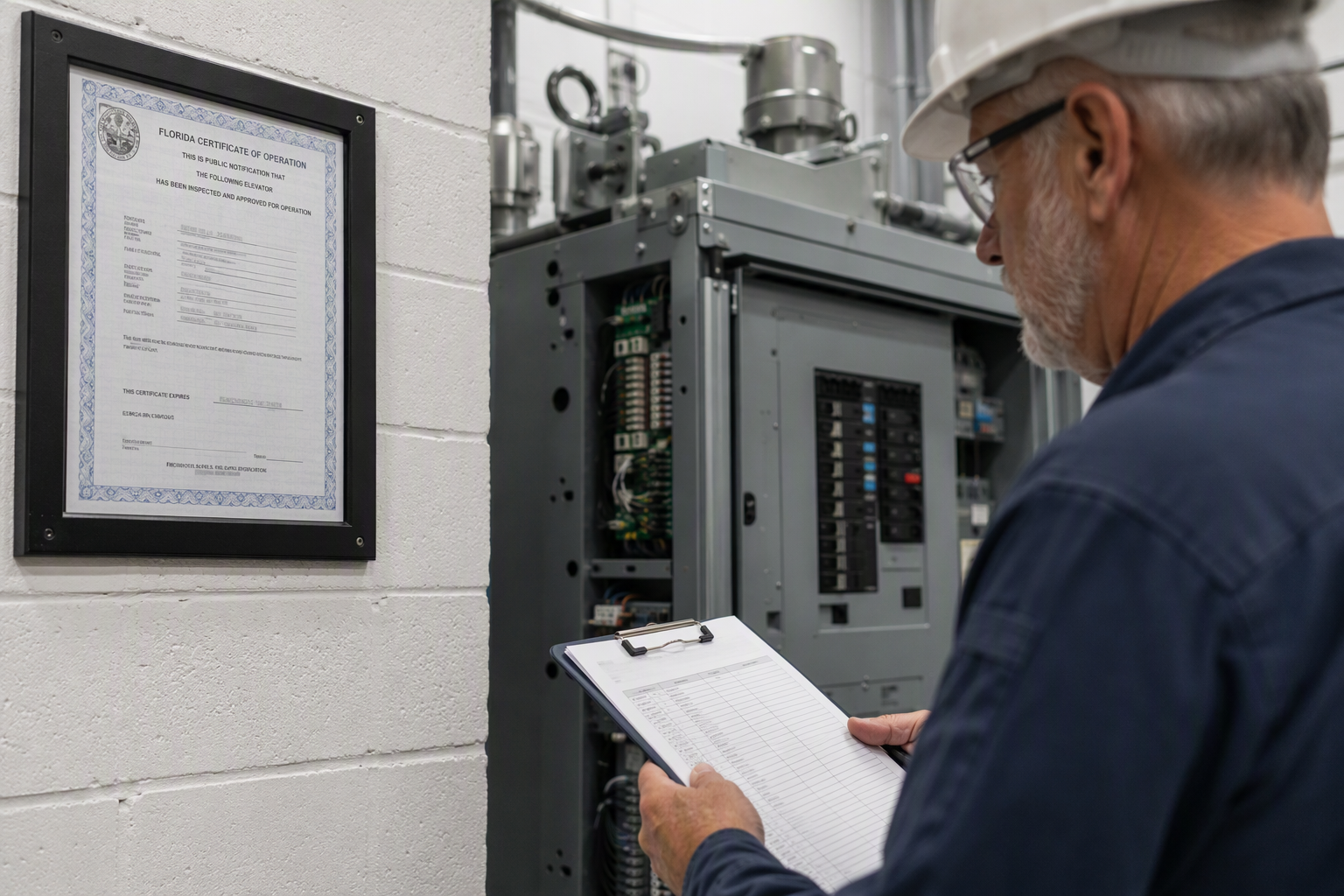
Also ask whether the contractor will provide documentation and records necessary for the state inspection, such as maintenance logs, test reports, and repair records. Florida building owners who cannot produce complete maintenance documentation at inspection time may face penalties, even if the elevator itself passes the physical inspection.
What are the technician qualification requirements stated in the contract?
Direct answer: The contract should confirm that all technicians performing work are licensed by the state of Florida and qualified to service the specific type and brand of elevator installed in the building.
Florida requires elevator mechanics to hold a valid state license. Ask the vendor to confirm this in writing and ask whether technicians are manufacturer-trained on the specific equipment in the building. A technician certified on one drive system may not be qualified to service a different manufacturer’s proprietary controls. This is especially relevant for modern microprocessor-based systems where improper adjustments can introduce safety hazards or void warranties.
Contracts should also address subcontracting. Some maintenance companies use unlicensed subcontractors for overflow work. Insist that any substitute or subcontracted technician must meet the same licensing standards as the primary service provider, and require written notice before any subcontracting occurs.
Does the contract comply with ADA accessibility maintenance obligations?
Direct answer: Elevators serving as a means of access for people with disabilities must remain operational and maintained in conformance with ADA requirements, and the contract should address how accessibility features are maintained and restored when they fail.
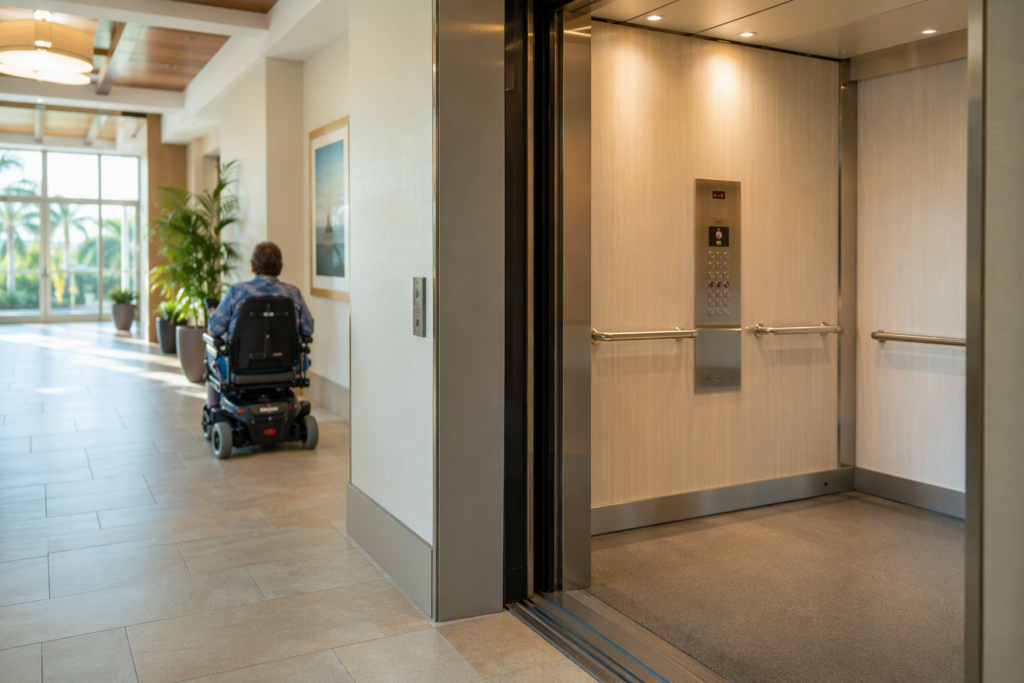
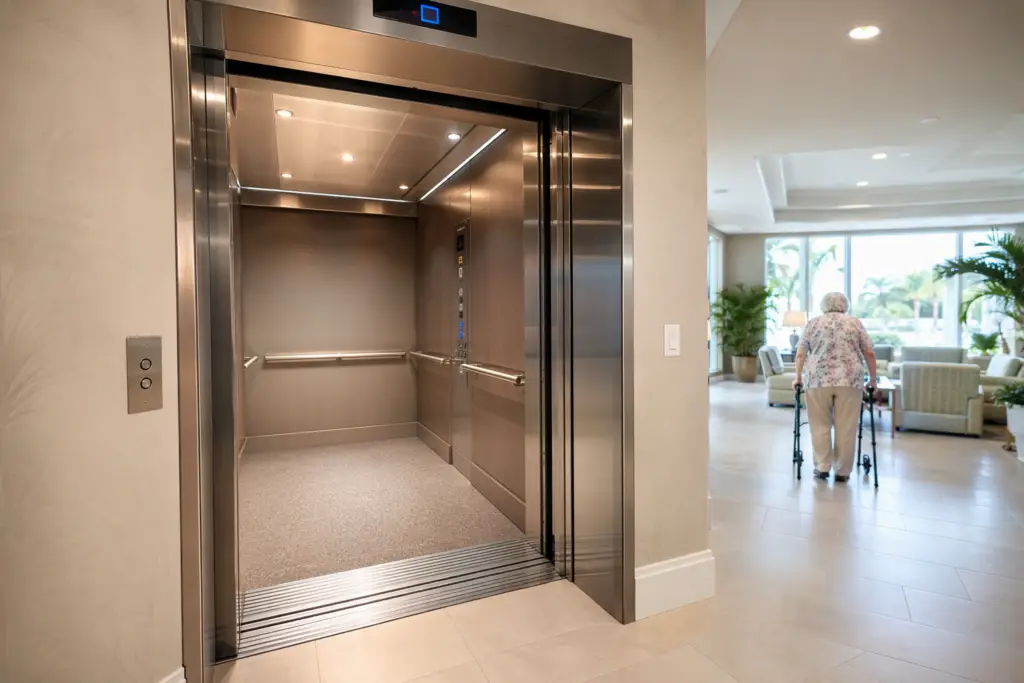
The ADA mandates that accessible routes remain operational. When an elevator serving as the only accessible route is out of service, building owners may have legal obligations to provide alternative accessible access. The maintenance contract should specify maximum allowable downtime targets and how the provider prioritizes repairs to accessibility-critical equipment such as door sensors, leveling systems, call buttons at accessible heights, and audible/visual indicators.
Ask whether the contract covers ADA-required features specifically, or whether those components fall under exclusions. Braille button pads, for instance, are sometimes classified as “interior finishes” and excluded from technical service coverage.
What is the contract’s response protocol when an elevator breaks down?
Direct answer: The contract must define in measurable terms how the provider responds to outages, entrapments, and safety-related breakdowns — not just offer vague assurances of “prompt service.”
Ask for the specific call-back procedure for passenger entrapments. Florida building owners should know whether after-hours emergency calls are handled by the primary contractor or routed to a third-party answering service. Understand whether emergency response incurs additional charges beyond the monthly retainer, and whether those charges are capped or open-ended.
Confirm the escalation process: if the responding technician cannot resolve the issue on the first visit, who is notified, and what is the timeline for follow-up? A well-structured contract will define these steps clearly rather than leaving them to verbal assurances.
How does the contract handle parts — are they included, and are there limitations?
Direct answer: Parts coverage is one of the most variable and financially significant elements of any elevator maintenance contract, and the specific inclusion or exclusion of parts should be defined in writing with no ambiguity.
Elevator maintenance contracts generally fall into three tiers: oil-and-grease (labor only, no parts), parts-included (commonly excludes major components), and full-coverage (comprehensive parts and labor). Ask for a written list of excluded parts in every case. Common exclusions include cab flooring, cab lighting, door sills, hoist cables, hydraulic cylinders, and proprietary circuit boards.
Also ask whether the vendor uses original equipment manufacturer (OEM) parts or aftermarket alternatives. OEM parts are generally preferable for reliability and warranty compliance, but some contractors substitute aftermarket components without disclosure. Require written consent before any non-OEM part is installed.
| Contract Tier | Labor Included | Routine Parts | Major Components | Emergency Calls | Code Compliance Support |
|---|---|---|---|---|---|
| Oil & Grease (Basic) | Yes | No | No | Often extra charge | Varies by vendor |
| Parts & Labor (Mid-Tier) | Yes | Yes | Typically excluded | Often included | Varies by vendor |
| Full Coverage (Comprehensive) | Yes | Yes | Yes (with caps) | Included | Typically included |
| Modernization-Inclusive | Yes | Yes | Yes | Included | Included with modernization scope |
What are the contract term length and auto-renewal provisions?
Direct answer: Many Florida elevator maintenance contracts include automatic multi-year renewals with escalating rates, and building owners should negotiate clear terms, opt-out windows, and rate caps before signing.
Contract terms typically range from one to five years. Longer terms may offer price stability but reduce leverage if service quality declines. Ask whether the contract auto-renews and, if so, how much advance notice is required to cancel before auto-renewal triggers — 30, 60, and 90-day notice windows are common. Missing the window can lock a building into another full term.
Rate escalation clauses are also common. Ask whether annual increases are tied to a published index (such as CPI) or are at the vendor’s discretion. Uncapped escalation clauses can significantly increase costs over a multi-year term. Negotiate a maximum annual increase percentage and have it written into the agreement.
What are the termination-for-cause and exit provisions in the contract?
Direct answer: A fair elevator maintenance contract should allow the building owner to terminate without penalty if the service provider fails to meet its stated obligations — and that right should be explicit, not implied.
Ask specifically: “Under what conditions can I terminate this contract without paying a penalty?” Common termination-for-cause triggers include repeated missed service visits, failure to correct a code violation within a defined timeframe, or loss of contractor licensing. If the contract only allows termination for convenience with a buyout fee, negotiate a parallel termination-for-cause provision with no financial penalty.
Also ask about the contractor’s right to terminate and what notice they must provide. A contractor who can cancel on short notice without cause leaves a building without a maintenance provider, which creates a compliance gap under Florida’s elevator safety requirements.
How does the contract address OSHA safety obligations for elevator work?
Direct answer: Elevator maintenance involves confined space entry, electrical hazards, and fall risk — all regulated under OSHA standards — and the contract should confirm the provider maintains a documented safety program.
Ask whether the maintenance company has a written OSHA-compliant safety program for elevator work, including lockout/tagout (LOTO) procedures, confined space entry protocols for pit work, and fall protection for hoistway access. Building owners can face shared liability for contractor injuries that occur on their property if the contractor lacks a compliant safety program.
Require a certificate of insurance that includes workers’ compensation coverage, general liability, and completed operations coverage. Verify that subcontractors are held to the same insurance requirements before any work begins on the property.
Does the contract specify maintenance visit frequency and documentation requirements?
Direct answer: The contract should state the exact number of preventive maintenance visits per year and require written documentation of every visit — because undocumented maintenance is indistinguishable from no maintenance during a state inspection.
Florida elevator maintenance best practice — and the spirit of ASME A17.1 maintenance requirements — calls for scheduled preventive maintenance at defined intervals based on equipment type, usage level, and age. Ask whether the contract specifies monthly, quarterly, or bi-monthly visits, and whether that frequency is appropriate for the building’s traffic volume. A high-rise residential building typically requires more frequent attention than a low-traffic two-stop commercial unit.
Require that maintenance records be provided to the building owner after every visit, not just retained in the contractor’s system. Florida property managers who cannot produce maintenance logs during a DBPR inspection may face compliance findings even if the work was performed.
How does the vendor handle code-mandated modernization or safety upgrades?
Direct answer: Florida elevator owners should ask whether the maintenance contract includes notification of upcoming code-required upgrades and whether the same vendor can perform them — avoiding costly surprises when the AHJ mandates a safety retrofit.
ASME A17.3 (the Safety Code for Existing Elevators and Escalators) establishes requirements for retrofitting older equipment when changes in applicable code are adopted. Ask the vendor whether they proactively identify equipment approaching the end of code compliance life and whether they provide written advance notice when a required upgrade is approaching. Some vendors withhold this information until the AHJ issues a violation order, which leaves building owners with far less time to budget for the work.
Also ask whether the maintenance company can perform modernization work, or whether that would require hiring a separate contractor. Continuity of service providers during a modernization project often reduces downtime and coordination errors.
What happens to the maintenance contract if the building is sold or changes ownership?
Direct answer: Elevator maintenance contracts are often written to bind successors and assigns, meaning a new property owner may inherit the remaining contract term — a fact that should be discovered before the real estate transaction closes, not after.
Ask the contractor whether the agreement is assignable and under what conditions. If a building sale is possible during the contract term, negotiate a provision that allows assignment to the new owner or termination without penalty upon a qualifying change of ownership. Some contracts require written consent from the elevator company for any assignment, which can complicate or delay real estate closings.
For property managers in high-turnover commercial real estate markets such as Pompano Beach and Sarasota, this clause is particularly important to address at the time of initial contract negotiation rather than at the point of sale.
How are disputes and unsatisfactory work handled under the contract?
Direct answer: The contract should define a clear, written process for raising service quality disputes and require the vendor to remedy deficiencies within a defined timeframe — not simply at their discretion.
Ask who the primary point of contact is for service complaints, how complaints are logged, and what the contractual remedy is if the vendor fails to correct a deficiency. Binding arbitration clauses are common in elevator contracts and may limit a building owner’s right to pursue legal remedies in court. Review any arbitration or limitation-of-liability clause carefully with legal counsel before signing.
Escalation contacts matter too. Ask whether the agreement provides direct access to a service manager or regional supervisor if field-level complaints go unresolved. A single point of contact with no escalation path is a warning sign for service quality accountability.
Does the contract address hydraulic elevator oil containment and environmental compliance?
Direct answer: Hydraulic elevators in Florida are subject to environmental regulations related to oil containment, and the maintenance contract should address who is responsible for secondary containment inspection and oil disposal.
Florida’s proximity to groundwater and the environmental sensitivities of both coastal Pompano Beach and Sarasota make hydraulic oil containment particularly important. Ask whether the contract includes inspection of the pit secondary containment system, hydraulic cylinder integrity, and proper disposal of used hydraulic fluid. If a hydraulic leak causes environmental contamination on the property, the building owner may face remediation liability.
Confirm whether the vendor carries environmental liability coverage and whether the contract indemnifies the building owner for spills caused by the contractor’s negligence or failure to identify a deteriorating hydraulic cylinder.
What proprietary lock-in provisions exist, and how do they affect future vendor changes?
Direct answer: Some elevator contractors install proprietary control systems or use non-standard components that effectively prevent a competitor from servicing the equipment — a practice Florida building owners should identify and evaluate before signing.
Ask directly: “Will your maintenance work or any equipment installed remain serviceable by another licensed elevator company if we choose to change vendors?” If the answer is no or evasive, ask for specifics on what components would be proprietary. Some manufacturers and service providers legitimately use proprietary diagnostics, but the contract should address what access or documentation is provided if the relationship ends.
Axxiom Elevator Florida encourages building owners in Pompano Beach and Sarasota to ensure that any service agreement preserves the right to change providers without rendering the elevator inoperable or requiring costly replacements of contractor-installed proprietary hardware.
How should I evaluate a vendor’s financial stability before signing a long-term contract?
Direct answer: A maintenance provider that goes out of business mid-contract leaves a Florida building without a licensed maintainer, which creates an immediate compliance problem, so financial due diligence is a legitimate pre-signing step.
Ask how long the company has been operating in Florida and whether it is a locally owned operation or a division of a larger company. Request trade references from current clients with similar building types in Florida. Verify the vendor’s license status through the Florida DBPR before signing, since a lapsed or restricted license immediately disqualifies a provider from legal compliance work in the state.
Also ask who holds the maintenance responsibility if the local branch closes — is there a parent company backstop, or does the building owner need to source a new provider immediately? This question is especially relevant for smaller independent contractors without a regional or national support structure.
What steps should I follow when reviewing an elevator maintenance contract before signing?
Direct answer: A structured review process protects building owners from missing critical provisions buried in contract language — follow each step below before committing to any agreement.
- Obtain the full contract document, including all exhibits, schedules, and addenda, before any review begins.
- Identify and list every component and system in the building’s elevator(s) and compare against the contract’s explicit scope of work.
- Confirm that the vendor holds a current, active Florida elevator contractor license through the DBPR before reading any further.
- Review all exclusion lists and ask for written clarification on any ambiguous item.
- Identify the contract term, auto-renewal clause, notice window for cancellation, and any buyout or early termination penalties.
- Confirm the inspection coordination language and determine who bears the cost of required Florida state inspections.
- Review the parts coverage tier and request a written excluded-parts list if one is not already provided.
- Evaluate the emergency response protocol and confirm whether after-hours calls incur additional charges.
- Review all insurance requirements and request current certificates of insurance before signing.
- Have legal counsel review any arbitration, limitation-of-liability, or indemnification clause before executing the agreement.
Are there red flags in elevator maintenance contracts that Florida building owners should watch for?
Direct answer: Several common contract provisions signal that a vendor is prioritizing its own financial protection over the building owner’s interests — knowing these red flags can prevent costly mistakes.
Watch for contracts that reference outdated code editions without a commitment to update compliance as standards are revised. Avoid agreements that allow the contractor to perform “modernization” work at its sole discretion and charge it separately outside the contract without prior written owner approval. Be cautious of contracts that include automatic multi-year renewals with no notice requirement and no rate cap.
Be skeptical of vague language such as “maintain in good working order” without specific task lists, visit frequencies, or documentation requirements. Language that limits the vendor’s liability to the monthly contract fee — regardless of the damage caused by negligence — should be reviewed carefully with legal counsel before signing. Finally, any contract that prohibits the building owner from sharing its terms with a competing bidder is designed to prevent comparison shopping and deserves scrutiny.
Why should Florida property owners consider Axxiom Elevator Florida for elevator maintenance services?
Direct answer: Axxiom Elevator Florida is a certified elevator service company operating in Pompano Beach and Sarasota, offering maintenance programs structured around Florida regulatory requirements and the full scope of ASME A17.1 compliance obligations.
Property owners throughout Florida’s Pompano Beach and Sarasota markets work with Axxiom Elevator Florida because the company designs its service agreements to address the specific questions raised on this page — transparent scope definitions, documented maintenance records, code-compliant inspection coordination, and technicians licensed under Florida’s elevator safety program. The company’s service contracts are written to be readable and specific, so building owners understand exactly what is and is not covered before they sign.
Whether managing a residential high-rise in Pompano Beach or a commercial property in Sarasota, building owners who partner with Axxiom Elevator Florida receive maintenance programs designed to support continuous code compliance, minimize unplanned downtime, and provide clear documentation for state inspections. For building owners currently evaluating a contract from another provider, Axxiom Elevator Florida also offers independent contract reviews as part of its free elevator assessment service.
Need elevator service you can rely on? Axxiom Elevator Florida is ready to help.