Elevator Repair FAQ: Who to Contact and How Fast Elevators Can Be Fixed
After 15 years maintaining and repairing elevators across South and Central Florida, I’ve fielded thousands of urgent calls from building managers, property owners, and HOA boards who weren’t sure who to call or what to expect. This comprehensive guide answers every question I get — from emergency response times to Florida compliance codes — so you can act fast and get your elevator running safely.
Who should I contact when my elevator needs repair?
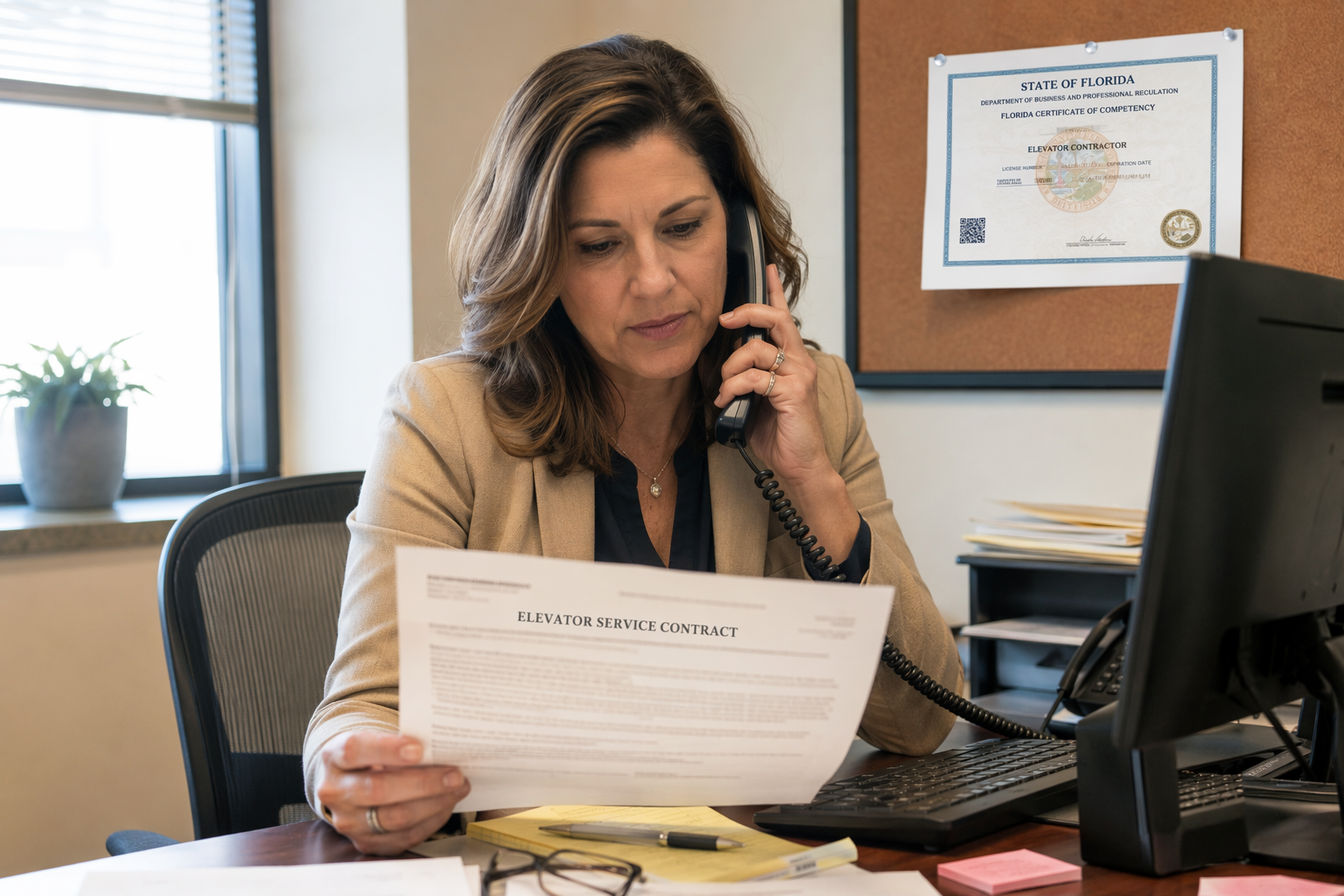
Contact a licensed, state-certified elevator service contractor immediately — not a general maintenance company, not your building’s handyman, and not the elevator manufacturer directly unless they provide local service contracts.
In Florida, elevator repair and maintenance must be performed by a licensed elevator contractor as required under Florida Statute 399, which governs the design, construction, installation, alteration, maintenance, repair, and inspection of elevators statewide. Calling an unlicensed technician not only voids your insurance coverage but can expose your building to serious liability.
If the situation involves a passenger trapped inside the elevator cab, call 911 first. Emergency responders are trained for passenger extraction. Once the immediate life-safety issue is resolved, contact your certified elevator contractor to diagnose and repair the underlying mechanical or electrical fault.
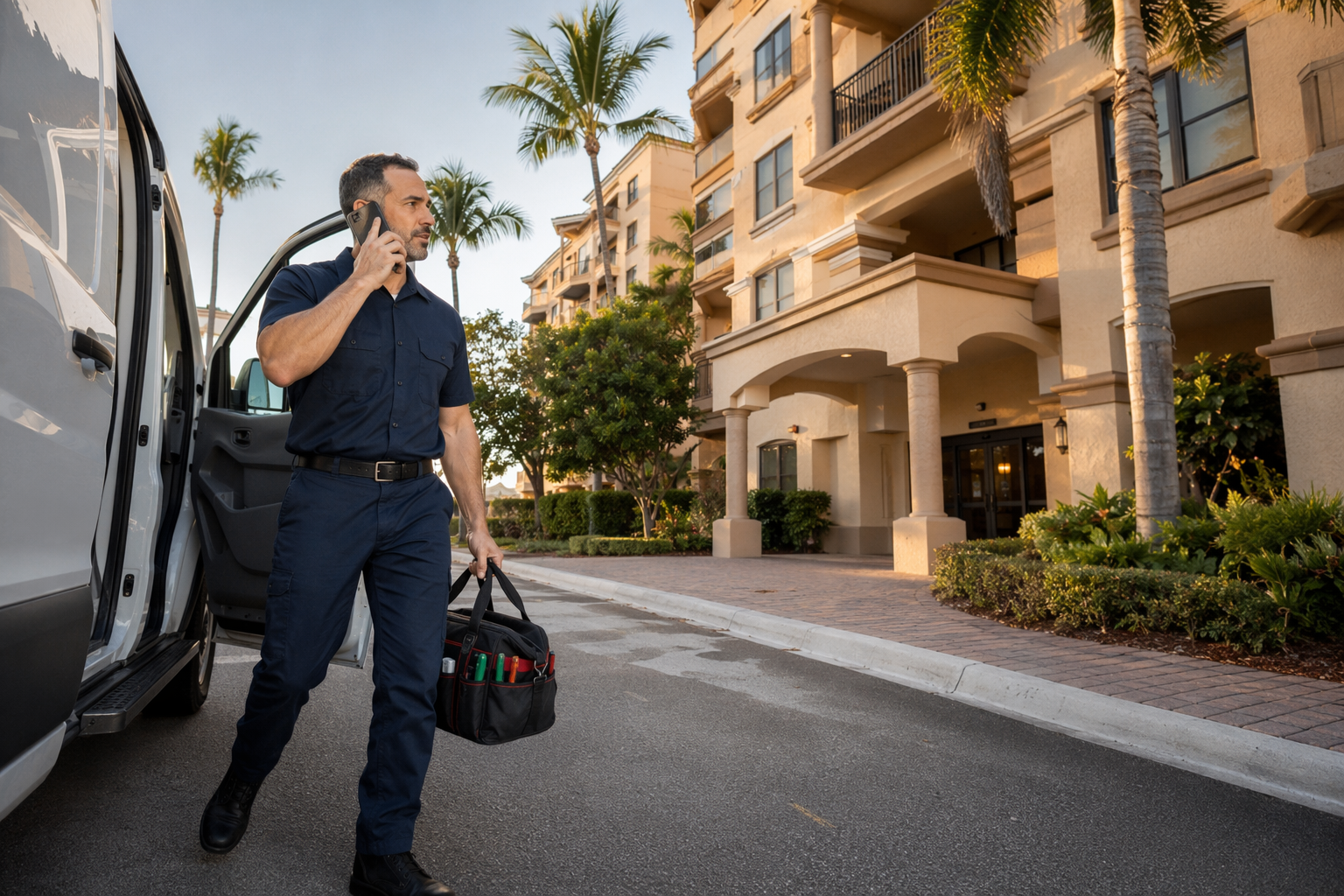
For property managers in Broward and Sarasota counties, Axxiom Elevator Florida provides 24/7 emergency dispatch from Pompano Beach and Sarasota service centers, with certified IUEC technicians on call every day of the year.
How fast can an elevator be repaired after a breakdown?
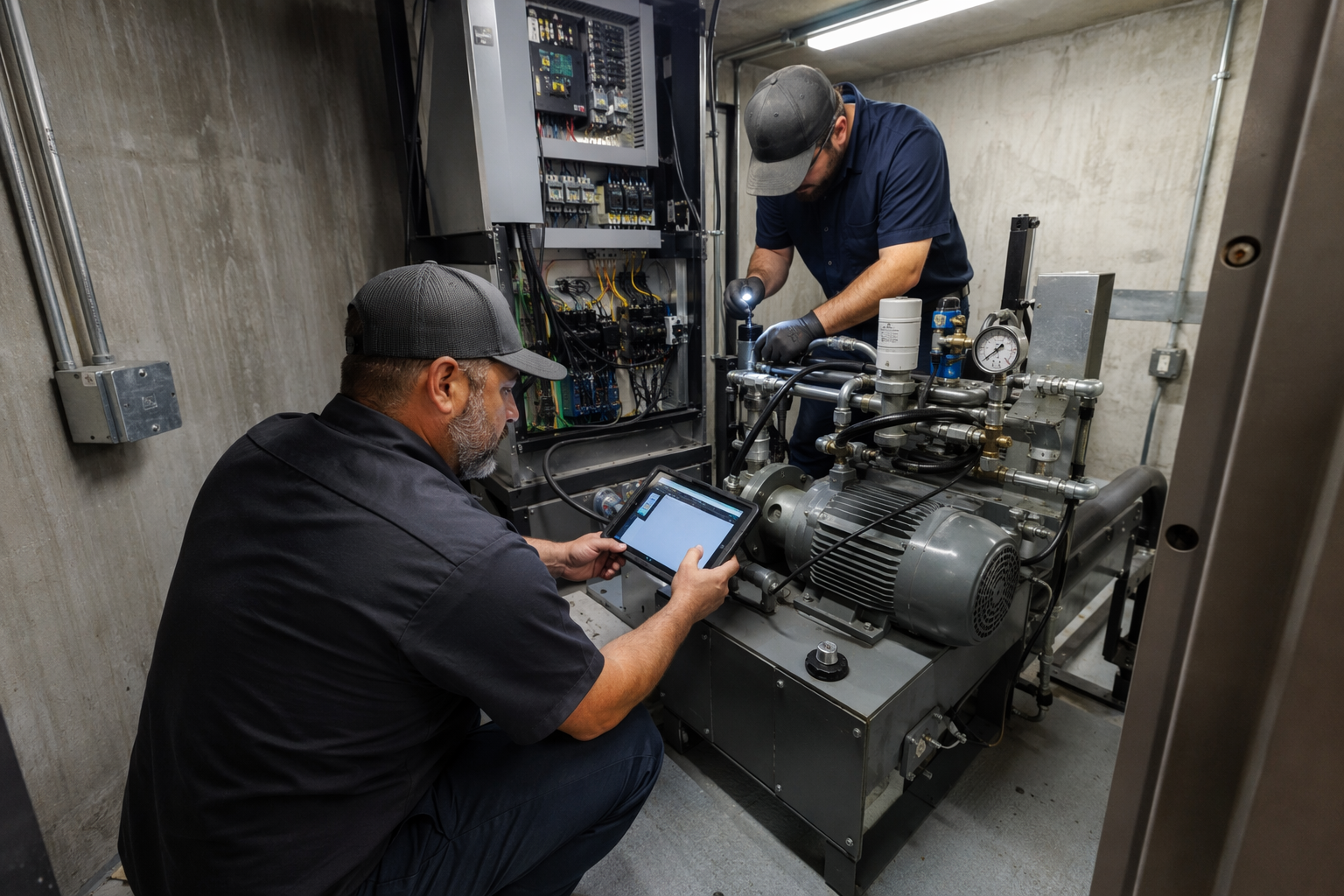
Most elevator breakdowns are resolved within 2–8 hours for emergency calls, and 1–5 business days for non-emergency repairs requiring parts sourcing.
Response and repair time depends on three variables: the severity of the fault, parts availability, and your contractor’s local inventory. From experience, the majority of emergency service calls — door operator failures, controller errors, and minor hydraulic issues — are resolved same-day when a well-stocked service vehicle arrives on site.
Larger component replacements such as hydraulic cylinders, motor controllers, or traction machine sheaves can take 3–10 business days when specialty parts must be ordered from the manufacturer. Older elevators — particularly those installed before 1990 — may require longer lead times because legacy parts are no longer in standard production and must be sourced from specialty suppliers or fabricated.
| Repair Type | Emergency Response Time | Typical Completion Time | Parts Availability |
|---|---|---|---|
| Door sensor / door operator fault | 2–4 hours | Same day | Usually in-stock |
| Controller reset / software fault | 2–4 hours | Same day | No parts needed |
| Hydraulic fluid leak (minor) | 2–6 hours | Same day – 1 day | Fluid in-stock |
| Brake adjustment or replacement | 2–6 hours | 1–3 business days | Usually in-stock |
| Motor or pump replacement | 4–8 hours | 3–7 business days | Order required |
| Hydraulic cylinder replacement | 4–8 hours | 5–14 business days | Custom order likely |
| Controller modernization | Next business day | 2–4 weeks | Planned procurement |
| Full elevator modernization | Scheduled | 4–12 weeks | Full project scope |
What should I do immediately when an elevator breaks down?
Follow a clear, sequential protocol to protect passengers, preserve safety, and document the incident for compliance purposes.
- Determine if any passengers are trapped. Use the intercom or phone the elevator cab emergency line. If passengers are inside and cannot exit safely, call 911 immediately before taking any other action.
- Place the elevator out of service. Switch the elevator to the “Independent Service” or “Inspection” mode at the machine room or hall call panel if you are authorized to do so. Place clear signage at every landing.
- Call your certified elevator contractor. Provide the building address, elevator ID number, approximate time of failure, any error codes displayed, and whether passengers were affected.
- Do not attempt to manually operate or force the elevator. Untrained attempts to manually lower a hydraulic elevator or release a traction elevator brake have caused fatalities. Leave the equipment alone until a licensed technician arrives.
- Document everything. Note the time of failure, any unusual sounds or smells, the floor where the cab stopped, and the names of affected passengers. This documentation is required for Florida Department of Business and Professional Regulation (DBPR) incident reporting.
- Notify your building’s insurance carrier if the breakdown caused injury, property damage, or extended service outage.
- Obtain a repair report from your contractor and retain it with your elevator’s maintenance log. Florida Statute 399 requires maintenance records to be available for state inspection at all times.
Is there a difference between an elevator emergency repair and a routine repair?
Yes — emergency repairs address immediate life-safety failures and trigger 24/7 response protocols, while routine repairs are scheduled during standard service windows and generally cost less.
Emergency repair scenarios include: passengers trapped in the cab, elevator failure between floors, smoke or burning odors from the machine room, hydraulic fluid actively leaking, broken door mechanisms that expose the shaft, and safety circuit faults that prevent the elevator from holding position. These situations demand immediate response regardless of time of day.
Routine repairs cover worn door gibs, minor hydraulic adjustments, lighting replacements, call button failures, and controller software updates. These can typically be scheduled within the normal service window without removing the elevator from service for extended periods.
What are the most common reasons elevators break down?
Door system failures account for approximately 70–80% of all elevator service calls, followed by hydraulic system issues and electrical controller faults.
In my experience across hundreds of Florida properties, the leading causes of unexpected elevator downtime are:
- Door operator and sensor failures: Safety edges, infrared curtains, and mechanical door couplers wear out with heavy use — particularly in high-traffic commercial buildings.
- Hydraulic fluid contamination or leaks: Florida’s heat accelerates fluid degradation. Hydraulic elevators require periodic fluid sampling and replacement.
- Controller board failures: Older relay-logic controllers and first-generation microprocessor boards are increasingly unreliable. Modernization is often more cost-effective than repeated board repairs.
- Worn brake linings: Traction elevator brakes must be inspected regularly under ASME A17.1 Safety Code for Elevators and Escalators requirements. Worn linings cause drifting and safety circuit trips.
- Deferred maintenance: Properties that skip annual or semi-annual maintenance appointments consistently experience 3–5 times more emergency calls than those on regular service contracts.
How much does elevator repair cost in Florida?
Elevator repair costs in Florida range from $150–$500 for minor diagnostic and adjustment calls to $5,000–$50,000+ for major component replacements, with emergency after-hours service typically adding a 25–50% premium.
Cost variables include the type of elevator (hydraulic vs. traction vs. MRL), age of the equipment, parts pricing, labor rates, and whether the repair occurs during standard hours or after-hours. Buildings without a preventive maintenance contract almost always pay significantly more per incident than those under a full-service agreement.
In Pompano Beach and Sarasota markets, full-service maintenance contracts that include labor and most parts typically run $200–$600 per month per elevator depending on elevator age, complexity, and call volume. This investment consistently reduces total annual repair costs and minimizes unplanned downtime.
Does Florida law require a licensed contractor to repair elevators?
Yes — Florida Statute 399 mandates that all elevator installation, alteration, maintenance, and repair work be performed by or under the direct supervision of a licensed elevator contractor, with no exceptions.
Florida is one of the most strictly regulated states for elevator work. The Florida Department of Business and Professional Regulation (DBPR) licenses elevator contractors and certificates of competency are required. Violations can result in stop-work orders, fines, and loss of the Certificate of Operation — which legally requires the elevator to be taken out of service until compliance is restored.
Additionally, every elevator in Florida must carry a current Certificate of Operation, which is only issued after a state inspection confirms compliance with ASME A17.1 Safety Code for Elevators and Escalators. Allowing an unlicensed individual to perform repairs will invalidate this certificate and expose the property owner to civil liability.
How often should elevators be inspected to prevent breakdowns?
Florida requires elevators to undergo a state inspection at least once every 12 months, but industry best practice calls for preventive maintenance visits every 1–3 months depending on usage level.
High-traffic elevators in commercial office buildings, hospitals, and apartment complexes with more than 100 trips per day should receive monthly maintenance. Moderate-use residential and low-rise commercial elevators typically perform well on a quarterly schedule. The annual state inspection required under Florida Statute 399 is a minimum safety baseline — not a substitute for regular preventive maintenance.
Axxiom Elevator Florida offers customized preventive maintenance programs for properties in Pompano Beach and Sarasota, calibrated to actual usage data rather than one-size-fits-all schedules.
What ASME codes govern elevator repair standards?
The primary governing code is ASME A17.1 Safety Code for Elevators and Escalators, with the 2019 edition currently adopted as the reference standard by Florida’s DBPR as of 2026.
ASME A17.1 covers design, construction, installation, operation, inspection, testing, maintenance, alteration, and demolition of elevators. For existing equipment, ASME A17.3 Safety Code for Existing Elevators and Escalators provides the applicable standards for inspections and alterations on legacy installations. Both codes are referenced in Florida’s adopted standards.
When a repair rises to the level of an “alteration” under ASME A17.1 — such as replacing a controller, changing a machine, or modifying the safety system — a permit must be obtained, the work must be inspected by a state-licensed inspector, and a new or amended Certificate of Operation must be issued before the elevator returns to passenger service.
What ADA requirements apply to elevator repairs?
Under ADA Standards for Accessible Design, any alteration to an elevator serving the public must maintain or improve accessibility features, including cab dimensions, door timing, control panel height, and audible/visual signals.
The ADA requires that elevators serving multiple floors in public accommodations and commercial facilities meet specific technical standards: minimum cab interior dimensions of 51 inches deep by 68 inches wide for rear-opening doors, door reopening devices that remain effective for a minimum of 20 seconds, and call buttons no higher than 54 inches above the floor for a side approach.
When performing repairs that involve door systems, control panels, or cab interiors, a certified technician must verify that the completed work maintains ADA compliance. Failing to do so during an alteration can trigger a compliance violation independent of the elevator code citation.
Can a building be fined for an elevator that is out of service too long?
In Florida, a building is not directly fined for downtime duration, but operating an elevator without a valid Certificate of Operation or failing to remove an unsafe elevator from service are both violations subject to fines and enforcement action.
The more significant financial risk from extended downtime is civil liability and breach of lease claims. Multi-tenant commercial buildings and residential apartment complexes with elevator-dependent units — particularly those housing residents with disabilities — face ADA-based fair housing complaints if elevator service is not restored within a reasonable timeframe. Courts have found that “reasonable” in multi-story residential buildings typically means 48–72 hours for a single-elevator building.
Properties that experience repeated or extended outages due to deferred maintenance are also flagged during state inspections, which can result in conditional operating certificates and mandatory compliance timelines.
What is the difference between elevator repair and elevator modernization?
Repair restores a specific failed component to its original operating condition; modernization replaces outdated systems with current technology to improve performance, reliability, energy efficiency, and code compliance.
Modernization becomes the right choice when repair costs on aging equipment begin to approach or exceed 30–40% of the modernization cost within a 12-month period. Additional triggers include: inability to source parts, repeated controller failures, hydraulic cylinder corrosion requiring full replacement, and inability to meet current ASME A17.1 or ADA standards without comprehensive system upgrades.
From a financial perspective, modernization is treated as a capital improvement and may qualify for depreciation and energy efficiency incentives, while individual repairs are operating expenses. Building owners in Pompano Beach and Sarasota should request a lifecycle cost analysis from Axxiom Elevator Florida to determine the crossover point for their specific equipment.
How do I choose the right elevator repair contractor in Florida?
Verify Florida DBPR licensure, IUEC certification, local parts inventory, 24/7 emergency availability, and references from comparable properties before signing any service agreement.
The checklist I recommend to every property manager:
- Florida DBPR License: Verify the contractor holds an active Elevator Contractor license — searchable at the DBPR website. No license, no work.
- IUEC Technician Certification: Technicians should be members of or trained to International Union of Elevator Constructors standards.
- Local presence: A contractor with a service center within 30–45 minutes of your property will always deliver faster emergency response than a regional dispatch center hours away.
- Parts inventory: Ask specifically what common parts are stocked in local vehicles. A contractor who must order every part from a national warehouse will consistently underperform on repair timelines.
- Transparent pricing: Service agreements should clearly define what is included, what triggers additional charges, and the after-hours rate structure.
- Safety record: Ask for OSHA incident data and reference the contractor’s safety program. OSHA standards for elevator industry work are governed under 29 CFR 1926.552 and related subparts.
What is a full-service elevator maintenance contract and do I need one?
A full-service maintenance contract covers all routine labor, most replacement parts, emergency response, and regulatory compliance support under a fixed monthly fee — and for any building with more than one elevator or more than moderate daily usage, it is almost always the most cost-effective option.
There are three common contract structures in the Florida market:
- Oil and Grease (Lubrication Only): The contractor performs lubrication and basic adjustments only. Parts and most labor are billed separately. Lowest monthly cost, highest risk of large unexpected repair bills.
- Parts and Labor: Covers most routine parts and labor but excludes major components like motors, cylinders, and controllers. Mid-range monthly cost.
- Full Service / Comprehensive: Covers nearly all parts and labor including major components, emergency response at no additional call charge, and regulatory compliance documentation. Highest monthly cost but the most predictable total cost of ownership.
For properties in Pompano Beach and Sarasota, Axxiom Elevator Florida structures agreements to match the actual risk profile of each property — residential high-rises, commercial offices, and healthcare facilities each have different needs and usage patterns.
What are the signs that my elevator needs emergency repair versus routine service?
Emergency repair is required any time there is a risk to passenger safety, active mechanical failure, or a safety circuit fault — do not wait for a scheduled maintenance visit in these situations.
Call for emergency service if you observe any of the following:
- Elevator stops between floors with passengers inside
- Doors do not fully open or close, or reverse unexpectedly
- Cab is not level with the floor (misleveling more than ½ inch)
- Burning smell or smoke from the machine room or pit
- Unusual loud noise — grinding, banging, or squealing
- Elevator moves when doors are open
- Emergency alarm or intercom system non-functional
- Visible hydraulic fluid on the pit floor or under the jack cylinder
Schedule routine service (non-emergency) for issues such as slow door operation, dim cab lighting, worn floor indicators, minor noise during normal operation, or call button failures that do not prevent safe operation.
How does Florida’s humidity and heat affect elevator repair frequency?
Florida’s subtropical climate — with average humidity above 70% and summer temperatures exceeding 95°F — accelerates corrosion, fluid degradation, and electrical component failure at rates measurably higher than temperate climates.
In my 15 years of Florida elevator work, I’ve seen hydraulic fluid degrade 40–60% faster in machines without climate-controlled machine rooms compared to manufacturer specifications written for temperate conditions. Pit moisture is a constant challenge — water intrusion from ground-level installations corrodes buffer springs, oil line fittings, and limit switch wiring. Coastal properties in Pompano Beach face additional salt-air corrosion on exposed components.
Florida-specific maintenance adaptations include: quarterly hydraulic fluid sampling rather than annual, corrosion-inhibiting coatings on pit steel components, sealed electrical enclosures in machine rooms without air conditioning, and more frequent door track cleaning to prevent debris accumulation that accelerates wear.
Can I get a repair estimate before authorizing elevator work?
Yes — any reputable Florida elevator contractor should provide a written estimate before beginning non-emergency repair work, and you have the right to a second opinion before authorizing major expenditures.
For emergency calls where immediate action is required to restore safety, technicians may need to perform initial stabilization work — such as manually lowering a stuck cab or securing open shaft doors — before a full diagnostic is complete. However, before proceeding with any significant parts replacement, you should receive a written scope of work and estimated cost.
For major repairs exceeding $2,000–$3,000, it is entirely reasonable to request quotes from two qualified Florida-licensed contractors. The key is to ensure both contractors are quoting to the same scope and ASME A17.1 compliance standard — not just comparing headline prices.
What records should I keep after an elevator repair?
Florida law requires that elevator maintenance and inspection records be retained and made available to state inspectors at all times — maintain a permanent log that includes every service visit, repair, parts replaced, and test result.
Required documentation includes:
- Certificate of Operation (must be posted in or near the elevator)
- Most recent state inspection report
- All maintenance visit reports with technician name, date, work performed, and parts replaced
- Repair reports for any breakdown incidents, including cause and corrective action
- Permits and inspection sign-offs for any alterations
- Test records for annual and five-year safety tests required under ASME A17.1
Many property managers maintain a physical binder in the machine room and a digital backup. Cloud-based maintenance management systems are increasingly used by professional property managers handling multiple elevator units across different buildings.
How do I prevent elevator breakdowns before they happen?
Preventive maintenance on a regular schedule — combined with real-time monitoring technology — is the single most effective strategy for reducing unplanned elevator downtime by 60–80% compared to reactive repair-only approaches.
The most impactful preventive measures are:
- Scheduled lubrication and adjustment visits: Monthly for high-use elevators, quarterly for moderate-use. Never skip these visits — deferred lubrication is the leading cause of accelerated component wear.
- Annual safety tests: Governor and safety device tests, pit inspection, machine room inspection, and door system force testing as required under ASME A17.1.
- Five-year hydraulic tests: Hydraulic cylinder and piping pressure tests required at five-year intervals.
- Remote monitoring: Modern elevator controllers support IoT-based monitoring that detects abnormal door operation, leveling variations, and motor temperature spikes before they cause a failure.
- Prompt response to minor symptoms: A slightly slow door or a subtle leveling variation that is ignored today will become an emergency call in 30–60 days. Call your contractor when you first notice anything unusual.
Why should I choose a local elevator contractor over a national service company?
Local certified contractors consistently outperform national chains on emergency response time, parts availability, and personalized service — which directly translates to less downtime and lower total cost for your property.
National elevator service companies operate through regional dispatch hubs that may be 60–120 miles from your property. When your elevator fails at 7:00 PM on a Friday, your emergency call enters a queue alongside calls from dozens of other properties. A locally based contractor with technicians living and working in your market can respond in a fraction of the time.
Axxiom Elevator Florida is based in and specifically serves Pompano Beach and Sarasota — our technicians know the buildings, the equipment commonly installed in each market, and the local inspection personnel. That local knowledge translates to faster diagnosis, faster parts sourcing, and a working relationship with state inspectors that helps accelerate certificate reinstatement after permitted repairs.
Get Your Elevator Running Safely — Contact Axxiom Elevator Florida Today
Whether you are dealing with an elevator that just went down, planning preventive maintenance, or evaluating a modernization project, Axxiom Elevator Florida is ready to help. Our IUEC-certified technicians serve Pompano Beach, Sarasota, and surrounding communities with 24/7 emergency response, transparent pricing, and full Florida DBPR compliance.
Contact Axxiom Elevator Florida for a free elevator assessment:
Available 24 hours a day, 7 days a week — including holidays — for emergency elevator service throughout Broward and Sarasota counties.