Elevator Entrapment Rescue Procedure: Complete Guide for Building Owners, Passengers & Safety Teams
Elevator entrapments are more common than most building owners realize. According to 2026 industry data from the National Elevator Industry Inc. (NEII), approximately 10,000 elevator entrapments occur annually in the United States. Understanding the correct rescue procedure — and having a certified service provider on call — is not just a best practice. In Florida, it is a legal obligation under Florida Statute 399 and the Florida Building Code, which adopts ASME A17.1 as its governing elevator safety standard.
This guide covers every aspect of elevator entrapment rescue: what to do immediately, who is authorized to perform the rescue, what the codes require, how long it should take, and what preventive measures reduce entrapment risk. Whether you manage a commercial property in Pompano Beach, a condominium tower in Sarasota, or a medical facility anywhere in South or Central Florida, this resource gives you the procedural clarity you need.
What Is the Standard Elevator Entrapment Rescue Procedure?
The standard procedure requires stopping the elevator car, communicating with passengers, manually positioning the car to the nearest floor landing, and releasing passengers through the hoistway door — performed only by a licensed elevator mechanic or trained emergency responder following ASME A17.1 Section 2.27.
The rescue sequence follows a strict order of operations to prevent secondary injuries. A passenger must never attempt to exit through the top escape hatch without professional guidance, and untrained building staff should not attempt to manually release brake mechanisms. The procedure differs slightly depending on whether the elevator is hydraulic or traction-driven, but the communication-first, movement-second approach is universal.
Under ASME A17.1-2022, the elevator machine room must contain written emergency instructions, and a licensed mechanic must be reachable within a defined response window. Florida adds a layer of specificity: the Florida Department of Business and Professional Regulation (DBPR) requires that any person performing a manual rescue operation hold a valid Florida elevator certificate of competency.
What Should a Trapped Passenger Do Immediately?

A trapped passenger should press the alarm button, use the emergency two-way communication system, remain calm, stay inside the cab, and wait for a trained technician — never attempt to force open doors or exit through the top hatch unsupported.
- Press and hold the alarm button — This triggers the audible alarm and in modern systems alerts a 24/7 monitoring center.
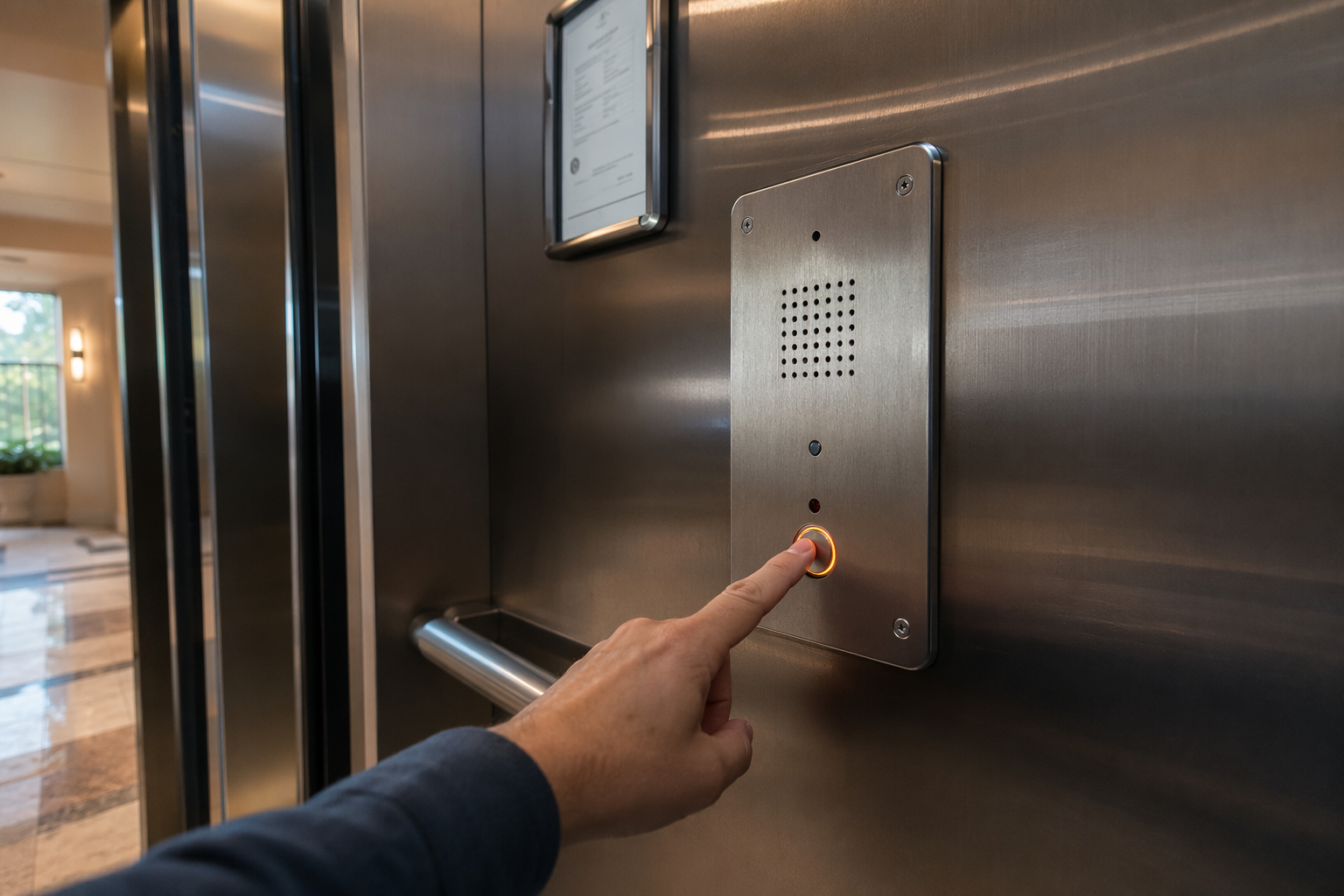
- Use the two-way emergency phone — ASME A17.1 Section 2.27.1 requires a code-compliant two-way communication device in every elevator cab. Press the help button and speak clearly.
- Communicate your condition — Tell the operator how many people are in the car, whether anyone is injured or has a medical condition, and your approximate floor location.
- Move away from the doors — Stand toward the center-rear of the cab to stay clear when doors are opened during rescue.
- Do not attempt to pry doors open — Door interlock mechanisms under tension can snap shut, causing serious lacerations or crush injuries.
- Do not climb through the escape hatch — An elevator hoistway is an active mechanical environment. Exit through the hatch is authorized only by rescue personnel on-scene.
- Stay low if smoke is present — In a fire situation, crouch and wait for fire department instruction. Do not use the elevator for evacuation per ADA and building code fire safety protocols.
- Reassure others in the cab — Panic increases the risk of injury. Remind fellow passengers that entrapments rarely indicate structural danger and that help is coming.
Who Is Authorized to Perform an Elevator Entrapment Rescue in Florida?
In Florida, only a licensed elevator mechanic holding a certificate of competency issued under Florida Statute 399, or a trained fire department rescue team operating under established procedures, is legally authorized to perform an elevator entrapment rescue.
Building engineers, security guards, and property managers — regardless of experience — are not authorized to manipulate elevator braking or drive systems unless they hold the appropriate Florida DBPR elevator license. Violations can result in civil liability, code violations, and license revocation for the building operator.
Fire departments in Broward County (which covers Pompano Beach) and Sarasota County train rescue personnel on elevator-specific procedures, but they typically defer to licensed elevator mechanics for anything beyond basic door-release maneuvers. This is why having a service agreement with a certified provider like Axxiom Elevator Florida — with technicians stationed in both Pompano Beach and Sarasota — ensures that a credentialed mechanic can be on-site within the required response window.
What Are the Step-by-Step Rescue Procedures for Building Staff?
Building staff have a defined, limited role in elevator entrapment: notify, communicate, document, and facilitate professional rescue — not physically intervene in mechanical systems.
- Confirm the entrapment — Verify via the building’s emergency phone system or intercom that passengers are trapped and identify their location.
- Call your elevator service company immediately — Your maintenance contract should include a 24/7 emergency dispatch number. Response time SLAs (service-level agreements) typically range from 30 minutes to 2 hours depending on the contract tier.
- Call 911 if there is a medical emergency — If a passenger reports chest pain, difficulty breathing, or if the entrapment exceeds 30 minutes in extreme heat, dispatch emergency medical services concurrently.
- Post staff at the elevator landing — Station a staff member at the floor nearest the stalled car to assist passengers during exit and keep bystanders clear of the hoistway door area.
- Do not attempt to operate the car from the machine room — Unless you are licensed, do not touch brake release levers, hand-winding wheels, or electrical panels.
- Document the time, car number, and reported floor — This information assists the arriving technician and is required for the incident report mandated under Florida Administrative Code 61C-5.
- Keep the machine room accessible — Unlock the machine room and ensure the arriving technician has unobstructed access to the drive unit, controller, and brake assembly.
- Complete an incident report within 24 hours — Florida regulations require building owners to file a report with the DBPR following any entrapment incident.
How Does a Certified Technician Physically Perform an Elevator Rescue?
A certified elevator mechanic performs the rescue by accessing the machine room, verifying car position via the car position indicator, manually releasing the brake (or activating the emergency lowering valve on hydraulic units), easing the car to the nearest landing, and coordinating door release with ground staff.
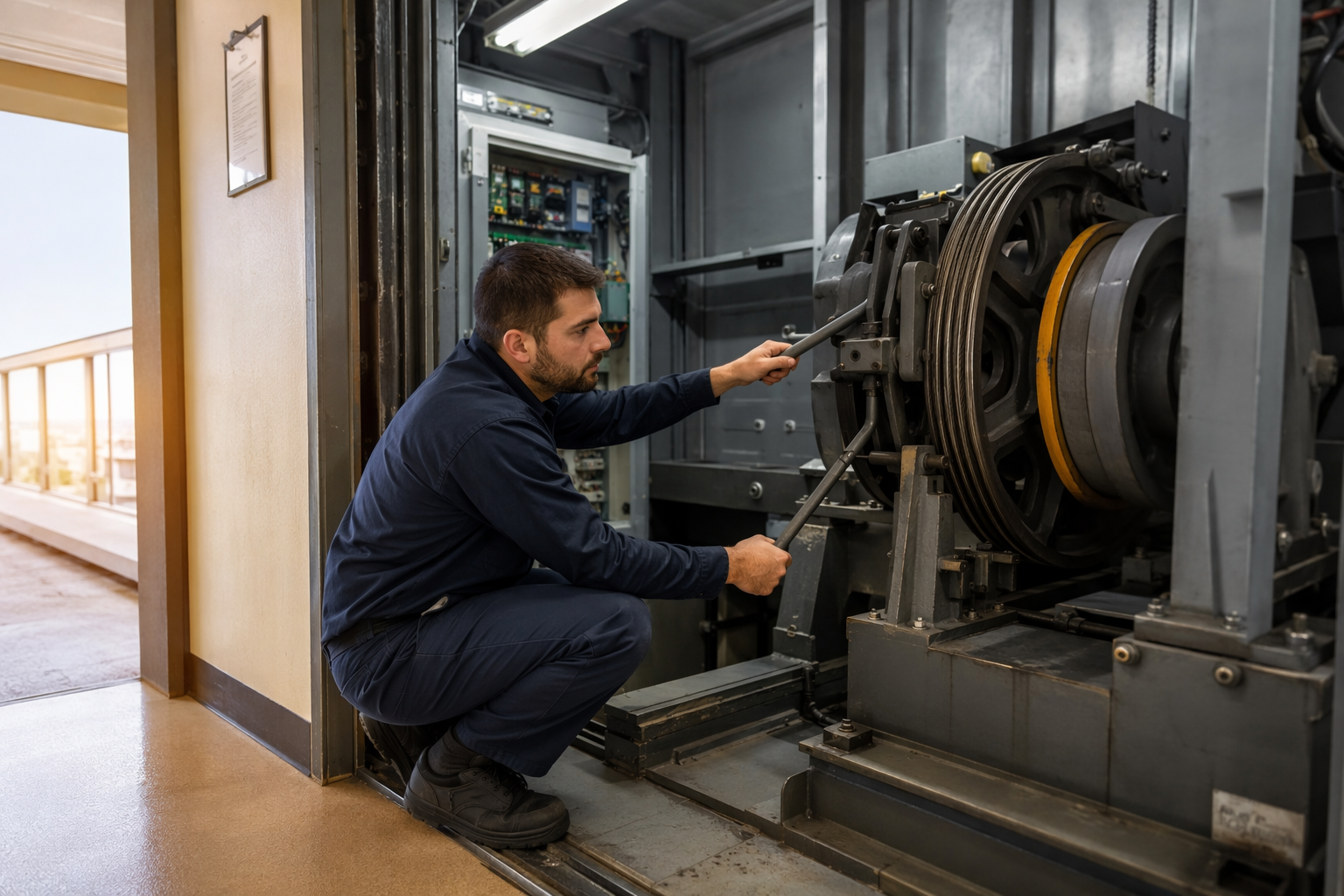
For traction elevators, the technician uses the hand-winding wheel on the drive sheave to manually move the car to the nearest floor, monitoring the car position indicator throughout. The brake is released in small increments to allow controlled movement. This process requires two people: one in the machine room operating the brake and winding wheel, one at the landing confirming car position and managing the door.
For hydraulic elevators, the technician accesses the pump unit and opens the manual lowering valve, allowing hydraulic fluid to return to the tank and the car to descend by gravity to the nearest lower landing. The descent rate is controlled by the valve opening. Hydraulic rescues are generally faster but only allow downward movement.
Once the car is level with a landing (within the ±1-inch tolerance required by ASME A17.1 Section 2.1.4 for leveling accuracy), the technician releases the door interlock using the hoistway door unlocking key (sometimes called an “emergency key” or “drop key”), opens the car and landing doors, and assists passengers to exit safely.
What Does ASME A17.1 Require for Elevator Emergency Operations?
ASME A17.1-2022 requires that every elevator have an emergency two-way communication system, written rescue instructions posted in the machine room, a means of manual operation, and that Phase I and Phase II emergency recall and operation features be fully functional at all times.
Key ASME A17.1 requirements relevant to entrapment rescue include:
- Section 2.27.1: Two-way emergency communication device in every elevator cab, capable of connecting to a location staffed 24/7.
- Section 2.27.3: Emergency lighting providing a minimum of 1 foot-candle at floor level for at least 4 hours.
- Section 2.8.2: Phase I Emergency Recall — elevators must return to the designated recall floor upon activation of the building fire alarm.
- Section 2.8.3: Phase II In-Car Emergency Operation — allows firefighters to operate the car manually during an emergency.
- Section 2.26.9: Requires that means for manual operation in case of power failure be provided and described in machine room instructions.
Florida adopts ASME A17.1 by reference in the Florida Building Code, 7th Edition (2020), with local amendments. Building owners who are not current on code compliance risk failed inspections and — more critically — longer rescue times during a real entrapment event.
What Is the Required Response Time for an Elevator Entrapment in Florida?
Florida does not prescribe a specific statutory response time for entrapment rescue, but ASME A17.1 and industry standards set a 1-hour benchmark as the acceptable maximum, with most full-service contracts guaranteeing 30–60 minute emergency response.
In practice, response time depends on technician proximity, time of day, and your service agreement terms. The table below compares typical response tiers available in the Florida market:
| Service Tier | Emergency Response Time | Coverage Hours | Typical Contract Cost (Annual) | Entrapment Protocol Included |
|---|---|---|---|---|
| Basic Maintenance Only | 2–4 hours (next available) | Business hours only | $800–$1,500/unit | No guaranteed response |
| Standard Full-Service | 60–90 minutes | Mon–Fri, 7am–5pm | $1,500–$3,000/unit | Basic call-back service |
| Premium 24/7 Full-Service | 30–60 minutes | 24/7/365 | $3,000–$6,000/unit | Dedicated on-call technician |
| Axxiom Elevator Florida | 30–45 minutes (Pompano Beach & Sarasota zones) | 24/7/365 | Competitive — contact for quote | Full ASME A17.1-compliant rescue protocol |
For properties with vulnerable populations — assisted living facilities, hospitals, senior housing — a 30-minute or faster response is strongly recommended and may be required by facility licensing standards under the Agency for Health Care Administration (AHCA) in Florida.
What Equipment Does a Technician Use During an Elevator Rescue?
A certified elevator rescue technician uses a combination of specialized tools including a hand-winding wheel, brake release lever, hoistway door unlocking key, car position indicator, emergency lighting, and for hydraulic elevators, a manual lowering valve tool.
Standard equipment carried by a qualified elevator mechanic for entrapment response includes:
- Hoistway door unlocking key (drop key) — Required by ASME A17.1 Section 2.12.6. Must be kept in the building and accessible only to authorized personnel.
- Hand lantern or portable lighting — Machine rooms and hoistways may lose lighting during the same event that caused the entrapment.
- Communication device — Two-way radio to coordinate between machine room technician and landing-level staff.
- Personal protective equipment — Hard hat, safety gloves, and steel-toed boots are minimum PPE for hoistway proximity work.
- Machine room rescue instructions — ASME A17.1 requires laminated rescue instructions specific to that elevator to be posted in the machine room. The technician reviews these on every new property.
- Voltage tester — To verify power status before touching any drive or brake components.
How Long Does an Elevator Entrapment Rescue Typically Take?
From the time a licensed technician arrives on-site, a standard elevator entrapment rescue takes between 5 and 30 minutes depending on the elevator type, car position, and accessibility of the machine room.
The overall timeline from initial call to passenger release typically breaks down as follows:
- 0–5 minutes: Passenger activates alarm; building staff or monitoring center contacts elevator service company.
- 5–45 minutes: Technician travel time to site (varies by location and time of day).
- 2–5 minutes: Technician assesses situation, accesses machine room, verifies car position.
- 5–20 minutes: Manual rescue operation — moving car to landing, releasing doors, assisting passengers.
- 10–30 minutes: Post-rescue inspection to identify root cause before returning elevator to service.
Total elapsed time from entrapment to passenger release is typically 45–90 minutes for after-hours emergencies and 20–45 minutes during business hours in well-covered service areas like Pompano Beach and Sarasota.
Can Firefighters Perform an Elevator Entrapment Rescue?
Yes, firefighters are trained and authorized to perform elevator entrapment rescues, particularly when passengers face a medical emergency or when the entrapment is associated with a fire alarm activation, but they defer to licensed elevator mechanics for mechanical intervention when time permits.
Fire departments in Florida receive training on elevator Phase I/Phase II operations, door interlock release, and hoistway access procedures. However, complex mechanical rescues — particularly those involving disabled drive systems or stuck safeties — require the expertise of a licensed elevator mechanic. The recommended protocol in most Florida jurisdictions is to dispatch both the fire department and the elevator service company simultaneously for any entrapment involving a vulnerable passenger or a duration exceeding 15 minutes.
What Causes Most Elevator Entrapments?
The majority of elevator entrapments are caused by door malfunctions, leveling failures, power outages, and deferred maintenance — most of which are preventable with a proactive quarterly inspection and maintenance program.
According to 2026 NEII industry data, door-related issues account for approximately 42% of all elevator entrapments. The breakdown of common causes includes:
- Door operator failures (42%) — Worn rollers, misaligned door gibs, and failing clutch mechanisms.
- Leveling and re-leveling failures (21%) — Encoder drift, worn brake linings, or hydraulic oil contamination causing the car to stop between floors.
- Power interruptions (18%) — Including utility outages, GFCI trips, and controller failures.
- Safety device activation (12%) — Governor overspeed trips, buffer contact, or oil buffer problems on hydraulic units.
- Other/miscellaneous (7%) — Including vandalism, overloading, and environmental factors.
Preventive maintenance addressing these specific failure modes — particularly door components and leveling systems — is the single most effective way to reduce entrapment frequency. Axxiom Elevator Florida technicians in Pompano Beach and Sarasota prioritize door system inspection and brake lining measurement during every scheduled maintenance visit precisely because of these statistics.
What Are Florida’s Legal Requirements for Elevator Entrapment Response Plans?
Florida Statute 399 and Florida Administrative Code Rule 61C-5 require that every building with a permitted elevator maintain a current service contract with a licensed elevator contractor and have written emergency procedures accessible to building management staff.
Specific Florida requirements relevant to entrapment preparedness include:
- All elevators must be under a maintenance contract with a Florida-licensed elevator contractor (F.S. 399.02).
- Annual safety inspections must be performed by a licensed elevator inspector; the certificate of inspection must be posted inside the elevator cab (F.A.C. 61C-5.001).
- Buildings must maintain a current emergency contact number for their elevator service provider and have it posted in the machine room and at the building management office.
- Entrapment incidents must be reported to the Florida DBPR, particularly if the entrapment involved a safety device activation or injury.
- Assisted living facilities and healthcare facilities are subject to additional AHCA requirements regarding elevator emergency response time and documentation.
How Does an ADA-Compliant Elevator Affect Entrapment Rescue for People with Disabilities?
ADA-compliant elevators include features specifically designed to facilitate rescue for passengers with disabilities, including two-way communication at accessible height (15–48 inches AFF), illuminated call buttons, and audible/visual emergency signals — but the rescue procedure itself must also account for mobility limitations during exit.
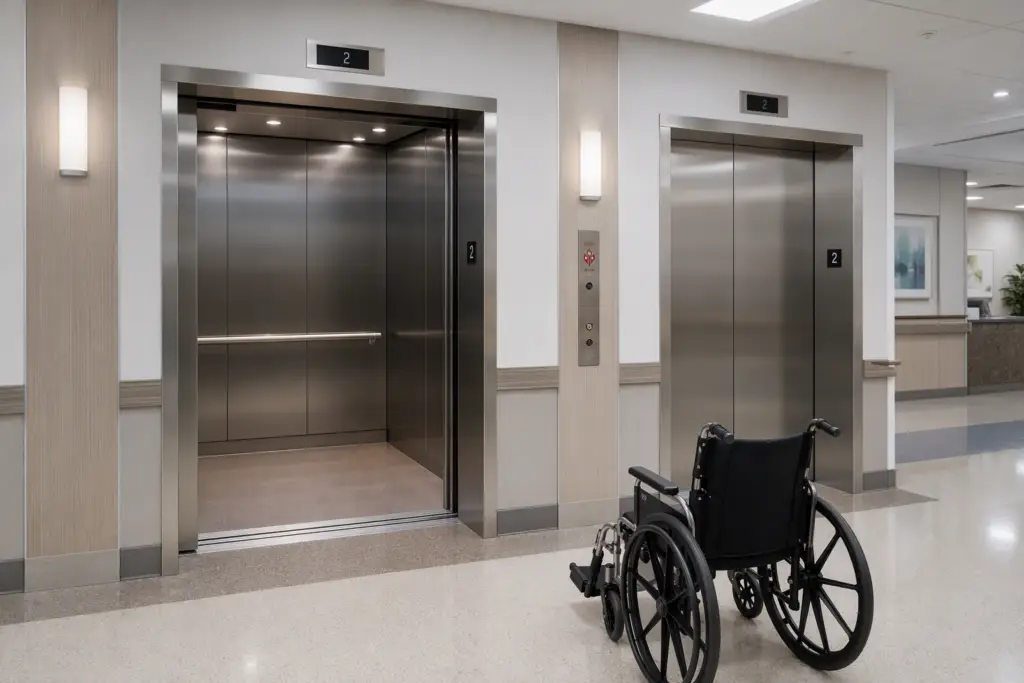
Under the Americans with Disabilities Act and ADA Standards for Accessible Design (Section 407), elevator emergency communication systems must be usable without voice (for passengers who are deaf or have speech impairments) and operable with one hand without tight grasping or twisting. During a rescue involving a passenger with a mobility disability, technicians must ensure the car is precisely level with the landing — within the ±½-inch tolerance — before opening doors, as any gap creates a trip and fall hazard for wheelchair users or those with canes and walkers.
Buildings serving significant populations of people with disabilities — including the senior residential communities common in both Pompano Beach and Sarasota — should include disability-specific protocols in their elevator emergency response plan, such as designating a staff member to assist with wheelchair transfer during rescue exit.
What Should Be Included in a Building’s Elevator Emergency Response Plan?
A compliant elevator emergency response plan must include the service company emergency contact, machine room access procedures, passenger communication protocols, staff role assignments, entrapment documentation requirements, and coordination procedures with local fire and EMS services.
A well-structured plan includes the following components:
- 24/7 emergency contact for your licensed elevator service provider
- Local fire department non-emergency dispatch number for simultaneous notification
- Machine room location, key access procedure, and authorized personnel list
- Elevator-specific rescue instructions (required to be posted in machine room per ASME A17.1)
- Staff communication tree — who calls whom and in what order
- Passenger reassurance script for building staff (what to say over the intercom)
- Incident documentation form meeting Florida DBPR reporting requirements
- Post-incident out-of-service notification procedure for building occupants
Axxiom Elevator Florida provides clients in both Pompano Beach and Sarasota with a customized emergency response plan template as part of their maintenance agreement — ensuring that building staff are prepared before an entrapment ever occurs.
How Often Should Elevator Safety Systems Be Tested to Prevent Entrapments?
Under ASME A17.1 and Florida law, elevator safety tests are required on a defined schedule: annual Category 1 tests, five-year Category 5 tests for hydraulic units, and periodic tests for safeties, buffers, and governors — all performed by licensed personnel.
The testing schedule under Florida’s adoption of ASME A17.1 includes:
- Category 1 (Annual): No-load safety and operational test of all functions including emergency lighting, two-way communication, door reopening devices, and leveling accuracy.
- Category 3 (Every 3 years): Governor and safety device test for traction elevators.
- Category 5 (Every 5 years): Full-load rated speed test of safeties and buffers for traction elevators; pressure relief and lowering valve tests for hydraulic units.
- Monthly (recommended): Door operator functionality, emergency lighting, and two-way phone verification — these are the systems most directly involved in entrapment rescue.
What Is the Difference Between Elevator Entrapment and Elevator Breakdown?
An elevator entrapment means passengers are physically trapped inside the cab and cannot self-exit; a breakdown means the elevator is inoperable but no one is trapped — entrapment is always a higher-priority emergency requiring immediate dispatch.
The distinction matters for dispatch priority and legal reporting obligations. An entrapment triggers the full emergency response protocol — immediate technician dispatch, potential fire department notification, and DBPR reporting if the entrapment exceeds certain thresholds or involves injury. A breakdown (car out of service, stuck between calls but empty) is logged as a standard service call. Many elevator monitoring systems now differentiate these conditions automatically using load sensors and door position data, transmitting different alarm codes to the monitoring center.
How Can Building Owners Reduce Elevator Entrapment Risk?
Building owners can significantly reduce entrapment risk through quarterly preventive maintenance, monthly door system inspections, annual safety testing, immediate repair of callback issues, and modernization of aging control systems past their 20-year service life.
The most impactful actions a building owner can take in 2026 include:
- Upgrade to a full-service maintenance contract — Not all maintenance contracts are equal. Ensure yours includes lubrication, adjustment, and parts replacement, not just inspection.
- Install remote monitoring — Modern elevator monitoring systems detect anomalies — unusual door cycle counts, irregular leveling patterns, brake wear indicators — before they cause an entrapment.
- Address callbacks immediately — Every service callback is a warning sign. A car that has already stopped unexpectedly once is statistically likely to do so again.
- Test emergency communication monthly — A two-way phone that fails during an entrapment dramatically worsens the outcome. Monthly verification takes under 5 minutes.
- Plan for modernization — Elevators over 20–25 years old with original controls and door operators are significantly more prone to entrapments. A modernization assessment is a sound investment for properties in this category.
What Does an Elevator Entrapment Rescue Cost, and Who Pays?
Emergency entrapment rescue calls typically cost $150–$500 or more for after-hours labor if not covered under a service contract; building owners bear this cost and any associated liability, which is why full-service maintenance agreements with emergency coverage are the financially prudent choice.
Cost variables include:
- After-hours labor rates: Emergency calls outside business hours typically carry overtime rates of 1.5x–2x standard labor, ranging from $150–$350/hour in the Florida market as of 2026.
- Minimum dispatch fee: Most service companies charge a minimum of 2–4 hours labor for emergency calls.
- Parts and repairs: If the entrapment was caused by a failed component (door operator board, brake coil, hydraulic valve), repair costs are separate from the rescue call and can range from $200 to several thousand dollars.
- Liability exposure: If a passenger is injured during an entrapment — physically or psychologically — building owners without documented maintenance and response protocols face significant civil liability exposure.
Buildings under a comprehensive service agreement with Axxiom Elevator Florida have emergency rescue response included in their contract, eliminating surprise labor costs and providing documented compliance that protects building owners in the event of an insurance claim or litigation.
How Do I Choose the Right Elevator Service Company for Emergency Rescue Coverage in Florida?
Choose a Florida-licensed elevator contractor with IUEC-certified technicians, 24/7 emergency dispatch, documented response time guarantees, local coverage in your area, and a track record of ASME A17.1-compliant rescue procedures — not just the lowest annual contract price.
Key criteria to evaluate when selecting or switching elevator service providers include:
- Florida DBPR license verification — Confirm the company holds a current Florida elevator contractor license. This is publicly verifiable through the DBPR website.
- IUEC technician certification — Technicians should hold International Union of Elevator Constructors certification or equivalent credentialing.
- Local technician deployment — A company with technicians physically based in your service area (not dispatching from 3 counties away) delivers faster response times.
- Emergency response SLA in writing — Any verbal promise of response time is meaningless. Insist on a written service-level agreement with defined emergency response windows.
- References from similar property types — A company experienced with residential high-rises may not be the best choice for a hospital or a senior living facility, and vice versa.
Axxiom Elevator Florida serves Pompano Beach and Sarasota with locally based, IUEC-certified technicians, written emergency response guarantees, and full compliance with Florida Statute 399 and ASME A17.1-2022. For building owners evaluating their current service coverage, requesting a comparison assessment is a no-obligation way to identify gaps in your current entrapment response preparedness.
Ready to Ensure Your Property Is Prepared for an Elevator Entrapment Emergency?
Elevator entrapments happen without warning. The difference between a 10-minute rescue and a 90-minute ordeal — and between a protected building owner and an exposed liability — comes down to one factor: who you have on call. Don’t wait for an entrapment to discover your current provider’s response time doesn’t meet code expectations or your tenants’ safety needs.
Contact Axxiom Elevator Florida for a free elevator assessment. Our IUEC-certified technicians serve Pompano Beach, Sarasota, and surrounding Florida communities with 24/7 emergency entrapment rescue response, full ASME A17.1 compliance programs, and transparent service agreements that protect you, your tenants, and your property.
Call us today:
Or reach out online to schedule your no-cost elevator safety and emergency preparedness assessment. We’ll review your current maintenance contract, test your emergency communication systems, verify your machine room rescue instructions, and provide a written report of any gaps — at no charge.