An elevator breakdown is more than an inconvenience — it can be a safety emergency. Whether a car stalls mid-shaft, doors fail to open, or the system shuts down entirely, knowing exactly who to call and in what order can protect passengers, limit liability, and get the unit back in service as quickly as possible. This comprehensive FAQ answers every question building owners, property managers, and facility directors need to navigate an elevator breakdown from the first moment of failure through full restoration and compliance documentation.
Who is the first person to call when an elevator breaks down?
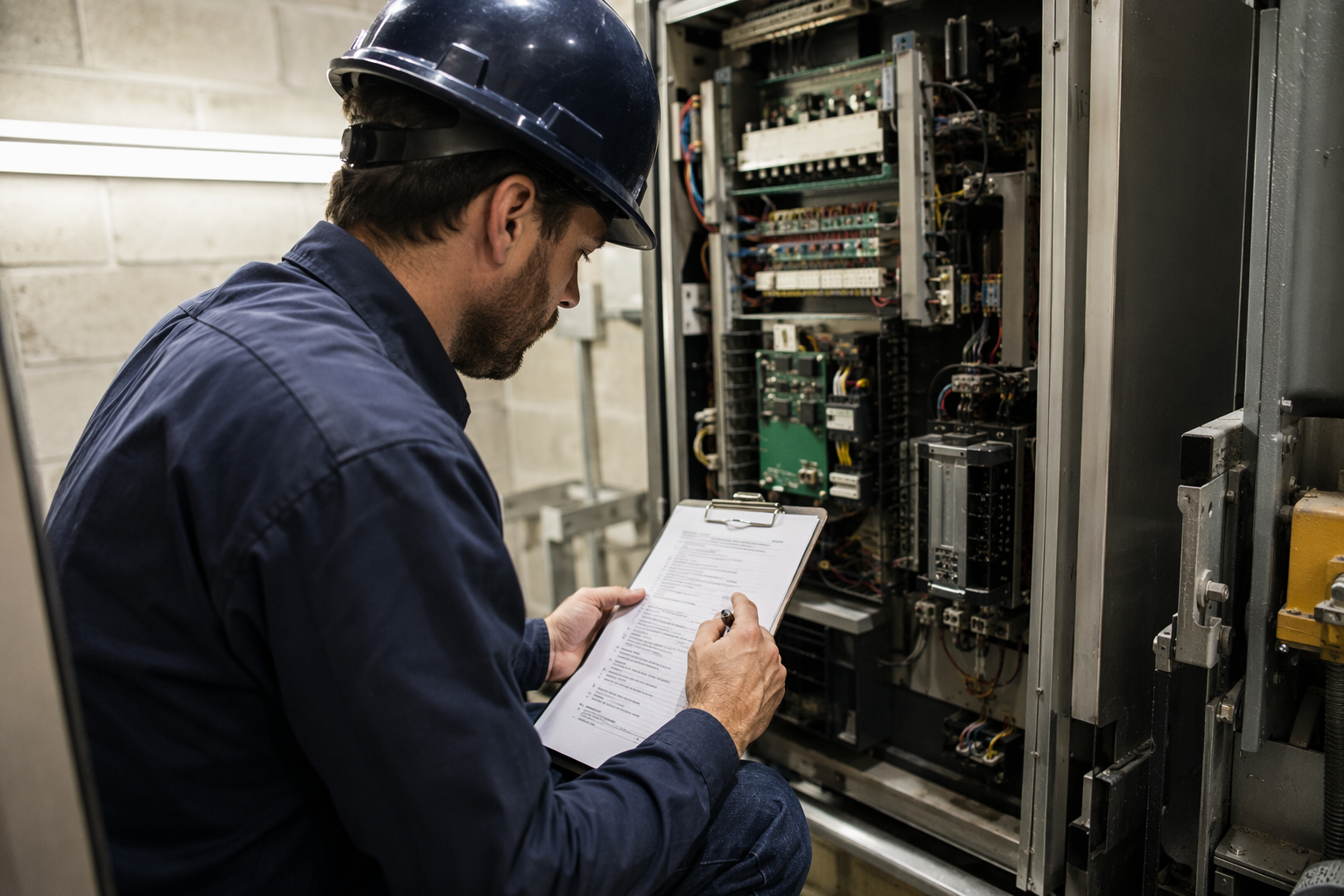
If anyone is trapped inside the elevator car, call 911 immediately, then contact your certified elevator service contractor.
Local fire and rescue departments are trained to perform passenger extractions, but they are not elevator technicians and will not repair the unit. Once the fire department confirms passenger safety, the responsibility shifts entirely to a licensed elevator service company. Building owners should post an emergency contact number — including a 24-hour elevator service line — inside every elevator machine room and at the building’s main security or management desk. Axxiom Elevator Florida serves property owners and managers throughout Pompano Beach and Sarasota with certified elevator breakdown response.
What should I do immediately when an elevator stops working?
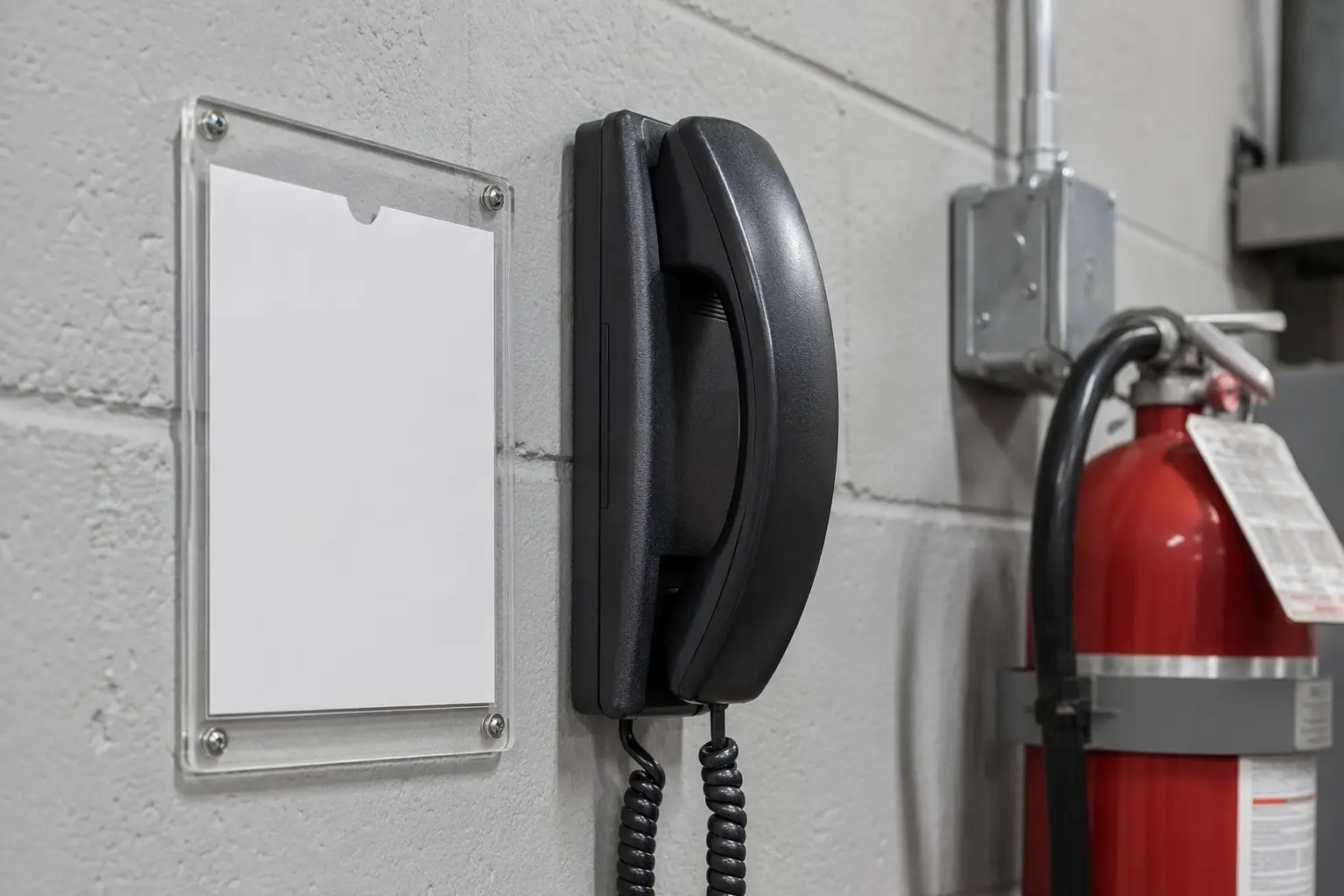
Follow a clear sequence of steps to protect passengers and begin the repair process without delay.
- Determine if anyone is trapped. Approach the elevator landing, listen for voices, and check the communication intercom if the car is equipped with one — as required by ASME A17.1 Safety Code for Elevators and Escalators.
- Call 911 if passengers are inside. Do not attempt a manual rescue without fire department coordination. Improper extraction can injure passengers or cause the car to move unexpectedly.
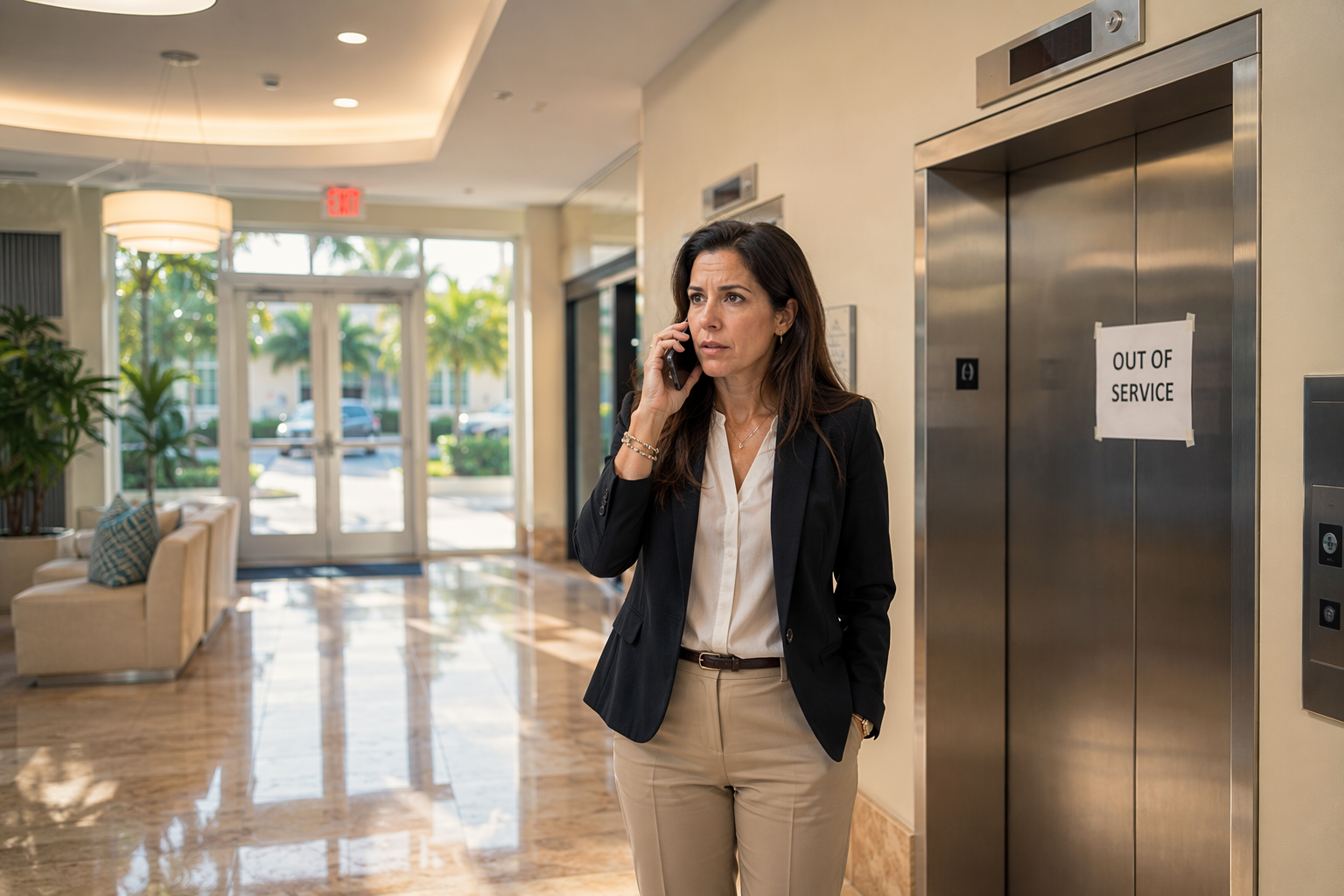
- Place the elevator out of service. Use the key switch or lock off the call buttons at each landing to prevent additional passengers from attempting to board.
- Post signage at every landing. Clearly mark the elevator as out of service and direct passengers to stairs or an accessible alternative route.
- Call your licensed elevator service contractor. Provide the elevator address, unit number, the nature of the failure (doors, movement, complete shutdown), and whether anyone was inside at the time of stoppage.
- Document the incident. Note the time, floor location of the car, any error codes displayed, and the names of witnesses. This documentation will support insurance claims and regulatory reporting.
- Notify your insurance carrier if passengers were trapped or if property damage occurred.
- Do not reset or restart the elevator yourself unless you are a licensed elevator technician. Bypassing safety systems can create additional hazards and may void insurance coverage.
When should I call 911 versus my elevator service company?
Call 911 any time a person is trapped, injured, or in immediate danger; call your elevator service company for all mechanical failures where passengers are not at risk.
The distinction matters because fire rescue personnel handle life-safety extractions while elevator service technicians diagnose and repair mechanical, electrical, and hydraulic faults. Calling only the elevator company when someone is trapped delays rescue; calling only 911 for a non-entrapment shutdown delays repair and restoration. Both calls may ultimately be necessary, but sequence and context determine priority. Florida building codes reinforce this division of responsibility by requiring a two-way emergency communication system in every elevator car — a provision aligned with ASME A17.1 requirements — so that passengers can always reach help directly.
What qualifications should an emergency elevator contractor have?
Any contractor performing elevator repairs in Florida must hold a valid state elevator contractor license issued through the Florida Department of Business and Professional Regulation (DBPR).
Florida Statute Chapter 399 governs elevator safety, licensing, and inspections. Under this framework, elevator contractors must be licensed before performing installation, maintenance, alteration, or repair work on any elevator or related conveyance. Beyond state licensure, qualified contractors should demonstrate familiarity with ASME A17.1 Safety Code for Elevators and Escalators, the applicable edition adopted by Florida, as well as ADA accessibility requirements that affect elevator design and operation. When evaluating a contractor, building owners should request proof of state licensure, ask about their familiarity with the specific make and model of elevator installed, and confirm that technicians dispatched for emergency calls are qualified to work on that equipment type.
What are the most common causes of elevator breakdowns?
The most frequent causes of elevator failures include door system malfunctions, electrical faults, worn mechanical components, hydraulic fluid issues, and overloading.
Door-related problems account for a significant share of elevator service calls. Misaligned door tracks, faulty door operators, and worn door contacts can prevent doors from opening or closing correctly, triggering safety shutdowns. Electrical issues — including control board failures, sensor malfunctions, and wiring degradation — can cause unpredictable behavior or complete loss of operation. In hydraulic elevators common in low-rise buildings across Pompano Beach and Sarasota, fluid leaks or pump failures are a frequent source of breakdowns. Traction elevators may experience brake wear, hoist rope deterioration, or sheave issues. Regular preventive maintenance, as outlined in ASME A17.1, is the most reliable method for preventing these failures before they occur.
How does preventive maintenance reduce elevator breakdowns?
Scheduled preventive maintenance catches wear, misalignment, and component degradation before they cause failures, reducing unplanned outages and extending equipment life.
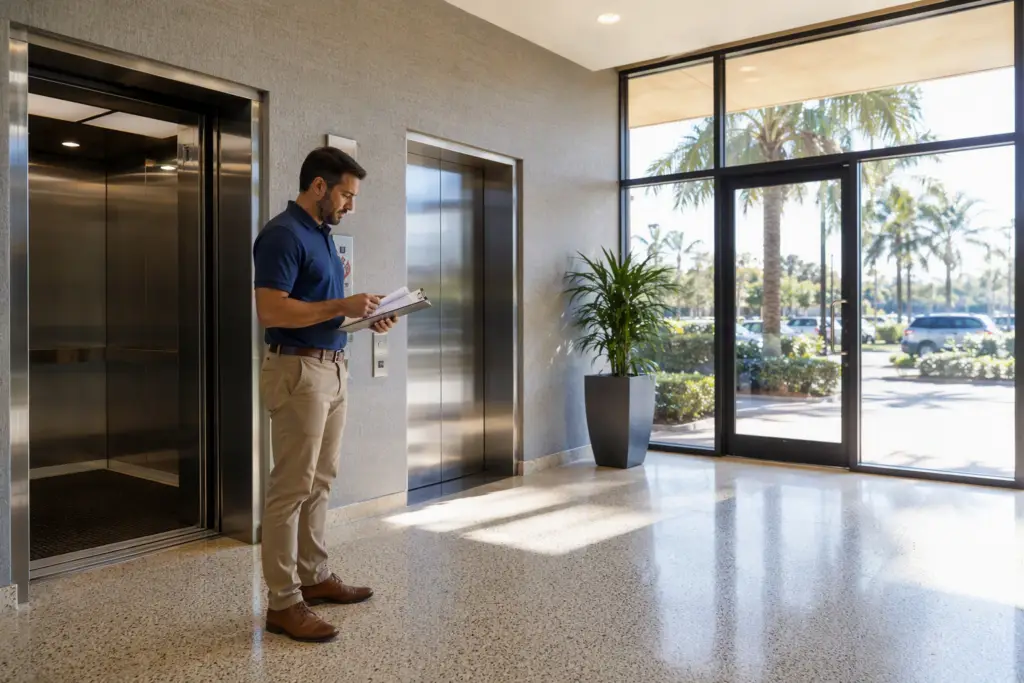
A structured maintenance program typically includes inspection of mechanical components such as guide rails, rollers, and buffers; testing of safety devices including governors, safeties, and door interlocks; lubrication of moving parts; examination of electrical systems including control panels, wiring, and emergency lighting; and testing of the two-way communication system. These tasks are not optional — ASME A17.1 defines maintenance obligations for elevator owners and contractors, and Florida’s Chapter 399 mandates that elevators be maintained in safe operating condition at all times. Property managers in Sarasota and Pompano Beach who partner with Axxiom Elevator Florida for ongoing maintenance contracts benefit from documented service histories that also support regulatory inspections.
What compliance codes govern elevator repairs and maintenance in Florida?
Florida elevator repairs must comply with ASME A17.1, the ADA, applicable OSHA standards for technician safety, and Florida Statute Chapter 399.
| Code / Regulation | Governing Body | Scope | Relevance to Elevator Breakdown Response |
|---|---|---|---|
| ASME A17.1 Safety Code for Elevators and Escalators | American Society of Mechanical Engineers | Design, installation, maintenance, and inspection of elevators | Defines maintenance intervals, safety device testing, emergency communication requirements |
| Americans with Disabilities Act (ADA) | U.S. Department of Justice | Accessibility requirements for public and commercial buildings | Requires elevators to remain accessible; outages affecting ADA compliance must be addressed promptly |
| Florida Statute Chapter 399 | Florida DBPR / Bureau of Elevator Safety | Licensing, inspection, and safety of elevators in Florida | Mandates licensed contractors for all repairs; requires periodic state inspections |
| OSHA Standards | U.S. Occupational Safety and Health Administration | Workplace safety for elevator technicians | Governs lockout/tagout, confined space, and electrical safety during breakdown response |
Understanding this regulatory landscape is essential for building owners. A breakdown that goes unaddressed or is repaired by an unlicensed contractor can result in fines, failed inspections, and increased liability exposure. Contractors like Axxiom Elevator Florida operate within this full compliance framework across their Pompano Beach and Sarasota service areas.
Are building owners legally responsible for elevator breakdowns?
Yes — under Florida Statute Chapter 399 and common law premises liability, building owners bear legal responsibility for maintaining elevators in safe operating condition.
This means that if an elevator fails due to deferred maintenance and a passenger is injured, the building owner or property manager can face significant civil liability. Responsibility includes ensuring the elevator is inspected at required intervals, that a licensed contractor performs all maintenance and repairs, and that safety devices are functional at all times. ADA obligations add another dimension: if a building’s only accessible means of vertical transportation is an elevator that is out of service, the owner may need to provide an alternative accommodation. Documentation of maintenance activities, inspection certificates, and repair records is critical for demonstrating due diligence in the event of a legal claim.
How long is an elevator allowed to remain out of service before it must be repaired?
Florida law does not specify a universal maximum downtime period, but elevators must be returned to safe, code-compliant operation as quickly as practicable, and prolonged outages affecting ADA accessibility can trigger additional legal obligations.
From a practical standpoint, every day an elevator remains out of service creates compounding risks: liability exposure if tenants or visitors are injured attempting to use stairs, ADA complaints if the elevator is the only accessible route, and potential citation from the Florida Bureau of Elevator Safety. Building owners should treat elevator restoration as an urgent priority and avoid delays caused by seeking lower-cost bids when a qualified contractor is ready to proceed. Proactive maintenance agreements are the most effective strategy for minimizing both downtime duration and frequency.
What information should I provide when calling for emergency elevator service?
Providing complete and accurate information at the time of the service call allows the responding technician to arrive prepared with the correct tools, parts, and knowledge of the system.
When calling for emergency elevator service, be ready to communicate the following:
- Building address and specific elevator location (e.g., “north elevator bank, Tower A”)
- Elevator make, model, and serial number — typically found on the data plate inside the machine room or car
- Type of elevator — hydraulic, traction, or machine-room-less (MRL)
- Nature of the malfunction — doors not closing, car won’t move, complete shutdown, unusual noise, error code displayed
- Floor where the car is stalled
- Whether anyone is or was recently trapped
- Last known maintenance date and name of the maintenance contractor
- Whether the elevator has been reset or tampered with since the failure
What is the difference between an emergency repair and routine maintenance?
An emergency repair addresses a sudden failure that renders the elevator non-operational or unsafe, while routine maintenance is scheduled, proactive service performed to prevent failures and ensure ongoing compliance.
The distinction has practical and financial implications. Emergency repairs typically involve unplanned labor dispatched outside of a standard service window, diagnosis of an unknown fault, and potentially expedited sourcing of replacement parts. Routine maintenance, by contrast, follows a defined checklist performed at regular intervals and is generally covered under a preventive maintenance contract. Building owners who defer routine maintenance are statistically more likely to incur higher emergency repair costs, as degraded components fail under load rather than being replaced proactively. From a compliance standpoint, ASME A17.1 frames maintenance as an ongoing obligation rather than an optional service, making the distinction between preventive and reactive care not merely operational but regulatory.
Can a building manager or maintenance staff attempt to fix the elevator themselves?
No — elevator repairs in Florida must be performed by a licensed elevator contractor; unauthorized repairs violate Florida Statute Chapter 399 and can expose the building owner to serious liability.
Even seemingly minor interventions — resetting a tripped breaker on the elevator control panel, adjusting door gap spacing, or manually lowering a hydraulic car — can constitute regulated elevator work under Florida law if performed by an unlicensed individual. Beyond the legal risk, amateur intervention in elevator systems can mask underlying faults, create new hazards, or trigger safety device activations that require additional licensed work to clear. The only safe, legal, and insurable path is to secure the area, take the elevator out of service, and call a licensed contractor immediately. OSHA standards governing lockout/tagout and electrical safety also apply to anyone who accesses elevator mechanical or electrical systems.
How do I choose between local and national elevator service companies?
Local elevator service companies often provide faster response, greater familiarity with regional code requirements, and more direct accountability than national contractors operating through regional dispatch centers.
For properties in Pompano Beach and Sarasota specifically, working with a contractor rooted in the Florida market means technicians are familiar with the state’s regulatory environment under Chapter 399, the Florida Building Code, and the local inspection processes administered by the Florida Bureau of Elevator Safety. National providers may have broader parts inventory, but local contractors like Axxiom Elevator Florida can often respond more directly and maintain closer relationships with the building management teams they serve. When evaluating any service provider, ask about their familiarity with the specific elevator brand and model installed, their documentation practices for regulatory compliance, and how they handle emergency calls outside of standard business hours.
What questions should I ask an elevator service company before hiring them for breakdown response?
Asking the right screening questions before a breakdown occurs — not during one — ensures that the contractor is qualified, licensed, and prepared to meet your building’s specific needs.
Key questions include:
- Are you licensed by the Florida DBPR as an elevator contractor?
- Are your technicians familiar with the specific make and model of elevator in our building?
- What is your process for emergency calls, and how does dispatch work?
- Do you provide written documentation of all work performed, including parts replaced and safety tests conducted?
- Can you assist with scheduling and preparing for Florida Bureau of Elevator Safety inspections?
- Do you offer preventive maintenance contracts, and what do they cover?
- How do you handle parts availability for older or less common elevator models?
- What is your process when a repair requires a permit or variance under Florida code?
How does ADA compliance factor into elevator breakdown response?
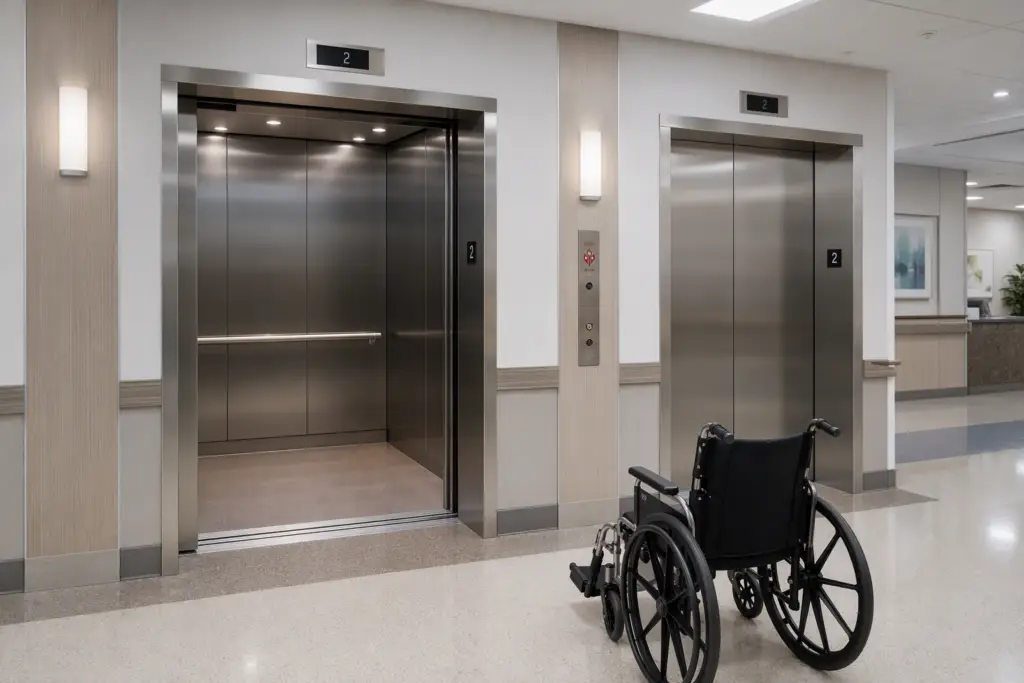
When an elevator is the sole accessible means of vertical travel in a building, an outage can create an immediate ADA compliance issue that building owners must address.
Under the Americans with Disabilities Act, public accommodations and commercial facilities must ensure that people with disabilities have equal access to all areas of a building that are accessible to others. When an elevator is out of service, building management should assess whether the outage creates a barrier for individuals who cannot use stairs and document what interim accommodations — if any — can reasonably be provided. This is particularly relevant in multi-story buildings where upper floors contain offices, healthcare services, retail spaces, or residential units that must remain accessible. Swift engagement of a qualified service contractor is not only a mechanical priority but an ADA compliance imperative.
What should I do if the elevator passes inspection but still breaks down frequently?
Frequent breakdowns despite passing inspection indicate that the elevator may have underlying chronic issues requiring a more comprehensive diagnostic evaluation or modernization assessment.
Annual inspections assess whether an elevator meets code at a point in time — they are not designed to evaluate long-term reliability trends. If a unit passes inspection but experiences repeated service calls for the same or related faults, this pattern suggests component degradation, systemic issues with a particular system (such as an aging control board or deteriorating hydraulic cylinder), or a mismatch between the maintenance being performed and the actual needs of the equipment. A qualified contractor can conduct a condition assessment that goes beyond the inspection checklist to evaluate the remaining service life of major components and provide recommendations for targeted repairs or modernization. Elevator modernization can address reliability, energy efficiency, and code compliance simultaneously.
How often are Florida elevators required to be inspected?
Florida requires annual safety inspections of elevators by a licensed elevator inspector under the provisions of Chapter 399, consistent with the inspection intervals referenced in ASME A17.1.
The Florida Bureau of Elevator Safety coordinates the state’s elevator inspection program. Elevators that fail inspection must be taken out of service and may not be returned to operation until deficiencies are corrected and the unit passes re-inspection. Periodic inspections complement but do not replace the ongoing maintenance obligations of building owners and their service contractors. Properties that maintain current, documented maintenance programs are generally better prepared for inspections and less likely to encounter findings that require immediate corrective action. Building owners in Pompano Beach and Sarasota should keep their Certificate of Operation current and ensure that maintenance records are available for review by inspectors.
What records should a building owner keep related to elevator breakdowns and repairs?
Building owners should maintain a complete, organized file of all elevator-related documentation including inspection certificates, maintenance logs, repair work orders, and any incident reports involving the elevator.
Florida Chapter 399 requires that the Certificate of Operation be displayed in or near the elevator. Beyond this statutory requirement, good record-keeping practice includes retaining signed work orders for every service call, documentation of parts replaced and safety tests performed, records of any modernization or alteration work, and copies of all inspection reports. In the event of a passenger injury claim, a regulatory audit, or an insurance review, comprehensive records are the building owner’s primary defense and evidence of due diligence. Contractors should always provide written documentation of every repair visit, and building owners should establish a filing system — physical or digital — to maintain these records over the life of the equipment.
What is elevator modernization, and when should it be considered after repeated breakdowns?
Elevator modernization is the process of upgrading components or entire systems — including controls, drive systems, cab interiors, and safety devices — to current code standards and reliability benchmarks.
Modernization becomes a practical consideration when an elevator experiences escalating maintenance costs, repeated breakdowns involving the same systems, difficulty sourcing parts for obsolete components, or when the unit no longer meets current accessibility or code requirements. Unlike a full replacement, modernization can be staged, addressing the highest-priority systems first. Any modernization work in Florida must comply with the currently adopted edition of ASME A17.1 and must be performed by a licensed elevator contractor. Projects of significant scope typically require permits from the Florida Bureau of Elevator Safety. A qualified contractor can evaluate whether targeted repairs or a broader modernization strategy offers the best long-term value for a specific unit.
How can property managers in Pompano Beach and Sarasota prepare for elevator emergencies before they happen?
Proactive preparation — including having a service contract in place, posting emergency procedures at every landing, and training building staff on the correct response protocol — significantly reduces the impact of any elevator breakdown.
Property managers should establish a relationship with a licensed elevator service contractor before an emergency arises, so that when a breakdown occurs, the call goes to a known provider rather than an unknown party located through an internet search under pressure. Emergency procedures should be posted at each elevator landing and in the building’s central management area, including the elevator contractor’s contact information and the local fire department’s non-emergency line. Building staff should understand that they are not authorized to perform repairs, that their role is to secure the area and communicate with passengers until professional help arrives, and that documentation of the event should begin immediately. Axxiom Elevator Florida works with commercial and residential property managers throughout Pompano Beach and Sarasota to establish these preparedness frameworks as part of their ongoing service relationships.
Get Expert Elevator Support from a Florida-Licensed Contractor
Elevator breakdowns require immediate, qualified response — not guesswork. Whether you manage a commercial property in Pompano Beach, a residential high-rise in Sarasota, or any building in between that depends on reliable vertical transportation, having the right contractor on call before a breakdown occurs is the single most important step a property owner can take.
Axxiom Elevator Florida provides certified elevator services — including breakdown response, preventive maintenance, inspections, and modernization assessments — to property owners and managers throughout Pompano Beach FL and Sarasota FL, operating in full compliance with Florida Statute Chapter 399, ASME A17.1, and ADA accessibility standards.
Contact Axxiom Elevator Florida for a free elevator assessment.
Call us today: