Building owners, property managers, architects, and facility directors frequently face the same urgent question: when an elevator fails to meet ADA standards, or when a new construction project requires vertical accessibility, who exactly is responsible for guidance and enforcement? The answer involves multiple authorities — federal regulators, state agencies, local building departments, and qualified elevator professionals. This guide identifies every contact point, explains what each authority governs, and outlines the steps required to achieve and maintain full compliance in 2026.
—
What Does the ADA Actually Require for Elevators?
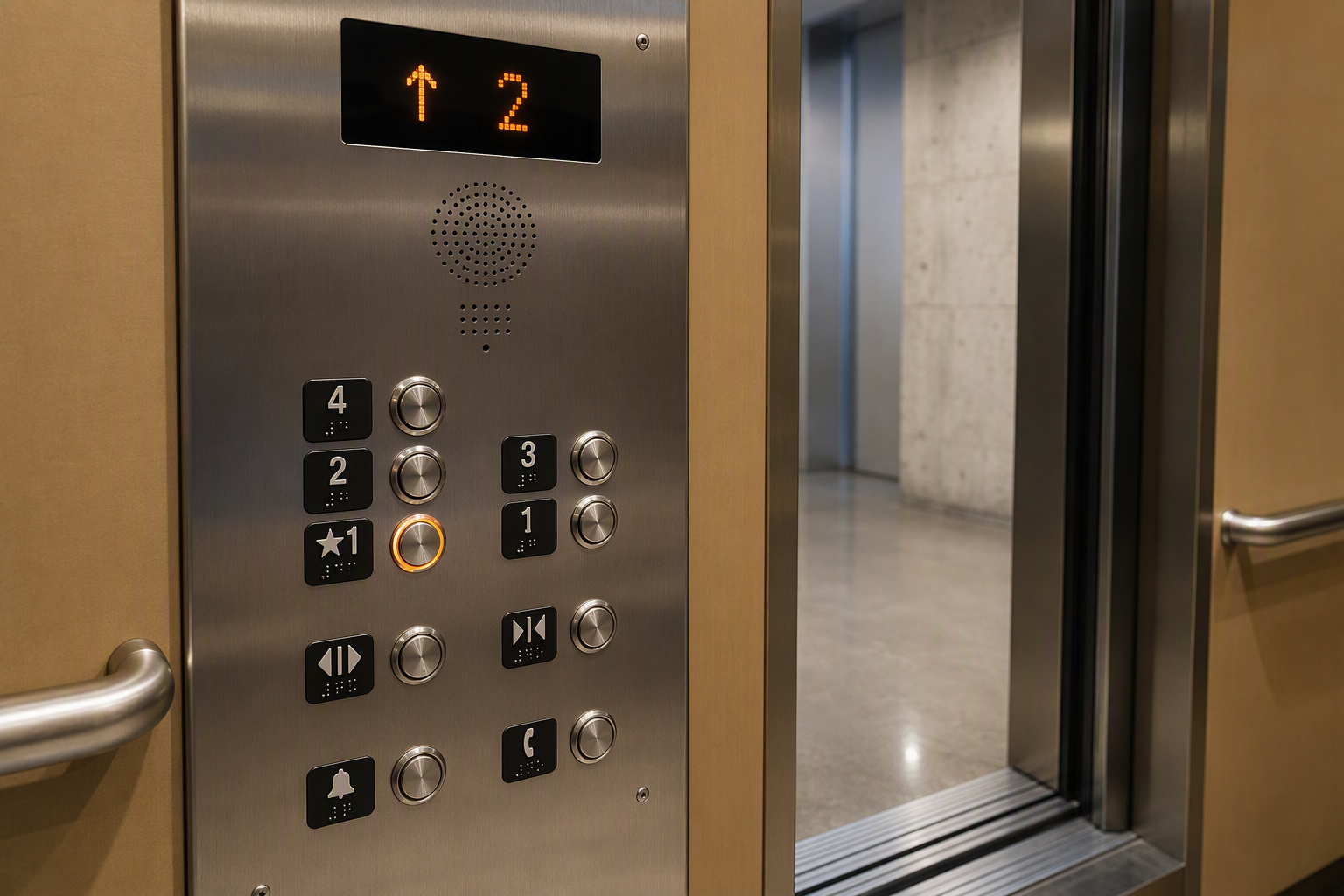
The Americans with Disabilities Act establishes accessibility requirements for places of public accommodation and commercial facilities. Under the ADA Standards for Accessible Design, elevators are generally required in new multi-story buildings and in existing buildings undergoing alterations that affect usability, unless a specific exemption applies.
Key elevator accessibility requirements under the ADA include:
- Minimum cab dimensions sufficient to allow wheelchair maneuvering
- Accessible call buttons at specified mounting heights
- Audible and visual floor indicators
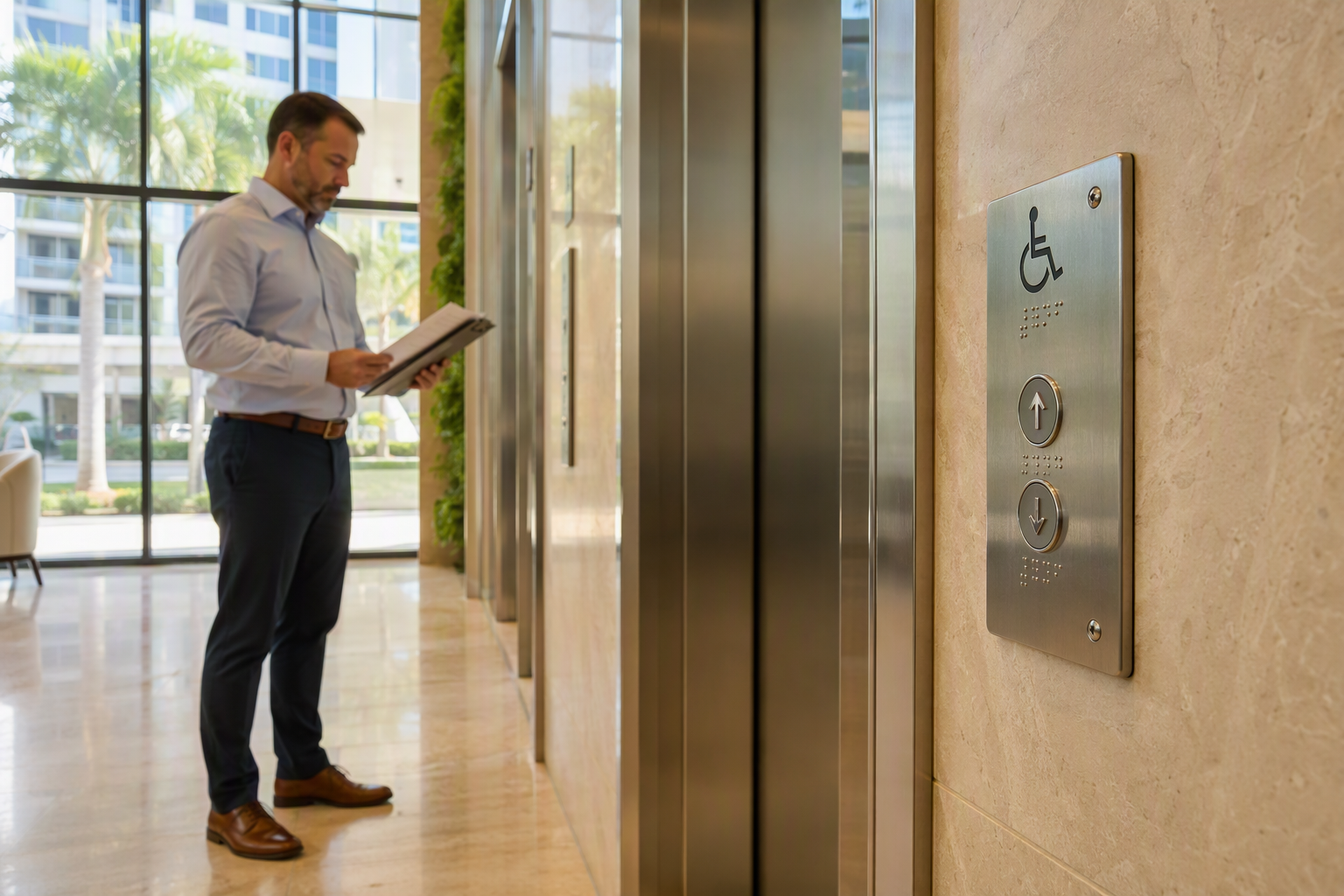
- Braille and raised character floor designations
- Door reopening devices that respond to obstructions
- Leveling accuracy so the cab floor aligns with the landing floor
- Emergency two-way communication systems within the cab
Importantly, the ADA does not stand alone. Technical elevator safety — including inspection intervals, mechanical specifications, and installation standards — is governed separately by the ASME A17.1 Safety Code for Elevators and Escalators, which most Florida jurisdictions adopt by reference. A building can meet ADA accessibility dimensions while still failing ASME safety requirements, and vice versa. Full legal compliance requires satisfying both frameworks.
—
Who Are the Primary Contacts for ADA Elevator Compliance?
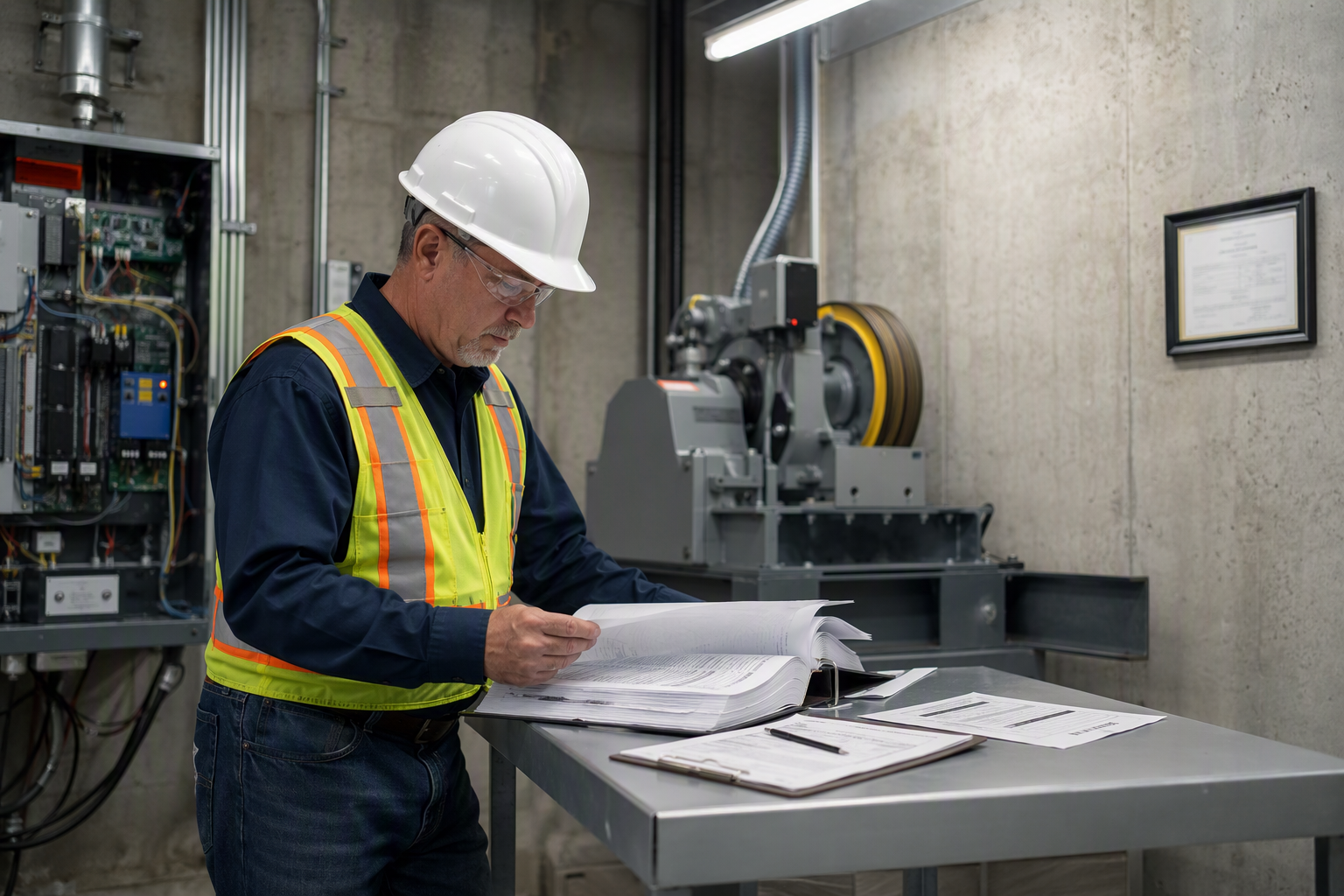
There is no single phone number to call for complete ADA elevator guidance. Compliance involves a layered structure of federal, state, and local contacts, each with a distinct role:
1. The U.S. Department of Justice (DOJ)
The DOJ enforces the ADA for places of public accommodation and state and local government facilities. The DOJ’s ADA Information Line fields questions from building owners and the public. Complaints about non-compliant facilities are filed with the DOJ. The agency’s technical assistance publications — available through ADA.gov — provide interpretive guidance on what the Standards require and how they apply to specific building scenarios.
2. The U.S. Access Board
The Access Board is the federal agency that develops and maintains the ADA Accessibility Guidelines (ADAAG). While the Access Board does not enforce compliance directly, it publishes the technical criteria that form the basis of the ADA Standards for Accessible Design. The Access Board also operates a technical assistance program for architects, builders, and facility managers with complex design questions.
3. Your Local Authority Having Jurisdiction (AHJ)
In Florida, the AHJ is typically the local building department — city or county — that issues permits, reviews construction documents, and conducts inspections. When a building permit is pulled for elevator installation or alteration, the AHJ reviews plans for both ADA compliance and adherence to the adopted Florida Building Code, which incorporates accessibility requirements. The AHJ’s elevator inspector signs off on final installation and periodic safety inspections.
4. The Florida Department of Business and Professional Regulation (DBPR)
Florida’s DBPR oversees elevator safety at the state level through its Bureau of Elevator Safety. State-licensed inspectors conduct periodic safety inspections, and elevator contractors must be state-licensed. When accessibility deficiencies are discovered during a state inspection, the DBPR issues violation notices that require correction within defined timeframes.
5. A Licensed Elevator Contractor
A licensed elevator contractor is the operational contact who translates code requirements into physical upgrades, modifications, or new installations. Contractors familiar with both the ADA Standards and the ASME A17.1 Safety Code for Elevators and Escalators can conduct a gap analysis of an existing elevator, prepare a scope of work, pull permits, perform the work, and coordinate final inspections.
6. An ADA Accessibility Consultant or Attorney
For complex facilities — particularly those facing litigation, federal investigations, or large-scale renovation planning — an ADA consultant or attorney who specializes in built-environment accessibility provides expert guidance on legal exposure, barrier removal priorities, and transition planning.
—
What Is the Step-by-Step Process for Achieving ADA Elevator Compliance?
- Conduct a Baseline Assessment: Retain a licensed elevator contractor or certified accessibility consultant to evaluate the existing elevator against the current ADA Standards for Accessible Design. Document every dimension, control placement, and communication feature.
- Identify the Applicable Code Edition: Confirm which edition of the ADA Standards and the Florida Building Code applies to your building based on the original construction date and any subsequent alterations. Retroactive requirements differ from new construction requirements.
- Contact the Local AHJ: Before designing any corrective work, contact the local building department to confirm permit requirements and any locally amended accessibility provisions.
- Consult the DBPR Bureau of Elevator Safety: Verify the current state inspection status of the elevator and identify any open violations on record.
- Develop a Scope of Work: Working with the licensed contractor, prepare a detailed scope covering all required modifications — cab dimensions, control heights, signage, door timing, leveling tolerances, and communication systems.
- Submit Permit Applications: File for all required permits with the AHJ. Permit sets typically include architectural drawings, equipment specifications, and a load calculation.
- Complete the Modifications: The licensed contractor performs all work under active permits, adhering to both ADA accessibility standards and ASME A17.1 Safety Code for Elevators and Escalators mechanical requirements.
- Schedule Final Inspections: Coordinate AHJ and DBPR inspections to obtain final sign-off and updated operating certificates.
- Document Everything: Retain all inspection reports, permits, and compliance records. These documents are critical if a complaint is filed with the DOJ or if litigation arises.
- Establish a Maintenance Program: ADA compliance is ongoing. Leveling accuracy, door reopening sensitivity, and communication systems can drift out of tolerance over time. A preventive maintenance agreement helps sustain compliance between inspection cycles.
—
Does the ADA Require Elevators in All Multi-Story Buildings?
No. The ADA includes specific exemptions. Private buildings that are less than three stories or have fewer than 3,000 square feet per story are generally exempt from the elevator requirement — unless the building houses certain occupancies such as a shopping center, shopping mall, or the professional office of a health care provider, where the exemption does not apply. New construction planned in 2025 and 2026 should be evaluated by both an architect and an accessibility consultant early in the design process to determine whether the elevator exemption applies, because the exemption analysis involves multiple overlapping factors.
—
What Types of Elevators Satisfy ADA Requirements?
The ADA Standards specify performance criteria rather than mandating a specific product type. Several elevator configurations can satisfy requirements depending on the building context:
- Hydraulic elevators: Common in low-rise buildings; must meet ADA cab dimensions, control, and signage requirements
- Traction elevators: Typical in mid- and high-rise buildings; subject to the same ADA accessibility criteria
- Limited-use/limited-application (LULA) elevators: Permitted in certain existing building alterations where a full elevator is technically infeasible
- Platform lifts: Permitted in specific circumstances defined by the ADA Standards, including in existing buildings where space constraints preclude elevator installation
Platform lifts and LULA elevators have their own dimensional and operational requirements under both the ADA Standards and the ASME A17.1 Safety Code for Elevators and Escalators. They are not universally interchangeable with full elevators and require careful evaluation before selection.
—
What Workplace and Construction Site Accessibility Obligations Overlap with ADA?
For construction sites and multi-employer workplaces, OSHA regulations govern elevator safety during construction and installation phases. OSHA standards address construction hoists, personnel lifts, and the safety of workers who install, maintain, or repair elevators. Building owners overseeing elevator modernization projects should confirm that all contractor activities comply with applicable OSHA standards, which are separate from the ADA’s accessibility requirements for building occupants.
—
How Long Does an ADA Elevator Compliance Project Typically Take?
Timeline varies significantly based on the scope of deficiencies identified. A project limited to cab signage, control button height adjustment, and communication system upgrades can often be completed in a matter of days once permits are in hand. A more involved project — such as cab expansion to meet minimum dimension requirements, or replacement of an outdated hydraulic unit — may require weeks of engineering, permitting, and installation work. In Florida, permit review timelines vary by county and municipality and can affect overall project duration. Engaging the AHJ early in the process helps identify potential review bottlenecks before work begins.
—
What Are the Consequences of Non-Compliance with ADA Elevator Requirements?
Non-compliance exposes building owners to several categories of legal and financial risk:
- DOJ complaint investigations: Any member of the public can file a complaint with the DOJ alleging an ADA violation. The DOJ may investigate and require corrective action.
- Private litigation: The ADA permits private lawsuits seeking injunctive relief — court orders requiring specific modifications. Attorney’s fees are also recoverable by prevailing plaintiffs.
- State enforcement actions: The Florida DBPR can issue violation notices and fines for elevator safety deficiencies discovered during state inspections.
- Operating certificate revocation: In serious safety cases, the AHJ or DBPR can order an elevator taken out of service, which may render portions of a building inaccessible or unusable.
—
What Industry Trends Are Shaping ADA Elevator Compliance in 2025 and 2026?
Several qualitative trends are influencing how building owners and elevator professionals approach ADA compliance heading into 2026:
- Increased enforcement activity: Federal and state authorities have signaled continued attention to built-environment accessibility, particularly in healthcare, hospitality, and multi-family residential sectors.
- Aging building stock: A significant portion of Florida’s commercial and residential elevator inventory was installed decades ago under earlier code editions. As these units age, modernization projects that trigger full accessibility compliance reviews are becoming more common.
- Technology integration: Destination-dispatch systems, touchless controls, and remote monitoring capabilities are increasingly standard in modernization projects. Each new technology component must be evaluated for ADA compliance — touchless controls, for example, raise questions about reach range and usability for individuals with limited dexterity.
- Proactive barrier removal planning: Forward-looking property managers are shifting from reactive compliance — fixing violations after complaints — to proactive multi-year barrier removal plans that prioritize elevator accessibility alongside other building systems.
- Code coordination complexity: As Florida continues to adopt updated editions of the Florida Building Code, and as ASME publishes new editions of its safety standards, keeping track of which version applies to a specific building and a specific scope of work requires ongoing professional attention.
—
How Does Axxiom Elevator Florida Support ADA Compliance?
Axxiom Elevator Florida provides data-driven elevator assessment, modernization, and maintenance services to building owners and facility managers across Florida. The team evaluates elevators against current ADA Standards and the ASME A17.1 Safety Code for Elevators and Escalators, identifies compliance gaps, and develops documented scopes of work that support the permitting and inspection process. Axxiom Elevator Florida works alongside building owners, property managers, architects, and legal counsel to coordinate the full compliance pathway — from initial assessment through final inspection sign-off and ongoing maintenance.
—
What Should I Bring to My First Conversation with an Elevator Compliance Professional?
Coming prepared accelerates the assessment process. Useful documents and information to gather before contacting a licensed elevator contractor include:
- The elevator’s current operating certificate from the DBPR or local AHJ
- Any open violation notices from prior inspections
- The original installation date and any subsequent modernization records
- Current maintenance agreement documentation
- Architectural drawings showing cab dimensions and hoistway configuration
- Any prior ADA audit reports or accessibility assessments
- Documentation of any ADA complaints or litigation related to the elevator
—
Are Platform Lifts an Acceptable ADA Alternative to Elevators?
Platform lifts are permitted by the ADA Standards in specific circumstances, including when a new elevator is technically infeasible due to structural constraints, and in certain existing buildings undergoing alterations. However, platform lifts are not a universal substitute. They have their own dimensional, operational, and safety requirements, and their use is subject to AHJ approval. Building owners considering platform lifts as an alternative to full elevator installation should confirm acceptability with both the local AHJ and an accessibility consultant before committing to equipment.
—
What Is the Difference Between ADA Compliance and Elevator Safety Code Compliance?
These are parallel but distinct legal frameworks. The ADA is a civil rights law that addresses accessibility — ensuring that people with disabilities can use a building’s vertical transportation on an equal basis with others. The ASME A17.1 Safety Code for Elevators and Escalators is an engineering standard that addresses mechanical safety — ensuring that the elevator operates without risk of injury to all users. Both must be satisfied. An elevator that is physically accessible to wheelchair users but has malfunctioning door safety edges fails ASME requirements. An elevator with flawless mechanical safety but cab controls mounted at heights unreachable from a wheelchair fails ADA requirements. Full compliance requires satisfying both frameworks simultaneously.
—
Sourced Data Reference Table
| Standard / Authority | What It Governs | Source |
|---|---|---|
| ADA Standards for Accessible Design | Elevator accessibility dimensions, controls, signage, communication systems | ADA.gov |
| ASME A17.1 Safety Code for Elevators and Escalators | Mechanical safety, inspection intervals, installation requirements | ASME.org |
| OSHA Standards | Worker safety during elevator installation, maintenance, and repair | OSHA.gov |
—
Call to Action
Get a Free ADA Elevator Compliance Assessment
Building owners and property managers across Florida trust Axxiom Elevator Florida to evaluate their elevators against current ADA Standards and ASME A17.1 Safety Code for Elevators and Escalators requirements — before a complaint, a failed inspection, or a legal filing forces the issue.
Contact Axxiom Elevator Florida for a free elevator assessment:
Need elevator service you can rely on? Axxiom Elevator Florida is ready to help.