Hotel Elevator Maintenance: Top-Rated Practices for Healthcare and Hospitality Facilities in Florida
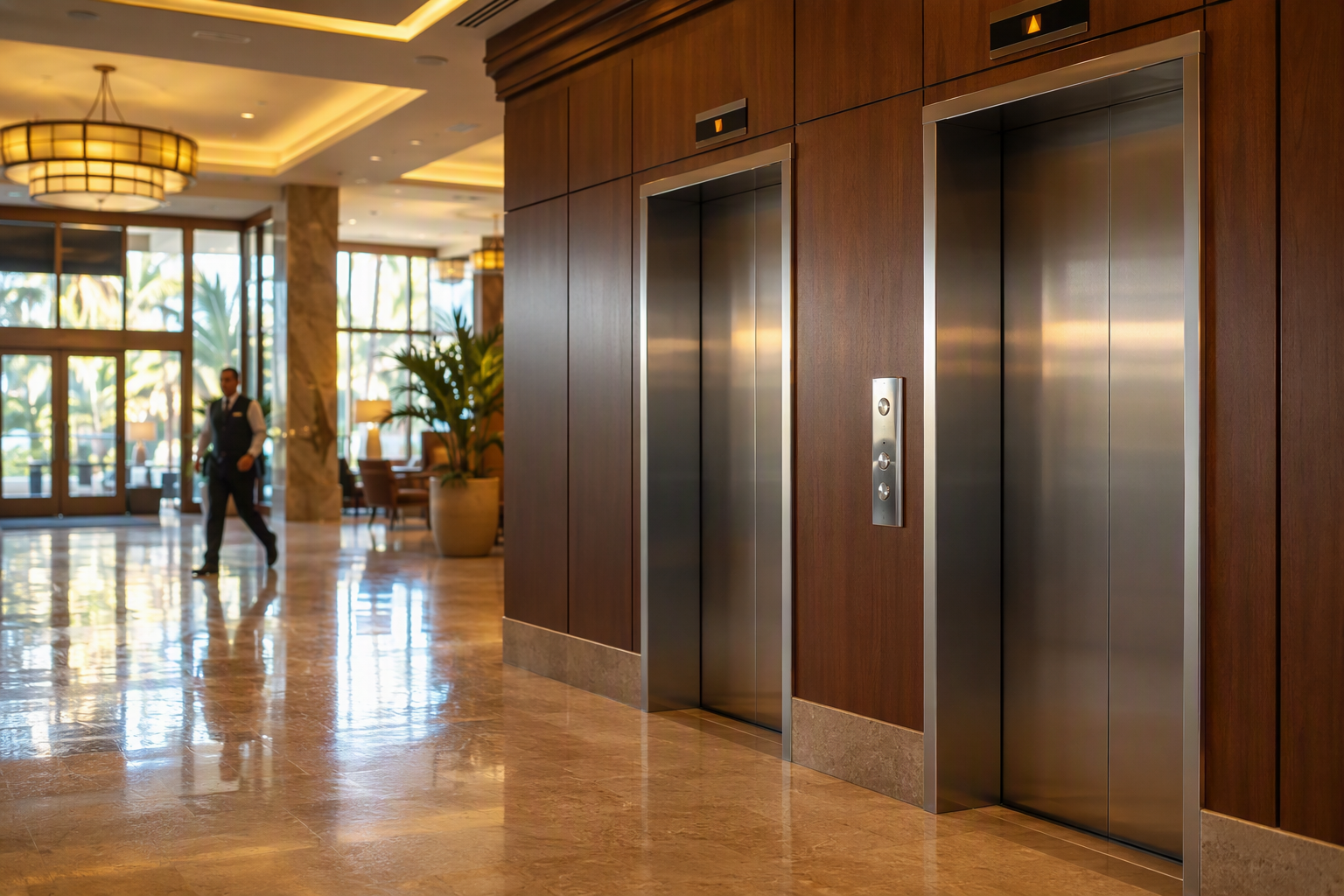
Hotels and healthcare-adjacent hospitality facilities — such as medical hotels, assisted-living resort properties, and hospital guest lodges — operate elevators under exceptional demand. Guests, patients, visitors, and medical staff rely on vertical transportation around the clock. A single elevator failure can disrupt operations, trigger regulatory scrutiny, and compromise guest safety. Understanding top-rated maintenance practices is not optional for Florida property managers — it is a regulatory and operational necessity.
Axxiom Elevator Florida serves commercial and healthcare-adjacent properties across Pompano Beach, FL and Sarasota, FL, providing compliance-focused elevator maintenance programs built around current code requirements and Florida-specific inspection standards.
What Are the Core Components of a Top-Rated Hotel Elevator Maintenance Program?
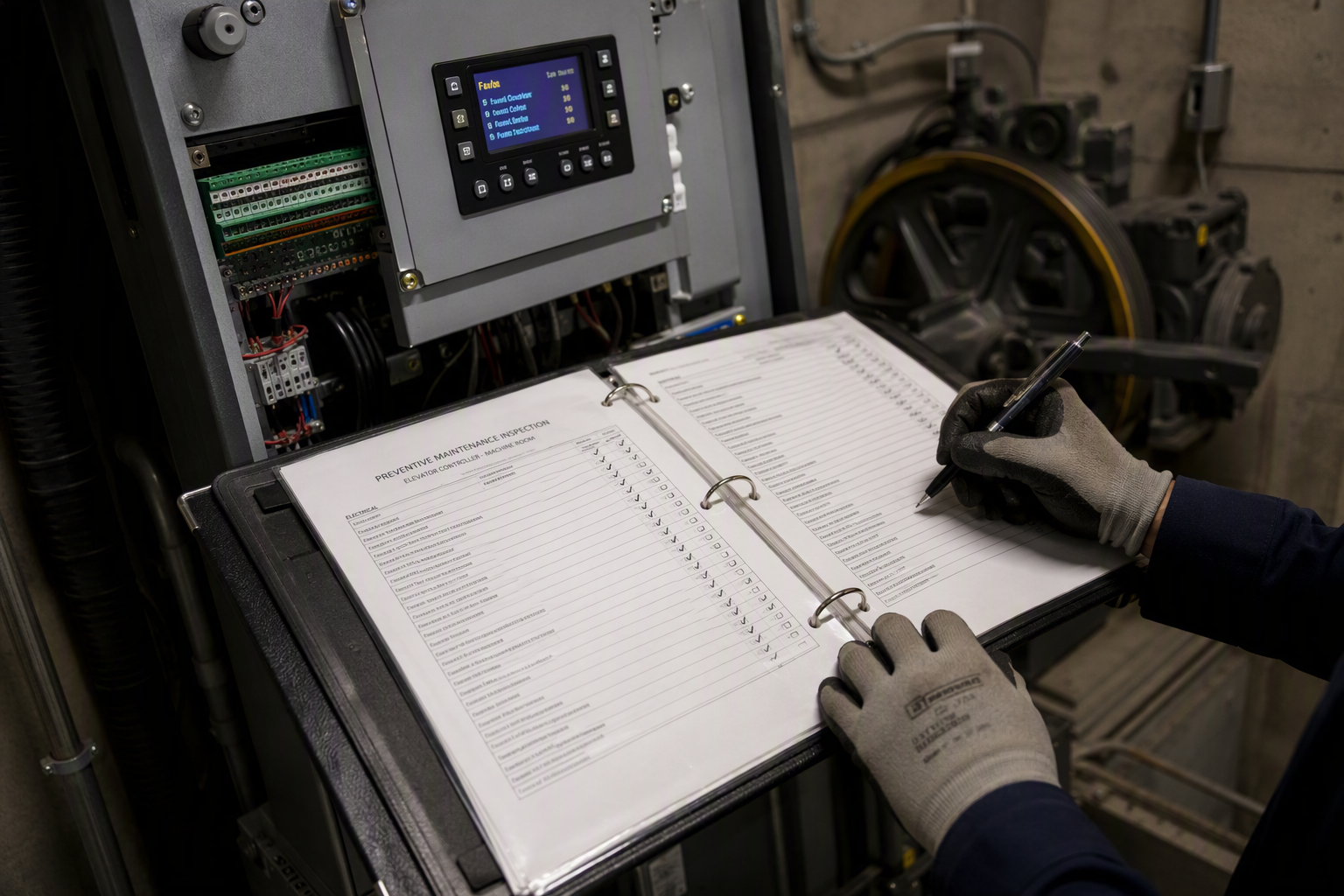
A high-performing maintenance program for hotel elevators rests on four pillars:
- Scheduled Preventive Maintenance (PM) Visits: Regular lubrication, mechanical inspection, and component adjustment performed on a documented schedule — monthly, quarterly, or as required by the elevator’s usage classification and manufacturer specifications.
- Compliance Documentation: Maintaining current certificates of inspection, service logs, and test records in accordance with Florida Department of Business and Professional Regulation (DBPR) requirements and ASME A17.1 Safety Code for Elevators and Escalators.
- Modernization Readiness Assessments: Evaluating aging components — controllers, hydraulic systems, door operators — before they reach failure thresholds, reducing unplanned downtime.
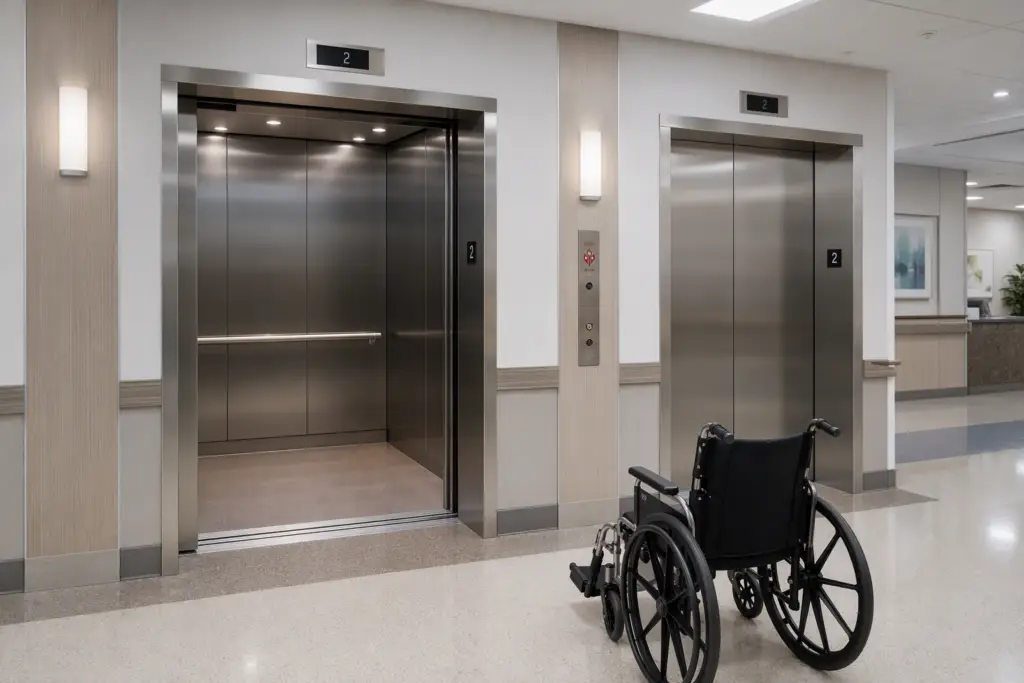
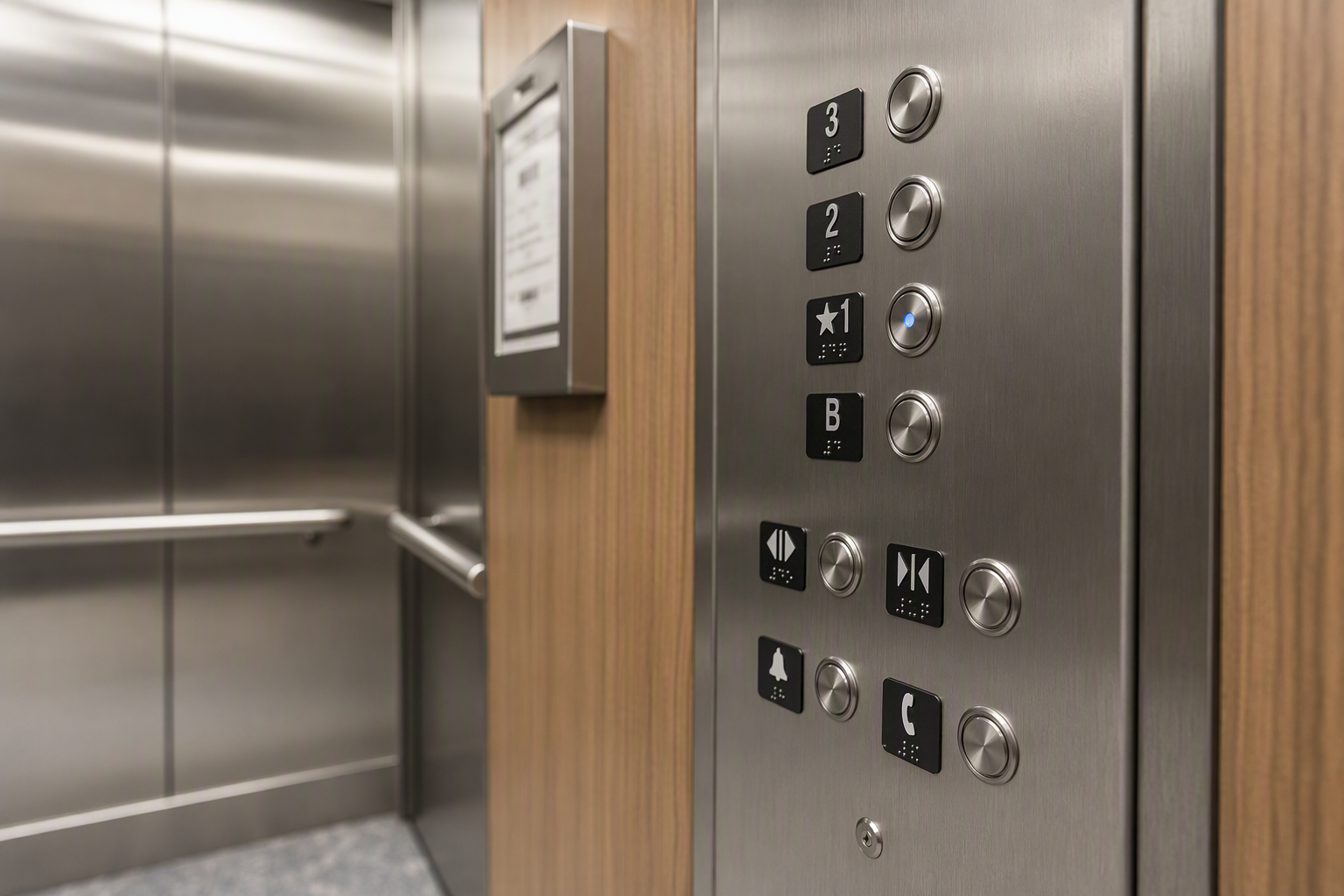
- ADA Compliance Reviews: Verifying that cab dimensions, control panel heights, auditory signals, and Braille labeling remain consistent with ADA requirements, which is especially critical in healthcare-adjacent hospitality environments serving guests with mobility limitations.
When Axxiom Elevator Florida evaluates a hotel property, each of these pillars is assessed individually and documented for the property manager’s records.
What Compliance Codes Govern Hotel Elevator Maintenance in Florida?
Florida hotel operators must navigate a layered compliance environment. The primary standards applicable in 2026 include:
- ASME A17.1 Safety Code for Elevators and Escalators: The foundational national standard governing the design, construction, operation, inspection, testing, maintenance, alteration, and repair of elevators. Florida adopts this code through its DBPR elevator safety program.
- Americans with Disabilities Act (ADA): Mandates specific elevator cab sizes, door timing, control panel configurations, and auditory/visual indicators. Hotels open to the public are subject to ADA Title III requirements.
- Florida Statutes Chapter 399: Florida’s specific elevator safety law, which requires periodic inspections by state-licensed inspectors and mandates that elevators operating in public-access facilities maintain valid certificates of operation.
- OSHA General Industry Standards: Applicable to the maintenance workforce performing elevator work, covering lockout/tagout procedures, machine room safety, and fall protection.
Healthcare-adjacent hotel properties — such as those affiliated with rehabilitation centers or serving medical tourism guests — may also face Joint Commission Environment of Care standards if they share facilities with licensed healthcare operations. In those contexts, elevator maintenance documentation must align with accreditation audit requirements.
How Often Should Hotel Elevators Be Inspected and Maintained?
Under Florida law and ASME A17.1, elevators in high-traffic commercial buildings such as hotels require periodic inspections — typically annually for a full safety inspection and on a separate cycle for specific load and safety device tests. The exact intervals depend on the elevator type (traction, hydraulic, limited-use/limited-application) and the jurisdiction’s adoption of specific ASME code editions.
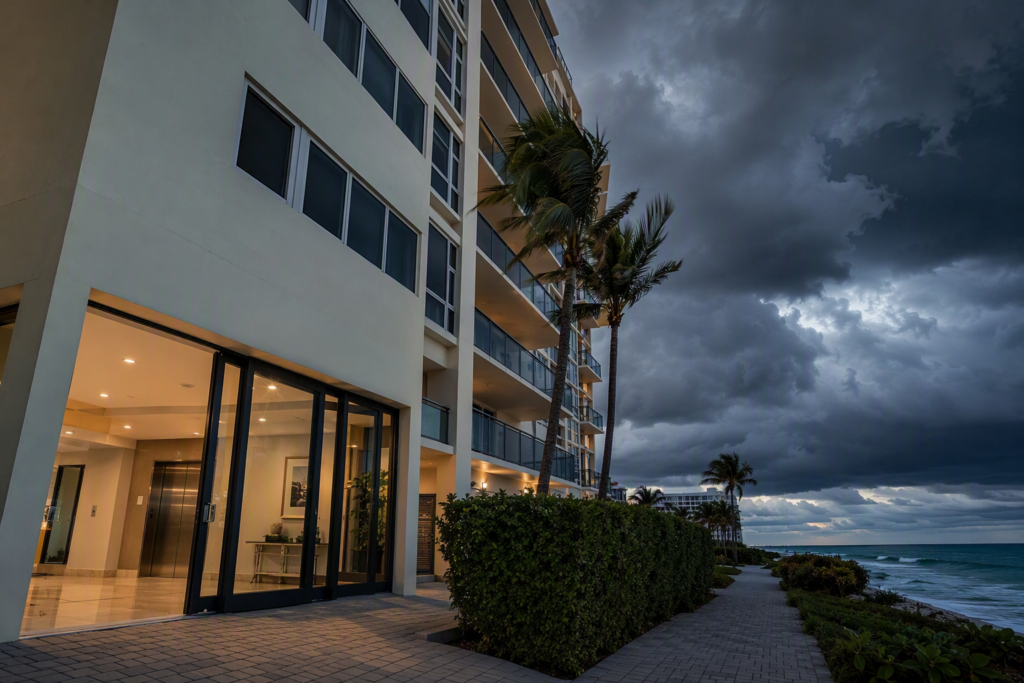
Preventive maintenance visits, separate from formal inspections, are generally recommended on a monthly or quarterly basis for hotel elevators given their continuous occupancy and heavy use patterns. Properties in coastal Florida markets like Pompano Beach and Sarasota also face elevated humidity and salt-air exposure, which accelerates corrosion on door tracks, cables, and mechanical components — making more frequent lubrication and inspection cycles a practical necessity rather than an optional upgrade.
What Are the Most Commonly Found Maintenance Deficiencies in Hotel Elevators?
Elevator inspection records across the commercial hospitality sector consistently surface a recognizable set of maintenance deficiencies, including:
- Door operator malfunctions — slow, inconsistent, or non-compliant closing speeds
- Worn or frayed hoist ropes requiring replacement or adjustment
- Hydraulic fluid leaks in basement or pit environments
- Outdated or non-functional emergency communication systems (required under ASME A17.1 and ADA)
- Pit sump pump failures leading to water accumulation
- Corroded or damaged cab interiors — particularly call buttons and Braille panels — impacting ADA compliance
- Controller and software obsolescence in elevators beyond their design service life
Identifying these deficiencies before an annual inspection — rather than during one — is the core value proposition of a preventive maintenance contract managed by a certified provider like Axxiom Elevator Florida.
What Should a Hotel Do Immediately After an Elevator Malfunction or Entrapment?
- Activate the emergency communication system inside the cab to establish contact with trapped occupants and provide calm, clear instructions to remain in place.
- Contact your elevator maintenance contractor to dispatch a qualified technician for emergency retrieval — do not attempt manual retrieval without trained personnel.
- Notify hotel management and security to cordon the elevator lobby and redirect guests to alternative vertical transportation.
- Document the incident with time, cab number, number of occupants, and observed malfunction symptoms for inclusion in the maintenance log and any required regulatory reporting.
- File any required incident report with the Florida DBPR if the malfunction involved injury or a reportable safety event, per Florida Statutes Chapter 399.
- Hold the elevator out of service until a qualified elevator contractor clears it for return to operation following inspection and any necessary repair.
- Review maintenance records to determine whether the malfunction was preceded by warning signs that were logged but not acted upon, and adjust the PM schedule accordingly.
How Does ADA Compliance Specifically Apply to Hotel Elevator Maintenance?
The ADA imposes specific, ongoing obligations on hotel elevators that go beyond initial installation. Maintenance activities must preserve the functional integrity of ADA-required features, including:
- Door reopening devices that remain operational and appropriately sensitive to obstruction
- Level stopping accuracy within acceptable tolerances so mobility device users can board and exit safely
- Audible and visible floor indicators in working condition
- Braille and raised-character signage on control panels that remain legible and undamaged
- Two-way emergency communication systems that function without requiring voice communication — critical for guests with hearing impairments
In healthcare-adjacent hotel settings where a significant proportion of guests may use wheelchairs, walkers, or other mobility aids, ADA elevator failures carry heightened operational and legal risk. A maintenance program that explicitly includes ADA compliance verification at each PM visit reduces that exposure.
How Does Coastal Florida’s Climate Affect Hotel Elevator Maintenance Requirements?
Florida’s subtropical climate — characterized by high humidity, salt-laden air in coastal markets like Pompano Beach and Sarasota, and frequent temperature differentials between air-conditioned interiors and outdoor environments — accelerates wear on elevator components in ways not typically addressed by manufacturer maintenance schedules designed for temperate climates.
Florida-specific maintenance adaptations include more frequent inspection of:
- Door tracks and sills for corrosion and salt residue accumulation
- Hydraulic lines and fittings for oxidation and micro-leaks
- Electrical connections and control panels for moisture intrusion
- Pit areas for water infiltration, particularly during hurricane season
- Hoist ropes and sheaves for accelerated surface degradation
Axxiom Elevator Florida’s maintenance protocols account for these regional conditions, ensuring that service schedules reflect actual environmental exposure rather than generic national templates.
What Is the Difference Between a Preventive Maintenance Contract and an On-Call Service Agreement for Hotels?
A preventive maintenance (PM) contract commits a certified elevator contractor to scheduled, proactive service visits on a defined calendar — inspecting, lubricating, adjusting, and testing components before failure occurs. Service logs are maintained for each visit, and findings are documented for regulatory and liability purposes.
An on-call or time-and-materials service agreement means the contractor responds only when a malfunction is reported. There is no proactive inspection schedule, no documentation of component wear trends, and no advance warning of impending failures.
For hotels, where elevator downtime directly impacts guest satisfaction scores, occupancy rates, and ADA compliance obligations, a PM contract is the industry-standard best practice. The documentation generated under a PM contract also provides critical evidence of due diligence if a guest injury or regulatory inspection ever becomes a legal matter.
How Should Hotel Managers Evaluate and Compare Elevator Maintenance Vendors?
When selecting an elevator maintenance provider, hotel property managers should evaluate vendors across the following criteria:
- Florida State Licensure: The contractor must hold a valid Florida elevator contractor license issued by the DBPR. Verify licensure status independently through the DBPR public database before signing any contract.
- Code Familiarity: Confirm the contractor’s working knowledge of current ASME A17.1 requirements and Florida-specific adoption amendments.
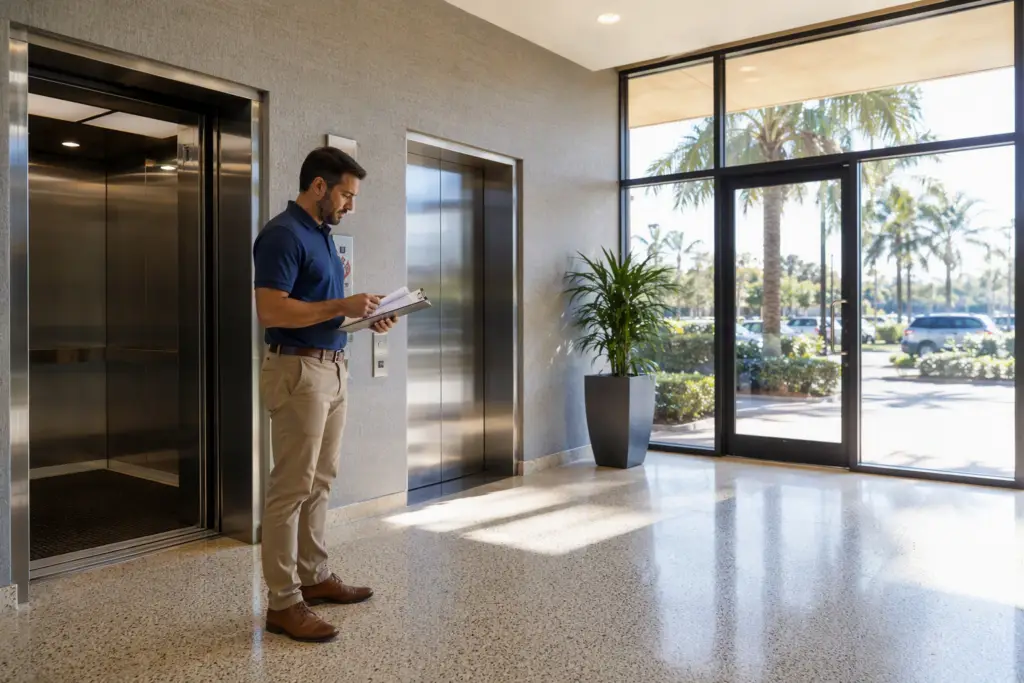
- Documentation Standards: Request sample maintenance logs and inspection reports. A reputable contractor provides clear, detailed records after every visit.
- Local Market Presence: A contractor with established operations in the specific Florida market — Pompano Beach, Sarasota — is more likely to understand regional code enforcement patterns and environmental factors.
- Scope of Services: Verify that the contract covers emergency callback service, not just scheduled PM visits, and clarifies which repairs are included versus billed separately.
- References from Comparable Properties: Request references from other hotel or healthcare-adjacent hospitality clients in Florida.
Questions Your Inspector Will Ask
When a Florida DBPR-authorized inspector arrives at a hotel property, the following questions and documentation requests are standard. Property managers should be prepared to answer each one with supporting records:
- “Where is your current certificate of operation?” — Must be posted in or adjacent to the elevator cab or machine room per Florida Statutes Chapter 399.
- “Can I see your maintenance log for the past 12 months?” — Logs should show dates, work performed, technician identification, and findings for every PM visit.
- “When was the last Category 1 and Category 5 test performed?” — These ASME A17.1-required periodic load and safety tests must be documented with test results and contractor sign-off.
- “Has the emergency communication system been tested?” — Two-way communication test results should appear in the maintenance log.
- “Are all ADA-required features functional?” — Inspectors may physically test door timing, leveling accuracy, and call button functionality.
- “Has this unit had any reported malfunctions or entrapments since the last inspection?” — Incident reports, if any, should be on file and available for review.
- “What is the status of any open correction notices from the prior inspection?” — Outstanding deficiencies from previous inspections must be corrected and documented before re-inspection or certificate renewal.
- “Who is your elevator maintenance contractor and are they Florida-licensed?” — Be prepared to provide the contractor’s license number and contact information on request.
Why Do Florida Hotels Choose Axxiom Elevator Florida for Ongoing Maintenance?
Hotel operators in Pompano Beach and Sarasota work with Axxiom Elevator Florida because the company’s service model is built around the compliance and documentation demands that Florida’s regulatory environment requires. Maintenance programs are structured to generate the records that both state inspectors and hotel ownership groups expect — not as a secondary output, but as a primary deliverable.
For healthcare-adjacent properties where guest vulnerability is higher and regulatory exposure is more acute, that documentation discipline is not a differentiator — it is a baseline requirement. Axxiom Elevator Florida approaches every maintenance contract with that standard in mind.
Get a Free Elevator Assessment for Your Florida Hotel Property
Whether your property is located in Pompano Beach, Sarasota, or the surrounding South Florida and Gulf Coast markets, a documented preventive maintenance program is the single most effective way to protect guests, satisfy inspectors, and prevent costly unplanned repairs.
Contact Axxiom Elevator Florida for a free elevator assessment. A qualified elevator specialist will review your current maintenance records, identify compliance gaps, and recommend a service program tailored to your property’s elevator inventory and usage profile.
Need elevator service you can rely on? Axxiom Elevator Florida is ready to help.