What Happens If My Elevator Fails a Florida State Inspection? Violations, Timelines & the Path Back to Compliance
A failed elevator inspection is one of the most disruptive events a building owner or property manager can face. Tenants lose access, liability exposure rises, and every day the elevator sits idle costs money in lost productivity, potential lease disputes, and emergency repair expenses. Understanding exactly what happens after a failed inspection — and what steps move the elevator back into legal operation — is essential for any Florida property stakeholder.
This guide walks through the inspection failure process from the moment the inspector issues a violation notice, through the repair and re-inspection phases, to final certificate reinstatement. It also compares common violation categories by severity, cost impact, and typical resolution timeline so building owners can make informed decisions quickly.
What Does It Mean When an Elevator Fails a Florida State Inspection?
Florida regulates elevators and other conveyances under Chapter 399 of the Florida Statutes, administered by the DBPR’s Bureau of Elevator Safety. When a licensed state elevator inspector performs a periodic inspection and identifies conditions that do not meet the applicable safety code — most commonly the ASME A17.1 Safety Code for Elevators and Escalators — the inspector issues a written violation notice and the elevator’s operating permit is suspended.
A suspended permit means the elevator cannot legally operate. Building owners who allow passengers to ride an out-of-service elevator face significant civil liability and potential regulatory penalties under Florida law. The elevator must remain physically locked out of service until the DBPR authorizes reinstatement.
What Are the Most Common Reasons Elevators Fail Florida Inspections?
Violations fall into a spectrum from minor administrative deficiencies to major safety hazards. The table below organizes the most frequently cited categories by severity.
| Violation Category | Examples | Severity Level | Typical Resolution Complexity | Effect on Operation |
|---|---|---|---|---|
| Documentation / Certificate | Expired operating certificate, missing inspection records | Low–Moderate | Administrative — often resolved quickly | Out of service until corrected |
| Pit Conditions | Water intrusion, inadequate lighting, missing stop switch, pit ladder deficiencies | Moderate | Low-to-moderate repair scope | Out of service until corrected |
| Door Safety Devices | Faulty door reopening devices, worn sills, door operator malfunctions | Moderate–High | Moderate — parts sourcing can extend timeline | Out of service until corrected |
| Emergency Systems | Non-functional emergency lighting, phone, or alarm; missing or expired firefighters’ service | High | Moderate — code-compliant upgrades may be required | Out of service until corrected |
| Mechanical / Structural | Worn ropes, sheave deficiencies, buffer issues, broken governor | High–Critical | High — major parts replacement, longer lead times | Out of service until corrected |
| Accessibility Compliance | Non-compliant controls, signage, or door timing per ADA Standards for Accessible Design | Moderate | Moderate — may require modifications to controls or cab | May trigger citation alongside state violation |
| Machine Room Conditions | Inadequate clearances, improper storage, missing fire extinguisher, temperature issues | Low–Moderate | Low — often corrected without specialized parts | Out of service until corrected |
| Overdue Periodic Tests | Missing five-year full-load safety test, governor and safeties test | High | High — requires licensed witness and test documentation | Out of service until test completed and filed |
What Are the Immediate Steps to Take After a Failed Florida Elevator Inspection?
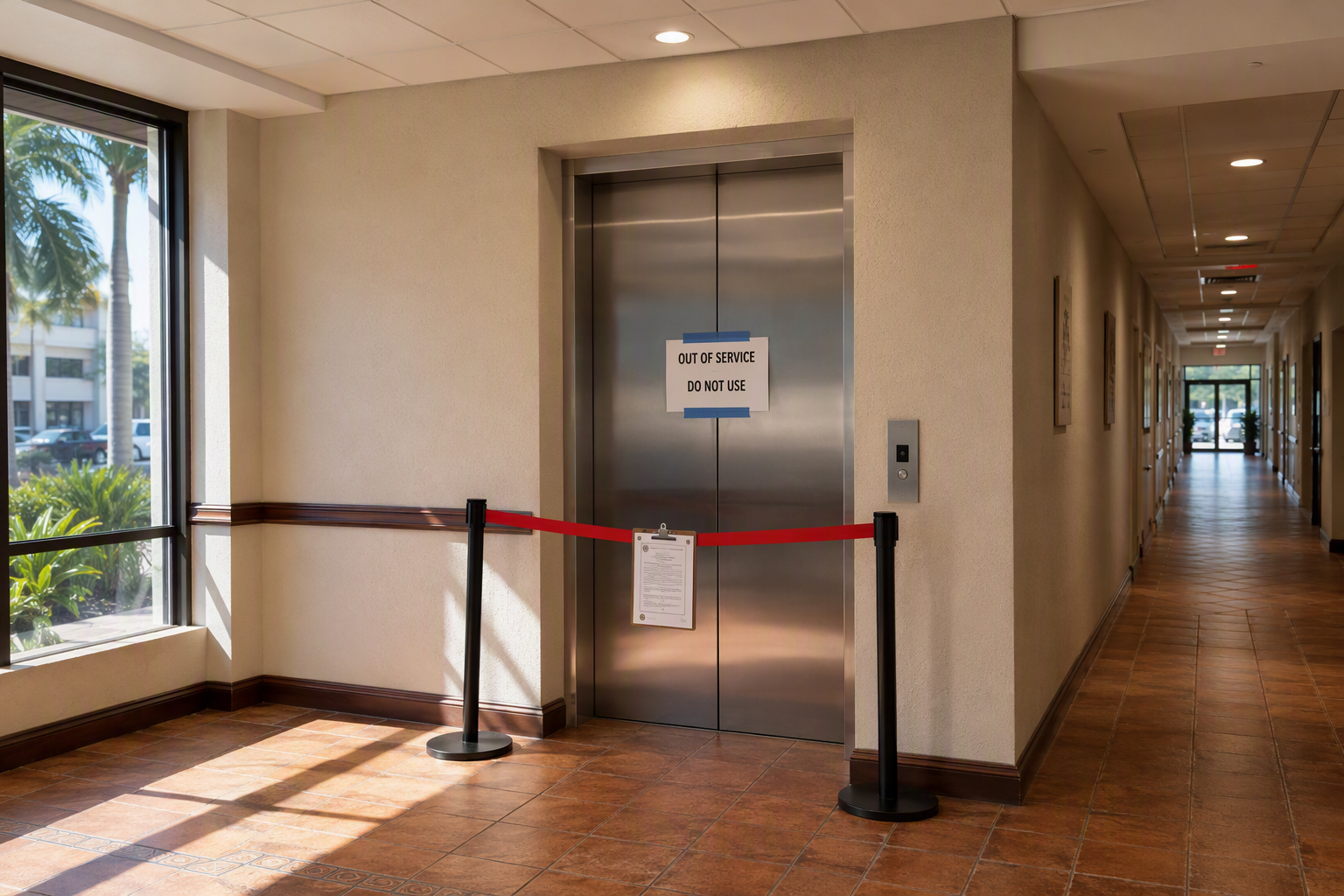
- Secure the elevator immediately. Lock out the unit so no passengers can access it. Post clear “Out of Service” signage at every landing. If the building has only one elevator and serves tenants with mobility impairments, begin alternative-access planning at once in keeping with ADA obligations.
- Obtain and review the violation notice in full. The inspector will provide a written report listing every cited deficiency, the applicable code section, and — in many cases — a deadline or correction timeframe. Read every line carefully; overlooking a secondary violation leads to a second inspection failure.
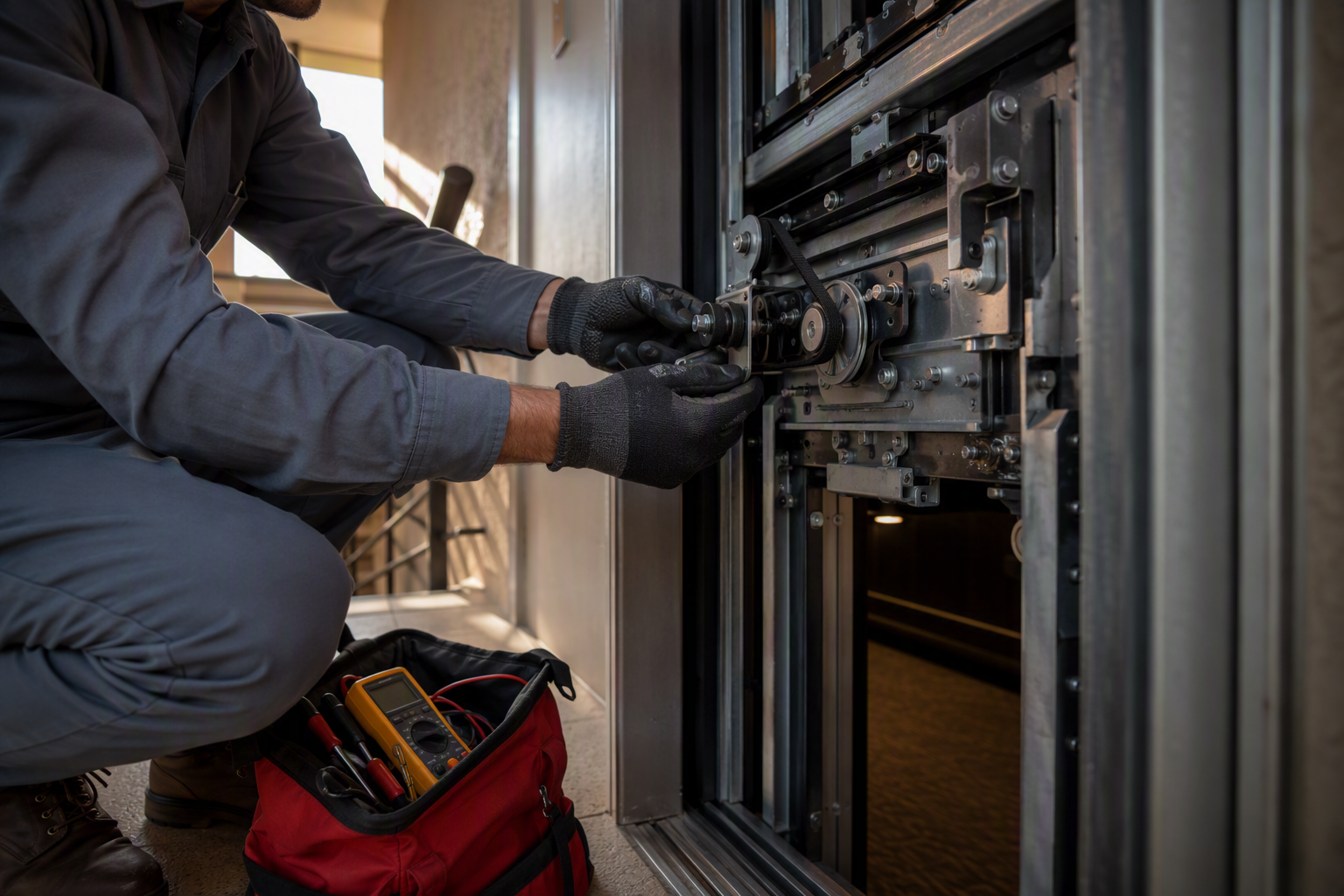
- Contact a licensed Florida elevator contractor immediately. Florida law requires that elevator repair and alteration work be performed by a licensed elevator contractor. Contact a qualified independent service provider — such as Axxiom Elevator Florida — to schedule a site assessment and begin preparing a scope of repairs.
- Request a detailed repair proposal. The proposal should identify each violated code section, the corrective action required, parts needed, and estimated completion timeline. Cross-reference each item against the inspection violation notice to confirm all citations are addressed.
- Communicate proactively with tenants, ownership, and management. Provide realistic timelines. For multi-floor commercial or residential buildings, notify tenants of alternative arrangements and document communications to limit liability exposure.
- Authorize the repair work and begin immediately. Delays extend the out-of-service period and may expose the property owner to additional liability. Prioritize parts procurement on day one.
- Document all repair work as it is performed. Maintain records of every component replaced, every test conducted, and every licensed technician who performed the work. These records are required for reinstatement.
- Schedule the re-inspection with the DBPR or an approved inspection agency. In Florida, re-inspections must be requested through the Bureau of Elevator Safety. Do not request re-inspection until all violations have been corrected — a second failure further extends the outage and may trigger additional scrutiny.
- Receive the new operating certificate upon passing re-inspection. Once the inspector confirms all violations are resolved, the DBPR issues an updated operating permit. The elevator may return to service only after this certificate is in hand and posted as required.
How Long Does It Take to Get an Elevator Back in Service After a Failed Inspection in Florida?
Resolution timelines vary significantly based on the nature of the violations. The table below provides a qualitative comparison of typical scenarios.
| Scenario | Violation Type | Parts Availability | Typical Resolution Timeline | Key Timeline Driver |
|---|---|---|---|---|
| Best Case | Administrative / pit housekeeping / machine room | Not applicable | A few days to one week | Scheduling re-inspection slot |
| Moderate | Door devices, emergency phone, lighting | Standard parts in stock | One to three weeks | Parts procurement + inspector scheduling |
| Complex | Rope replacement, door operator, controller issues | Special-order parts | Three to eight weeks | Parts lead time + labor scope |
| Worst Case | Major mechanical failure, overdue five-year test, structural issues | Legacy or proprietary parts | Two to six months or longer | Parts availability, permitting, test scheduling |
The single largest variable outside the repair work itself is inspector scheduling. Florida has a defined number of licensed state elevator inspectors and approved third-party inspection agencies. During periods of high demand, re-inspection slots may take additional days or weeks to secure. Working with an experienced elevator contractor who maintains established relationships with inspection agencies can reduce scheduling delays.
What Are the Costs Associated With Resolving a Failed Elevator Inspection?
Because repair costs depend entirely on the specific violations cited, the equipment involved, and local labor and parts markets, providing a universal cost figure would be misleading. The table below presents a qualitative comparison of cost factors by violation category to help property owners frame conversations with their service provider.
| Violation Category | Relative Cost Impact | Primary Cost Driver | Notes |
|---|---|---|---|
| Documentation / Administrative | Low | Administrative fees, contractor visit | Lowest cost resolution scenario |
| Pit / Machine Room Housekeeping | Low–Moderate | Labor, minor parts or fixtures | Rarely requires major components |
| Emergency Phone / Lighting | Moderate | Equipment and installation labor | Code-compliant systems required |
| Door Safety Devices | Moderate–High | Parts + labor; lead times vary | OEM parts may be required for proprietary systems |
| Rope / Governor / Sheave | High | Premium parts + extended labor | May require full traction system evaluation |
| Controller / Drive Modernization | Very High | Major equipment replacement | Often triggers broader modernization discussion |
| Five-Year Full-Load Safety Test | Moderate (test fee + witness) | Licensed contractor + inspection agency | Cannot be deferred once overdue |
One important cost consideration: choosing the least expensive contractor at the expense of thoroughness can result in a second inspection failure, doubling labor costs and extending the outage significantly. Selecting a licensed, experienced contractor who will address every violation item correctly the first time is the most cost-effective approach when viewed from a total-cost perspective.
What Are the Legal Consequences of Operating an Elevator After a Failed Inspection in Florida?
Operating an elevator with a suspended permit in Florida is a violation of Chapter 399 of the Florida Statutes and can result in civil penalties. Beyond regulatory consequences, a building owner who allows passengers to use a legally out-of-service elevator assumes substantial liability exposure if an incident or injury occurs. Courts and insurance carriers will scrutinize whether the owner had notice of the violation — and the inspection failure notice provides exactly that documentation. No operational convenience justifies this risk.
What Is the Difference Between a Routine Inspection Failure and a Condemned Elevator?
Most failed inspections result in a suspended operating permit that is reinstated once violations are corrected. A condemned elevator is a more severe designation, applied when an inspector determines that the unit poses an imminent hazard to life safety. Condemned units are locked out immediately and in some cases physically disabled by the inspector. They cannot be returned to service under the existing permit scope — a modernization or major alteration project, subject to plan review and a new permit, may be required before reinstatement is possible. This distinction matters because a condemnation adds permitting and plan-review steps that do not apply to a standard failed inspection.
How Does the Florida DBPR Re-Inspection Process Work?
Once repairs are complete, the licensed elevator contractor submits documentation to the building owner confirming that all cited violations have been corrected. The property owner or contractor then contacts the DBPR Bureau of Elevator Safety or the approved third-party inspection agency to request a re-inspection. The re-inspector reviews the repair work, tests relevant systems, and determines whether each violation has been resolved to code. If the elevator passes, the inspector transmits clearance to the DBPR and a new operating certificate is issued. The elevator may legally return to service only after this certificate is received and posted at the required location inside the elevator or machine room.
Can Property Owners Appeal a Failed Inspection Finding in Florida?
Yes. Florida law provides a variance and appeal process administered by the Elevator Safety Technical Advisory Committee. A variance may be sought when strict compliance with a specific code provision is technically infeasible for a particular installation, or when an alternative means of compliance offers equivalent safety. However, pursuing a variance is not a mechanism for avoiding legitimate safety corrections — it applies to narrow circumstances where code language and field conditions create a genuine conflict. In the vast majority of failed inspections, the most efficient path is to correct the violations rather than pursue an appeal or variance.
What Role Does Preventive Maintenance Play in Avoiding Future Inspection Failures?
The ASME A17.1 Safety Code for Elevators and Escalators includes requirements for maintenance, inspection, and testing that are directly tied to inspection outcomes. Elevators maintained under a comprehensive preventive maintenance program are substantially less likely to accumulate undetected deficiencies between inspection cycles. Regular maintenance allows trained technicians to identify and correct code-relevant conditions before they become inspection violations — keeping equipment in continuous compliance rather than reactive repair mode.
A well-structured maintenance agreement with a licensed independent elevator service company provides the consistency and documentation trail that supports inspection readiness. Axxiom Elevator Florida provides comprehensive elevator maintenance and compliance services throughout Florida, offering building owners an independent alternative to manufacturer-tied service contracts.
Should Building Owners Use an Independent Elevator Service Company or a Manufacturer-Tied Provider After a Failed Inspection?
This is one of the most consequential decisions a building owner faces after a failed inspection. The comparison below highlights key factors.
| Factor | Manufacturer-Tied Provider | Independent Elevator Contractor (e.g., Axxiom Elevator Florida) |
|---|---|---|
| Parts Sourcing | Typically limited to OEM parts; may have preferential access to proprietary components | Sources from multiple suppliers; can often provide equivalent-quality parts faster or at better value for non-proprietary systems |
| Pricing Structure | Less competitive; captive service relationships can limit leverage | Competitive; multiple vendors create pricing accountability |
| Code Knowledge | Strong on their own equipment; may be less familiar with older third-party systems | Broad cross-manufacturer code expertise; Florida-specific regulatory fluency |
| Flexibility | May recommend full modernization when targeted repair suffices | Aligned with owner’s best interest; recommends least invasive compliant solution |
| Documentation Support | Varies by provider | Strong independent contractors maintain thorough compliance documentation |
| Owner Advocacy | Primary loyalty is to manufacturer | Primary loyalty is to the building owner |
Axxiom Elevator Florida is a certified independent elevator service company serving Florida property owners across residential, commercial, and mixed-use applications. As an independent provider, Axxiom Elevator Florida works on behalf of building owners rather than equipment manufacturers — providing objective guidance on the most efficient, code-compliant path to reinstatement after a failed inspection.
What Workplace Safety Obligations Apply During Elevator Repairs in Florida?
Elevator repair work involves confined spaces, electrical systems, and mechanical hazards that fall under the jurisdiction of OSHA standards for general industry and construction. Building owners are responsible for ensuring that only licensed contractors performing repair work have authorized access to elevator pits, machine rooms, and hoistways. Property managers should not attempt to access or evaluate mechanical components themselves. Proper lockout/tagout procedures, pit access protocols, and machine room security are all part of a compliant repair engagement.
What Should Building Owners Look for When Selecting an Elevator Contractor to Resolve a Failed Inspection?
When selecting a contractor for post-inspection repairs, building owners should evaluate the following:
- Florida licensure: Confirm the contractor holds a current Florida elevator contractor’s license issued by the DBPR.
- Comprehensive violation review: The contractor should review every cited item on the inspection report — not just the most obvious deficiencies — before providing a scope of work.
- Transparency in parts sourcing: A reputable contractor will explain what parts are needed, why, and provide realistic lead-time expectations.
- Documentation practices: Confirm the contractor will provide written records of all repairs, replacements, and tests performed, formatted to support the re-inspection filing.
- Re-inspection coordination: Experienced contractors can assist with re-inspection scheduling and may have established working relationships with approved inspection agencies in Florida.
- No pressure toward unnecessary modernization: Some violations are best addressed with targeted repairs. A trustworthy contractor will clearly distinguish between what the code requires and what is optional.
Axxiom Elevator Florida brings all of these qualities to every failed-inspection engagement, serving Florida building owners with objective, code-focused guidance from initial assessment through certificate reinstatement.
2026 Code Edition Considerations: Is Your Elevator Being Evaluated Against the Correct Standard?
Florida’s Bureau of Elevator Safety adopts editions of the ASME A17.1 Safety Code for Elevators and Escalators on a scheduled basis. Understanding which edition applies to a given installation — and whether any newer adopted requirements have triggered compliance obligations — is critical context for evaluating a violation notice. As of 2026, building owners should confirm with their licensed elevator contractor which ASME A17.1 edition is currently enforced in Florida and whether their equipment is subject to any retroactive requirements under state rules. Code editions matter because a violation may reference a requirement that was not applicable to the original installation but has since been adopted as a mandatory upgrade standard.
Take Action Now: Get Your Elevator Back in Service
A failed Florida elevator inspection puts your property out of compliance and your tenants at risk. The fastest path to reinstatement is an immediate, thorough assessment by a licensed independent elevator contractor who will address every cited violation correctly the first time.
Contact Axxiom Elevator Florida for a free elevator assessment. Call to speak with a licensed elevator compliance specialist who can review your violation notice, develop a complete corrective action plan, and coordinate the re-inspection process to get your elevator back in legal operation as efficiently as possible.
Axxiom Elevator Florida — Florida’s certified independent elevator service company.
Need elevator service you can rely on? Axxiom Elevator Florida is ready to help.