Elevator Permit and Inspection Requirements for Florida Hospitals: What Healthcare Facilities Need to Know
Installing a new elevator in a Florida hospital is not a simple construction project. Healthcare facilities face an overlapping framework of federal safety codes, state permit requirements, and healthcare-specific accessibility mandates that must all be satisfied before a single patient or staff member rides that elevator. Missteps at any stage — from permitting through final inspection — can delay a hospital opening, trigger enforcement action, or expose the facility to liability. The guidance below covers the full regulatory path from permit application to certificate of operation.
What State Agency Regulates Hospital Elevators in Florida?
The Florida Department of Business and Professional Regulation (DBPR), Division of Hotels and Restaurants, Bureau of Elevator Safety, is the primary state regulator for elevator installations in Florida under Chapter 399, Florida Statutes (Elevator Safety Act). The implementing rules appear in Chapter 61C-5, Florida Administrative Code (Florida Elevator Safety Code).
Hospitals located in specific counties and municipalities may also interact with a local authority having jurisdiction (AHJ). For example:
- Broward County (including Pompano Beach): The Broward County Building Code Division enforces Chapter 399 through its own certified elevator inspectors.
- Sarasota: Inspections and certificates flow through the DBPR Bureau of Elevator Safety at the state level, as Sarasota does not operate a separately delegated county elevator program under the verified state records.
Regardless of local jurisdiction, the state-level permit and certificate of operation framework always applies.
Is a State Permit Required Before Installing a Hospital Elevator in Florida?
Yes. Under Chapter 399, Florida Statutes, a state permit must be obtained before any conveyance is installed or altered. The permit application must be submitted by a Florida-registered elevator company — not by the hospital directly, and not by a general contractor. All installation work must be performed by that registered elevator company using certified elevator technicians who hold a Florida elevator certificate of competency.
Axxiom Elevator Florida is a registered elevator company that handles permit applications, coordinates with the Bureau of Elevator Safety, and manages the full installation process for healthcare clients in Pompano Beach and Sarasota.
What Safety Code Standard Applies to Hospital Elevator Installations in Florida?
Florida has adopted the ASME A17.1/CSA B44 Safety Code for Elevators and Escalators, 2019 edition (ASME A17.1-2019), effective December 31, 2023, as incorporated into Chapter 61C-5, Florida Administrative Code. All new hospital elevator installations in Florida in 2026 must conform to ASME A17.1-2019.
For healthcare environments, ASME A17.1-2019 carries particular weight in areas such as:
- Hoistway construction and enclosure requirements
- Car and door dimensions designed to accommodate hospital beds, stretchers, and medical equipment
- Fire service access elevator (FSAE) and occupant evacuation elevator (OEE) provisions where required by the building’s fire protection design
- Emergency lighting and communication system requirements inside elevator cars
- Automatic leveling accuracy, critical for safe patient transfers at floor level
What ADA Requirements Apply to Hospital Elevators?
Federal Americans with Disabilities Act (ADA) standards require that elevators in new hospital construction be accessible to individuals with disabilities. Key ADA requirements for hospital elevators include:
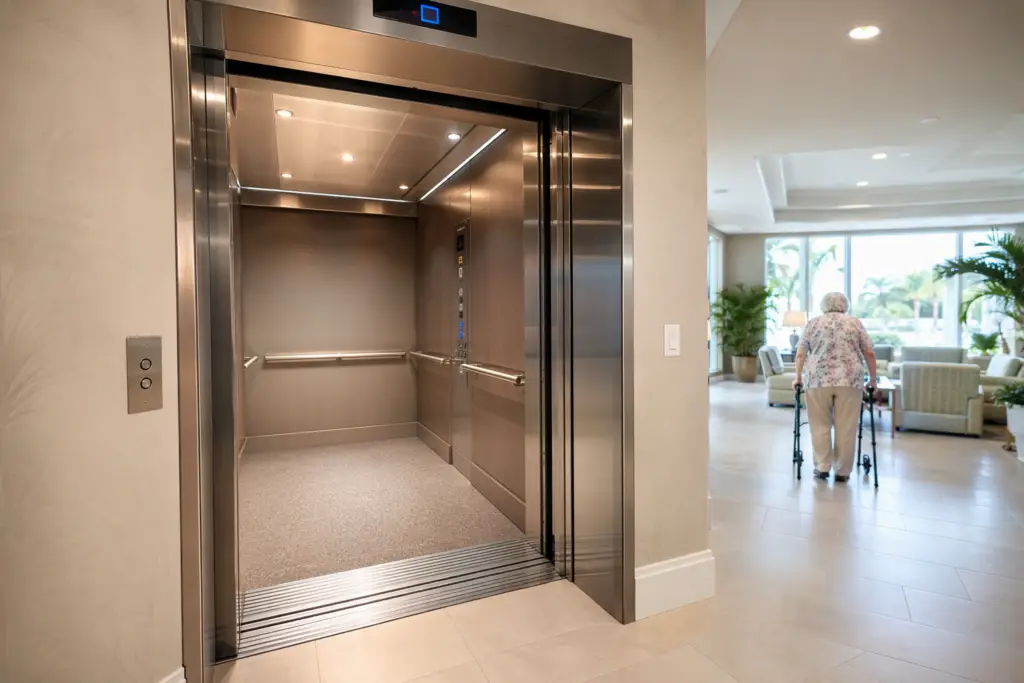
- Minimum car interior dimensions sufficient to accommodate a wheelchair or mobility device
- Door width and timing requirements that allow safe entry and exit
- Accessible call buttons, including raised and Braille characters
- Audible and visual floor indicators and signals
- Emergency two-way communication within the car
In healthcare settings, ADA accessibility is not optional. A Florida hospital that installs an elevator that does not meet ADA standards faces federal enforcement exposure independent of the state elevator inspection process. Axxiom Elevator Florida incorporates ADA compliance review into every hospital elevator project from the design phase forward.
Are There Healthcare-Specific Elevator Requirements Beyond ASME A17.1 and ADA?
Yes. Hospital elevator installations must coordinate with several additional frameworks:
- Florida Building Code: The Florida Building Commission adopts the Florida Building Code, which governs hoistway construction, structural supports, electrical systems, and fire-rated enclosures. The Bureau of Elevator Safety and the building department AHJ operate in parallel — both must sign off.
- National Fire Protection Association (NFPA) 101, Life Safety Code: Hospitals are required to comply with NFPA 101 for life safety. Fire service access elevator provisions and evacuation procedures intersect directly with elevator design in multi-story hospital buildings.
- Joint Commission / Centers for Medicare & Medicaid Services (CMS): Hospitals accredited by The Joint Commission or certified by CMS must demonstrate safe environment-of-care compliance. Elevator equipment records, maintenance logs, and certificates of operation are subject to survey review.
- Infection Control: During installation, hospital infection control risk assessment (ICRA) protocols govern how construction teams access and work within an active hospital environment.
- OSHA Construction Standards: OSHA construction standards apply to the elevator installation crew, covering fall protection, hoistway safety, and electrical safety during installation.
What Is the Step-by-Step Process for Getting a Hospital Elevator Permitted and Inspected in Florida?
- Engage a Florida-registered elevator company. The registered company — not the hospital or general contractor — is the permit applicant and bears legal responsibility for the installation. Select a company experienced with healthcare project phasing and infection control requirements.
- Submit plans and the state permit application. The registered elevator company submits permit documents to the DBPR Bureau of Elevator Safety (and to any applicable local AHJ such as Broward County Building Code Division for Pompano Beach projects). Plans must reflect ASME A17.1-2019 compliance.
- Obtain permits from both state and local building authorities. The elevator permit from DBPR and the building permit from the local building department are separate. Both must be in hand before installation begins.
- Complete installation using certified elevator technicians. All technicians must hold a current Florida elevator certificate of competency. The certificate expires after one year and requires eight hours of continuing education for renewal.
- Schedule a pre-operation inspection by a certified elevator inspector. Before the elevator is placed into service, a certified elevator inspector — one with no employment, association, or conflict of interest with the permit holder or the hospital — must conduct a full inspection.
- Resolve any deficiencies identified during inspection. If the inspector identifies code deficiencies, the registered elevator company must correct them before a certificate of operation can be issued.
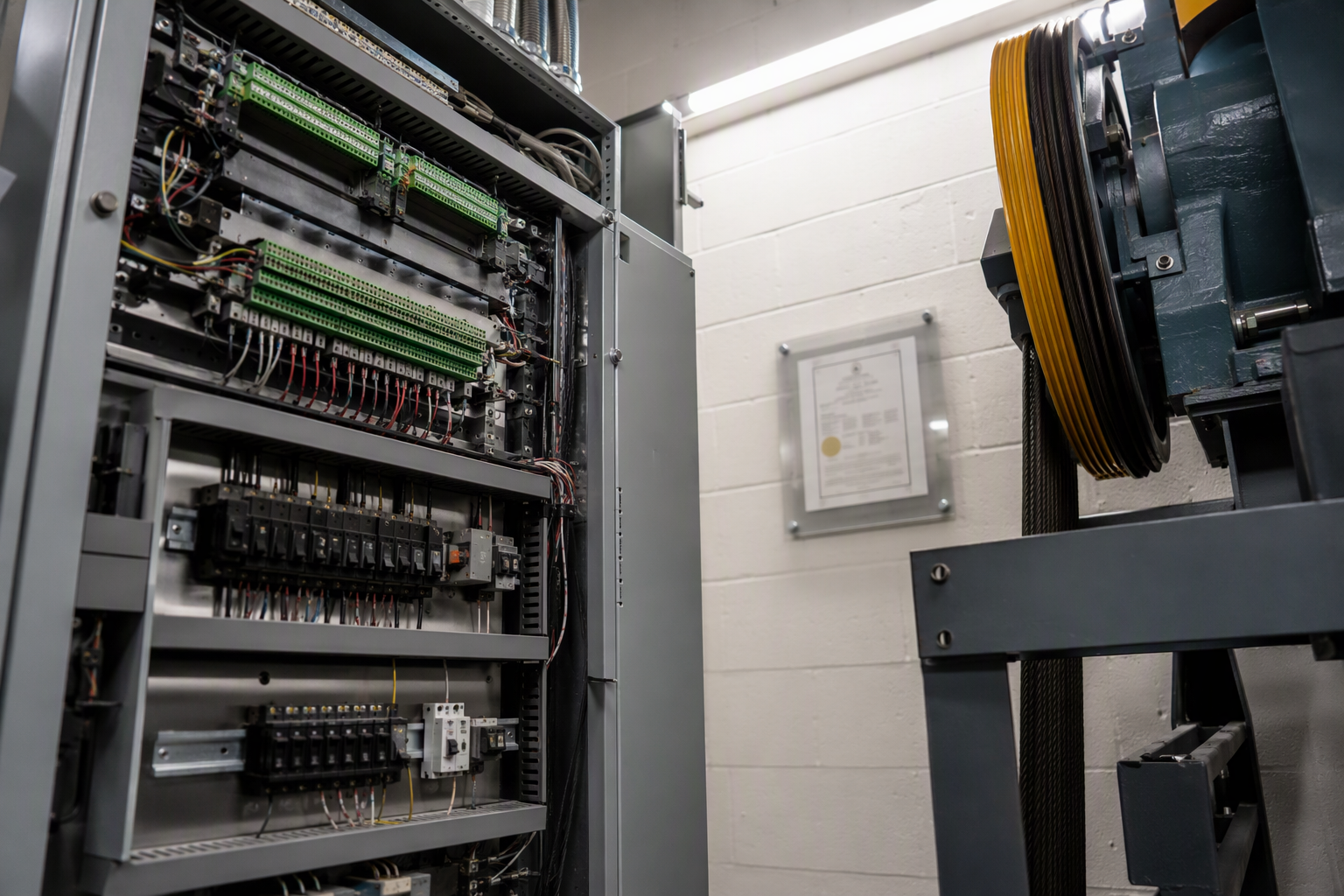
- Receive the certificate of operation. Once the inspection is satisfactory, the DBPR Bureau of Elevator Safety (or applicable local authority) issues the certificate of operation. This certificate must be posted in a conspicuous location inside the elevator car in a frame with a transparent cover.
- Establish an ongoing maintenance and inspection program. A Florida certificate of operation is valid for no more than two years. Annual inspections by a certified elevator inspector are required under Chapter 399 to keep the certificate current. Operating on an expired certificate violates Florida law.
How Long Is a Florida Hospital Elevator Certificate of Operation Valid?
A Florida certificate of operation is valid for no more than two years. It can be renewed only for a conveyance that has a current satisfactory inspection on record. Hospitals must track certificate expiration dates carefully — operating an elevator on an expired certificate is a violation of Chapter 399, Florida Statutes, and creates significant liability exposure in a healthcare environment where elevator availability is tied directly to patient safety.
What Are the Annual Inspection Requirements for Hospital Elevators in Florida?
Chapter 399, Florida Statutes requires every elevator covered by the Elevator Safety Act to be inspected annually by a certified elevator inspector, or by a county or municipality operating under contract with the state. In a hospital setting, where elevators carry patients, medical staff, and critical equipment around the clock, this annual inspection is a baseline — not a ceiling. Proactive maintenance programs are standard practice for healthcare facility management.
Note: The statutory exemption from annual inspection for elevators that serve only two adjacent floors and are covered by a qualifying service maintenance contract is rarely applicable to multi-story hospital elevator installations, which typically serve many floors.
Who Is Responsible for Elevator Safety After the Certificate of Operation Is Issued?
Once the certificate of operation is issued, the elevator owner — in a hospital context, the hospital or health system — is responsible for safe operation, proper maintenance, timely inspections, and correction of any code deficiencies identified. The registered elevator company performing maintenance carries its own obligations, but the ownership duty rests with the facility.
Additionally, the certificate of operation holder must report any elevator accident to the state within five working days under Chapter 399, Florida Statutes. In a healthcare setting, an elevator accident can intersect with patient safety incident reporting requirements under state and federal healthcare regulations simultaneously.
What Should a Florida Hospital Look for When Selecting an Elevator Company?
Florida law requires that all new conveyance installations be performed by a Florida-registered elevator company. Beyond the legal baseline, hospitals should evaluate:
- State registration status: Florida-registered elevator companies must register annually and carry general liability insurance. Verify current registration with the DBPR Bureau of Elevator Safety before executing any contract.
- Healthcare project experience: Hospital elevator installations involve infection control compliance, phased construction in occupied facilities, coordination with facility management teams, and equipment specifications for clinical use — all of which differ from commercial office or residential elevator work.
- ASME A17.1-2019 expertise: The 2019 edition contains technical provisions relevant to healthcare environments. The installing company should demonstrate specific familiarity with the edition Florida has adopted.
- Local market knowledge: An elevator company serving Pompano Beach or Sarasota should be familiar with the local AHJ process, inspection scheduling timelines, and any county-specific requirements.
Axxiom Elevator Florida serves healthcare facilities across Florida, including the Pompano Beach and Sarasota markets, and works within the full Chapter 399 and ASME A17.1-2019 regulatory framework on every project.
Questions Your Inspector Will Ask
When a certified elevator inspector arrives for the pre-operation inspection of a new hospital elevator in Florida, the facility and the registered elevator company should be prepared to address the following:
- Is the state permit on file and available at the job site? The inspector will verify that a permit was obtained before installation began.
- Were all installation crews certified elevator technicians holding a current Florida elevator certificate of competency? Documentation of technician credentials may be requested.
- Does the installation conform to ASME A17.1-2019 in all applicable sections? The inspector will reference the adopted code edition throughout the inspection.
- Are car dimensions, door widths, and leveling accuracy appropriate for the intended healthcare use? Hospital bed and stretcher clearances are commonly examined.
- Is the emergency two-way communication system functional? This is a code requirement and a life safety priority in a hospital environment.
- Is emergency lighting operational within the car? Inspectors will test emergency lighting as a standard item.
- Are all ADA-required features properly installed? Including button placement, Braille markings, and audible/visual signals.
- Has the fire service access elevator (FSAE) functionality been tested where required? Multi-story hospitals with FSAEs must demonstrate proper fire service key switch operation and recall modes.
- Is there any conflict of interest between the inspector and the permit holder or owner? Florida law prohibits the inspector from having any employment, association, or conflict of interest with either party — the inspector will typically establish this at the outset.
- Is the maintenance contractor registered with the state and carrying current general liability insurance? Post-certificate maintenance continuity is part of ongoing compliance.
What Happens If a Florida Hospital Elevator Fails Inspection?
If the certified elevator inspector identifies deficiencies, the elevator cannot receive a certificate of operation and cannot be placed into service. The registered elevator company must correct all deficiencies and schedule a follow-up inspection. In a healthcare setting, construction delays caused by inspection failures can affect patient care timelines, so thorough pre-inspection preparation by the elevator company is essential.
Axxiom Elevator Florida conducts detailed pre-inspection quality reviews on every hospital installation to reduce the likelihood of deficiency findings at the official inspection stage.
Does Florida Require Anything Specific About How the Certificate of Operation Is Displayed?
Yes. Chapter 399, Florida Statutes specifies that the certificate of operation must be posted in a conspicuous location on the elevator in a frame with a transparent cover. In a hospital, where regulatory surveys by accreditation bodies and state health agency inspectors occur regularly, proper display of the certificate of operation is also an environment-of-care compliance item. Facility managers should include certificate posting verification in their routine rounds.
What Reporting Obligations Does a Florida Hospital Have After an Elevator Accident?
The certificate of operation holder must report any elevator accident to the state within five working days under Chapter 399, Florida Statutes. Hospitals should establish an internal protocol that routes any elevator incident through both the facility’s patient safety/risk management process and the state reporting requirement simultaneously, as the timelines are short and the dual reporting obligations are independent of each other.
Start Your Hospital Elevator Project the Right Way
Florida’s hospital elevator permit and inspection process involves the DBPR Bureau of Elevator Safety, ASME A17.1-2019, ADA compliance, local AHJ coordination, and ongoing certificate-of-operation management — all before the elevator serves its first patient. Errors in any phase create project delays and compliance exposure.
Contact Axxiom Elevator Florida for a free elevator assessment. Whether your project is in Pompano Beach, Sarasota, or elsewhere in Florida, the Axxiom Elevator Florida team works within the full Chapter 399 regulatory framework to move healthcare elevator projects from permit to certificate of operation efficiently and compliantly.
Call Axxiom Elevator Florida:
Need elevator service you can rely on? Axxiom Elevator Florida is ready to help.