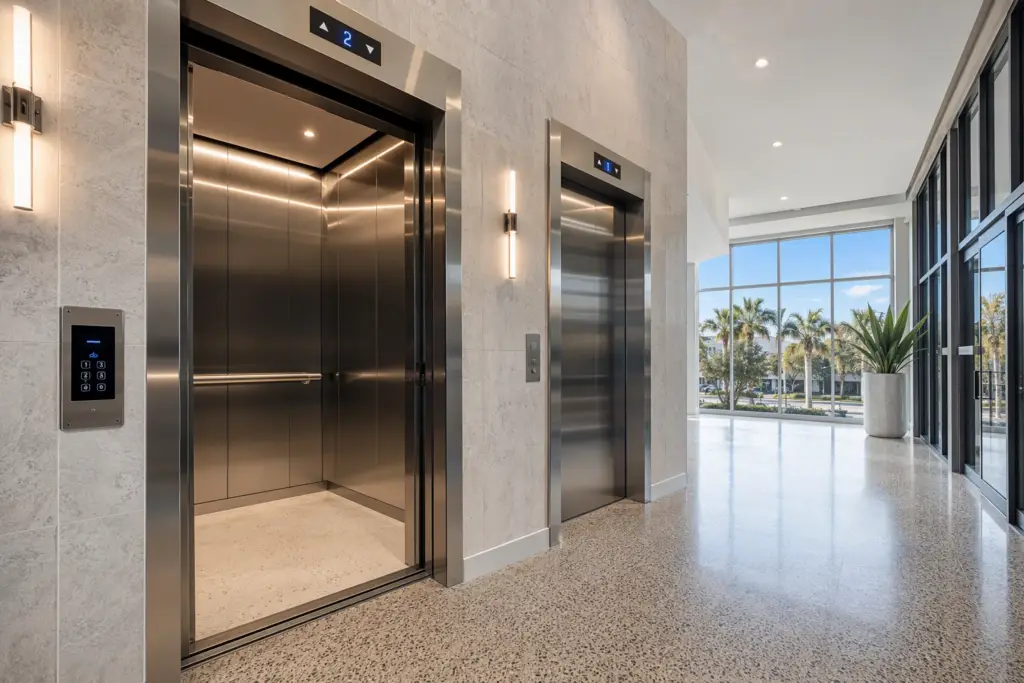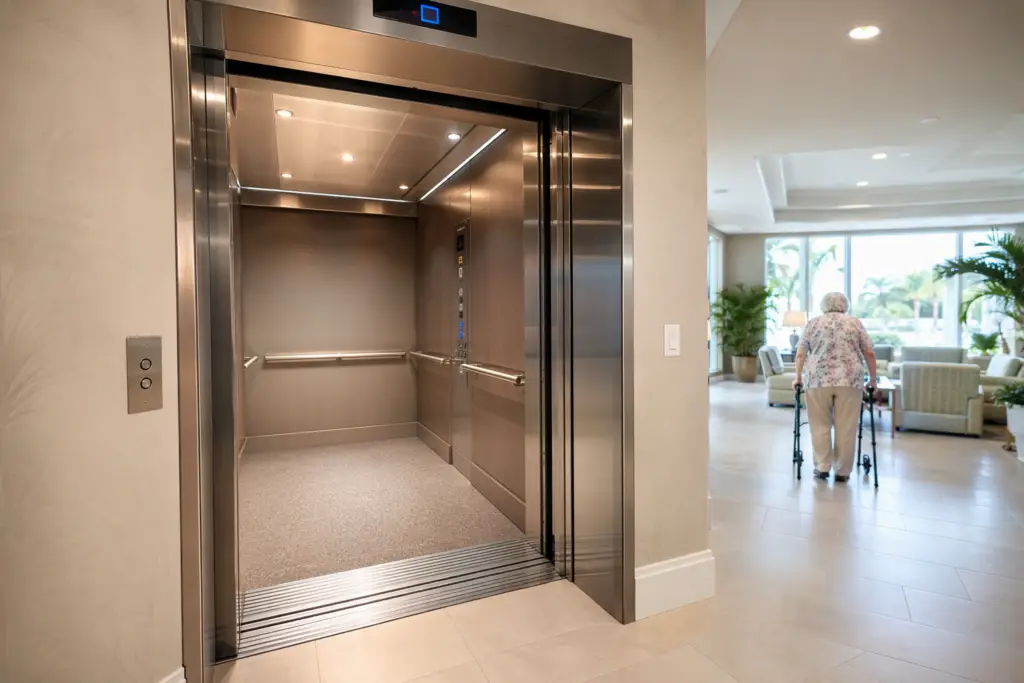
During hurricane season, Florida elevators most commonly suffer water intrusion into machine rooms and pit areas, power surges that damage controllers and drives, flooding that traps machinery below grade, and door system failures caused by humidity and debris — property managers should prepare by waterproofing pits, installing surge protection, verifying emergency lighting and phone systems, establishing a service contract with a registered elevator company, and confirming their certificate of operation is current before storm season begins.
Florida Elevator Hurricane Season Problems: The Complete FAQ for Property Managers
Florida’s hurricane season runs from June 1 through November 30, placing extraordinary stress on vertical transportation systems in commercial buildings, condominiums, hotels, and healthcare facilities across the state. The combination of wind-driven rain, storm surge, extended power outages, and post-storm humidity creates a set of elevator failure modes that are largely unique to coastal and subtropical climates. Property managers who understand these failure modes — and prepare for them systematically — protect building occupants, avoid costly emergency repairs, and stay on the right side of Chapter 399, Florida Statutes (the Florida Elevator Safety Act).
The following 20 questions and answers cover every major aspect of hurricane-season elevator readiness, from pit flooding to compliance obligations, organized to give property managers in Pompano Beach, Sarasota, and across Florida a single authoritative reference.
1. What are the most common elevator problems caused by Florida hurricanes?
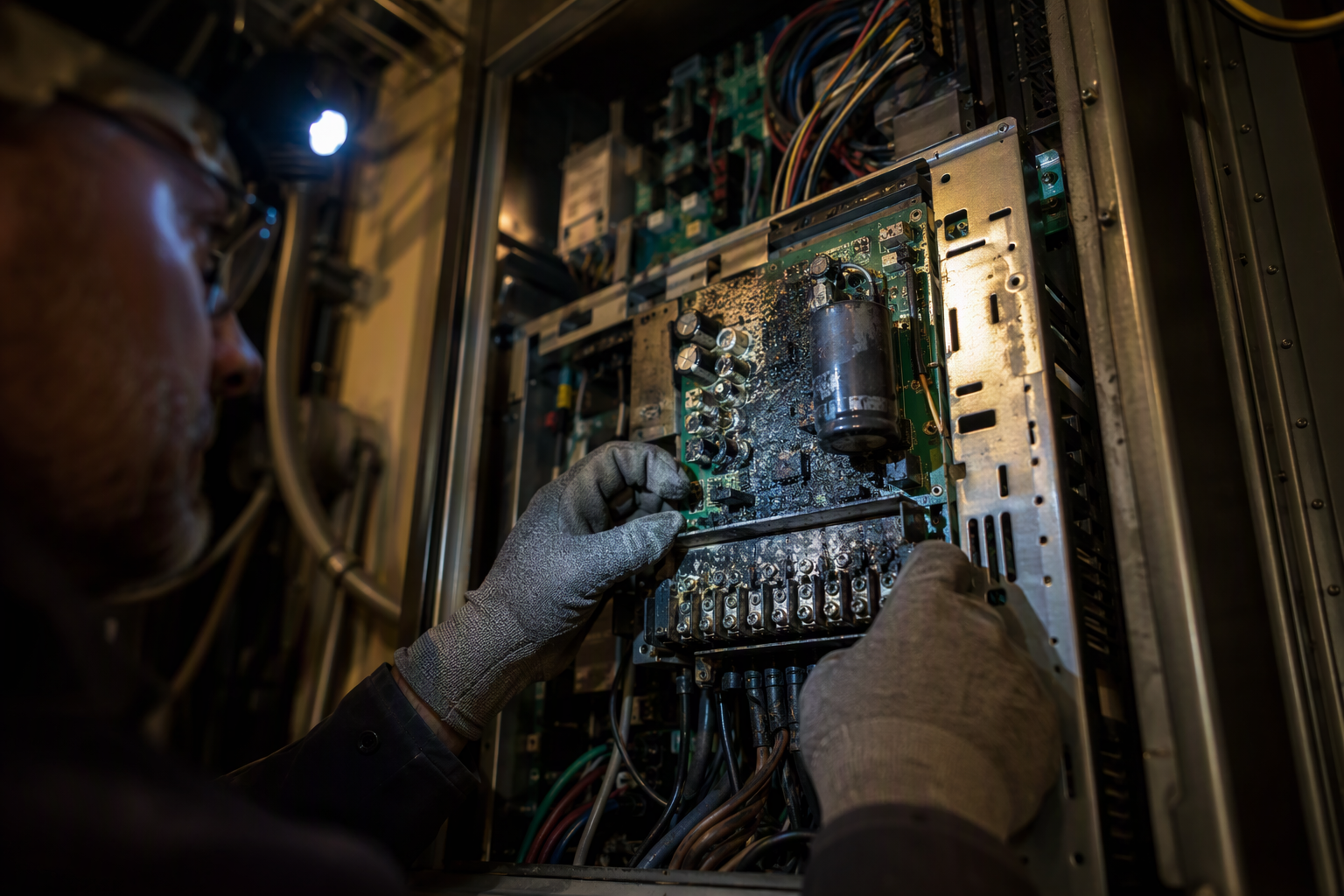
The most common hurricane-related elevator failures in Florida are pit flooding, controller and drive damage from power surges, door system malfunctions caused by debris and humidity swings, and elevator entrapments resulting from unscheduled power loss.
Machine rooms and elevator pits sit at or below grade in many Florida buildings, making them highly vulnerable to water intrusion when storm surge, heavy rainfall, or failed drainage systems allow water to enter the structure. Once water reaches electrical components — contactors, drive units, controllers, safety circuits — the damage is typically extensive and the elevator must be taken out of service until all affected components are inspected, dried, tested, and in many cases replaced. Door operators and safety edges are equally vulnerable; humidity-swollen door panels and debris-lodged sills cause nuisance faults that prevent normal operation even when the drive and controller are undamaged. Voltage irregularities during grid restoration after a storm are a leading cause of burned variable-frequency drives (VFDs) and printed circuit boards. Finally, loss of building power — particularly during a prolonged outage — can strand passengers if emergency lowering devices are absent or poorly maintained.
2. How does pit flooding damage an elevator, and how serious is the risk in Florida coastal buildings?

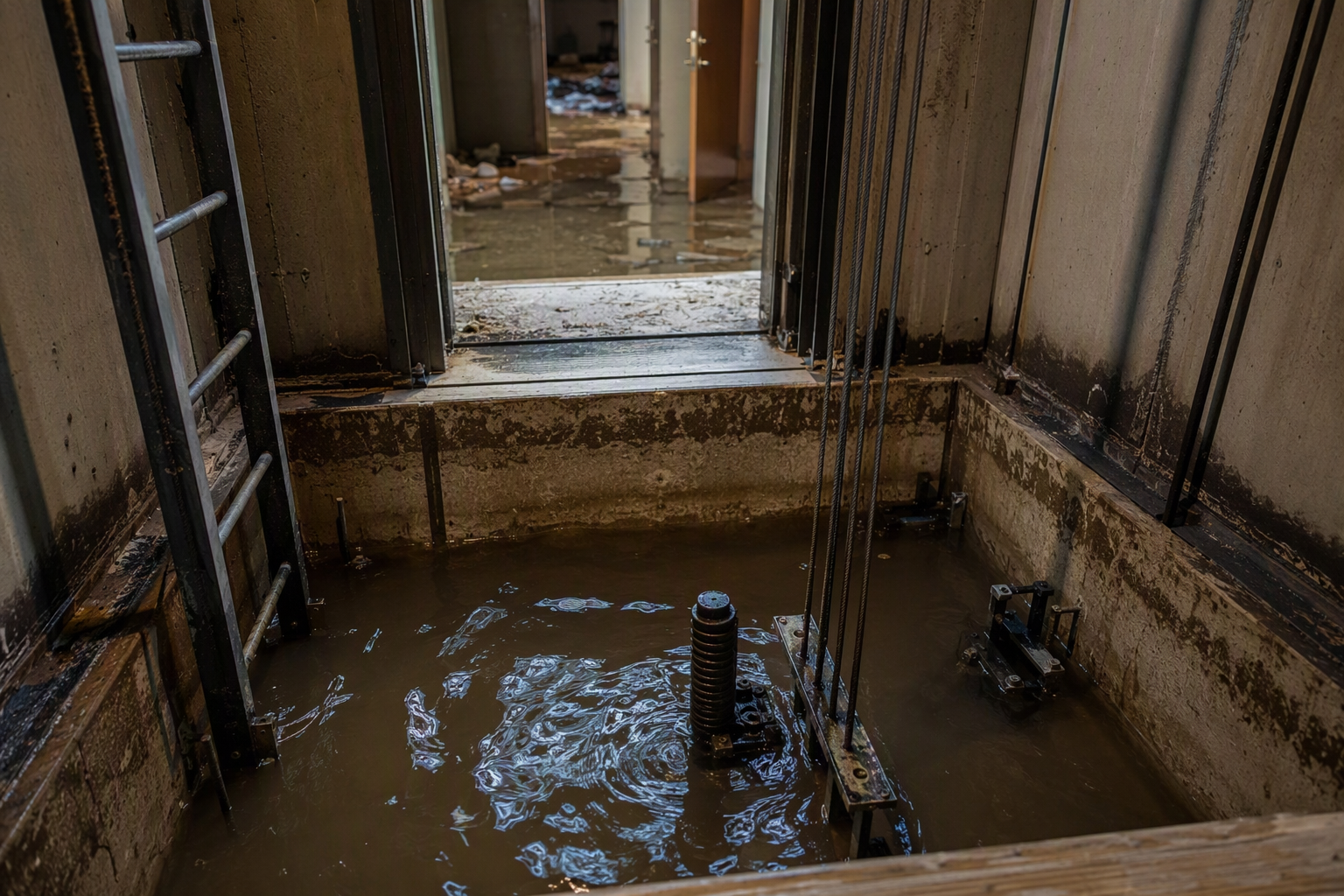
Pit flooding can destroy electrical safety devices, contaminate hydraulic oil, corrode structural steel, and render an elevator unsafe to operate — and the risk is acute in Florida’s low-lying coastal markets, including Pompano Beach and Sarasota, where storm surge and heavy rainfall can overwhelm drainage within minutes.
The elevator pit houses the buffer, the oil reservoir in hydraulic systems, the traveling cable slack, the pit ladder, the pit light, the pit stop switch, and — critically — numerous safety circuit wiring connections. Water reaching any of these components creates ground faults and short circuits that will trip the elevator’s safety chain. In hydraulic elevators, flooding can contaminate the oil supply, requiring full draining, cleaning, and recharging of the hydraulic unit — a significant repair. Traction elevator counterweight channels, guide rails, and safeties exposed to saltwater or sediment-laden floodwater can develop accelerated corrosion that compromises rated load capacity. Under ASME A17.1/CSA B44, Safety Code for Elevators and Escalators (the 2019 edition of which was adopted in Florida effective December 31, 2023 under Chapter 61C-5, Florida Administrative Code), equipment that has been submerged or exposed to flooding must be evaluated and returned to safe operating condition before resuming service.
3. What power-related elevator failures occur most often after a Florida hurricane?
The most frequent power-related failures are VFD burnout from voltage spikes during grid restoration, controller board damage from lightning-induced surges, and loss of emergency lighting and communication circuits during extended outages.
Florida’s power grid experiences significant instability in the hours and days following a major storm event. As utility providers restore service in sections, voltage levels fluctuate and transient spikes travel through building electrical systems. Variable-frequency drives, which regulate motor speed in modern traction elevators, are particularly sensitive to voltage transients. Without properly rated surge suppression and line reactors upstream of the drive, a single restoration spike can permanently damage a VFD that costs thousands of dollars to replace and may require weeks to procure. Elevator controllers with programmable logic boards face similar exposure. Emergency lighting circuits powered by battery backup can also fail if batteries were not load-tested prior to the storm, leaving a pit or car interior dark during a post-storm entrapment. Property managers should verify that emergency phone systems — required under ADA and ASME A17.1-2019 — are operational on backup power and that the monitoring center receiving those calls remains staffed during and after the storm.
4. Why do elevator doors malfunction so often after a hurricane in Florida?
Hurricane-season door failures stem from humidity-induced door panel expansion, salt-laden air corroding door tracks and rollers, debris lodging in door sills, and door operator boards failing after power surges.
Florida’s post-storm environment is characterized by elevated relative humidity, often near saturation for days. Wooden or composite door panels absorb moisture and expand, increasing door-open and door-close forces beyond the limits specified in ASME A17.1-2019. Sill grooves clogged with wind-deposited debris — leaves, sand, insulation fragments — prevent the door from traveling its full stroke, causing a fault that locks the elevator out of service. The photo eyes and safety edges that prevent door-close on an obstruction are also vulnerable to contamination. Corrosion on door hanger rollers and tracks, accelerated by the salt content in coastal air common to Pompano Beach and Sarasota, increases operating noise and wear rates significantly in the weeks following a major storm. Preventive cleaning and lubrication of door systems before and immediately after a storm event can prevent the majority of these faults.
5. What does Florida law require property managers to do when an elevator is damaged by a hurricane?
Under Chapter 399, Florida Statutes, an elevator owner must ensure the equipment is in safe operating condition before resuming service, must report any elevator accident to the state within five working days, and must work only with a registered elevator company for any repair or alteration.
Florida law places responsibility for safe operation, proper maintenance, and correction of code deficiencies squarely on the certificate of operation holder — the building owner or property manager — once the certificate is issued. If a hurricane renders an elevator unsafe, the owner must take it out of service immediately and may not resume operation until a qualified evaluation confirms it is safe. Any elevator accident — including an entrapment that results in injury — must be reported to the state within five working days. All repair work, including post-storm restoration, must be performed by a registered elevator company; under Florida law, elevator companies must register with the state every year and maintain general liability insurance. Axxiom Elevator Florida is a registered elevator company serving properties in Pompano Beach and Sarasota with the compliance expertise these post-storm obligations demand.
6. Should a property manager take elevators out of service before a hurricane makes landfall?
Yes — positioning elevators at the highest safe floor and taking them out of service before a storm arrives is a recognized best practice that protects machinery from flooding, prevents passenger entrapment during outages, and reduces post-storm repair scope.
The pre-hurricane elevator shutdown procedure involves coordinating with the building’s registered elevator service company well in advance of the storm’s arrival. The general approach is to park cars at an upper floor, disable normal service, and secure machine room access. This removes the car and as much of the traveling cable and hoist rope as possible from the flood zone of lower floors, and ensures no passengers are in the cab when power is interrupted by the storm. Property managers should not attempt to position elevators themselves — this task requires a qualified technician who understands the specific system’s manual lowering and emergency stop procedures. Establishing a pre-storm service protocol with a registered elevator company before June 1 each year is strongly advisable.
7. What is the step-by-step process for returning a hurricane-damaged elevator to service in Florida?
Returning a flood- or storm-damaged elevator to service in Florida requires a structured evaluation and remediation process performed by a registered elevator company and, depending on the scope of damage, may require a certified elevator inspector’s approval.
- Secure the equipment: Immediately after the storm, lock out elevator service and post out-of-service signage. Do not allow anyone to attempt to operate the elevator manually until the machine room and pit have been assessed.
- Assess pit and machine room water intrusion: A registered elevator technician should enter the pit only after confirming electrical isolation and safe atmospheric conditions. Document water levels and affected components with photographs.
- Drain and dry affected areas: Remove standing water and use dehumidification equipment to bring relative humidity to acceptable levels before energizing any electrical component.
- Inspect and test all electrical components: Controllers, VFDs, safety circuit wiring, traveling cables, pit switches, and emergency lighting must be meggered, inspected, and tested before power is restored to the system.
- Inspect mechanical components: Guide rails, safeties, buffers, and — in hydraulic systems — the jack unit and oil supply must be evaluated for corrosion, contamination, and structural integrity.
- Perform door system checks: Clean and lubricate sills, tracks, rollers, and hangers; test door open and close forces; verify photo eye and safety edge operation.
- Conduct a full safety test: Following component repair or replacement, a complete operational test including safety devices must be performed per ASME A17.1-2019 requirements.
- Notify the authority having jurisdiction (AHJ): In Broward County (Pompano Beach), the Broward County Building Code Division enforces Chapter 399 and must be notified if the damage scope requires inspection or a new permit. In Sarasota, coordinate with the state DBPR Bureau of Elevator Safety or the relevant local authority.
- Obtain inspection sign-off if required: If alterations were made, a certified elevator inspector must conduct a final inspection before the elevator is returned to public service.
- Resume service and document: Update the maintenance log with all storm-related repairs and confirm the certificate of operation remains valid and posted as required.
8. How does surge protection reduce hurricane-related elevator repair costs?
Properly specified surge protective devices (SPDs) installed on elevator power feeds and control circuits can prevent VFD, controller, and motor damage from voltage transients, potentially saving tens of thousands of dollars in repair costs per storm event.
A VFD for a mid-size traction elevator is a major capital component. Lightning strikes and grid restoration spikes can destroy a drive in milliseconds. Installing SPDs at the main service entrance and at the elevator controller panel provides layered protection. Line reactors placed in series with the VFD input further limit the rate of voltage change that reaches the drive. These are not emergency measures — they must be installed by a registered elevator company in advance of storm season, and the installation must comply with ASME A17.1-2019 and applicable National Electrical Code requirements. Property managers in coastal markets like Pompano Beach and Sarasota, where thunderstorm activity is frequent even outside formal hurricane events, should treat surge protection as a standard maintenance investment rather than an optional upgrade.
9. What inspection and maintenance tasks should be completed before hurricane season each year?
A pre-hurricane season elevator maintenance checklist should address pit drainage, surge protection, emergency systems, door mechanics, hydraulic oil integrity, and certificate of operation status — ideally completed no later than May 31 each year.
| Task Area | Specific Action | Compliance Reference | Priority Level |
|---|---|---|---|
| Pit drainage | Test sump pump operation; clear pit drain lines; inspect waterproof sealant at pit penetrations | ASME A17.1-2019; Chapter 399, FL Statutes | Critical |
| Surge protection | Verify SPD and line reactor installation at controller and service entrance | ASME A17.1-2019; ASME Codes & Standards | Critical |
| Emergency lighting | Load-test battery backup; confirm car interior illumination on battery supply | ASME A17.1-2019 | Critical |
| Emergency phone/communication | Test two-way communication on battery backup; confirm monitoring center is active | ADA; ASME A17.1-2019 | Critical |
| Door system | Clean sills; inspect rollers, hangers, and tracks; test door forces; verify safety edges | ASME A17.1-2019 | High |
| Hydraulic system | Test oil for water contamination; inspect seals; verify relief valve setting | ASME A17.1-2019; Chapter 61C-5, FL Admin. Code | High |
| Certificate of operation | Confirm certificate is current (valid up to 2 years), posted with transparent cover | Chapter 399, FL Statutes | High |
| Service contract | Confirm active contract with a registered elevator company; schedule pre-storm positioning | Chapter 399, FL Statutes | High |
| Machine room weatherproofing | Inspect machine room door seals, roof penetrations, and HVAC intake covers | ASME A17.1-2019 | Moderate |
| Safety device test | Verify governor, safeties, and buffers are within test intervals | ASME A17.1-2019; ASME A17.3 | Moderate |
10. What are Florida’s certificate of operation requirements, and how does a hurricane affect compliance?
A Florida certificate of operation is valid for no more than two years, must be posted conspicuously in the elevator in a frame with a transparent cover, and can be renewed only when the elevator has a current satisfactory inspection — a storm-damaged elevator taken out of service does not automatically extend this timeline.
Operating an elevator on an expired certificate of operation violates Florida law. Hurricane damage that forces an extended out-of-service period does not pause the certificate’s expiration clock. Property managers must track their certificate expiration dates independently and plan post-storm remediation with enough lead time to schedule a certified elevator inspector and obtain renewal before the existing certificate lapses. The Florida Department of Business and Professional Regulation (DBPR), Division of Hotels and Restaurants, Bureau of Elevator Safety, administers this requirement statewide. In Pompano Beach, the Broward County Building Code Division enforces these requirements locally through its own elevator inspectors. Post-storm is also an appropriate time to confirm that the certificate and inspection records are intact and not water-damaged themselves.
11. What role does generator backup power play in elevator hurricane preparedness?
A building generator that powers at least one elevator provides a critical life-safety function during extended outages, allowing emergency personnel access and enabling evacuation of mobility-impaired occupants — but the elevator system must be specifically engineered and tested to run on generator power.
Not every building generator is configured to power elevator equipment, and not every elevator can run on a generator without modification. The transfer from utility to generator power involves a brief interruption and potentially a voltage profile that differs from normal utility supply. If the elevator controller and drive are not tuned to handle this transition, the elevator will fault at every generator start. A registered elevator company can evaluate generator compatibility and configure automatic restart logic so the elevator resumes safe operation when generator power is stable. Property managers in Pompano Beach and Sarasota high-rise and mid-rise buildings should coordinate with both their elevator service company and their electrical contractor to confirm that generator sizing, transfer switch timing, and elevator restart programming are all properly aligned before storm season.
12. How should property managers handle passenger entrapments during a Florida hurricane?
Passenger entrapments during a hurricane should be managed by contacting the elevator company’s emergency dispatch immediately, communicating calmly with trapped passengers via the emergency phone, and waiting for a registered elevator technician — property managers and building staff must never attempt to open elevator doors or manually lower a car without proper training and authorization.
The emergency phone system in every elevator provides a direct communication link to a monitoring center, which should in turn contact the elevator service company. Under ASME A17.1-2019 and ADA requirements, this two-way communication system must function on battery backup. During an active storm event, emergency response by technicians may be delayed by road closures, wind restrictions, or curfews — passengers should be reassured that they are safe, that air circulation is maintained, and that help is being dispatched. Property managers should have the elevator company’s emergency contact number posted in the building management office and pre-loaded in all facilities staff phones. Attempting to open hoistway doors from the landing without a hoistway access key and proper training can result in passenger injury and creates liability exposure for the property owner.
13. Are hydraulic elevators more vulnerable to hurricane damage than traction elevators?
Hydraulic elevators face higher vulnerability to pit flooding and oil contamination, while traction elevators face greater exposure to overhead machine room and drive damage — both types require targeted pre-storm preparation specific to their technology.
Hydraulic elevators have their power unit — pump, motor, oil tank, and control valve — typically located in a ground-level or basement machine room adjacent to the pit. A storm surge or severe rainfall event that floods this space can contaminate the oil reservoir, saturate the motor windings, and destroy the electronic control package. Because hydraulic cylinders are in-ground in many older installations, underground groundwater pressure can also create jack cylinder issues over time. Traction elevators, with machine rooms at or above the top of the hoistway, are generally less vulnerable to flooding but are exposed to roof leaks, wind-driven rain through machine room louvers, and the power quality issues described above. Both system types benefit from the same surge protection, emergency system testing, and pre-storm parking protocols — the difference is in the specific mechanical components that require targeted inspection and remediation after a storm event.
14. What ADA obligations must property managers maintain for elevators during and after a hurricane?
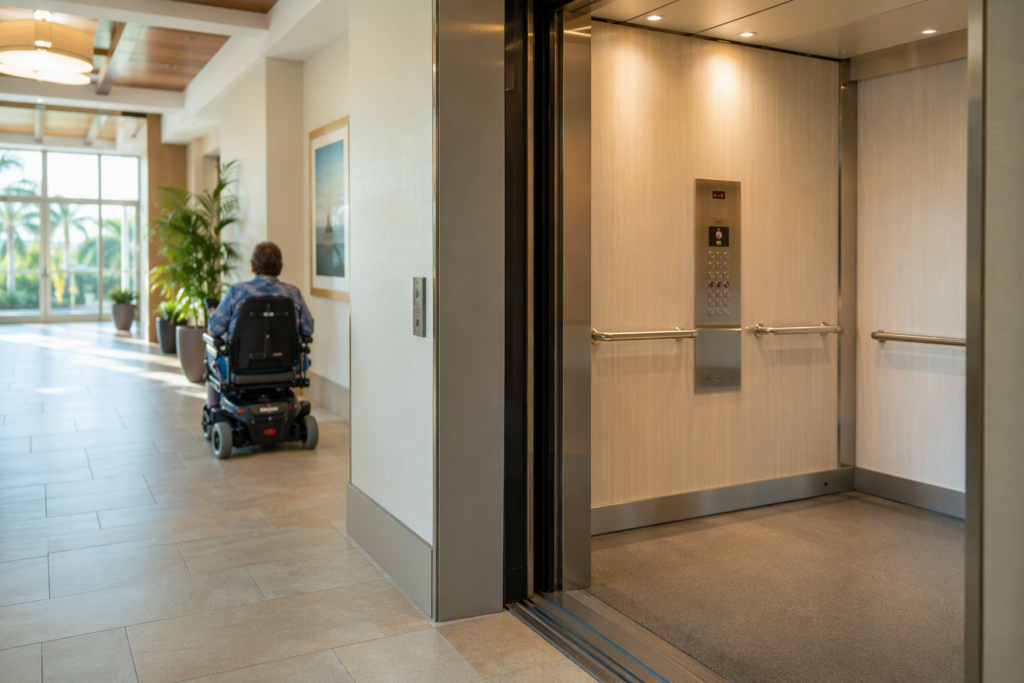
The ADA requires that elevators providing access to programs and services remain accessible, meaning property managers must restore elevator service to mobility-impaired residents and tenants as a priority following any storm-related outage.
Under the Americans with Disabilities Act (ADA), buildings subject to ADA requirements must provide accessible routes. When an elevator is the primary or only accessible means of vertical travel, its extended out-of-service status creates a potential ADA compliance issue for tenants and visitors with mobility impairments. Property managers should document the steps taken to restore service, communicate proactively with affected residents, and — where the building layout permits — identify any temporary accessible alternatives during the repair period. Emergency communication systems within elevator cars, including two-way intercoms accessible to people with hearing impairments, must also function on backup power. Axxiom Elevator Florida assists property managers in Pompano Beach and Sarasota in evaluating their ADA compliance posture as part of a comprehensive hurricane preparedness assessment.
15. What is the importance of a service maintenance contract specifically for hurricane season readiness?
A service maintenance contract with a registered Florida elevator company provides structured pre-storm preparation, priority post-storm response, and ensures that maintenance records supporting the certificate of operation remain current — all of which are critical during hurricane season.
Florida law recognizes the maintenance contract as an important element of elevator safety. A two-adjacent-floor elevator covered by a qualifying service maintenance contract is actually exempt from the annual inspection requirement under Chapter 399, demonstrating the legislature’s recognition of the contract’s safety value. For all other elevators, a maintenance contract ensures that qualified technicians perform scheduled lubrication, adjustment, safety device testing, and compliance verification throughout the year — not just at annual inspection time. In the hurricane context, a contract gives the property manager a direct relationship with a registered company whose technicians know the building’s equipment and can respond to pre-storm positioning requests and post-storm assessment calls. Axxiom Elevator Florida offers maintenance contracts tailored to the needs of properties in Pompano Beach and Sarasota, covering both hydraulic and traction elevator systems.
16. What should property managers know about elevator insurance claims after a hurricane?
Successful elevator insurance claims after a hurricane require documented pre-storm maintenance records, a detailed post-storm damage assessment prepared by a registered elevator company, and photographs taken before any remediation work begins.
Insurance adjusters evaluating hurricane damage to elevator equipment will scrutinize whether the property owner fulfilled maintenance obligations. A complete maintenance log — including inspection reports, parts replacements, safety device test records, and the current certificate of operation — demonstrates due diligence and strengthens the claim. The post-storm damage assessment prepared by the registered elevator company should itemize every affected component, its condition, the remediation required, and the applicable parts and labor costs. Photographs of water levels in the pit, damaged controllers, corroded components, and flood tide marks should be taken before cleanup begins and preserved with the claim file. Property managers should also understand whether their property insurance policy covers the elevator’s power unit and electrical components as building equipment or whether a separate equipment breakdown rider applies.
17. How often must Florida elevators be inspected, and does hurricane damage trigger an additional inspection?
Florida requires annual inspection of most elevators covered by Chapter 399, and significant storm damage that requires repair or alteration work will typically trigger an additional inspection by a certified elevator inspector before the elevator may return to service.
Under Chapter 399, Florida Statutes, every elevator covered by the Act must be inspected annually by a certified elevator inspector, or by a county or municipality under contract with the state. A certificate of operation may be valid for no more than two years. When hurricane damage requires alterations — meaning changes beyond routine maintenance, such as controller replacement, drive replacement, or safety device modification — Florida law requires that a state permit be applied for by a registered elevator company, and that the new or altered equipment be inspected by a certified elevator inspector before it is returned to service. Property managers should budget for this potential additional inspection cost when estimating post-storm repair expenses and should not assume that the annual inspection cycle is the only inspection trigger they will face.
18. What should a property manager’s hurricane season elevator emergency plan include?
An effective hurricane season elevator emergency plan for a Florida building should include pre-storm preparation protocols, emergency contact trees, post-storm assessment procedures, passenger entrapment response scripts, and compliance verification checklists.
Key elements of the written plan include: the name and emergency phone number of the building’s registered elevator company; procedures for elevator shutdown and car positioning prior to storm arrival; the building’s generator configuration and which elevator(s) it powers; the location and accessibility of the hoistway access key for emergency retrieval; the contact number for the Broward County Building Code Division (for Pompano Beach properties) or the DBPR Bureau of Elevator Safety (for Sarasota and other markets); the post-storm inspection protocol and who is authorized to order the elevator returned to service; and the five-working-day deadline for reporting any elevator accident to the state. This plan should be reviewed and updated annually before June 1 and should be distributed to all facilities and management staff who may be on-site during a storm event.
19. How do Florida’s coastal humidity and salt air conditions affect elevator maintenance needs year-round?
Florida’s coastal climate — characterized by year-round high humidity, salt-laden air, and intense UV exposure in common areas — accelerates corrosion on elevator structural components, drive systems, and door hardware, requiring more frequent lubrication and inspection intervals than inland installations.
Properties in Pompano Beach and Sarasota are exposed to marine-influenced air that carries salt particles capable of accelerating corrosion on steel guide rails, hoist ropes, counterweight frames, door tracks, and controller enclosures. This is not a seasonal phenomenon limited to hurricane season — it is a year-round condition that compresses the effective service life of lubricated and unprotected metal components. Elevator technicians serving coastal Florida properties should apply corrosion-inhibiting lubricants rated for marine environments, inspect hoist rope for corrosion-induced fatigue at intervals shorter than those typical of inland installations, and check controller enclosure gaskets and seals regularly. These considerations should be explicitly addressed in any service maintenance contract governing a coastal Florida property. Axxiom Elevator Florida’s service approach accounts for the specific environmental demands of the Pompano Beach and Sarasota markets.
20. How can property managers find and verify that an elevator company is properly registered in Florida?
Property managers can verify elevator company registration through the Florida DBPR, which maintains records of all registered elevator companies required to renew their registration annually and maintain general liability insurance.
Under Chapter 399, Florida Statutes, all elevator companies performing installation, maintenance, or repair work in Florida must register with the state every year and carry general liability insurance. Technicians performing this work must hold a Florida elevator certificate of competency, which also requires annual renewal with proof of eight hours of continuing education. Florida certified elevator inspectors conducting inspections must maintain their qualified elevator inspector credential in good standing and register annually with proof of eight hours of continuing education and general liability insurance. Property managers should ask any prospective elevator company to provide proof of current Florida registration before engaging them for post-storm repair work. Hiring an unregistered company exposes the property owner to liability and may create compliance problems with the DBPR. The Florida Elevator Safety Act (Chapter 399) is the governing statute for all these requirements.
Additional Compliance Resources for Florida Property Managers
Property managers seeking to deepen their understanding of elevator compliance obligations may consult the following authoritative sources:
- Chapter 399, Florida Statutes — Florida Elevator Safety Act (Florida DBPR, Bureau of Elevator Safety)
- ASME A17.1/CSA B44, Safety Code for Elevators and Escalators — the 2019 edition adopted in Florida effective December 31, 2023
- Americans with Disabilities Act (ADA) — accessibility requirements applicable to vertical transportation in public accommodations and commercial facilities
- OSHA — occupational safety requirements applicable to elevator installation and maintenance work
Protect Your Florida Building’s Elevators Before the Next Storm
Preparation is the single most effective way to reduce elevator repair costs, avoid compliance violations, and protect building occupants during Florida’s demanding hurricane season. Axxiom Elevator Florida provides hurricane readiness assessments, pre-storm service protocols, post-storm damage evaluations, and ongoing maintenance contracts for properties in Pompano Beach and Sarasota.
Contact Axxiom Elevator Florida for a free elevator assessment:
Need elevator service you can rely on? Axxiom Elevator Florida is ready to help.