Elevator Code and Accessibility Requirements for Healthcare Facilities in Florida
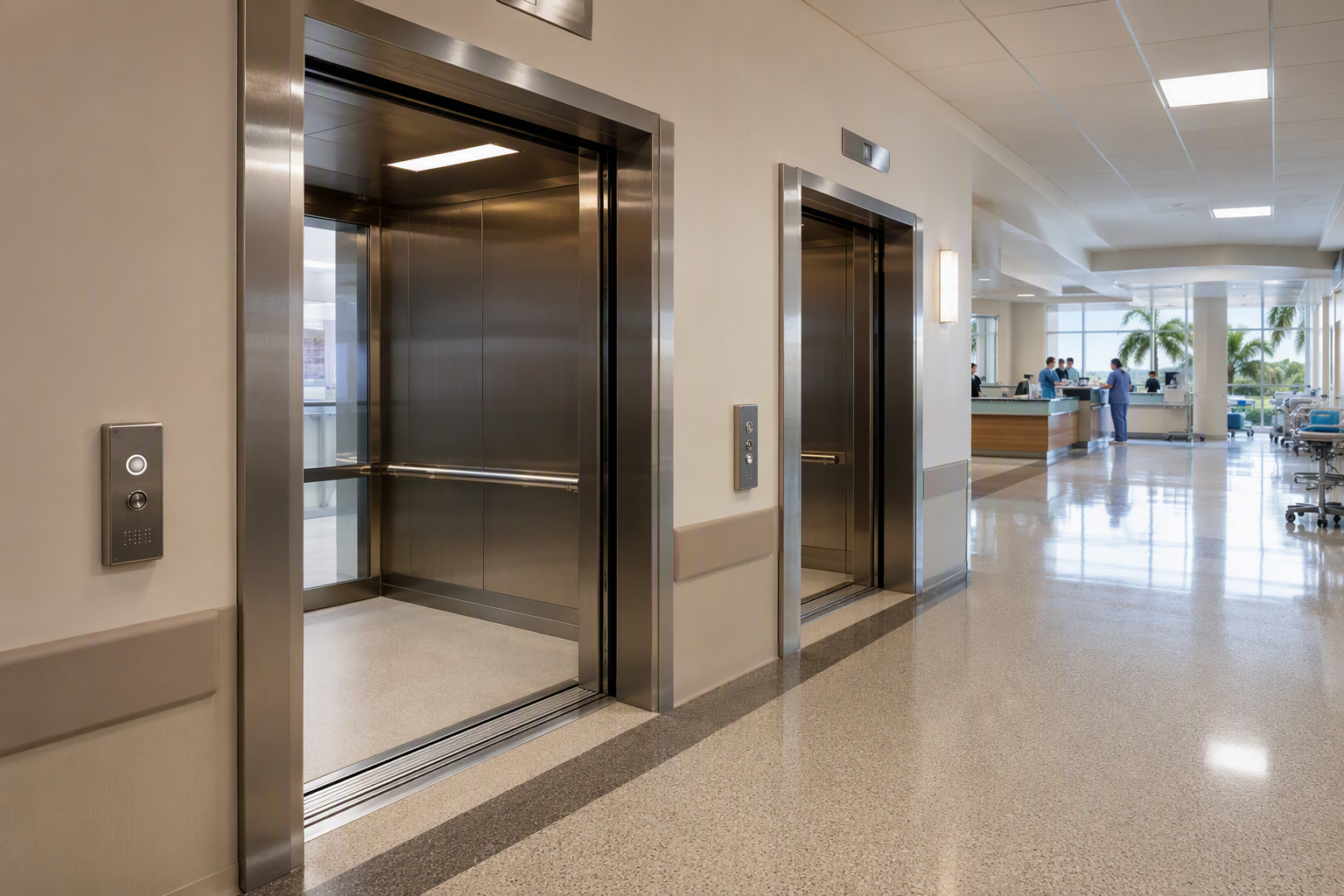
For hospitals, medical office buildings, outpatient clinics, and long-term care facilities across Florida, elevator compliance is not a checkbox exercise — it is a patient safety and operational continuity issue. A non-compliant elevator in a healthcare setting can delay emergency transport, expose a facility to regulatory action, and create serious liability. This guide covers every compliance layer that healthcare facility managers and administrators in Pompano Beach, Sarasota, and across Florida need to understand in 2026.
What Are the Core Elevator Codes That Apply to Florida Healthcare Facilities?
Florida healthcare facilities are subject to a layered compliance framework. Understanding which standards apply — and how they interact — is the first step toward a compliant, safe vertical transportation system.
- ASME A17.1 Safety Code for Elevators and Escalators: This is the primary mechanical and safety standard adopted by Florida. It governs construction, installation, operation, inspection, testing, and maintenance of elevators in all commercial buildings, including healthcare facilities.
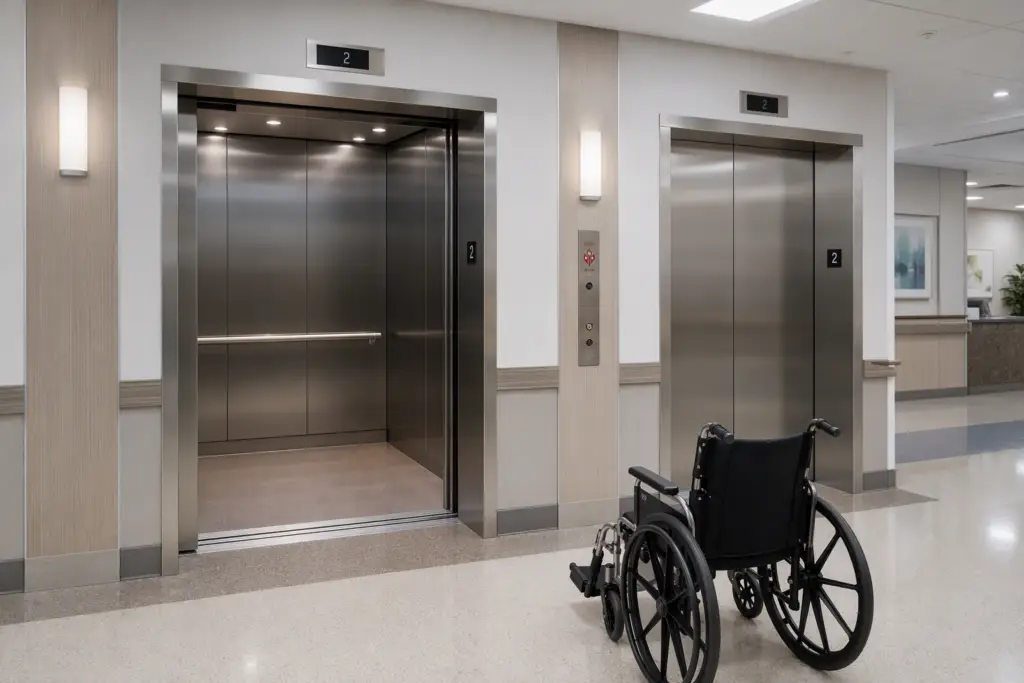
- Americans with Disabilities Act (ADA): Requires that elevators in multi-story healthcare facilities be accessible to individuals with disabilities, including patients using wheelchairs, walkers, or other mobility aids. Specific requirements cover cab dimensions, door timing, call button placement, and audible/visual signals.
- Florida Building Code, Chapter 30: Florida adopts and amends ASME A17.1 through Chapter 30 of the Florida Building Code. The Florida Department of Business and Professional Regulation (DBPR) enforces elevator inspections and licensure statewide.
- Facility Guidelines Institute (FGI) Guidelines for Design and Construction of Hospitals and Outpatient Facilities: While not a mandatory code in every jurisdiction, these guidelines are widely adopted by Florida’s Agency for Health Care Administration (AHCA) for licensed healthcare facilities. They prescribe minimum elevator quantities, cab sizes, and door widths based on facility type and bed count.
- Joint Commission Standards: Accredited hospitals must maintain compliant vertical transportation as part of the Environment of Care standards.
Axxiom Elevator Florida helps healthcare facilities in Pompano Beach and Sarasota navigate this multi-layer compliance environment, identifying which standards apply to a specific building type, age, and use classification.
What Elevator Dimensions Are Required for Healthcare Facilities in Florida?
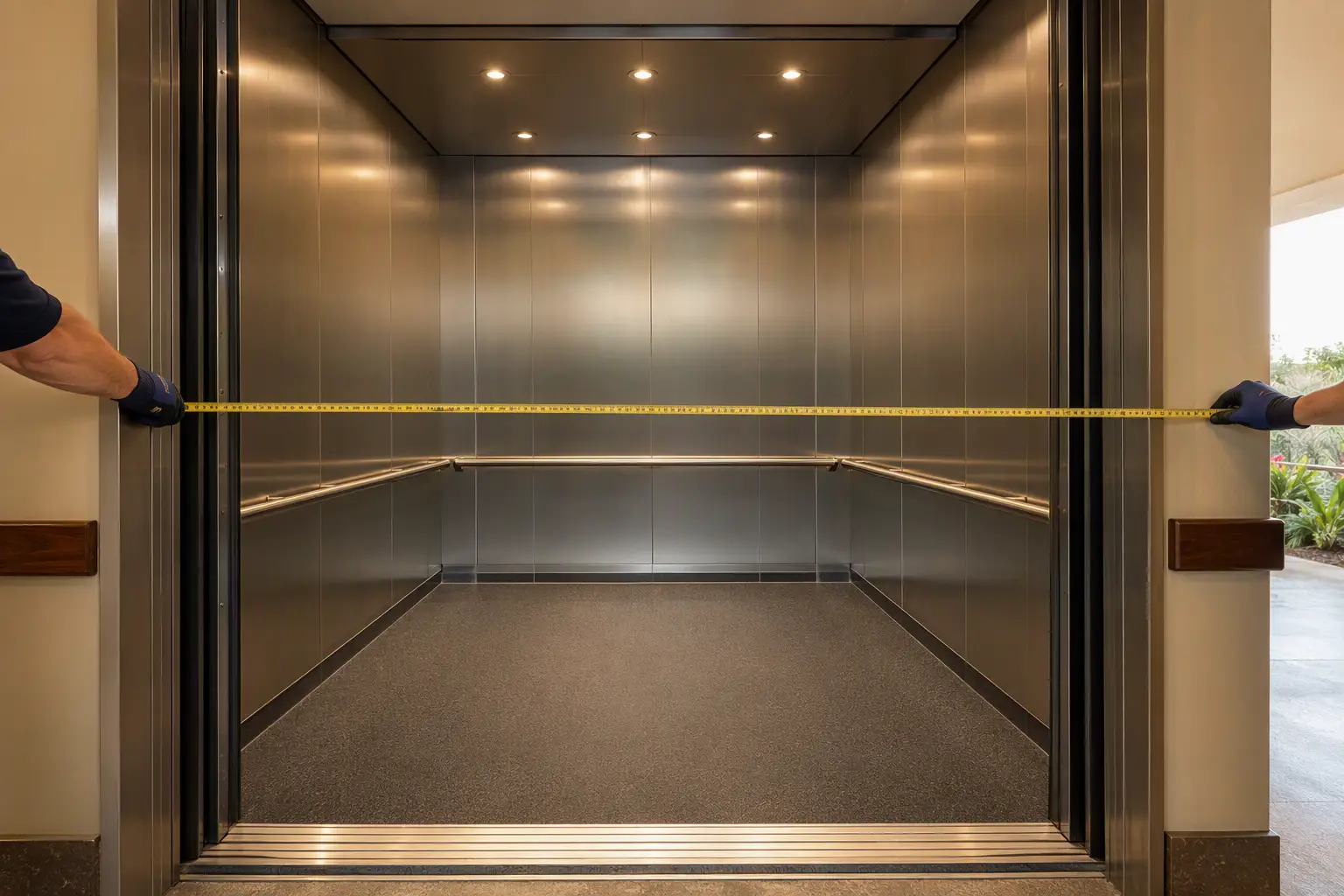
Healthcare elevators must accommodate stretchers, hospital beds, wheelchairs, and medical carts — requirements that go well beyond standard commercial elevator dimensions.
- Cab width and depth: The FGI guidelines and AHCA requirements for licensed hospitals and outpatient facilities typically require at least one elevator sized to transport a fully reclined hospital bed or gurney. This generally calls for a cab with minimum interior dimensions sufficient to accommodate a standard hospital stretcher plus attendants on all sides.
- Door width: Healthcare facility elevators serving patient areas typically require door clear openings wider than the standard commercial minimum to allow hospital beds and large medical equipment to pass without obstruction.
- ADA door clear width: The ADA requires a minimum clear door opening width for accessible elevators. Healthcare facilities must meet or exceed this minimum.
- Door open time: The ADA requires that elevator doors remain fully open for a minimum period to allow individuals with disabilities adequate time to enter and exit. In healthcare settings, this timing may need to be adjusted further to accommodate slower-moving patients and equipment.
Because code requirements for exact dimensions are subject to edition year, building classification, and AHCA facility license type, facility managers should work directly with a certified elevator service company to verify applicable minimums for their specific building.
Are Periodic Inspections Required for Elevators in Florida Healthcare Facilities?
Yes. Florida law requires periodic inspections of all elevators, and healthcare facilities face additional scrutiny from AHCA during facility licensure surveys.
Under the Florida Building Code and DBPR regulations, elevators must receive:
- A routine periodic inspection by a licensed elevator inspector at intervals prescribed by state regulation.
- A witnessed test — a more thorough evaluation of safety devices, brakes, governors, and load-bearing components — at intervals defined by the adopted edition of ASME A17.1.
- Category 1 and Category 5 tests as defined under ASME A17.1, which evaluate safety devices under no-load and full-load conditions respectively.
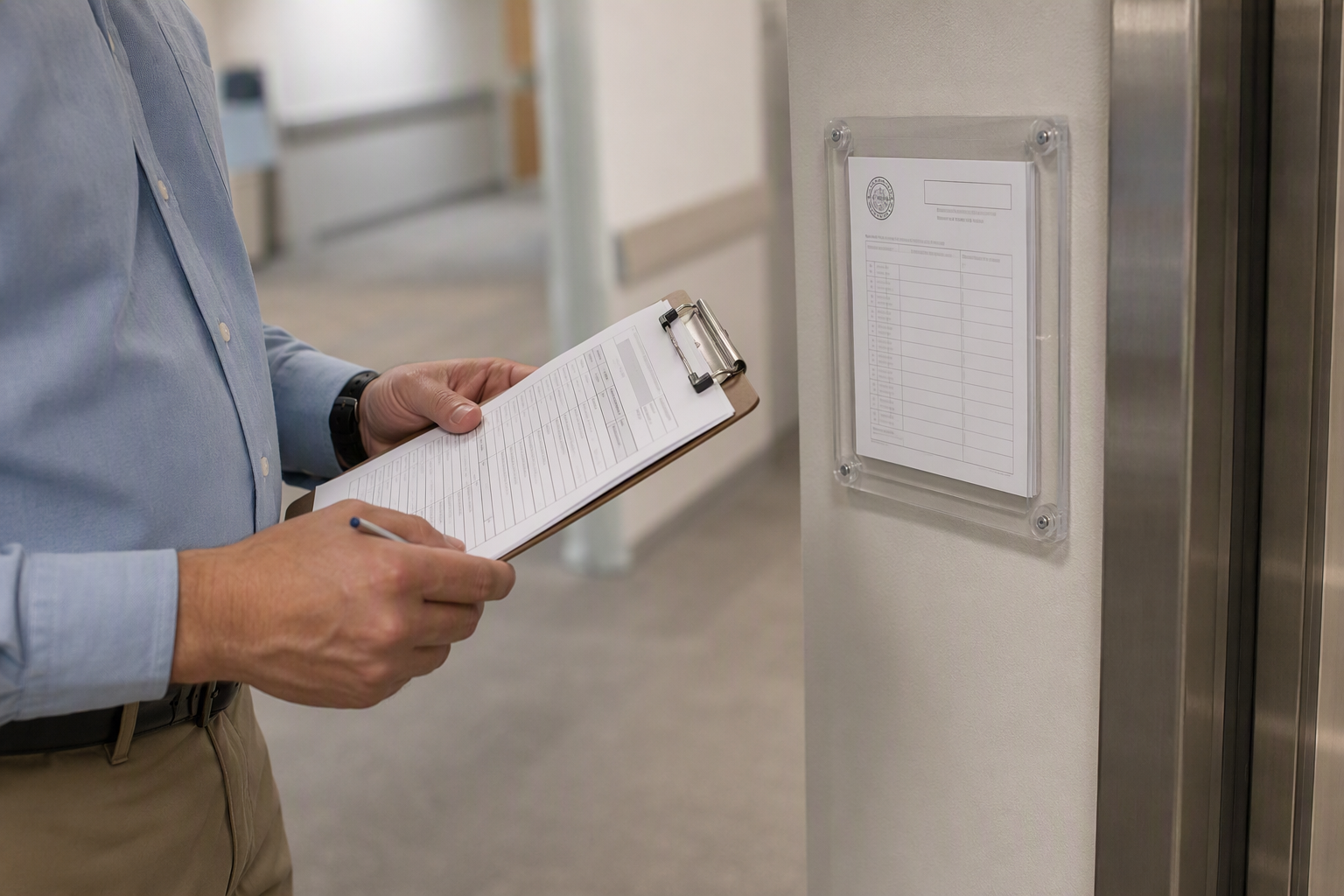
After each inspection, a current certificate of inspection must be posted in the elevator cab or available on-site. AHCA surveyors will verify this documentation during facility reviews. Axxiom Elevator Florida assists healthcare clients in Pompano Beach and Sarasota with inspection scheduling, documentation management, and corrective maintenance to maintain continuous certificate validity.
What ADA Accessibility Features Are Mandatory for Healthcare Elevators in Florida?
The ADA Standards for Accessible Design establish specific features that accessible elevators must include. For healthcare facilities, these are baseline requirements — many facilities implement enhancements beyond the ADA minimums to support patient populations.
- Call buttons: Must be located at a height accessible from a seated position, with raised characters and braille.
- Floor designation: Each floor must be identified inside the cab with raised characters and braille at a compliant height adjacent to the hoistway door.
- Audible signals: Audible signals must indicate the cab’s direction of travel and arrival at each floor.
- Visual signals: Visual indicators must show direction of travel and floor position.
- Two-way emergency communication: The ADA requires a hands-free two-way communication system inside the cab for emergency use — critical in healthcare settings where a patient in a wheelchair may be alone.
- Handrails: Interior handrails on at least one wall are required and strongly recommended on multiple walls in healthcare settings.
- Leveling accuracy: Elevators must level within a tolerance that allows wheelchair users to enter and exit without a significant threshold gap or raised edge.
How Does the Florida Building Code Interact With ASME A17.1 for Healthcare Buildings?
Florida adopts ASME A17.1 by reference through Chapter 30 of the Florida Building Code, but the state also applies Florida-specific amendments. This means a healthcare facility must comply with the base ASME standard and any Florida modifications, which can differ from what another state might require using the same base ASME edition.
Additionally, existing healthcare buildings constructed under older code editions may be subject to “grandfathering” provisions — but only to a point. When a facility undergoes a change of use, substantial renovation, or a major equipment modernization, the Florida Building Code typically triggers the requirement to bring the elevator into compliance with current standards. This is a common compliance gap that facility managers encounter when planning building upgrades.
What Are the Elevator Requirements Specific to Florida Hospitals vs. Outpatient Clinics?
The compliance requirements vary based on facility classification:
- Licensed hospitals: Subject to AHCA rules that incorporate FGI guidelines. Hospitals with inpatient beds above the ground floor must provide a minimum number of patient-accessible elevators sized for hospital bed transport. Emergency departments require consideration of direct transport routes from receiving areas.
- Ambulatory surgery centers (ASCs): AHCA licensing standards for ASCs reference elevator access for patients arriving and departing via stretcher. Elevator dimensions and quantity requirements depend on the scope of procedures performed and number of operating rooms.
- Medical office buildings (MOBs): Multi-story MOBs are commercial buildings under the Florida Building Code. They must comply with ASME A17.1 and ADA, but are not subject to AHCA hospital-specific elevator sizing unless they house a licensed clinical facility within the building.
- Long-term care and skilled nursing facilities: Subject to both AHCA licensing and federal CMS Conditions of Participation, which include environment of care requirements affecting elevator maintenance documentation.
What Happens If a Healthcare Facility Elevator Fails Inspection in Florida?
A failed inspection in a Florida healthcare facility carries consequences beyond the elevator itself:
- The DBPR may issue an order to place the elevator out of service until deficiencies are corrected and re-inspected.
- AHCA surveyors can cite the facility for an Environment of Care deficiency during a licensure survey, which can affect accreditation and licensing status.
- For Joint Commission-accredited facilities, documented elevator non-compliance can trigger a finding under Environment of Care standards.
- Operating a failed elevator in a healthcare setting creates significant liability exposure if a patient or staff member is injured.
Proactive maintenance and documentation are the most effective way to prevent inspection failures. Axxiom Elevator Florida provides maintenance programs that keep healthcare elevators in compliant operating condition and maintain the records required by state inspectors and AHCA surveyors.
What Is the Modernization Timeline for Bringing an Older Healthcare Elevator Into Compliance?
Modernization timelines vary based on the scope of work required, equipment lead times, and whether the facility can take the elevator out of service temporarily. Healthcare facilities must plan modernization carefully to maintain patient care continuity.
Typical modernization considerations include:
- Assessment phase: A qualified elevator service company inspects the existing equipment, identifies code gaps, and prepares a scope-of-work document.
- Permitting: Florida requires permits for elevator modernization work, submitted to the local jurisdiction and DBPR. Permit review timelines vary by county.
- Equipment procurement: Specialized healthcare elevator components — wide-door operators, heavy-duty door systems, accessible fixtures — may have lead times that affect the overall project schedule.
- Installation and testing: Installation is followed by required testing and a final inspection before the elevator returns to service.
- Re-inspection and certificate issuance: The DBPR or authorized inspection agency must issue a new certificate before the elevator can legally operate.
Facility managers in Pompano Beach and Sarasota planning a modernization project should begin the assessment process well in advance of any planned renovation or accreditation survey cycle.
Questions Your Inspector Will Ask
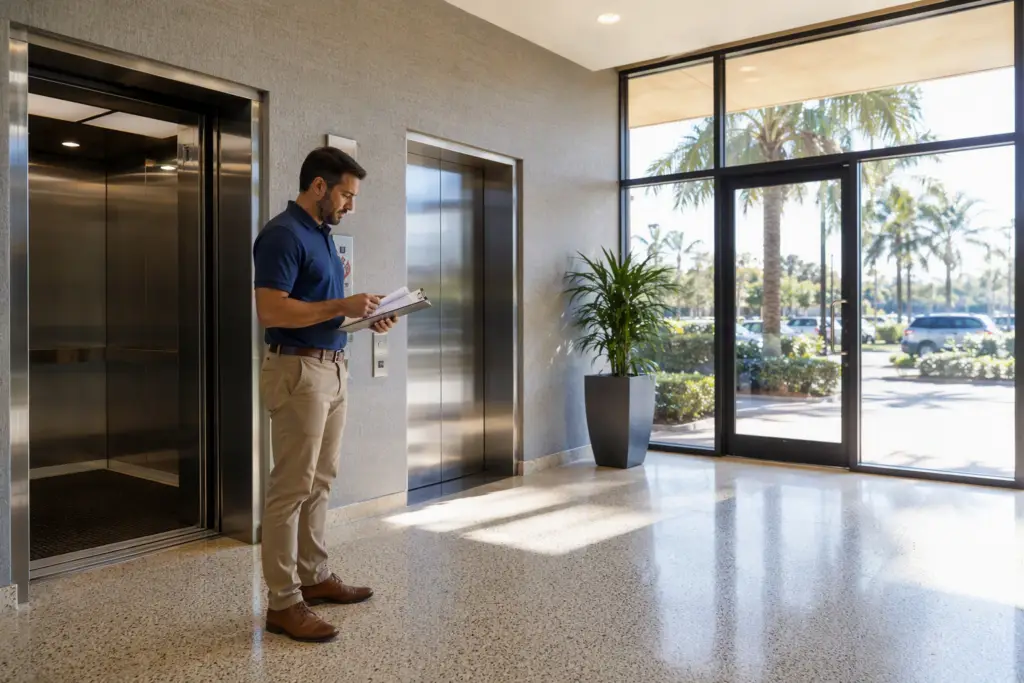
When a Florida DBPR elevator inspector or an AHCA surveyor reviews a healthcare facility’s vertical transportation, they typically focus on the following areas. Facility managers and compliance officers should be prepared to answer — and document — each of these:
- Is the current certificate of inspection posted in the elevator cab or available on-site? The certificate must be valid and unexpired.
- When was the last Category 1 and Category 5 test performed, and is the documentation available? Test records must be maintained and available for review.
- Is there a current, executed maintenance contract with a licensed elevator contractor? Florida requires maintenance by a licensed contractor.
- Are all required maintenance logs and service records up to date and on-site? ASME A17.1 requires maintenance records to be kept in the machine room or accessible location.
- Does the elevator’s two-way emergency communication system function correctly? The inspector will test this — and in a healthcare facility, it is particularly critical.
- Are all ADA-required fixtures — call buttons, braille, audible signals, visual signals — present and functional?
- Does the elevator level accurately at each floor landing? The inspector will check floor-to-sill leveling tolerance.
- Are there any outstanding correction orders from previous inspections, and have they been addressed? Open correction orders from prior inspections are a red flag for surveyors.
How Should Healthcare Facilities Choose an Elevator Service Company in Florida?
Selecting the right elevator service partner is a compliance decision as much as a vendor decision. Key criteria include:
- Licensure by the Florida DBPR as an elevator contractor
- Demonstrated experience servicing healthcare and medical facility elevators
- Familiarity with AHCA documentation requirements and survey processes
- Ability to maintain and produce compliant maintenance records
- Local presence to support ongoing maintenance and inspections
Axxiom Elevator Florida serves healthcare facilities throughout Florida, including Pompano Beach and Sarasota, providing maintenance, inspection support, modernization, and compliance documentation services tailored to the healthcare environment.
What Should a Healthcare Facility Do Right Now to Assess Elevator Compliance?
A structured compliance review is the most effective starting point. Follow these steps:
- Locate current inspection certificates for all elevators on-site and verify they are unexpired.
- Retrieve maintenance logs and confirm they are complete, current, and stored in the required location.
- Review the most recent inspection report for any open correction orders and confirm they have been resolved.
- Confirm that your facility has a current, executed maintenance contract with a DBPR-licensed elevator contractor.
- Walk each elevator cab and verify that ADA-required features — call buttons at compliant heights, braille floor designations, audible signals, visual signals, and two-way emergency communication — are present and operational.
- Verify that leveling accuracy is within acceptable tolerance at each floor.
- Contact a licensed elevator service company to conduct a formal compliance assessment before any scheduled AHCA survey or Joint Commission review.
Schedule Your Free Healthcare Elevator Assessment Today
Florida healthcare facilities in Pompano Beach, Sarasota, and throughout the state face serious consequences for elevator non-compliance — including failed AHCA surveys, out-of-service orders, and patient safety risks. The most cost-effective strategy is proactive compliance review and properly documented maintenance.
Contact Axxiom Elevator Florida for a free elevator assessment. A licensed elevator professional will evaluate your facility’s compliance status, review your inspection and maintenance documentation, and identify any corrective actions needed to keep your elevators compliant with ASME A17.1, the ADA, Florida Building Code Chapter 30, and AHCA requirements.
Need elevator service you can rely on? Axxiom Elevator Florida is ready to help.