Elevator Service in Pompano, FL | Axxiom Elevator Florida
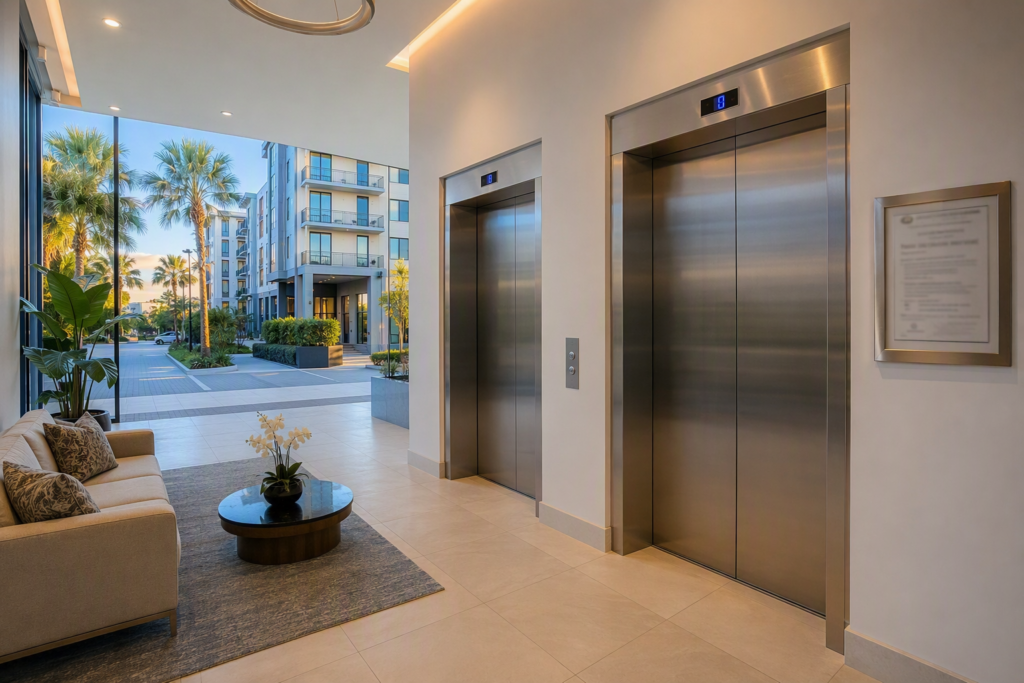
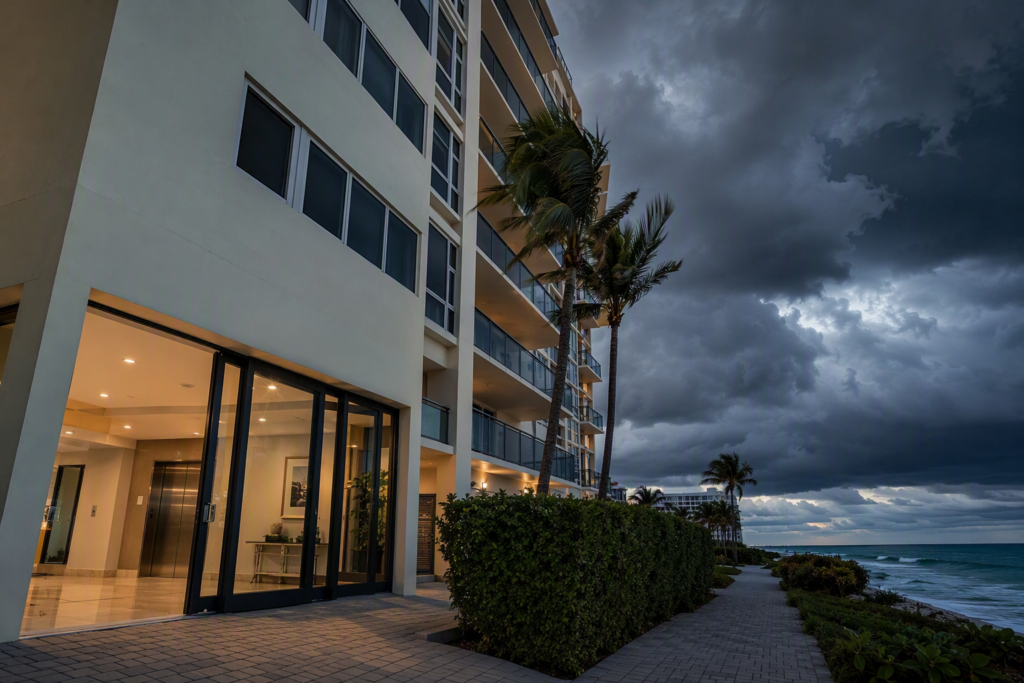
Hotels and resorts in Pompano, FL and across the state face a distinct compliance challenge: elevators carry guests around the clock, seven days a week, making every lapse in maintenance a potential safety, legal, and reputational risk. Florida enforces a multi-agency framework that covers routine inspections, periodic load testing, accessibility compliance, and licensed contractor requirements. Understanding what that framework demands — and keeping every certificate current — is essential for any hospitality property operating vertical transportation in the state.
—
What Florida Agencies Govern Hotel Elevator Compliance?
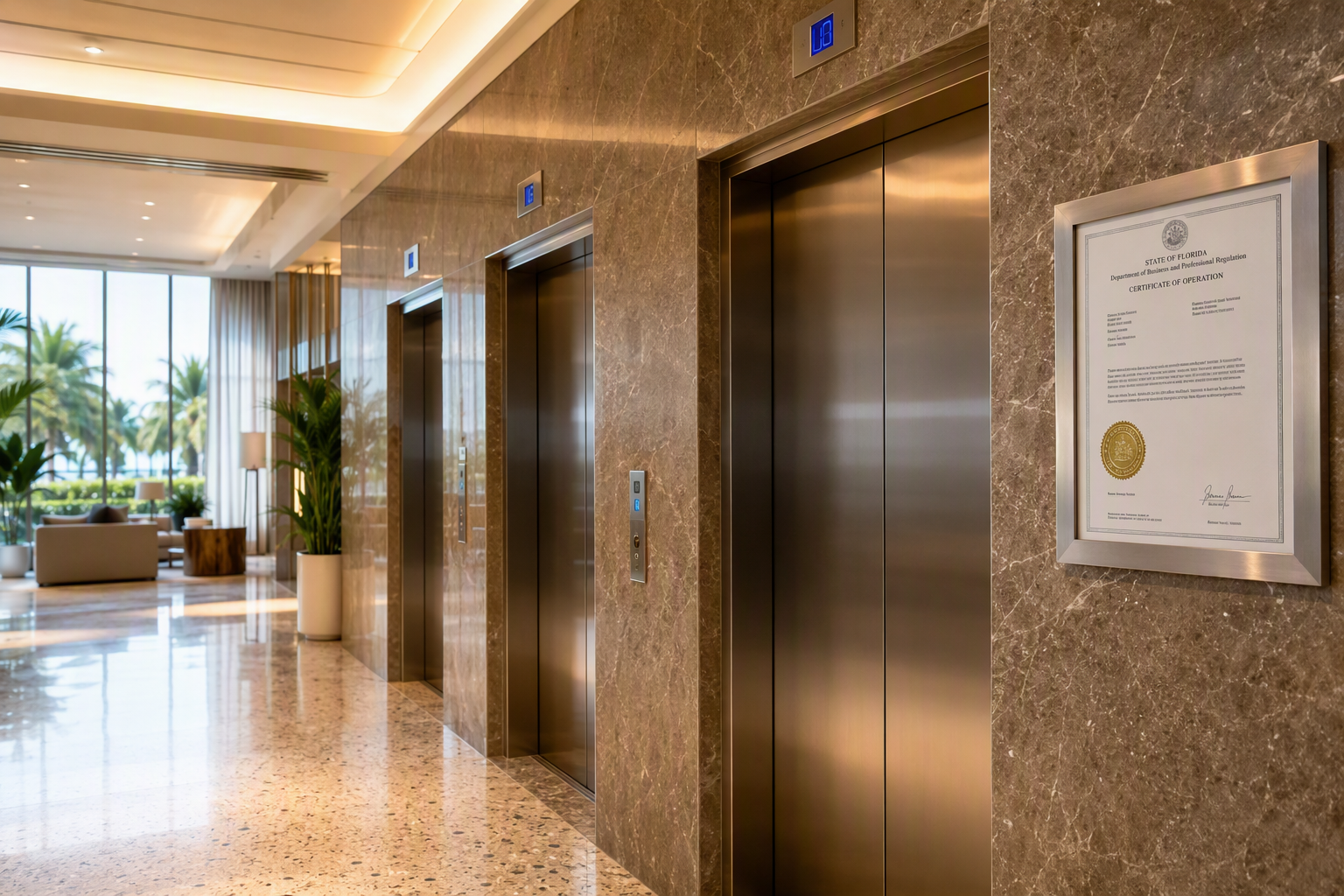
In Florida, elevator oversight falls primarily under the Florida Department of Business and Professional Regulation (DBPR), Division of Hotels and Restaurants, which enforces the Florida Elevator Safety Code. The DBPR requires that any elevator in a public lodging establishment — including hotels, motels, resorts, and vacation rentals with common-area elevators — hold a valid Certificate of Operation issued after a satisfactory inspection by a licensed elevator inspector.
Local Authorities Having Jurisdiction (AHJs), such as Broward County and the City of Pompano Beach, may layer additional permit and inspection requirements on top of state minimums. Hospitality property managers should confirm which AHJ governs their building address, because the certificate of operation issued by the state does not replace local building department sign-offs for new installations or major modifications.
At the federal level, ADA Title III requires that places of public accommodation — a category that includes hotels — provide accessible vertical transportation where elevators are the primary means of reaching a floor. OSHA standards additionally govern elevator-related worker safety during maintenance and construction activities.
—
Which Safety Codes Apply to Hotel Elevators in Florida?
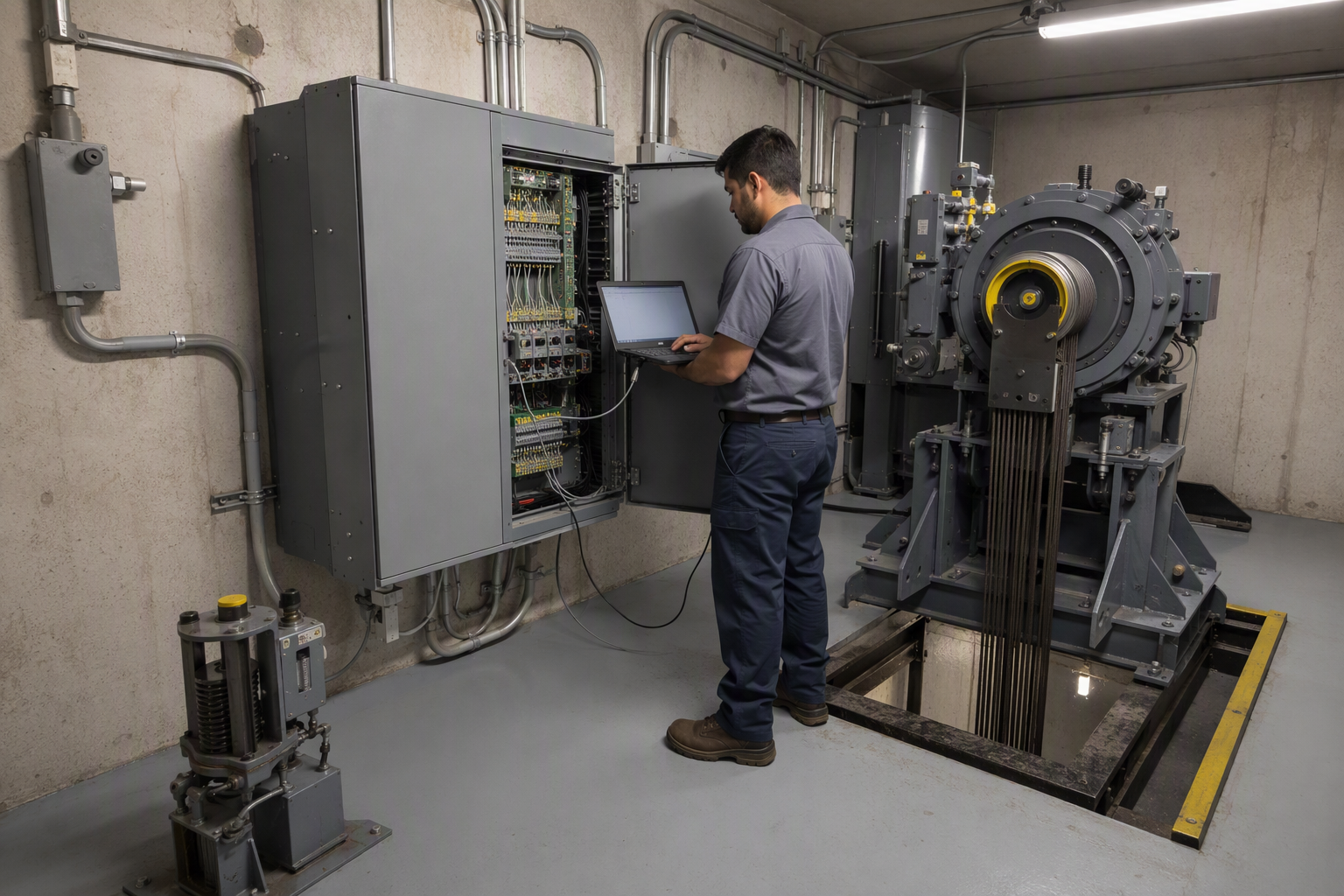
Florida adopts the ASME A17.1 Safety Code for Elevators and Escalators as the construction and installation standard for new equipment, and ASME A17.3 Safety Code for Existing Elevators and Escalators as the retrofit and maintenance standard for equipment already in service. Both codes are incorporated by reference into Florida’s administrative rules, meaning compliance with ASME requirements is not optional — it is a legal obligation for hotel operators.
Key areas these codes address include:
- Car and hoistway safety devices (governor, safeties, buffers)
- Door interlock and re-opening device standards
- Emergency lighting and communication systems within the elevator car
- Machine room environmental and access controls
- Firefighters’ emergency operation (Phase I and Phase II)
- Seismic and load-capacity requirements
—
How Often Do Hotel Elevators Need to Be Inspected in Florida?
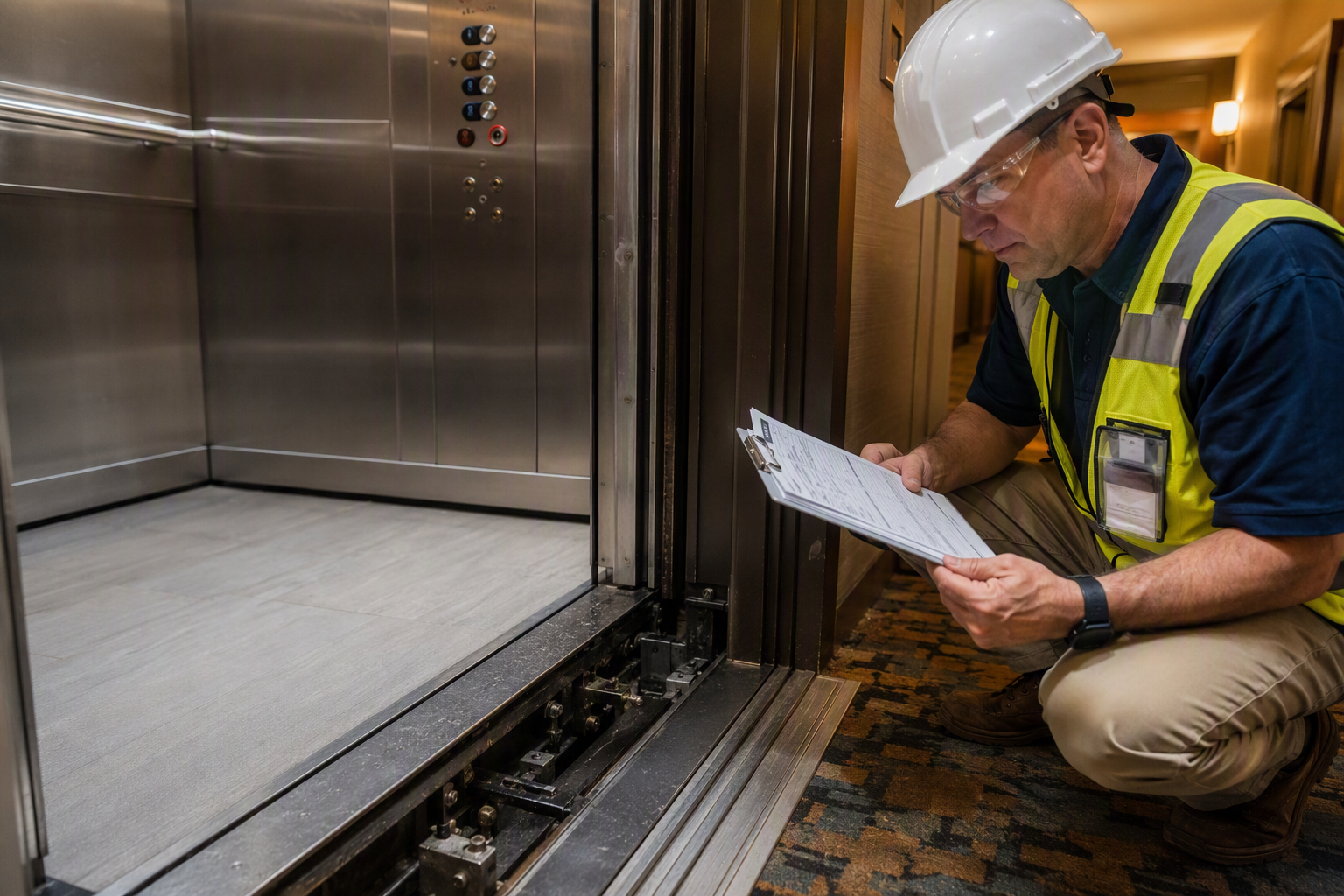
Florida law requires that most passenger elevators in public lodging establishments undergo a periodic inspection at least annually. In addition to annual inspections, Florida requires a full-load safety test at regular intervals established in the state’s adopted version of ASME A17.1 and A17.3 — these load tests verify that safety devices, brakes, and buffers perform correctly under realistic operating conditions.
The Certificate of Operation issued by the DBPR after a satisfactory inspection must be posted inside or immediately adjacent to the elevator car. An expired or absent certificate is a violation that can result in an order to shut down the unit — a scenario no hotel wants during peak occupancy.
Inspections must be performed by an inspector who holds a Qualified Elevator Inspector (QEI) certification, as recognized under Florida’s elevator safety rules. The elevator company performing maintenance work must also hold a current Florida elevator contractor license.
—
What ADA Accessibility Requirements Apply to Hotel Elevators?
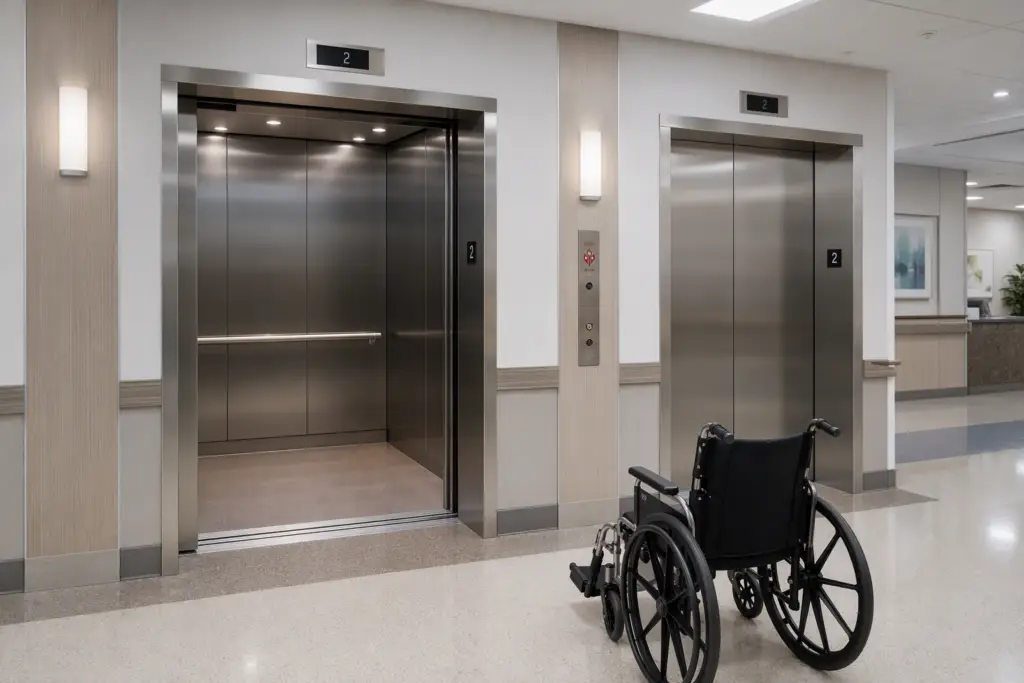
Under ADA Title III and the ADA Standards for Accessible Design, hotel elevators that serve as the primary accessible route to upper floors must meet specific dimensional, operational, and communication requirements. These include:
- Minimum car interior dimensions to accommodate wheelchairs
- Raised and Braille characters on hall call and car operating panel buttons
- Audible and visible floor indicators (voice annunciators and position indicators)
- Door reopening devices that respond to obstructions
- Accessible thresholds and level landings at each floor
- Two-way emergency communication systems usable by guests with hearing or speech disabilities
ADA compliance is enforced independently of state elevator inspections. A hotel can hold a valid DBPR certificate and still face a federal ADA complaint if accessibility features are out of service or were never properly installed. Routine maintenance plans should include verification of ADA-required features at every service visit.
—
What Maintenance Tasks Are Required — Not Just Recommended?
Florida’s adopted safety codes treat certain maintenance activities as mandatory rather than discretionary. Under ASME A17.1 and A17.3, a documented maintenance control program (MCP) is required for elevators in service. The MCP must specify scheduled maintenance tasks, frequencies, and record-keeping procedures. For hotel properties, a compliant MCP typically covers:
- Lubrication of guide rails, sheaves, and machine components
- Inspection and adjustment of door operators and interlock devices
- Testing of governor and safeties
- Verification of emergency lighting, communication, and firefighters’ service
- Inspection of pit conditions, including sump pump operation and lighting
- Review and correction of any findings from the previous periodic inspection
Maintenance records must be retained and made available to the AHJ or state inspector upon request. Missing or incomplete logs are themselves a compliance violation.
—
What Should Hotel Management Do When an Elevator Fails Inspection?
- Remove the elevator from service immediately. Operating a unit after a failed inspection or stop-work order exposes ownership to significant liability and regulatory penalties.
- Obtain a copy of the inspection report detailing every cited deficiency.
- Contact a licensed Florida elevator contractor to review the deficiency list and schedule corrective repairs in priority order.
- Complete all required repairs and document each correction with dated service records.
- Request a re-inspection by a QEI-certified inspector; the DBPR or local AHJ will issue a new Certificate of Operation once the unit passes.
- Post the updated certificate in the elevator car or adjacent landing before returning the unit to guest service.
- Review your maintenance control program to identify what preventive measures could have avoided the deficiency.
—
How Does Emergency Operation Compliance Work for Hotels?
Florida’s adopted codes require that hotel elevators equipped with firefighters’ emergency operation (FEO) be tested and maintained in working order. Phase I recall — which brings all cars to a designated landing when a fire alarm activates — and Phase II firefighter-controlled operation must function correctly at every periodic inspection.
Hotels should coordinate with their fire safety and elevator service providers to ensure that the building’s fire alarm system interface with elevator FEO is tested as a unified system, not in isolation. Axxiom Elevator Florida works with hospitality properties throughout Pompano and South Florida to schedule these integrated tests so that no compliance gap exists between the elevator contractor’s scope and the fire alarm contractor’s scope.
Emergency communication devices inside each car — required under both ASME A17.1 and ADA — must also be functional at all times. These devices must connect to a monitored location capable of initiating a rescue, not simply ring a line that goes unanswered after business hours.
—
Why Do Hospitality Properties in Pompano Choose Axxiom Elevator Florida?
Axxiom Elevator Florida is a certified elevator service company serving hotels, resorts, and hospitality properties throughout Pompano Beach and the broader South Florida market. The company holds the Florida state elevator contractor license required to legally perform maintenance, repair, and modernization work on commercial elevator equipment.
Hospitality clients benefit from service plans designed around the realities of hotel operations: high call volume, 24-hour guest presence, and zero tolerance for elevator downtime during peak season. Axxiom Elevator Florida’s team is familiar with the local AHJ requirements for Broward County and Pompano Beach, the DBPR inspection process, and the documentation standards that keep a Certificate of Operation current and defensible.
The company serves a broad range of property types across South Florida — from boutique beachfront hotels to large convention-adjacent resorts — providing preventive maintenance contracts, compliance audits, modernization consulting, and coordination with state and local inspectors.
—
What Should Hotels Look for When Selecting an Elevator Service Vendor in Florida?
Not every elevator company is qualified or licensed to work on commercial hotel equipment in Florida. When evaluating vendors, hospitality property managers should confirm:
- Active Florida elevator contractor license issued by the DBPR
- Familiarity with the current editions of ASME A17.1 and A17.3
- Experience maintaining the specific elevator make and model installed on property
- Ability to provide a written Maintenance Control Program that satisfies ASME requirements
- Clear documentation practices and inspection report management
- Coordination capability with QEI inspectors and local AHJs
- Understanding of ADA compliance requirements for hospitality properties
A vendor who cannot produce evidence of licensure or who lacks documented MCP protocols is not a compliant choice for a Florida hotel — regardless of price.
—
Schedule a Free Consultation
Keeping a hotel’s elevators compliant in Florida is an ongoing responsibility — not a once-a-year checkbox. Axxiom Elevator Florida works with hospitality properties in Pompano Beach and across South Florida to build maintenance programs that satisfy DBPR requirements, ASME safety codes, and ADA standards, while minimizing disruption to guests and operations.
Contact Axxiom Elevator Florida today to schedule a free compliance consultation for your property.
📞
Need elevator service you can rely on? Axxiom Elevator Florida is ready to help.