Florida Multifamily Apartment Elevator Requirements: Safety & Compliance Guide
For property owners, developers, and property managers of Florida apartment communities, elevator compliance is not optional — it is a legal prerequisite for operating any vertical transportation equipment. Understanding exactly which codes apply, which agencies enforce them, and what a building must do to stay in good standing can be the difference between smooth operations and costly shutdowns. This page covers the full compliance landscape for multifamily elevator and lift requirements in Florida.
What codes govern elevator safety in Florida multifamily buildings?
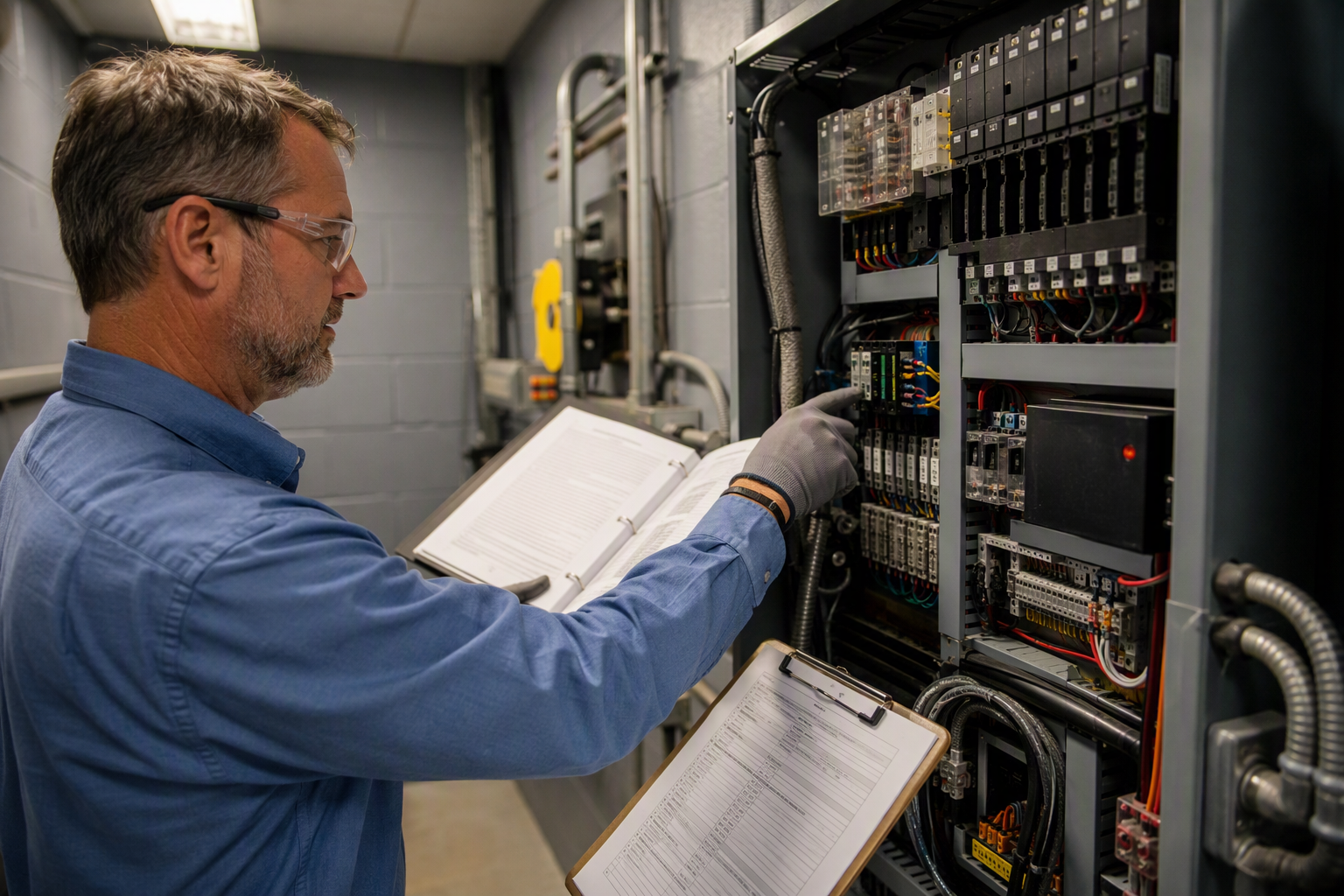
Florida’s elevator safety program is administered by the Florida Department of Business and Professional Regulation (DBPR), Electrical Contractors’ Licensing Board and Building Code Administrators and Inspectors Board sections, operating under the Florida Building Code and Florida Statute Chapter 399 (elevator safety law). The state adopts and references the ASME A17.1 Safety Code for Elevators and Escalators as its technical standard for new and altered elevators, and the ASME A17.3 Safety Code for Existing Elevators and Escalators for equipment already in service. These ASME standards establish the minimum requirements for car enclosures, doors, safety devices, electrical systems, load ratings, and emergency features.
For accessibility, any multifamily apartment building with common-use areas that are covered under Title III or Title II of the ADA — or any building subject to the Fair Housing Act — must ensure that elevator access meets the requirements of the Americans with Disabilities Act. This encompasses door width minimums, floor leveling tolerances, call button heights, and audible/visual floor announcement systems.
Workplace safety for elevator technicians and maintenance personnel performing work on the equipment falls under federal OSHA standards, including lockout/tagout procedures and confined-space entry requirements.
Which Florida apartment buildings are required to have elevators?
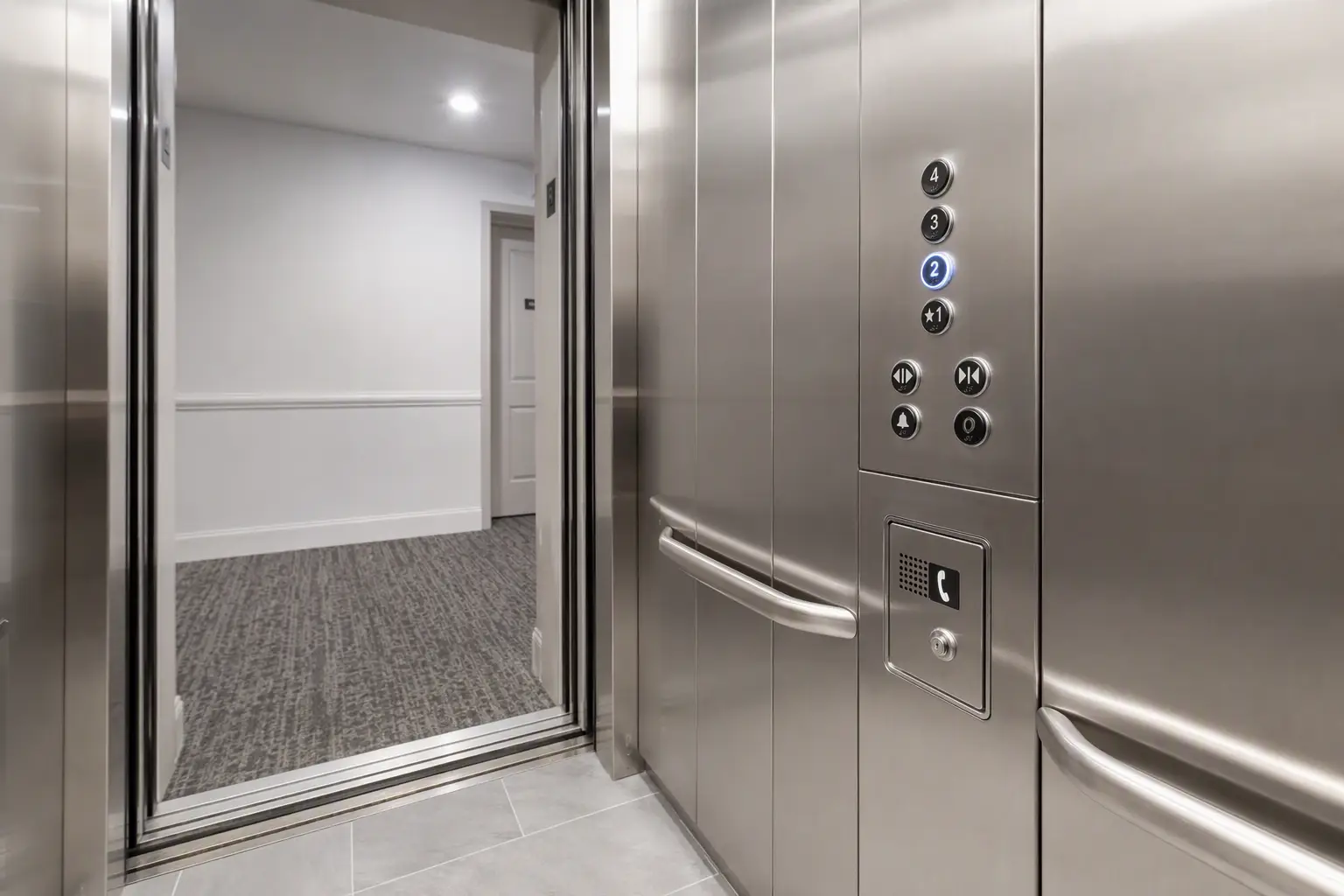
Florida’s Building Code and accessibility requirements do not mandate that every multifamily building install an elevator — but the threshold for when one is legally required depends on building height, occupancy classification, and whether the building is subject to the Fair Housing Act. Generally, residential buildings of four or more stories are required to provide accessible routes to all units, which in practice means elevators are a necessity in most mid-rise and high-rise apartment construction. The ADA applies to common areas in multifamily housing offered to the general public, while the Fair Housing Act imposes design requirements on buildings with four or more units built after 1991.
Buildings with three or fewer stories that have no elevator and no more than a defined number of units per building may qualify for exceptions under the Fair Housing Act, but any building that voluntarily installs a lift or elevator immediately becomes subject to state inspection and permitting rules under Florida Statute Chapter 399.
What types of elevators and lifts are used in Florida apartment buildings?
Florida multifamily properties use several categories of vertical transportation equipment, each governed by specific sections of the ASME codes:
- Traction elevators (geared and gearless): Common in mid-rise and high-rise apartment towers. These use ropes, sheaves, and counterweights, and are governed by ASME A17.1.
- Hydraulic elevators: Frequently used in low-rise apartment buildings (typically up to five or six stories). Hydraulic units require specific pit depth, cylinder casing, and oil containment requirements under ASME standards and Florida environmental regulations.
- Machine-room-less (MRL) elevators: An increasingly common choice for mid-rise multifamily construction, MRL units place drive components in or adjacent to the hoistway rather than a dedicated machine room, reducing construction costs while meeting ASME A17.1 requirements.
- Platform lifts (vertical wheelchair lifts): Used to provide ADA-compliant access across small elevation changes in common areas. Governed by ASME A18.1 Safety Standard for Platform Lifts and Stairway Chairlifts and subject to Florida DBPR permitting.
- Limited-use/limited-application (LULA) elevators: Smaller, slower elevators sometimes used in low-traffic multifamily applications where a full commercial elevator is not required, also governed under ASME standards adopted by Florida.
What are the inspection and Certificate of Operation requirements for Florida apartment elevators?
Florida Statute Chapter 399 requires that every elevator and lift in a multifamily building hold a valid Certificate of Operation issued by the DBPR or a local authority having jurisdiction (AHJ). To obtain and renew this certificate, the equipment must undergo periodic inspections performed by a licensed elevator inspector. The inspection evaluates whether the equipment complies with the applicable edition of ASME A17.1 or A17.3, depending on whether the elevator is new or existing.
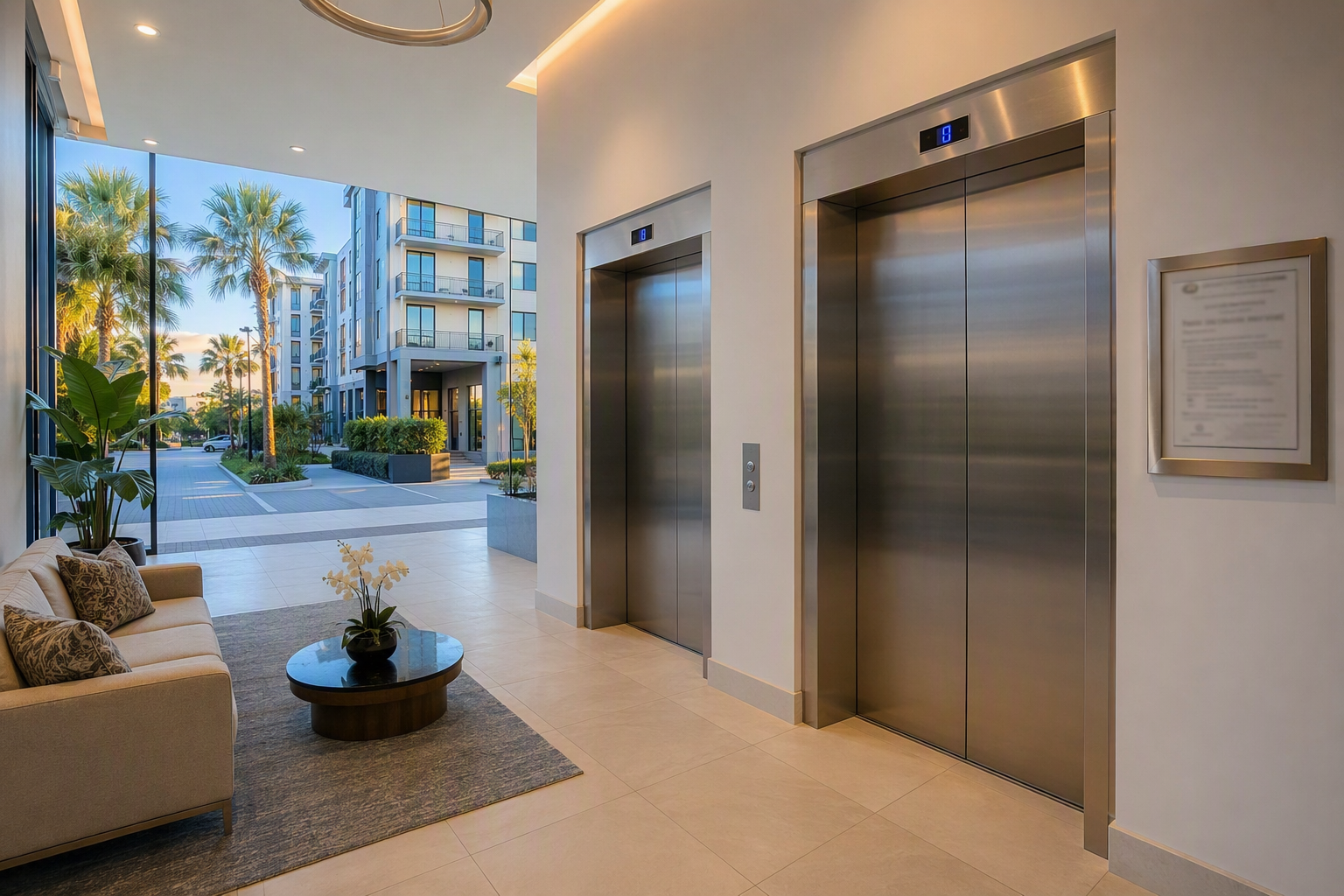
Inspections in Florida are conducted either by DBPR inspectors or by a qualified special inspector approved by the local AHJ. Following a passed inspection, the certificate must be posted in the elevator car in a visible location — this is a requirement property managers should verify regularly. Operating an elevator without a valid, posted Certificate of Operation is a violation of Florida law and can result in mandatory shutdown orders.
Beyond the standard periodic inspection, Florida also requires category tests — including load tests and safety device tests — at intervals defined in ASME A17.1 and A17.3. These tests must be witnessed by a licensed elevator inspector and documented with test reports submitted to the appropriate authority.
What ADA accessibility requirements apply to apartment building elevators in Florida?
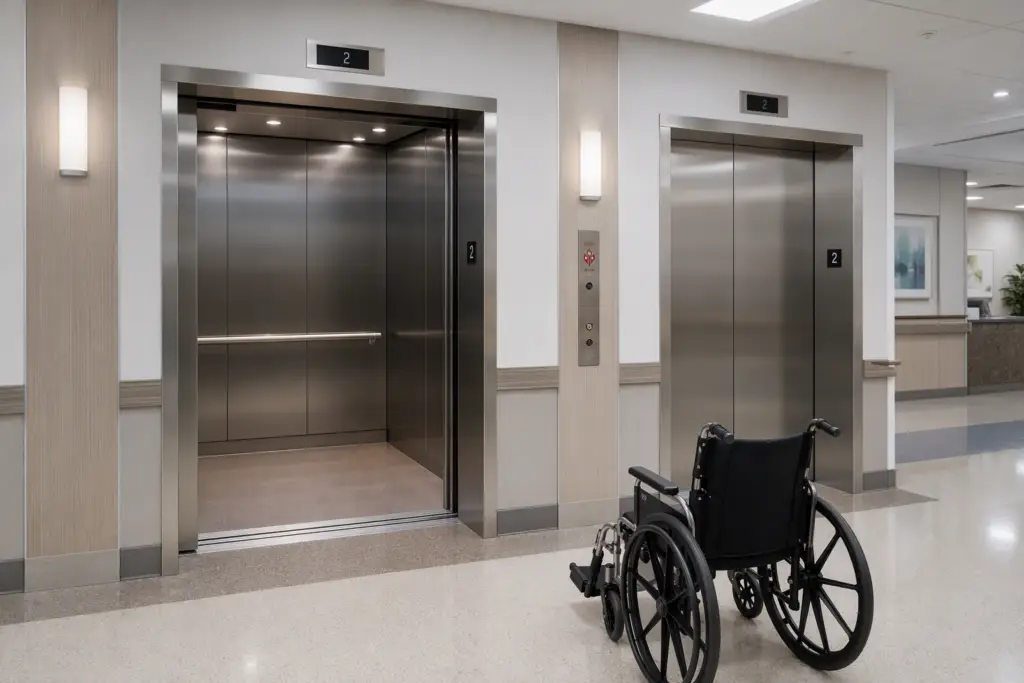
The ADA Standards for Accessible Design specify requirements that apply to elevators serving public and common-use areas in multifamily housing. Key requirements include:
- Elevator car doors with a minimum clear opening width that allows wheelchair access
- Hall call buttons positioned at a height accessible to wheelchair users
- Raised and Braille characters on elevator controls and floor designations
- Audible and visible floor arrival signals
- Car floor leveling within a defined tolerance so there is no significant gap or height difference between the car floor and the landing floor
- Adequate car interior dimensions to allow wheelchair maneuvering
- Two-way emergency communication systems accessible to people with hearing or speech impairments
Property owners undertaking elevator modernizations or alterations must ensure that any altered elements comply with current ADA requirements. Failing to maintain ADA compliance can expose apartment building owners to federal civil rights complaints and litigation.
What are the permit and licensing requirements for elevator installation and maintenance in Florida?
Florida requires that any elevator installation, alteration, or major repair be performed by a licensed elevator contractor holding a state-issued license from the DBPR. The contractor must pull a permit through the local building department before work begins, and inspections must be scheduled and passed before the elevator is placed back in service or a new Certificate of Operation is issued.
Routine maintenance — such as lubrication, adjustments, and minor component replacements — must also be performed by qualified elevator mechanics working under a licensed elevator contractor. This requirement protects building owners from liability and ensures work meets the standards referenced in ASME A17.1 and A17.3. Hiring unlicensed individuals for elevator work is a violation of Florida law and can void equipment warranties, complicate insurance claims, and create significant liability exposure.
What emergency and entrapment protection features are required in Florida apartment elevators?
Florida elevator code requires that apartment elevators be equipped with specific emergency and safety features designed to protect occupants in the event of a power failure, mechanical failure, or entrapment. Required features include:
- Emergency lighting: Illumination in the elevator car that activates automatically upon loss of normal power
- Two-way emergency communication: A means for a trapped passenger to contact help, meeting ADA requirements for accessibility, including communication methods usable by people with hearing impairments
- Firefighters’ emergency operation (FEO): Required under ASME A17.1, this allows fire service personnel to control the elevator during emergencies, including recall to a designated landing
- Automatic rescue operation: Systems that use battery backup or other means to move a stranded car to the nearest landing and open doors during a power outage
- Governor and safety devices: Mechanical overspeed governors and car safety devices that halt a descending car if it exceeds rated speed
- Pit stop switches and other maintenance safety devices: Required under ASME standards to protect workers performing maintenance in confined areas
What happens when an apartment elevator fails inspection in Florida?
When an elevator fails a periodic inspection or category test in Florida, the inspector issues a report detailing the deficiencies. The building owner or elevator contractor is required to correct all violations within the timeframe specified by the inspector or the DBPR. If deficiencies represent an immediate safety hazard, the inspector has authority to order the elevator taken out of service immediately — meaning the elevator cannot be used until repairs are made and the unit passes a re-inspection.
Property owners should understand that operating an elevator under a shutdown order — or continuing to operate equipment with known, unaddressed safety violations — can result in substantial fines, legal liability if an injury occurs, and damage to the building’s reputation with tenants and insurers. Proactive maintenance and pre-inspection assessments are widely recognized in the industry as the most effective strategy to avoid failed inspections.
What is involved in an elevator modernization for an older Florida apartment building?
Many Florida apartment buildings constructed in the 1970s, 1980s, and 1990s have elevators that are approaching or exceeding their typical service life. Modernization — the process of replacing major components such as controls, drives, door operators, and sometimes the entire machine — is frequently the most cost-effective path to bringing aging equipment into compliance with current editions of ASME A17.3 and current ADA standards.
A typical modernization project follows this process:
- Condition assessment: A licensed elevator contractor evaluates the existing equipment, identifies code deficiencies, and documents the scope of work required.
- Scope definition and specification: The contractor and owner agree on which components will be replaced, which codes apply, and what performance improvements are expected.
- Permitting: The licensed contractor submits permit applications to the local building department before any work begins.
- Equipment procurement: Replacement components — controls, motors, door systems, cabs, fixtures — are ordered and scheduled for delivery.
- Removal and installation: The existing components are removed and new equipment is installed by licensed elevator mechanics.
- Category testing: Required load and safety device tests are performed and witnessed by a licensed inspector.
- Final inspection: The local AHJ or DBPR conducts a final inspection; upon passing, a new Certificate of Operation is issued.
- Closeout documentation: The building owner receives all permits, test reports, and the new Certificate of Operation for records.
What are the industry trends shaping Florida apartment elevator compliance in 2025–2026?
Several notable trends are shaping the elevator compliance landscape for Florida multifamily properties heading into 2025 and 2026:
Remote monitoring and predictive maintenance adoption: Elevator manufacturers and service contractors are increasingly offering remote monitoring systems that track elevator performance in real time, detect anomalies before they cause failures, and provide building managers with data on call-back frequency, door performance, and component wear. Florida’s multifamily sector is seeing growing adoption of these systems as a strategy to reduce unplanned downtime and support compliance documentation.
Growing modernization demand: Florida’s aging multifamily housing stock — particularly in South Florida, the Tampa Bay area, and the Orlando market — means a significant volume of elevators installed decades ago is reaching end-of-life. Demand for modernization services is expected to remain strong through 2026 as owners seek to address accumulating code deficiencies and avoid escalating maintenance costs on obsolete equipment.
Increased enforcement attention: Industry observers have noted increased scrutiny from inspectors and building officials in Florida following high-profile incidents involving aging vertical transportation equipment in residential buildings across the state. Property owners can expect that compliance documentation, proper certificate posting, and timely correction of deficiencies will receive heightened attention from AHJs.
Energy efficiency and machine-room-less technology: New construction and full replacement projects are trending toward MRL traction and variable-frequency drive (VFD) hydraulic systems, which offer reduced energy consumption compared to legacy equipment. While specific energy savings figures vary by building and usage, these technologies are increasingly specified in new Florida apartment construction.
Emergency communication upgrades: As telephone landline infrastructure continues to decline, many older apartment buildings face the practical challenge of maintaining compliant two-way emergency communications in their elevator cabs. Cellular-based and internet-protocol emergency communication systems are becoming the standard replacement, and building owners with legacy phone-based systems are advised to evaluate their current setup for reliability and ADA compliance.
How can apartment building owners in Florida prepare for elevator inspections?
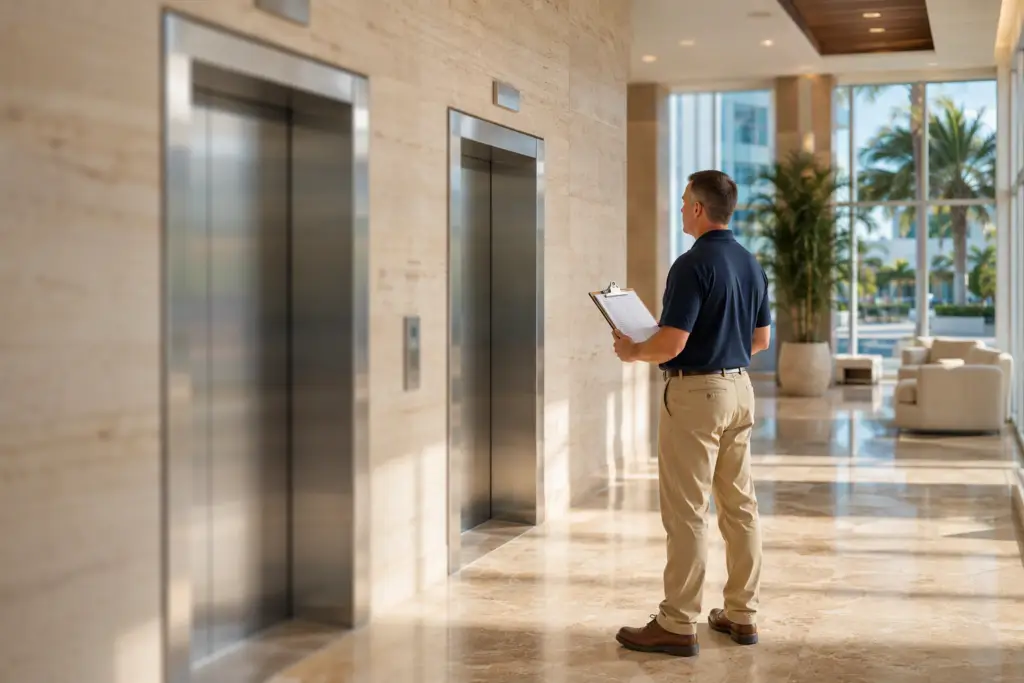
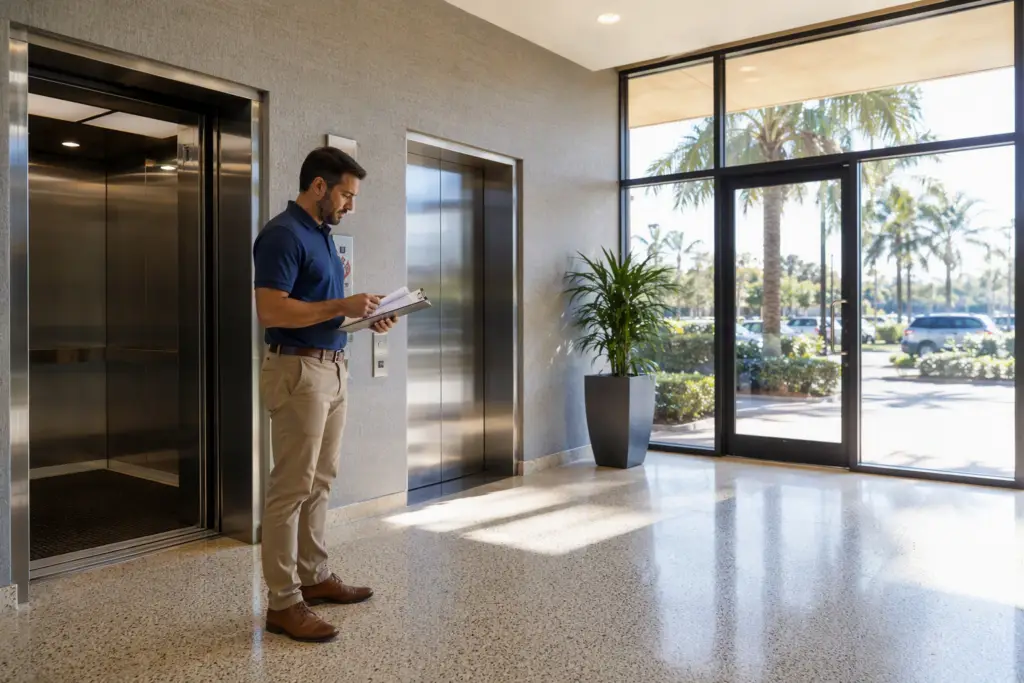
Proactive preparation is the most reliable way for Florida property owners to pass elevator inspections without deficiency notices or delays. The following steps outline a recommended pre-inspection protocol:
- Review the prior inspection report: Identify any previously noted deficiencies and confirm they have been corrected and documented by a licensed elevator contractor.
- Verify the Certificate of Operation: Confirm that the current certificate is posted visibly inside the elevator car and that the expiration date has not passed.
- Confirm category test due dates: Check with your elevator service contractor to determine whether any periodic load tests or safety device tests are due under ASME A17.1 or A17.3 before or during the inspection cycle.
- Test emergency systems: Verify that emergency lighting, two-way communication, and firefighters’ emergency operation features are functioning properly.
- Check door operation: Door reopening devices, door-close force limits, and door timing are among the most frequently cited deficiencies — confirm these are within code tolerances.
- Inspect the machine room and pit: Ensure the machine room is clean, dry, properly lit, and free of stored materials not related to the elevator. The pit should be dry, properly lit, and equipped with required safety switches.
- Confirm ADA features: Verify that call button heights, Braille characters, floor announcements, and leveling accuracy meet ADA requirements.
- Gather maintenance records: Have documentation of all recent maintenance, repairs, and tests available for the inspector’s review.
How does Axxiom Elevator Florida support multifamily property owners with compliance?
Axxiom Elevator Florida provides elevator installation, modernization, maintenance, and compliance assessment services for multifamily apartment properties throughout Florida. The company approaches each property with a data-driven methodology — evaluating existing equipment against current ASME A17.1 and A17.3 requirements, documenting deficiencies, and developing clear remediation plans that prioritize life safety and regulatory compliance.
For apartment building owners navigating the complexity of Florida DBPR requirements, periodic inspection schedules, ADA compliance, and aging equipment, Axxiom Elevator Florida serves as a technical resource — not just a service vendor. Work is performed by licensed elevator contractors in accordance with Florida Statute Chapter 399 and the applicable ASME codes, with full permitting and inspection coordination included in every project scope.
Property managers dealing with failed inspections, unplanned outages, or uncertainty about their equipment’s compliance status are encouraged to request a structured assessment before problems escalate into emergency situations or enforcement actions.
Sourced Reference Data
| Code / Standard | Scope | Source |
|---|---|---|
| ASME A17.1 Safety Code for Elevators and Escalators | New elevator installations and alterations in Florida | ASME Codes & Standards |
| ASME A17.3 Safety Code for Existing Elevators and Escalators | Existing elevators and periodic inspection requirements | ASME Codes & Standards |
| ASME A18.1 Safety Standard for Platform Lifts and Stairway Chairlifts | Vertical platform lifts used for accessibility in multifamily common areas | ASME Codes & Standards |
| ADA Standards for Accessible Design | Accessibility requirements for elevator controls, dimensions, and communication systems | ADA.gov |
| OSHA General Industry Standards | Worker safety during elevator maintenance and repair operations | OSHA.gov |
Get a Professional Elevator Compliance Assessment
Florida apartment building owners should not wait for a failed inspection or an enforcement order to evaluate their elevator’s compliance status. Proactive assessment is the most cost-effective path to maintaining safe, compliant, and operationally reliable vertical transportation equipment.
Contact Axxiom Elevator Florida for a free elevator assessment. Call to speak with a licensed elevator professional about your property’s specific requirements under Florida law, ASME standards, and ADA accessibility guidelines.
Need elevator service you can rely on? Axxiom Elevator Florida is ready to help.