Elevator Certificate of Compliance: Everything Florida Property Owners Need to Know
Operating an elevator in Florida without a valid certificate of compliance is not only a code violation — it exposes property owners to significant liability, potential fines, and forced shutdowns. Whether you manage a condominium in Pompano Beach, a commercial building in Sarasota, or any multi-story property across the state, understanding how elevator compliance certificates work is essential to keeping your building safe, legally operational, and insurable. This comprehensive guide answers every question property managers, building owners, and facility directors typically ask about the elevator certificate of compliance process in Florida.
What is an elevator certificate of compliance?
An elevator certificate of compliance is an official document issued by a licensed elevator inspection authority confirming that a specific elevator unit has been inspected, tested, and found to meet all applicable safety codes and state regulations required for legal operation.
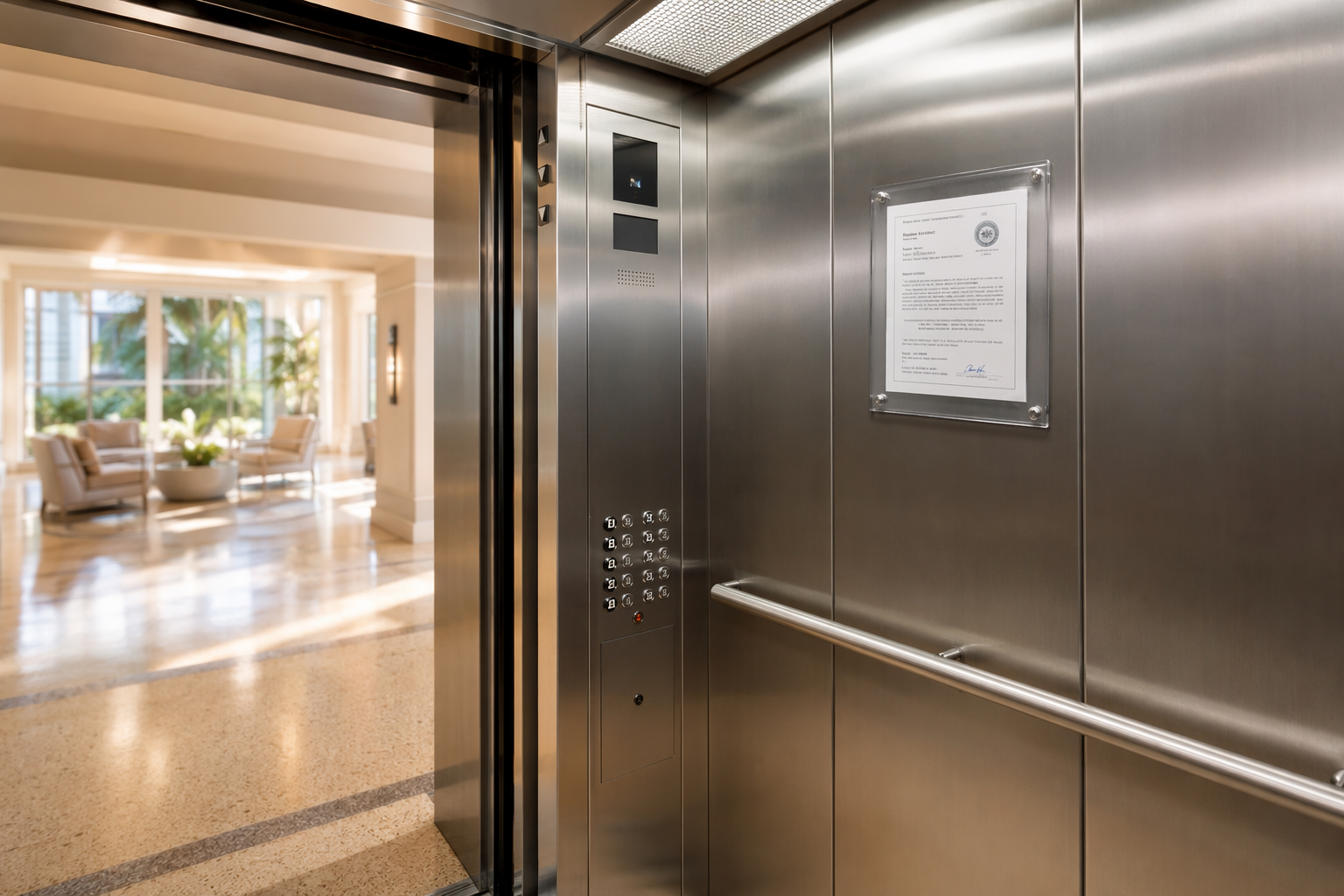
In Florida, the certificate of compliance is governed under Florida Statute Chapter 399, which places oversight of elevators, escalators, and related conveyances under the Florida Department of Business and Professional Regulation (DBPR). The certificate must be posted inside the elevator car in a visible location and must reflect a passing result from the most recent required inspection. Without a current, valid certificate on display, an elevator is technically not authorized for passenger use.
The certificate ties a specific unit to a specific inspection date, inspector credentials, and inspection type. It is not transferable between units or properties, and it does not carry over to new ownership without verification of current compliance status.
Why is an elevator certificate of compliance legally required in Florida?
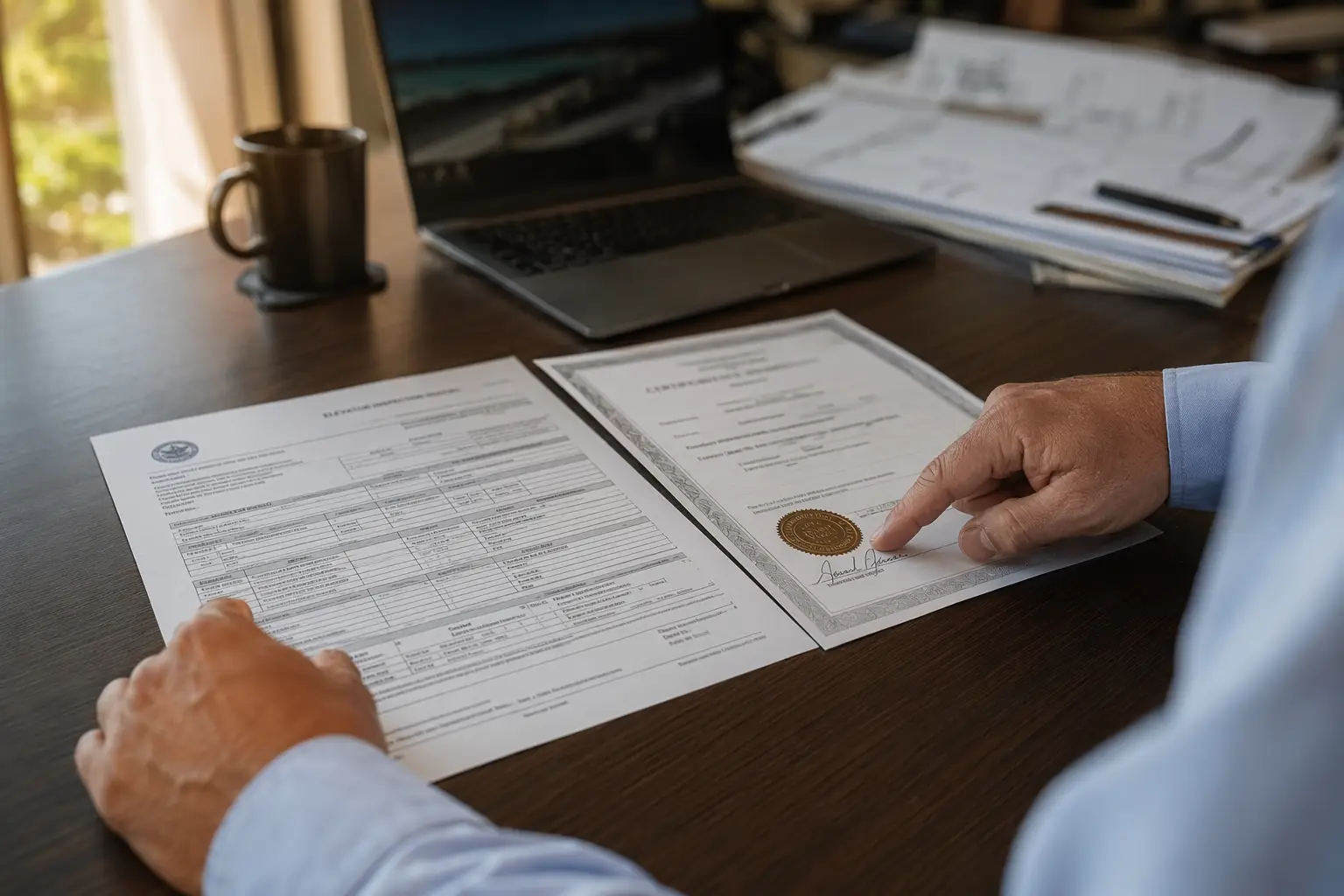
Florida law requires an elevator certificate of compliance to protect the safety of elevator passengers, hold property owners accountable for equipment maintenance, and create a documented public record that conveyances operating in the state have been independently verified as safe.
The legal framework stems from Florida Statute Chapter 399, which applies to all elevators, escalators, moving walks, dumbwaiters, and other conveyances accessible to the public or to building occupants. This statute grants the DBPR authority to enforce inspection requirements, impose fines, and order elevators out of service when compliance cannot be demonstrated.
Beyond Florida state law, the underlying safety code that inspectors use to evaluate elevator systems is the ASME A17.1 Safety Code for Elevators and Escalators. This nationally recognized standard defines design requirements, testing protocols, and maintenance obligations that directly inform what inspectors look for during a compliance inspection. Florida has adopted the ASME A17.1 as its technical reference standard.
What is the difference between an elevator inspection and a certificate of compliance?
The inspection is the physical evaluation process conducted by a licensed inspector, while the certificate of compliance is the official document issued after a successful inspection — the certificate is the legal outcome of a passing inspection.
Property owners sometimes confuse the two terms. An elevator inspection involves a licensed inspector visiting the property, physically examining the elevator equipment, reviewing maintenance records, and conducting operational tests. If the elevator passes, the inspector issues or facilitates the issuance of a certificate of compliance. If deficiencies are found, a conditional notice or violation may be issued instead, and no compliance certificate is granted until the issues are corrected and a re-inspection passes.
It is also worth noting that there are different types of inspections — routine periodic inspections, witness tests after major alterations, and Category 1 or Category 5 tests as defined by ASME A17.1 — each of which can result in the issuance or renewal of a compliance certificate depending on the scope and outcome.
How often must an elevator be inspected to maintain a valid certificate of compliance in Florida?
In Florida, most elevators are required to undergo a periodic safety inspection at least once every year to maintain a current certificate of compliance.
Annual inspections are the standard requirement for passenger elevators operating in commercial buildings, residential properties, and public facilities throughout Florida. However, additional testing requirements exist beyond the routine annual inspection. Under ASME A17.1, hydraulic elevators require a Category 1 pressure test at regular intervals, and traction elevators are subject to Category 1 and Category 5 tests at defined frequencies. These supplementary tests are separate from the annual inspection but contribute to the overall compliance record of the unit.
After any major alteration, repair, or modernization project, an elevator must also pass a witness test before being returned to service and before a new or updated certificate can be issued. Property owners in Pompano Beach and Sarasota should coordinate with their elevator service contractor to ensure that all required test schedules are tracked and not inadvertently missed.
Who is authorized to inspect elevators and issue compliance certificates in Florida?
In Florida, elevator inspections must be performed by either a licensed state elevator inspector employed by the DBPR or by a licensed private elevator inspection company authorized by the state to conduct third-party inspections on behalf of building owners.
Florida allows property owners to contract with qualified private inspection companies, which can provide more scheduling flexibility than relying solely on state inspectors. However, all inspectors — whether state employees or private contractors — must hold the appropriate licensure under Florida Statute Chapter 399. Inspectors typically hold credentials aligned with the ASME Codes & Standards framework and may carry nationally recognized certifications from organizations that establish inspector competency standards.
It is important to distinguish between the inspector (who evaluates the equipment) and the elevator service company (who maintains and repairs the equipment). While both must be licensed, Florida regulations generally prohibit the same party that performs maintenance from also conducting the compliance inspection, preserving the independence of the certification process.
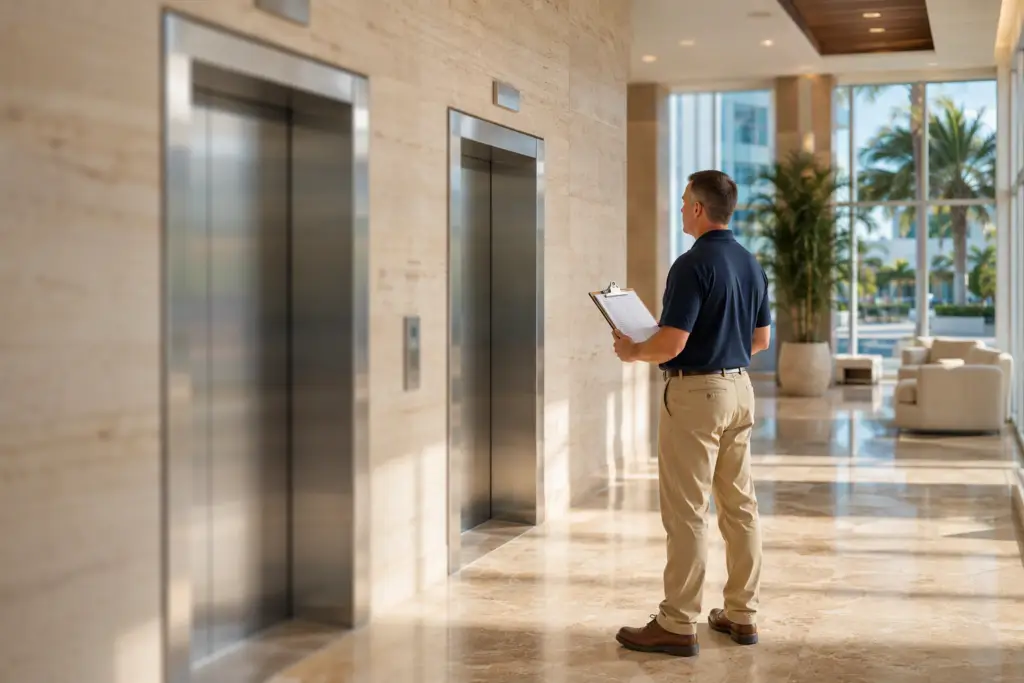
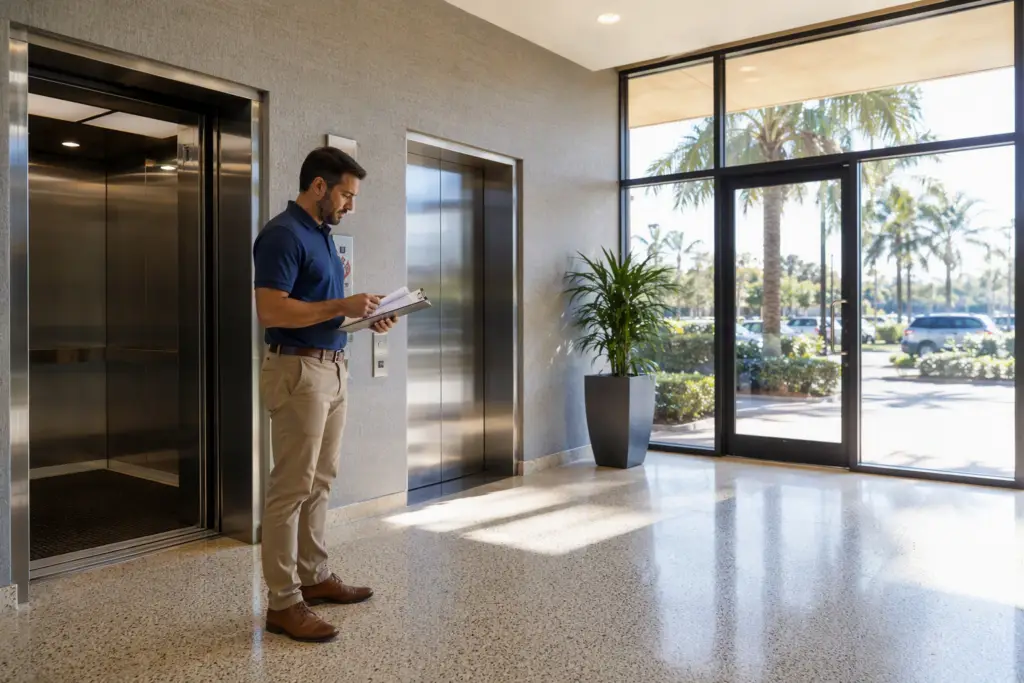
What does an inspector evaluate during a compliance inspection?
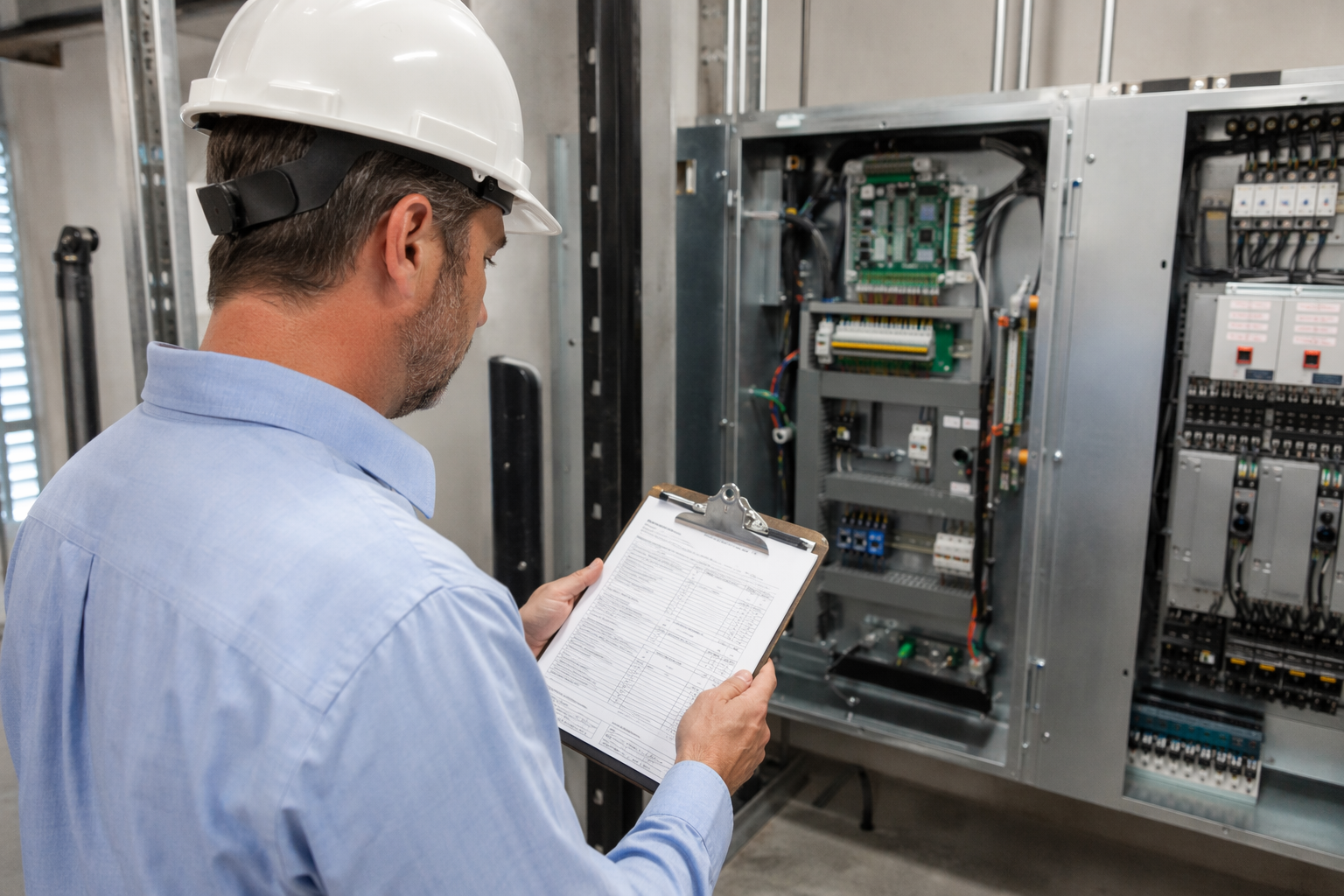
During a compliance inspection, an inspector evaluates the elevator’s structural components, safety devices, control systems, door operation, emergency communication, lighting, and overall adherence to the applicable edition of ASME A17.1 and Florida-specific code requirements.
The inspection typically includes a review of the following areas:
- Car and hoistway: Clearances, guarding, lighting, ventilation, and structural integrity
- Door and gate systems: Closing force, reopening devices, and interlock mechanisms
- Safety devices: Overspeed governors, safeties, buffers, and pit stop switches
- Drive and control systems: Motor operation, leveling accuracy, and emergency stop function
- Emergency communication: Two-way communication device functionality, a requirement also reinforced by ADA regulations for accessible elevators
- Maintenance records: Documentation verifying that routine maintenance has been performed by a licensed elevator contractor
Any deficiency in these areas can result in a failed inspection, a conditional certificate, or an immediate out-of-service order depending on the severity of the finding.
What happens if an elevator fails its compliance inspection in Florida?
If an elevator fails its compliance inspection, the inspector may issue a notice of violation, place the unit out of service, and require that all identified deficiencies be corrected before a re-inspection can be scheduled and a certificate of compliance issued.
Minor deficiencies may allow the elevator to remain in service conditionally while repairs are arranged, but serious safety violations — such as malfunctioning door interlocks, failed safety devices, or structural issues — will typically result in an immediate order to cease operation. Operating an elevator that has been placed out of service exposes the property owner to significant civil liability and DBPR enforcement action, including fines.
After corrections are made, the property owner must arrange a re-inspection through a licensed inspector. Only after the re-inspection confirms that all violations have been resolved will a certificate of compliance be issued. This underscores the importance of proactive maintenance — catching issues before an inspection avoids costly downtime and emergency repair situations.
What should a property owner do immediately if their elevator’s certificate of compliance has expired?
A property owner whose elevator’s certificate of compliance has expired should take the following steps immediately to restore compliance and protect building occupants.
- Remove the elevator from passenger service until a valid certificate is in place. Operating without a valid certificate creates direct liability exposure.
- Contact a licensed elevator service contractor to conduct a thorough pre-inspection maintenance review and identify any issues that could cause a failed inspection.
- Gather and organize all maintenance records from the current and prior inspection periods, as inspectors typically review documentation as part of the compliance evaluation.
- Schedule an inspection with a licensed state or private elevator inspector authorized in Florida.
- Complete any required repairs or corrections identified during the maintenance review before the inspection appointment.
- Obtain the certificate following a successful inspection and post it conspicuously inside the elevator car as required by Florida Statute Chapter 399.
- Set calendar reminders for the next inspection due date and all required periodic testing intervals under ASME A17.1.
Axxiom Elevator Florida assists property owners in Pompano Beach and Sarasota with pre-inspection preparation, maintenance documentation review, and coordination with licensed inspection authorities to help restore compliance efficiently.
How do ASME A17.1 code requirements relate to the Florida certificate of compliance process?
ASME A17.1 is the technical safety code that Florida has adopted as the benchmark standard against which all elevator equipment is evaluated during compliance inspections — meeting ASME A17.1 requirements is functionally synonymous with meeting the technical prerequisites for a certificate of compliance in Florida.
The ASME A17.1 Safety Code for Elevators and Escalators establishes detailed requirements for equipment design, installation, operation, testing, and maintenance. Inspectors use this code as their primary technical reference when evaluating whether an elevator is fit for a compliance certificate. Florida typically adopts updated editions of ASME A17.1 on a rolling basis, so property owners and service contractors must stay current with the applicable edition in force for 2026 compliance evaluations.
Importantly, ASME A17.1 also defines the maintenance obligations — including the requirement for a written maintenance control program — that building owners must demonstrate compliance with as part of the inspection record. Elevators that lack documented maintenance histories are at higher risk of failing compliance inspections regardless of the physical condition of the equipment.
How do ADA requirements intersect with elevator compliance in Florida?
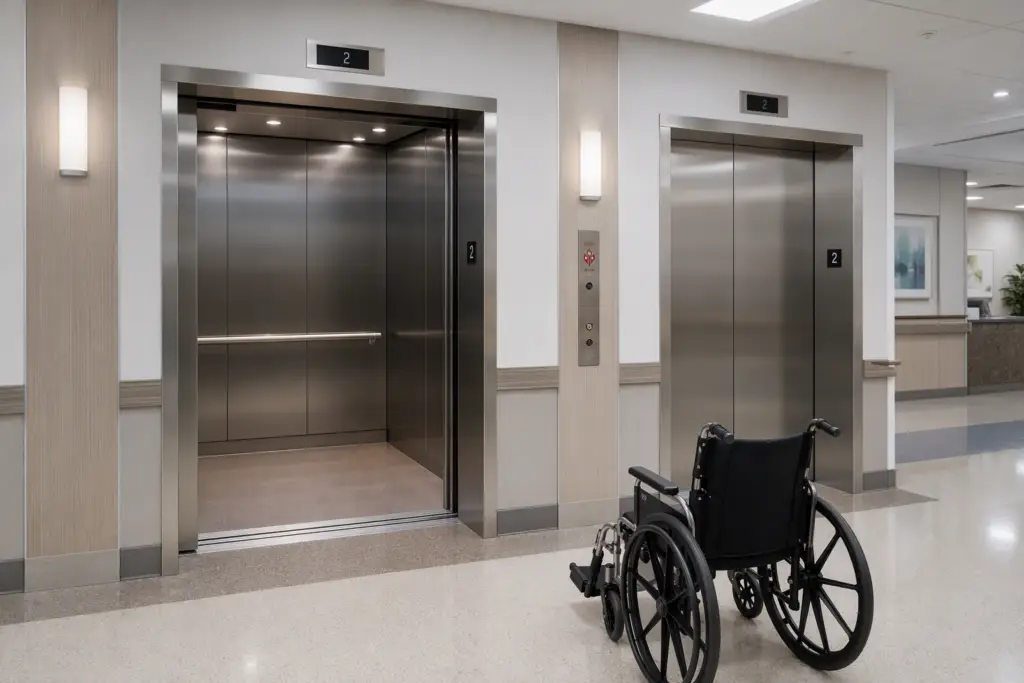
ADA requirements establish accessibility standards that elevators serving multi-story public accommodations and commercial facilities must meet, and ADA compliance issues can be cited during elevator inspections and affect the overall compliance status of a unit.
Under ADA regulations, elevators in covered facilities must meet specific requirements for car dimensions, door widths, control panel heights, Braille and tactile signage, floor call buttons, leveling accuracy, and two-way emergency communication. While the ADA is a federal civil rights law enforced separately from the Florida DBPR inspection process, inspectors may note ADA-related deficiencies as part of their evaluation, and unresolved ADA issues can complicate the renewal of a certificate of compliance, particularly in commercial properties subject to federal access requirements.
Property owners in Sarasota and Pompano Beach managing commercial or public-use buildings should ensure that ADA accessibility features are regularly verified as part of their overall elevator maintenance program — not treated as a separate concern from ASME code compliance.
What types of elevators require a certificate of compliance in Florida?
In Florida, virtually all conveyances covered under Florida Statute Chapter 399 require a certificate of compliance, including passenger elevators, freight elevators, escalators, moving walks, dumbwaiters, platform lifts, and stairway chairlifts installed in public or commercial use buildings.
The following table summarizes the major conveyance types and their general compliance inspection applicability under Florida regulations:
| Conveyance Type | Certificate of Compliance Required | Primary Code Reference | Typical Inspection Frequency |
|---|---|---|---|
| Passenger Elevator (Traction) | Yes | ASME A17.1 | Annual + Category 1/5 tests |
| Passenger Elevator (Hydraulic) | Yes | ASME A17.1 | Annual + Category 1 pressure test |
| Freight Elevator | Yes | ASME A17.1 | Annual |
| Escalator | Yes | ASME A17.1 | Annual |
| Moving Walk | Yes | ASME A17.1 | Annual |
| Dumbwaiter | Yes (if covered under Chapter 399) | ASME A17.1 | Annual |
| Platform Lift / LULA Lift | Yes | ASME A18.1 | Annual |
| Private Residence Elevator | Typically exempt from public inspection requirements | ASME A17.1 | N/A (private use) |
Property owners uncertain about which of their conveyances falls under mandatory compliance inspection requirements should consult with a licensed elevator service contractor or contact the Florida DBPR directly for guidance specific to their equipment type and use classification.
How long does it take to obtain an elevator certificate of compliance?
The time required to obtain an elevator certificate of compliance depends on the current condition of the equipment, the availability of a licensed inspector, and whether any deficiencies require correction before a passing inspection can be achieved — a well-maintained elevator in good condition can often be certified within a matter of days once an inspection is scheduled.
For elevators that are current on maintenance and have no outstanding violations, the process can move quickly: an inspector schedules the visit, conducts the evaluation, and if the elevator passes, the certificate is issued. The administrative processing time may vary depending on whether a state inspector or licensed private inspector is used.
For elevators with deferred maintenance, code deficiencies, or expired certificates following an out-of-service order, the timeline extends to account for repair work, parts procurement, and re-inspection scheduling. Complex modernization projects or major alterations can extend the compliance timeline further. Working with an experienced elevator service company from the outset helps identify and resolve issues before they create inspection delays.
What records should property owners maintain to support their elevator compliance certificate?
Property owners should maintain a complete file of inspection reports, maintenance logs, repair records, test certificates, and contractor service documentation — this records package both supports the issuance of a compliance certificate and demonstrates due diligence in the event of an incident or audit.
Specifically, the maintenance control program required under ASME A17.1 mandates that a written record of all maintenance tasks and intervals be kept and made available for inspection. Best practice record-keeping for Florida property owners includes:
- Copies of all previous certificates of compliance with inspection dates
- Maintenance logs from the licensed elevator contractor, including dates of service visits and tasks performed
- Repair orders and parts replacement documentation
- Category 1 and Category 5 test reports
- Hydraulic oil inspection and cylinder test records (for hydraulic elevators)
- Emergency phone test documentation confirming two-way communication functionality
- Modernization permits and post-modernization inspection reports
Can a new property owner inherit elevator compliance, or must they obtain a new certificate?
A new property owner should verify the current validity of the elevator’s certificate of compliance at the time of acquisition — a certificate does not automatically transfer with ownership, and the new owner assumes full legal responsibility for maintaining compliance from the moment of transfer.
During a real estate transaction involving buildings with elevators, due diligence should include requesting copies of current compliance certificates, maintenance records, and any outstanding violation notices. If the certificate is current and no violations are open, the new owner generally benefits from the unexpired certificate until its next renewal date. However, if deficiencies exist, the new owner becomes responsible for resolving them and should factor correction costs into the acquisition analysis.
Axxiom Elevator Florida offers pre-acquisition elevator assessments for property buyers in Pompano Beach and Sarasota, providing a professional evaluation of equipment condition, compliance status, and estimated upcoming maintenance and testing obligations before a transaction closes.
What are the consequences of operating an elevator without a valid certificate of compliance in Florida?
Operating an elevator in Florida without a valid certificate of compliance can result in DBPR enforcement action, monetary fines, forced shutdown orders, and significant civil liability if an elevator-related incident occurs while the unit was operating without proper certification.
The Florida DBPR has authority under Chapter 399 to levy fines against property owners operating non-compliant conveyances. Beyond regulatory penalties, the liability exposure in the event of a passenger injury involving a non-certified elevator is substantial — the absence of a valid compliance certificate is likely to be introduced as evidence of negligence in any personal injury litigation. Insurance carriers may also deny coverage for incidents occurring on equipment that was not in compliance at the time of the event.
The financial consequences of maintaining compliance are consistently less than the financial and reputational consequences of operating without it.
How does routine elevator maintenance affect the certificate of compliance renewal process?
Consistent, documented routine maintenance is the single most important factor in achieving a clean, uncomplicated certificate of compliance renewal — elevators with continuous maintenance histories are statistically less likely to present inspection deficiencies.
The ASME A17.1 Safety Code for Elevators and Escalators places an affirmative obligation on building owners to ensure that elevators are maintained by a licensed contractor following a documented maintenance control program. Inspectors review this documentation as part of the compliance evaluation. Gaps in the maintenance record — even on equipment that appears physically sound — can raise questions and lead to additional scrutiny during an inspection.
Regular maintenance also allows the service contractor to identify and correct minor issues on a planned basis rather than discovering them during an inspection when the pressure to resolve violations quickly can lead to higher repair costs and extended downtime. Property managers in Sarasota and Pompano Beach who work with Axxiom Elevator Florida benefit from a structured maintenance program designed to keep equipment in inspection-ready condition year-round.
What is a Category 5 test and when is it required for compliance purposes?
A Category 5 test is a full-load, full-speed safety test of an elevator’s governor and safety system — including an intentional overspeed trip — and it is required by ASME A17.1 at defined intervals for traction elevators as a condition of maintaining ongoing compliance.
Category 5 tests are among the most demanding compliance tests required under ASME A17.1 and must be performed by a licensed elevator contractor in the presence of a licensed inspector. The test verifies that the elevator’s safety system will function correctly in an overspeed condition — a critical life-safety verification. Because Category 5 tests require the elevator to be taken out of service for an extended period and involve specialized equipment, they require advance planning and coordination between the service contractor, the inspector, and the building’s operational staff.
Failure to complete required Category 5 tests on schedule can result in the lapse of a certificate of compliance even if the elevator has otherwise passed its annual inspection.
How do elevator modernization projects affect compliance certificates?
Any elevator modernization or major alteration requires a permit, a witness inspection by a licensed inspector upon completion, and the issuance of a new or updated certificate of compliance before the modernized elevator can be returned to passenger service.
Florida Statute Chapter 399 and ASME A17.1 both address the requirements triggered by alterations to existing elevator equipment. When major components — such as the controller, drive system, door operator, or cab — are replaced or significantly modified, the elevator is subject to re-evaluation against current code requirements applicable to the altered components. This can introduce new code obligations that did not apply to the original installation.
Property owners planning modernization projects should budget for both the contractor permit fees and the post-modernization inspection and certification process. Axxiom Elevator Florida works with building owners in Pompano Beach and Sarasota to manage the full modernization process, including permit coordination and post-modernization compliance documentation.
Are there OSHA requirements related to elevator compliance for workplace settings?
OSHA regulations apply to elevators in workplace settings — particularly freight elevators and construction hoists — and OSHA compliance obligations may run parallel to Florida DBPR certification requirements for elevators used in commercial and industrial environments.
OSHA regulations address elevator safety as part of general industry and construction standards. For commercial property elevators primarily used by employees, OSHA’s general duty clause can be applied to elevators that present recognized hazards even if they are not specifically addressed by a dedicated OSHA elevator standard. In construction settings, OSHA has specific requirements for personnel and material hoists that operate alongside state DBPR requirements. Property owners and facility managers in Florida who operate elevators in workplace environments should ensure that both OSHA obligations and Florida DBPR compliance certificate requirements are simultaneously met.
What should property owners in Pompano Beach and Sarasota look for when selecting an elevator service company?
Property owners in Pompano Beach and Sarasota should select an elevator service company that holds all required Florida licenses, demonstrates familiarity with ASME A17.1 and Florida Statute Chapter 399, provides documented maintenance control programs, and has verifiable experience maintaining the specific type and brand of elevator equipment installed in their building.
Key selection criteria include:
- Florida licensure: Verify that the contractor holds a valid Florida elevator contractor license under the DBPR
- Code familiarity: The contractor should demonstrate working knowledge of ASME A17.1, Florida Chapter 399, and ADA accessibility requirements
- Documented maintenance programs: The company should provide written maintenance control programs aligned with ASME A17.1 requirements
- Local presence: A contractor with established operations in the Pompano Beach and Sarasota markets will be familiar with local building stock, inspection authorities, and permit processes
- Transparent service records: The contractor should provide comprehensive service logs that support compliance documentation at every inspection
Axxiom Elevator Florida is a certified elevator service company serving property owners throughout Pompano Beach and Sarasota, providing maintenance, repair, modernization, and compliance support services designed to keep elevators operating safely and in full regulatory compliance.
How can property owners avoid elevator compliance lapses between annual inspections?
Property owners can avoid compliance lapses by implementing a proactive maintenance schedule, tracking all inspection and test due dates on a compliance calendar, and partnering with a licensed elevator service contractor who monitors certification expiration dates as part of their service program.
Reactive management — responding to elevator problems only when they arise — is the leading cause of unexpected compliance failures. A compliance calendar should include:
- Annual inspection due date with a lead time reminder at least 60 days prior
- Category 1 and Category 5 test schedules as applicable to equipment type
- Hydraulic oil and cylinder inspection intervals
- Emergency communication system test dates
- Maintenance control program review dates
Building owners and property managers who treat elevator compliance as an ongoing operational priority — rather than an annual checkbox — consistently experience fewer disruptions, lower emergency repair costs, and cleaner inspection outcomes. The investment in a structured maintenance and compliance program pays dividends in reduced downtime, extended equipment lifespan, and sustained certification.
Ready to Ensure Your Elevator Has a Valid Certificate of Compliance?
Don’t wait for an inspection failure or compliance lapse to take action. Whether your building is in Pompano Beach, Sarasota, or anywhere in the surrounding Florida area, Axxiom Elevator Florida provides comprehensive elevator maintenance, pre-inspection preparation, modernization, and compliance support to help property owners stay fully certified and operating safely.
Contact Axxiom Elevator Florida for a free elevator assessment:
Our team serves commercial buildings, residential properties, and public facilities throughout Pompano Beach FL and Sarasota FL — helping property owners navigate Florida’s elevator compliance requirements with confidence.