Healthcare Facility Elevator Code: Requirements, Compliance & Standards
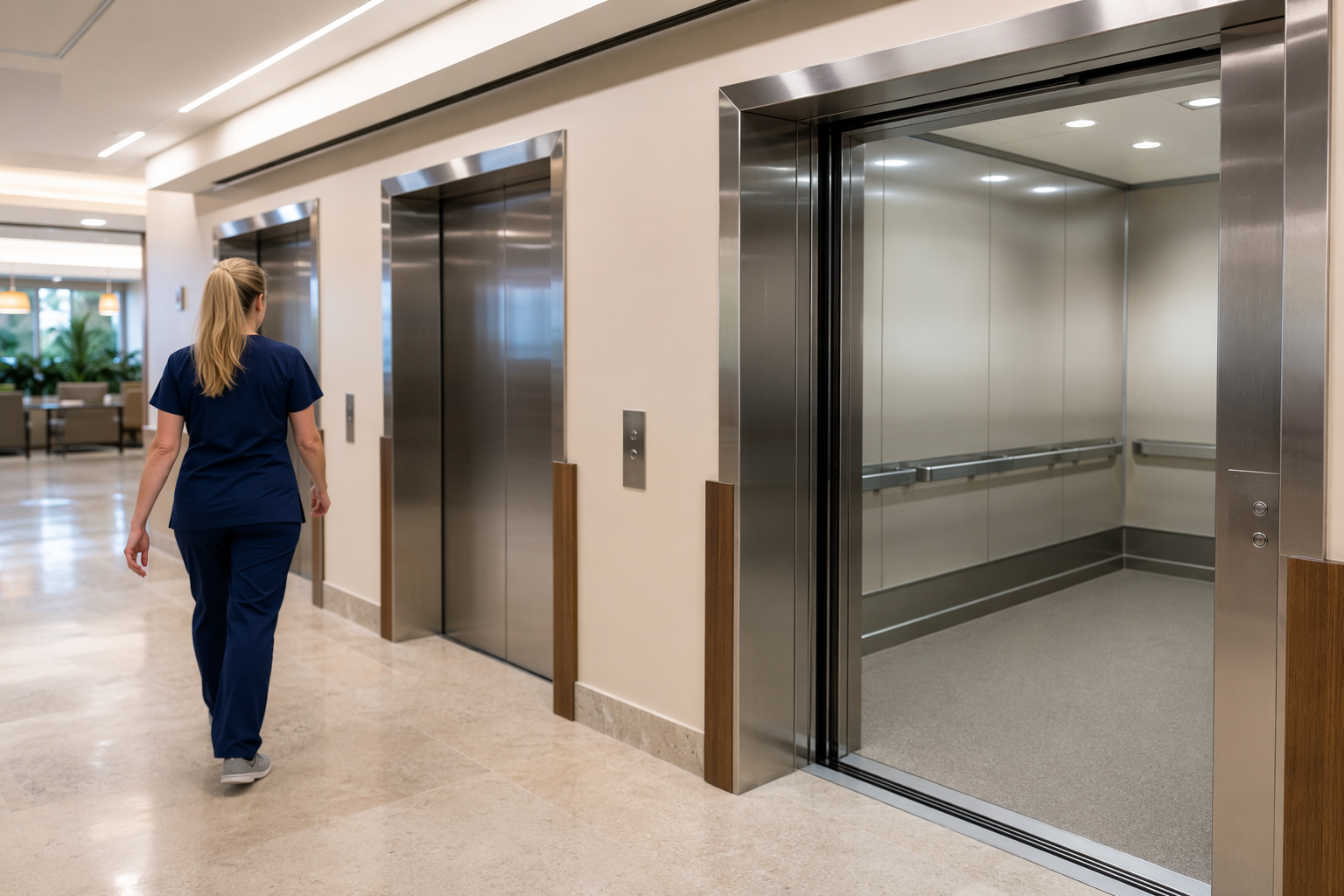
Healthcare facilities — hospitals, surgery centers, skilled nursing facilities, and medical office buildings — operate elevators under some of the most demanding code environments in any commercial sector. Elevator failures in these settings are not merely inconvenient; they can interrupt the transport of patients, delay emergency care, and trigger regulatory penalties. Understanding which codes apply, how they interact, and what compliance looks like in practice is essential for facility managers, compliance officers, and administrators throughout Florida and beyond.
What Federal Codes Govern Healthcare Facility Elevators?

Healthcare facility elevators are subject to a layered framework of federal, state, and local codes. At the federal level, two primary bodies of law shape requirements:
- ASME A17.1 Safety Code for Elevators and Escalators: This is the foundational mechanical safety standard adopted by most U.S. jurisdictions. It governs construction, installation, operation, inspection, testing, and maintenance of elevators. Most states, including Florida, adopt ASME A17.1 by reference into their elevator safety rules.
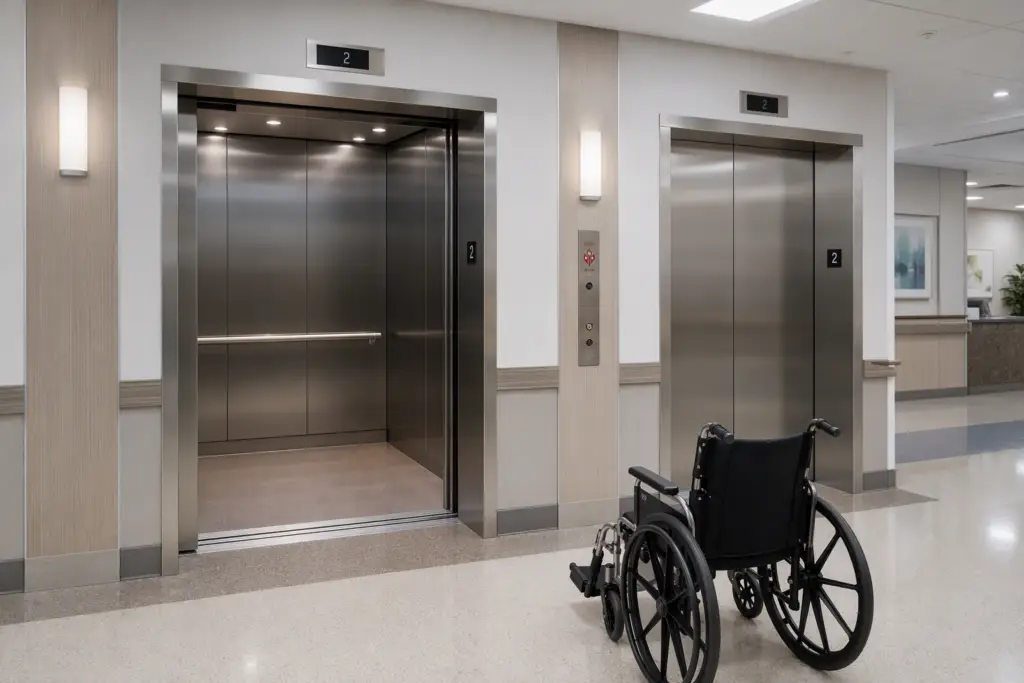
- Americans with Disabilities Act (ADA): The ADA requires that elevators in multi-story facilities be accessible to individuals with disabilities. In healthcare settings, where patients may use wheelchairs, stretchers, or mobility aids, ADA compliance is especially critical. Requirements cover cab dimensions, door timing, call button placement, floor indicators, and Braille signage.
Beyond these federal standards, the Centers for Medicare & Medicaid Services (CMS) requires that facilities participating in Medicare and Medicaid comply with the Life Safety Code published by the National Fire Protection Association (NFPA 101), which includes provisions affecting elevator lobbies, fire-rated doors, and emergency recall systems. Facilities that fail to meet these standards risk losing CMS certification — a consequence far more severe than most code violations in other building types.
How Does ASME A17.1 Apply Specifically to Hospitals and Medical Facilities?
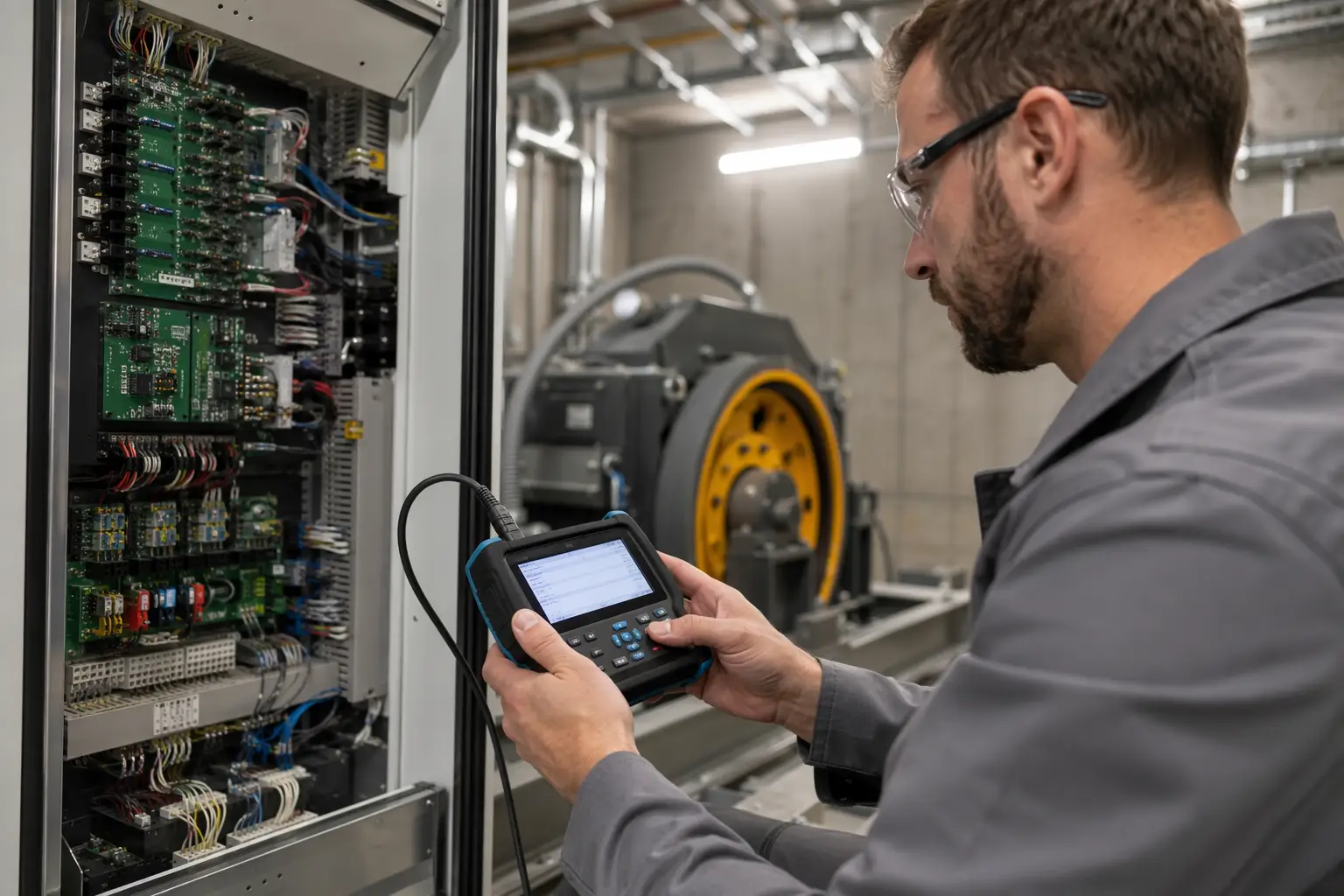
The ASME A17.1 Safety Code for Elevators and Escalators does not create a separate chapter exclusively for hospitals, but its provisions carry particular weight in healthcare settings due to the nature of the loads and the criticality of continuous operation. Key areas where ASME A17.1 shapes healthcare elevator design and maintenance include:
- Load capacity and car dimensions: Hospital elevators must accommodate bariatric patients, hospital beds, stretchers, and heavy medical equipment. While ASME A17.1 sets the mechanical standards for rated load and platform size, healthcare design guidelines typically call for larger cab dimensions than the code minimums to meet operational demands.
- Door width and timing: Code requirements for door dwell times and reopening devices are essential in healthcare, where a closing door on a patient transport is a safety risk.
- Phase I and Phase II emergency firefighter operation: ASME A17.1 mandates fire service recall features. In hospitals, these systems must be fully functional and regularly tested because fire evacuation protocols for non-ambulatory patients depend on elevator availability during certain fire scenarios.
- Inspection and testing intervals: The code specifies required periodic inspections and tests — including annual inspections and periodic load tests — that must be performed by qualified inspectors. Healthcare facilities cannot defer these without risking both code violations and patient safety.
- Seismic requirements: In applicable seismic zones, ASME A17.1 includes provisions for seismic switches and counterweight retainers. Florida facilities primarily face wind and storm considerations that intersect with elevator pit flooding protections.
What ADA Requirements Apply to Healthcare Elevators?
The ADA requirements for elevators in healthcare settings are found in the ADA Standards for Accessible Design, which are enforceable under Title III for private healthcare facilities and Title II for public hospitals. Core requirements include:
- Elevator lobbies must provide adequate turning radius for wheelchair users.
- Call buttons must be within reach ranges specified by the standards, with tactile indicators.
- Cab interiors must meet minimum floor area requirements so that wheelchairs and mobility devices can enter, turn, and exit without obstruction.
- Hall lanterns and audible signals must indicate the direction of travel.
- Controls inside the cab must include Braille and raised characters, positioned within specified height ranges.
- Door reopening devices must remain fully operational — a particular concern in high-traffic hospital environments where sensor wear is accelerated.
Healthcare administrators should note that ADA compliance is not a one-time certification. It is an ongoing obligation. As equipment ages, sensors degrade, signage fades, and door timing drifts — all of which can create ADA deficiencies even in elevators that were compliant at installation.
What Are the Florida-Specific Elevator Code Requirements for Healthcare Facilities?
Florida enforces elevator safety through the Florida Department of Business and Professional Regulation (DBPR), Bureau of Elevator Safety. Florida law requires that elevators be inspected by a licensed elevator inspector and that elevator contractors performing work on elevators hold a state license. Florida adopts the ASME A17.1 code by reference, meaning all hospitals and healthcare facilities in the state must meet those standards as a baseline.
Florida’s subtropical climate creates conditions that affect healthcare elevator compliance in ways not always anticipated during design. High humidity, flooding risk during storm events, and temperature fluctuations affect electrical components, pit conditions, and door operator mechanisms. Pit flooding — a real risk in Florida’s low-lying geography — can damage pit equipment and is addressed through waterproofing and sump pit requirements that responsible facility managers should factor into their maintenance planning.
Florida healthcare facilities subject to CMS oversight must also align their elevator maintenance and inspection records with the survey readiness requirements enforced during Joint Commission or CMS inspections. Gaps in maintenance documentation are frequently cited during these surveys.
What Types of Elevators Are Typically Required in Healthcare Facilities?
The type of elevator appropriate for a healthcare facility depends on the facility type, patient census, and traffic patterns. Common configurations include:
- Traction elevators: Electric traction elevators are standard in multi-story hospitals because they offer the speed, capacity, and reliability needed for continuous clinical operations. Machine-room-less (MRL) traction systems are increasingly used in newer construction where space efficiency is a priority.
- Hydraulic elevators: Found in lower-rise medical office buildings and outpatient centers. Hydraulic systems involve specific environmental compliance considerations related to hydraulic fluid containment, which ASME A17.1 and environmental regulations address.
- Service and freight elevators: Many hospitals operate dedicated service elevators for food service, linen, waste, and supply transport, keeping these flows separate from patient transport elevators. These elevators carry their own code requirements for load ratings and door configurations.
- Litter/bed elevators: Designed specifically for stretcher and bed transport, these cars require larger platform dimensions and are typically positioned to serve surgical, intensive care, and emergency departments with minimal travel distance.
What Is the Required Inspection Schedule for Healthcare Facility Elevators?
Under the ASME A17.1 Safety Code for Elevators and Escalators and Florida’s adopted rules, healthcare facility elevators are subject to mandatory periodic inspection and testing. The general framework includes:
- Annual inspections: A licensed elevator inspector must perform a routine inspection of all elevator systems, documenting conditions and identifying deficiencies that must be corrected within required timeframes.
- Periodic load tests: Full-load and no-load tests, including safety device tests, must be performed at intervals specified by the code. These tests verify that safety mechanisms function as designed under actual load conditions.
- Firefighter service tests: Phase I and Phase II emergency operation must be tested at required intervals to confirm that recall and in-car control functions operate correctly — a non-negotiable requirement in healthcare settings where fire evacuation plans depend on these systems.
- Door safety device inspections: Door reopening devices — including light curtains and mechanical edges — must be tested and confirmed operational during inspections. In healthcare settings, door malfunctions represent both safety and ADA compliance risks.
- Hydraulic system pressure tests: For hydraulic elevators, pressure tests and cylinder integrity assessments are required at code-specified intervals.
- Documentation and recordkeeping: All inspections, tests, and corrective maintenance must be documented and records kept accessible. During CMS or Joint Commission surveys, inspectors routinely request elevator maintenance logs as part of the Environment of Care review.
What Happens When a Healthcare Facility Elevator Fails a Code Inspection?
When an elevator in a healthcare facility fails inspection, the consequences cascade quickly. The elevator may be ordered out of service immediately if the deficiency is a category that poses imminent safety risk. For hospitals and nursing facilities, an out-of-service elevator is not merely an inconvenience — it disrupts patient transport workflows, may violate CMS conditions of participation, and can trigger survey findings that jeopardize Medicare certification.
Deficiencies that do not require immediate shutdown are typically assigned a correction deadline. Facility management must engage a licensed elevator contractor to perform the required repairs or modifications, after which a follow-up inspection confirms compliance. The cost of rushed repairs — particularly when they involve replacement of major components — is substantially higher than the cost of proactive preventive maintenance. From a risk management perspective, healthcare facility administrators benefit from treating elevator maintenance as a patient safety function, not merely a facilities management task.
How Does OSHA Relate to Healthcare Elevator Compliance?
While OSHA regulations primarily address worker safety, they are directly relevant to healthcare elevator compliance in two ways. First, elevator maintenance technicians performing work in healthcare facilities are covered by OSHA’s general industry and construction standards, including lockout/tagout (LOTO) requirements for energy control during maintenance. Healthcare facility managers have a duty to ensure that contractors working on their property comply with applicable OSHA standards.
Second, OSHA’s General Duty Clause requires employers to provide a workplace free from recognized hazards. In a hospital, staff members — nurses, technicians, environmental services workers — use elevators constantly. A deficient elevator that injures a staff member creates OSHA exposure for the facility in addition to the code violation. This dual exposure makes elevator compliance a human resources and risk management concern, not just a facilities issue.
What Are the Key Differences Between New Construction and Existing Healthcare Elevator Compliance?
New healthcare construction must meet the current edition of ASME A17.1 and ADA Standards as adopted by the authority having jurisdiction (AHJ) at the time permits are issued. Existing facilities face a more nuanced situation. Most jurisdictions apply a grandfather principle — existing elevators are not automatically required to be upgraded to the current code edition simply because a new edition is published. However, triggers that can require upgrades include:
- Major alterations or modernizations to the elevator system
- A change of use or occupancy classification for the building
- Specific state or local ordinances mandating retroactive upgrades (such as door detector requirements rolled out in various jurisdictions)
- Conditions found during inspection that represent a safety hazard, requiring correction regardless of code vintage
Healthcare facilities undergoing renovation or expansion should consult with both the AHJ and a licensed elevator contractor early in the design process to determine which code edition applies and what, if any, upgrades to existing equipment will be triggered.
What Modernization Triggers Are Common in Healthcare Elevator Upgrades?
Healthcare facilities often face modernization decisions when aging elevator equipment reaches the point where parts are no longer available, maintenance costs escalate significantly, or reliability becomes inconsistent with clinical operations. Common drivers of modernization in healthcare settings include:
- Obsolete controllers that cannot be reliably serviced or programmed
- Hydraulic system cylinders that require pit flooding prevention upgrades
- Door operator replacements that bring ADA compliance into scope
- Emergency lighting and communication system upgrades required by current code
- Machine room equipment replacement that triggers broader code compliance review
When any major component is replaced, the AHJ typically requires that the portion of the system being altered meets the current applicable code. Healthcare facility planners benefit from phased modernization strategies that prioritize the components most critical to patient safety and operational continuity.
What Industry Trends Are Shaping Healthcare Elevator Compliance in 2025 and 2026?
Several significant trends are influencing how healthcare facilities approach elevator compliance in 2025 and 2026:
- Remote monitoring and predictive maintenance: Healthcare facilities are increasingly adopting elevator monitoring systems that collect operational data and alert maintenance teams to developing issues before they result in failures. This approach supports both code compliance and the continuous uptime that clinical environments require.
- Sustainability and energy efficiency: Regenerative drive systems that recover and return energy to the building grid are gaining adoption in larger hospital elevator banks, driven by healthcare sustainability initiatives and energy cost management goals.
- Bariatric patient accommodation: As healthcare systems respond to changing patient demographics, demand for larger-capacity elevator cabs and reinforced platforms is increasing in new construction and renovation projects.
- Cybersecurity for elevator control systems: Modern elevator controllers are networked, creating cybersecurity considerations that healthcare IT and facilities teams must address collaboratively — particularly given the sensitivity of healthcare environments to system disruptions.
- Code edition adoption cycles: States and local jurisdictions continue to update their adopted code editions, and healthcare facility managers must track when their AHJ moves to a newer version of ASME A17.1, as this can affect what is required during modernization projects.
How Should Healthcare Facility Managers Prepare for an Elevator Code Inspection?
- Compile all maintenance records, previous inspection reports, and any outstanding deficiency correction documentation into a readily accessible file.
- Verify that all required periodic tests — load tests, firefighter service tests, door safety device tests — are current and documented with dates and inspector credentials.
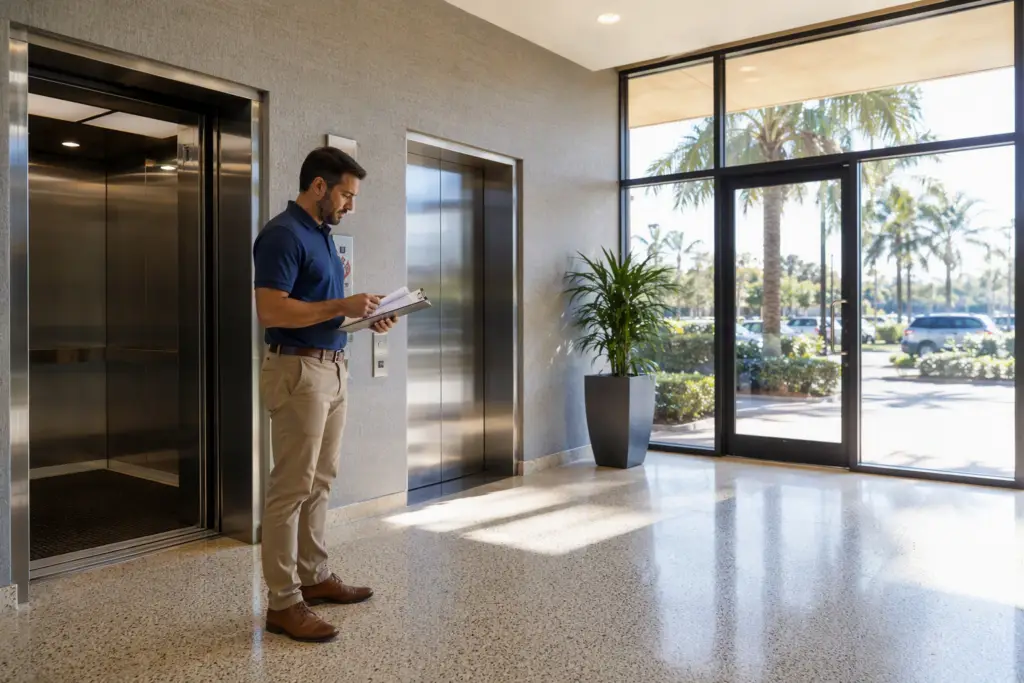
- Walk each elevator with the maintenance contractor prior to the inspection to identify visible deficiencies such as worn threshold plates, malfunctioning call buttons, missing Braille signage, or lighting failures.
- Confirm that machine rooms and pits are clean, dry, properly lit, and free of stored materials — common inspection findings that reflect general maintenance culture.
- Verify that emergency communication systems in each cab are functional and connect to a continuously monitored location as required by code.
- Confirm that all signage — including cab capacity placeholders, inspector certificates, and emergency instruction placards — is current and legible.
- Review any open work orders or deferred maintenance items and assess whether any represent potential inspection deficiencies that should be corrected before the inspection date.
- Ensure that the facility’s elevator contractor is aware of the inspection date and available to respond if deficiencies require immediate correction.
How Does Axxiom Elevator Florida Support Healthcare Facility Compliance?
Axxiom Elevator Florida provides elevator inspection, maintenance, modernization, and compliance support services to healthcare facilities throughout Florida. The team understands that healthcare elevators operate in a uniquely demanding regulatory environment — one where code compliance intersects directly with patient safety, CMS certification, and operational continuity.
Axxiom Elevator Florida approaches healthcare elevator compliance as a data-driven discipline. Rather than reactive repair cycles, the company supports facilities in building structured maintenance programs that align with ASME A17.1 inspection requirements, ADA standards, and Florida DBPR rules. When modernization is needed, Axxiom Elevator Florida helps facility teams understand which code provisions apply to their specific equipment vintage, what upgrade scope the AHJ is likely to require, and how to phase work to minimize disruption to clinical operations.
Healthcare facility managers seeking an objective assessment of their elevator fleet’s compliance status, maintenance documentation, and readiness for upcoming inspections are encouraged to engage Axxiom Elevator Florida for a structured evaluation.
Sourced Data Reference Table
| Standard / Authority | Scope in Healthcare Elevator Context | Source |
|---|---|---|
| ASME A17.1 Safety Code for Elevators and Escalators | Mechanical safety, inspection intervals, load testing, fire service operation, construction and installation requirements | ASME Codes & Standards |
| ADA Standards for Accessible Design | Cab dimensions, door timing, call button placement, Braille signage, reach range requirements | ADA.gov |
| OSHA General Duty Clause & LOTO Standards | Worker safety during elevator maintenance, contractor compliance obligations for healthcare facility operators | OSHA.gov |
Frequently Asked Questions: Healthcare Facility Elevator Code
What is the primary code governing healthcare elevator safety in the United States?
The ASME A17.1 Safety Code for Elevators and Escalators is the primary mechanical safety standard adopted by most U.S. states, including Florida. It governs the design, installation, inspection, testing, and maintenance of elevators in all facility types, including hospitals and healthcare buildings.
Are healthcare facilities required to meet ADA elevator standards?
Yes. Under the Americans with Disabilities Act, elevators in multi-story healthcare facilities must meet accessibility standards covering cab dimensions, door operation, signage, controls, and audible signals. These requirements apply to both new construction and, in many cases, alterations to existing facilities.
How often must hospital elevators be inspected in Florida?
Florida requires annual inspections performed by a licensed elevator inspector under the DBPR Bureau of Elevator Safety, consistent with the inspection requirements in the adopted edition of ASME A17.1. Additional periodic tests — including load tests and safety device tests — are required at intervals specified by the code.
What happens if a hospital elevator fails a code inspection?
Depending on the severity of the deficiency, the elevator may be ordered out of service immediately or given a corrective deadline. Failures can also trigger consequences for CMS certification if the deficiency is identified during a healthcare survey, making elevator compliance a patient safety and accreditation issue as well as a code matter.
Do existing hospital elevators need to be upgraded to the current code edition?
Existing elevators are generally governed by the code edition in effect at the time of their installation under grandfather provisions. However, major alterations, modernizations, or specific safety-related mandates can trigger requirements to meet current code provisions. Healthcare facilities should consult with the authority having jurisdiction and a licensed elevator contractor before any significant project.
What elevator features are specifically important for patient transport?
Elevators used for patient transport should accommodate hospital beds, stretchers, and bariatric patients — requiring larger cab dimensions and higher load ratings than typical commercial elevators. Door timing, reopening device reliability, and smooth leveling are critical to safe patient transfers.
How does OSHA apply to healthcare elevator maintenance?
Under OSHA regulations, elevator maintenance technicians must follow lockout/tagout (LOTO) energy control procedures. Healthcare facility operators bear responsibility for ensuring that contractors working on their premises comply with applicable OSHA standards, and the General Duty Clause creates additional employer obligations regarding workplace hazard prevention for staff who use elevators regularly.
What documentation should a healthcare facility maintain for elevator compliance?
Facilities should maintain complete records of all inspections, periodic tests, maintenance work orders, deficiency corrections, and contractor service reports. These records are subject to review during CMS surveys, Joint Commission inspections, and state elevator safety audits. Gaps in documentation are frequently cited as findings even when the physical equipment is otherwise compliant.
What are the most common elevator code violations found in healthcare facilities?
Common deficiencies in healthcare elevator inspections include non-functional or degraded door reopening devices, inoperative emergency lighting or communications systems, documentation gaps for required periodic tests, machine room and pit housekeeping deficiencies, and outdated or missing cab signage. Many of these issues are preventable through structured preventive maintenance programs.
How can a healthcare facility prepare for an elevator compliance audit by CMS or the Joint Commission?
Preparation involves assembling complete maintenance and inspection records, verifying that all required tests are current, conducting a pre-audit walkthrough with the elevator contractor, and ensuring that any known deficiencies have been corrected and documented. Healthcare facilities should treat elevator compliance as part of their ongoing Environment of Care program rather than a one-time preparation exercise.
Get a Professional Healthcare Elevator Compliance Assessment
Healthcare facility elevator compliance is too consequential to leave to reactive maintenance cycles. Whether preparing for an upcoming inspection, planning a modernization project, or evaluating the current condition of an aging elevator fleet, professional guidance from a knowledgeable elevator contractor helps healthcare administrators make informed, defensible decisions.
Contact Axxiom Elevator Florida for a free elevator assessment. Call to speak with the Axxiom Elevator Florida team about your facility’s elevator code compliance needs.