Signs an Elevator Motor or Hydraulic System Is About to Fail — And How to Prevent an Emergency Breakdown
Elevator failures rarely happen without warning. Both electric traction motors and hydraulic power units send a series of detectable signals before they fail completely. Building managers, property owners, and facility teams in Pompano Beach and Sarasota who learn to recognize these signals — and who partner with a qualified elevator service company — can prevent costly emergency shutdowns, protect passenger safety, and stay on the right side of Florida’s elevator compliance requirements.
The 20 questions and answers below cover the full spectrum of this topic: identifying failure warning signs, understanding the mechanical causes, knowing what codes apply, and taking the right preventive steps before a breakdown occurs.
1. What are the earliest warning signs that an elevator motor is about to fail?
The earliest motor failure signs are unusual humming or grinding sounds, sluggish acceleration, and recurring nuisance trips on the motor’s thermal overload protection.
An electric traction elevator motor that is approaching end-of-life often shows gradual performance degradation rather than a sudden stop. The motor windings may overheat, causing the thermal protection relay to trip intermittently. Building staff may notice the elevator taking longer than usual to respond to calls, or hearing a low, irregular hum that was not present during normal operation. Bearing wear produces a metallic grinding or rumbling sound that intensifies over weeks or months. Vibration through the cab floor or walls is another sensory indicator that should never be dismissed.
These symptoms should be reported to a licensed elevator contractor immediately. Axxiom Elevator Florida technicians serving Pompano Beach and Sarasota are trained to diagnose motor health using electrical testing, temperature measurement, and vibration analysis before a complete failure occurs.
2. What are the warning signs that a hydraulic elevator system is about to fail?
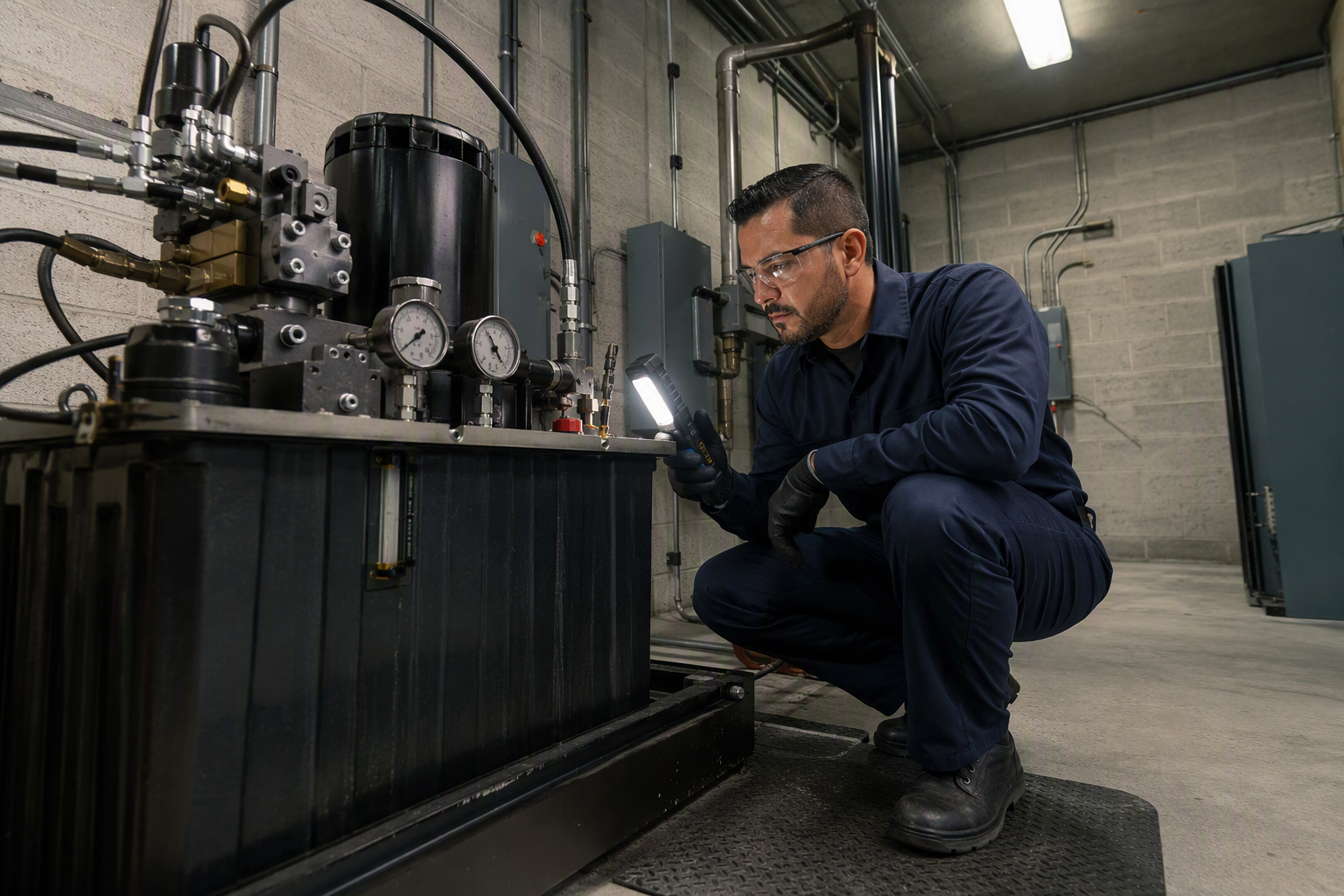
Key hydraulic failure warning signs include slow or uneven descent, a noticeable drop in the car after the doors close (known as “drift”), oil leaks around the power unit or cylinder, and an overworked pump that runs continuously or trips on thermal protection.
Hydraulic elevators rely on a pump, a reservoir, a control valve, and a buried or above-ground cylinder to lift the cab. When any of these components degrades, the system displays measurable symptoms. Oil contamination — caused by moisture intrusion, oxidation, or metal particle shedding — breaks down valve performance and causes erratic pressure control. A leaking piston seal allows the car to settle below floor level after stopping, creating an accessibility and trip hazard. The pump motor working harder than normal to compensate for pressure loss will overheat and eventually fail.
Underground cylinder leaks are particularly critical because hydraulic oil released into the soil is classified as a reportable release under Florida Department of Environmental Protection (FDEP) regulations, adding environmental liability to the operational risk.
3. How does abnormal elevator noise indicate a specific mechanical problem?
Different sounds correspond to different components: grinding suggests bearing or gear wear, banging indicates rope or chain slack, squealing points to worn brake linings, and a laboring hum from the machine room signals motor or pump stress.
Understanding the acoustic signature of elevator problems allows maintenance teams to triage issues before they escalate. A rhythmic clunking that occurs at regular intervals as the car travels is often correlated with a flat spot on a guide roller or a worn sheave groove. A high-pitched squeal during braking is a reliable indicator that brake shoe linings have worn past serviceable thickness. In hydraulic systems, a loud “pop” or pressure surge when the pump starts is commonly caused by air entrapped in the hydraulic fluid, often the result of a low reservoir or a failing pump coupling.
4. What does elevator “drift” mean and why is it a serious failure warning?
Elevator drift occurs when a hydraulic car settles below the landing level after stopping, caused by a leaking control valve or cylinder seal, and it is both a passenger safety hazard and a code compliance violation.
Under ASME A17.1 Safety Code for Elevators and Escalators, the elevator car must stop and remain level at each floor within an acceptable tolerance. When drift occurs, passengers step across an uneven threshold, creating a trip-and-fall risk. For ADA-compliant buildings governed by the Americans with Disabilities Act, a drifting car that creates a significant floor gap can constitute a barrier to access. Drift that exceeds the ASME-specified tolerance requires the unit to be taken out of service until the valve or cylinder is repaired or replaced.
5. How often should elevator motors and hydraulic systems be inspected in Florida?
Florida requires periodic inspections of elevators by a licensed elevator inspector, and the ASME A17.1 code mandates routine periodic tests, but preventive maintenance visits from a qualified contractor should occur more frequently than code-minimum inspection intervals.
In Florida, elevator inspections are administered under Chapter 399 of the Florida Statutes, which places oversight with the Florida Department of Business and Professional Regulation (DBPR). Conveyance licenses and inspection certificates must be current and posted in the elevator cab. Code-mandated inspections establish a legal floor, not an operational ceiling — meaning building owners who rely solely on annual code inspections and skip monthly or quarterly preventive maintenance are accepting a significantly elevated risk of unplanned failure. A structured preventive maintenance agreement with a qualified company like Axxiom Elevator Florida addresses what code inspections are not designed to do: ongoing component monitoring between inspection cycles.
6. What is the difference between preventive maintenance and a code inspection for elevators?
A code inspection verifies that an elevator meets minimum safety standards at a point in time, while preventive maintenance is an ongoing service program designed to monitor component condition, lubricate moving parts, adjust controls, and catch developing problems before they cause a failure or a failed inspection.
These two activities are complementary, not interchangeable. A state-licensed inspector examines the elevator against the requirements of the applicable ASME code edition and Florida statutes. A preventive maintenance technician, by contrast, performs hands-on tasks: checking hydraulic fluid levels and quality, testing motor insulation resistance, adjusting brake clearance, lubricating guide rails and sheaves, inspecting rope or chain condition, and testing safety devices. Buildings that maintain consistent preventive maintenance records also tend to pass code inspections more reliably, because known deficiencies are corrected before the inspection date.
7. What causes hydraulic elevator oil to degrade and how does it accelerate failure?
Hydraulic oil degrades through oxidation, moisture contamination, and metal particle accumulation — and degraded fluid accelerates valve wear, causes pressure instability, and can lead to complete pump failure if left uncorrected.
Fresh hydraulic fluid is engineered to specific viscosity, anti-wear, and anti-oxidant standards. Over time, heat cycles cause oxidation, which thickens the fluid and reduces its lubricity. Water intrusion — common in Florida’s humid coastal climate in cities like Pompano Beach and Sarasota — promotes microbial growth and emulsification that clogs control valve orifices. Metal particles shed from worn pump gears or valve bodies act as abrasive contaminants that accelerate further wear. A proper preventive maintenance program includes periodic fluid sampling and analysis, with fluid replacement scheduled based on condition rather than arbitrary calendar intervals.
8. What electrical warning signs indicate a traction elevator motor is failing?
Electrical warning signs include repeated circuit breaker trips, motor running hot to the touch, burned insulation odor from the machine room, voltage fluctuations during starting, and erratic speed controller behavior.
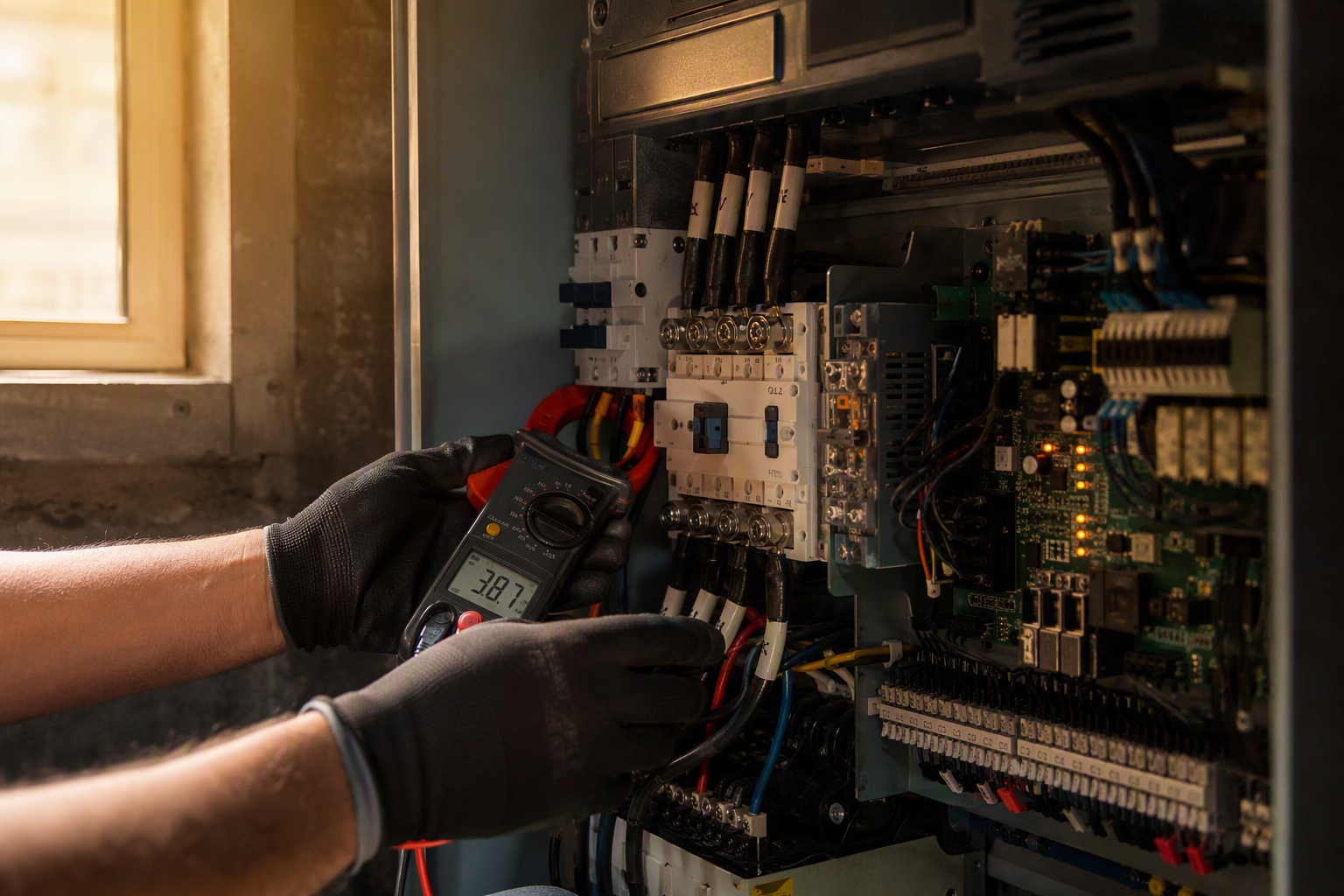
Modern traction elevators use variable-frequency drives (VFDs) or solid-state motor controllers to regulate motor speed. When motor winding insulation begins to break down, the insulation resistance drops and the controller may log fault codes or shut down the drive as a protective measure. Maintenance technicians use a megohmmeter (megger test) to measure winding insulation resistance; values below acceptable thresholds indicate that rewinding or motor replacement is necessary before catastrophic failure occurs. Fault codes stored in a VFD’s memory are a valuable diagnostic resource that experienced elevator technicians use to trace the history of developing problems.
9. How do worn elevator guide shoes or rollers contribute to system failure?
Worn guide shoes or rollers allow excessive lateral car movement, which stresses the hoistway components, accelerates rope wear, and can cause the elevator to trigger safety devices unnecessarily.
Guide shoes or roller guides keep the elevator car centered on the guide rails as it travels. When the wear inserts or roller wheels degrade, the car rocks from side to side. This oscillation transmits shock loads to the hitch plate, the ropes, and the sheave — accelerating wear on components that are costly to replace. Rail lubrication is closely linked to guide shoe wear: dry rails dramatically shorten guide insert life. In hydraulic elevators, lateral movement stresses the piston and cylinder alignment, potentially causing seal damage and the oil leaks described earlier.
10. What role does the elevator brake play in preventing or causing a failure?
The elevator brake is a safety-critical component that stops and holds the car when power is removed; a worn or misadjusted brake can cause the car to slip, fail to hold position, or — if the brake seizes — prevent the motor from releasing the car at all.
On traction elevators, the machine brake is a spring-set, electrically released device. Proper brake adjustment is specified in ASME A17.1 Safety Code for Elevators and Escalators and must be verified during periodic tests. Brake lining wear is measurable and predictable, but only if a technician physically inspects it during scheduled maintenance. A brake that releases slowly causes the motor to work harder on starting — which harms the motor. A brake that does not hold the car fully can allow drift, as described above. Emergency brake testing is one of the core activities performed during a comprehensive maintenance visit.
11. What is a hydraulic elevator underground cylinder leak and how serious is it?
An underground cylinder leak occurs when the buried piston cylinder develops a perforation or seal failure, releasing hydraulic oil into the surrounding soil — it is simultaneously an operational failure, a regulatory violation, and an environmental liability requiring immediate remediation.
Single-bottom hydraulic cylinders installed in older buildings are particularly susceptible to external corrosion from groundwater and soil chemistry. The ASME A17.1 code and subsequent editions have introduced requirements for single-bottom cylinder testing and the installation of PVC liner systems to provide secondary containment. Florida’s DEP requires reporting of petroleum product releases to soil or groundwater above threshold quantities. Building owners in Sarasota and Pompano Beach with older hydraulic elevators should ask their elevator service contractor about the age and type of their cylinder, and whether a liner or cylinder replacement program is appropriate. Axxiom Elevator Florida can assess cylinder condition and advise on the appropriate compliance path.
12. What immediate steps should a building manager take when they suspect elevator failure is imminent?
When failure warning signs appear, the building manager should immediately document the symptoms, restrict or suspend elevator use if passenger safety is at risk, and contact a licensed elevator service contractor for emergency evaluation.
- Record the specific symptoms observed: the type of noise, the floor or direction where it occurs, the time and frequency, and any error messages displayed on the cab or landing panels.
- Check the machine room for visible oil leaks, unusual heat, burning smell, or circuit breakers in the tripped position.
- If any safety device has tripped, or if the car is not leveling properly with landings, take the elevator out of service immediately by switching the elevator to independent service or shutting down power at the disconnect.
- Post a clear out-of-service notice at all landing call stations.
- If passengers are trapped, follow established entrapment procedures and contact emergency services — do not attempt to open doors manually without qualified personnel.
- Contact a licensed elevator service company to dispatch a technician for evaluation and repair authorization before returning the unit to service.
- Document all actions taken and retain records for the building’s compliance file.
13. How does Florida’s climate affect elevator motor and hydraulic system reliability?
Florida’s high humidity, salt air in coastal markets like Pompano Beach, and heat accelerate corrosion of metal components, degrade hydraulic seals, promote moisture contamination of electrical systems, and shorten lubricant service life — making more frequent preventive maintenance a practical necessity rather than an option.
Coastal salt air is particularly aggressive toward exposed metal surfaces in elevator pits and machine rooms. Relay contacts, terminal blocks, and control board connectors are susceptible to oxidation-related resistance increases that cause intermittent faults. Rubber seals and hydraulic hoses degrade faster in heat, increasing the frequency of leak events. Building owners in Sarasota and Pompano Beach should discuss Florida-specific maintenance protocols with their elevator contractor, including corrosion-resistant lubrication products and more frequent fluid and seal inspections compared to temperate climates.
14. What ASME and ADA compliance requirements are relevant to elevator mechanical condition?
The ASME A17.1 Safety Code for Elevators and Escalators governs design, installation, and maintenance standards, while the Americans with Disabilities Act requires that elevators providing accessible routes remain operational — meaning a mechanically failing elevator in an ADA-required accessible path creates both a safety and a civil rights compliance issue.
ASME A17.1 is adopted in Florida as the primary technical standard for new elevator installations. ASME A17.3, the Safety Code for Existing Elevators and Escalators, applies to units already in service. Together, these standards define the acceptable condition of brakes, safeties, buffers, governors, hydraulic systems, and electrical controls. Under the ADA, when an elevator is the only accessible means of vertical access between floors in a covered building, an extended out-of-service period without an alternative accessible route can constitute a violation. Building owners should address mechanical deficiencies promptly to avoid intersecting safety and civil rights exposure.
15. What is a preventive maintenance schedule benchmark for elevator motors and hydraulic systems?
A properly structured preventive maintenance schedule addresses different components at different intervals — monthly, quarterly, semi-annual, and annual — based on the component’s wear rate and criticality to safe operation.
| Maintenance Task | System Type | Recommended Interval | Why It Matters |
|---|---|---|---|
| Hydraulic fluid level & visual condition check | Hydraulic | Monthly | Low fluid or dark/cloudy fluid indicates leak or contamination |
| Pit inspection for leaks and water intrusion | All types | Monthly | Pit conditions affect safety device operation and cylinder integrity |
| Guide rail lubrication | All types | Monthly to Quarterly | Dry rails accelerate guide shoe and rope wear |
| Motor temperature and insulation resistance test | Traction | Semi-Annual to Annual | Detects winding degradation before catastrophic motor failure |
| Brake lining inspection and adjustment | Traction | Quarterly | Required for ASME A17.1 compliance and passenger safety |
| Hydraulic fluid analysis (laboratory sample) | Hydraulic | Annual or condition-based | Identifies oxidation, water content, and metal particle levels |
| Rope or chain inspection for wear and elongation | Traction | Semi-Annual | Rope failure is catastrophic; ASME A17.1 specifies retirement criteria |
| Control valve adjustment and leak test | Hydraulic | Quarterly | Prevents drift and pressure instability |
| Safety device functional test | All types | Per ASME A17.1 periodic test schedule | Required by code; confirms governor, safeties, and buffers operate correctly |
| VFD fault log review and parameter verification | Traction (VFD-controlled) | Quarterly | Fault history reveals developing motor or drive issues before failure |
16. How long can a building owner expect an elevator motor or hydraulic pump to last with proper maintenance?
With consistent preventive maintenance, traction elevator motors and hydraulic pump units can operate reliably for many years beyond what poorly maintained units achieve, though actual service life depends on usage intensity, environment, and component quality — not on a fixed calendar date.
The key point is that maintenance quality is the primary variable within a building owner’s control. High-rise buildings in urban markets with frequent elevator usage will accumulate operating hours faster than low-rise residential buildings. Florida’s climate adds environmental stress that is absent in drier or cooler climates. A unit that receives consistent lubrication, fluid changes, and electrical testing will reach the end of its mechanical life on a gradual, manageable trajectory — not through sudden catastrophic failure. When components approach end-of-life, a proactive elevator contractor will recommend planned replacement during scheduled downtime rather than waiting for emergency conditions.
17. What are the hidden costs of an emergency elevator breakdown compared to preventive maintenance?
Emergency breakdowns carry costs far beyond the repair bill itself, including emergency service premiums, business disruption, ADA compliance exposure, potential tenant or passenger claims, and the higher cost of unplanned component replacement versus planned procurement.
When an elevator fails without warning, building owners face emergency dispatch costs, potential passenger entrapment liability, and loss of building function during repair. In a multi-story commercial building in Pompano Beach or Sarasota where the elevator is the only accessible route, an extended outage may trigger ADA-related complaints or legal exposure. Replacement parts procured on an emergency basis often carry premium pricing compared to planned component orders. A preventive maintenance agreement, by contrast, is a predictable operational expense that eliminates most of these downstream costs while also extending the service life of major components.
18. How can building managers use elevator controller fault codes to predict failures?
Modern elevator controllers log fault and event codes that record abnormal conditions such as motor overtemperature, door re-openings, safety device activations, and communication errors — and reviewing these logs regularly allows maintenance technicians to detect patterns that indicate developing problems.
A fault code that appears once may indicate a transient condition. The same fault appearing repeatedly at the same time of day, or escalating in frequency, is a strong predictor of imminent component failure. For example, repeated low-pressure faults on a hydraulic controller suggest pump wear or valve degradation. Repeated door fault codes may indicate that a struggling door motor is affecting overall system reliability. Building managers who have access to their elevator controller interface should share fault log data with their elevator service contractor at each maintenance visit. Axxiom Elevator Florida includes fault code review as part of its preventive maintenance program for clients in Sarasota and Pompano Beach.
19. When should an elevator motor or hydraulic power unit be replaced rather than repaired?
Replacement is typically the appropriate decision when repair costs approach or exceed a significant fraction of replacement cost, when the root failure mode is inherent to the component’s age or design, or when the component is no longer supported by parts availability — and a qualified elevator contractor can help owners make this calculation objectively.
Elevator motors with degraded windings can sometimes be rewound, but a rewind on a motor with additional bearing or housing wear may simply defer the next failure by a short period. Hydraulic power units that have experienced pump gear failure, contaminated reservoirs, and failed solenoid valves across multiple service calls may be better candidates for complete power unit replacement than continued individual component repair. The decision should be made with full knowledge of the unit’s age, maintenance history, parts availability, and the cost differential between repair and replacement — all factors that a knowledgeable contractor like Axxiom Elevator Florida can quantify for building owners.
20. How do I choose a qualified elevator maintenance company in Pompano Beach or Sarasota, Florida?
A qualified elevator maintenance company in Florida must hold a valid elevator contractor license issued under Florida Statutes Chapter 399, employ certified elevator mechanics, demonstrate familiarity with ASME A17.1 and A17.3 requirements, and have a documented approach to preventive maintenance rather than reactive-only service.
When evaluating elevator service providers, building owners should ask for proof of Florida DBPR licensure, ask how preventive maintenance visits are documented and reported, and determine whether the company has experience with the specific type of elevator in their building — whether hydraulic, traction, or machine-room-less (MRL). References from comparable properties in the same geographic market are valuable. Response capability for service calls is important, but the goal of a well-chosen maintenance partner is to minimize the situations requiring emergency response in the first place. Axxiom Elevator Florida serves property owners across Pompano Beach and Sarasota with a comprehensive approach that prioritizes proactive maintenance, regulatory compliance, and transparent communication with building management teams.
Additional Resources
- ASME A17.1 Safety Code for Elevators and Escalators — the primary technical standard governing elevator design, installation, and maintenance in Florida
- ASME A17.3 Safety Code for Existing Elevators and Escalators — applies to in-service units and governs retrofit and maintenance requirements
- Americans with Disabilities Act (ADA) — governs accessible route requirements that elevators are often required to fulfill
- OSHA — provides standards relevant to elevator pit and machine room worker safety during maintenance operations
Need elevator service you can rely on? Axxiom Elevator Florida is ready to help.