Elevator Compliance Requirements for Florida Hospitals: Joint Commission and State Inspection Guide
For hospital administrators and facilities managers in markets such as Pompano Beach and Sarasota, elevator compliance is not a single checkbox — it is a layered obligation that touches state law, a nationally adopted safety code, federal accessibility rules, and accreditation standards. A lapse in any one layer can trigger a deficiency citation during a Joint Commission survey, a failed state inspection, or both. The sections below break down every layer clearly.
What Florida State Law Requires for Hospital Elevators?
Florida’s elevator program is administered by the Florida Department of Business and Professional Regulation (DBPR), Bureau of Elevator Safety, under Chapter 399, Florida Statutes — commonly called the Elevator Safety Act — and its companion rule, Chapter 61C-5, Florida Administrative Code.
Key state obligations for hospital elevator owners include:
- Annual certified inspection. Every elevator covered by Chapter 399 must be inspected at least once per year by a Florida-certified elevator inspector.
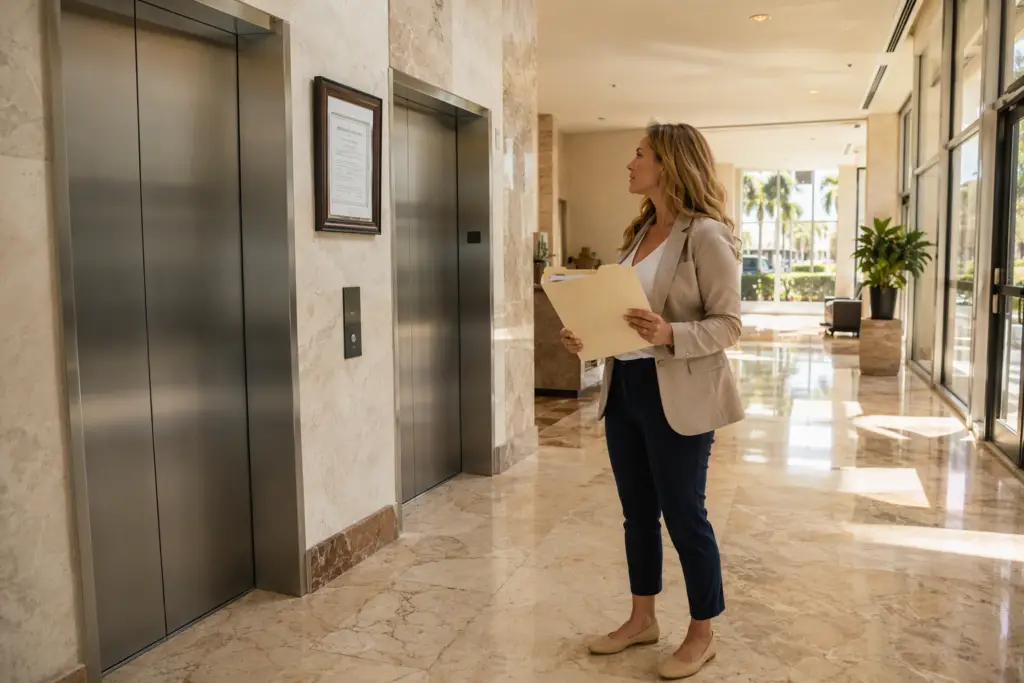
- Certificate of operation. A Florida certificate of operation is valid for no more than two years. Operating on an expired certificate violates state law. The certificate must be posted in a conspicuous location inside the elevator in a frame with a transparent cover.
- Owner responsibility. Once a certificate of operation is issued, the elevator owner — in a hospital’s case, the facility or health system — is responsible for safe operation, proper maintenance, inspection, and correction of all code deficiencies.
- Accident reporting. The certificate of operation holder must report any elevator accident to the state within five working days.
- Registered companies only. All maintenance, repair, and installation work must be performed by a Florida-registered elevator company whose technicians hold a Florida elevator certificate of competency.
- Adopted safety code. Florida adopted ASME A17.1/CSA B44, 2019 edition, effective December 31, 2023, as the technical standard for elevator construction, installation, operation, and maintenance statewide.
Hospitals located in Pompano Beach fall under the jurisdiction of the Broward County Building Code Division, which enforces Chapter 399 through its own certified elevator inspectors. Hospitals in Sarasota are subject to DBPR’s statewide oversight. Facilities should confirm which local authority having jurisdiction (AHJ) applies to their specific address before scheduling inspections.
How Does ASME A17.1-2019 Apply to Hospital Elevators in Florida?
The ASME A17.1 Safety Code for Elevators and Escalators is the technical backbone of Florida elevator law. Because Florida adopted the 2019 edition effective December 31, 2023, all hospital elevators — whether newly installed or existing — must conform to its requirements as enforced through Chapter 61C-5.
For healthcare facilities, the code’s most operationally significant provisions include:
- Periodic inspection and testing intervals. ASME A17.1 specifies required frequencies for routine inspections and for category tests (hydraulic pressure relief, governor and safety devices, brake tests, and others). Maintenance programs must align with these intervals.
- Firefighters’ emergency operation (FEO). Hospital elevators must be equipped and maintained with firefighters’ emergency operation features as specified by the code, a requirement that also intersects with life-safety survey criteria.
- Door reopening devices. Code specifies requirements for door re-opening devices to prevent passenger entrapment — a critical patient-safety concern in clinical environments.
- Machine room and hoistway conditions. Lighting, temperature control, housekeeping, and access restrictions are all code-defined and frequently reviewed during inspections.
- Maintenance control programs. ASME A17.1-2019 requires a written maintenance control program (MCP) that documents inspection intervals, tests performed, and findings. Axxiom Elevator Florida supports hospital clients in developing and maintaining compliant MCPs.
What ADA Requirements Apply to Hospital Elevators?
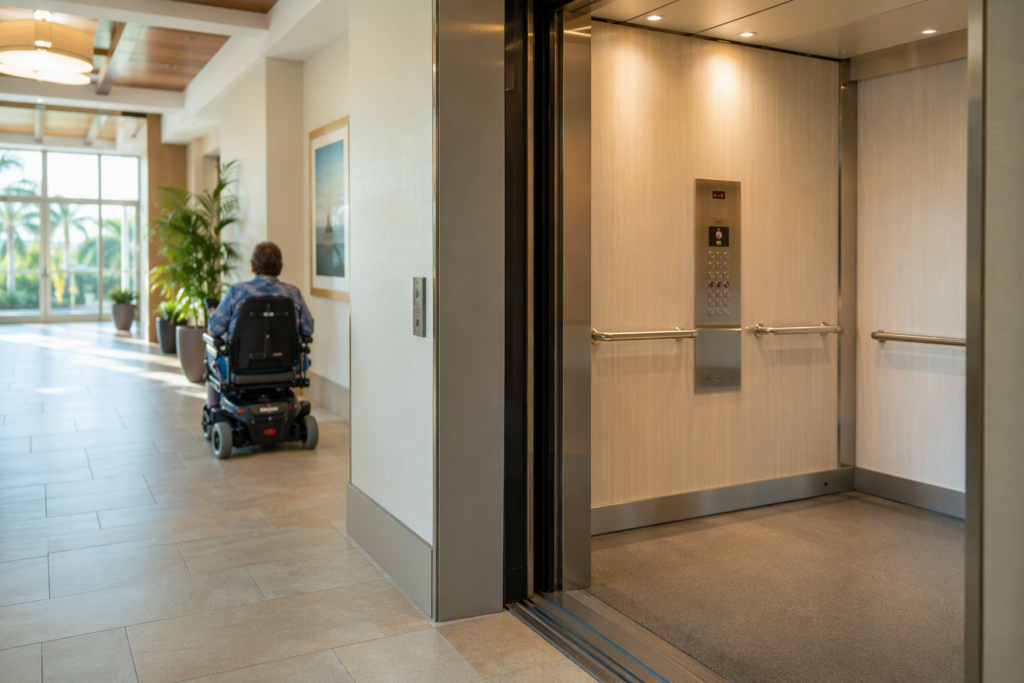
Under the Americans with Disabilities Act, hospitals are public accommodations and must ensure that elevators are accessible to persons with disabilities. ADA Standards for Accessible Design govern elevator cab dimensions, door clear widths, call button height and marking, audible and visible signals, Braille and raised character floor designations, and leveling tolerances.
In a healthcare setting, ADA compliance is also directly relevant to Joint Commission Environment of Care standards because patients, visitors, and staff with mobility impairments depend on elevators as the primary means of vertical access. A maintenance program that allows an elevator to fall out of ADA compliance — such as a leveling issue that creates a tripping hazard between the cab floor and landing — can simultaneously generate a Joint Commission finding and a federal complaint.
What Does The Joint Commission Look for During Elevator-Related Surveys?
The Joint Commission does not operate a separate elevator inspection program, but its Environment of Care (EC) and Life Safety (LS) chapters create compliance obligations that directly intersect with elevator maintenance. Surveyors typically assess:
- Documentation of inspections and testing. Hospitals are expected to produce current inspection records, test results, and certificates of operation on demand. Gaps in documentation are a common citation source.
- Maintenance logs and work orders. A continuous, legible maintenance history demonstrates that the facility is actively managing its equipment rather than responding only to failures.
- Firefighters’ emergency operation functionality. Surveyors may verify that fire recall and firefighters’ service features operate as designed, because these are life-safety systems under NFPA 101, which The Joint Commission incorporates by reference.
- Out-of-service and impairment management. When an elevator is taken out of service, the hospital must have a documented process for communicating the impairment and providing equivalent access — particularly for patients who cannot use stairs.
- Vendor qualification. Surveyors may ask how the facility selects and oversees its elevator maintenance contractor. Working with a Florida-registered company such as Axxiom Elevator Florida, whose technicians hold current state certificates of competency, provides a documentable answer to that question.
What Is a Maintenance Control Program and Does a Hospital Need One?
A Maintenance Control Program (MCP) is a written document, required under ASME A17.1-2019, that specifies the maintenance tasks, inspection intervals, and testing procedures applicable to each conveyance in a building. For hospitals, the MCP also serves as audit-ready documentation during Joint Commission surveys and state inspections.
An MCP should identify each piece of equipment by unit number, list all required periodic tasks, record who performed them and when, and capture any findings or corrective actions. Facilities that lack a current MCP are at elevated risk for both state deficiency citations and Joint Commission findings. Axxiom Elevator Florida assists healthcare clients in Pompano Beach, Sarasota, and across its Florida service area in establishing and maintaining compliant MCPs tailored to each facility’s elevator inventory.
What Happens If a Hospital Elevator Fails a State Inspection?
When a Florida certified elevator inspector identifies deficiencies, the elevator owner receives written notice of the conditions that must be corrected. The severity of deficiencies determines whether the elevator remains in service pending correction or is ordered out of service immediately. Operating an elevator with an expired certificate of operation or after an out-of-service order violates Chapter 399 and can expose the facility to enforcement action.
For a hospital, an out-of-service elevator during active patient operations is a patient-safety event. Facilities should treat every deficiency notice as time-sensitive, even when the elevator is not immediately ordered out of service, and maintain a service relationship with a registered elevator company capable of responding promptly.
Any elevator accident must be reported by the certificate of operation holder to the state within five working days.
How Often Should a Florida Hospital Schedule Preventive Elevator Maintenance?
The frequency of preventive maintenance tasks is defined by the ASME A17.1-2019 Maintenance Control Program requirements and by the specific equipment type, age, and usage profile of each elevator. In a hospital environment — where elevators operate continuously, transport patients on gurneys and in wheelchairs, and are subject to high call volumes — maintenance intervals appropriate for a low-traffic commercial building are generally insufficient.
Florida law requires at minimum an annual certified inspection, but preventive maintenance visits by a registered elevator company should occur on a schedule that reflects the equipment’s actual duty cycle. The maintenance control program documents that schedule and provides the inspection record that both state inspectors and Joint Commission surveyors expect to see. Axxiom Elevator Florida can evaluate a hospital’s specific elevator inventory and recommend a maintenance schedule consistent with ASME A17.1-2019 and the facility’s operational demands.
What Are the Local Inspection Requirements for Hospitals in Pompano Beach and Sarasota?
In Pompano Beach, hospital elevators fall under the enforcement jurisdiction of the Broward County Building Code Division, which conducts elevator inspections under the authority of Chapter 399, Florida Statutes, using its own certified elevator inspectors. Facilities should coordinate directly with the Broward County Building Code Division regarding inspection scheduling and certificate renewal timelines.
In Sarasota, elevators are subject to oversight by the Florida DBPR, Bureau of Elevator Safety, at the state level. Facilities should maintain contact with the Bureau to verify current inspection and certificate status for each elevator unit.
In both markets, the certificate of operation must be posted inside each elevator cab and must remain current — a Florida certificate of operation is valid for no more than two years and can be renewed only following a satisfactory inspection.
What Steps Should a Hospital Take After an Elevator Incident or Entrapment?
- Ensure passenger safety first. Activate the facility’s elevator entrapment or emergency response protocol. Do not attempt to free passengers by forcing doors open without trained personnel.
- Contact your registered elevator company. Notify the elevator maintenance contractor immediately so a certified technician can respond and assess the equipment.
- Take the elevator out of service. The affected unit should not be returned to service until a qualified technician has inspected it and confirmed it is safe to operate.
- Document the incident. Record the date, time, unit number, nature of the incident, individuals involved, and all actions taken.
- Report to the state within five working days. The certificate of operation holder must report the accident to the Florida DBPR, Bureau of Elevator Safety, within five working days as required by Chapter 399.
- Initiate corrective repairs. Work with your registered elevator company to identify the cause and complete all necessary repairs before returning the unit to service.
- Update the maintenance log and MCP. Document the incident, findings, and corrective actions in the maintenance control program records.
- Notify risk management and, if applicable, The Joint Commission. Evaluate whether the incident meets the facility’s threshold for an internal incident report or sentinel event review under Joint Commission standards.
Questions Your Inspector Will Ask
Whether the inspection is conducted by a Florida certified elevator inspector or a Joint Commission surveyor reviewing Environment of Care documentation, facilities should be prepared to answer the following:
- Is the certificate of operation current and posted inside the elevator cab? A certificate that has expired or is not visibly posted is an immediate citation under Chapter 399.
- Can you produce the maintenance log for this unit? Inspectors expect a complete, legible, and continuous record of all maintenance visits, tests performed, and findings — not just recent entries.
- Do you have a written Maintenance Control Program? The ASME A17.1-2019 MCP requirement is enforceable under Florida’s adopted code. The absence of a written program is a deficiency.
- Who performs maintenance on these elevators and are they registered with the state? The inspector may ask for the name of the registered elevator company and may verify that all technicians hold current Florida certificates of competency.
- When was the last category test performed, and what were the results? ASME A17.1 specifies category test intervals; inspectors will verify that required tests have been completed on schedule.
- Does firefighters’ emergency operation function correctly on all units? This is a life-safety feature; inspectors commonly test it in the field.
- Have there been any accidents or incidents since the last inspection? If so, the inspector will ask for documentation of the event, the five-day state report, and corrective action taken.
- How do you manage elevator impairments when a unit is out of service? Joint Commission surveyors specifically assess whether the hospital has a process to ensure patients and staff can access all care areas when an elevator is unavailable.
- Are all cab interiors, door systems, and leveling within code tolerances? Physical inspection of cab condition, door operation, and floor-to-landing leveling is standard at every inspection.
Why Does Elevator Compliance Matter for Hospital Accreditation?
The Joint Commission’s Environment of Care and Life Safety chapters require hospitals to maintain the physical environment in a way that supports safe, effective patient care. Elevators are classified as utility systems and as life-safety-related equipment in many healthcare facilities, meaning their maintenance status is directly evaluated during surveys. A pattern of deferred maintenance, missing inspection records, or lapsed certificates of operation can contribute to a Requirement for Improvement (RFI) or, in serious cases, affect accreditation status.
Beyond accreditation, Florida hospital licensing through the Agency for Health Care Administration (AHCA) incorporates physical environment standards that overlap with elevator safety. A state elevator inspection deficiency that is not corrected can become a factor in a broader facility compliance review. Axxiom Elevator Florida works with healthcare facilities to maintain the documentation continuity that both state inspectors and accreditation surveyors expect.
How Should a Hospital Evaluate an Elevator Service Company?
When selecting or renewing a contract with an elevator maintenance company, hospital facilities managers should verify:
- The company is registered with the Florida DBPR, Bureau of Elevator Safety, and maintains current general liability insurance as required by state law.
- Technicians assigned to the facility hold current Florida elevator certificates of competency, renewed annually with proof of continuing education.
- The company can produce or assist in developing a written Maintenance Control Program for the facility’s specific elevator inventory.
- The company has documented experience with hospital-grade elevator systems, including high-duty-cycle traction and hydraulic units, oversized cab configurations, and integrated fire alarm and firefighters’ service systems.
- The company maintains complete, legible service records that are accessible to the facility for inspection and accreditation purposes.
Axxiom Elevator Florida is a Florida-registered elevator service company serving healthcare facilities in Pompano Beach, Sarasota, and throughout Florida. The team supports hospitals with compliant maintenance programs, inspection preparation, and documentation practices aligned with ASME A17.1-2019 and Chapter 399 requirements.
Summary: Compliance Checklist for Florida Hospital Elevators
- ☐ Current Florida certificate of operation posted in each elevator cab
- ☐ Annual inspection completed by a Florida-certified elevator inspector
- ☐ Written Maintenance Control Program in place for each unit
- ☐ Maintenance performed exclusively by a Florida-registered elevator company
- ☐ ASME A17.1-2019 category tests completed on schedule and documented
- ☐ Firefighters’ emergency operation tested and functional
- ☐ ADA leveling, door operation, and signage requirements met
- ☐ Elevator accident reporting process established (five-day state reporting requirement)
- ☐ Elevator impairment management policy documented for Joint Commission review
- ☐ All service records retained and accessible for inspection
Need elevator service you can rely on? Axxiom Elevator Florida is ready to help.