Elevator ADA Compliance and Safety Requirements for Florida Hospitals and Healthcare Facilities: A Complete Upgrade Guide
Florida hospitals and healthcare facilities face a layered compliance landscape. Federal accessibility law, national elevator safety codes, and state-level inspections all converge on a single question: does this elevator safely and independently serve every patient, visitor, and staff member who depends on it? This guide breaks down every major upgrade category, compares the compliance options available, and helps facilities make informed decisions about where to invest and in what order.
What Does ADA Compliance Actually Require for Hospital Elevators?
The ADA establishes minimum accessibility standards that apply to elevators in places of public accommodation and commercial facilities — a category that includes virtually every hospital, outpatient clinic, rehabilitation center, and long-term care facility in Florida. The ADA Standards for Accessible Design, incorporated into the 2010 ADA Standards, set specific dimensional and operational requirements for elevators serving multiple floors in facilities of this type.
Key ADA requirements for hospital elevators include:
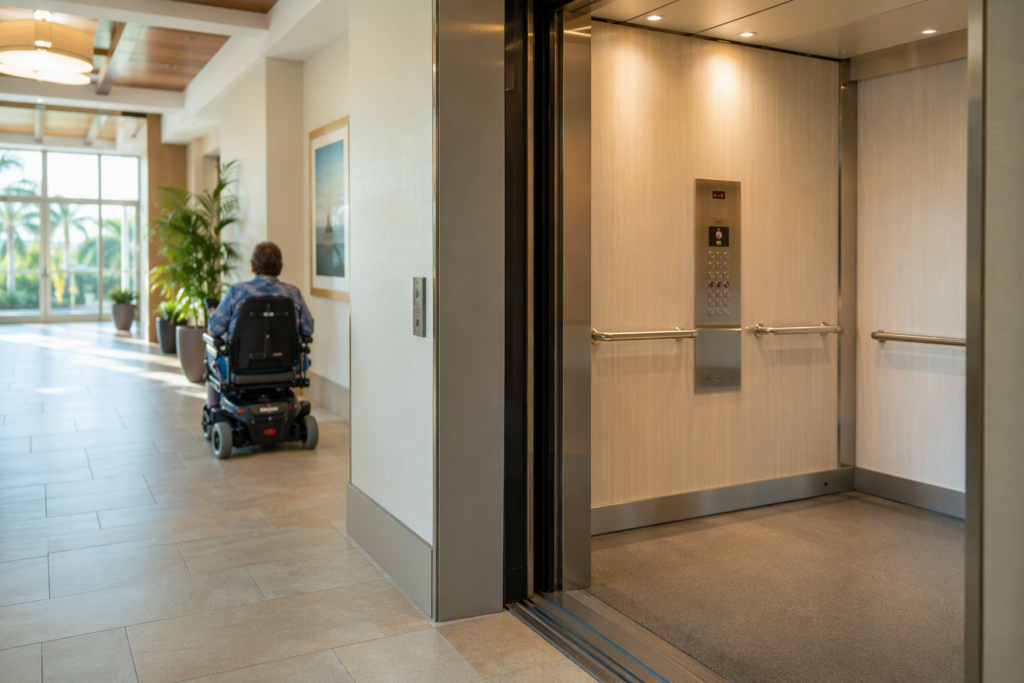
- Cab interior dimensions: Sufficient clear floor space to accommodate a wheelchair or mobility device, with the ADA specifying minimum clear floor dimensions for passenger elevator cabs depending on door configuration.
- Door timing: Doors must remain open long enough for individuals moving at a slower pace — including patients with mobility impairments — to board safely before closing.
- Control panel placement: Call buttons and floor buttons must be mounted within reachable range for wheelchair users, with the highest operable part within the reach range specified in the ADA Standards.
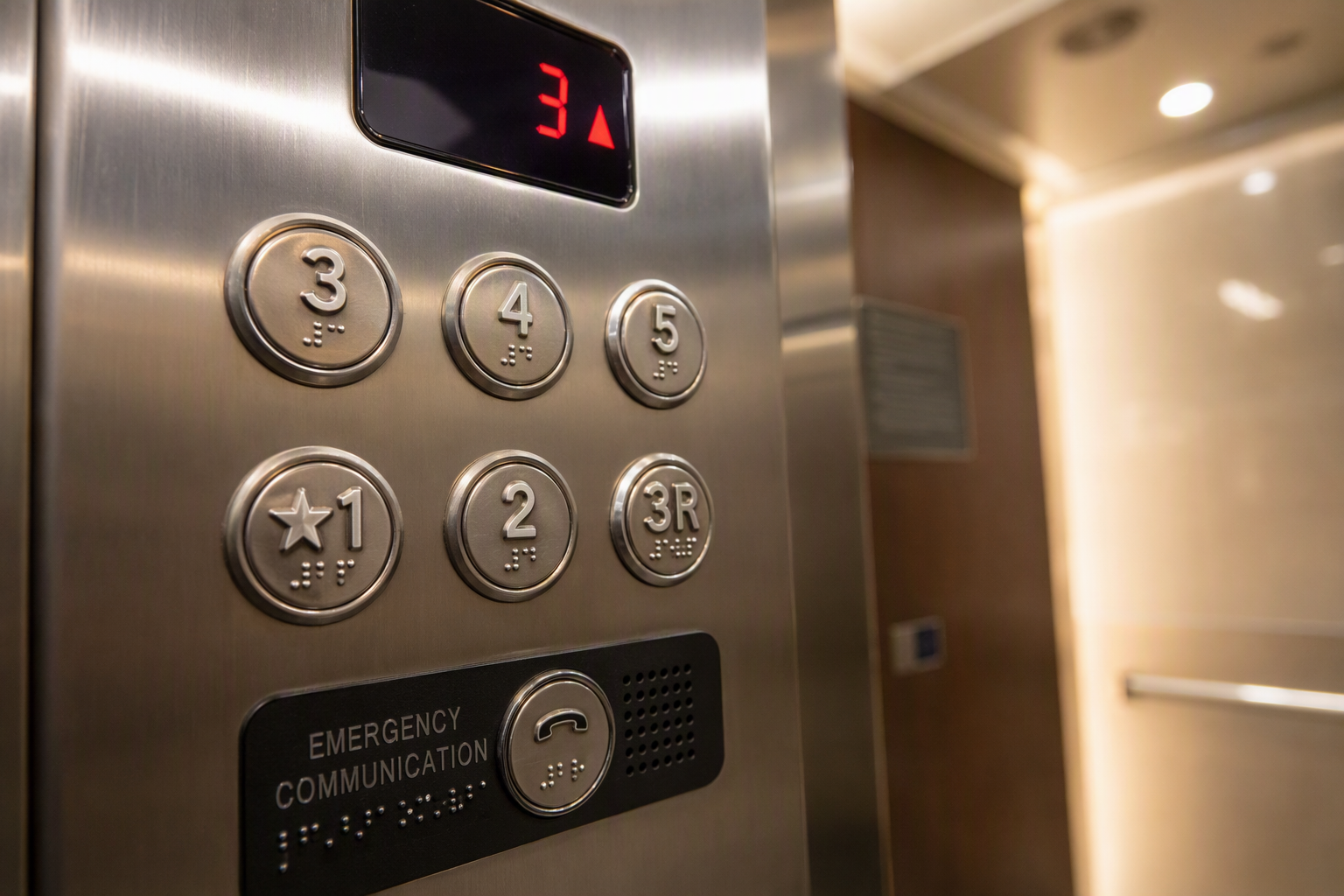
- Braille and raised characters: All floor designations and control labels must include tactile characters and Braille.
- Audible and visual signals: Both floor arrival signals (audible tone or verbal announcement) and visible signals at each floor landing are required.
- Two-way emergency communication: Every ADA-compliant elevator must include a means of two-way communication between the cab and a point of monitoring, operable without voice in emergencies.
- Leveling accuracy: Cabs must level to within a tolerance that allows smooth, barrier-free transition between the cab floor and the landing — critical for patients in wheelchairs, gurneys, and hospital beds.
For existing facilities, the ADA’s obligation to remove barriers applies when doing so is “readily achievable” — a standard that courts and the Department of Justice have interpreted as feasible without undue difficulty or expense relative to the facility’s resources. For alterations and new construction, the standards are stricter and more comprehensive.
How Do ASME A17.1 and A17.3 Apply to Florida Healthcare Elevators?
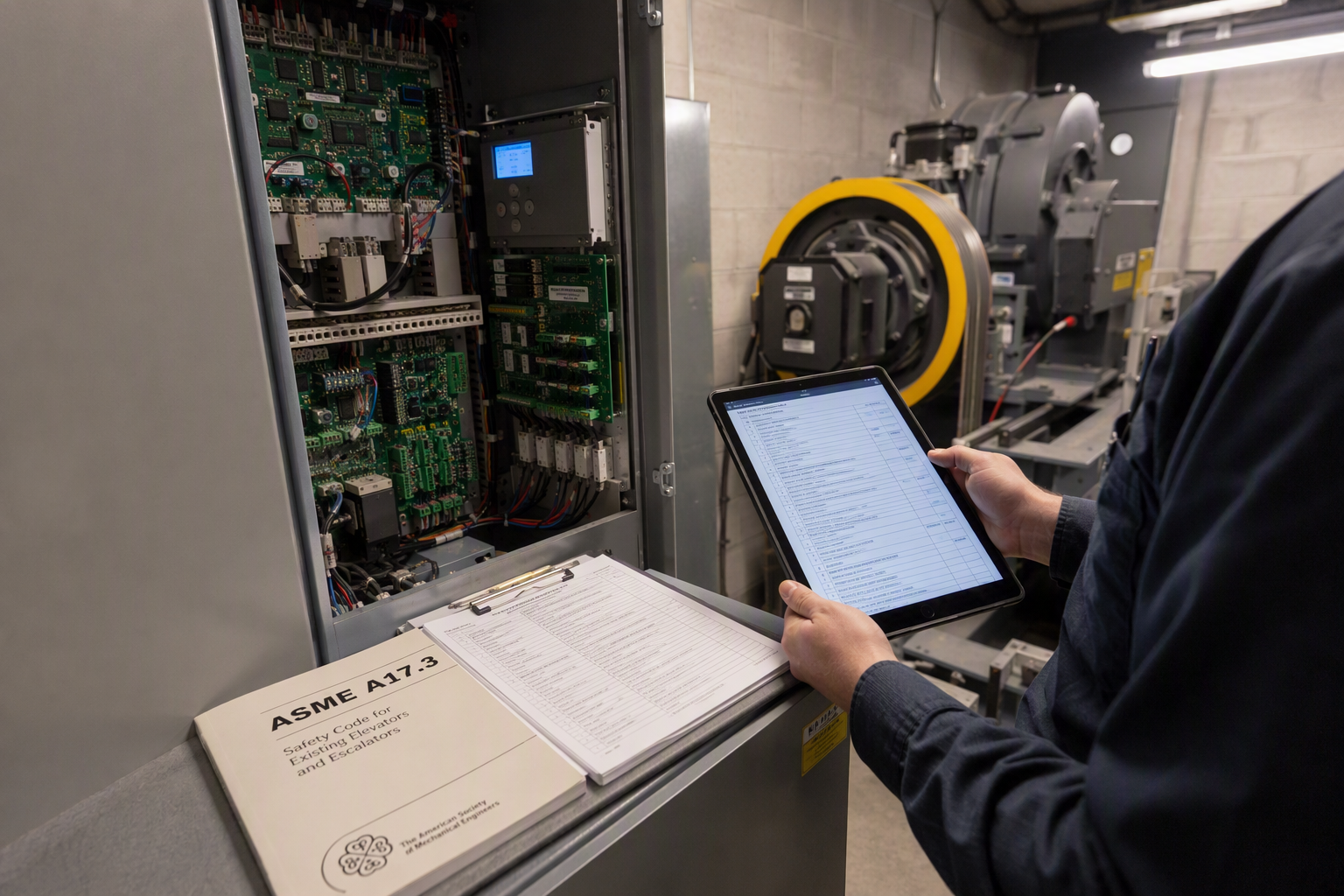
Florida’s elevator safety program enforces the ASME A17.1 Safety Code for Elevators and Escalators for new installations and alterations, and ASME A17.3, the Safety Code for Existing Elevators and Escalators, for equipment already in service. These codes govern the mechanical, electrical, and structural safety of elevator systems — separate from, but complementary to, ADA accessibility requirements.
In a healthcare setting, ASME code compliance takes on added urgency. Elevators in hospitals carry patients on stretchers, staff in emergency response situations, and heavy medical equipment. Failures in door operation, leveling, or emergency systems carry direct patient safety implications. Florida’s Division of Hotels and Restaurants — which administers elevator safety under the Florida Department of Business and Professional Regulation (DBPR) — conducts periodic inspections and requires that all elevators in the state maintain current inspection certificates.
What Are the Most Common Elevator Upgrades Required in Florida Hospitals?
Healthcare facilities in Florida most commonly require upgrades in the following categories. The priority of each depends on the age of the installation, whether alterations are planned, and the current inspection record.
Compliance Upgrade Comparison Table
| Upgrade Category | Applicable Standard | Typical Scope | Compliance Impact | Complexity |
|---|---|---|---|---|
| Door operator replacement / timing adjustment | ADA / ASME A17.1 | Reprogram hold-open time; replace door operator motor or controller | High — directly affects accessibility and injury prevention | Low–Medium |
| Control panel relocation / button replacement | ADA | Relocate panel; install ADA-height buttons with Braille and raised characters | High — required for accessible operation | Medium |
| Two-way emergency communication upgrade | ADA / ASME A17.1 | Install compliant hands-free two-way communication system | High — life safety requirement | Medium |
| Leveling system upgrade | ASME A17.1 / A17.3 / ADA | Recalibrate or replace position sensors and leveling controls | High — especially for gurney and wheelchair transfers | Medium–High |
| Audible / visual floor indicators | ADA | Install compliant hall lanterns, audible signals, and cab position indicators | Medium–High | Low–Medium |
| Cab expansion / new cab installation | ADA / ASME A17.1 | Full cab replacement to meet minimum clear floor space requirements | High — required when existing cab is non-compliant in dimension | High |
| Controller modernization | ASME A17.3 | Replace relay-logic or outdated microprocessor controls with current-generation systems | High — enables other upgrades and improves reliability | High |
| Firefighters’ Emergency Operation (FEO) | ASME A17.1 / A17.3 | Upgrade or add Phase I and Phase II recall functionality per current code | High — life safety / Florida inspection requirement | Medium–High |
New Construction vs. Existing Facility vs. Alteration: Which Rules Apply?
| Facility Scenario | ADA Obligation Level | ASME Code Applied | Flexibility | Florida Inspection Trigger |
|---|---|---|---|---|
| New hospital construction | Full compliance required — no exceptions | ASME A17.1 | Low — all standards must be met from day one | Required before occupancy |
| Facility undergoing planned alteration | Full compliance in altered path of travel | ASME A17.1 for altered elements | Limited — alteration triggers full compliance for affected areas | Required before return to service |
| Existing facility, no alteration planned | Barrier removal when “readily achievable” | ASME A17.3 | Moderate — phased upgrades may be permissible | Routine periodic inspection |
What Is the Step-by-Step Process for Bringing a Florida Hospital Elevator into ADA Compliance?
- Conduct a comprehensive accessibility audit. A qualified elevator service provider assesses every passenger elevator in the facility against the current ADA Standards for Accessible Design and applicable ASME A17.3 requirements, documenting each deficiency in writing.
- Review Florida DBPR inspection records. Obtain and review the current inspection certificate and any outstanding violations cited by the state’s Authority Having Jurisdiction (AHJ) to ensure all safety deficiencies are captured alongside accessibility gaps.
- Prioritize life safety and code-required items first. Firefighters’ Emergency Operation, emergency communication, and leveling accuracy deficiencies carry the highest risk and should be addressed before cosmetic or signage upgrades.
- Develop a phased upgrade plan. Working with a certified elevator contractor, create a written scope of work prioritized by urgency, cost, and operational impact — accounting for the hospital’s need to keep elevators in service during patient care hours.
- Submit permit applications to the Florida DBPR. Most elevator alterations in Florida require a permit from the state’s elevator safety program before work begins. Permits must be obtained before the contractor commences any alteration work.
- Complete the upgrade work with licensed elevator contractors. All installation, modification, and testing must be performed by contractors and mechanics holding the appropriate Florida state licenses under the DBPR elevator safety program.
- Arrange and pass the state inspection. After work is completed, a state-licensed inspector must inspect and approve the elevator before it is returned to full service. The inspector issues a new inspection certificate upon passing.
- Document everything and establish a maintenance schedule. Retain all permits, inspection certificates, and work orders in facility records. Establish a preventive maintenance agreement to keep the elevator in continuous compliance between inspection cycles.
Are There Specific ADA Requirements for Hospital Gurney Elevators?
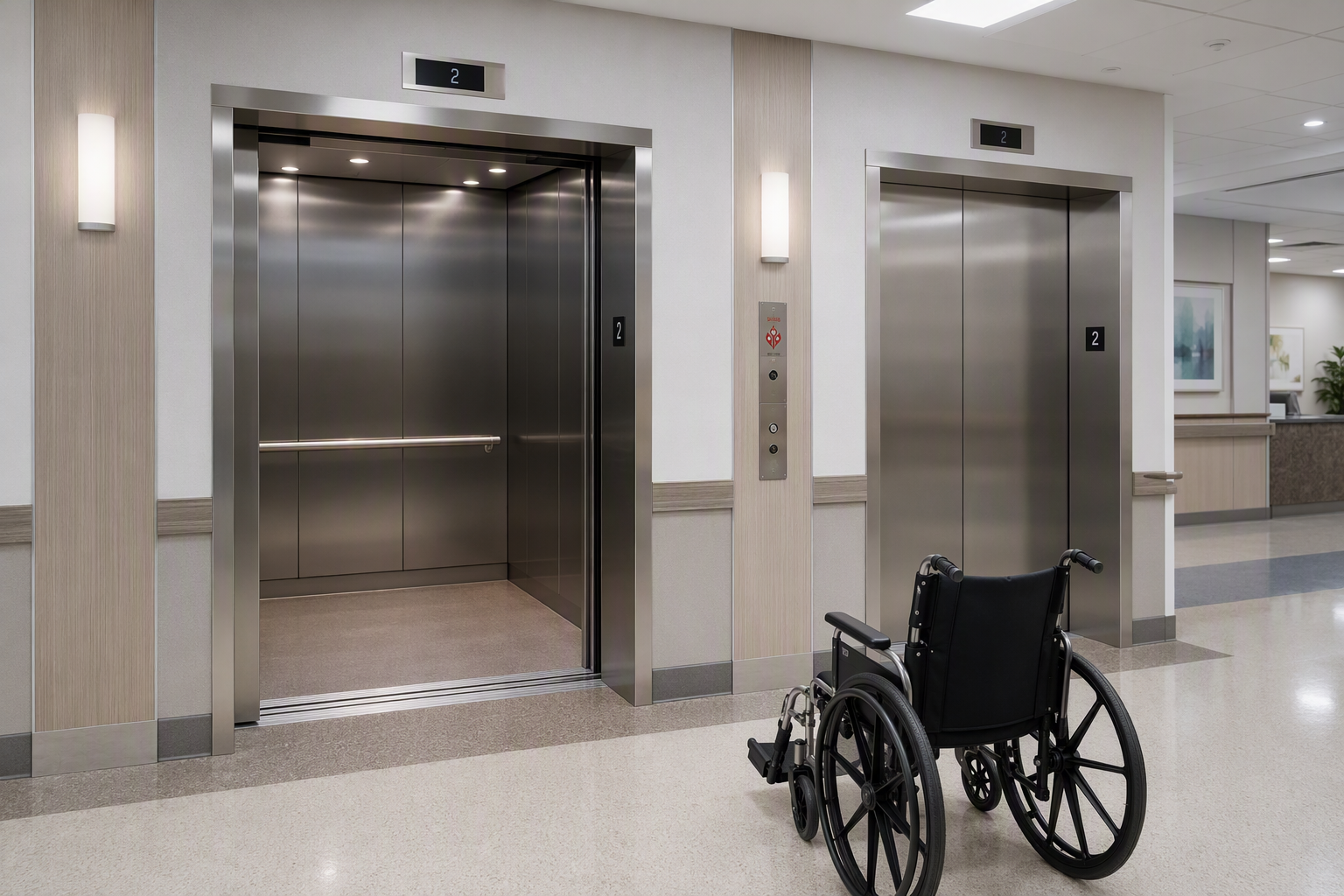
Yes. The ADA Standards for Accessible Design include a separate category for “Destination-Oriented Elevators” and for elevators serving medical and healthcare occupancies. Hospitals frequently require elevators large enough to accommodate a hospital bed or gurney — a dimension that exceeds standard passenger elevator requirements. When a facility’s floor plan designates specific elevators for patient transport, those elevators must meet the applicable dimensional minimums for the type of service they provide, and failure to do so constitutes a barrier that must be removed when readily achievable.
Gurney-accessible elevators must also achieve precise leveling, as even minor gaps or height differences between the cab floor and the landing can create hazards during patient transport. The ASME A17.1 Safety Code for Elevators and Escalators establishes leveling tolerances that directly support this patient safety requirement.
What Happens If a Florida Hospital Elevator Fails Its State Inspection?
When an elevator fails a periodic inspection conducted under Florida’s DBPR elevator safety program, the elevator may be ordered out of service until the cited deficiencies are corrected and the unit is re-inspected. For a hospital, a non-operational elevator can disrupt patient transport, emergency response, and the movement of supplies and equipment to upper floors — making compliance not merely a legal obligation but an operational necessity.
Repeat or serious violations can also trigger increased inspection frequency and administrative penalties. Facilities are strongly advised to address any cited deficiencies through a licensed contractor promptly after receiving an inspection report, and to keep documentation of corrective work for review by the AHJ.
How Does OSHA Apply to Elevator Safety in Florida Healthcare Facilities?
The Occupational Safety and Health Administration (OSHA) governs workplace safety, which includes the safety of employees who use and work around elevators in healthcare settings. OSHA’s General Duty Clause requires employers — including hospitals — to provide a workplace free from recognized hazards that cause or are likely to cause serious harm. Elevator malfunctions, door failures, leveling defects, and non-functional emergency communication systems can all constitute OSHA-recognizable hazards in a hospital environment. Florida operates under federal OSHA, and compliance with ASME A17.1 and A17.3 is widely regarded as establishing the safety baseline that satisfies OSHA’s requirements for elevator installations.
How Long Do ADA Elevator Upgrades Typically Take in a Healthcare Facility?
Timeline varies significantly by upgrade type and facility complexity. Signage, Braille overlays, and button adjustments can often be completed in a single scheduled maintenance window without removing the elevator from service for an extended period. Door operator replacements and control panel relocations typically require the elevator to be taken out of service for a matter of days. Controller modernizations, cab replacements, and full system modernizations are multi-week projects that require careful scheduling to minimize disruption to hospital operations.
| Upgrade Type | Typical Downtime | Planning Lead Time | Inspection Required After? |
|---|---|---|---|
| Signage / Braille / button replacement | Hours to 1 day | Days to weeks | Depends on scope — permit may be required |
| Door operator replacement | 1–3 days | 2–4 weeks | Yes — state permit and inspection required |
| Emergency communication upgrade | 1–2 days | 2–4 weeks | Yes |
| Controller modernization | 1–3 weeks | 4–12 weeks | Yes — full inspection required |
| Full cab replacement | 2–4 weeks | 8–16 weeks | Yes — full inspection required |
What Are the Pros and Cons of Full Modernization vs. Targeted Upgrades for Hospital Elevators?
| Approach | Pros | Cons | Best For |
|---|---|---|---|
| Full modernization | Addresses all compliance gaps at once; improved reliability and energy efficiency; single inspection event; longer service life | Higher upfront investment; longer planned downtime; significant capital planning required | Elevators older than 20–25 years; multiple outstanding deficiencies; facilities planning major renovation |
| Targeted / phased upgrades | Lower per-project cost; shorter individual downtime; immediate resolution of highest-priority items; preserves capital budget | Multiple permit and inspection events; risk of secondary issues discovered during work; may cost more over time if done piecemeal | Newer installations with isolated deficiencies; budget-constrained facilities; when only one or two items are out of compliance |
How Should a Hospital Evaluate an Elevator Service Provider for ADA Compliance Work?
Not all elevator contractors are equally qualified to handle the complexities of ADA compliance work in a healthcare environment. Facilities should look for providers who are:
- Licensed under Florida’s DBPR elevator contractor licensing program — a legal requirement for any firm performing elevator work in the state.
- Independent of major OEM manufacturers, which allows them to specify and source the most appropriate equipment for compliance upgrades rather than being limited to a single product line.
- Familiar with both ADA accessibility standards and ASME A17.1 and A17.3 safety codes as they are enforced in Florida.
- Capable of managing the permit and inspection process with the Florida DBPR on behalf of the facility.
- Experienced with the operational constraints of healthcare facilities, including the need to schedule work around patient care hours and keep elevators in service to the extent possible.
Axxiom Elevator Florida is an independent elevator service provider operating throughout Florida, serving hospitals, healthcare facilities, and commercial properties. As an independent contractor, Axxiom Elevator Florida is not tied to any single elevator manufacturer, which means compliance recommendations are driven by code requirements and facility needs — not product inventory. Axxiom Elevator Florida works with Florida’s DBPR licensing and inspection framework and provides comprehensive assessments, modernization planning, and ongoing maintenance for healthcare elevator systems.
What Documentation Should a Florida Hospital Maintain for Elevator ADA Compliance?
Florida hospitals and healthcare facilities should maintain the following records in organized, accessible form:
- Current Florida DBPR elevator inspection certificate for each elevator in the facility
- All permits issued for elevator alterations, modernizations, or repairs
- Written inspection reports from state-licensed inspectors, including any deficiency notices and documentation of corrective action
- Records of all maintenance performed under the facility’s preventive maintenance agreement
- Written ADA accessibility audit reports, including documentation of the “readily achievable” analysis for barrier removal decisions in existing facilities
- Copies of contracts and scopes of work for all upgrade or modernization projects
- Test records for emergency communication systems and Firefighters’ Emergency Operation features, which may be required to demonstrate ongoing compliance
These records are essential for responding to ADA complaints, OSHA inspections, state elevator inspections, and Joint Commission surveys — all of which may review elevator safety and accessibility documentation in a healthcare setting.
Can a Florida Hospital Be Held Liable for Non-Compliant Elevators?
Yes. Non-compliant elevators in a healthcare facility create multiple layers of legal and regulatory exposure. Under the ADA, patients, visitors, and employees with disabilities may file complaints with the U.S. Department of Justice or bring private lawsuits alleging denial of equal access. Under OSHA, facilities can face citations and penalties if elevator deficiencies constitute recognized workplace hazards. Florida’s DBPR can order elevators out of service and impose administrative penalties for uncorrected inspection violations. And in the event of a patient or visitor injury related to an elevator defect, the facility faces potential civil liability in addition to regulatory consequences.
Proactive compliance — beginning with a documented accessibility audit and a written upgrade plan — is both the legally defensible and operationally sound approach for any Florida healthcare facility.
Ready to Bring Your Hospital Elevators into Full ADA and Safety Compliance?
Axxiom Elevator Florida provides comprehensive elevator assessments for Florida hospitals and healthcare facilities, identifying every ADA deficiency, ASME code gap, and Florida DBPR inspection issue — with a clear, prioritized plan for resolving them.
Contact Axxiom Elevator Florida for a free elevator assessment:
Need elevator service you can rely on? Axxiom Elevator Florida is ready to help.