What are the clearest signs that an elevator controller is too old to repair?
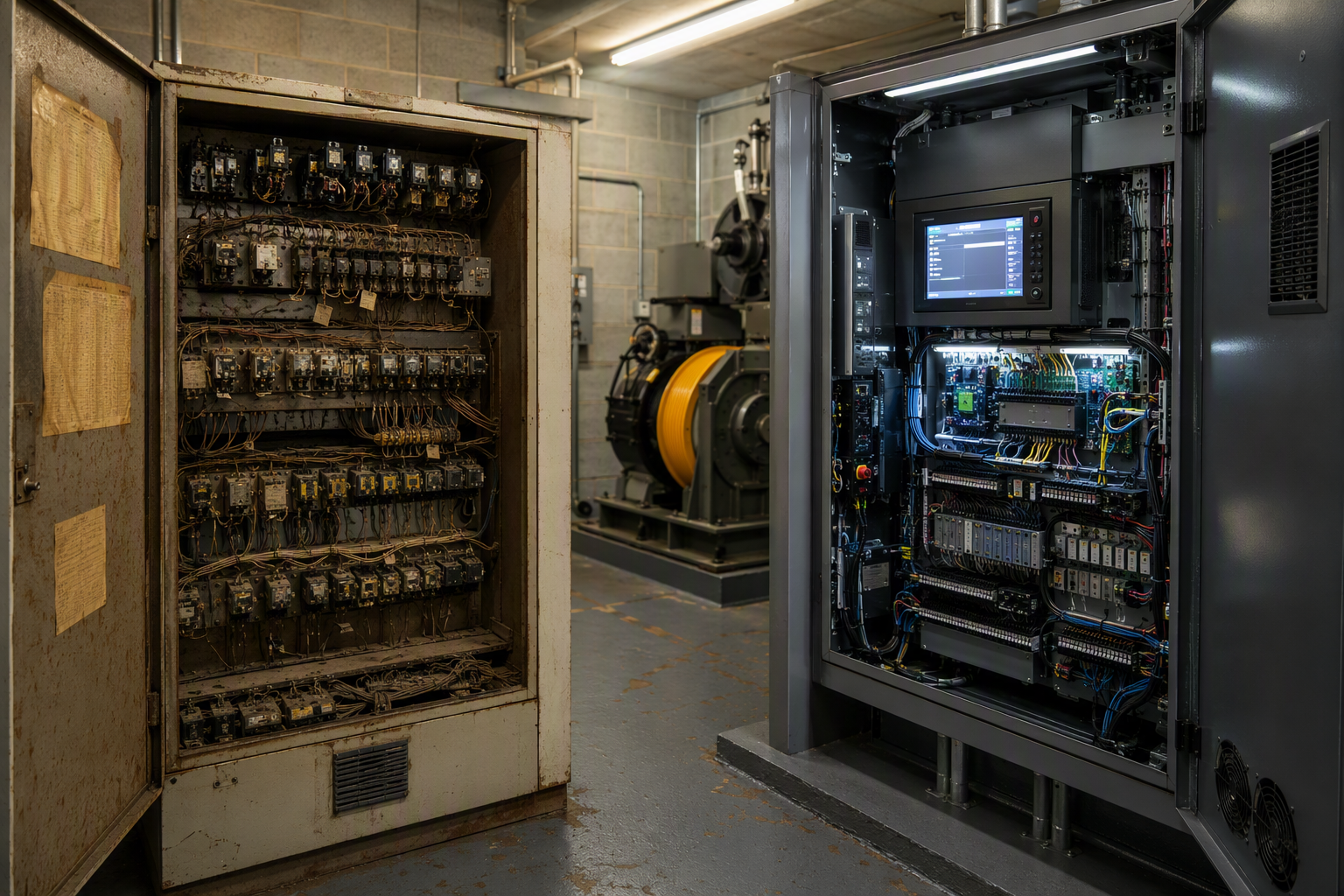
An elevator controller has reached the end of its serviceable life when replacement logic boards, relays, or software are no longer available from any manufacturer or parts distributor, and when the cost of sourcing salvaged components exceeds the cost of a modern solid-state replacement.
Relay-logic and early microprocessor controllers installed before the 1990s are the most common candidates for this assessment. These systems rely on electromechanical relays, drum switches, and proprietary circuit boards that manufacturers stopped producing decades ago. When a single failed board grounds an entire building’s vertical transportation, and that board cannot be sourced, the controller has crossed from “aging but repairable” to “end of life.” Beyond parts availability, older controllers lack the diagnostic transparency of modern systems — there is no fault log, no remote monitoring interface, and no predictive alert when a relay is weakening. That absence of data accelerates unplanned downtime and increases liability exposure.
Axxiom Elevator Florida evaluates controller age, parts availability, and callback frequency as a combined picture before recommending modernization to building owners in Pompano Beach and Sarasota.
How do I know when mechanical components like motors, sheaves, and buffers need replacement rather than repair?

Mechanical components require replacement rather than repair when wear measurements fall outside the tolerances specified in ASME A17.1, when the base metal is cracked or corroded beyond resurfacing, or when the component’s design no longer conforms to current safety code editions.
Key mechanical wear indicators include:
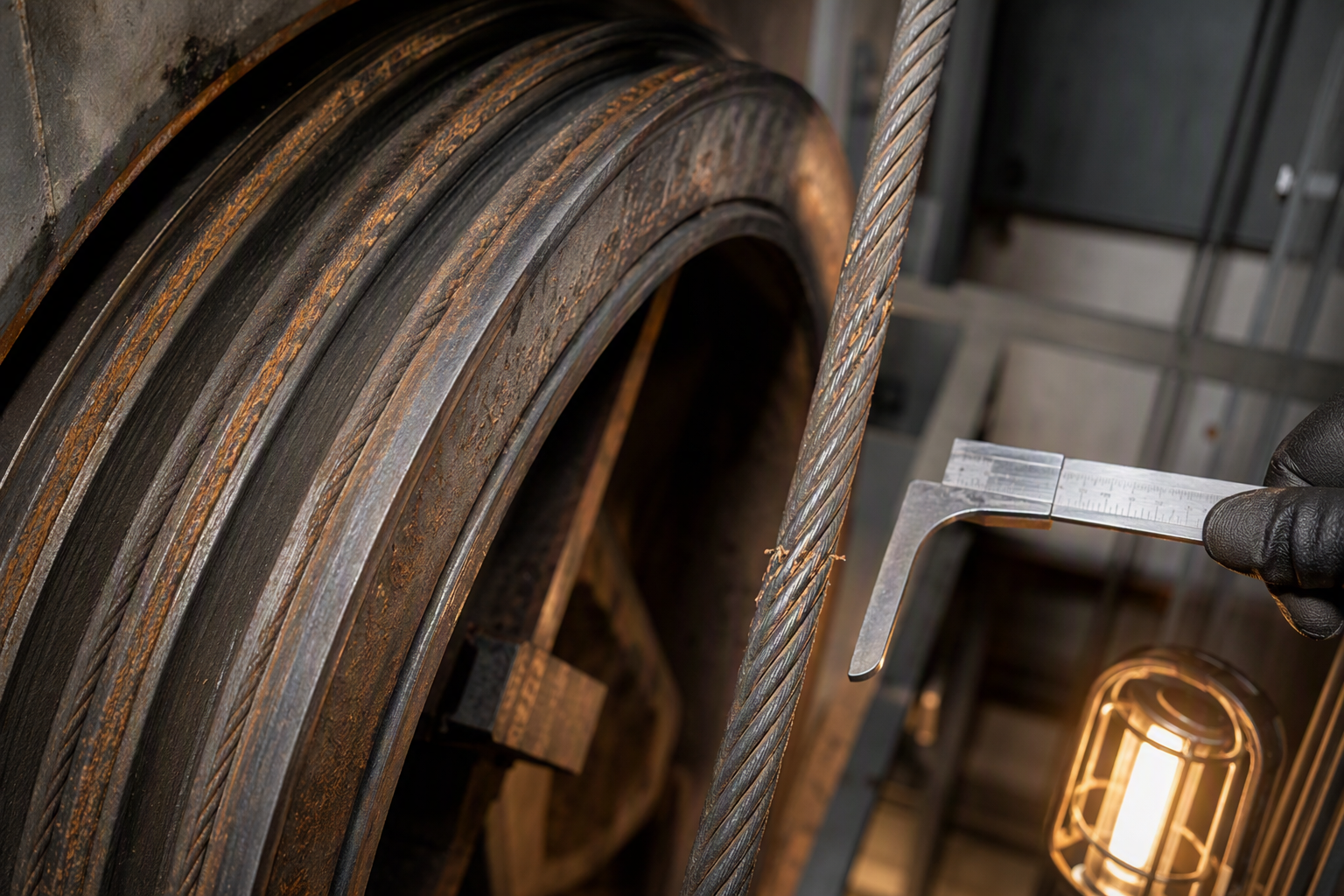
- Hoist ropes and cables: Broken wires per lay, corrosion, and diameter reduction are measured against ASME A17.1 criteria. Once thresholds are exceeded, ropes must be replaced — splicing is not an accepted repair.
- Drive sheaves and secondary sheaves: Groove wear that allows ropes to bottom out changes the rope-to-sheave contact geometry, reducing traction and accelerating rope fatigue. Regrooving is possible up to a point, but a sheave with insufficient remaining metal must be replaced.
- Gearboxes (worm gear machines): Worm and wheel wear produces excessive backlash and heat. When tooth-face pitting reaches a defined depth and oil analysis shows metallic particulate above acceptable limits, rebuilding is no longer cost-effective.
- Buffers: Oil buffers must return to full extension within the time specified in ASME A17.1. A buffer that fails this test and cannot be rebuilt to specification must be replaced.
- Guide rails and brackets: Corrosion, deformation from car impacts, or inadequate fastening to building structure are conditions requiring replacement, not field repair.
What is the typical service life of elevator components before replacement becomes necessary?
Component service life varies widely by type, usage intensity, maintenance quality, and environment, but the table below provides industry-recognized benchmark ranges used as planning guides — not guarantees.
| Component | Typical Service Life (years) | Primary Failure Mode | Repair vs. Replace Threshold |
|---|---|---|---|
| Relay-logic controller | 25–40 | Parts obsolescence, relay contact wear | Replace when parts unavailable |
| Microprocessor controller (early gen) | 15–25 | Board failure, software incompatibility | Replace when OEM support ends |
| Modern solid-state controller | 20–30+ | Component failure, firmware obsolescence | Repair while OEM support active |
| AC/DC hoist motor | 20–30 | Winding insulation breakdown, bearing wear | Rewind if windings viable; replace if frame cracked |
| Worm gear machine | 20–35 | Gear tooth wear, seal failure | Rebuild to ~mid-life; replace at severe wear |
| Gearless machine (MRL) | 25–40+ | Bearing wear, motor magnet degradation | Bearing replacement viable; motor replacement at failure |
| Hoist ropes (6×19 or 8×19) | 5–15 | Wire fatigue, corrosion, wear | Replace per ASME A17.1 criteria — never splice |
| Door operator | 15–25 | Motor/clutch wear, cam wear | Repair if parts available; replace if obsolete design |
| Safety devices (governor, safeties) | 20–30 | Mechanical wear, spring fatigue | Annual testing per ASME A17.1; replace at failure |
| Hydraulic power unit | 15–25 | Pump wear, valve seat erosion, seal failure | Pump rebuild viable mid-life; replace at severe corrosion |
| Hydraulic jack/cylinder | 20–30 | Seal leak, corrosion, underground pit corrosion | Replace single-bottom jacks per Florida code |
Note: These ranges reflect general industry planning guidance. Actual service life depends on maintenance history, duty cycle, and environmental conditions. A certified elevator contractor should assess each unit individually.
What does callback frequency tell me about whether repair or replacement is the right decision?
When a specific component or subsystem generates callbacks at an accelerating rate over a rolling twelve-month period, that pattern indicates systemic degradation rather than isolated faults, and replacement becomes the more reliable long-term investment.
A single, isolated callback — a stuck relay, a worn brush, a misadjusted door clutch — is a normal part of elevator ownership and is resolved through routine repair. The concern arises when the same system produces multiple service calls within months of each repair. This “repeat callback” pattern signals that the root cause is systemic wear or design obsolescence, not a discrete failure. Each callback carries a direct cost (labor and parts) plus an indirect cost (tenant inconvenience, potential ADA non-compliance during downtime, and reputational risk for building management). When the annualized callback cost for a single system component approaches or exceeds a significant fraction of that component’s replacement cost, the financial case for modernization becomes compelling.
How do ASME A17.1 and Florida state regulations determine when components must be replaced?
The ASME A17.1 Safety Code for Elevators and Escalators establishes mandatory replacement thresholds for safety-critical components, and Florida adopts and enforces these requirements through the Florida Department of Business and Professional Regulation (DBPR), Bureau of Elevator Safety.
Florida’s elevator law requires that all conveyances comply with the edition of ASME A17.1 adopted by the state at the time of installation, as well as any mandatory retroactive provisions in subsequent editions. Retroactive provisions — those that apply to existing installations regardless of original installation date — have historically required upgrades such as firefighters’ emergency operation, door reopening devices, and car lighting minimums. Building owners who have not reviewed their equipment against current retroactive provisions may unknowingly be operating out of compliance.
Specific mandatory replacement triggers under ASME A17.1 include: exceeding wire-break limits on hoist ropes; buffer performance test failure; governor overspeed test failure; and car and counterweight safety device test failure. Any component that fails a periodic test required by the code and cannot be repaired to pass that test must be replaced before the elevator returns to service.
What is the difference between modernization and full elevator replacement?
Modernization replaces specific subsystems — controller, machine, doors, cab finishes — while retaining the hoistway structure and other serviceable components, whereas full elevator replacement involves removing all equipment and installing an entirely new system within the existing or a new hoistway.
Most aging elevators in commercial and residential buildings in Florida are candidates for phased or full modernization rather than full replacement, because the hoistway structure and guide rails are often still serviceable. A well-executed controller modernization alone can restore reliable operation, improve energy efficiency, and bring the unit into compliance with current ASME A17.1 retroactive requirements. Full replacement is typically reserved for situations where the hoistway itself is structurally compromised, the pit depth or overhead clearance does not meet current code for any viable equipment configuration, or the total cost of incremental modernization over a planning horizon exceeds the cost of a new installation.
How do obsolete parts affect the repair-versus-replace decision?
When original equipment manufacturer (OEM) support ends and no compatible aftermarket source exists, an elevator is effectively irreparable for the affected subsystem, making replacement the only path to reliable and compliant operation.
Parts obsolescence is the single most definitive trigger for the replacement decision because it removes the repair option entirely. Relay-logic controllers from the 1960s through early 1980s are the most extreme example: proprietary circuit boards were never standardized across manufacturers, and most are no longer available through any channel. Some specialty distributors maintain inventories of salvaged boards, but salvaged electronic components carry no warranty and may introduce new failure modes. When a building owner discovers that a controller replacement board is available only as a used pull from a demolished building, that is a clear signal that modernization to a modern solid-state system is overdue.
What role does ADA compliance play in deciding whether to modernize elevator components?
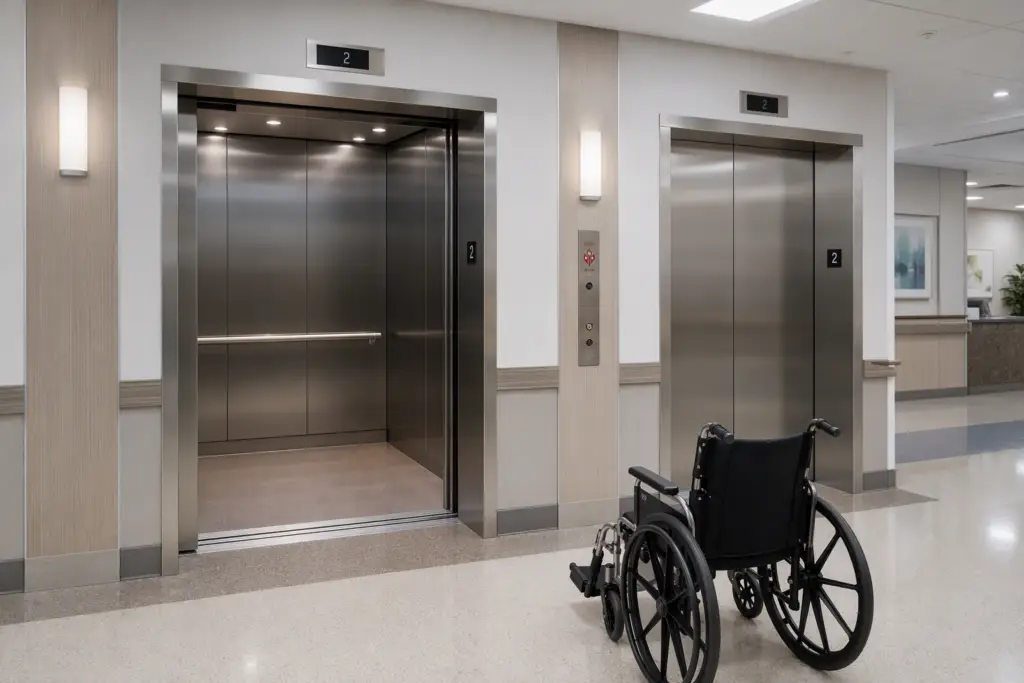
A modernization project that touches the cab, controls, or doors may trigger ADA compliance requirements for the entire unit, making it important to plan the scope of modernization to address accessibility features comprehensively rather than piecemeal.
The ADA requires that elevators serving the public meet specific standards for control panel height and reach range, audible and visual floor signals, Braille and raised-character markings, door timing, and car dimensions. Older elevators — particularly those installed before the ADA’s 1990 enactment — frequently fall short on multiple criteria. When a building owner undertakes a controller modernization, the project is an opportunity to bring the entire unit into ADA compliance. Failing to do so and then performing a follow-on modernization years later doubles project management and permitting costs. Axxiom Elevator Florida advises clients in Pompano Beach and Sarasota to treat ADA compliance as an integrated scope item within any modernization project, not an afterthought.
What are the financial considerations when comparing repair costs to modernization costs?
The most widely used planning heuristic is that when the projected cost of repairs over the next three to five years approaches or exceeds the cost of modernization, replacement of the affected subsystem is the financially sound choice.
This analysis should account for: direct repair labor and parts costs; estimated callback frequency and associated service call costs; downtime costs (lost rent, tenant complaints, ADA exposure); energy consumption differences between old and new equipment; and the risk premium associated with operating on an unserviceable platform where a single failure could ground the unit indefinitely. Modern controllers with variable-frequency drives (VFDs) also reduce energy consumption compared to older single-speed or two-speed systems, though the specific savings depend on duty cycle and utility rates. A qualified elevator contractor can provide a lifecycle cost analysis to support a capital planning decision.
How do I evaluate a contractor’s recommendation to replace versus repair?
A credible replacement recommendation should be supported by documented evidence: parts obsolescence confirmation, callback history, code compliance gap analysis, and a written lifecycle cost comparison — not simply an assertion that the equipment is old.
Building owners and facility managers should request the following from any contractor recommending replacement:
- A written parts availability assessment identifying which specific components are no longer sourced and from which suppliers.
- A callback log for the previous twelve to twenty-four months, annotated with root cause for each call.
- A code compliance review identifying any retroactive provisions under the current edition of ASME A17.1 that the existing equipment does not meet.
- A side-by-side comparison of projected five-year repair costs versus modernization cost.
- A scope-of-work document specifying exactly which components are being replaced and which are being retained.
- Confirmation that the proposed modernization will satisfy Florida DBPR permit and inspection requirements.
If a contractor cannot provide all of the above, a second opinion from a qualified independent elevator contractor is warranted.
What specific hydraulic elevator issues signal that replacement is necessary?
Hydraulic elevators with single-bottom jack cylinders — which are no longer permitted in new installations — and those experiencing underground oil leaks or cylinder corrosion are strong candidates for replacement of the hydraulic system or conversion to a different drive type.
Florida’s climate accelerates corrosion of underground hydraulic cylinders. A corroding single-bottom jack presents both an environmental contamination risk (hydraulic fluid leaking into soil and groundwater) and a structural failure risk. Florida’s adoption of ASME A17.1 has progressively tightened requirements around hydraulic system integrity, including mandatory PVC liner requirements for underground cylinders in new and certain modernized installations. When an underground cylinder fails leak testing and cannot be reliably relined, replacement of the hydraulic unit or conversion to a machine-room-less (MRL) traction system may be the safest and most cost-effective long-term solution. Power unit issues — worn pump, failed lowering valve, deteriorated tank — are generally repairable, but should be evaluated in the context of cylinder condition before committing to power unit investment.
How does the age of the building affect the replace-versus-repair decision for elevator components?
Building age creates a planning context but is not itself a decision criterion — the condition of the elevator equipment, its compliance status, and its parts availability are the operative factors, regardless of whether the building was constructed in 1960 or 1995.
That said, older buildings — common in both Pompano Beach’s commercial corridors and Sarasota’s historic districts — frequently contain elevators that have never been modernized and are operating on original equipment now forty or more years old. In these cases, multiple systems are often simultaneously approaching end of life: the controller, the machine, the ropes, and the door operators. A phased approach to modernization, prioritizing the systems with the greatest safety and compliance impact, allows building owners to spread capital expenditure over a planning horizon while restoring reliable operation systematically.
What happens during a Florida elevator inspection that could trigger a mandatory replacement order?
Florida DBPR elevator inspectors have authority to issue a Notice of Unsafe Condition or an order to cease operation if they find a component that fails to meet the mandatory safety requirements of the adopted ASME A17.1 code edition, effectively compelling replacement as a condition of returning the elevator to service.
Annual inspections in Florida include operational tests and physical examination of safety devices, ropes, doors, lighting, and emergency systems. Inspectors may also require the five-year full-load safety and governor test and the five-year hydraulic pressure test where applicable. A failed test result is documented on the inspection report, and the building owner is given a compliance timeline. Components that cannot be brought into compliance through repair must be replaced before a Certificate of Operation is reissued. Operating an elevator without a current Certificate of Operation in Florida is a violation of state law and exposes building owners to significant liability. Axxiom Elevator Florida provides pre-inspection assessments for property owners in Pompano Beach and Sarasota to identify and address deficiencies before the state inspector arrives.
What are the signs that an elevator door operator system needs replacement rather than ongoing repair?
A door operator system requires replacement when the mechanical cam, clutch, and motor assembly produces repeated nuisance door-related callbacks that are not resolved by adjustment and lubrication, when replacement parts are no longer available from the OEM or aftermarket, or when the door performance no longer meets the timing and force requirements of current code.
Door-related calls are among the most frequent in elevator service. Most can be resolved through cleaning, adjustment, and replacement of wear items like rollers, gibs, and clutch pads. However, some older door operator designs — particularly direct-current operators from early-generation systems — have become parts-orphaned. Beyond parts availability, current ASME A17.1 specifies maximum closing force and minimum reopening device sensitivity requirements. An older door operator that cannot be adjusted to meet these kinetic energy limits must be replaced, as operating non-compliant doors creates direct passenger safety risk and liability exposure.
How does a building owner plan the budget and timeline for elevator modernization in Florida?
Elevator modernization budgeting should begin with a condition assessment at least twelve to eighteen months before the planned start date, allowing time for contractor selection, permitting through Florida DBPR, equipment lead times, and scheduling coordination with building occupants.
The permitting process in Florida requires submission of engineering drawings and specifications to the DBPR Bureau of Elevator Safety before work begins. Lead times for major components — controllers, machines, and hydraulic units — can extend several months depending on manufacturer production schedules and supply chain conditions. Building owners who begin the planning process late often face the choice between operating unreliable equipment longer than prudent or rushing a procurement decision that could result in a suboptimal system selection. A phased modernization plan — replacing the controller in year one, the machine and ropes in year two, and performing cab and door upgrades in year three, for example — can smooth the capital impact while progressively improving reliability and compliance.
What questions should a building manager ask before signing a modernization contract?
Before signing any modernization contract, a building manager should have clear written answers to questions about scope, warranty, permitting responsibility, interim service during outage, and post-modernization maintenance obligations.
The most important pre-contract questions include:
- Which specific components are being replaced, and which are being retained? Will retained components be certified as serviceable?
- Who is responsible for obtaining and paying for all Florida DBPR permits and final inspections?
- What is the manufacturer’s warranty on new components, and is there a workmanship warranty separate from the equipment warranty?
- What is the projected duration of the outage, and what interim arrangements (temporary lift, schedule coordination) will the contractor support?
- What post-modernization maintenance contract terms apply, and are they competitive with the open market?
- Does the proposed modernization address all known retroactive compliance requirements under the current edition of ASME A17.1?
- Does the proposed scope address all applicable ADA requirements for the unit?
Can a partially modernized elevator still fail a Florida inspection?
Yes — a partially modernized elevator can fail inspection if retained components do not meet the code requirements triggered by the modernization scope or if the combination of new and old components creates a non-compliant configuration under ASME A17.1 or Florida DBPR rules.
This is a critical point that building owners sometimes underestimate. When a modernization replaces the controller, for example, the new controller may require updated wiring, terminal limit switches, and safety circuit architecture that the existing equipment does not provide. The inspection following a modernization covers the entire unit, not just the replaced components. Contractors who propose a narrow scope to win a lower bid price may leave building owners with a unit that cannot obtain its Certificate of Operation without additional unplanned work. A thorough pre-modernization code compliance gap analysis prevents this outcome.
How does worker and passenger safety factor into the decision to replace aging components?
Safety is the overriding consideration, and any component that has failed or is at high risk of failing in a way that could result in an uncontrolled car movement, door entrapment, or fall hazard must be replaced immediately, regardless of cost or planning timeline.
Elevator safety incidents, while statistically uncommon in well-maintained systems, carry severe consequences when they do occur. OSHA jurisdiction applies to elevator work performed by and on workers, and both OSHA and the Florida DBPR treat uncontrolled car movement, door-related entrapments, and rope failures as the highest-severity failure categories. Building owners have a duty of care to passengers and a legal obligation to maintain equipment in compliance with applicable codes. When a component presents a known safety risk and cannot be reliably repaired, the replacement decision is not discretionary — it is a legal and ethical obligation. Axxiom Elevator Florida performs safety-priority assessments for building owners who need an objective, third-party evaluation of their equipment’s condition.
What is the process for getting a professional assessment of whether elevator components need replacement?
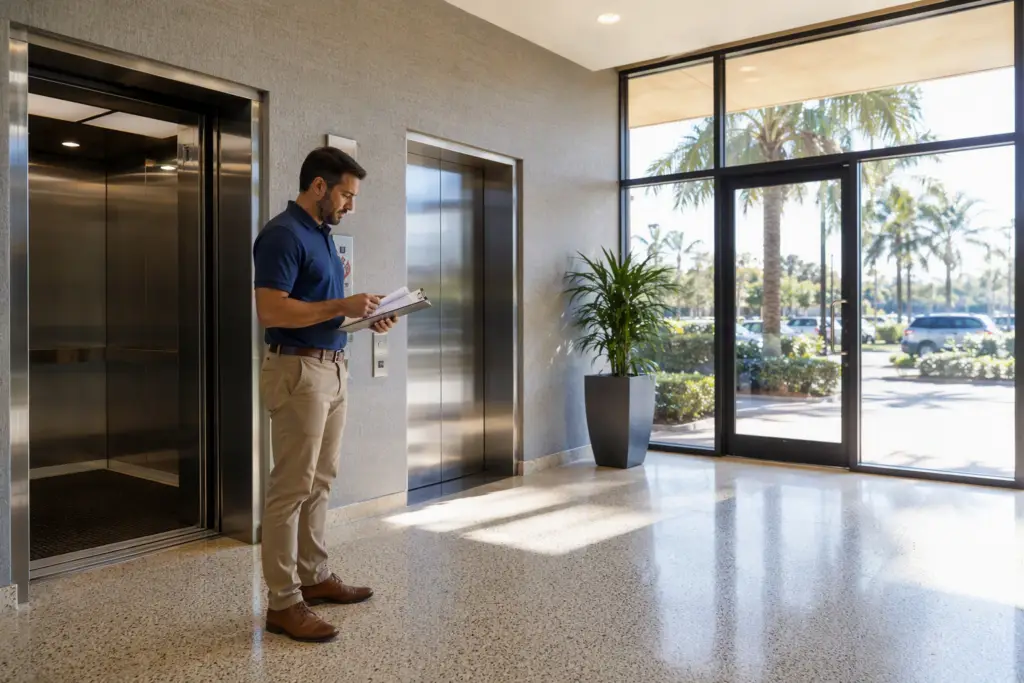
A professional elevator modernization assessment follows a structured process that includes document review, physical inspection, functional testing, and production of a written report with findings and recommendations.
The standard assessment process typically proceeds as follows:
- Document collection: Gather existing inspection reports, maintenance logs, callback records, original equipment documentation, and any outstanding violation notices.
- Physical inspection: A qualified elevator mechanic inspects the machine room, hoistway, pit, and cab for visible wear, corrosion, obsolescence markers, and safety hazards.
- Functional testing: The elevator is operated through its full range of functions — normal operation, door performance, emergency stop, lighting, communications — and deviations from code-required performance are noted.
- Parts availability research: The technician confirms current availability and pricing for any components identified as candidates for replacement.
- Code compliance gap analysis: The existing installation is compared against the current edition of ASME A17.1 and any Florida DBPR retroactive requirements.
- Report production: A written report documents findings, prioritizes deficiencies by safety impact and compliance status, and provides options with cost ranges for repair versus modernization of each system.
- Owner consultation: The contractor reviews the report with the building owner or facility manager, answers questions, and assists with capital planning if requested.
How does Axxiom Elevator Florida support building owners through the modernization decision process?
Axxiom Elevator Florida provides certified elevator assessment services to building owners and property managers in Pompano Beach and Sarasota, delivering objective, documented evaluations that support informed repair-versus-replace decisions without pressure toward any predetermined outcome.
The assessment process used by Axxiom Elevator Florida follows the structured methodology described above, covering controller condition and parts availability, mechanical system wear, code compliance gaps under current ASME A17.1 requirements, ADA accessibility compliance, and Florida DBPR permit history. Clients receive a written report they can use for capital budgeting, insurance documentation, and contractor bid solicitation. Whether the right answer is a targeted repair, a phased modernization, or a full system replacement, Axxiom Elevator Florida provides the technical foundation for that decision — and then executes the work to the highest standard of quality and code compliance for properties across South Florida and the Gulf Coast.
Get a Professional Elevator Assessment Today
If your elevator is showing signs of age — repeated callbacks, obsolete components, failed inspections, or ADA gaps — do not wait for a complete failure or a compliance violation to force the decision. Contact Axxiom Elevator Florida for a free elevator assessment. Serving commercial, residential, and institutional properties throughout Pompano Beach, FL and Sarasota, FL, Axxiom Elevator Florida delivers the technical expertise and objective analysis you need to make the right repair-versus-replace decision with confidence.
Call Axxiom Elevator Florida today: