Commercial Elevator Inspection in Florida: Complete FAQ Guide (2026)
Florida building owners, property managers, and facility directors face strict legal obligations when it comes to elevator safety and inspection compliance. Failing to meet these requirements can result in fines, elevator shutdowns, and serious liability exposure. This comprehensive FAQ covers everything you need to know about commercial elevator inspection frequency, who is authorized to perform inspections, what inspectors look for, and how to stay compliant across every property type in Florida — including properties in Pompano Beach and Sarasota.
How Often Does a Commercial Elevator Need to Be Inspected in Florida?
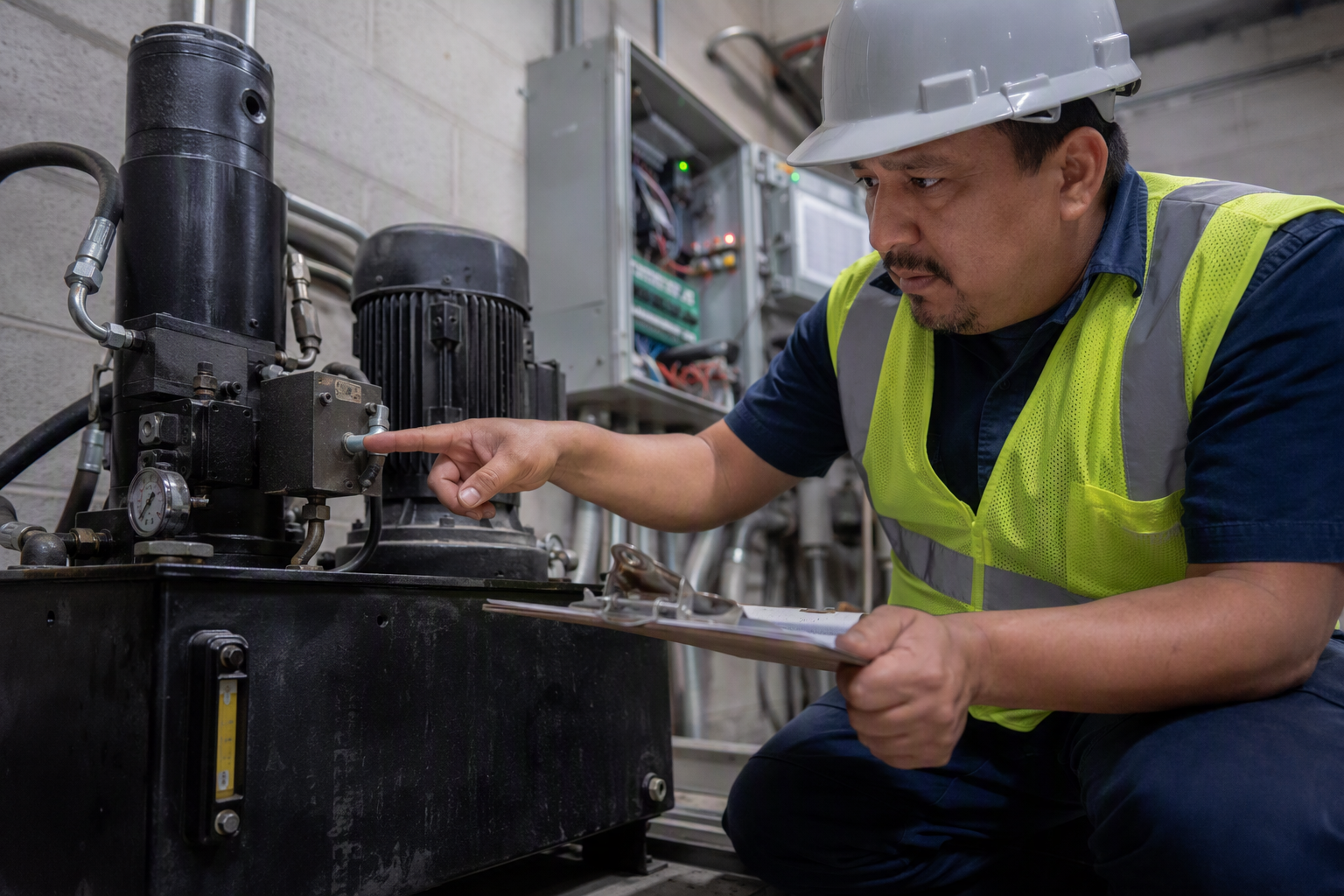
Florida law requires commercial elevators to receive a routine periodic inspection at least every six months, with a full witnessing of the required tests performed on the schedule defined by the adopted edition of the ASME A17.1 Safety Code for Elevators and Escalators.
Under Florida Statutes § 399.061, elevators and other conveyances subject to state jurisdiction must be inspected periodically. The Florida DBPR Division of Hotels and Restaurants has historically administered this program, and the inspection frequency is tied to the risk category and use classification of the equipment. For most commercial passenger elevators — those found in office buildings, retail centers, hotels, hospitals, and multifamily residential buildings above three stories — the mandated interval is every six months.
Hydraulic elevators, traction elevators, escalators, dumbwaiters, and moving walkways each carry their own inspection and test schedules, all governed by the ASME A17.1 Safety Code for Elevators and Escalators. Florida has adopted ASME A17.1 by reference into its administrative rules, meaning compliance with the code is a legal requirement, not merely a best practice.
In addition to the routine periodic inspection, commercial elevators must also undergo a periodic safety test (sometimes called a Category 1 or Category 5 test depending on the equipment type) on longer intervals — typically annually or every five years respectively — as specified in ASME A17.1. These tests are more intensive than a routine inspection and require the elevator to be taken out of service for a defined period.
Who Is Legally Authorized to Inspect a Commercial Elevator in Florida?

Only a licensed elevator inspector holding a valid Certificate of Competency issued under Florida Statutes Chapter 399 — or an inspector employed by a municipality or county with an approved elevator inspection program — may legally inspect a commercial elevator in Florida.
Florida uses a two-track inspection system. The first track involves inspectors employed directly by the state through the DBPR. The second track allows licensed third-party inspection agencies and their individual certified inspectors to perform inspections on behalf of property owners, provided those inspectors hold the appropriate Florida license or a nationally recognized credential accepted by the state, such as a QEI (Qualified Elevator Inspector) certification from the National Association of Elevator Safety Authorities (NAESA International).
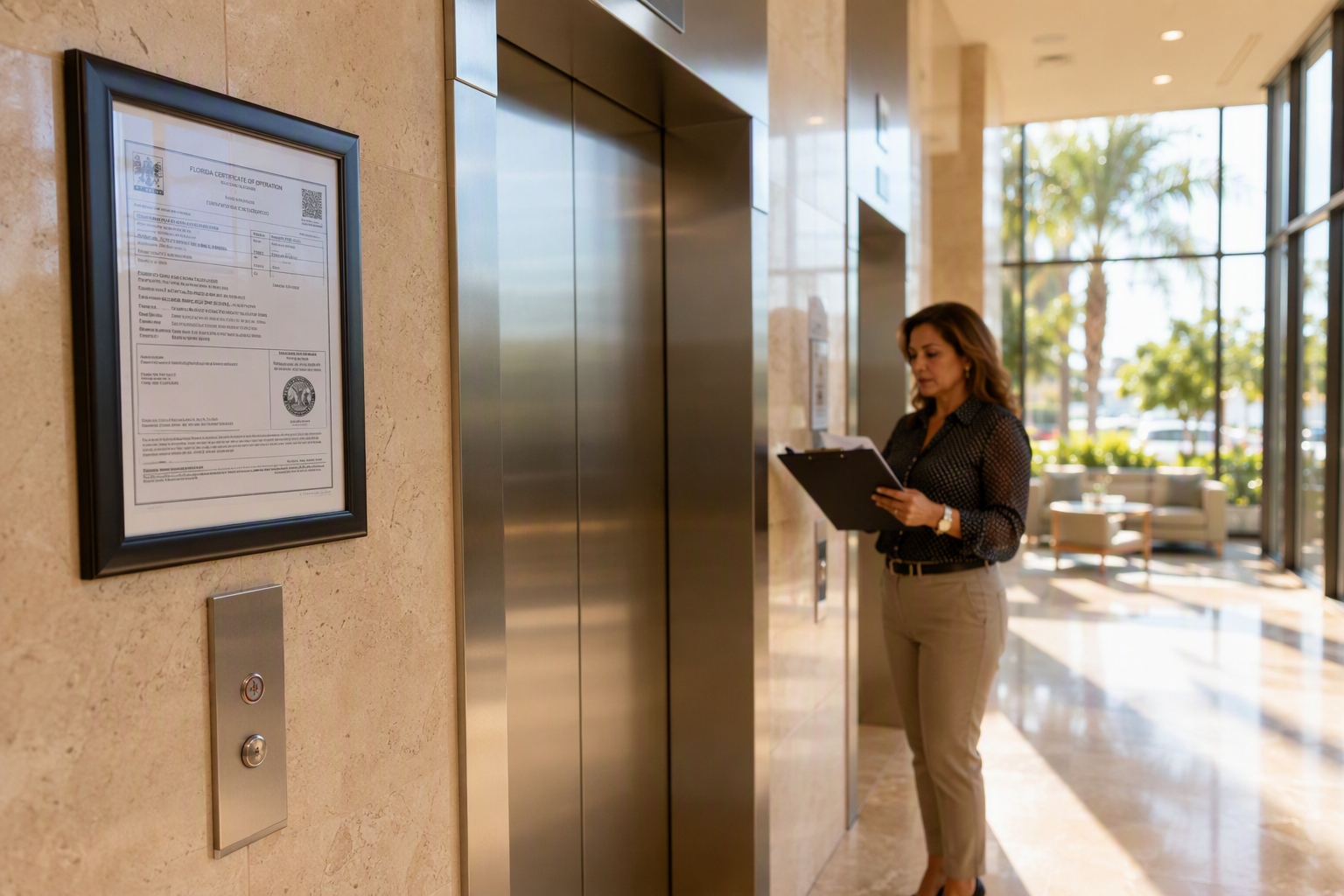
Elevator maintenance contractors and general building inspectors are not authorized to perform the official periodic inspection required for the issuance of a Florida operating permit. The inspection must be documented on the approved state forms, and the resulting certificate of operation must be posted inside the elevator cab in a location visible to passengers.
Companies like Axxiom Elevator Florida, operating in Pompano Beach and Sarasota, work alongside licensed inspectors and can coordinate inspection scheduling, prepare equipment for inspection readiness, and address any deficiencies cited during an inspection — ensuring the entire compliance cycle is managed efficiently.
What Is the Difference Between a Periodic Inspection and a Periodic Test?
A periodic inspection is a visual and operational examination of the elevator’s systems and safety devices performed on a routine schedule, while a periodic test is a formal, witnessed functional test of safety components that must be performed at less frequent but legally mandated intervals under ASME A17.1.
The ASME A17.1 Safety Code for Elevators and Escalators classifies tests into categories:
- Category 1 Tests: Annual no-load safety tests and brake tests applicable to most traction and winding drum elevators.
- Category 3 Tests: Applicable to hydraulic elevators, typically performed every five years.
- Category 5 Tests: Full-load safety tests performed every five years for traction elevators — the most comprehensive and disruptive test type.
Understanding which category applies to your equipment is essential for budgeting and scheduling. Property managers who confuse routine maintenance visits with code-required inspections and tests often find themselves out of compliance at renewal time.
What Documents Does a Florida Building Owner Need to Maintain for Elevator Compliance?
Florida building owners must maintain a current Certificate of Operation (operating permit), the most recent inspection report, and records of all periodic tests — and these documents must be available for review by state or local authorities upon request.
Specifically, the certificate of operation must be posted inside the elevator cab. The inspection report and test records should be kept in a maintenance log that is accessible to inspectors. Florida Statutes Chapter 399 also requires that any deficiencies noted during an inspection be corrected within a defined timeframe, and documentation of the corrective action must be retained.
Best practice — recommended by elevator compliance professionals — is to maintain a conveyance maintenance log for each unit on the property. This log should include installation records, all inspection and test reports, maintenance service records, repair invoices, and any violation notices and their resolution documentation.
What Happens If a Commercial Elevator Fails a Florida Inspection?
If a commercial elevator fails its Florida inspection, the inspector has authority to issue an order to cease operation, and the elevator must be taken out of service immediately until all cited deficiencies are corrected and a re-inspection confirms compliance.
Deficiencies are typically classified by severity:
- Immediately Dangerous (ID) deficiencies require the elevator to be shut down on the spot.
- Non-immediately dangerous (NID) deficiencies allow the elevator to remain in operation for a defined correction period, commonly 30 to 60 days depending on the nature of the deficiency and the enforcing authority.
Owners who fail to address cited deficiencies within the correction window may face civil penalties under Florida Statutes Chapter 399. Continued operation of a condemned elevator can also expose building owners to significant tort liability in the event of an injury.
When deficiencies are identified, acting quickly is critical. Axxiom Elevator Florida serves property owners in Pompano Beach and Sarasota who need prompt corrective repairs following an inspection finding, helping facilities return to compliant operation as efficiently as possible.
What Do Florida Elevator Inspectors Examine During a Routine Inspection?
During a routine periodic inspection, a licensed Florida elevator inspector examines the machine room, the hoistway, the car interior and exterior, the pit, all safety devices, emergency communication systems, lighting, signage, and operational functions in accordance with ASME A17.1 requirements.
Key inspection checkpoints include:
- Machine room temperature controls and access security
- Governor and overspeed safety system condition
- Door interlock and door reopening device function
- Car leveling accuracy at each floor
- Emergency lighting and two-way communication device
- Pit ladder, lighting, and stop switch condition
- Oil levels and hydraulic system integrity (hydraulic elevators)
- Hoistway clearances and buffer conditions
- Maximum capacity and signage posting
- Certificate of operation display
ADA compliance elements — such as control panel height, braille signage, and door timing — may also be flagged during an inspection, though ADA enforcement is technically a separate federal obligation under the Americans with Disabilities Act.
Does Florida Require a Separate ADA Inspection for Elevators?
Florida does not mandate a separate ADA-specific elevator inspection as part of the state’s operating permit process, but building owners remain independently obligated under federal law to ensure elevator accessibility features comply with ADA Standards for Accessible Design.
The Americans with Disabilities Act requires that elevators in commercial buildings be accessible to individuals with disabilities. This includes requirements for car dimensions, door widths, control panel heights, auditory signals, raised and braille markings, and two-way communication systems. ADA accessibility features are evaluated separately from the state safety inspection, and deficiencies in ADA compliance can expose building owners to federal complaints and civil litigation even when the state safety certificate is current.
How Does the Florida Elevator Permit Renewal Process Work?
Florida elevator operating permits are renewed annually, and renewal requires the submission of a completed inspection report from a licensed inspector demonstrating that the elevator passed its most recent periodic inspection and that all required tests are current.
The renewal cycle in Florida is managed through the DBPR or, in some jurisdictions, through a local elevator safety authority operating under a state-approved program. Owners typically receive a renewal notice, must schedule and pass the required inspection, pay the applicable permit fee, and post the renewed certificate of operation inside the elevator cab before the expiration date of the prior certificate.
Letting a permit lapse — even unintentionally — places the building owner in violation of Florida Statutes Chapter 399. Operating an elevator without a current certificate of operation is a violation that can result in fines and mandatory shutdown.
What Is the Difference Between Elevator Maintenance and Elevator Inspection?
Elevator maintenance is the ongoing, routine servicing performed by a licensed elevator mechanic to keep equipment operating safely and reliably, while an elevator inspection is a formal, independent examination performed by a licensed inspector to verify legal compliance with state and ASME code requirements.
These are distinct functions performed by different parties for different purposes:
| Factor | Elevator Maintenance | Elevator Inspection |
|---|---|---|
| Purpose | Prevent failures; keep equipment operational | Verify code compliance; issue operating permit |
| Performed By | Licensed elevator mechanic / maintenance contractor | State-licensed or approved third-party inspector |
| Frequency | Monthly, quarterly, or per service contract terms | Every 6 months (routine); annually or 5-year cycles (tests) |
| Legal Outcome | No certificate issued; affects equipment condition | Pass/fail; triggers certificate of operation renewal |
| ASME A17.1 Reference | Part 8 (Maintenance, Repair, and Replacement) | Part 8.6 (Inspections and Tests) |
| ADA Relevance | Ensures accessibility features function correctly | May flag ADA issues; ADA enforcement is federal |
Maintaining a robust service contract with a qualified elevator company ensures equipment is always in inspection-ready condition. Axxiom Elevator Florida provides maintenance services for commercial elevator clients in Pompano Beach and Sarasota, helping properties stay consistently prepared for state inspections.
Does a New Elevator Installation Require an Inspection Before Operation in Florida?
Yes — a newly installed elevator in Florida must pass a full acceptance inspection and witnessing of all acceptance tests before it can legally operate and receive its initial certificate of operation.
The acceptance inspection is among the most comprehensive examinations an elevator undergoes in its lifecycle. Under ASME A17.1, acceptance inspections and tests must verify that the installation conforms to the approved construction documents, that all safety devices function correctly under test conditions, and that the installation meets the code edition adopted at the time the permit was issued.
No elevator may be placed in passenger service until the accepting authority — the DBPR or the local authority having jurisdiction (AHJ) — has received, reviewed, and approved the inspection and test reports and issued the initial certificate of operation.
What Should a Building Owner Do Immediately After Receiving an Inspection Violation?
Upon receiving a violation notice, a building owner should take the following steps in sequence to restore compliance and protect occupants and liability exposure:
- Read the violation notice carefully — Identify whether each deficiency is classified as immediately dangerous (requiring immediate shutdown) or non-immediately dangerous (allowing continued operation during a correction period).
- Take immediately dangerous elevators out of service — Post clear “Out of Service” signage on all affected car doors and machine room access.
- Contact a licensed elevator service company — Engage a qualified elevator maintenance contractor immediately to evaluate and correct each cited deficiency.
- Obtain written repair estimates and a repair timeline — Document all communication with your service provider for the compliance file.
- Complete all required repairs — Ensure work is performed by licensed elevator mechanics in compliance with ASME A17.1 and Florida administrative rules.
- Schedule a re-inspection — Contact the licensing authority or your authorized inspection agency to schedule a follow-up inspection to verify corrections.
- Update your maintenance log — File all repair invoices, re-inspection reports, and the renewed certificate of operation in the conveyance maintenance record.
- Review your maintenance program — Assess whether existing maintenance practices were sufficient to prevent the cited deficiencies and adjust your service contract accordingly.
Are Elevator Inspections in Florida the Same for All Building Types?
No — while the base inspection frequency and ASME A17.1 standards apply broadly, the specific requirements, jurisdictional oversight, and enforcement mechanisms can vary depending on building type, ownership classification, and the local authority having jurisdiction.
For example, elevators in state-owned buildings may be subject to inspection by different state agencies than those in privately owned commercial buildings. Elevators in hospitals and healthcare facilities may face additional oversight from the Agency for Health Care Administration (AHCA) in addition to DBPR requirements. Elevators in single-family residential settings or private homes are generally exempt from Florida’s mandatory inspection program, though they remain subject to ASME A17.1 from a design and installation standpoint.
Hotels and lodging establishments, which are regulated under a different DBPR division than general commercial buildings, may have slightly different administrative renewal procedures, though the core inspection and test requirements under ASME A17.1 remain consistent.
What Are the Most Common Reasons Commercial Elevators Fail Inspection in Florida?
The most frequently cited deficiencies in commercial elevator inspections relate to door safety devices, emergency communication systems, lighting, and overdue test documentation — many of which are preventable through consistent preventive maintenance.
Common inspection failure points include:
- Door reopening devices (safety edges or light curtains) that are worn, misaligned, or non-functional
- Two-way emergency communication systems that are inoperative or fail to connect to a continuously monitored location
- Expired or overdue Category 1 or Category 5 safety test documentation
- Machine room access or temperature control violations
- Missing or illegible maximum capacity placards
- Pit lighting, stop switch, or ladder deficiencies
- Oil leaks in hydraulic systems without proper containment
- Failure to display a current certificate of operation in the cab
Many of these issues are identified and corrected during routine preventive maintenance before an inspector ever visits the property — which is one of the primary values of a structured service agreement.
How Does OSHA Relate to Elevator Safety in Commercial Workplaces?
OSHA’s General Duty Clause (Section 5(a)(1) of the Occupational Safety and Health Act) requires employers to provide a workplace free from recognized hazards, and elevator safety in commercial settings can fall within OSHA’s enforcement authority — particularly in workplaces where elevator failures pose risks to employees.
While elevator safety is primarily governed at the state level through DBPR and ASME A17.1 in Florida, OSHA can cite employers for elevator-related hazards under its General Industry Standards, particularly in construction settings (29 CFR 1926.552 covers material and personnel hoists) or when an elevator malfunction creates a workplace hazard. OSHA does not replace Florida’s elevator inspection program — it operates concurrently and adds a layer of employer accountability for elevator-related workplace safety.
Can a Building Owner Hire Any Elevator Company to Perform Inspection-Related Repairs?
Repairs on commercial elevators in Florida must be performed by or under the direct supervision of a licensed elevator contractor holding a valid state Certificate of Competency — not all elevator companies hold the required Florida credentials, so verification is essential before engaging any service provider.
Florida Statutes Chapter 399 requires that elevator work — including installation, alteration, repair, and maintenance — be performed by or under the supervision of a licensed elevator contractor. Property managers should verify that any company they engage holds a current Florida elevator contractor license and that the mechanics performing work in the field hold the appropriate journeyman or apprentice credentials under state law.
Axxiom Elevator Florida operates as a certified elevator service company in Pompano Beach and Sarasota, providing commercial clients with compliant maintenance, repair, and modernization services that meet Florida’s licensing requirements.
How Long Does a Florida Commercial Elevator Inspection Typically Take?
A routine periodic inspection of a single commercial elevator typically takes between one and three hours depending on the elevator type, the number of floors served, the accessibility of the machine room and pit, and the inspector’s findings during the examination.
More complex equipment — high-rise traction elevators, multi-car banks, or elevators requiring a Category 5 test — will require significantly more time and may necessitate the elevator being taken out of service for an extended period. Category 5 tests, which involve full-load safety device tests, require careful coordination between the building, the maintenance contractor, and the inspection authority to minimize disruption to building occupants.
Property managers in high-traffic commercial buildings in Pompano Beach and Sarasota should communicate with their elevator service company well in advance of scheduled inspections to plan for appropriate service interruptions.
What Is the Cost Range for Commercial Elevator Inspections in Florida?
Inspection fees vary depending on the type of equipment, the inspection authority, and whether the inspection is performed by a state inspector or a licensed third-party inspection agency — property owners should contact licensed inspection providers directly for current fee schedules applicable to their specific equipment and jurisdiction.
Beyond the direct inspection fee, owners should budget for the costs of any deficiency corrections identified during the inspection, the state permit renewal fee charged by the DBPR or local authority, and the cost of any required periodic tests (Category 1 or Category 5) that fall due during the permit year. These costs vary considerably based on elevator type, age, and condition, and are best evaluated through a site assessment by a qualified elevator professional.
How Do Elevator Inspection Requirements Differ Between Pompano Beach and Sarasota?
Both Pompano Beach (Broward County) and Sarasota (Sarasota County) fall under the jurisdiction of the Florida DBPR for elevator safety oversight, though each municipality may have local amendments, permit fee structures, or administrative procedures that supplement the state’s baseline requirements.
Florida’s elevator safety law — Chapter 399 — establishes statewide minimum standards, but municipalities and counties retain the authority to adopt stricter requirements or administer their own elevator inspection programs if approved by the state. Building owners in both Pompano Beach and Sarasota should confirm whether their specific property falls under direct DBPR oversight or under a locally administered program, as this affects the procedural steps for permit renewal and re-inspection scheduling.
Axxiom Elevator Florida serves clients in both markets and is familiar with the administrative processes, inspection authority contacts, and local compliance landscape in Pompano Beach and Sarasota — providing property managers with guidance that is specific to their jurisdiction rather than generic statewide advice.
What Modernization Triggers a New Inspection in Florida?
Any alteration to a commercial elevator that falls within the definition of a “major alteration” under ASME A17.1 or Florida administrative rules triggers a requirement for new construction permits, plan review, and a full acceptance inspection before the modernized elevator can return to service.
Under the ASME A17.1 Safety Code for Elevators and Escalators, alterations are classified by scope, and major alterations — such as replacement of the drive machine, controller, car frame, or safety devices — require the altered components to meet the code edition in effect at the time of the alteration, not the original installation code. This can create significant code upgrade requirements for older equipment undergoing modernization.
Property owners planning modernization projects should engage their elevator service company and the DBPR or local AHJ early in the planning process to understand permit requirements, inspection obligations, and code upgrade implications before work begins.
How Can Building Owners Stay Ahead of Inspection Requirements and Avoid Violations?
The most effective strategy for maintaining continuous elevator compliance is to combine a structured preventive maintenance contract with a proactive inspection tracking system that alerts property managers to upcoming permit renewals, required test intervals, and routine inspection dates well in advance.
Practical steps for proactive compliance management include:
- Maintaining a compliance calendar that tracks permit expiration dates, Category 1 test due dates, and Category 5 test due dates for each unit on the property
- Scheduling routine maintenance visits at a frequency that keeps equipment in inspection-ready condition at all times
- Engaging a licensed elevator contractor who will communicate proactively about upcoming code-required tests and their scheduling implications
- Conducting informal pre-inspection walkthroughs with the maintenance contractor before each scheduled state inspection to identify and correct minor deficiencies in advance
- Ensuring that maintenance logs, repair records, and prior inspection reports are organized and accessible in the machine room or on-site office
- Verifying that the certificate of operation displayed in each cab is current and legible at all times
Building owners who treat elevator compliance as a year-round program — rather than a once-or-twice-a-year event — consistently experience fewer violations, lower emergency repair costs, and reduced liability exposure.
Florida Commercial Elevator Inspection Quick Reference
| Inspection / Test Type | Frequency | Governing Standard | Performed By | Key Output |
|---|---|---|---|---|
| Routine Periodic Inspection | Every 6 months | Florida Statutes § 399.061 / ASME A17.1 | Licensed FL elevator inspector | Pass/fail report; permit renewal |
| Category 1 Safety Test | Annually | ASME A17.1 (traction elevators) | Licensed inspector; witnessed test | Test report on file |
| Category 3 Hydraulic Test | Every 5 years | ASME A17.1 (hydraulic elevators) | Licensed inspector; witnessed test | Test report on file |
| Category 5 Full-Load Safety Test | Every 5 years | ASME A17.1 (traction elevators) | Licensed inspector; witnessed test | Test report on file |
| Acceptance Inspection (new/altered) | Before initial operation or post-alteration | ASME A17.1 / Florida Statutes § 399 | Licensed inspector; AHJ approval | Initial certificate of operation |
Need elevator service you can rely on? Axxiom Elevator Florida is ready to help.