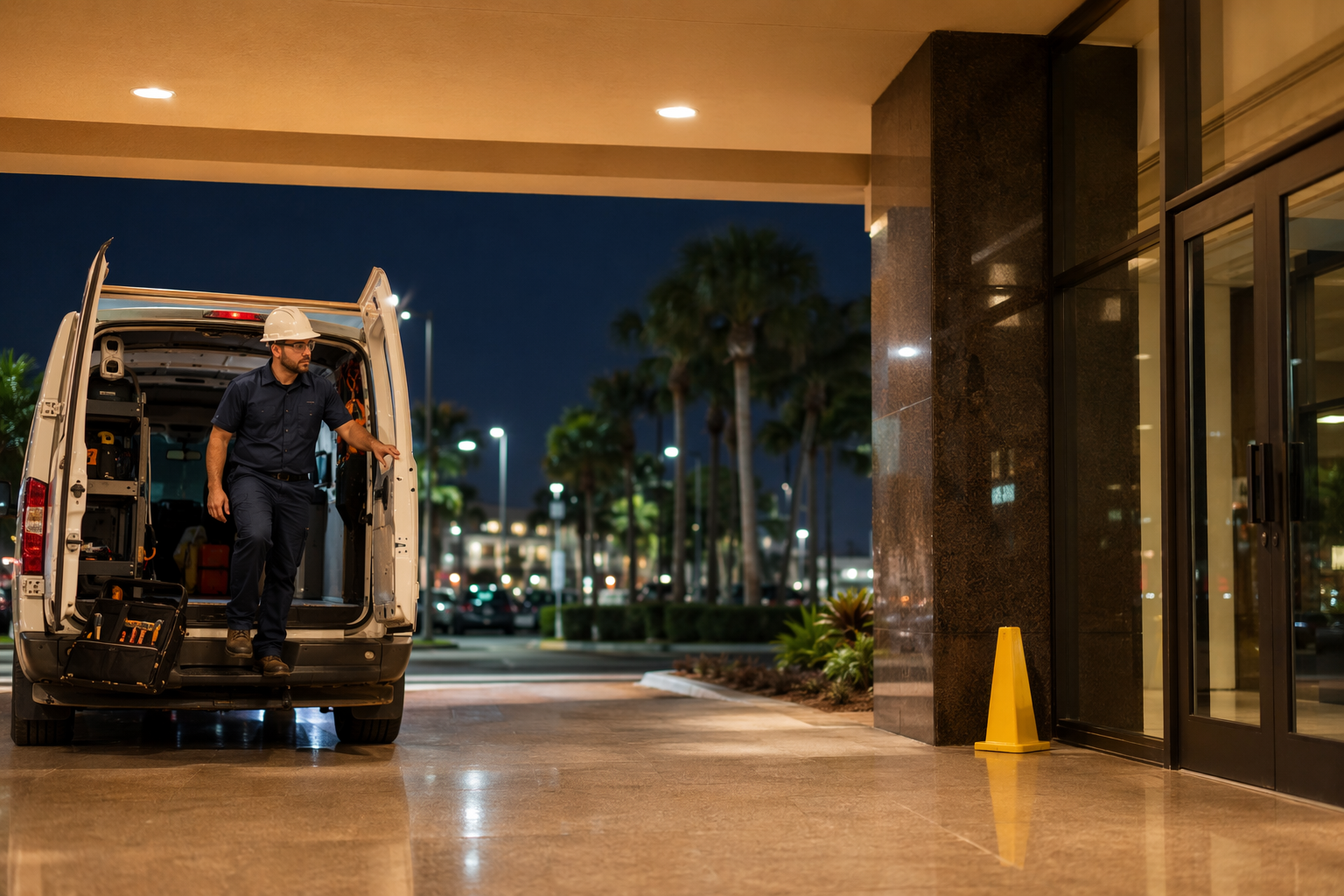
After more than 15 years in the field servicing hydraulic, traction, and MRL elevator systems across Florida, I have responded to hundreds of after-hours emergency calls. Whether a passenger is trapped between floors at 2 a.m. or a freight elevator fails during a Saturday warehouse shift, the wrong call — or a delayed call — turns a mechanical issue into a liability crisis. This FAQ hub covers every question building owners, property managers, and facility directors ask about 24-hour elevator repair in Florida, including costs, compliance obligations, what to do during a breakdown, and how to choose the right vendor.
Who is qualified to perform 24-hour emergency elevator repair in Florida?
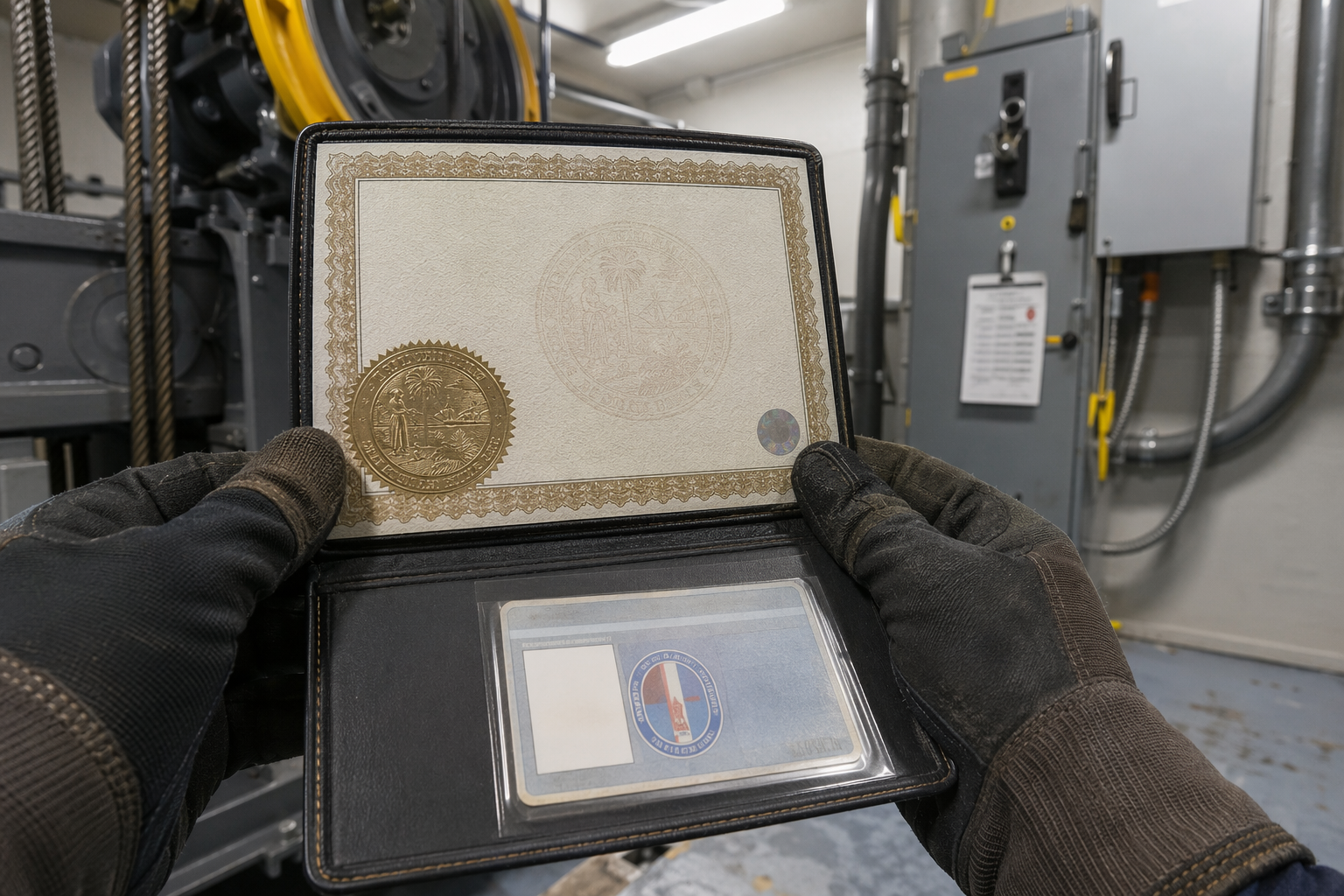
Only a state-licensed elevator contractor holding a Florida Certificate of Competency under Florida Statute 399 and employing IUEC (International Union of Elevator Constructors)-certified mechanics is legally qualified to perform emergency elevator repair in Florida.
Florida Statute 399.02 requires all elevator work — including emergency repairs — to be performed by licensed contractors. This is not optional; a building owner who permits an unlicensed vendor to work on elevator equipment can face fines of up to $5,000 per violation from the Florida Department of Business and Professional Regulation (DBPR). In 2026, the DBPR continues active enforcement sweeps in high-density markets like Broward and Sarasota counties.
When evaluating a 24-hour provider, always request their Florida elevator contractor license number and confirm IUEC mechanic certification. Axxiom Elevator Florida carries full licensing and employs IUEC-certified technicians dispatched directly from Pompano Beach and Sarasota service hubs, ensuring response times well below the industry average.
What counts as a true elevator emergency requiring immediate repair?
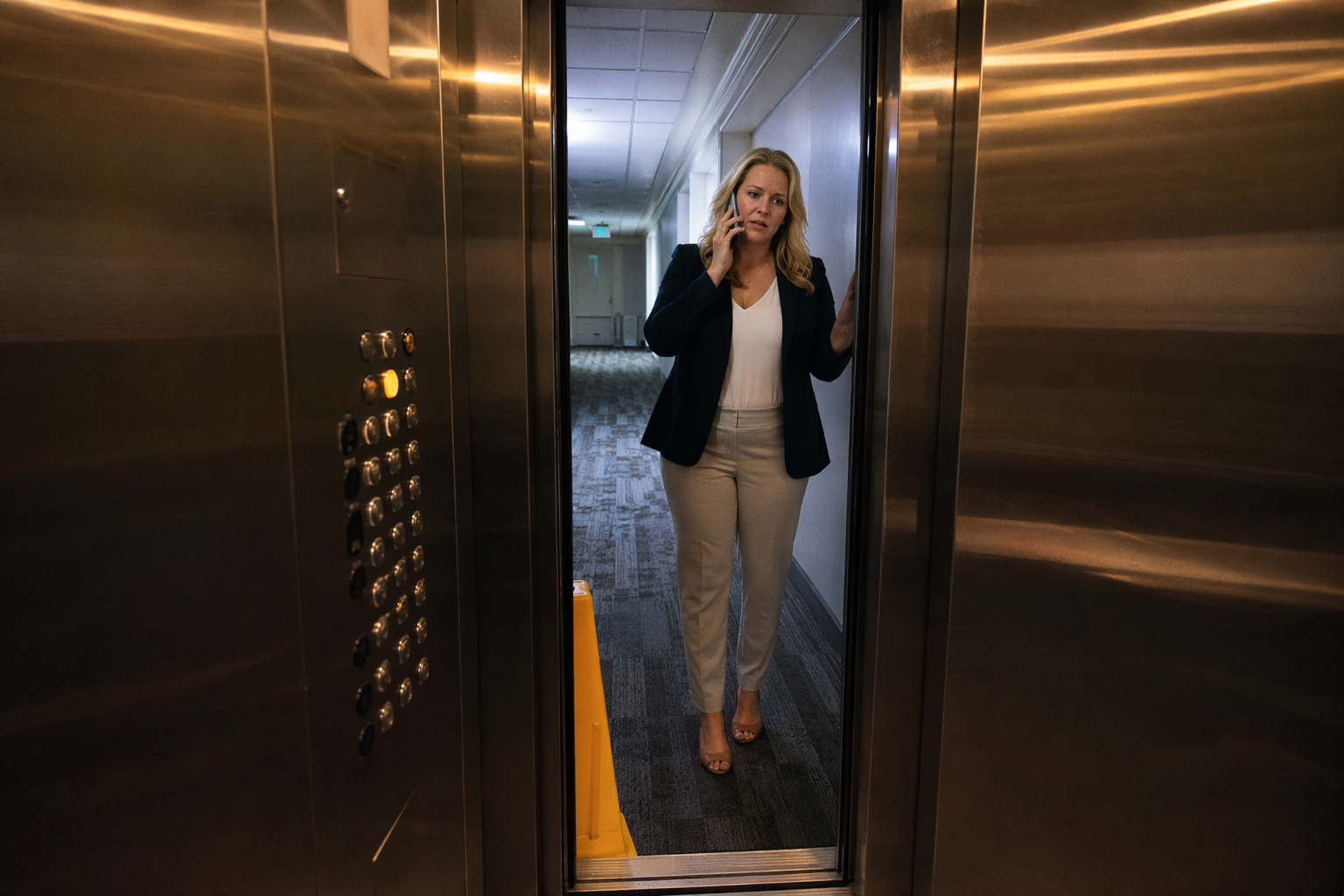
A true elevator emergency is any condition that traps passengers, creates immediate fall or entrapment risk, disables ADA-required access, or involves fire recall, hydraulic fluid leaks, or electrical smoke — all requiring dispatch within 1–2 hours, not the next business day.
From a code standpoint, ASME A17.1-2019/CSA B44, the governing safety code for elevators in the United States, classifies certain deficiencies as “Category 5 Imminent Hazard” — these must be taken out of service immediately and repaired before the elevator is returned to operation. Examples include broken governor ropes, failed safety gear, flooded pit conditions exceeding 12 inches of water, and malfunctioning door-locking devices.
Non-emergency situations that still require same-day or next-day attention include slow door operation, leveling drift of more than ½ inch, nuisance shutdowns, and lighting failures in the cab. Never assume a “slow” elevator is safe — leveling issues are a leading cause of trip-and-fall injuries and ADA violations under ADA Standards for Accessible Design Section 4.10.
What should I do immediately when an elevator breaks down with passengers inside?
When passengers are trapped in an elevator, follow a specific emergency protocol to keep them calm and safe while certified help is dispatched — never attempt to manually open doors or extract passengers yourself.
- Activate the emergency call button inside the cab — This connects passengers to your building’s monitoring station or a live answering service. Confirm that someone is actively speaking with the trapped occupants.
- Call 911 if passengers report medical distress, fire, or smoke — Fire departments have protocols for elevator rescue but cannot perform equipment repairs. Their role ends at safe extraction.
- Call your licensed 24-hour elevator repair company immediately — Provide the elevator ID number (typically posted inside the cab), the floor or zone where it is stopped, and the number of passengers.
- Do NOT attempt to pry open hoistway doors — Hoistway doors opened improperly expose a fall hazard of up to the full height of the building. This action has caused fatalities.
- Keep communication lines open with trapped passengers — Use the intercom, phone through the door, or maintain voice contact. Inform them that certified help is en route and provide a time estimate.
- Secure the elevator lobby on adjacent floors — Post staff or signage to prevent other passengers from approaching the doors.
- Document the incident — Note the time of failure, conditions reported, and all actions taken. This is required for your Florida DBPR incident report and may be needed for insurance purposes.
- Upon technician arrival, provide full access — Machine room keys, pit access, and elevator ID documentation should be ready to hand off immediately.
How quickly should a 24-hour elevator repair company respond to an emergency call?
Industry best practice and most elevator service contracts define emergency response time as within 2 hours of the call, though entrapments with passengers inside should trigger a dispatch target of 60 minutes or less.
Response time benchmarks vary significantly by provider type. The table below compares typical response scenarios across vendor categories in Florida markets as of 2026:
| Vendor Type | Avg. Emergency Response Time | Licensed in Florida? | 24/7 Live Dispatch? | IUEC-Certified Mechanics? |
|---|---|---|---|---|
| National OEM Service Company | 3–8 hours | Yes | Yes (call center) | Yes |
| Independent Local Contractor (non-certified) | Varies / unpredictable | Sometimes | Rarely | Rarely |
| Regional Independent (licensed + IUEC) | 1–3 hours | Yes | Yes | Yes |
| Axxiom Elevator Florida | Under 2 hours (Pompano Beach & Sarasota) | Yes | Yes — live technician dispatch | Yes |
One critical distinction: national OEM companies often route emergency calls through centralized call centers, sometimes adding 30–90 minutes before a local technician is even notified. A regional provider like Axxiom Elevator Florida dispatches from local hubs, meaning the technician who takes your call is often the same mechanic arriving at your door.
What are the costs of 24-hour emergency elevator repair in Florida?
Emergency elevator repair in Florida typically costs between $350 and $950 for the service call alone, with after-hours labor rates running 1.5x to 2x standard rates, and total repair bills ranging from $500 to $15,000+ depending on the failed component.
Here is a realistic breakdown of what to expect in 2026:
- Emergency dispatch fee (nights, weekends, holidays): $250–$500
- After-hours labor rate: $120–$220 per hour per mechanic (vs. $80–$140 standard)
- Common repairs — door operator replacement: $800–$2,500
- Hydraulic pump/valve repair: $1,200–$6,000
- Controller board replacement: $2,000–$12,000
- Governor rope replacement: $1,500–$4,500
- Emergency entrapment extraction only (no repair): $350–$700
Buildings on a full preventive maintenance contract typically pay significantly less for emergency visits because the emergency rate is contractually capped and some repairs fall within the contract scope. This is one of the strongest financial arguments for enrolling in a comprehensive maintenance agreement rather than relying on time-and-materials emergency calls.
Does Florida law require building owners to have a 24-hour elevator service contract?
Florida Statute 399 does not mandate a specific service contract format, but it does require that all elevators subject to public use be maintained in safe operating condition by a licensed contractor, which as a practical matter necessitates a service relationship with a qualified provider.
Under Florida Statute 399.02 and the Florida Department of Business and Professional Regulation’s elevator safety rules (Chapter 61C-5), owners of public-use elevators must ensure all inspections, tests, and maintenance are performed by licensed entities. The statute does not prescribe “full maintenance” versus “oil and grease” contract types, but DBPR inspectors are empowered to issue immediate stop-use orders for elevators that show evidence of deferred maintenance — a condition that becomes a legal liability for owners.
For condominiums, commercial properties, and healthcare facilities in particular, insurance underwriters in 2026 increasingly require proof of a maintenance agreement with a licensed contractor as a condition of property and general liability coverage.
How do I verify that an elevator repair company is properly licensed in Florida?
Verify any elevator contractor’s Florida license through the DBPR’s online license verification portal at myfloridalicense.com, where you can search by company name, license number, or individual qualifier.
Specifically, search for a Certified Elevator Certificate of Competency or a Registered Elevator Certificate of Competency. Also confirm:
- The company’s liability insurance and workers’ compensation certificates (request COIs directly — do not accept verbal confirmation)
- IUEC union hall affiliation or individual mechanic certifications
- Certificate of Authorization from the Florida DBPR for the corporate entity
- Proof of QEI (Qualified Elevator Inspector) affiliation for inspection services
Axxiom Elevator Florida maintains all required Florida licensure and insurance documentation and makes verification simple for property managers evaluating service vendors.
What elevator systems and brands can a 24-hour repair service work on?
A fully equipped 24-hour elevator repair service should be capable of servicing all major elevator types — hydraulic, geared traction, gearless traction, MRL (machine-room-less), and LULA (limited-use/limited-application) — across all major OEM brands.
The most common elevator brands found in Florida commercial and residential buildings include Otis, KONE, Schindler, ThyssenKrupp, Mitsubishi, Fujitec, and Dover/Montgomery. Emergency repairs on proprietary controller systems (such as KONE’s V3F drives or Schindler’s Miconic systems) require technicians with OEM-specific training or access to the manufacturer’s diagnostic software.
When vetting a 24-hour provider, ask specifically: “Can your technicians access the diagnostic interface for [your elevator brand]?” A technician who cannot pull fault codes from the controller cannot efficiently diagnose the problem, which extends downtime and drives up labor costs.
What ASME and ADA compliance issues require emergency attention versus scheduled repair?
Under ASME A17.1, any deficiency classified as a Category 1 or Category 5 safety hazard must trigger an immediate out-of-service determination, while ADA leveling violations exceeding ½ inch require correction before the elevator can legally serve as the accessible route.
| Issue Type | Governing Code | Urgency Level | Out-of-Service Required? |
|---|---|---|---|
| Passenger entrapment | ASME A17.1 / Florida Statute 399 | Immediate (0–60 min) | Yes |
| Broken or worn governor rope | ASME A17.1 Section 2.18 | Immediate | Yes |
| Hydraulic fluid leak (active) | ASME A17.1 Section 3.18 | Same day | Yes |
| Door reopening device failure | ASME A17.1 Section 2.13 | Same day | Recommended |
| Leveling accuracy > ½ inch | ADA Section 4.10 / ASME A17.1 | Within 48 hours | If sole accessible route |
| Emergency lighting failure | ASME A17.1 Section 2.27 | Within 72 hours | No |
| Cab interior cosmetic damage | None (aesthetic) | Scheduled | No |
How often should elevator systems be inspected to prevent emergency breakdowns?
Florida requires annual standard inspections and periodic Category 1, 3, and 5 testing per ASME A17.1, but industry data consistently shows that buildings on quarterly preventive maintenance programs experience 60–70% fewer emergency service calls than those on annual-only inspection cycles.
The Florida DBPR mandates annual inspections by a licensed QEI (Qualified Elevator Inspector), but inspection alone is not maintenance. The ASME A17.1-2019 code requires:
- Category 1 tests — Annual safety and operational tests
- Category 3 tests — Every 3 years for hydraulic systems (pressure relief valve)
- Category 5 tests — Every 5 years for traction elevators (full-load safety test)
Beyond code minimums, a professional preventive maintenance schedule includes monthly lubrication of guide rails and sheaves, quarterly controller inspection and contact cleaning, semi-annual door operator adjustment, and annual rope inspection. Buildings that defer this work typically see escalating emergency repair frequency beginning in year 3 of neglect.
What is the difference between an elevator maintenance contract and an emergency repair agreement?
A maintenance contract is a proactive, scheduled service agreement covering routine upkeep and often including emergency response, while an emergency repair agreement (or time-and-materials arrangement) only governs how you are billed when a breakdown occurs — it provides no preventive service.
There are four primary contract types in the elevator service industry:
- Oil and Grease (OG): Covers lubrication and minor adjustments only. Labor and parts for repairs billed separately. Lowest upfront cost, highest long-term risk.
- Parts and Labor (P&L): Covers all repair labor and most standard parts. Excludes major components like controllers and motors. Mid-tier cost.
- Full Maintenance (FM): Covers virtually all parts and labor including major component replacement. Highest monthly cost but most predictable budget and fastest response.
- Time and Materials (T&M): No contract, billed per incident. Appropriate only for buildings with very low traffic and newer equipment under manufacturer warranty.
For most commercial buildings in Pompano Beach and Sarasota, a Parts and Labor or Full Maintenance agreement with a 24/7 emergency response clause is the financially sound choice.
Can I call the elevator manufacturer directly for 24-hour emergency service?
You can call the OEM manufacturer’s service line, but response times for non-contract buildings are often significantly longer than those from a local licensed independent service provider, and proprietary restrictions may not apply to your specific system.
Major OEMs like Otis, KONE, and Schindler maintain national emergency lines, but their dispatch priority model favors buildings under their own service contracts. In 2026, independent buildings calling an OEM emergency line should expect response times of 4–10 hours in secondary markets like Sarasota — compared to under 2 hours from a local licensed contractor with local inventory.
Additionally, OEM “entrapment fees” and after-hours premiums are frequently higher than independent contractor rates. For buildings not under OEM contract, independent IUEC-certified contractors often represent a faster, more cost-effective emergency option.
What information should I have ready when I call for 24-hour elevator repair?
Having six specific pieces of information ready before you call dramatically reduces dispatch time and helps the technician arrive with the correct tools and parts.
- Building address and suite/unit access instructions — Include after-hours entry procedures, gate codes, and where to find the machine room.
- Elevator make, model, and serial number — Found on the certificate of operation posted inside the cab or on the controller in the machine room.
- Number of stops and elevator type — Hydraulic, traction, or MRL; number of floors served.
- Nature of the problem — Is the elevator moving? Stuck between floors? Door not closing? Error code displayed?
- Number of passengers trapped (if applicable) — Ages, any medical conditions if known.
- Last known service date and current maintenance provider — This helps the incoming technician understand service history and system condition.
How do I choose between local versus national elevator service companies for 24-hour coverage?
Local licensed contractors consistently outperform national companies on emergency response time, personalized service, and cost transparency, while national OEMs may have advantages for proprietary system diagnostics on their own equipment.
The decision framework most experienced facility managers use in 2026:
- Choose a local IUEC-certified independent if: You have a mixed brand portfolio, your building is in a secondary market (like Sarasota), response time is your top priority, or you have been underserved by your current OEM contract.
- Choose the OEM if: Your elevator is under warranty, you have a new proprietary system with locked diagnostics, or you are in a major metro with fast OEM response SLAs.
- Avoid any vendor who cannot provide: A written Florida contractor license number, proof of liability insurance, IUEC certification documentation, and a contractual response time guarantee.
Are there special considerations for 24-hour elevator repair in healthcare or high-rise buildings?
Yes — healthcare facilities and high-rise buildings above 75 feet have additional code requirements under ASME A17.1, The Joint Commission standards, and Florida’s high-rise building code that elevate both the urgency and technical complexity of emergency repairs.
In healthcare settings, elevator downtime directly impacts patient care, particularly for facilities using elevators to transport patients, medical equipment, and emergency response teams. The Joint Commission’s Environment of Care standards (EC.02.06.01) require healthcare organizations to maintain medical equipment — including vertical transport — in safe operating condition, with documented response protocols.
High-rise buildings above 75 feet are subject to Florida Building Code Section 3007 (fire service access elevators) and Section 3008 (occupant evacuation elevators), which impose additional testing, signage, and emergency power requirements. Emergency repairs on these systems must account for firefighter service mode operation under ASME A17.1 Section 2.27.3.
What happens if an elevator fails a Florida DBPR inspection — do I need emergency repair?
If a DBPR inspector issues an out-of-service order or a Certificate of Operation is withheld due to a failed inspection, you are legally required to complete the cited repairs before reopening the elevator to the public — making it a time-sensitive repair, though not necessarily a 3 a.m. emergency.
Florida DBPR inspection failures fall into two categories:
- Imminent hazard (red tag): Elevator must be taken out of service immediately. Building owner has no discretion. Repairs must be completed and re-inspected before the elevator can return to service.
- Standard deficiency (correction notice): Owner is given a specific timeframe (typically 30–90 days) to correct the cited issue. Elevator may remain in service during the correction period at the inspector’s discretion.
In both cases, only a licensed Florida elevator contractor can perform the corrective work, and documentation of the completed repair must be submitted to the DBPR. Axxiom Elevator Florida is experienced in navigating the DBPR re-inspection process and can coordinate paperwork on behalf of building owners in Pompano Beach and Sarasota.
What are the most common causes of after-hours elevator emergencies in Florida?
The five most common causes of after-hours elevator emergencies in Florida commercial buildings are door system failures, hydraulic fluid overheating, power fluctuations causing controller faults, pit flooding from summer storms, and worn brake assemblies.
Florida’s climate creates unique elevator failure patterns that technicians in northern states rarely encounter:
- Pit flooding: Florida’s high water table and intense summer rainfall frequently flood elevator pits, triggering automatic shutdown via the pit stop switch. This is the most common weather-related emergency from June through September.
- Hydraulic fluid viscosity breakdown: Florida heat accelerates hydraulic oil degradation, causing sluggish leveling, overtemperature shutdowns, and eventual pump failure if oil changes are deferred.
- Door operator failures: High humidity warps door sill tracks and degrades door operator components. Door failures account for approximately 40% of all elevator service calls nationally, and that percentage climbs in coastal Florida markets.
- Power surge controller faults: Florida’s lightning frequency — the highest in the United States — causes frequent voltage spikes that corrupt elevator controller memory and trip breakers.
- Brake wear acceleration: Buildings with heavy freight or residential move-in/move-out traffic experience accelerated brake pad wear, which in extreme cases triggers the safety circuit and takes the elevator out of service unexpectedly.
How long does a typical 24-hour emergency elevator repair take to complete?
Most emergency elevator repairs in Florida are resolved within 2–6 hours of technician arrival, though complex component replacements — controller boards, hydraulic cylinders, or hoist ropes — may require a temporary out-of-service period of 1–5 business days pending parts procurement.
Realistic time expectations by repair type in 2026:
- Entrapment extraction (no repair): 30–90 minutes on-site
- Controller reset / software fault: 1–3 hours
- Door operator adjustment or replacement: 2–5 hours
- Hydraulic fluid refill and leak repair: 3–6 hours
- Motor starter or contactor replacement: 2–4 hours
- Controller board replacement (in stock): 4–8 hours
- Hoist rope replacement: 8–16 hours (usually scheduled, not emergency)
- Hydraulic cylinder replacement: 3–7 business days
Technicians with local parts inventory — a key operational advantage of local contractors — dramatically reduce wait times for common components like door operators, contactors, and valve assemblies.
Does 24-hour elevator repair service include entrapment rescue, or is that the fire department’s job?
In Florida, both the fire department and licensed elevator technicians play distinct roles in passenger entrapment — fire departments perform the physical rescue extraction, while the elevator technician is legally required to perform the mechanical investigation and repair before the elevator returns to service.
Under Florida Statute 399 and local fire codes, fire rescue personnel are authorized to manually release hoistway doors and extract passengers in entrapment emergencies. However, they are not licensed to operate or repair the elevator equipment. Once passengers are safely extracted, the elevator must remain out of service until a licensed contractor performs a full mechanical assessment and documents clearance for return to service.
This means that even after fire rescue has extracted a trapped passenger, building owners still need a licensed 24-hour elevator repair service like Axxiom Elevator Florida to respond, diagnose the root cause, perform any necessary repairs, and restore the elevator to legal operation. Skipping this step and simply resetting the elevator violates Florida law and voids liability protection.
How do I set up a long-term 24-hour elevator service relationship to avoid crisis calls?
The most reliable way to minimize emergency calls is to enroll in a comprehensive preventive maintenance contract with a 24/7 emergency response clause before a breakdown occurs — not after.
Building owners in Pompano Beach and Sarasota who have the best outcomes follow this approach:
- Audit your current equipment condition — Commission a full elevator assessment from a licensed third-party contractor (not the incumbent if you suspect deferred maintenance).
- Select a contract type appropriate to equipment age and traffic volume — Buildings with elevators over 15 years old should strongly consider full maintenance coverage.
- Negotiate a contractual emergency response time SLA — Get the response time guarantee (60–120 minutes for entrapments) in writing, with penalty provisions for non-performance.
- Establish a single emergency contact number — Ensure it routes to a live person, not a voicemail or national call center queue.
- Create an internal emergency binder — Document elevator serial numbers, machine room locations, access codes, and the service company’s emergency line for every property manager and after-hours security staff member.
- Review your contract annually — Equipment ages, usage patterns change, and your contract scope should evolve accordingly.
Ready to Ensure 24-Hour Elevator Coverage for Your Property?
Whether you are managing a condominium tower in Pompano Beach, a medical office building in Sarasota, or a mixed-use commercial property anywhere in between, elevator downtime is a liability you cannot afford to leave to chance. Axxiom Elevator Florida provides IUEC-certified emergency response, Florida-licensed repair work, and transparent maintenance contracts built for the demands of Florida’s climate and code environment.
Contact Axxiom Elevator Florida for a free elevator assessment. Our certified technicians will evaluate your current equipment condition, review your maintenance history, and recommend the right service coverage to protect your building, your tenants, and your liability exposure.
Call us 24 hours a day, 7 days a week:
Serving Pompano Beach, Sarasota, and surrounding Florida communities — licensed, insured, and IUEC-certified.