After 15-plus years in the elevator industry, I’ve responded to hundreds of entrapment calls, after-hours breakdowns, and compliance emergencies across Florida. One of the most common and preventable problems I see is that building managers, tenants, and property owners simply don’t know who to call when something goes wrong with an elevator. This comprehensive guide will walk you through every aspect of elevator emergency contacts — from in-cab phone requirements to Florida-specific regulations, real response timelines, and exactly what to do when someone is trapped.
Who is responsible for providing an elevator emergency phone number?
The building owner or property management company is legally responsible for ensuring a working emergency telephone is installed in every elevator cab and that callers can reach a live person 24 hours a day, 7 days a week.
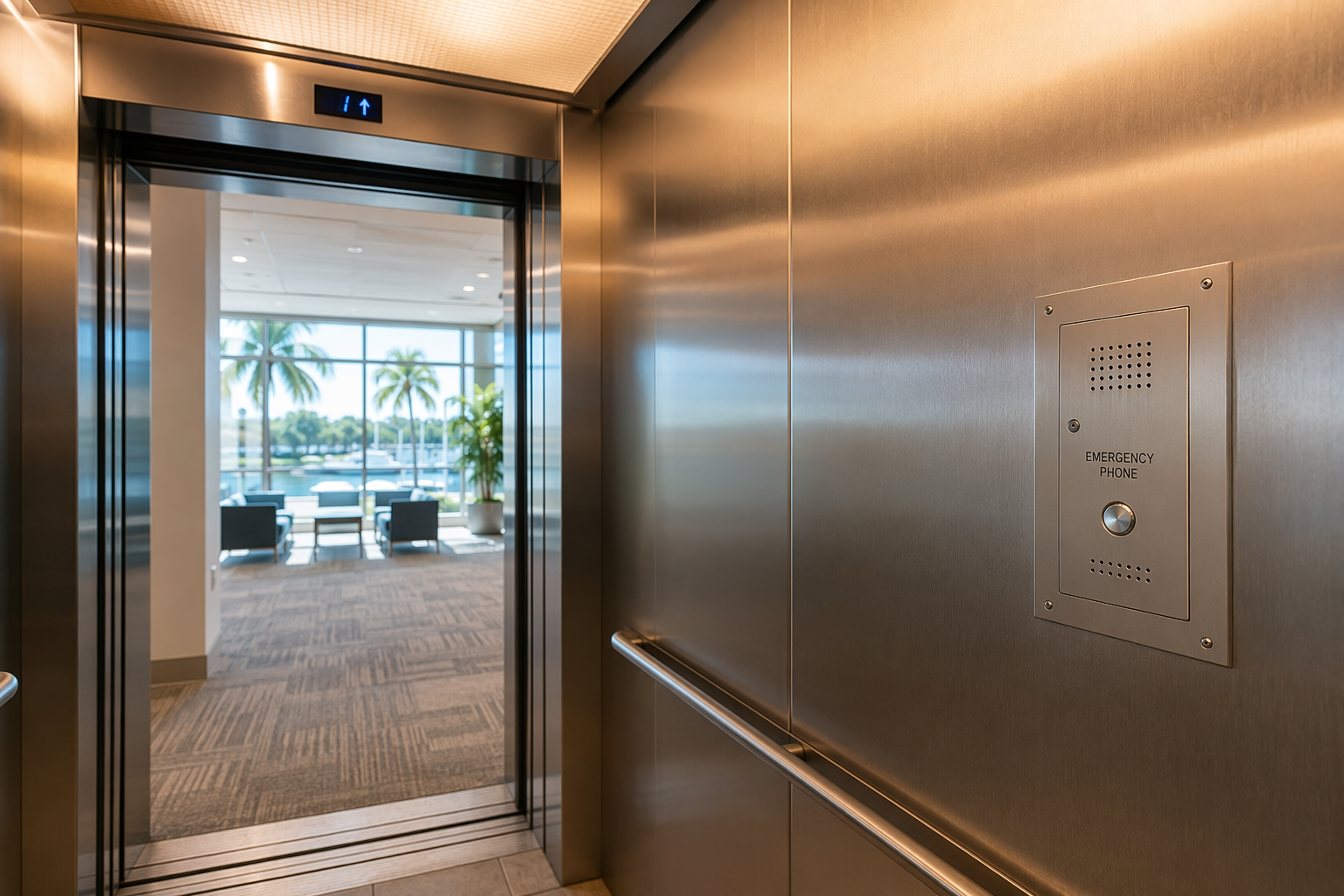
Under ASME A17.1-2019/CSA B44-19 Safety Code for Elevators and Escalators, Section 2.27.1.5, every elevator must be equipped with a two-way emergency communication system that connects to a location staffed around the clock. This is not optional — it is a hard code requirement that applies to virtually every commercial and multi-family residential elevator in the United States, including all elevators in Pompano Beach, FL and Sarasota, FL.
Florida Statute 399 further reinforces this requirement, placing the burden of compliance squarely on the building owner. If that phone is broken, disconnected, or rings to voicemail, the owner is in violation and can face fines from the Florida Department of Business and Professional Regulation (DBPR). As a technician, I recommend building managers post the elevator service company’s emergency line both inside the cab and at the building’s main entrance so it’s accessible even when someone isn’t trapped inside the elevator.
What is the correct emergency phone number to call when someone is trapped in an elevator?
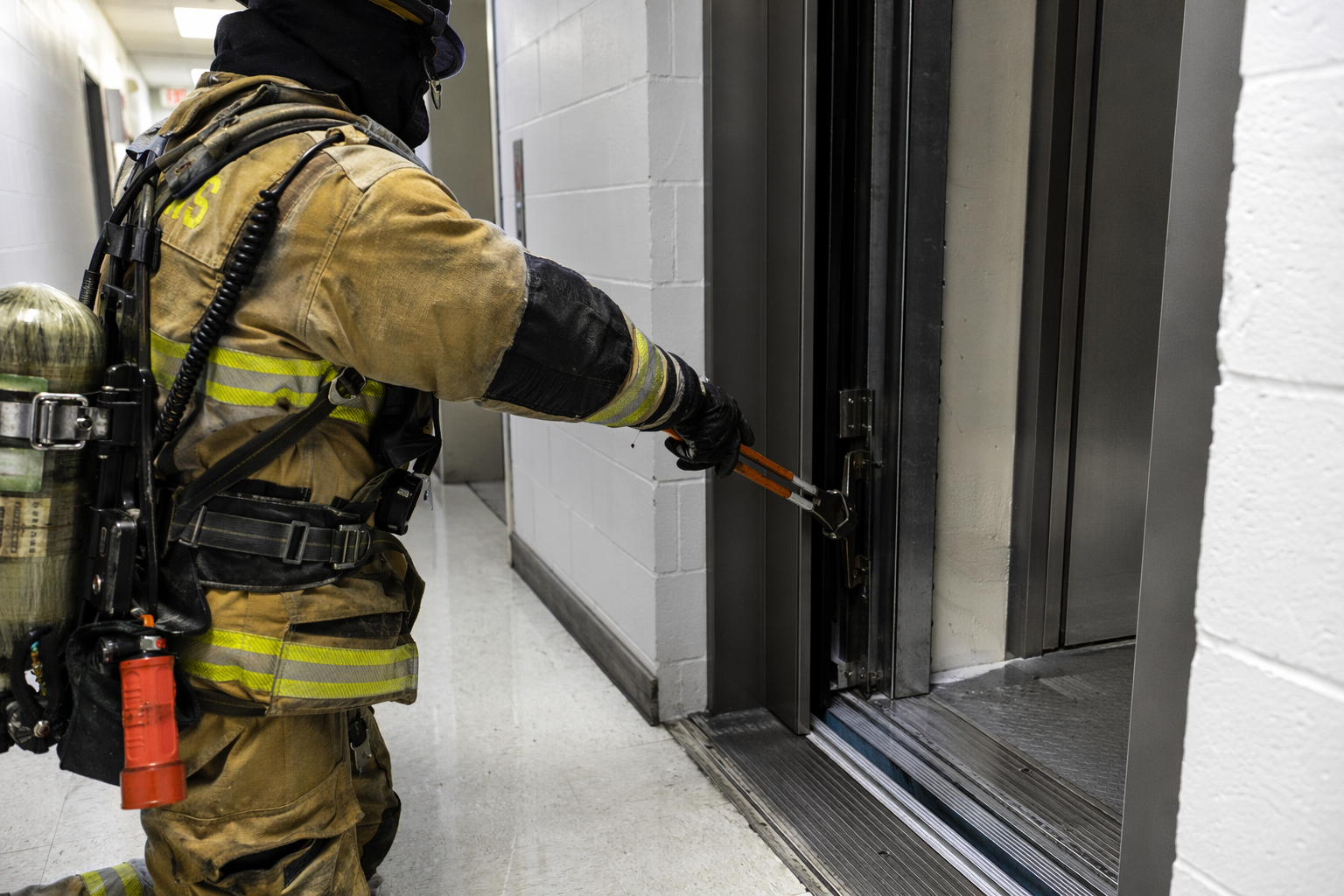
If someone is trapped in an elevator and the in-cab phone is not working, call 911 immediately — fire departments are trained to perform elevator rescues — and simultaneously contact your elevator maintenance company’s 24/7 emergency line.
In Florida, local fire departments in cities like Pompano Beach and Sarasota have specialized rescue teams trained for elevator entrapment scenarios. However, they are not elevator technicians. They can open doors manually and free a trapped passenger, but they cannot diagnose or repair the underlying mechanical or electrical failure. That is why calling your certified elevator service provider at the same time is critical.
The in-cab emergency phone, when functioning correctly, should connect directly to your elevator service provider’s dispatch center. Axxiom Elevator Florida maintains a monitored 24/7 dispatch line specifically for these situations, with guaranteed technician response times compliant with Florida DBPR standards.
What does ASME A17.1 require for elevator emergency communication systems?
ASME A17.1 requires that every elevator cab contain a two-way voice communication device capable of connecting to a staffed location without requiring the trapped passenger to dial any number — it must be a one-button or automatic activation system.
Specifically, the code mandates the following as of the 2019 edition (still the governing reference in 2026 for most Florida jurisdictions):
- The communication device must operate on a dedicated circuit or battery backup so it functions during a power failure.
- It must be operable by a person who cannot speak (typically via a visual or audible confirmation signal).
- The location receiving the call must be staffed 24/7 — an answering machine or automated system alone does not satisfy this requirement.
- The device must be located no higher than 48 inches from the floor, per ADA accessibility guidelines.
- Instructions for use must be printed in Braille and raised characters adjacent to the device.
Many older buildings in South Florida still have cab phones that ring to a third-party monitoring center that is not always staffed with personnel capable of dispatching an elevator technician. I strongly recommend auditing your cab communication system annually to verify it meets the current standard.
What are Florida’s specific regulations for elevator emergency phone lines?
Florida Statute Chapter 399, enforced by the Florida Department of Business and Professional Regulation (DBPR), requires all elevators to comply with ASME A17.1 standards and mandates that building owners maintain operable, code-compliant emergency communication devices at all times.
Florida is one of the stricter states when it comes to elevator enforcement. The DBPR Bureau of Elevator Safety conducts random inspections and can issue citations with fines ranging from $500 to $5,000 per violation for non-functioning emergency communication systems. Buildings in violation may also face an immediate Notice of Unsafe Equipment, which requires the elevator to be taken out of service until the issue is corrected.
Building owners in Pompano Beach and Sarasota should be aware that local jurisdictions may add requirements on top of state minimums. For example, certain Broward County and Sarasota County permit offices require documentation that the emergency phone line was tested during the annual inspection. For more information, visit the Florida DBPR Elevator Safety page at myfloridalicense.com.
What should you do immediately if someone is trapped in an elevator?
If someone is trapped in an elevator, follow these steps in order — do not attempt to force the doors open yourself, as this can cause serious injury or make the situation worse.
- Stay calm and reassure the trapped passenger. Communicate through the door. Let them know help is on the way. Panic is the biggest danger in a short-term entrapment.
- Instruct the passenger to press the emergency call button inside the cab. This should automatically connect to a monitored dispatch center or your elevator service provider.
- Call 911 if the in-cab phone is not working or there is no response. Provide the building address, elevator number or location, and number of people trapped.
- Call your elevator maintenance company’s 24/7 emergency line. For Axxiom Elevator Florida clients in Pompano Beach and Sarasota, that number is.
- Do NOT attempt to manually open elevator doors or assist the passenger in climbing out. This is extremely dangerous if the car is between floors, and only a licensed technician or trained firefighter should perform a manual rescue.
- Keep the trapped passenger informed of estimated arrival times. Silence increases anxiety. A 10-minute update makes a significant difference.
- Document the incident. Note the time of entrapment, time of call, and time of rescue for your records — this is required for Florida DBPR incident reporting.
How quickly must an elevator technician respond to an emergency in Florida?
Florida does not mandate a specific minute-based response time in statute, but industry best practice and most service contracts require a technician to be on-site within 2 to 4 hours for a standard entrapment, and immediately dispatched for any medical emergency.
In practice, response time depends heavily on your service agreement. Full-service maintenance contracts typically include priority emergency response, often with a 2-hour guarantee in urban markets like Pompano Beach and Sarasota. Time-and-materials arrangements, by contrast, may result in significantly longer waits — sometimes 6 to 8 hours on nights and weekends.
When evaluating elevator service providers, always ask specifically: “What is your guaranteed emergency response time, in writing, and does it apply 24/7/365?” A reputable company will put this in the contract. Vague answers about “doing our best” are a red flag.
What information should be posted inside every elevator cab for emergencies?
Every elevator cab in a Florida building should display the elevator contractor’s emergency contact number, the building management company’s phone number, the elevator’s certificate of operation number, and the Florida DBPR elevator safety complaint line.
As a best practice, I recommend a clearly visible placard — not just a small sticker — with the following information:
- Elevator service company name and 24/7 emergency phone number
- Building management or property manager contact number
- Elevator unit ID or number (critical when a building has multiple elevators)
- Florida DBPR Bureau of Elevator Safety: (850) 487-1395
- Instructions in both English and Spanish (best practice in South Florida markets)
The ASME A17.1 code does not specify the exact format of this signage, but Florida DBPR inspectors expect to see enough information for a passenger or bystander to reach competent help without access to a smartphone. Laminated 5×7 cards mounted at eye level work well in practice.
What is the difference between an elevator monitoring service and a direct emergency phone line?
An elevator monitoring service is a third-party call center that receives emergency calls from the cab phone and relays messages to a dispatcher, while a direct emergency phone line connects callers immediately to a staffed elevator service company with the authority and capability to dispatch a technician on the spot.
This distinction matters enormously in a real emergency. Third-party monitoring centers often operate on a relay model: the passenger pushes the button, the call center answers, takes the information, then calls the elevator company, which then dispatches a tech. In the worst cases, this chain adds 30 to 60 minutes to the response before a technician is even notified.
Direct-line service providers, where the call goes straight to a dispatch center operated by the elevator company itself, eliminate that relay delay. When you work with Axxiom Elevator Florida, the emergency line connects directly to our own dispatch team — not a third-party relay — which means faster technician notification and shorter on-site response times.
How much does elevator emergency service typically cost in Florida?
Emergency elevator service calls in Florida typically cost between $250 and $900 for after-hours response, depending on the time of call, parts required, and whether you have a maintenance contract in place.
| Service Scenario | Estimated Cost Range (2026) | Typical Response Time | Notes |
|---|---|---|---|
| Emergency call with full-service contract | $0–$150 (often included) | 1–2 hours | Labor covered; parts may be extra |
| Emergency call, time-and-materials (business hours) | $175–$350 | 2–4 hours | Standard hourly rate applies |
| Emergency call, time-and-materials (after hours/weekend) | $350–$900+ | 2–6 hours | Overtime rates; travel fees may apply |
| Emergency entrapment with fire department assist | $0 (fire dept.) + tech fees | Fire: 5–15 min; Tech: 1–4 hrs | Fire frees passenger; tech repairs elevator |
| Emergency phone system repair (non-entrapment) | $150–$600 | Next business day to 48 hrs | DBPR violation risk if not repaired promptly |
The most cost-effective way to manage emergency call expenses is a comprehensive maintenance contract. These agreements typically cover labor for emergency responses and can reduce the total annual cost of unplanned repairs by 30% to 50% compared to time-and-materials billing, based on industry data from the National Elevator Industry Inc. (NEII) 2025 market report.
What happens if an elevator’s emergency phone is broken or out of service?
A broken or non-functional emergency phone is a code violation under ASME A17.1 and Florida Statute 399, and the elevator must be taken out of service until the communication system is restored to full working order.
In practical terms, a broken cab phone discovered during a routine inspection will result in a written citation from the Florida DBPR inspector. The building owner has a defined window — typically 24 to 72 hours depending on the severity — to correct the violation before the elevator is posted as unsafe and locked out of service. Fines accumulate daily in some cases.
Beyond the regulatory risk, a broken emergency phone represents a genuine life-safety hazard. If a passenger with a medical condition is trapped and cannot summon help, the consequences can be fatal. I’ve seen buildings attempt to use a simple sign saying “Call [number] if trapped” as a substitute — that does not satisfy the ASME or ADA requirement for a two-way voice communication device, and inspectors will cite it accordingly.
Are elevator emergency phones required to be ADA compliant?
Yes — elevator emergency communication devices must comply with ADA Standards for Accessible Design, specifically requiring that the device be operable without grasping, pinching, or twisting, and must be accessible to people with hearing or speech disabilities.
Key ADA requirements for elevator emergency phones (as of 2026 ADA Standards) include:
- Mounted no higher than 48 inches above finished floor
- Must not require voice communication alone — a visual or tactile signal must confirm the call was received
- Controls must be operable with a closed fist (no small buttons requiring precise grip)
- Braille and raised character labeling required adjacent to the device
- TTY/text capability or equivalent must be available for callers who cannot speak
In my experience, this last point — accommodation for non-verbal callers — is the most frequently overlooked requirement. Many older cab phones simply open a voice line. If the caller cannot speak or is deaf, there is no way to confirm the call was received and understood. Modern compliant systems send an automatic visual signal in the cab and a digital alert to the monitoring station simultaneously.
How often should elevator emergency communication systems be tested?
Elevator emergency communication systems should be tested at minimum once per month by building management staff and verified by a licensed elevator technician during every periodic maintenance visit — typically quarterly or monthly depending on your service agreement.
Florida DBPR requires that emergency communication devices function correctly at the time of annual inspection. However, waiting for the annual inspection to discover a failed phone is far too late. Best practice, and what I recommend to all building managers in Pompano Beach and Sarasota, is a monthly test log:
- Press the emergency call button and verify a live person answers
- Confirm the monitoring station can identify the building address and elevator unit from the incoming call
- Test battery backup by briefly disconnecting primary power (with elevator out of service)
- Document the test date, tester name, result, and any corrective action in a written log
This log becomes important evidence if there is ever a DBPR inspection or a personal injury lawsuit involving an entrapment.
What is the Florida DBPR elevator safety complaint line and when should you use it?
The Florida DBPR Bureau of Elevator Safety complaint line is (850) 487-1395, and you should use it when a building owner refuses to repair a broken elevator emergency phone, when an elevator is operating without a valid certificate of inspection, or when you observe an imminent safety hazard.
The DBPR takes elevator safety complaints seriously. A complaint about a non-functioning emergency phone will typically trigger an unannounced inspection within 5 to 15 business days. Complaints about immediate life-safety risks — such as a door that won’t open or brake failure — can generate a same-day response. Tenants, employees, and visitors all have the right to file a complaint, not just building owners.
You can also submit a complaint online through the Florida DBPR portal at myfloridalicense.com. Keep a record of your complaint reference number.
Should property managers have a separate emergency contact list beyond the in-cab phone?
Absolutely — property managers should maintain a written emergency contact protocol that includes their elevator service company’s 24/7 number, building owner contacts, local fire department non-emergency dispatch, and the Florida DBPR hotline, stored both digitally and in a physical binder on-site.
A single point of failure — relying solely on the in-cab phone — is a risk management mistake. Here is what a comprehensive elevator emergency contact sheet for a Florida commercial property should include:
- Primary elevator service provider: name, 24/7 line, account number
- Backup elevator company for after-hours overflow (if applicable)
- Building owner or asset manager cell phone
- Local fire department non-emergency line (not 911, for non-life-threatening entrapments)
- Florida DBPR Bureau of Elevator Safety: (850) 487-1395
- Building’s elevator certificate of operation number and expiration date
- Location of elevator machine room key
I advise every property manager in Sarasota and Pompano Beach to laminate this sheet and post it at the front desk, in the security office, and in the elevator machine room. When a panicked building manager calls at 2 a.m. during a entrapment, they should not have to search for a phone number.
How do you choose the right elevator service company to handle emergency calls?
Choose an elevator service company that holds a valid Florida DBPR elevator contractor license, employs IUEC-certified technicians, provides a contractually guaranteed emergency response time in writing, and operates its own 24/7 dispatch center rather than relying on a third-party answering service.
When vetting a provider, ask these specific questions:
- What is your Florida DBPR contractor license number? (Verify at myfloridalicense.com)
- Are your technicians IUEC (International Union of Elevator Constructors) certified or equivalent?
- What is your guaranteed on-site response time for after-hours entrapments?
- Who answers your emergency line — your own dispatch team or a third-party call center?
- Do you service both traction and hydraulic elevators?
- Can you provide references from other buildings in Pompano Beach or Sarasota?
Axxiom Elevator Florida checks every box on this list. We are fully licensed with the Florida DBPR, our technicians hold IUEC certifications, and our emergency dispatch is handled in-house — not outsourced. We serve commercial, residential, and industrial properties throughout Pompano Beach and Sarasota with the kind of accountability that a major national brand often cannot offer at the local level.
What types of elevators require emergency phone systems in Florida?
All passenger elevators — including hydraulic, traction, machine-room-less (MRL), and limited-use/limited-application (LULA) elevators — require a code-compliant emergency communication system under ASME A17.1 and Florida Statute 399.
Here is a quick reference by elevator type:
- Hydraulic elevators: Most common in low-rise buildings in Florida. Full ASME 2.27 emergency comm requirement applies.
- Traction elevators: Standard in mid-to-high-rise buildings. Same emergency phone requirements; battery backup is critical given longer travel times between floors.
- Machine-Room-Less (MRL): Increasingly common in new construction. Emergency phone still required; location of controls may vary.
- LULA (Limited Use/Limited Application): Common in smaller commercial buildings and churches. Same communication requirements under ASME A17.1 Section 5.3.
- Freight elevators: If used to transport workers, emergency communication is still required. If freight-only with zero passenger occupancy, requirements may vary by jurisdiction — consult your local DBPR office.
- Home elevators (private residence): Governed by ASME A17.1 Part 25; emergency communication requirements differ but are still present in Florida for residential units in multi-family buildings.
Can a tenant or building visitor call for elevator help directly, or must it go through management?
Anyone — tenant, visitor, or bystander — can and should call for elevator help directly by using the in-cab emergency phone, calling 911, or contacting the elevator service provider directly; there is no requirement to go through building management first in an emergency.
This is an important point that many people misunderstand. I’ve been on calls where bystanders waited 20 minutes trying to reach a property manager before calling 911, while someone was trapped inside. In a genuine emergency — especially if the passenger reports a medical condition, chest pain, difficulty breathing, or the entrapment has lasted more than 10 minutes — call 911 immediately. Do not wait for permission from anyone.
Building management should be notified as soon as possible, but that notification is secondary to getting the trapped passenger free. The Florida DBPR also takes a very clear position: life-safety comes first, and no procedural hierarchy should delay an emergency rescue.
What is the typical cost of installing or upgrading an elevator emergency phone system?
Installing or upgrading an elevator emergency communication system in Florida typically costs between $400 and $2,500 per elevator, depending on the system type, whether new wiring is required, and the monitoring service contract chosen.
Costs break down roughly as follows in 2026:
- Basic cab phone replacement (same location, existing wiring): $400–$800 including parts and labor
- Cellular-based emergency communication system: $800–$1,500 installed; no landline required
- Full ADA-compliant two-way system with visual indicators: $1,200–$2,500 installed
- Monthly monitoring service fee: $15–$45 per elevator per month, depending on provider
Cellular-based emergency phones have become the preferred solution for many Florida buildings because they eliminate dependence on a landline, which can fail during hurricanes and tropical storms — a real concern in both Pompano Beach and Sarasota. Modern cellular units also transmit the building address and elevator ID automatically when the call button is pressed, improving dispatch accuracy.
How do elevator emergency phones work during a power outage or hurricane?
Code-compliant elevator emergency phones must include battery backup power sufficient to operate for at least one hour after primary power loss, though best-practice systems in hurricane-prone Florida should include 4- to 8-hour battery capacity or a cellular backup system.
ASME A17.1 Section 2.27.1.5.2 specifies that the emergency communication device must be operable for a minimum duration on backup power, though the exact duration is not rigidly specified in the code — it defers to the system manufacturer’s design. In Florida, where power outages from tropical storms and hurricanes can last days, I strongly recommend:
- Cellular-based communication systems with 4-to-8-hour battery backup
- Automatic low-battery alerts sent to building management
- Annual load testing of battery backup systems (not just a brief press-and-release test)
Note that during a power outage, elevators themselves will typically not operate, so the emergency phone serves primarily to assist anyone trapped mid-ride when power fails, not for ongoing entrapments over multiple days.
How can building owners verify their elevator service company is properly licensed in Florida?
Building owners can verify their elevator contractor’s Florida license status in real time through the Florida DBPR license verification tool at myfloridalicense.com by searching the company name or license number under “Elevator Contractors.”
Florida law requires every elevator contractor working in the state to hold a valid Class I or Class II elevator contractor license issued by the DBPR Bureau of Elevator Safety. An expired or unlicensed contractor performing work on your elevator can void your certificate of operation, expose you to liability, and — most dangerously — result in non-code-compliant work that puts passengers at risk.
Beyond licensing, look for technicians with IUEC (International Union of Elevator Constructors) certifications, which represent the gold standard for field technician training and continuing education in 2026. Ask to see proof of insurance (general liability and workers’ compensation) before any technician enters your machine room.
Get Expert Help from a Certified Local Elevator Company
Whether you are managing a commercial property in Pompano Beach, a residential high-rise in Sarasota, or anything in between, your elevator emergency contact chain is only as strong as the company at the other end of the line. After 15-plus years in this industry, I can tell you: the time to find your elevator service provider is not during an entrapment at midnight. It is right now.
Axxiom Elevator Florida offers fully licensed, IUEC-certified elevator maintenance, 24/7 emergency response with in-house dispatch, and comprehensive service agreements that keep your emergency communication systems code-compliant and tested year-round. We serve property owners and managers throughout Pompano Beach and Sarasota with the local knowledge and accountability that national elevator companies simply cannot match.
Contact Axxiom Elevator Florida for a free elevator assessment. Call us today at — we answer 24 hours a day, 7 days a week, because elevator emergencies do not keep business hours.
Need elevator service you can rely on? Axxiom Elevator Florida is ready to help.