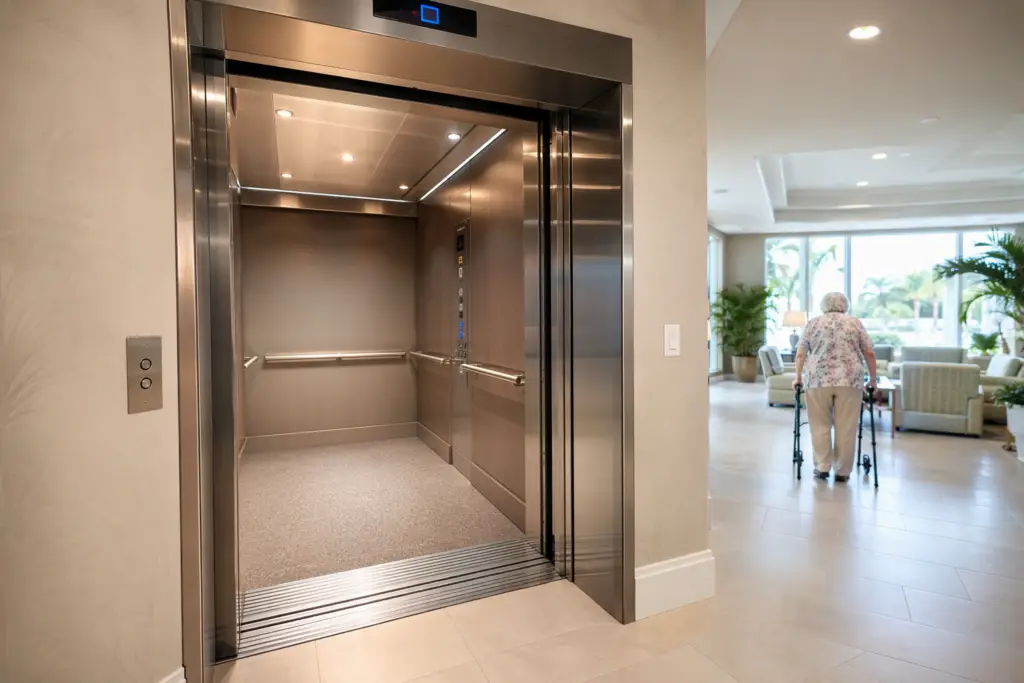
Elevator Permits and Inspections Required for a New Elevator Installation in Pompano Beach, Florida
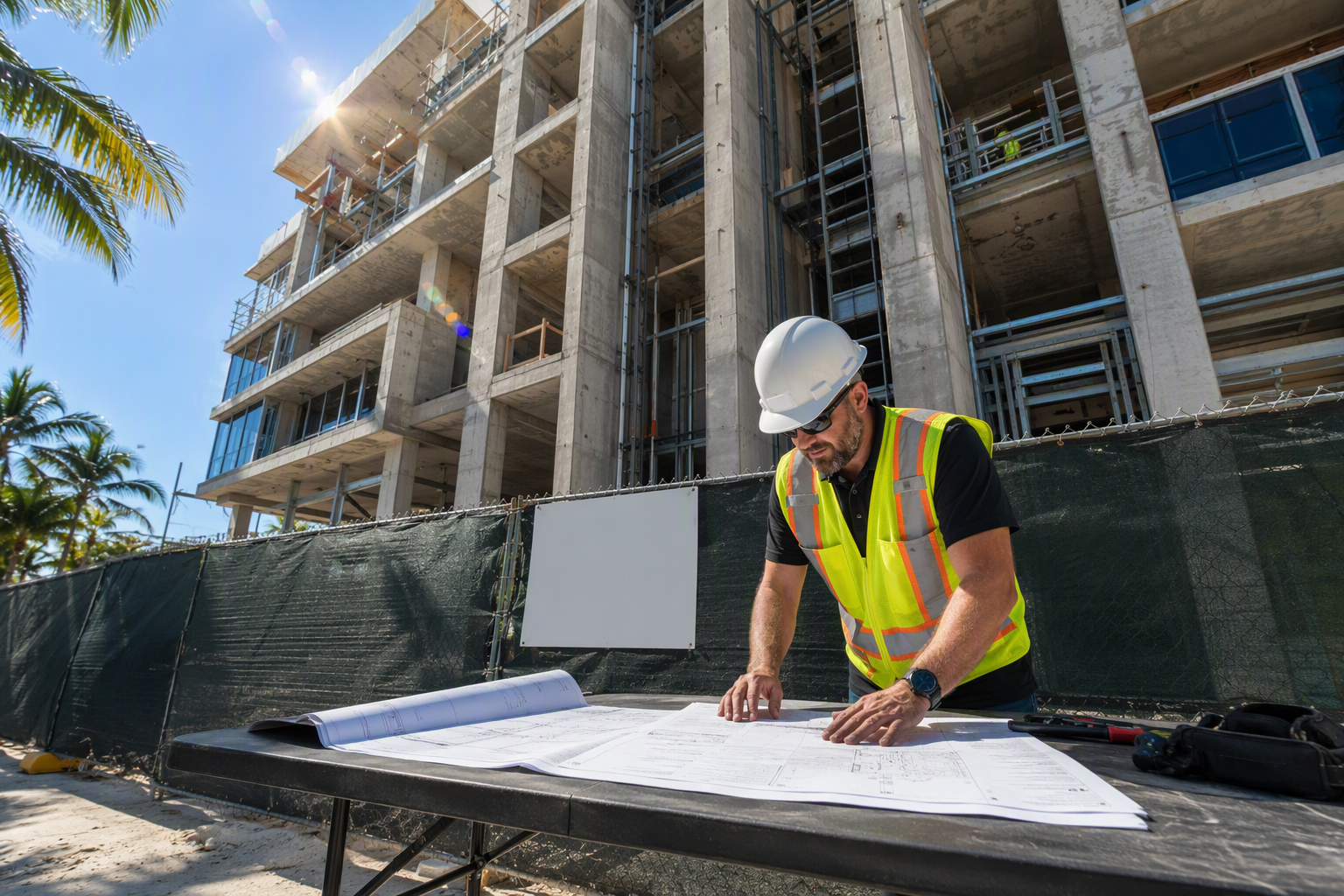
Installing a new elevator in Pompano Beach is a multi-step regulatory process governed by Chapter 399, Florida Statutes (the Elevator Safety Act), Florida Administrative Code Chapter 61C-5, and the ASME A17.1/CSA B44 Safety Code for Elevators and Escalators (2019 edition), which Florida adopted effective December 31, 2023. Pompano Beach falls within Broward County, and the Broward County Building Code Division enforces Florida’s elevator law through its own certified elevator inspectors. Understanding every permit, inspection, and compliance milestone before breaking ground protects property owners from costly delays, fines, and liability.
What State Permit Is Required Before Installing a New Elevator in Florida?
Under Chapter 399, Florida Statutes, a state permit must be obtained from the DBPR Bureau of Elevator Safety before any new conveyance is installed or altered. Critically, this permit application must be submitted by a registered elevator company — not a general contractor or building owner acting independently. Florida law requires all new conveyance installations to be performed exclusively by a state-registered elevator company. Operating without a state permit before installation begins is a direct violation of the Elevator Safety Act.
The permit covers the planned scope of installation, the equipment specifications, and the identity of the registered elevator company responsible for the work. No elevator may be energized, tested for public use, or placed into service until the permitting and inspection sequence described below is completed in full.
How Does the Local Broward County Permit Process Work for Pompano Beach?
Pompano Beach is an incorporated city within Broward County, and the Broward County Building Code Division enforces Florida’s elevator law — including Chapter 399 — through its own elevator inspectors. This means that in addition to the state-level permit from the DBPR Bureau of Elevator Safety, project teams typically coordinate with Broward County’s building inspection process as well.
Permit packages submitted at the local level generally include architectural and mechanical drawings, equipment specifications conforming to ASME A17.1-2019, structural load data, and documentation of the registered elevator company performing the installation. Because Broward County inspectors are authorized under state contract to conduct elevator inspections, their sign-off is an integral part of achieving the certificate of operation. Property owners and developers should confirm current submittal requirements directly with the Broward County Building Code Division, as local procedural requirements can be updated.
What Inspections Are Required Before a New Elevator Can Operate in Pompano Beach?
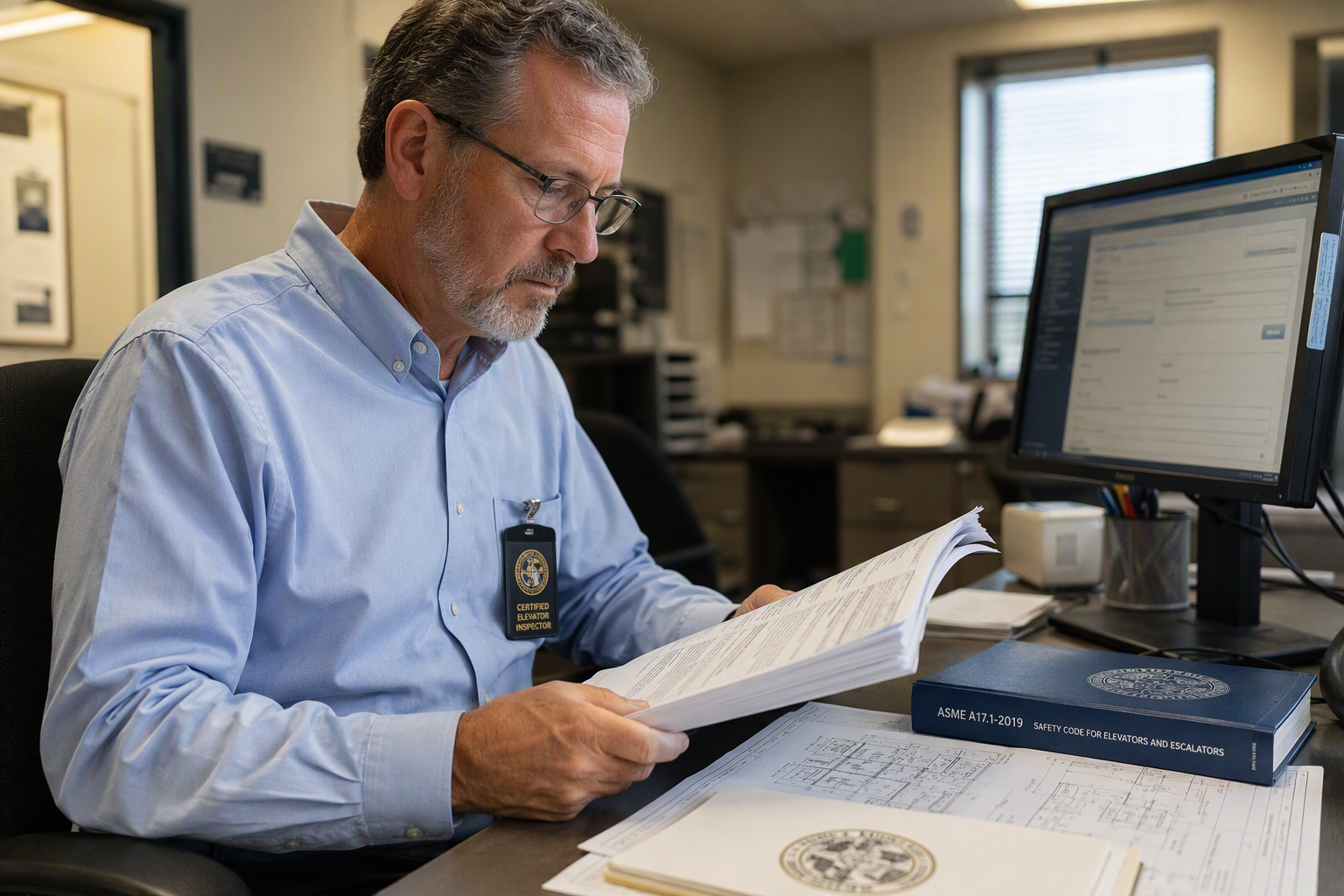
Before a newly installed elevator in Pompano Beach may be placed into service or used by the public, it must pass an acceptance inspection conducted by a certified elevator inspector who has no employment relationship, association, or conflict of interest with the permit holder or the building owner. This independence requirement is mandated by Chapter 399, Florida Statutes, and is designed to ensure an objective evaluation of the installation against ASME A17.1-2019 requirements.
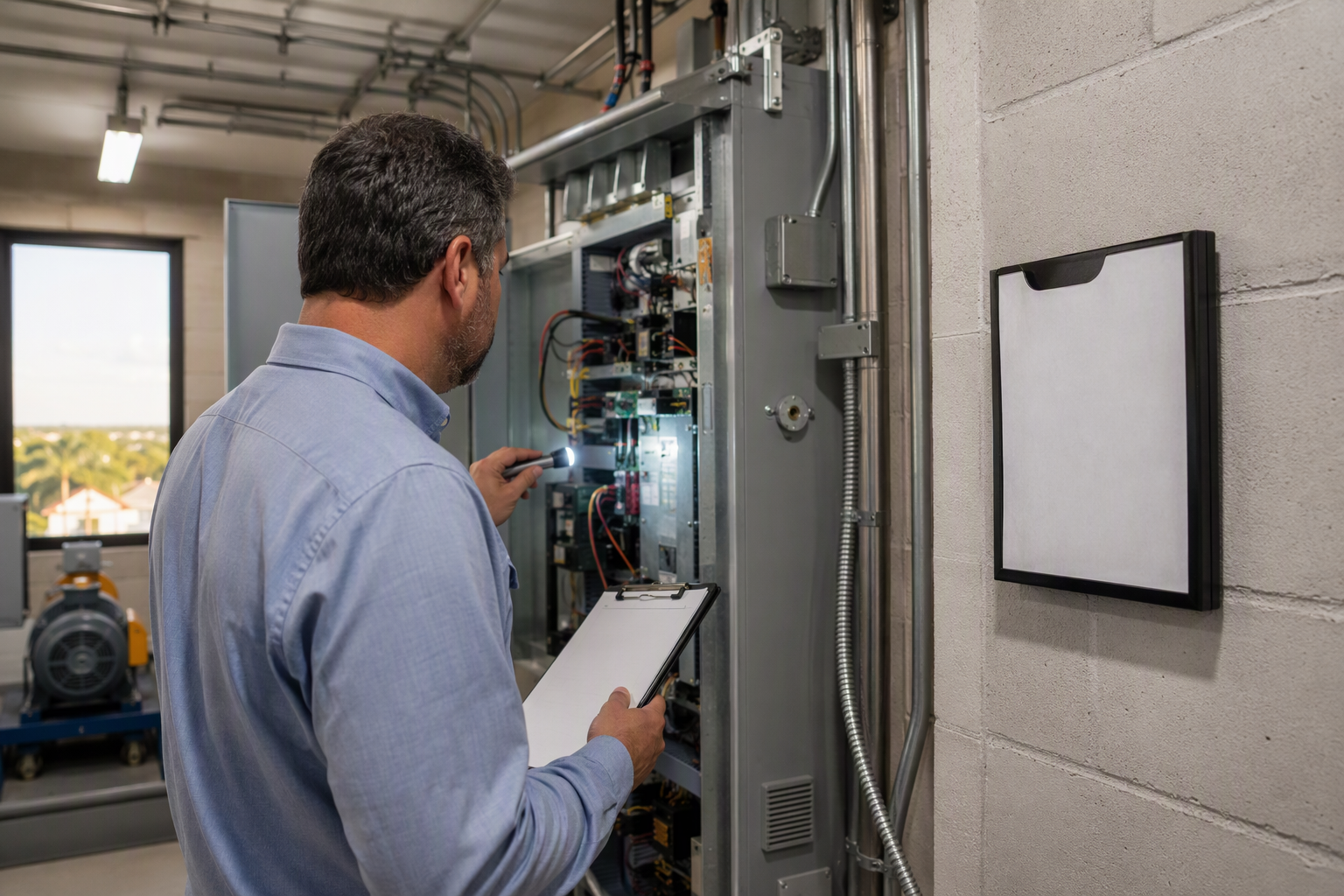
The acceptance inspection typically verifies safety devices, load capacity, travel limits, door operations, machine room conditions, emergency lighting, communication systems, and all other equipment characteristics required by the adopted code. Any deficiencies found during the acceptance inspection must be corrected before a certificate of operation is issued.
What Is a Certificate of Operation and When Is It Required?
A Florida certificate of operation is the legal authorization required for an elevator to remain in service. Under Chapter 399, Florida Statutes:
- A certificate of operation is valid for no more than two years.
- It can only be renewed for a conveyance with a current satisfactory inspection on file.
- Operating an elevator on an expired certificate of operation is a violation of state law.
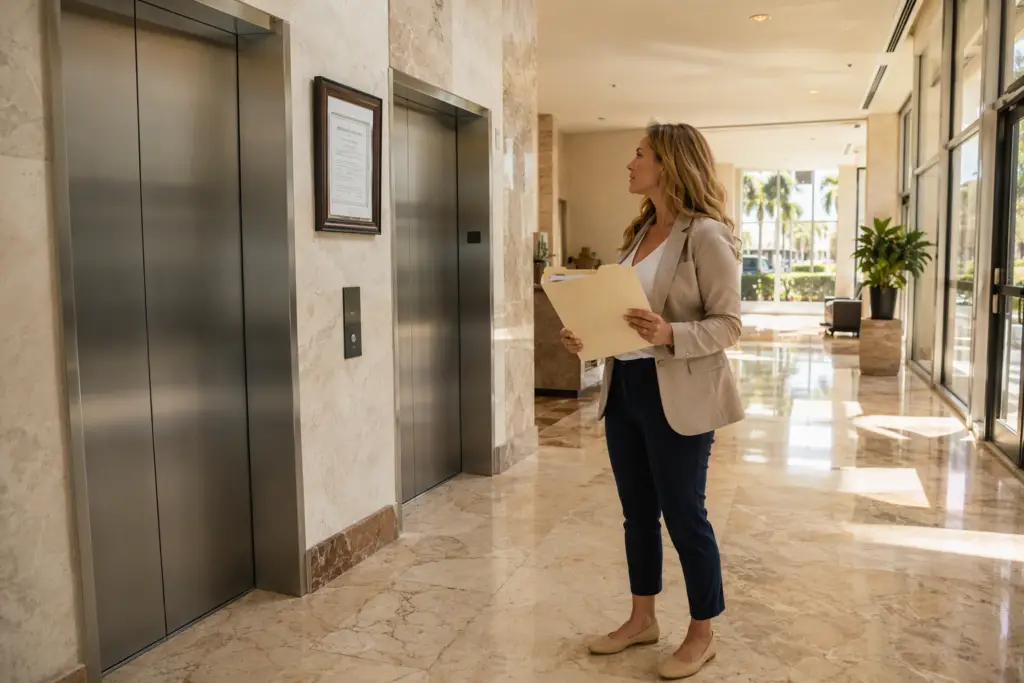
- The certificate of operation must be posted in a conspicuous location inside the elevator in a frame with a transparent cover — this is a display requirement, not merely an administrative formality.
For a brand-new installation, the certificate of operation is issued only after the acceptance inspection is passed. There is no grace period: the elevator cannot be used by occupants or the public until that certificate is in hand and properly posted.
What Code Standards Apply to New Elevator Installations in Florida in 2026?
Florida adopted the ASME A17.1/CSA B44 Safety Code for Elevators and Escalators, 2019 edition, effective December 31, 2023, through Chapter 61C-5, Florida Administrative Code. As of 2026, this is the controlling technical standard for new elevator installations throughout the state, including Pompano Beach.
ASME A17.1-2019 governs equipment design, construction, installation, operation, inspection, testing, maintenance, alteration, and repair. Key areas addressed by the code that directly affect new installations include:
- Hoistway and machine room construction requirements
- Driving machine and control specifications
- Safety device performance standards
- Door locking and reopening device requirements
- Emergency lighting and communication systems
- Seismic design considerations
- Firefighters’ emergency operation requirements
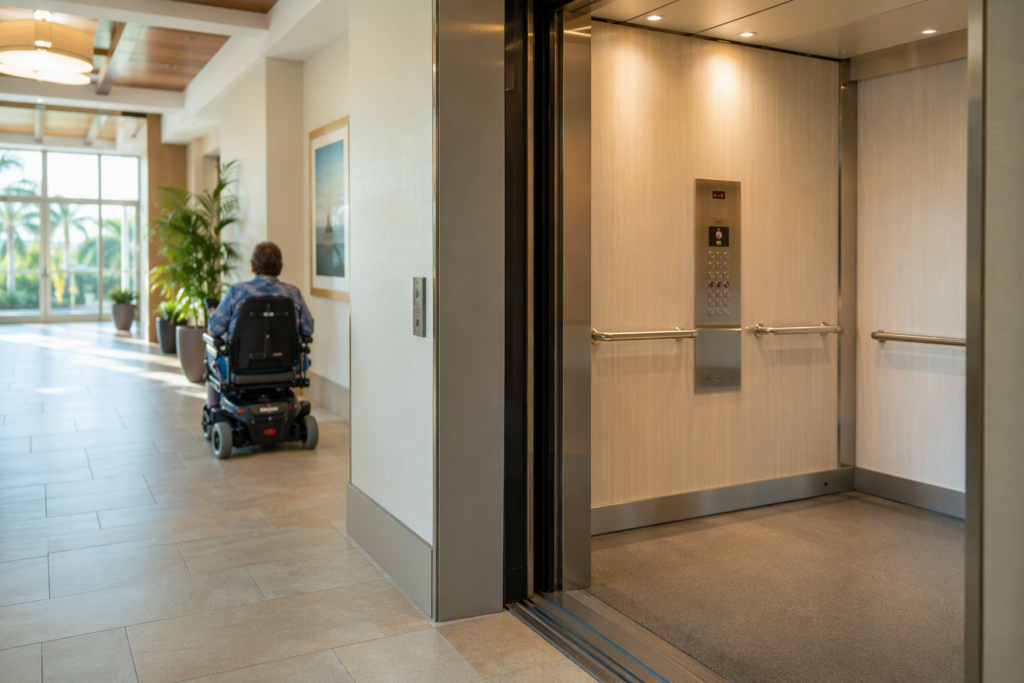
Installations that also serve the public or commercial occupancies must align with ADA (Americans with Disabilities Act) accessibility standards, which establish minimum cab dimensions, control panel heights, audible and visual signals, and door timing requirements. ADA compliance is a federal obligation independent of the state elevator safety permitting process.
Who Is Qualified to Install a New Elevator in Pompano Beach?
Florida law is explicit: all new conveyance installations must be performed by a company registered with the DBPR Bureau of Elevator Safety as a registered elevator company. These companies must renew their registration annually and maintain general liability insurance as required by Chapter 399, Florida Statutes.
The hands-on installation work must be performed by a Florida certified elevator technician — an individual who holds a state elevator certificate of competency. This certificate authorizes the technician to construct, install, maintain, or repair conveyances. Certified elevator technicians must renew their credentials annually, maintain general liability insurance, and complete eight hours of continuing education as a condition of certificate renewal. A Florida elevator certificate of competency expires after one year.
Axxiom Elevator Florida operates as a registered elevator company in Florida, working exclusively within the state’s regulatory framework to support property owners through the full installation and compliance lifecycle.
What Are the Ongoing Inspection Requirements After Installation?
Once a certificate of operation is issued, the owner of the elevator assumes full legal responsibility for its safe operation, proper maintenance, inspection, and correction of any code deficiencies identified — as established under Chapter 399, Florida Statutes.
Florida requires every elevator covered by Chapter 399 to be inspected annually by a certified elevator inspector, or by a county or municipality under contract with the state. One limited exemption applies: an elevator (other than an escalator or dumbwaiter) that serves only two adjacent floors and is covered by a qualifying service maintenance contract may be exempt from the annual inspection requirement while that contract remains in effect.
Because a Florida certificate of operation is valid for a maximum of two years, renewal requires a current satisfactory inspection. Allowing the certificate to lapse puts the building owner in violation of state law and can result in the elevator being taken out of service.
Additionally, the certificate of operation holder must report any elevator accident to the DBPR Bureau of Elevator Safety within five working days of the incident.
What Is the Step-by-Step Process for Getting a New Elevator Permitted and Inspected in Pompano Beach?
- Engage a Florida-registered elevator company. Only a state-registered elevator company may apply for the installation permit. Confirm the company’s registration is current with the DBPR Bureau of Elevator Safety before executing any contract.
- Prepare permit documentation. Compile engineering drawings, equipment specifications conforming to ASME A17.1-2019, structural data, and all required application materials for the state permit through DBPR and the local Broward County Building Code Division.
- Apply for and receive the state permit. The registered elevator company submits the permit application to the DBPR Bureau of Elevator Safety. No installation work may begin until this permit is issued.
- Coordinate with Broward County Building Code Division. Submit required plans and documentation to the Broward County Building Code Division for local review and to schedule county inspections as applicable during the construction phase.
- Complete the installation using certified elevator technicians. All installation work must be performed by Florida certified elevator technicians under the registered elevator company’s supervision. Technicians must hold a current certificate of competency.
- Schedule the acceptance inspection. Contact a certified elevator inspector who has no conflict of interest with the permit holder or owner. The inspector will conduct a thorough evaluation of the completed installation against ASME A17.1-2019 and Florida code requirements.
- Correct any deficiencies. Address all items cited by the inspector before requesting reinspection. Deficiencies left uncorrected prevent issuance of the certificate of operation.
- Obtain the certificate of operation. Once the inspection is passed and all state requirements are satisfied, the DBPR Bureau of Elevator Safety issues the certificate of operation.
- Post the certificate of operation. Display the certificate conspicuously inside the elevator in a frame with a transparent cover before placing the elevator into service.
- Verify ADA compliance. Confirm that the installation meets all applicable ADA accessibility standards before the building opens to the public.
- Establish an ongoing maintenance and inspection schedule. Plan for the annual inspection required under Chapter 399 and set a reminder for certificate of operation renewal, which cannot exceed two years.
Does ADA Compliance Apply to New Elevators in Pompano Beach?
Yes. The Americans with Disabilities Act (ADA) imposes federal accessibility requirements on most commercial and public-use elevators, separate from Florida’s elevator safety permitting process. ADA standards address minimum hoistway and cab dimensions, door width and timing, control panel reach ranges and button specifications, floor designation signage in Braille and raised characters, audible floor announcements, and leveling accuracy. Buildings subject to ADA must meet these requirements as a condition of federal compliance — not as part of the DBPR permit, but as a parallel federal obligation. New construction generally carries the most stringent ADA requirements.
Are There OSHA Requirements That Apply to Elevator Installation Work in Florida?
Yes. Workers engaged in elevator installation in Florida are subject to applicable OSHA construction safety standards. These cover fall protection, hoistway opening guarding, electrical safety during installation, confined space procedures, and hazard communication, among other topics. OSHA requirements govern worker safety during the construction process; they operate independently of the DBPR elevator safety permitting system, which governs the completed equipment and its ongoing operation.
What Happens If a Building Owner Skips the Permit or Inspection Process?
Operating an elevator without a valid certificate of operation, or installing one without the required state permit, constitutes a violation of Chapter 399, Florida Statutes. The DBPR Bureau of Elevator Safety has authority to order the elevator taken out of service. Beyond regulatory penalties, unpermitted or uninspected elevators create substantial liability exposure for building owners in the event of an accident or injury. Insurance carriers may deny claims related to equipment that was not properly permitted, inspected, and certified. The cost of regulatory non-compliance — in fines, shutdowns, and litigation — routinely far exceeds the cost of following the proper process from the start.
What Is the Difference Between the State Permit and the Certificate of Operation?
These are two distinct legal instruments with different purposes in Florida’s elevator regulatory system:
- The state permit authorizes the registered elevator company to begin installation work. It is issued before construction starts and is a prerequisite to any installation activity.
- The certificate of operation authorizes the owner to place the completed elevator into service for public or occupant use. It is issued only after a satisfactory acceptance inspection by a certified elevator inspector with no conflict of interest.
A permit does not allow an elevator to operate; a certificate of operation does not substitute for a permit. Both are required, and they must be obtained in sequence.
What Are the Industry Trends Affecting Elevator Permitting and Compliance in 2025–2026?
Several qualitative trends are shaping the elevator permit and inspection landscape in Florida and nationally as of 2025–2026:
- Digital permitting adoption: Florida jurisdictions, including Broward County, have been progressively moving toward online permit submission and tracking platforms, which can reduce administrative processing times and improve documentation transparency for contractors and building owners.
- Code modernization pressure: Florida’s adoption of ASME A17.1-2019 effective December 31, 2023 brought new requirements into force. Industry professionals anticipate continued code update cycles, and property owners with aging equipment should monitor alteration-triggered compliance obligations.
- Inspector workforce capacity: The industry nationally has discussed concerns around the pipeline of certified elevator inspectors. In high-growth markets like South Florida, demand for inspection services may affect scheduling timelines for new installations, reinforcing the value of early planning.
- Smart elevator technology and connectivity: New installations increasingly incorporate remote monitoring, predictive maintenance sensors, and destination dispatch systems. While ASME A17.1-2019 addresses many of these configurations, technology-forward installations may require additional plan review time to confirm code compliance.
- ADA enforcement awareness: Greater public and regulatory awareness of accessibility rights is driving closer scrutiny of elevator ADA compliance during new construction inspections and certificate of occupancy reviews.
Which Exemptions Apply to Elevator Permit and Inspection Requirements in Florida?
Florida law provides a narrow set of exemptions to its elevator regulatory requirements:
- Elevators, stairway chairlifts, and wheelchair lifts located in private residences do not require a Florida certificate of operation.
- An elevator (not an escalator or dumbwaiter) that serves only two adjacent floors and is covered by a qualifying service maintenance contract is exempt from the annual inspection requirement while that contract remains in effect.
- The ASME A17.1-2019 adoption includes exclusions for certain equipment types, including private residence elevators and marine elevators, as specified in Chapter 61C-5, Florida Administrative Code.
Property owners should not assume an exemption applies without confirming the specific equipment type and circumstances with the DBPR Bureau of Elevator Safety or a knowledgeable registered elevator company. Misidentifying an exemption can result in an elevator operating without a required certificate of operation.
How Can Axxiom Elevator Florida Help With the Permit and Inspection Process in Pompano Beach?
Axxiom Elevator Florida is a data-driven elevator service provider operating exclusively in Florida. The company supports building owners, developers, and property managers in Pompano Beach and throughout Broward County with the full regulatory lifecycle of a new elevator installation — from initial permit application through acceptance inspection coordination, certificate of operation, and ongoing annual inspection planning.
As a Florida-registered elevator company, Axxiom Elevator Florida works within the precise requirements of Chapter 399, Florida Statutes, Chapter 61C-5 Florida Administrative Code, and ASME A17.1-2019, using documented compliance processes rather than guesswork. The team understands the specific local authority having jurisdiction (AHJ) requirements of the Broward County Building Code Division and helps clients navigate both state and local permitting channels concurrently to minimize project delays.
Property owners planning a new installation benefit from an early pre-permit consultation to identify code compliance requirements, ADA obligations, equipment selection considerations, and realistic inspection scheduling timelines — all factors that influence project cost and completion dates.
Quick Reference: Key Florida Elevator Regulatory Facts for Pompano Beach Installations
| Requirement | Detail |
|---|---|
| State elevator regulator | DBPR, Division of Hotels and Restaurants, Bureau of Elevator Safety |
| Governing statute | Chapter 399, Florida Statutes (Elevator Safety Act) |
| Adopted technical code | ASME A17.1/CSA B44, 2019 edition (effective December 31, 2023) |
| Local AHJ (Pompano Beach) | Broward County Building Code Division |
| Permit required before installation? | Yes — applied for by registered elevator company only |
| Acceptance inspection requirement | By certified elevator inspector with no conflict of interest with permit holder or owner |
| Certificate of operation validity | Maximum 2 years; renewal requires current satisfactory inspection |
| Annual inspection requirement | Required for all covered conveyances (limited exemption for 2-floor units under service contract) |
| Certificate posting requirement | Conspicuous location in elevator, framed with transparent cover |
| Accident reporting deadline | Within 5 working days to DBPR Bureau of Elevator Safety |
| Private residence exemption | Residential elevators, stairway chairlifts, wheelchair lifts — no certificate of operation required |
| Federal accessibility standard | ADA (Americans with Disabilities Act) — applies to most commercial/public-use elevators |
| Worker safety standard | OSHA — applies to installation workforce |
Get Expert Guidance on Your Pompano Beach Elevator Installation
Navigating Florida’s elevator permit and inspection requirements — from the DBPR Bureau of Elevator Safety state permit to Broward County local authority coordination and ASME A17.1-2019 compliance — requires a registered elevator company with precise knowledge of the applicable code framework. Attempting to shortcut the process creates regulatory exposure that can halt a project or result in an elevator being taken out of service after opening.
Axxiom Elevator Florida provides data-driven, code-accurate support for property owners and developers pursuing new elevator installations in Pompano Beach and throughout Florida. Whether a project is in the planning stage or already underway, early consultation helps identify compliance requirements, permitting timelines, and inspection scheduling needs before they become costly surprises.
Contact Axxiom Elevator Florida for a free elevator assessment:
Need elevator service you can rely on? Axxiom Elevator Florida is ready to help.