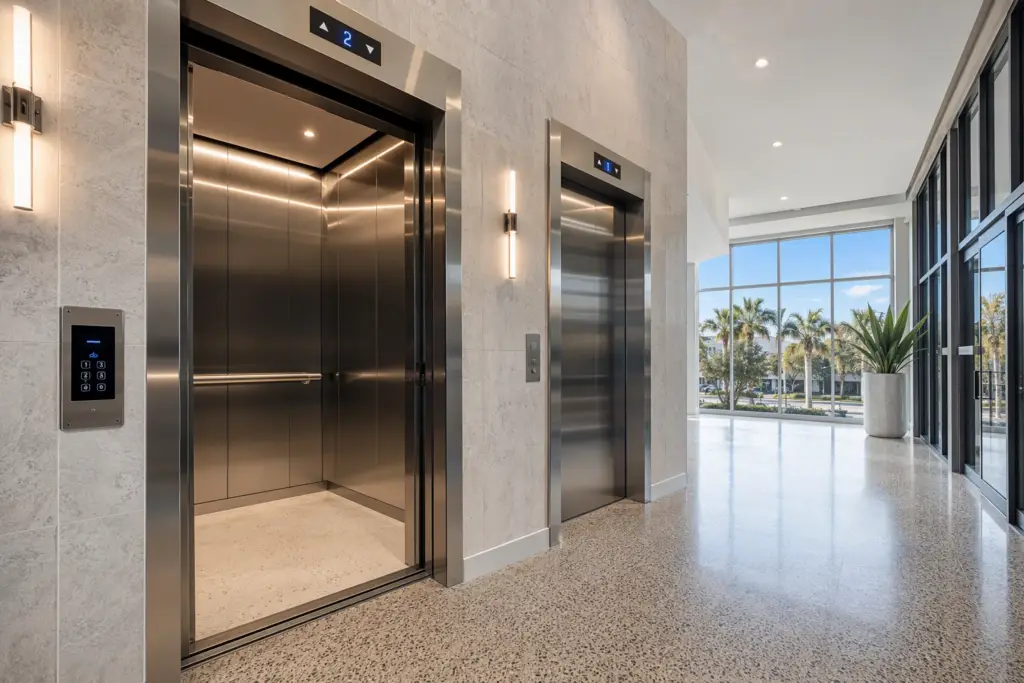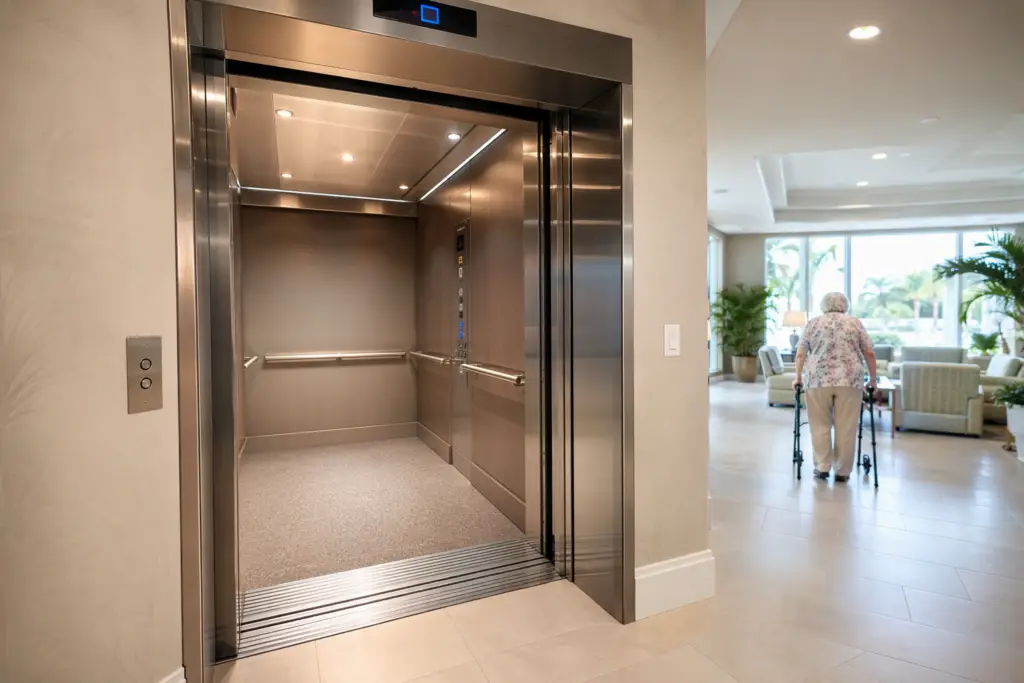
The most common elevator problems in Florida buildings during hurricane season include flooding of pit areas, electrical system damage from power surges and outages, corrosion of mechanical components from saltwater-laden humidity, and door operator failures — and preparing elevators before a storm means securing equipment to the top floor, shutting down power at the controller, waterproofing pit sumps, and scheduling a certified post-storm inspection before returning elevators to service.
Florida Hurricane Season Elevator Problems: Complete FAQ for Building Owners and Managers
Florida’s hurricane season — June through November — creates a uniquely hostile environment for vertical transportation equipment. Buildings in coastal markets such as Pompano Beach and Sarasota face storm surge risk, sustained high humidity, salt-air corrosion, extended power outages, and the possibility of direct wind and water intrusion. Understanding the failure modes that tropical weather triggers, and following a documented pre-storm protocol, protects equipment, preserves regulatory compliance under Chapter 399, Florida Statutes (Elevator Safety Act), and — most critically — protects building occupants.
What are the most common elevator problems caused by hurricanes and tropical storms in Florida?
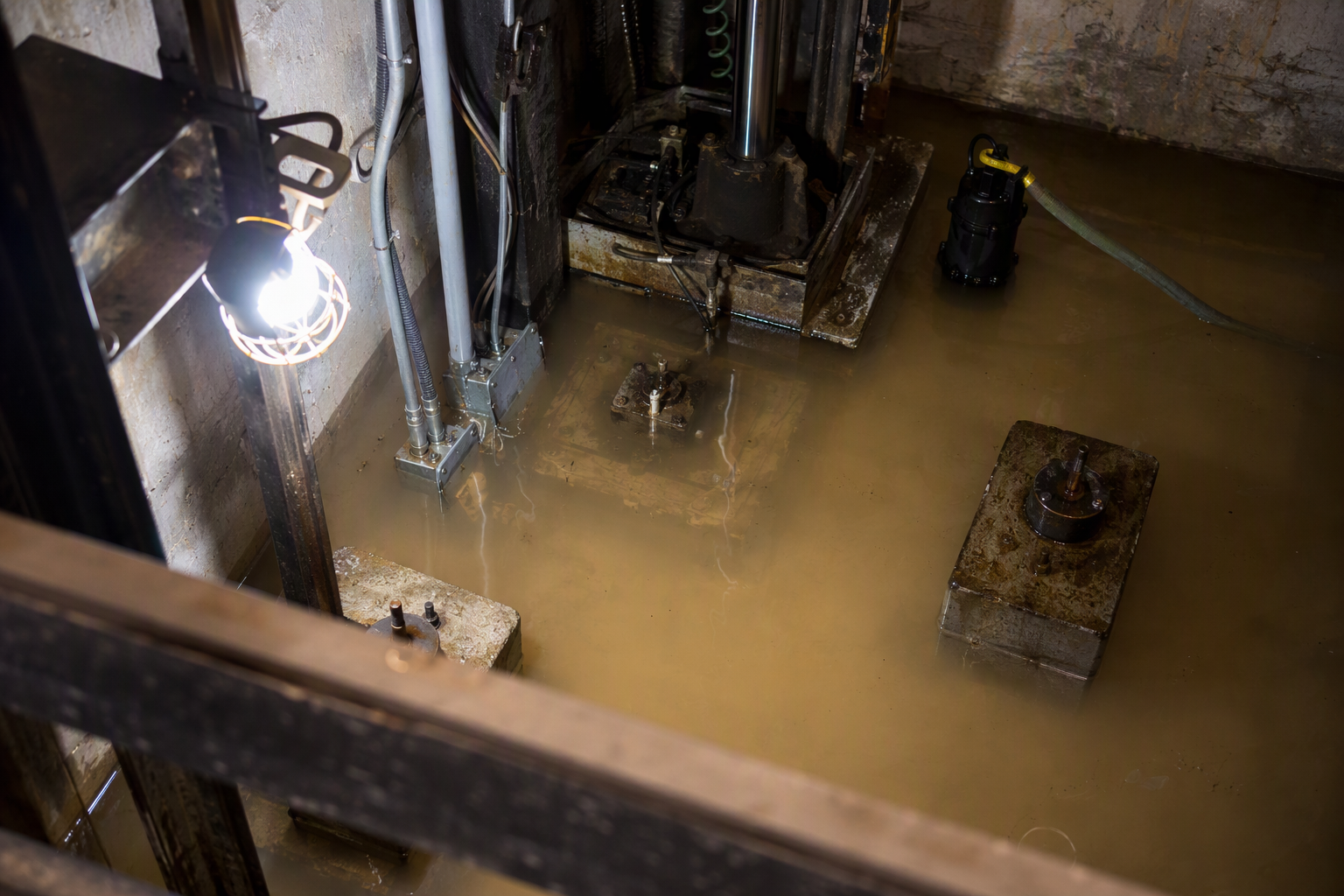
The most common hurricane-related elevator failures in Florida are pit flooding, electrical damage from power surges or brownouts, moisture-driven corrosion, and door system malfunctions.
Each of these failure modes is tied directly to the physical conditions a tropical storm or hurricane produces. Pit flooding occurs when storm surge, ground saturation, or roof drainage overwhelms a building’s waterproofing and enters the hoistway from below. Because elevator pits sit at or below grade in many Florida commercial and residential buildings, even a relatively modest surge can submerge buffers, safeties, oil hydraulic components, and electrical junction boxes within minutes.
Power-related failures are the second major category. Florida utilities frequently shed load or lose transmission infrastructure during major storms, producing voltage spikes, brownouts, and prolonged outages. Modern elevator controllers, variable-frequency drives (VFDs), and programmable logic boards are sensitive to voltage irregularities. A transient spike at restoration — when utility power comes back after an outage — is one of the most destructive events an elevator controller can experience.
Corrosion accelerates dramatically in the weeks following a storm because humidity levels stay exceptionally high and salt-laden air penetrates buildings through damaged envelopes. Steel cables, guide rails, counterweight frames, and exposed electrical contacts are all vulnerable. In Pompano Beach and other coastal South Florida markets, salt air corrosion is a year-round maintenance concern that becomes critical after storm events.
Finally, door operators and gibs suffer from debris intrusion, track warping from water infiltration, and swelling of door sills. These failures often do not appear immediately but manifest days after a storm as components that were merely stressed during the event begin to fail under normal load.
How does storm surge and pit flooding damage elevator systems?
Storm surge introduces water to the elevator pit, which can destroy electrical panels, corrode mechanical components, contaminate hydraulic oil, and create safety hazards that require a full certified inspection before the elevator can legally return to service.
The elevator pit contains some of the most sensitive and expensive components in the system: the hydraulic power unit (in hydraulic elevators), compensation sheaves, pit lighting, stop switches, buffers, and in many cases low-voltage control wiring. When floodwater enters, it carries silt, debris, and in coastal areas, salt. Even after water is pumped out, a residue of conductive material remains on electrical contacts, creating leakage paths that defeat safety circuits.
Hydraulic elevators face an additional threat: water contamination of the hydraulic fluid reservoir. Contaminated fluid degrades seals, causes corrosion inside the cylinder and pump assembly, and leads to slow-lowering events or complete loss of pressure. Hydraulic oil must be tested and typically replaced after any confirmed pit flooding event.
Under Chapter 399, Florida Statutes, the certificate of operation holder — typically the building owner — is responsible for the safe operation and proper maintenance of the elevator. Operating a flood-damaged elevator before a certified inspection is a violation of state law and exposes the owner to substantial liability.
What electrical damage do hurricanes typically cause to elevator systems?
Hurricanes cause elevator electrical damage primarily through power surges at grid restoration, brownout conditions during the storm, water intrusion into controller enclosures, and lightning-induced transients on building electrical systems.
Modern traction and hydraulic elevators rely on solid-state electronics — variable-frequency drives, microprocessor-based controllers, door operator boards, and position encoding systems — that are far more sensitive to power quality than the relay-logic systems they replaced. A voltage spike of even brief duration can destroy a VFD module or controller board that costs many thousands of dollars and may carry a lead time of several weeks from the manufacturer.
Building electrical engineers and elevator contractors both recommend surge-protective devices (SPDs) installed at the elevator controller as a basic protective measure before hurricane season. Additionally, a properly programmed controller should be set to park the elevator car at the top landing and shut down if power becomes irregular, rather than allowing the car to be stranded mid-travel during a power event.
Lightning poses a specific risk even for buildings that are not directly struck. Ground potential rises and induced transients can travel through building electrical systems and reach elevator controllers through grounding conductors. Proper grounding and bonding of all elevator equipment, as required by ASME A17.1/CSA B44 Safety Code for Elevators and Escalators (2019 edition, adopted in Florida effective December 31, 2023), is a critical baseline defense.
How does Florida’s coastal humidity and salt air affect elevator equipment between storms?
Florida’s high ambient humidity — combined with salt-laden air in coastal markets — accelerates corrosion of steel cables, guide rails, door tracks, and electrical contacts, shortening component service life and requiring more frequent lubrication and inspection cycles than inland installations.
Buildings within several miles of the Gulf of Mexico in Sarasota, or near the Atlantic coast in Pompano Beach, experience salt aerosol deposition year-round. Hurricane season intensifies this exposure dramatically because storm winds drive moisture deep into building envelopes and hoistway structures that would otherwise be protected. Guide rails that lose their lubricant film will develop corrosion pitting that accelerates wear on roller guide assemblies. Wire rope hoist cables exposed to salt can lose tensile strength at a rate exceeding what routine visual inspection detects, making periodic nondestructive testing an important part of a coastal elevator maintenance program.
Elevator companies serving Florida coastal markets typically recommend more frequent lubrication intervals and corrosion-inhibiting treatments for exposed components in buildings within proximity of saltwater bodies. Axxiom Elevator Florida’s maintenance approach accounts for these coastal-specific conditions when servicing buildings in Pompano Beach and Sarasota.
What should building owners do to prepare elevators before a hurricane makes landfall?
Before a hurricane arrives, building owners should complete a structured pre-storm elevator shutdown sequence that parks the car, secures the controller, protects the pit from water intrusion, and documents the system’s pre-storm condition.
- Confirm service contract status: Contact the elevator service company — such as Axxiom Elevator Florida — at least 48 to 72 hours before projected landfall to coordinate pre-storm and post-storm service. Service demand spikes immediately after a storm, and pre-arranged priority scheduling ensures faster response.
- Send the car to the highest available floor: Park the elevator cab at the top landing of the building. This positions the car as far as possible from pit flooding and protects the cab and its components from ground-level surge.
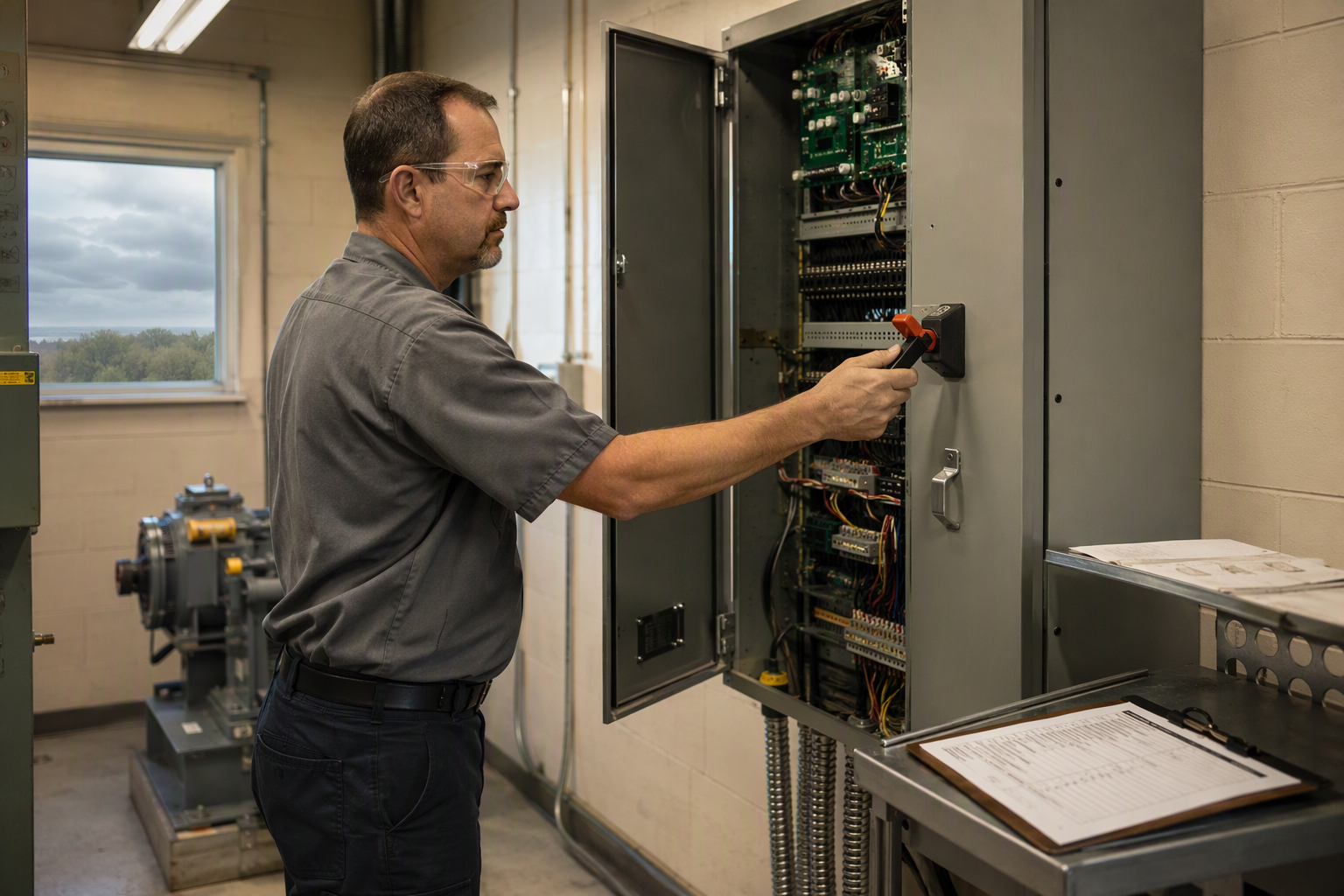
- Shut down power at the elevator controller disconnect: Once the car is parked at the top floor, open the main line disconnect switch at the controller to cut power. This prevents surge damage at grid restoration and eliminates the risk of the elevator attempting to self-rescue or travel during an unstable power event.
- Do not simply set the elevator to independent service or turn off the machine room light: The controller disconnect must be opened — not just the car’s independent service switch — to truly isolate the system from incoming power.
- Inspect and clear pit drain and sump pump: Verify the pit sump pump is operational and that the pit drain is clear of debris. If the building is in a known flood zone, consult with the elevator contractor about temporary flood barriers or additional waterproofing measures for the pit access door.
- Document the system condition: Photograph or video the machine room, controller, and pit area before the storm. This pre-storm documentation supports insurance claims and helps the post-storm inspector establish a baseline.
- Secure the machine room: Close and latch all machine room doors and windows. Where machine rooms are vented to the exterior, verify that louvers are functional and not blocked with debris.
- Post a notice at each elevator lobby: Inform building occupants that elevators will be taken out of service before the storm and provide guidance on stairwell access.
What are the post-storm steps for returning an elevator to safe operation?
After a hurricane or tropical storm passes, elevators must not be returned to service until a qualified elevator professional has inspected the equipment and confirmed it is safe — no matter how minor the storm appeared to be.
- Do not restore power before inspection: Even if there is no visible water damage, do not close the controller disconnect until a qualified elevator technician has examined the pit, machine room, controller, and hoistway.
- Inspect the pit for water: Check the pit for standing water, silt, or debris. If water is present, it must be fully removed and the pit dried before any energization.
- Inspect the machine room and controller: Look for water stains, condensation inside the controller cabinet, corrosion on terminals, and any evidence of surge damage such as burned components or tripped breakers.
- Test the pit sump pump: Confirm the sump pump is operational before restoring power to the elevator system.
- Restore power and perform a functional test: A qualified elevator technician should restore power incrementally, observing for unusual current draw, fault codes, or abnormal behavior before committing to full operation.
- Test all safety devices: Verify that all pit stop switches, hoistway door interlocks, emergency lighting, emergency communication, and overspeed governors function correctly per ASME A17.1/CSA B44 requirements.
- Schedule a certified post-storm inspection if any damage occurred: If any damage, flooding, or electrical anomaly is confirmed, a certified elevator inspector must inspect the equipment before it returns to normal public service. Under Chapter 399, Florida Statutes, the certificate of operation holder is responsible for ensuring the elevator is safe for use.
- Report any accident to the state within 5 working days: If any injury or accident occurred related to the elevator during or immediately after the storm event, Florida law requires the certificate of operation holder to report it to the state within 5 working days.
What Florida regulations govern elevator safety and compliance during storm recovery?
Elevator safety in Florida is governed by Chapter 399, Florida Statutes and Chapter 61C-5, Florida Administrative Code, administered by the Florida Department of Business and Professional Regulation (DBPR), Division of Hotels and Restaurants, Bureau of Elevator Safety.
Florida adopted ASME A17.1/CSA B44, 2019 edition as the technical standard for elevator safety, effective December 31, 2023, with certain exclusions for equipment types such as private residence and marine elevators. All maintenance, repair, and inspection activity must conform to this adopted edition.
In Pompano Beach, elevator enforcement is handled locally by the Broward County Building Code Division, which enforces Florida’s elevator law (Chapter 399) through its own certified elevator inspectors. In Sarasota, building owners should confirm their current jurisdictional authority. Regardless of local enforcement delegation, the state framework — DBPR oversight, Chapter 399 requirements, and the ASME A17.1-2019 technical standard — applies uniformly.
Under Florida law, every elevator covered by Chapter 399 must be inspected annually by a certified elevator inspector (with a specific exemption for elevators serving only two adjacent floors that are covered by a service maintenance contract). A Florida certificate of operation is valid for no more than two years and can only be renewed following a satisfactory inspection. The certificate must be posted in the elevator cab in a frame with a transparent cover. Operating on an expired certificate violates state law.
All installation, alteration, maintenance, and repair work must be performed by a Florida registered elevator company employing Florida certified elevator technicians. Work performed by unregistered individuals or companies does not satisfy state law requirements and may void insurance coverage.
How does a service maintenance contract affect Florida elevator inspection requirements after a storm?
A qualifying service maintenance contract under Chapter 399 provides a specific inspection exemption for certain elevator types, but this exemption does not eliminate the obligation to conduct a post-storm safety assessment before returning equipment to service.
Florida law provides that an elevator (not an escalator or dumbwaiter) that serves only two adjacent floors and is covered by a service maintenance contract is exempt from the annual certified inspection requirement while the contract remains in effect. For the vast majority of commercial and multi-story residential buildings — those with elevators serving three or more floors — this exemption does not apply, and annual certified inspections remain mandatory.
Even where an exemption applies, it pertains to the routine annual inspection schedule, not to post-casualty assessment. A flood-damaged elevator cannot be returned to service on the basis of a maintenance contract exemption. The obligation for safe operation under Chapter 399 rests with the certificate of operation holder regardless of inspection scheduling exemptions.
What are the differences in hurricane risk between hydraulic and traction elevators in Florida buildings?
Hydraulic and traction elevator systems face different primary hurricane risks — hydraulic systems are more vulnerable to pit flooding and fluid contamination, while traction systems face greater electrical exposure from machine room equipment and overhead machinery.
| Risk Factor | Hydraulic Elevator | Traction Elevator (MRL and Machine Room) |
|---|---|---|
| Pit flooding impact | High — power unit, hydraulic reservoir, and pump motor at pit level or below | Moderate — fewer critical components in pit, though pit electrical and safety devices remain at risk |
| Hydraulic fluid contamination | High — water intrusion into reservoir degrades seals and pump assembly | Not applicable — no hydraulic fluid |
| Controller/VFD surge risk | Moderate — typically older relay-logic or basic solid-state controllers in lower-rise buildings | High — modern VFDs and microprocessor controllers are highly sensitive to transients |
| Machine room exposure | Lower — machine room typically at or below pit level in basement installations | Higher — overhead machine room or distributed MRL components throughout hoistway |
| Wire rope/cable corrosion | Low — no overhead wire ropes in standard hydraulic | High — hoist ropes, governor rope, and compensation cables are all vulnerable to salt-air corrosion |
| Post-storm restoration complexity | High if flooded — oil decontamination required | Moderate to high depending on electrical damage |
| Typical Florida building type | Low-rise commercial, 2–6 story residential | Mid-rise and high-rise commercial and residential |
Does ADA compliance affect how elevators must be maintained or restored after a hurricane?
Yes — the Americans with Disabilities Act (ADA) requires that accessible elevators remain operational, meaning post-storm restoration of elevator service is not just a property management concern but a federal accessibility obligation for covered buildings.
Under the ADA, elevators in buildings that are required to provide accessible routes must be maintained in operable working condition. A hurricane that takes an elevator out of service creates a potential ADA compliance gap for building occupants who cannot use stairs. Building owners should prioritize post-storm elevator restoration and, where restoration will be delayed, implement temporary alternative accessible route measures in consultation with legal counsel.
The ADA’s maintenance obligation does not require that elevators operate during the storm event itself — taking equipment out of service for safety is an appropriate and legally defensible pre-storm action. The obligation resumes as soon as the building is re-occupied and accessible routes must be provided.
How often should Florida elevators be inspected outside of hurricane season?
Florida law requires that elevators covered by Chapter 399 be inspected by a certified elevator inspector annually, except for the specific exemption covering two-floor service elevators under a maintenance contract, and the certificate of operation must remain current at all times.
Beyond the statutory minimum, industry best practice in Florida’s coastal environment — where humidity, salt air, and seasonal weather extremes accelerate component wear — supports more frequent maintenance visits than the annual inspection floor. A thorough maintenance contract that includes regular lubrication, adjustment, and safety device testing keeps equipment in the condition required to withstand the additional stresses of storm season. Axxiom Elevator Florida recommends that building owners in Pompano Beach and Sarasota review their current maintenance contract terms annually to ensure coverage aligns with the demands of Florida’s operating environment.
What qualifications must an elevator company have to legally perform storm-related repairs in Florida?
In Florida, any company performing elevator installation, maintenance, or repair — including storm damage repairs — must be a Florida registered elevator company, and all technicians performing the work must hold a Florida elevator certificate of competency.
Florida registered elevator companies must register with the state annually and maintain general liability insurance. Certified elevator technicians must similarly register annually, carry general liability insurance, and renew their certificate of competency each year with proof of eight hours of continuing education. A certificate of competency that has lapsed is not a valid authorization to perform work.
Building owners should request proof of current state registration and technician certification before authorizing any post-storm elevator repair work. This is particularly important in the chaotic post-storm environment when unregistered contractors may solicit emergency repair business. Axxiom Elevator Florida maintains all required state registrations and employs certified elevator technicians to serve buildings in Pompano Beach and Sarasota.
What is the role of the Broward County Building Code Division in elevator oversight for Pompano Beach buildings?
The Broward County Building Code Division enforces Florida’s elevator law — Chapter 399, Florida Statutes — through its own certified elevator inspectors for buildings in Broward County, which includes Pompano Beach.
This local enforcement delegation means that elevator permits, inspections, and certificates in Pompano Beach flow through the Broward County process rather than directly through the state DBPR office. Building owners and managers in Pompano Beach should be aware that their post-storm inspection and return-to-service process will involve coordination with the Broward County Building Code Division. The underlying legal framework — Chapter 399 and the ASME A17.1-2019 technical standard — remains the same regardless of which authority conducts the inspection.
Can a building owner legally operate an elevator that has storm damage if the certificate of operation is still current?
No — a current certificate of operation does not authorize operating an elevator that has known storm damage or safety deficiencies; the certificate of operation holder is legally responsible under Chapter 399 for safe operation at all times.
Florida law places the burden of safe operation squarely on the certificate of operation holder. If a building owner or manager knows — or reasonably should know — that an elevator has been damaged by flooding, power surge, or other storm-related event, operating the elevator exposes passengers to risk and the owner to significant legal liability. The certificate of operation reflects the condition of the elevator at the time of the most recent satisfactory inspection; it is not a license to operate damaged equipment.
The correct course of action after any storm event that may have affected elevator equipment is to keep the elevator out of service until a qualified elevator technician — from a company such as Axxiom Elevator Florida — has assessed the system and confirmed it is safe to operate.
What should be included in an elevator pre-storm checklist for Florida building managers?
A comprehensive Florida elevator pre-storm checklist should address controller shutdown, car parking position, pit protection, machine room security, documentation, and post-storm service scheduling.
- Confirm current certificate of operation is posted in the cab and not expired
- Verify contact information for the registered elevator service company is on file
- Pre-schedule post-storm inspection with the elevator service company
- Ensure pit sump pump is tested and operational
- Clear pit drain of any debris
- Assess pit waterproofing and address any known gaps before storm season begins
- Confirm surge protection devices are installed at the elevator controller
- Establish a written controller shutdown procedure and train building maintenance staff
- Park car at top floor and open main line disconnect before storm arrival
- Photograph machine room, controller, and pit for pre-storm documentation
- Secure machine room doors and accessible hoistway openings
- Post elevator-out-of-service notices at each lobby landing
- Review emergency communications system in the cab — required under ASME A17.1 — to confirm it will function if cellular service is disrupted
How do generators and emergency power systems affect elevator operation during Florida storms?
Emergency generator systems can maintain limited elevator operation during power outages, but generator-fed elevators require specific controller configuration, load testing, and coordination with the building’s life safety systems to operate safely.
Many Florida commercial and residential high-rise buildings include provisions for emergency power to at least one elevator, which is critical for firefighter access under both Florida’s adopted building codes and life safety standards. However, generator-powered elevator operation requires that the controller is properly configured for the generator’s frequency and voltage output, that automatic transfer switching is set up correctly, and that the generator’s capacity matches the elevator’s demand profile — including the higher inrush current of hydraulic pump motors or VFD-driven traction machines.
Building owners who rely on emergency generator power for hurricane season elevator availability should have their generator-elevator interface tested annually before storm season begins. An improperly configured generator can cause the same controller damage as utility power irregularities. Axxiom Elevator Florida can assess generator-elevator compatibility as part of a pre-storm evaluation for buildings in Pompano Beach and Sarasota.
What are the signs that an elevator needs immediate service after a tropical storm or hurricane?
After a tropical storm or hurricane, immediate professional elevator service is needed if the pit contains water, the controller shows fault codes or visible damage, the car is stranded, door operation is abnormal, or any safety device has been tripped.
- Visible water or moisture in the pit, machine room, or on the controller
- Controller fault codes, error displays, or tripped circuit breakers
- Car stranded mid-travel or at a non-landing position
- Doors failing to open, close, or lock properly
- Unusual sounds during travel — grinding, scraping, or clicking from guide assemblies
- Burning smell or discoloration around electrical panels or motor components
- Loss of emergency lighting or communication in the cab
- Visible corrosion, rust staining, or debris in the hoistway
- Sump pump alarm or evidence that sump pump failed during storm
- Leveling issues — car stopping above or below landing sill
None of the conditions above should be addressed by building maintenance staff without a qualified elevator technician present. OSHA standards governing elevator and escalator safety, combined with Florida’s statutory framework, make clear that elevator repair work must be performed by qualified, authorized personnel.
How long does post-storm elevator restoration typically take in Florida?
Post-storm elevator restoration timelines vary widely based on the type and extent of damage — minor electrical resets may take hours, while flooded pits, contaminated hydraulic systems, or destroyed controllers can require days to weeks depending on parts availability.
After a major storm event such as a Category 3 or higher hurricane, parts supply chains for elevator components — particularly custom controller boards, VFD modules, and hydraulic power units — can be significantly disrupted. Lead times that might be two to three days under normal conditions can extend considerably when regional demand spikes simultaneously. This is one of the strongest practical arguments for pre-season assessment and any necessary component upgrades before storm season begins, rather than relying on reactive post-storm sourcing.
Building owners should also account for certified inspection time in the restoration timeline. Returning a flood-affected elevator to service requires not just the repair work but a post-repair inspection by a certified inspector, which itself involves scheduling in a post-storm environment where inspection demand is high across the region. Axxiom Elevator Florida coordinates both the repair and inspection phases for building clients in Pompano Beach and Sarasota, helping to streamline the path back to compliant operation.
What proactive upgrades reduce hurricane-related elevator damage in Florida buildings?
Proactive upgrades that reduce hurricane vulnerability include pit waterproofing and sump pump systems, surge-protective devices at the controller, elevated hydraulic power units in flood-prone buildings, VFD bypass capability, and battery-lowering systems for traction elevators.
Pit sump pumps with battery backup are among the highest-value investments for Florida buildings in flood-prone areas. A sump pump that loses utility power — exactly when it is most needed during a storm — provides no protection. Battery-backed sump systems maintain pit drainage even during extended outages.
Surge-protective devices installed at the elevator controller and at the building’s main electrical panel protect sensitive electronics from the transient spikes that occur at power restoration. This is a relatively low-cost upgrade compared to the expense of replacing a VFD or controller board after storm damage.
Battery-powered automatic lowering systems for traction elevators allow the car to travel to the lowest landing and open doors when power is lost, preventing occupant entrapment during outages and allowing the car to be correctly positioned before storm shutdown. These systems also reduce the risk of a car being stranded mid-travel when power fails unexpectedly as a storm approaches.
Building owners seeking a structured assessment of their current storm preparedness posture are encouraged to contact Axxiom Elevator Florida for a professional evaluation before hurricane season begins.
Is there a Florida requirement to report elevator storm damage to state authorities?
Florida law requires the certificate of operation holder to report any elevator accident to the state within 5 working days, and storm-related events that result in injury or damage meeting the definition of an accident under Chapter 399 fall within that reporting obligation.
The reporting requirement under Chapter 399, Florida Statutes applies to accidents — events involving personal injury or significant equipment damage — not to every instance of storm-related wear or minor component failure. However, building owners should consult with their elevator service company and, if appropriate, legal counsel to determine whether a specific storm-related event triggers the reporting obligation. Erring on the side of notification is the more protective approach.
Beyond the accident reporting obligation, the broader duty of safe operation under Chapter 399 means that building owners cannot defer post-storm assessment indefinitely. Documenting the storm event, the post-storm inspection, any repairs performed, and the return-to-service date creates a defensible record that demonstrates the owner’s good-faith compliance with Florida’s elevator safety framework.
Need elevator service you can rely on? Axxiom Elevator Florida is ready to help.