Emergency Elevator Repair in Sarasota, FL: Complete FAQ Guide
After 15-plus years diagnosing and repairing elevator systems across Florida, I’ve responded to hundreds of emergency calls — from passenger entrapments in Sarasota high-rises to sudden hydraulic failures in Pompano Beach commercial buildings. This guide answers every critical question building owners, property managers, and facility directors ask when an elevator goes down unexpectedly. Know what to do, what it costs, what the law requires, and who to call.
What counts as an elevator emergency in Sarasota, FL?
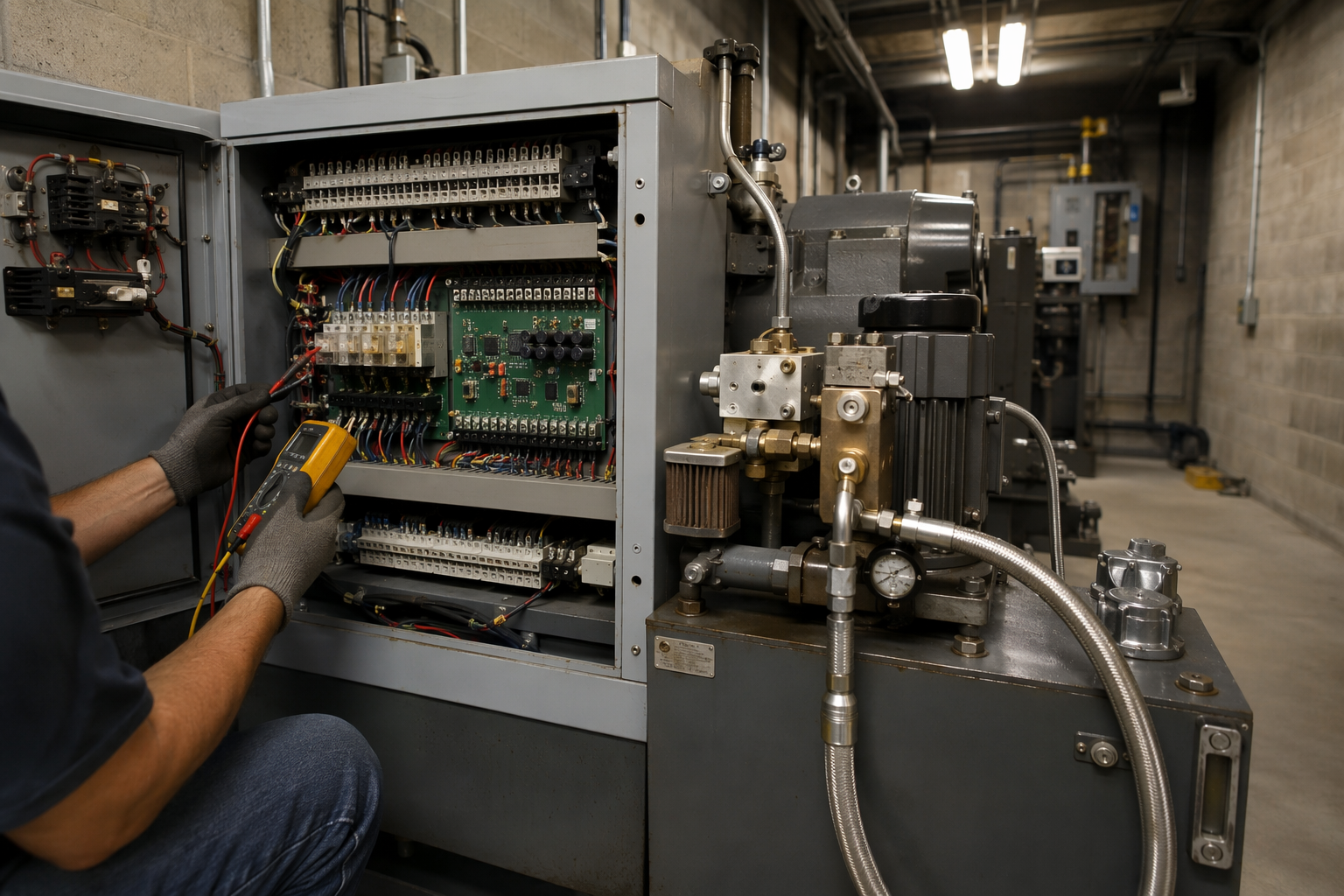
An elevator emergency is any situation involving passenger entrapment, unusual noises indicating imminent mechanical failure, visible smoke or burning smell from the machine room, door malfunctions that create a fall hazard, or sudden uncontrolled movement of the cab.
Not every breakdown is an emergency in the life-safety sense, but every breakdown is operationally urgent. Florida law under ASME A17.1 Safety Code for Elevators and Escalators requires that equipment be taken out of service immediately when a hazardous condition is discovered. In multi-story Sarasota buildings — condominiums, medical offices, hotels — a single out-of-service elevator can violate ADA accessibility requirements within hours, creating compounding legal liability.
The two categories I triage every call into are: (1) life-safety emergencies requiring 911 first, certified tech second; and (2) mechanical failures requiring immediate dispatch of a licensed elevator contractor. Understanding the difference saves time and protects lives.
What should I do immediately when someone is trapped in an elevator in Sarasota?
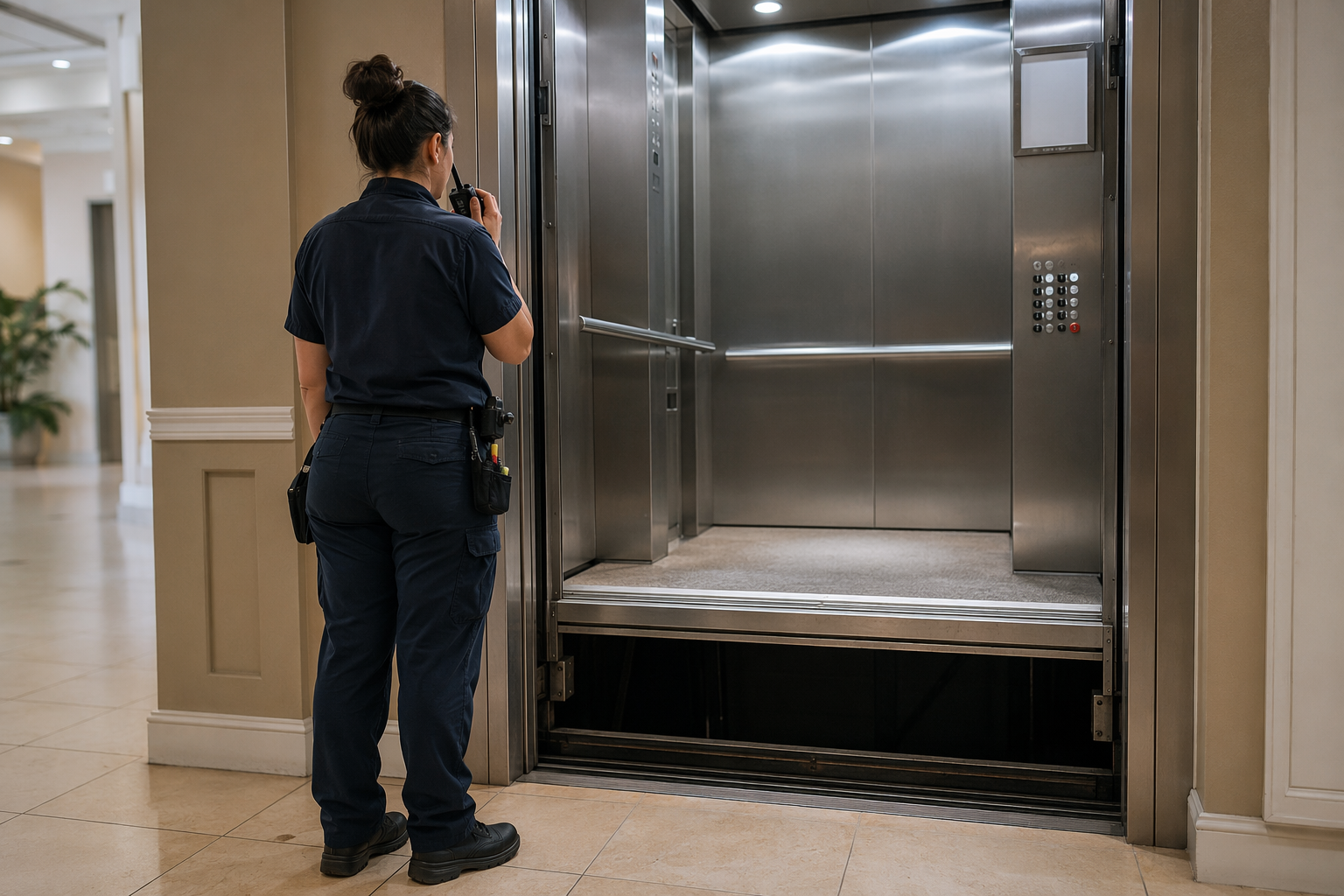
If a passenger is trapped inside an elevator, follow this exact protocol — do not attempt to pry doors open yourself, as this causes the majority of elevator-entrapment injuries.
- Call 911 first. Inform dispatch that there is a passenger entrapment in an elevator, provide the building address, and specify the floor the cab appears to be on.
- Communicate calmly with the trapped passenger. Use the intercom or speak through the door — reassure them help is on the way and instruct them not to try forcing the doors.
- Call your licensed elevator contractor immediately. Sarasota emergency response from a certified company like Axxiom Elevator Florida means a technician is dispatched concurrently with emergency services.
- Locate the machine room key. Your building should have a designated key accessible to management — hand it to the arriving elevator technician, not to firefighters, unless the tech is unavailable.
- Do not attempt manual door releases yourself. Only IUEC-certified technicians or trained firefighters should operate hoistway door unlocking devices per ASME A17.1 Section 2.12.2.
- Document the time of entrapment. Florida’s Bureau of Elevator Safety may require an incident report if injuries occur.
- Keep the elevator out of service until the certified technician has completed a full inspection and authorized return to operation in writing.
How quickly can an emergency elevator technician reach Sarasota?
A true 24/7 emergency elevator contractor serving Sarasota should have a technician on-site within 2–4 hours for mechanical failures and concurrent with fire rescue for entrapments.
Response time depends on the contractor’s local infrastructure. Companies with a physical presence in the Sarasota market — not just a dispatch center routing calls to distant crews — consistently deliver faster response. From my experience, the difference between a 2-hour and a 6-hour response time usually comes down to whether the contractor actually has technicians staged locally versus subcontracting from Tampa or Fort Myers.
Axxiom Elevator Florida maintains certified technicians serving the Sarasota market around the clock. When you call, you reach a live person who dispatches from the nearest available technician — not an automated system that queues your call for morning review.
What are the most common causes of emergency elevator failures in Sarasota?
The most common causes of sudden elevator failures in Sarasota include hydraulic fluid leaks, door operator failures, rope and sheave wear, control board malfunctions, and heat-related electrical faults exacerbated by Florida’s climate.
Florida’s heat and humidity create conditions that accelerate wear on components that might last 15 years in a northern climate but fail in 8–10 years here. Hydraulic elevators — extremely common in Sarasota’s two- to six-story commercial and residential buildings — are especially vulnerable to cylinder seal degradation when underground hydraulic cylinders are exposed to the state’s high water table and corrosive soil chemistry. I’ve pulled cylinders from Sarasota properties with wall thickness reduced by more than 40% due to external corrosion — a condition that can lead to sudden catastrophic failure without prior warning signs.
Traction elevators in taller Sarasota high-rises face rope fatigue and sheave groove wear as primary failure modes, while door operator failures — the number one cause of nuisance shutdowns industry-wide — are compounded locally by salt-air corrosion in Gulf-proximate buildings.
How much does emergency elevator repair cost in Sarasota, FL?
Emergency elevator repair in Sarasota typically costs between $500 and $8,000+ depending on the nature of the failure, parts required, and time of the service call, with after-hours emergency dispatch fees ranging from $250 to $600 on top of labor and parts.
| Repair Type | Estimated Cost Range | Typical Resolution Time | After-Hours Surcharge |
|---|---|---|---|
| Door operator repair/replacement | $800 – $2,500 | 2–6 hours | $250 – $400 |
| Hydraulic pump/valve repair | $1,500 – $5,000 | 4–12 hours | $350 – $600 |
| Control board replacement | $2,000 – $6,000 | 6–24 hours (parts dependent) | $350 – $600 |
| Rope/cable emergency inspection & temporary fix | $500 – $1,800 | 2–4 hours | $250 – $400 |
| Hydraulic cylinder emergency assessment | $750 – $2,000 | 2–6 hours | $300 – $500 |
| Entrapment rescue + root cause repair | $600 – $3,500 | 1–8 hours | $300 – $600 |
| Full modernization (post-failure) | $25,000 – $90,000+ | 2–8 weeks | N/A |
These figures reflect 2026 market conditions in Sarasota, including parts availability challenges driven by ongoing supply chain pressures affecting proprietary elevator components. Always request a written estimate before authorizing major repairs — any reputable contractor will provide one on-site before starting non-emergency work.
Is emergency elevator repair in Sarasota required to be done by a licensed contractor?
Yes — Florida law requires all elevator repair work, including emergency repairs, to be performed exclusively by licensed elevator contractors holding a state certificate of competency issued under Florida Statutes Chapter 399.
Florida’s Bureau of Elevator Safety, operating under the Department of Business and Professional Regulation (DBPR), enforces strict licensure requirements. Unlicensed elevator repair — including well-intentioned attempts by building maintenance staff — is illegal and voids equipment insurance coverage. If an injury occurs on an elevator repaired by an unlicensed party, the building owner faces direct civil and criminal liability.
In 2026, Florida conducts active enforcement sweeps in Sarasota and other high-density markets. Verify that any contractor dispatched to your property carries: (1) a current Florida elevator contractor license, (2) proof of general liability insurance, and (3) worker’s compensation coverage. Axxiom Elevator Florida maintains all required Florida state licensure and insurance, and technicians carry documentation available for inspection on every service call.
What Florida codes and safety standards govern emergency elevator repairs?
Emergency elevator repairs in Sarasota must comply with the ASME A17.1 Safety Code for Elevators and Escalators, Florida Statutes Chapter 399, and applicable OSHA standards for elevator work safety.
Florida adopted ASME A17.1-2019 as its governing technical standard for elevator construction, installation, inspection, and repair. Key provisions affecting emergency repairs include:
- Section 8.6: Requirements for taking defective equipment out of service and the conditions under which it may be returned.
- Section 2.19: Safety device testing requirements following any repair affecting the elevator’s safety systems.
- Section 3.26: Hydraulic elevator cylinder requirements, including inspection protocols after emergency shutdowns.
- Section 2.12: Emergency access and firefighter operation provisions relevant to entrapment response.
OSHA 29 CFR 1910.261 and 29 CFR 1926.552 govern worker safety during elevator repair operations, including lockout/tagout procedures that every certified technician must follow before accessing a hoistway or machine room. Florida’s Chapter 399 adds state-specific inspection scheduling, permit requirements for major repairs, and incident reporting mandates that apply immediately when a passenger entrapment results in injury.
How do I know if my Sarasota elevator is ADA compliant after an emergency repair?
After any emergency repair that affects cab dimensions, door timing, controls, or accessibility features, the elevator must be inspected to confirm it still meets ADA Standards for Accessible Design, specifically Sections 407–408 covering elevator specifications.
Emergency repairs sometimes involve temporary component substitutions — a door operator replaced with a non-OEM part, for example — that inadvertently change door dwell time below the ADA-required minimum (which varies by door width but is generally 3 seconds minimum at the landing). The ADA also mandates specific cab interior dimensions (minimum 51″ × 68″ for most applications), floor-to-floor leveling within ½ inch, and tactile control panels meeting specific height and Braille requirements. Any temporary repair that compromises these standards must be disclosed to the building operator and corrected before the elevator returns to full public service.
What happens if I don’t report an elevator emergency incident to Florida authorities?
Failure to report a qualifying elevator incident to Florida’s Bureau of Elevator Safety within the required timeframe can result in fines, license suspension for the property, and increased civil liability exposure if a passenger subsequently files a personal injury claim.
Florida Statutes Chapter 399.02 requires that any elevator accident resulting in injury, death, or significant property damage be reported to the Bureau of Elevator Safety. The reporting obligation falls on both the licensed contractor and the building owner. In 2026, Florida’s DBPR has increased enforcement of incident reporting compliance, with administrative fines for late or missing reports starting at $1,000 per violation per day. Beyond the regulatory penalty, unreported incidents create a documented paper trail showing the building owner had knowledge of a defect and failed to act — a plaintiff attorney’s best evidence in a negligence claim.
Can a Sarasota elevator be put back in service the same day after an emergency repair?
Yes — same-day return to service is possible for many emergency repairs, provided the certified technician completes all required safety device tests and the equipment passes inspection before the building operator is cleared to resume operations.
The return-to-service process under ASME A17.1 Section 8.6.5 requires the performing contractor to certify in writing that the repaired equipment is safe for passenger use. For repairs affecting safeties, buffers, governor, or the hydraulic system, an additional third-party inspection may be required by Florida’s Bureau of Elevator Safety before the elevator can legally operate. Simple door repairs, minor hydraulic valve adjustments, or control board swaps typically allow same-day return. Cylinder replacements, rope replacements, or safety device work typically require a state inspection that may add 2–5 business days to the timeline depending on inspector availability in Sarasota.
How do I choose a reliable emergency elevator repair company in Sarasota?
Choose a Sarasota emergency elevator repair contractor based on verified Florida state licensure, demonstrable local response capability, manufacturer-certified technicians, a transparent pricing structure, and confirmed 24/7 availability — not just a 24/7 phone answering service.
Here’s my checklist developed after years of seeing building owners get burned by out-of-area contractors who over-promise response times:
- Verify the Florida elevator contractor license number on the DBPR website before the first call
- Ask specifically where the nearest on-call technician is physically located — not where the dispatch office is
- Confirm they carry parts inventory locally for common hydraulic and door components
- Request references from Sarasota-area property managers they currently serve
- Ask whether their technicians are IUEC (International Union of Elevator Constructors) certified or carry manufacturer-specific credentials
- Confirm written estimates are provided before major repair authorization
- Ask about their relationship with Florida’s Bureau of Elevator Safety inspectors — experienced local contractors know the process
Axxiom Elevator Florida meets all of these criteria and serves Sarasota building owners with locally-staged certified technicians who understand the specific equipment mix and regulatory environment in this market.
What is the difference between emergency elevator repair and routine maintenance in Sarasota?
Emergency elevator repair addresses sudden failures that take equipment out of service or create safety hazards, while routine maintenance is the scheduled, preventive work performed under a maintenance contract to prevent those failures from occurring in the first place.
The practical difference from a cost standpoint is substantial. Buildings with comprehensive maintenance agreements typically pay 30–50% less in total elevator operating costs over a 10-year period compared to buildings that operate on a “run-to-failure” model. A maintenance visit that costs $300–$600 per month and catches a failing door cam roller before it causes a door operator failure saves a $2,500 emergency repair, an after-hours dispatch fee, and potential ADA compliance exposure during the downtime period.
Florida does not mandate a specific maintenance frequency in statute, but ASME A17.1-2019 establishes the technical framework for what maintenance must be performed. Most industry professionals — myself included — recommend monthly maintenance visits for high-use Sarasota elevators and quarterly visits for low-use residential applications.
What parts are most likely to need emergency replacement in Sarasota elevators?
The components most frequently requiring emergency replacement in Sarasota’s elevator inventory are door operators, hydraulic pump/valve units, control boards, and rope/sheave assemblies, with Florida’s climate directly accelerating wear on all of these systems.
Salt-air corrosion in beachside Sarasota properties is an especially destructive force on door track hardware, hatch roller guides, and electrical connector contacts. I routinely see door component lifespans cut by 30–40% compared to manufacturer specifications in buildings within two miles of the Gulf. Stock availability matters enormously in emergency situations — a contractor who carries door operator motors, hydraulic valve manifolds, and control board modules locally can complete repairs in hours that would take days if parts must be ordered from a national distributor.
Does my Sarasota building’s elevator need a permit for emergency repairs?
Yes — major emergency repairs in Florida require a permit from the Bureau of Elevator Safety, even when performed on an emergency basis, with the permit typically applied for within 24 hours of the emergency work beginning.
Florida’s permitting rules allow emergency work to proceed without waiting for a permit — life-safety cannot be held hostage to bureaucratic timelines — but the contractor is required to file the permit application within one business day of starting emergency work and to schedule a subsequent state inspection before the elevator returns to full service (for permit-required repairs). Minor repairs — like replacing a burned relay, a defective door sensor, or a hydraulic fluid top-off after a minor leak — typically do not require permits. The Florida Bureau of Elevator Safety’s permit threshold is defined by the scope and impact of the work on safety-critical systems, and an experienced contractor will advise you correctly on permit requirements during the initial site assessment.
How long does it typically take to complete an emergency elevator repair in Sarasota?
Most emergency elevator repairs in Sarasota are resolved within 4–24 hours for common failures, while complex repairs involving hydraulic cylinders, rope replacement, or major modernization can extend from several days to several weeks.
Timeline variables include: parts availability locally versus requiring shipment, permit and inspection scheduling with the Bureau of Elevator Safety, and whether the failure has exposed additional cascading damage that must be addressed before return to service. I always communicate realistic timelines with property managers on arrival — false optimism about a 2-hour fix that turns into a 3-day repair creates unnecessary conflict and disrupts building operations without any benefit. Axxiom Elevator Florida technicians provide a written scope and realistic timeline estimate within the first hour of any emergency service call.
What should Sarasota building owners do to prevent elevator emergencies?
Sarasota building owners can prevent the majority of elevator emergencies by maintaining a current preventive maintenance contract with a licensed elevator contractor, scheduling Florida-required annual inspections on time, keeping a maintenance log, and responding promptly to any notice of deficiency issued by state inspectors.
Based on my field experience, the three highest-impact prevention steps are:
- Establish a written monthly maintenance agreement with a licensed elevator contractor who is physically local to Sarasota — not a national company that dispatches from outside the market.
- Complete all follow-up repairs identified during annual inspections within the timeframe specified by the Bureau of Elevator Safety. Deferred maintenance is the leading predictor of emergency failure.
- Train building staff on the warning signs of impending failure: unusual leveling, door hesitation, excessive noise, burning smells, and cab vibration are all actionable warnings that allow proactive repairs before a breakdown occurs.
What certifications should emergency elevator technicians in Sarasota hold?
Emergency elevator technicians operating in Sarasota should hold a Florida state elevator certificate of competency (mechanic-level or contractor-level), IUEC certification or equivalent manufacturer training credentials, and current OSHA 10 or 30 certification for construction/general industry safety.
Florida’s Bureau of Elevator Safety issues certificates of competency at the mechanic and contractor levels — the mechanic certificate authorizes field repair and maintenance work, while the contractor certificate authorizes oversight of all elevator work and direct regulatory responsibility for each job site. In 2026, Florida has strengthened its continuing education requirements for certificate renewal, requiring documented hours in updated ASME code provisions. When Axxiom Elevator Florida dispatches a technician to your Sarasota property, you are receiving a credentialed professional whose certifications are current and verified — not a general maintenance worker or an uncertified apprentice working without supervision.
What is the difference between a hydraulic and traction elevator emergency in Sarasota?
Hydraulic elevator emergencies typically involve fluid leaks, pump failures, or cylinder problems — usually slower-developing and detectable early — while traction elevator emergencies more commonly involve rope integrity, brake system, or drive machine failures that can be more sudden and require a different set of emergency protocols.
Sarasota’s building inventory skews heavily toward hydraulic elevators in its abundant two- to five-story condominium and commercial stock. Hydraulic systems have the advantage of a more straightforward emergency lowering procedure — most can be manually lowered to a floor for passenger rescue using the hand pump or by manipulating the lowering valve. Traction systems in the city’s taller Gulf-front towers require more complex emergency procedures involving brake releases and counterweight management, and the technician’s specific experience with the installed drive machine manufacturer matters significantly in these situations.
How does Sarasota’s salt air environment affect elevator reliability and emergency risk?
Sarasota’s proximity to the Gulf of Mexico creates a salt-air environment that measurably accelerates corrosion of elevator door hardware, electrical contacts, hydraulic fittings, and structural components — increasing emergency failure risk by an estimated 25–40% compared to inland Florida locations.
This isn’t theoretical — it’s visible in the field. Buildings within one mile of the Gulf routinely present with door track corrosion, pit flooding damage, and electrical connector failures at intervals that would be considered premature by standard industry lifecycle benchmarks. My recommendation for Sarasota coastal properties is to specify marine-grade lubricants, stainless steel hardware where substitution is feasible, and monthly maintenance intervals rather than quarterly — and to budget for component replacement at roughly 75% of the manufacturer’s standard lifecycle, not 100%. This is the kind of local market knowledge that makes the difference between proactive management and repeated emergency calls.
What information should I have ready when I call for emergency elevator repair in Sarasota?
When calling for emergency elevator repair in Sarasota, have ready: the building address and elevator location, the equipment manufacturer and model number (found on the data plate inside the cab or machine room), a description of the failure symptoms, the current status of any passengers, and your maintenance contract number if applicable.
Having this information immediately available can cut dispatch time significantly. The manufacturer and model allow the technician to pre-stage appropriate parts before leaving for your location. The symptom description helps identify whether a control issue, mechanical issue, or hydraulic issue is likely — narrowing the tools and parts needed. If you have a current maintenance contract with Axxiom Elevator Florida, your equipment profile is already in our system, meaning the dispatched technician arrives already knowing your elevator’s service history, recent repairs, and any known recurring issues — a critical advantage in emergency response.
Ready for a Faster Emergency Response in Sarasota?
Don’t wait for a breakdown to discover your elevator contractor can’t reach you in time. Contact Axxiom Elevator Florida for a free elevator assessment — we’ll evaluate your equipment condition, review your maintenance history, and establish a 24/7 emergency response plan tailored to your Sarasota property.
Call now:
Serving Sarasota, FL and Pompano Beach, FL — Licensed, Insured, IUEC-Certified Technicians Available 24/7.