Elevator Maintenance Responsibility in Pompano Beach Commercial Buildings: What Owners, Tenants, and Property Managers Are Each Accountable For

Understanding who is legally and contractually responsible for elevator maintenance in a Pompano Beach commercial property is not just an administrative question — it is a compliance and liability issue. Florida law is clear about where ultimate accountability sits, yet leases and management agreements create overlapping duties that, if left undefined, can expose all three parties to risk. This guide breaks down each party’s role, maps it against Florida regulatory requirements, and helps building stakeholders make informed decisions about structuring maintenance responsibilities.
Who Holds the Primary Legal Responsibility for Elevator Maintenance Under Florida Law?
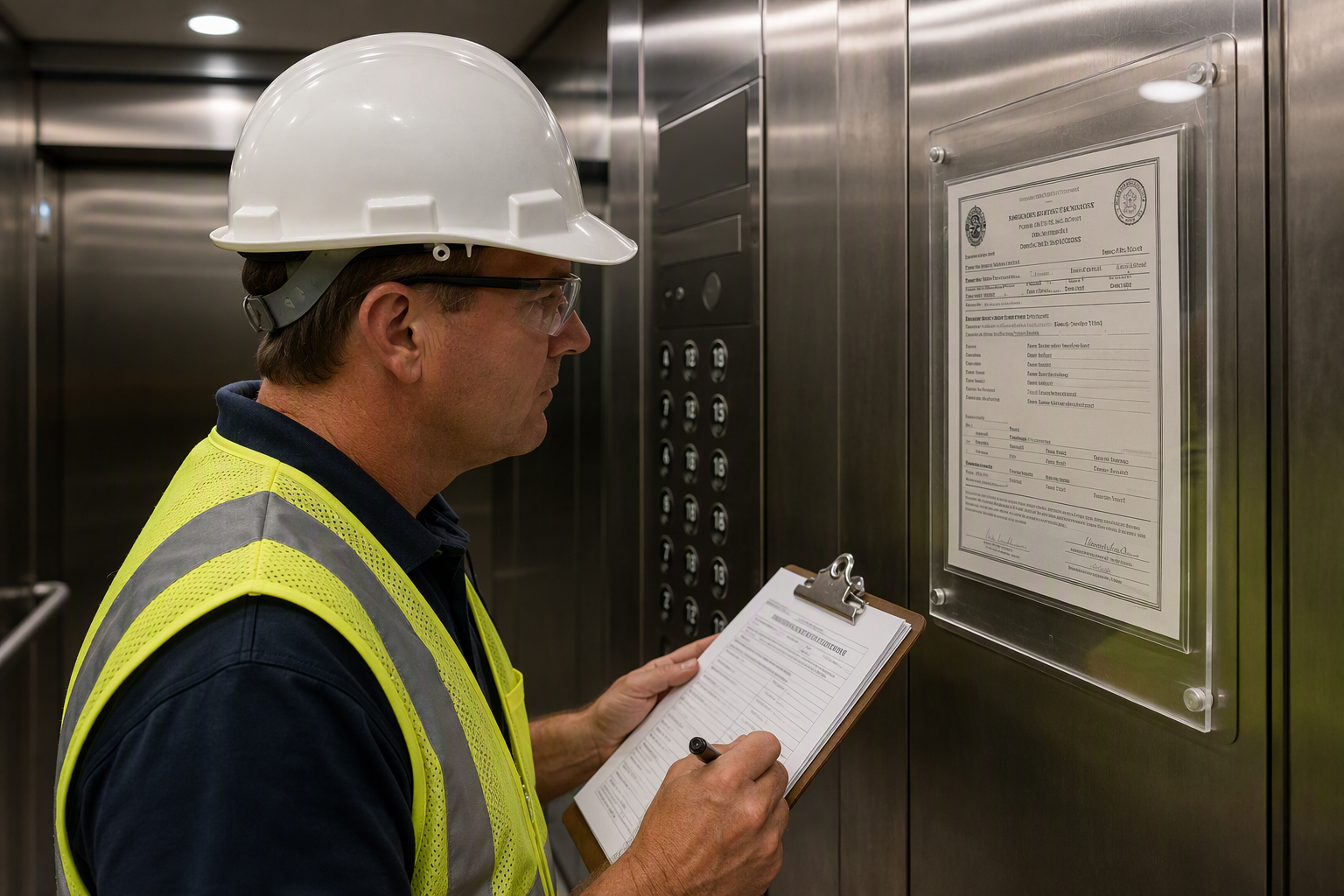
Under Chapter 399, Florida Statutes (the Florida Elevator Safety Act), once a certificate of operation is issued, the elevator owner is legally responsible for:
- Safe operation of the conveyance
- Proper and ongoing maintenance
- Ensuring required inspections are completed by a certified elevator inspector
- Correcting all code deficiencies identified during inspections
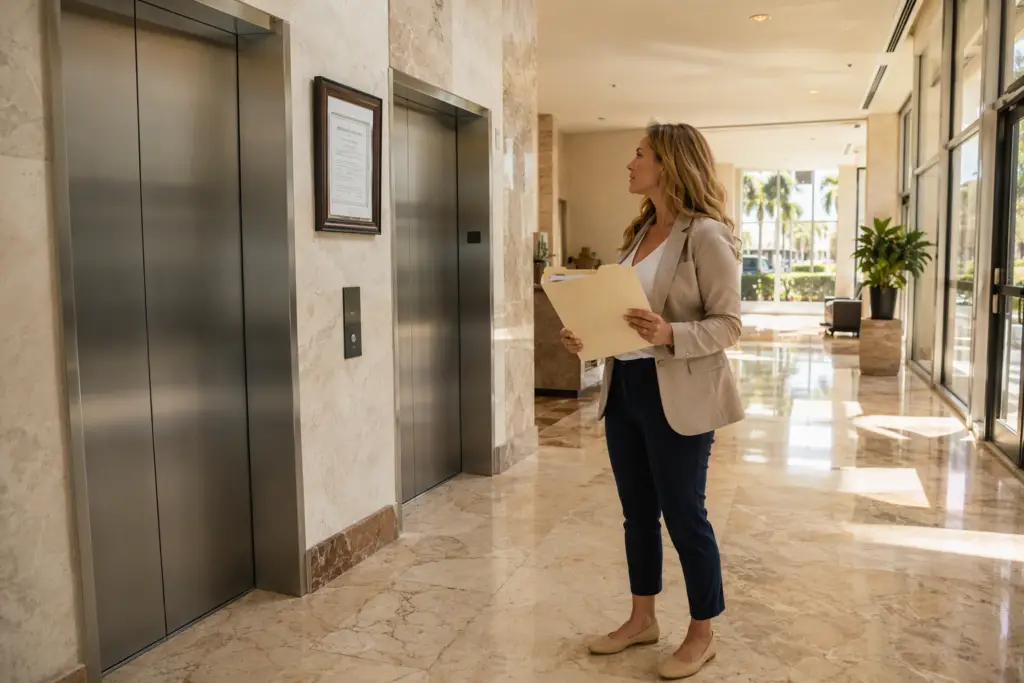
- Keeping a valid certificate of operation posted in a conspicuous location inside the elevator cab, in a frame with a transparent cover
- Reporting any elevator accident to the state within five working days
This statutory responsibility cannot be transferred or waived simply by signing a lease. Even when a property manager oversees day-to-day operations or a tenant controls access to the building, the owner — as certificate-of-operation holder — remains the party that Florida’s Bureau of Elevator Safety will hold accountable for violations, expired certificates, and unsafe conditions.
In Pompano Beach specifically, enforcement of Chapter 399 falls under the jurisdiction of the Broward County Building Code Division, which enforces Florida’s elevator law through its own certified elevator inspectors serving all municipalities in Broward County, including Pompano Beach.
What Are the Specific Roles of Owners, Tenants, and Property Managers?

While the law concentrates liability on the owner, practical responsibility is often distributed across three parties. The table below maps each stakeholder’s typical duties:
| Responsibility Area | Building Owner | Property Manager | Commercial Tenant |
|---|---|---|---|
| Certificate of Operation | Legally required to hold and maintain | May coordinate renewal on owner’s behalf | No direct role |
| Annual Inspection Scheduling | Ultimately responsible | Often coordinates as delegated by owner | Generally not responsible |
| Routine Maintenance Contract | Must ensure one is in place | May manage vendor relationship | Can be assigned by lease in rare cases |
| Code Deficiency Corrections | Legally obligated to correct | May manage contractor coordination | No direct role |
| Day-to-Day Use Oversight | Indirectly responsible | Often monitors on-site | Responsible for tenant-caused damage or misuse |
| Accident Reporting to State | Must report within 5 working days | Should notify owner immediately | Should notify property manager immediately |
| Certificate Posting in Cab | Required by law | May physically post certificate | No role; must not remove |
| ADA Compliance | Responsible for elevator accessibility | Flags accessibility issues | May be responsible for modifications within leased space per lease terms |
How Does Florida’s Certificate of Operation Requirement Affect Commercial Property Owners?
Florida law requires every elevator covered by Chapter 399, Florida Statutes to be inspected annually by a certified elevator inspector. A Florida certificate of operation is valid for no more than two years, and it can only be renewed when the elevator has a current satisfactory inspection on record. Operating an elevator on an expired certificate is a direct violation of state law.
Before a new elevator is placed into service, it must be inspected by a certified elevator inspector who has no employment, association, or conflict of interest with the permit holder or the owner — an important safeguard for Pompano Beach developers and building owners taking possession of newly constructed commercial properties.
One notable exemption under Florida law: an elevator that is not an escalator or dumbwaiter, serves only two adjacent floors, and is covered by a service maintenance contract is exempt from the annual inspection requirement as long as that contract remains in effect. This exemption underscores the importance of maintaining a continuous, documented maintenance agreement.
What Code Standards Must Pompano Beach Elevators Meet?
Florida has adopted the ASME A17.1/CSA B44 Safety Code for Elevators and Escalators, 2019 edition, effective December 31, 2023, as the governing technical standard under Chapter 61C-5, Florida Administrative Code. This standard establishes requirements for design, construction, installation, operation, inspection, testing, maintenance, and repair of elevators and related conveyances.
Federal requirements also apply in Pompano Beach commercial settings:
- Americans with Disabilities Act (ADA) — Governs elevator accessibility requirements in places of public accommodation, including cab dimensions, control panel heights, door timing, and audible/visual signals. Building owners bear primary ADA compliance responsibility.
- OSHA — Applies to elevator-related workplace safety, particularly when service technicians or maintenance workers are accessing elevator machinery spaces in commercial buildings.
How Should Lease Agreements Address Elevator Maintenance Responsibility?
A well-drafted commercial lease in Pompano Beach should explicitly define elevator maintenance responsibilities rather than leaving them ambiguous. The following comparison outlines common lease structures and their practical implications:
| Lease Structure | Who Pays for Maintenance? | Who Schedules Inspections? | Risk Level for Owner | Risk Level for Tenant |
|---|---|---|---|---|
| Gross Lease | Owner (included in rent) | Owner or property manager | Moderate — owner controls quality | Low — no direct maintenance obligation |
| Net Lease (NNN) | Tenant pays operating expenses including maintenance | Often property manager; tenant may coordinate | Moderate to High — owner retains statutory duty | Moderate — tenant pays but may not control vendor selection |
| Modified Gross Lease | Split — varies by negotiation | Depends on lease language | Moderate — depends on clarity of lease terms | Moderate — depends on what expenses tenant assumes |
| Single-Tenant Full Building Lease | Tenant often assumes all building expenses | Tenant typically manages; owner must verify compliance | High — owner retains legal liability under Florida law | High — tenant assumes financial burden |
Key takeaway: Regardless of how lease costs are allocated, the building owner cannot contractually shift the statutory compliance obligation under Chapter 399 to a tenant. If a tenant fails to schedule required maintenance under a NNN lease and the elevator’s certificate lapses, the owner is still the party exposed to state enforcement action.
What Is the Property Manager’s Role in Elevator Compliance?
Property managers occupy a critical middle position in Pompano Beach commercial buildings. While they bear no direct statutory liability under Florida elevator law, they are typically the operational party responsible for:
- Tracking inspection and certificate renewal deadlines
- Coordinating with state-registered elevator companies for maintenance and repairs
- Verifying that the maintenance contractor holds current Florida registration and general liability insurance
- Ensuring the certificate of operation is posted correctly in the elevator cab
- Receiving and relaying reports of elevator malfunctions, incidents, or entrapments to the owner
- Maintaining records of all inspections, maintenance visits, and repair work
Florida law requires that all elevator installation and maintenance work be performed by a registered elevator company — one that is registered with the state annually and carries general liability insurance. Property managers selecting elevator service vendors must verify these credentials, not simply rely on a vendor’s word.
What Happens If a Pompano Beach Commercial Elevator Fails Inspection?
When a certified elevator inspector identifies deficiencies in a Pompano Beach commercial elevator, the sequence of events and responsibilities is as follows:
- Inspection report issued: The certified elevator inspector documents deficiencies and provides the report to the owner or designated representative.
- Owner notified: The building owner, as certificate-of-operation holder, is legally responsible for correcting all identified code deficiencies.
- Property manager alerted: If a property manager is on record, they should be notified immediately and tasked with coordinating remediation.
- Registered elevator company engaged: Only a Florida-registered elevator company with a certified elevator technician may perform the corrective work. The technician must hold a current Florida elevator certificate of competency, renewed annually with proof of continuing education.
- Repairs completed and documented: All corrective work is documented for the follow-up inspection record.
- Re-inspection scheduled: A certified elevator inspector must verify that deficiencies have been corrected before a new certificate of operation can be issued or renewed.
- Certificate renewed and posted: Once a satisfactory inspection is recorded, the renewed certificate of operation is posted in the elevator cab in a frame with a transparent cover.
- Records retained: All inspection reports, repair records, and certificates should be retained by the owner and accessible to property managers for future reference and state inquiries.
Operating a commercial elevator on an expired certificate, or failing to correct cited deficiencies, is a violation of Florida law — and the legal exposure rests with the owner, not the tenant or property manager.
What Should a Pompano Beach Building Owner Do Before Signing a Property Management Agreement?
Before delegating elevator-related duties to a property management company, building owners in Pompano Beach should address the following in their management agreement:
- Clearly assign responsibility for scheduling annual inspections and tracking certificate expiration dates
- Specify that the property manager must verify that any elevator service company used is currently registered with the Florida DBPR Bureau of Elevator Safety
- Require the property manager to notify the owner immediately of any elevator malfunction, entrapment, or injury
- Confirm the property manager will coordinate five-working-day accident reporting to the state on the owner’s behalf when applicable
- Establish documentation and record-keeping protocols for all maintenance and inspection activities
- Clarify that final approval for any elevator installation, alteration, or major repair requiring a state permit rests with the owner
How Do ASME A17.1 Standards Apply to Ongoing Maintenance in Commercial Buildings?
The ASME A17.1/CSA B44 Safety Code for Elevators and Escalators — adopted by Florida in its 2019 edition — includes detailed requirements for periodic testing and maintenance of elevator components. These requirements are not optional; they form the technical baseline that Florida-registered elevator companies must follow when performing maintenance work in Pompano Beach commercial buildings.
Property owners and managers should understand that ASME A17.1 maintenance requirements are distinct from the annual state inspection. The code requires ongoing periodic testing and examination of components such as safety devices, buffers, governors, and door operating mechanisms. A maintenance contract with a registered elevator company should expressly reference compliance with these technical requirements — not simply promise a set number of visits per year.
What Are the ADA Obligations for Elevator Access in Pompano Beach Commercial Buildings?
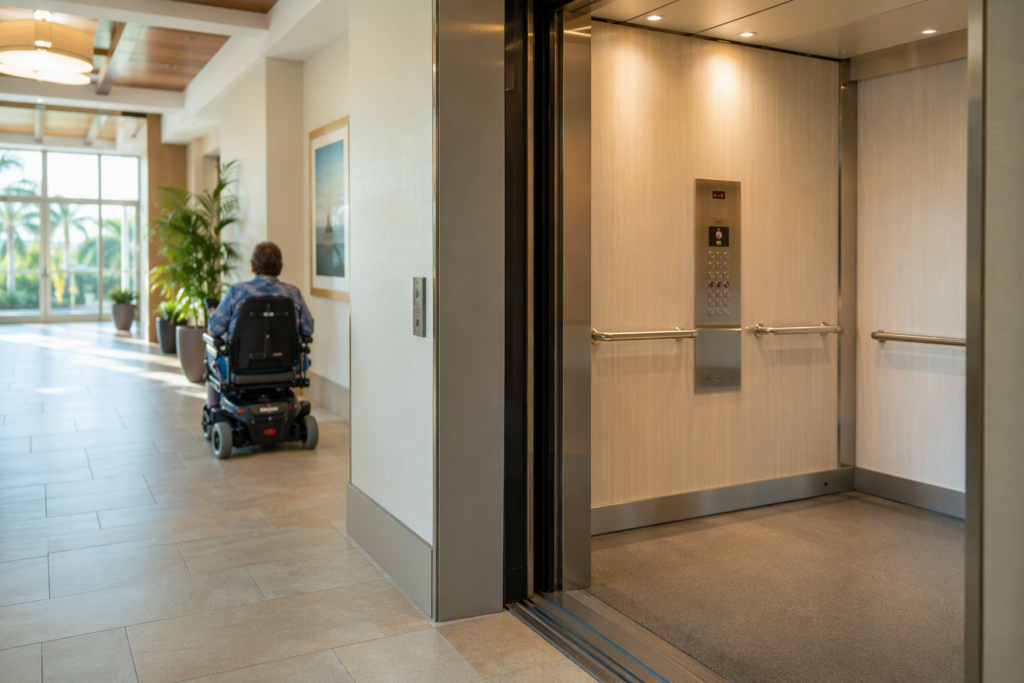
The Americans with Disabilities Act imposes accessibility requirements on commercial buildings that are places of public accommodation or commercial facilities. In multi-story Pompano Beach commercial buildings, elevators are frequently the primary means of accessible vertical access, making ADA compliance an ongoing obligation — not a one-time installation matter.
Relevant ADA elevator considerations for commercial property stakeholders include:
- Cab size and door width specifications
- Control panel heights and button requirements
- Door timing and reopening device functionality
- Audible and visual floor indicators
- Leveling accuracy at each floor
The building owner typically holds primary ADA compliance responsibility. However, where a tenant makes alterations to a leased space that affect accessible routes, the ADA may assign compliance obligations to the tenant for those specific alterations. Both parties should ensure that any elevator modifications are reviewed for ADA compliance before work begins.
Pros and Cons of Common Maintenance Responsibility Structures
| Structure | Pros | Cons | Best For |
|---|---|---|---|
| Owner retains full control | Direct oversight of compliance; vendor relationships owned; easier certificate management | Higher administrative burden on owner; requires internal tracking systems | Owners with small portfolios or single-property holdings |
| Property manager handles coordination | Owner freed from day-to-day logistics; professional coordination; single point of contact for tenants | Owner must audit manager’s compliance activities; misaligned incentives possible | Multi-tenant commercial buildings with full-service property management |
| Tenant assumes maintenance costs (NNN) | Reduces owner’s out-of-pocket maintenance expense; tenant has incentive to maintain equipment they use | Owner retains legal liability while losing control; certificate compliance risk high | Single-tenant buildings with sophisticated, well-resourced tenants |
| Shared responsibility with defined boundaries | Allocates costs fairly; creates clear accountability for each party | Complex to administer; requires detailed lease language and ongoing coordination | Multi-tenant buildings with mixed lease structures |
Why Should Pompano Beach Building Stakeholders Work With an Independent Elevator Service Provider?
One of the most consequential decisions a Pompano Beach building owner or property manager makes is selecting the elevator service company that holds the maintenance contract. An independent, Florida-registered elevator service company brings several advantages over manufacturer-tied service arrangements:
- No proprietary parts lock-in that can inflate repair costs
- Objective assessment of equipment condition without a vested interest in equipment replacement
- Flexibility to serve multi-brand elevator portfolios across a building or property management portfolio
- Transparent documentation that supports inspection compliance and certificate renewals
Axxiom Elevator Florida is an independent elevator service provider operating throughout Florida, including Pompano Beach and Broward County. The company performs maintenance, repair, and modernization work on commercial elevators, working within Florida’s regulatory framework — including compliance with Chapter 399, Florida Statutes and the ASME A17.1/CSA B44 Safety Code. Axxiom Elevator Florida provides building owners, property managers, and commercial tenants with documented, code-aligned service that supports certificate-of-operation renewals and positions buildings for satisfactory inspection outcomes.
Quick Reference: Key Regulatory Facts for Pompano Beach Commercial Elevator Compliance in 2026
| Regulatory Item | Requirement | Source |
|---|---|---|
| Governing Florida statute | Chapter 399, Florida Statutes (Elevator Safety Act) | Florida DBPR |
| Adopted technical standard | ASME A17.1/CSA B44, 2019 edition (effective December 31, 2023) | ASME |
| Inspection frequency | Annually (by certified elevator inspector) | Chapter 399 |
| Certificate of operation validity | No more than 2 years | Chapter 399 |
| Accident reporting deadline | Within 5 working days | Chapter 399 |
| Local enforcement authority (Pompano Beach) | Broward County Building Code Division | Chapter 399 |
| Certificate of operation holder | Elevator owner — legally responsible for safe operation, maintenance, and code deficiency correction | Chapter 399 |
| Federal accessibility standard | Americans with Disabilities Act | ADA.gov |
Need elevator service you can rely on? Axxiom Elevator Florida is ready to help.