Florida building owners and property managers face real legal exposure when elevator maintenance contracts contain provisions that quietly shift compliance burdens, limit contractor accountability, or lock facilities into unfavorable terms for years. The Florida Department of Business and Professional Regulation (DBPR), Bureau of Elevator Safety enforces Chapter 399, Florida Statutes (the Elevator Safety Act), and places ultimate responsibility for safe operation, maintenance, and correction of code deficiencies squarely on the elevator owner — not the contractor. Understanding every line of a maintenance agreement is therefore not a legal formality; it is a direct compliance and liability issue. This guide covers every major contract term Florida property professionals should scrutinize before signing or renewing.
What Are the Most Dangerous Contract Terms in a Florida Elevator Maintenance Agreement?
The most dangerous terms are automatic renewal clauses with short cancellation notice windows, scope exclusions for high-cost components, and liability caps that leave building owners responsible for code violations discovered during inspections.
Many standard elevator maintenance contracts are drafted by the service provider and favor the provider by design. Automatic renewal provisions — often requiring 60 to 90 days’ written notice before a contract anniversary to avoid another full term — can trap building owners in multi-year agreements with underperforming vendors. Scope exclusions buried in appendices may carve out hydraulic cylinders, control systems, door operators, or modernization work, leaving owners with large unexpected invoices for repairs they assumed were covered. Liability caps can limit the contractor’s exposure to the value of one month’s service fee, even when a deficiency the contractor missed results in regulatory shutdown or injury.
Florida law places the maintenance obligation firmly on the certificate-of-operation holder, so when a contractor’s limited-liability clause prevents full recovery for a missed deficiency, the building owner absorbs the legal and financial consequences. Reviewing contracts with both legal counsel and an experienced elevator service provider before signing is the most effective risk mitigation strategy available.
How Does Florida Law Define the Building Owner’s Maintenance Responsibility?
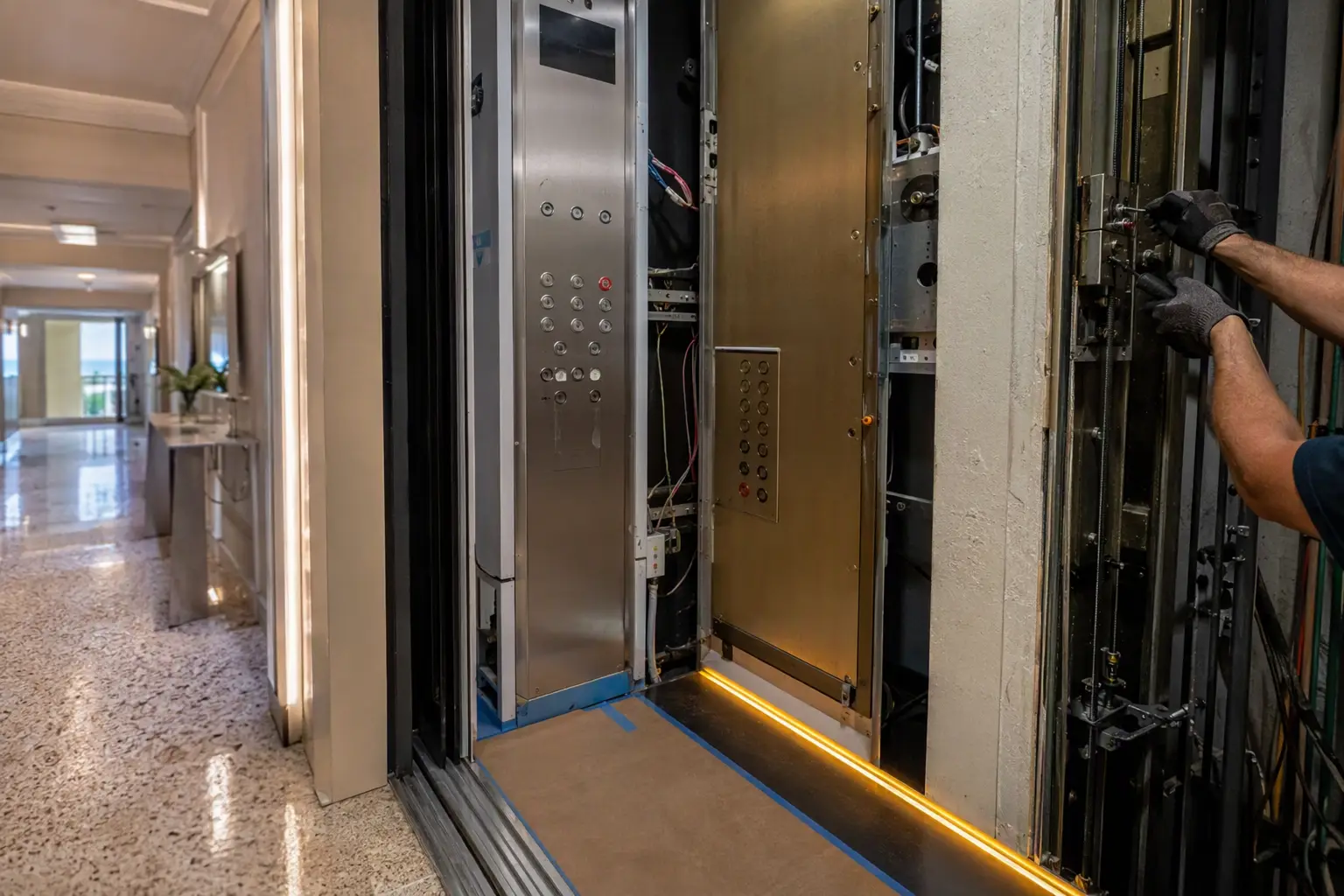
Under Chapter 399, Florida Statutes, once a certificate of operation is issued, the elevator owner is legally responsible for safe operation, proper maintenance, required inspections, and correction of any code deficiencies — regardless of what any private service contract says.
This statutory structure means that a building owner cannot outsource legal liability simply by signing a maintenance agreement. If an elevator operates with a deficiency that a contractor was contractually obligated to correct but did not, the state’s enforcement action will target the certificate-of-operation holder first. A maintenance contract should therefore include explicit language committing the service provider to timely correction of deficiencies identified during state-mandated inspections and to written documentation of all work performed, so the owner has an evidentiary record of contractor obligations fulfilled or missed.
Building owners in Pompano Beach should also be aware that Broward County Building Code Division enforces Florida’s elevator law through its own elevator inspectors in Broward County. Compliance requirements are administered locally, and contract language must account for local authority jurisdiction as well as state-level DBPR requirements.
What Is the Difference Between a Full-Maintenance Contract and a Lubrication-and-Adjustment Contract?
A full-maintenance contract covers parts, labor, and repairs within defined parameters, while a lubrication-and-adjustment (L&A) contract covers only routine servicing — leaving the cost of most repairs, parts replacements, and code-compliance upgrades entirely to the building owner.
L&A contracts carry a lower monthly fee but expose owners to unpredictable repair costs. Full-maintenance contracts typically include a defined parts schedule; owners must scrutinize that schedule carefully, because some “full” contracts still exclude major components such as hydraulic cylinders, machine room equipment, controllers, or door equipment. A contract described as “comprehensive” is not comprehensive unless the scope-of-work attachment explicitly lists covered components. Asking the prospective vendor to provide a written exclusion list — every component and repair type not covered — is the clearest way to compare contract value across providers.
Axxiom Elevator Florida recommends that building owners in Pompano Beach and Sarasota request itemized scope documentation before finalizing any agreement, so the coverage actually received matches the coverage price being paid.
What Inspection Obligations Must a Florida Elevator Maintenance Contract Address?
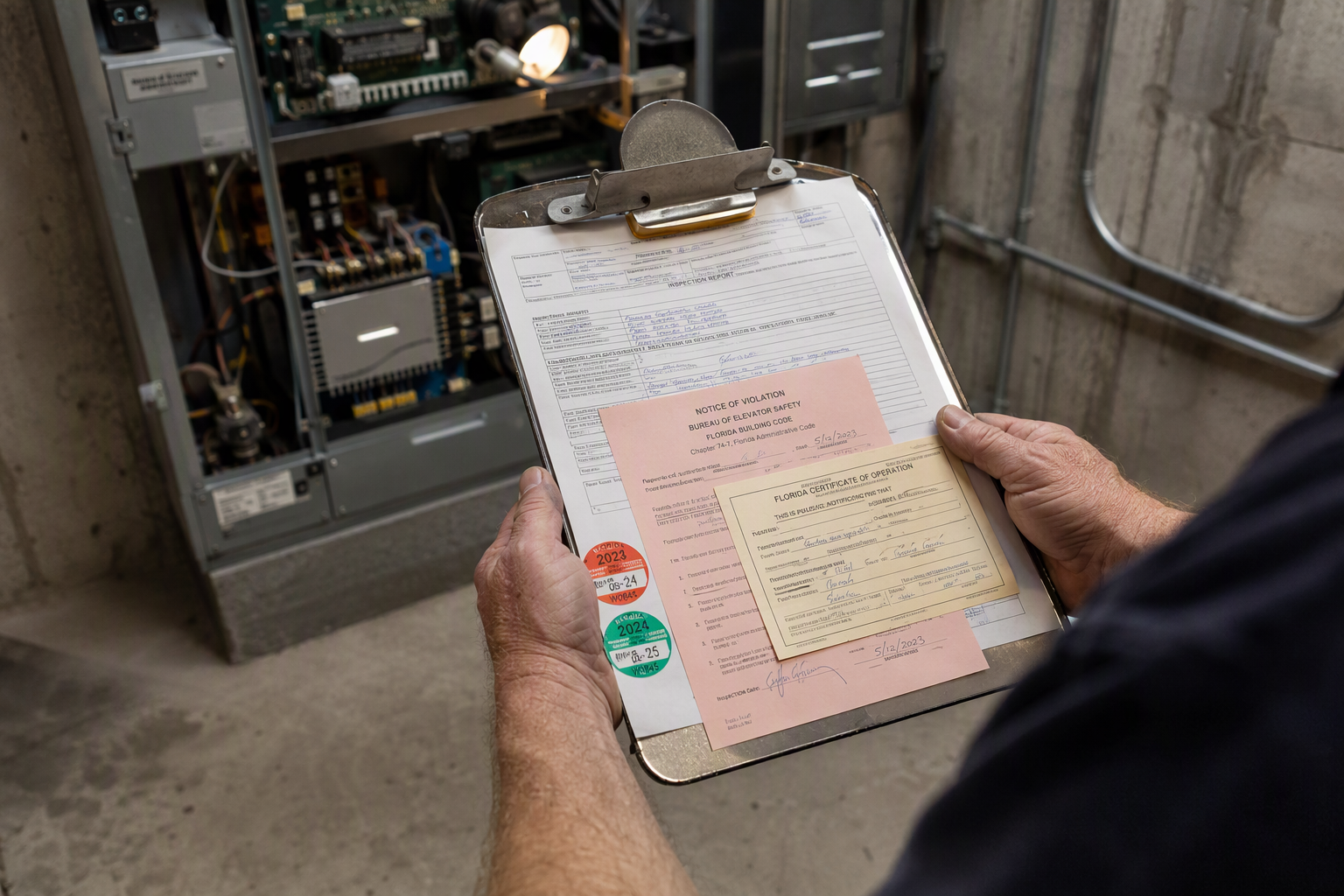
A compliant Florida elevator maintenance contract must address the building owner’s obligation to maintain a current certificate of operation, which is valid for no more than two years, and must support annual inspection requirements under Chapter 399, Florida Statutes.
Florida requires every elevator covered by Chapter 399 to be inspected annually by a certified elevator inspector. Notably, an elevator that is not an escalator or dumbwaiter, serves only two adjacent floors, and is covered by a service maintenance contract is exempt from the annual state inspection while that contract remains in effect — but the contract must remain continuously active to preserve the exemption. A gap in service coverage, such as a lapse during a contract transition period, eliminates the exemption and triggers the annual inspection requirement immediately.
A Florida certificate of operation can be renewed only for a conveyance with a current satisfactory inspection, and operating an elevator on an expired certificate violates state law. Any maintenance contract should specify which party — owner or contractor — is responsible for coordinating the inspection, scheduling the certified elevator inspector, and tracking certificate expiration dates. Ambiguity on these points creates compliance gaps that become the owner’s legal problem under Chapter 399.
The certificate of operation must also be posted in a conspicuous location on the elevator in a frame with a transparent cover. Contracts should assign responsibility for ensuring the certificate is current and properly posted at all times.
What Should Building Owners Know About Automatic Renewal and Cancellation Terms?
Automatic renewal clauses that require 60 to 90 or more days’ advance written notice to cancel can lock building owners into a renewed term involuntarily if the deadline passes unnoticed — making calendar tracking and early review essential.
Multi-year elevator maintenance contracts are common, and many include evergreen provisions that renew for an equivalent full term unless the owner acts within a narrow cancellation window. Some contracts specify that cancellation notice must be sent by certified mail to a specific address, and failure to follow the exact procedure voids the cancellation. Before signing, owners should negotiate the shortest possible automatic renewal term — ideally month-to-month after the initial period — and confirm the cancellation notice requirement, method, and address in writing. Building these review dates into facility management calendars at least six months before the renewal window closes is a practical protective measure.
How Should a Contract Handle Parts Availability and Obsolescence?
A maintenance contract should specify what happens when a required part is obsolete or unavailable, including who bears the cost of sourcing substitute components or undertaking partial modernization to restore compliant operation.
Elevators with aging equipment frequently reach a point where OEM parts are no longer manufactured. Without a contract provision addressing this scenario, disputes arise over whether the service provider is obligated to find equivalent parts, whether modernization costs are the owner’s responsibility, and what timeline is acceptable for extended downtime. Well-drafted contracts include a parts-obsolescence clause that defines the contractor’s obligation to source equivalent components, caps any associated markup, and establishes a clear escalation process when equipment age makes standard maintenance no longer feasible. The ASME A17.3 Safety Code for Existing Elevators and Escalators provides the technical framework for retrofit and modernization standards applicable to existing equipment in Florida.
What Emergency Response Terms Should a Florida Elevator Contract Include?
An elevator maintenance contract should include specific, measurable language about the contractor’s obligations during elevator entrapments, mechanical failures, and after-hours emergencies — not vague commitments to “prompt” or “reasonable” response.
Florida building owners should insist on contract language that specifies what emergency coverage hours are included, how emergency calls are dispatched, and what procedures apply when a passenger is trapped. The contract should distinguish between standard-hours service, after-hours coverage, and holiday coverage, and should state clearly whether emergency response is included in the monthly fee or billed separately. Vague “best efforts” language provides no enforceable standard. Under Chapter 399, Florida Statutes, the certificate-of-operation holder must report any elevator accident to the state within five working days — a contract provision requiring the service contractor to assist with and document that reporting obligation protects the owner’s compliance record.
What Compliance and Code-Update Obligations Should Be Specified in the Contract?
Florida adopted ASME A17.1/CSA B44, 2019 edition effective December 31, 2023, and maintenance contracts should clearly allocate responsibility for bringing equipment into conformance with adopted code changes — including who pays and on what timeline.
Florida’s adoption of ASME A17.1-2019 means that equipment must meet the requirements of that edition as enforced under Chapter 61C-5, Florida Administrative Code. When a code update requires physical modifications to existing equipment, maintenance contracts typically exclude that work from standard service fees — but many contracts are silent on the subject entirely, leaving owners unaware of upcoming compliance costs. A well-structured agreement will include a code-compliance clause that requires the contractor to notify the owner in writing within a defined period when a regulatory change requires equipment modifications, provide a scope and estimate, and hold the elevator in compliant operating status during the remediation process.
Similarly, ADA accessibility requirements may trigger retrofit obligations for certain building renovations. Contracts should specify whether ADA-related modifications — cab dimensions, control panel heights, tactile signage, door timing — fall within the maintenance scope or are separately billable.
How Can Building Owners Evaluate a Contractor’s Registration and Technician Credentials in Florida?
Florida requires all elevator companies performing installation, maintenance, or repair to register with the state annually and maintain general liability insurance, and all technicians performing work must hold a current Florida elevator certificate of competency — owners should verify both before signing any agreement.
Under Chapter 399, Florida Statutes, a Florida certified elevator technician is authorized to construct, install, maintain, or repair conveyances only after the state issues a certificate of competency. That certificate expires after one year and is renewed with proof of eight hours of continuing education. Florida certified elevator technicians must also register with the state every year and carry general liability insurance. Contracts should require the service provider to furnish proof of current company registration and evidence that all field technicians assigned to the property hold valid certificates of competency. Requiring annual re-verification as a contract condition — not just at signing — ensures ongoing compliance throughout the agreement term.
Axxiom Elevator Florida maintains state-required registrations and ensures all assigned technicians hold current Florida certificates of competency, providing clients in Pompano Beach and Sarasota with the documentation needed to verify credentials at any point during the service relationship.
What Happens to an Elevator Maintenance Contract If a Building Is Sold?
Most elevator maintenance contracts are assignable by the service provider without building owner consent, but assignment by the owner or new property purchaser typically requires contractor approval — a term that can create significant complications in real estate transactions.
When a building is sold, the buyer may inherit an elevator maintenance contract with unfavorable terms if the contract has not been reviewed and addressed in the purchase agreement. Assignment clauses, termination-for-sale provisions, and security deposit requirements vary significantly between providers. Sellers should disclose all active elevator maintenance agreements, and buyers should review those agreements before closing. In Florida, the incoming certificate-of-operation holder assumes full legal responsibility for the elevator’s maintenance and inspection status immediately upon transfer of ownership, so any inspection deficiencies or compliance gaps under the existing contract become the new owner’s statutory obligation at the moment of transfer.
What Is a Performance Benchmark or Service-Level Agreement and Should Elevator Contracts Include One?
A service-level agreement (SLA) within an elevator maintenance contract defines measurable standards for callback frequency, repair completion timelines, and equipment uptime — and including one gives building owners an enforceable baseline for evaluating contractor performance.
Without defined performance standards, building owners have no contractual basis to claim a breach when service quality deteriorates. SLA provisions should specify maximum allowable downtime per incident, the number of callbacks permitted before a pattern triggers a root-cause review, and the timeline within which non-emergency repairs must be completed after diagnosis. Contracts that include SLA language with defined remedies — such as service credits or early termination rights triggered by repeated failures — give building owners meaningful leverage that vague “good workmanship” standards do not provide.
What Records and Documentation Should a Maintenance Contract Require the Contractor to Provide?
A maintenance contract should require the service provider to deliver written service records after every visit, including the date, technician credentials, work performed, parts replaced, and any deficiencies identified — creating the documentation trail the building owner needs to demonstrate compliance under Chapter 399.
Because Florida places maintenance and deficiency-correction responsibility on the certificate-of-operation holder, the owner’s ability to demonstrate that a qualified contractor performed required work is legally significant. Digital service records accessible through a portal, monthly maintenance logs, and annual summary reports are all reasonable documentation requirements. Contracts that allow verbal reporting only or that provide summary records without technician-level detail leave owners without the evidence needed to rebut a state enforcement action or respond to a liability claim. Requiring the contractor to flag any observed deficiency in writing — even minor items deferred for a scheduled visit — creates a documented chain of custody for the elevator’s maintenance history.
How Should Pricing Escalation Clauses Be Structured in a Multi-Year Agreement?
Multi-year elevator maintenance contracts should include a clearly defined price escalation mechanism — typically tied to a published index — with a defined annual cap, rather than language granting the contractor unilateral discretion to adjust fees.
Open-ended escalation clauses that allow the contractor to increase rates “as necessary” or “to reflect market conditions” without a ceiling provide no financial predictability. Owners negotiating multi-year agreements should request that any annual escalation be tied to a specific published index with a maximum percentage cap per year, and that the escalation apply only after the initial contract term. Additionally, contracts should specify whether major parts replacements, emergency labor, code-mandated upgrades, and inspection-related repairs are priced at fixed rates, at a defined markup over cost, or at the contractor’s then-current published rates — each structure carries different long-term cost exposure.
What Warranty Terms Should Appear in a Florida Elevator Maintenance Contract?
A maintenance contract should include explicit warranty language covering the workmanship of all repairs performed and the fitness of all parts installed, with defined warranty periods and a clear remedy — typically no-cost re-performance — when warranted work fails.
Without warranty provisions, a repair completed in January that fails in March may be billed again as a new service call. Minimum workmanship warranty periods and parts warranty terms should be stated in the contract body, not implied. For new components installed during maintenance, the contract should clarify whether the manufacturer’s parts warranty passes through to the building owner and how warranty claims are submitted. Contracts that disclaim all implied warranties without substituting express warranty language leave owners with no recourse for repeated failures of the same component.
What Should a Contract Say About Permits Required for Elevator Alterations in Florida?
In Florida, a state permit applied for by a registered elevator company is required before a conveyance is installed or altered, and any maintenance contract covering alteration or modernization work must specify that the contractor will obtain all required permits before work begins.
Under Chapter 399, Florida Statutes, all new conveyance installations must be performed by a registered elevator company, and the permit obligation applies to alterations as well. A maintenance contract that includes modernization or upgrade provisions — whether for safety systems, drive systems, control panels, or cab interiors — should contain a permit obligation clause requiring the contractor to apply for and obtain all required DBPR permits before commencing work, to provide permit documentation to the building owner, and to coordinate any post-alteration inspection required before returning the elevator to service. Building owners should never accept verbal assurances that permit requirements have been handled; written documentation is the only enforceable standard.
How Should Contracts Address Elevator Shutdowns and Extended Downtime?
Maintenance contracts should define the contractor’s obligations during extended shutdowns — including planned outages for repairs and unplanned outages from equipment failure — specifying maximum allowable downtime, communication requirements, and any fee adjustments that apply when service is unavailable for extended periods.
For properties that include elevators serving populations with mobility limitations, extended downtime creates both ADA accessibility concerns and significant operational disruption. Contracts should specify that the contractor will provide written status updates at defined intervals during any outage exceeding a specified duration, that the contractor will provide a completion timeline after diagnosis, and that the owner retains the right to engage a second contractor at the first contractor’s expense if the primary contractor cannot restore service within a defined period. These provisions are particularly important for multi-elevator properties in Sarasota where a single-elevator outage may not trigger immediate accessibility concerns but where prolonged failures in any unit still carry liability exposure.
What Are the Key Differences Between Elevator Maintenance Contract Types in Florida?
| Contract Type | Coverage Scope | Parts Included | Labor Included | Code Compliance Work | Typical Cost Structure | Best Suited For |
|---|---|---|---|---|---|---|
| Lubrication & Adjustment (L&A) | Routine servicing only | No | Routine visits only | Not included | Lowest monthly fee; high variable repair cost | New equipment under OEM warranty |
| Parts & Labor | Routine service plus defined repairs | Defined list only | Covered repairs only | Usually excluded | Moderate monthly fee; selective repair cost | Mid-age equipment in stable condition |
| Full Maintenance | Routine service plus most repairs | Yes (exclusion list applies) | Yes (within scope) | Usually excluded | Higher monthly fee; predictable repair cost | Aging equipment; high-use facilities |
| Comprehensive / All-Inclusive | Broadest available scope | Yes (minimal exclusions) | Yes (most repairs) | Sometimes partially included | Highest monthly fee; lowest variable cost | High-traffic, compliance-critical facilities |
| Modernization-Inclusive | Full maintenance plus upgrade work | Yes | Yes | Included by scope | Premium; structured as multi-year commitment | Facilities planning major equipment updates |
What Steps Should a Building Owner Take Before Signing or Renewing an Elevator Maintenance Contract in Florida?
Building owners should follow a structured pre-signature review process to ensure the contract protects their interests and aligns with Florida statutory obligations under Chapter 399.
- Obtain the current certificate of operation and confirm its expiration date, then verify that the proposed contract start date and service scope will maintain continuous coverage without creating a compliance gap.
- Request a complete written exclusion list — every component, repair type, and circumstance not covered by the contract — and compare it against your elevator’s known equipment inventory and maintenance history.
- Verify the contractor’s current Florida company registration status and request documentation that all assigned field technicians hold valid Florida certificates of competency with current continuing education compliance.
- Identify every automatic renewal clause, confirm the cancellation notice period and required method, and enter the cancellation deadline into facility management systems with a reminder set at least six months in advance.
- Confirm that the contract requires the contractor to obtain all required DBPR permits before any alteration or modernization work begins, and that permit documentation will be provided to the building owner.
- Negotiate measurable service-level terms including maximum downtime per incident, callback response obligations, and written deficiency notification requirements.
- Review price escalation language and negotiate a defined index-linked cap on annual increases, with fixed pricing for any work types identified in the exclusion schedule.
- Have legal counsel review liability limitation clauses, indemnification provisions, and insurance requirements before execution.
- Request a sample service record or maintenance log to confirm the documentation format the contractor will provide after each visit.
- Confirm that the contract addresses accident reporting coordination consistent with the five-working-day reporting requirement under Chapter 399, Florida Statutes.
Axxiom Elevator Florida supports building owners in Pompano Beach and Sarasota through this review process and provides transparent scope-of-work documentation so clients can evaluate coverage before committing to any agreement.
How Do Local Authorities in Pompano Beach and Sarasota Affect Elevator Maintenance Contracts?
Pompano Beach is located in Broward County, where the Broward County Building Code Division enforces Florida’s elevator law through its own certified elevator inspectors — meaning compliance obligations are administered locally rather than directly through the state DBPR office, which can affect inspection scheduling and certificate-of-operation renewal timelines that maintenance contracts must account for.
Building owners in Pompano Beach should confirm that their maintenance contract clearly specifies how inspections are coordinated with Broward County’s local enforcement authority. Contracts that reference only state-level inspection processes without acknowledging local authority jurisdiction may create procedural gaps when inspection scheduling, permit applications, or compliance notices route through the county rather than the state directly. Sarasota building owners should confirm their applicable local authority jurisdiction and ensure contract language reflects the correct coordination pathway for inspections and certificate renewals in that jurisdiction. Axxiom Elevator Florida operates across both markets and is familiar with local authority processes in each jurisdiction it serves.
What Exit Rights Should a Building Owner Negotiate Into a Florida Elevator Maintenance Contract?
A well-negotiated elevator maintenance contract should include defined exit rights triggered by contractor non-performance, failure to maintain required state registrations or technician certifications, repeated safety violations, or extended equipment downtime — not only at the end of a term.
Default termination clauses that permit exit only for non-payment or insolvency leave building owners trapped when service quality deteriorates but does not technically breach a vague performance standard. Negotiated exit rights should include a cure period — typically 30 days’ written notice with a defined opportunity to remedy the deficiency — followed by a termination right if the cure is not completed. Contracts should also include a termination right if the contractor loses its Florida state registration, if assigned technicians cannot demonstrate current certificates of competency, or if the elevator fails a state inspection due to a condition within the contractor’s maintenance scope. These provisions protect the building owner’s ability to transition to a qualified provider without penalty when the existing contractor is no longer able to meet statutory requirements.
Contact Axxiom Elevator Florida for a free elevator assessment at 954-970-0020.
Need elevator service you can rely on? Axxiom Elevator Florida is ready to help.