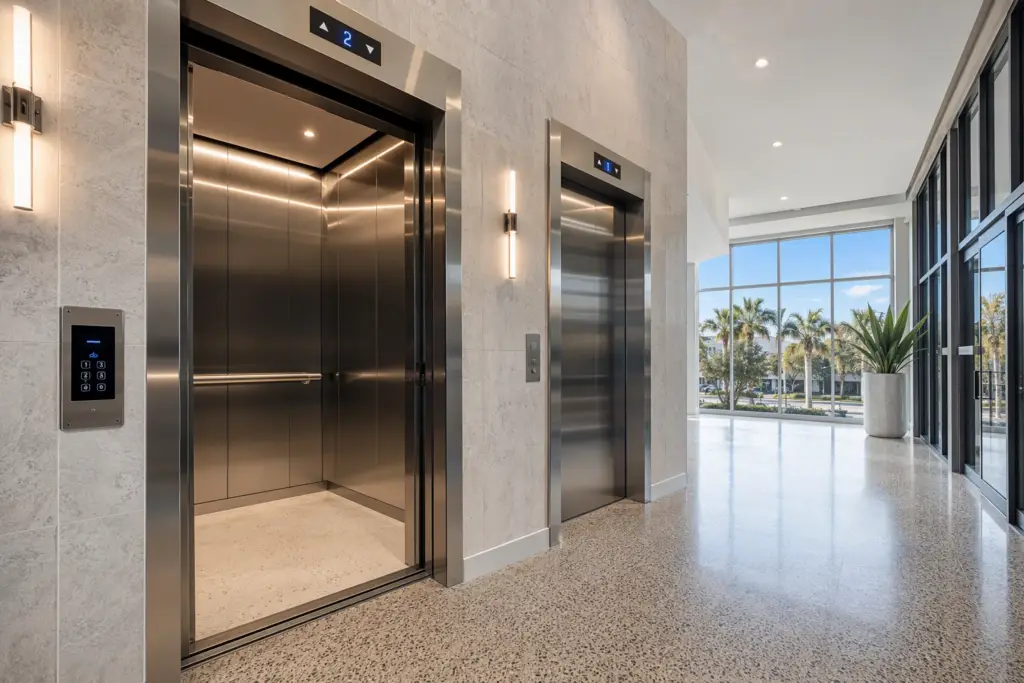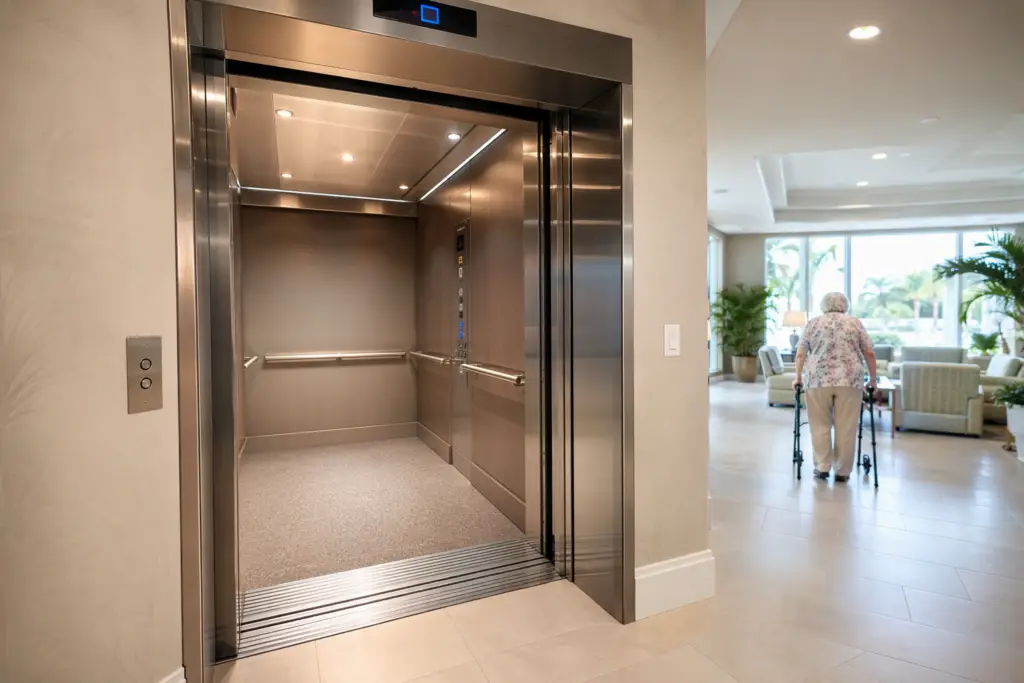
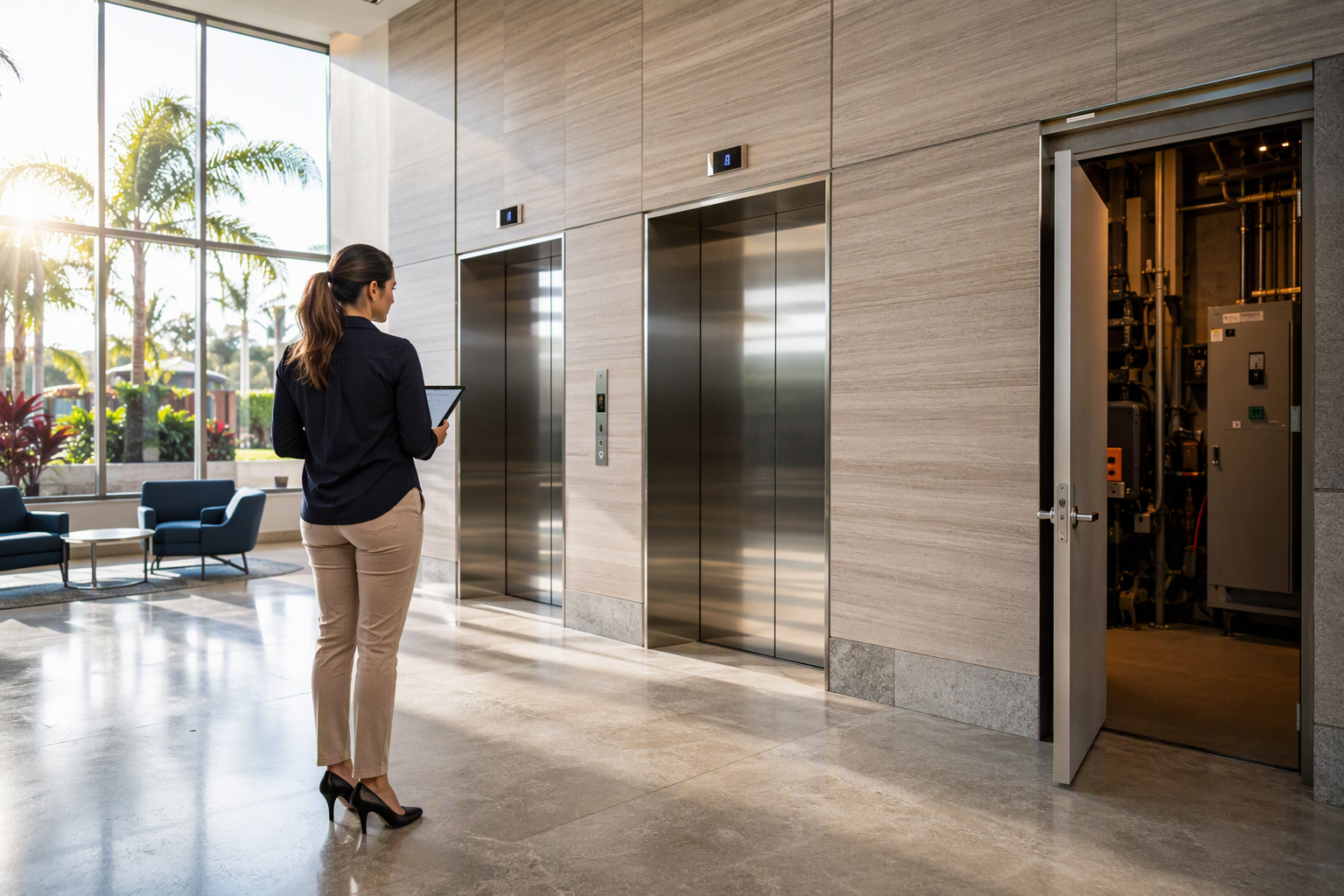
Reducing elevator energy consumption in a Florida commercial building is a practical, achievable goal — but not every upgrade delivers the same return. The technologies available in 2026 range from low-cost lighting swaps to full traction system modernizations. This guide breaks down the major options, compares real-world considerations, and helps Florida building owners and property managers make informed decisions without wading through vendor marketing claims.
What Are the Biggest Energy Consumers in a Commercial Elevator System?
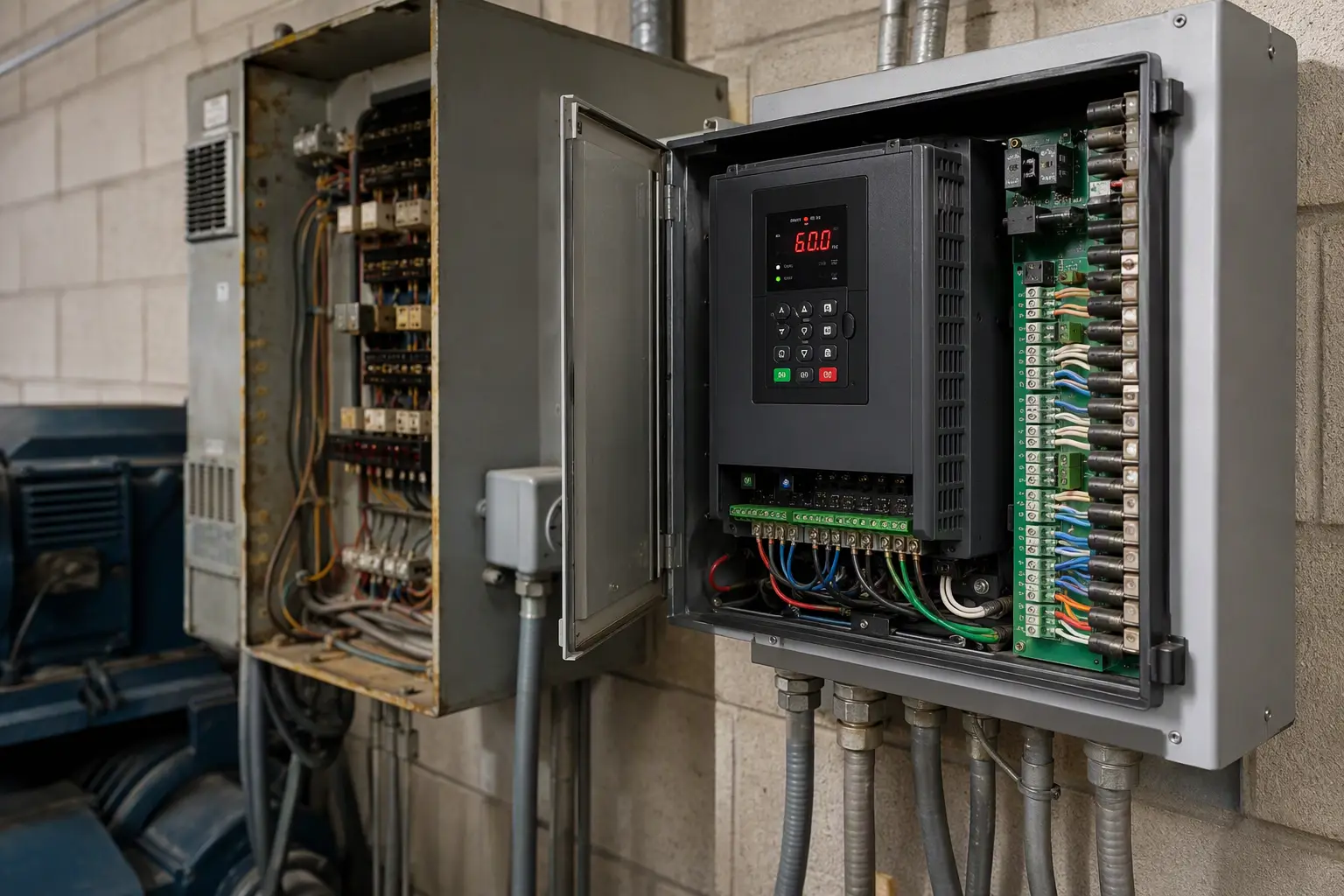
Before selecting an upgrade, it is essential to understand where elevator energy actually goes. A commercial elevator system draws power from several subsystems, and the proportion varies by equipment type and age.
- The drive motor and machine: The primary energy load, particularly in older hydraulic and geared traction systems. Older DC motors and single-speed AC motors are especially inefficient compared to modern permanent magnet machines.
- Cab lighting and ventilation: Older fluorescent and incandescent fixtures run continuously whenever a certificate of operation requires the cab to be lit and ventilated. In a multi-story office building with multiple cars, this load accumulates across long operating hours.
- Hydraulic power units: Older hydraulic systems run the pump motor even when the elevator is holding position, generating heat and consuming power with no productive output.
- Standby and idle power: Controllers, dispatching computers, and auxiliary systems often draw power around the clock regardless of traffic demand.
- Door operators: Inefficient door motors in high-traffic retail environments cycle hundreds of times per day.
Which Elevator Energy Upgrade Has the Best Return on Investment?
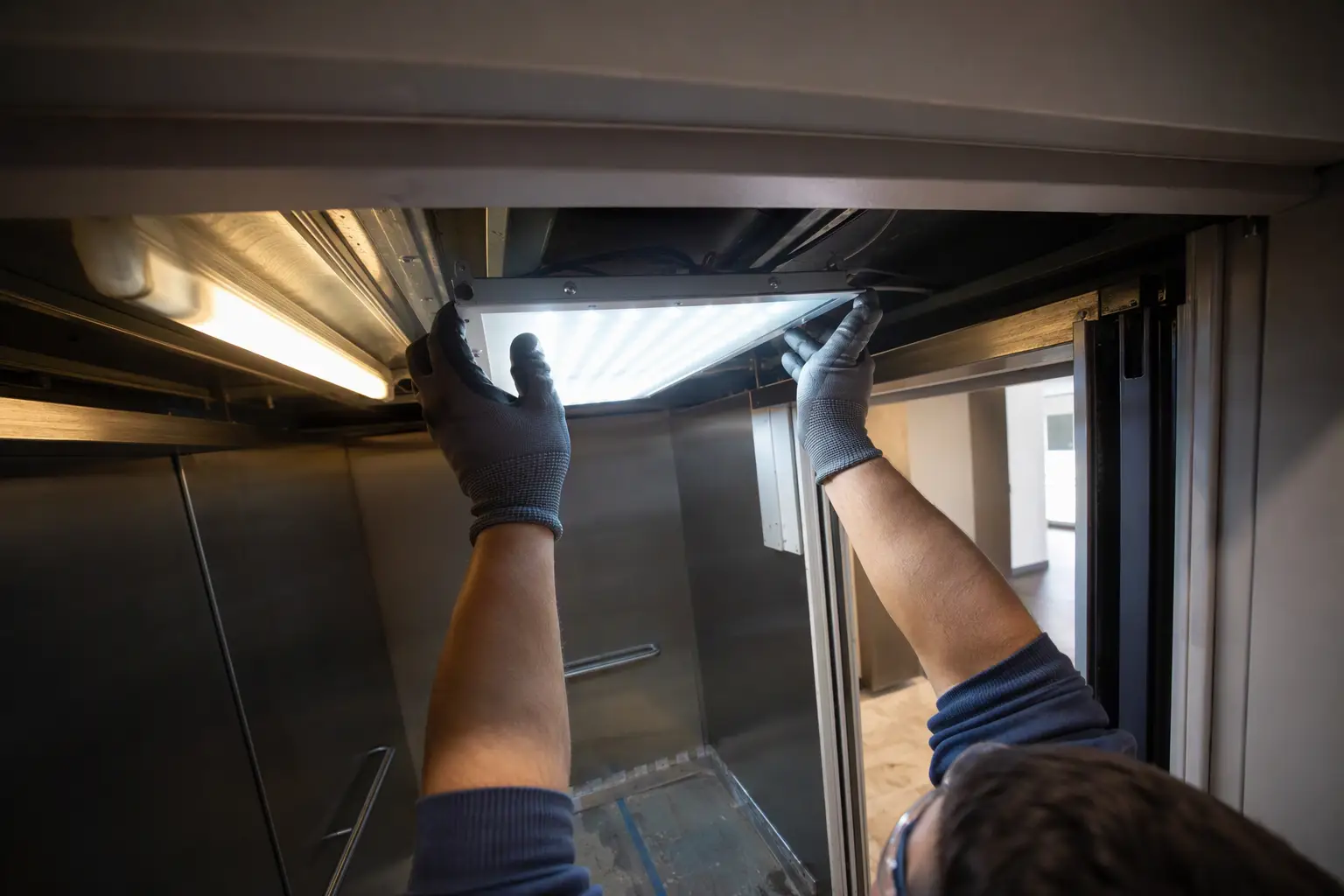
The answer depends on your building’s specific configuration, but the table below provides a structured comparison of the most commonly considered upgrades for Florida commercial buildings. Because installation costs, utility rates, and traffic profiles vary widely, the ranges below reflect general industry guidance rather than project-specific figures.
| Upgrade | Best Suited For | Typical Project Complexity | Energy Impact | Estimated Payback Timeline | Key Pros | Key Cons |
|---|---|---|---|---|---|---|
| LED Cab Lighting Retrofit | All elevator types, any age | Low — typically done during scheduled maintenance | Significant reduction in cab lighting load; LED fixtures consume a fraction of fluorescent equivalents | Short — often among the fastest-payback upgrades in any building | Low upfront cost, minimal disruption, immediate savings, improved cab aesthetics | Lighting is a small share of total system energy; savings in isolation are modest |
| Variable Frequency Drive (VFD) on Hydraulic or AC Motor | Hydraulic elevators, older AC traction systems | Moderate — requires motor and control integration | Substantial reduction in motor energy draw; VFDs match motor speed to actual load demand | Moderate — dependent on duty cycle and utility rates | Reduces peak demand charges, smoother ride quality, extends motor life | Installation requires skilled elevator technicians; may surface other aging component issues |
| Regenerative Drive (Regen Drive) | Mid- to high-rise traction elevators with high traffic volume | High — requires compatible traction machine and controller | Returns braking energy to the building’s electrical grid rather than dissipating it as heat | Longer — capital cost is higher; ROI improves with building height and traffic density | Highest energy-recovery potential, reduces HVAC load in machine room by eliminating heat dissipation | Higher upfront investment; less cost-effective in low-rise or low-traffic settings |
| Controller Modernization | Elevators with aging relay logic or early microprocessor controls | High — full controls replacement, may require new wiring | Modern microprocessor controllers reduce standby power and enable traffic-adaptive dispatching | Moderate to long — often bundled with other upgrades to improve overall ROI | Enables group dispatching efficiency, remote monitoring, and compatibility with regen drives | Significant upfront cost; may trigger code compliance reviews under ASME A17.1 Safety Code for Elevators and Escalators |
| Cab Ventilation Fan Upgrade | All elevator types | Low to moderate | Modern EC (electronically commutated) fans use substantially less power than legacy shaded-pole motors | Short to moderate | Simple installation, often paired with LED retrofit for combined savings | Energy savings from ventilation alone are incremental |
| Standby / Sleep Mode Controls | Buildings with defined off-peak periods (nights, weekends) | Low to moderate — software or controller modification | Turns off cab lighting, ventilation, and non-essential systems during idle periods | Short to moderate | No mechanical changes required in many cases; pairs with occupancy scheduling | Must not compromise safety systems; implementation should be reviewed against applicable code |
| Hydraulic Power Unit Replacement | Older hydraulic systems with inefficient pump-motor units | High — major mechanical work | Modern submersible pump-motor units with soft starters reduce energy draw and heat generation | Moderate to long — depends on existing equipment condition | Addresses reliability and fluid containment issues simultaneously; may extend hydraulic system life | High project cost; hydraulic systems are increasingly considered for conversion to traction in multi-story buildings |
| Full Traction Modernization | Buildings planning long-term asset retention with older hydraulic or geared traction equipment | Very high — extended outage, permitting, inspection required | Modern gearless permanent magnet traction machines with regen drives represent the highest efficiency tier | Long — justified by combined energy, maintenance, and reliability benefits over time | Comprehensive solution addressing energy, reliability, and compliance simultaneously | Highest capital cost and project disruption; requires Florida DBPR permit before work begins |
Does Florida Law Require Any Energy-Related Elevator Standards?
Florida does not currently impose a standalone elevator energy efficiency mandate. However, elevator alterations — including drive replacements, controller modernizations, and hydraulic unit replacements — constitute alterations under Chapter 399, Florida Statutes (the Elevator Safety Act) and Chapter 61C-5, Florida Administrative Code. Under those rules, a state permit applied for by a registered elevator company is required before a conveyance is installed or altered.
Florida has adopted the ASME A17.1/CSA B44 Safety Code for Elevators and Escalators, 2019 edition, effective December 31, 2023. Any alteration must conform to applicable provisions of that code. This matters practically: a drive modernization or controller replacement can trigger a code compliance review, which may surface items requiring correction before a new certificate of operation is issued. Building owners should factor this into project planning and budget.
Florida requires every covered elevator to be inspected annually by a certified elevator inspector, and a Florida certificate of operation is valid for no more than two years. Major alterations will require a fresh inspection and a new certificate before the elevator returns to service.
In Miami-Dade County, permitting and inspection authority sits with the Miami-Dade County Office of Elevator Safety (except in the City of Miami and the City of Miami Beach, which operate their own divisions). In Broward County, the Broward County Building Code Division enforces elevator law. In all other Florida jurisdictions, the Florida DBPR, Division of Hotels and Restaurants, Bureau of Elevator Safety oversees compliance.
Are VFDs Worth the Investment for Florida Hydraulic Elevators?
Variable frequency drives are widely regarded as one of the most cost-effective single upgrades for older hydraulic elevators in Florida commercial buildings. A hydraulic elevator’s pump motor is the dominant energy consumer in the system. Without a VFD, a fixed-speed motor runs at full power during every up-travel movement regardless of the actual load in the cab. A VFD modulates the motor’s speed to match real-time demand, reducing energy draw during partial-load conditions and eliminating the high-current inrush characteristic of across-the-line motor starts.
In Florida’s commercial real estate context, the financial case for VFDs is reinforced by Florida Power & Light, Duke Energy Florida, and other utilities that apply demand charges based on peak consumption. Because VFDs reduce peak current draw — not just average consumption — they can affect both the energy and demand components of a utility bill.
Project feasibility depends on the age and condition of the existing motor, the pump assembly, the controller compatibility, and whether the machine room has adequate electrical capacity for the drive unit. A qualified assessment by a registered elevator company should precede any capital commitment.
What Is a Regenerative Drive and When Does It Make Sense for a Florida Building?
A regenerative drive — sometimes called a regen drive — captures kinetic energy during elevator braking and deceleration and returns it to the building’s electrical system as usable power rather than burning it off as heat in resistor banks. This makes regen drives most valuable in buildings where elevators travel significant distances, run at high duty cycles, and where the building’s electrical infrastructure can absorb the returned energy.
For a mid-rise or high-rise Florida office tower with multiple traction elevator cars operating during peak business hours, regenerative drives can represent a meaningful source of recovered energy. For a two-story retail building with a single low-traffic elevator, the capital cost of regen technology is unlikely to be recovered in a reasonable timeframe.
A secondary benefit in Florida’s climate is meaningful: regen drives eliminate the heat generated by resistor banks in older dynamic braking systems. Reducing machine room heat load can decrease the demand on building HVAC serving that space, creating an additional energy benefit that is often overlooked in simple energy audits.
How Does Cab Lighting Affect Energy Consumption and Is LED Replacement Worthwhile?
Cab lighting and ventilation represent a smaller share of total elevator system energy than the drive motor, but they are continuous loads — running whenever the elevator is in service. In a Florida commercial building where elevators operate from early morning through evening, the aggregate annual hours are substantial.
Replacing legacy fluorescent or incandescent cab fixtures with LED equivalents reduces the lighting load per cab meaningfully and also generates less heat, marginally reducing ventilation requirements. LED retrofits are generally the lowest-disruption, lowest-cost entry point into elevator energy improvement and are appropriate as a first step even when larger modernization projects are not yet in the budget.
Pairing LED lighting with a standby mode — which dims or extinguishes cab lighting when the elevator has been idle for a defined period — extends the savings further without any compromise to safety, provided the implementation is reviewed for compliance with applicable code requirements.
What Should Be Included in an Elevator Energy Assessment for a Florida Office or Retail Building?
A thorough elevator energy assessment for a Florida commercial building should cover the following elements in sequence:
- Inventory all conveyances by type, age, and usage pattern. Distinguish between hydraulic and traction systems, note the number of floors served, and document the hours of peak and off-peak operation.
- Review utility billing history. Identify whether the building is subject to demand charges, time-of-use rates, or other tariff structures that affect the financial value of peak load reduction.
- Inspect drive and motor systems. Document whether existing motors are fixed-speed AC, variable-voltage variable-frequency (VVVF), or DC, and evaluate condition, efficiency class, and upgrade compatibility.
- Evaluate cab lighting and ventilation. Record fixture types, wattages, and whether standby controls are already in place.
- Assess controller age and architecture. Older relay-logic controllers are incompatible with modern energy management features and often cannot support regen drive integration without replacement.
- Document machine room conditions. Note temperature, ventilation adequacy, and electrical panel capacity — factors that affect both energy performance and upgrade feasibility.
- Identify certificate of operation status and any open inspection deficiencies. Alterations cannot lawfully proceed until compliance is confirmed under Chapter 399, Florida Statutes.
- Develop a prioritized upgrade roadmap with estimated project scope. Sequence upgrades from highest-ROI, lowest-disruption interventions to longer-horizon capital projects, aligned with the building’s operational schedule and lease obligations.
Does Elevator Modernization Require a New Florida Inspection and Certificate of Operation?
Yes. Any alteration to a covered conveyance in Florida requires a state permit — applied for by a registered elevator company — before work begins. Once the alteration is complete, the elevator must be inspected by a certified elevator inspector before it returns to service and before a new certificate of operation is issued. The certificate of operation must then be posted in the elevator cab in a frame with a transparent cover.
Building owners should confirm that the elevator company performing any modernization work is registered with the Florida DBPR and that all technicians hold current Florida elevator certificates of competency. Florida registered elevator companies must register with the state annually and maintain general liability insurance. Florida certified elevator technicians must register annually, carry general liability insurance, and renew their certificate of competency with proof of eight hours of continuing education each year.
Axxiom Elevator Florida operates as an independent certified elevator service company in Florida and is positioned to manage both the technical assessment and the compliance coordination that energy upgrade projects require.
How Should a Building Owner Compare Independent Elevator Service Providers Versus OEM Manufacturers for Energy Upgrades?
| Consideration | OEM (Original Equipment Manufacturer) Service | Independent Certified Elevator Company |
|---|---|---|
| Equipment brand flexibility | Typically limited to proprietary equipment and components | Can specify and source components across multiple manufacturers |
| Upgrade technology options | May favor proprietary drive and control systems | Can evaluate best-fit technology for the specific building |
| Pricing structure | Brand premium often applies; long-term contract lock-in common | Competitive pricing without single-brand dependency |
| Compliance knowledge | Strong for own equipment; variable for legacy third-party systems | Must demonstrate Florida-specific code competency; verify registration |
| Ongoing service flexibility | May require proprietary service contract to maintain warranty | Greater flexibility in maintenance contract terms |
| Assessment objectivity | Recommendations may reflect brand interest | Independent assessment without brand-driven upsell incentive |
For Florida commercial buildings with mixed elevator fleets or equipment from multiple manufacturers, an independent certified elevator company like Axxiom Elevator Florida can provide an unbiased evaluation across the full portfolio rather than recommending upgrades tied to a single brand ecosystem.
What Is the Impact of Florida’s Climate on Elevator Energy Efficiency Planning?
Florida’s subtropical climate creates conditions that are relevant to elevator energy planning in ways that differ from northern states. High ambient temperatures and humidity affect machine room environments, which in turn affect motor and drive performance and longevity. Buildings that invest in proper machine room climate control often see better performance and longer component life from drive systems.
Additionally, Florida’s utility rate structures — including demand charges and time-of-use pricing offered by major utilities — mean that technologies reducing peak demand (such as VFDs and regen drives) may offer financial returns beyond simple energy reduction. Building owners should review their specific utility tariff with their elevator service provider when modeling upgrade economics.
Florida’s building stock also includes a significant proportion of older commercial construction with hydraulic elevators. As these systems age, the case for modernization — combining energy efficiency, reliability, and code compliance improvements — becomes increasingly compelling.
How Can Building Owners Prioritize Upgrades When Capital Budgets Are Limited?
When capital is constrained, a phased approach based on payback period and operational impact is generally most effective. The recommended sequencing for most Florida office and retail buildings is:
- Phase 1 — Low-capital, fast-payback improvements: LED cab lighting, EC ventilation fans, and standby mode controls where already supported by the existing controller. These require minimal downtime and deliver immediate operating cost reductions.
- Phase 2 — Drive modernization: VFD installation on hydraulic or older AC traction systems. This is the upgrade category most likely to produce meaningful savings relative to investment for mid-range buildings and should be evaluated after a thorough utility cost analysis.
- Phase 3 — Controller and dispatching modernization: Modern microprocessor controls unlock efficiency features, remote diagnostics, and group dispatching optimization. Often most cost-effective when bundled with drive work.
- Phase 4 — Regenerative drives: Appropriate for high-rise or high-traffic buildings where the capital cost is justified by recovered energy volume. Best planned when controller modernization has already occurred or is concurrent.
- Phase 5 — Full system modernization or conversion: For buildings with aging hydraulic systems or end-of-life traction equipment, a comprehensive modernization incorporating all of the above is the long-term capital planning option.
Where Can Florida Building Owners Learn More About Applicable Codes and Standards?
The primary references for elevator safety and alteration requirements in Florida are:
- Chapter 399, Florida Statutes — Elevator Safety Act, administered by the Florida DBPR, Division of Hotels and Restaurants, Bureau of Elevator Safety
- ASME A17.1/CSA B44 Safety Code for Elevators and Escalators — the 2019 edition is Florida’s adopted standard as of December 31, 2023
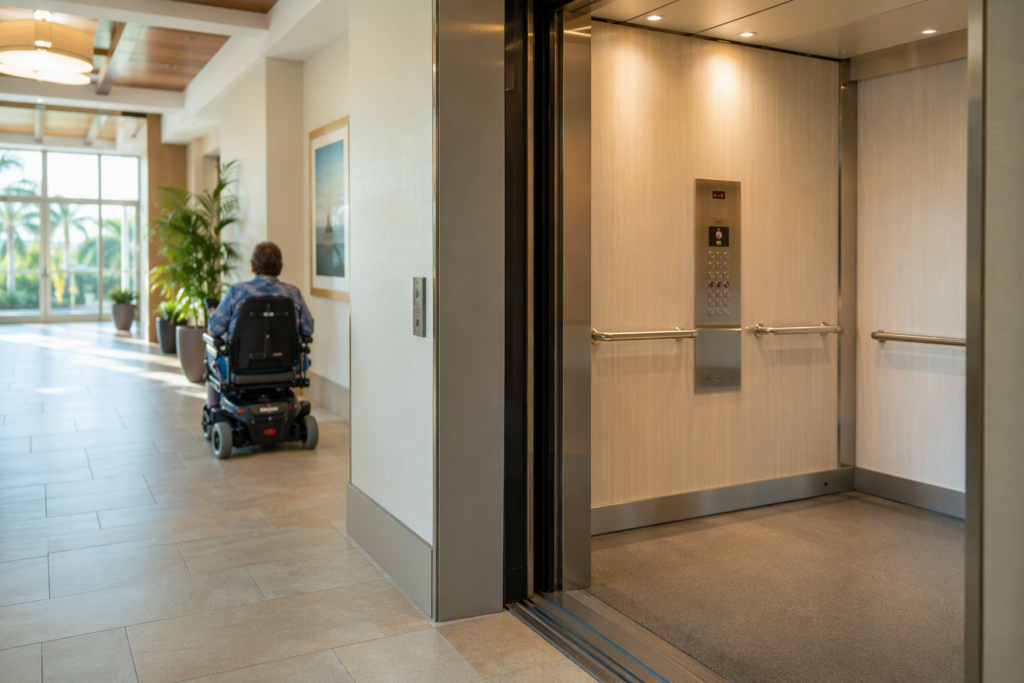
- Americans with Disabilities Act (ADA) — applicable to elevator cab dimensions, controls, and accessibility features in commercial buildings
- OSHA — worker safety requirements applicable during elevator installation and maintenance operations
Local authorities having jurisdiction (AHJs) — including the Miami-Dade County Office of Elevator Safety, the City of Miami Building Department Elevator Division, the City of Miami Beach Elevator Safety Division, and the Broward County Building Code Division — administer permitting and inspection in their respective territories and should be consulted for project-specific requirements.
Contact Axxiom Elevator Florida for a free elevator assessment at 954-970-0020.
Need elevator service you can rely on? Axxiom Elevator Florida is ready to help.