What to Do If Your Elevator Fails Inspection in Pompano Beach, Florida — and How Long You Have to Make Repairs

A failed elevator inspection in Pompano Beach is not simply a paperwork problem — it is a legally significant event that triggers specific obligations under Florida state law and Broward County’s delegated enforcement authority. This guide covers every step owners, property managers, and facilities directors need to take, the regulatory framework that governs repair timelines, and the compliance pathway back to a valid certificate of operation.
Who Regulates Elevators in Pompano Beach and Broward County?
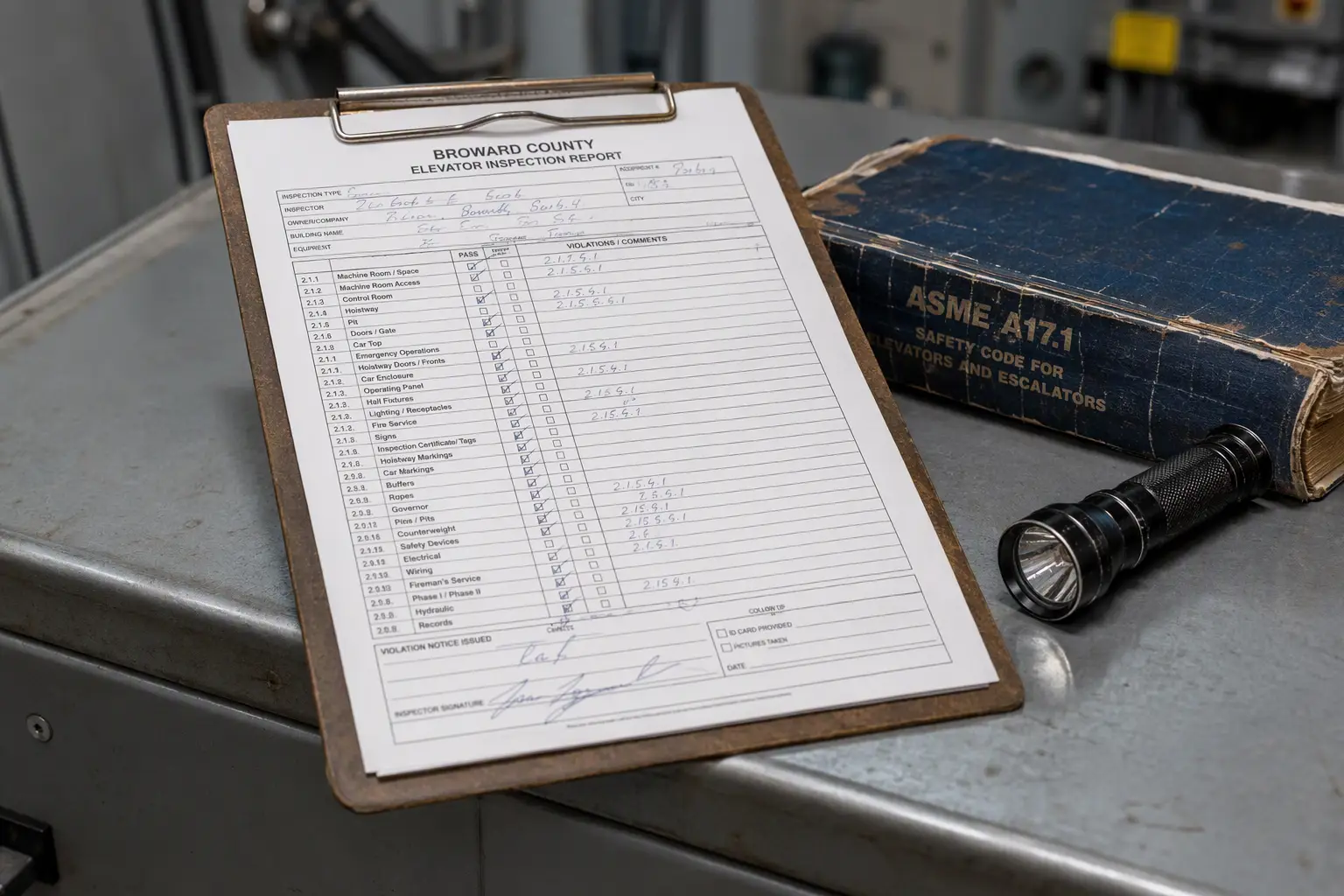
Pompano Beach sits within Broward County, and elevator jurisdiction in Broward County is held by the Broward County Building Code Division, which enforces Florida’s elevator law — Chapter 399, Florida Statutes (the Elevator Safety Act) — through its own certified elevator inspectors under a contract with the state. The state-level regulator is the Florida Department of Business and Professional Regulation (DBPR), Division of Hotels and Restaurants, Bureau of Elevator Safety.
Florida’s adopted technical standard is the ASME A17.1/CSA B44 Safety Code for Elevators and Escalators, 2019 edition, which became effective in Florida on December 31, 2023, and remains the controlling edition in 2026. The administrative rules that implement Chapter 399 are found in Chapter 61C-5, Florida Administrative Code.
What Happens Immediately After a Failed Inspection?
When a certified elevator inspector working for or under contract with Broward County finds a deficiency serious enough to fail the elevator, the inspector documents the specific violations on the inspection report. Depending on the severity of the deficiencies, the inspector may require the elevator to be taken out of service immediately or may allow continued operation under conditions while repairs are scheduled. In either case, the certificate of operation cannot be renewed or issued until every cited deficiency has been corrected and a follow-up satisfactory inspection has been completed.
Under Chapter 399, Florida Statutes, once a certificate of operation is issued the elevator owner bears legal responsibility for safe operation, proper maintenance, and correction of all code deficiencies. A failed inspection transfers that accountability into an active, trackable obligation.
What Are the Exact Steps to Take After a Failed Elevator Inspection?
- Read the inspection report in full. Every deficiency is listed with a code reference. Understanding exactly what failed — safety devices, door operation, pit conditions, lighting, signage, or structural components — determines the scope of work required.
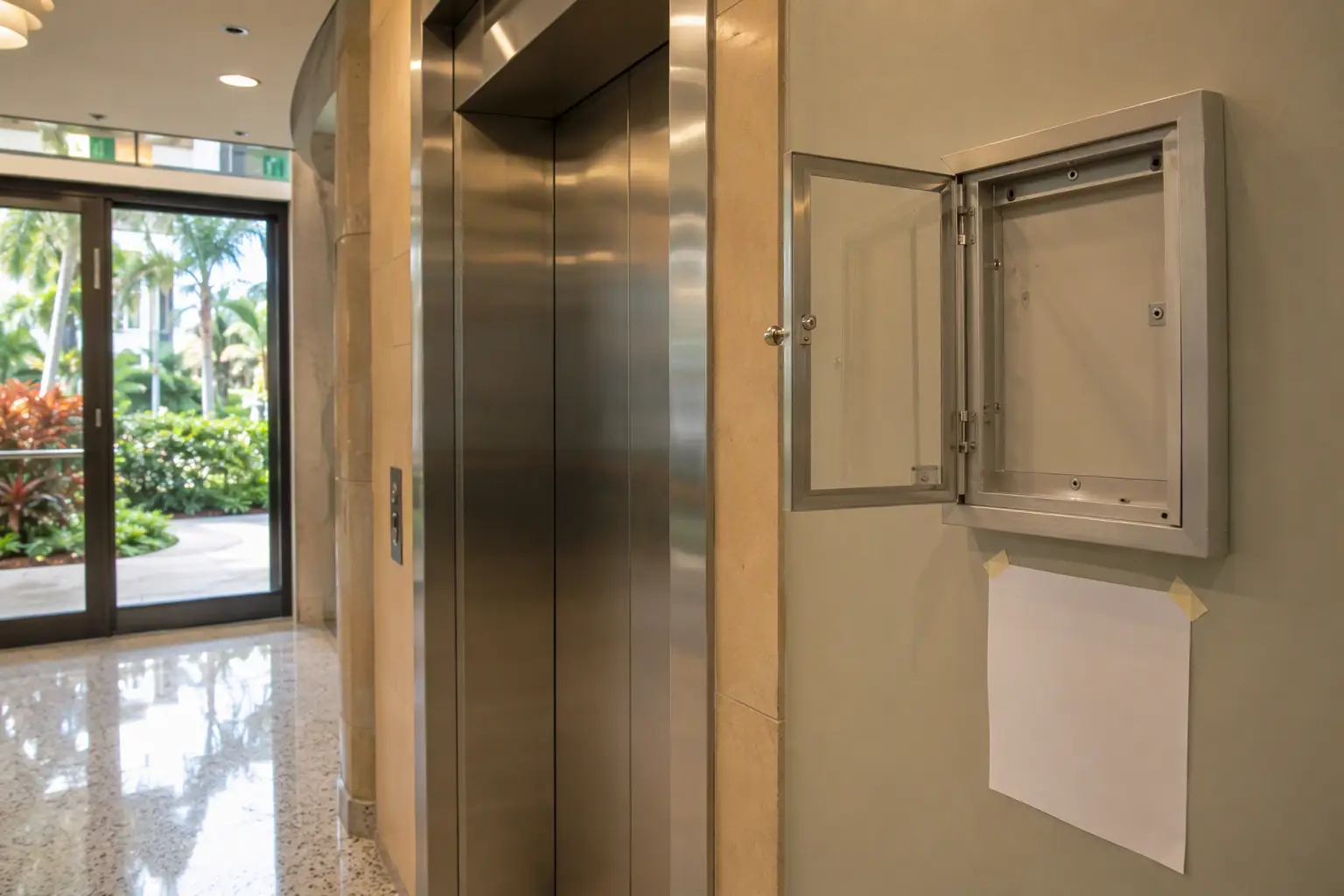
- Post the failed inspection notice. Florida law requires the certificate of operation to be posted in a conspicuous location in a frame with a transparent cover. If the elevator is out of service, place the appropriate out-of-service notice so passengers are not misled.
- Take the elevator out of service if directed. If the inspector or Broward County issues an order to cease operation, compliance is mandatory. Continuing to operate an elevator under a failed or expired certificate of operation violates Chapter 399.
- Contact a Florida-registered elevator company immediately. All repair and maintenance work on a conveyance subject to Chapter 399 must be performed by a company registered with the DBPR and staffed by certified elevator technicians holding a valid Florida elevator certificate of competency.
- Obtain the required permit for any alteration work. If any repair rises to the level of an “alteration” as defined under Florida law, the registered elevator company must apply for a state permit before work begins.
- Document every repair performed. Maintain written records of all work, parts replaced, and technician certifications. This documentation supports the follow-up inspection and protects the owner in the event of a dispute or accident.
- Schedule a follow-up inspection. Once all deficiencies have been corrected, request a reinspection through Broward County Building Code Division. The inspector will verify that each cited item now meets the requirements of ASME A17.1-2019 and Chapter 61C-5.
- Post the new certificate of operation. Once a satisfactory inspection result is recorded, the certificate of operation is issued or renewed — valid for no more than two years under Florida law — and must be posted in the required frame inside the elevator.
- Report any accident that occurred during the failed-inspection period. Under Chapter 399, the certificate of operation holder must report any elevator accident to the state within five working days.
How Long Do You Have to Make Repairs After a Failed Inspection in Florida?
Florida law and Chapter 61C-5 do not establish a single universal repair deadline expressed as a fixed number of days for all deficiency types. The practical timeline is governed by two intersecting factors: the severity of the deficiency and the validity of the existing certificate of operation.
For immediately hazardous conditions — where the inspector determines the elevator poses an imminent danger to passengers — the elevator must be taken out of service at once, and repairs must be completed before it can return to operation. There is no grace period for running a condemned elevator.
For non-imminent deficiencies identified during a routine annual inspection, the elevator may sometimes continue operating while repairs are scheduled, but the certificate of operation cannot be renewed until a satisfactory reinspection is completed. Because a Florida certificate of operation is valid for no more than two years, and operating on an expired certificate violates state law, any owner whose certificate is nearing expiration has an especially short practical window to complete repairs and schedule reinspection.
Broward County Building Code Division, as the local enforcement authority, may impose specific correction deadlines in its inspection orders. Property managers and owners should treat any written deadline from Broward County as a hard legal deadline, not a suggestion.
What Types of Deficiencies Commonly Cause Elevator Failures in Florida?
Inspectors applying ASME A17.1-2019 and Chapter 61C-5 in Florida typically cite deficiencies across several categories. The severity of each drives how quickly repairs must be completed:
- Safety device failures: Governor, safeties, buffers, and overspeed protection are life-safety components. Failures in these systems almost always result in an immediate out-of-service order.
- Door and gate operator issues: Non-compliant door closing force, door reversal device failures, or damaged interlocks are among the most frequently cited deficiencies.
- Pit and machine room conditions: Standing water, inadequate lighting, missing stop switches, or combustible storage in the pit or machine room are common citation categories.
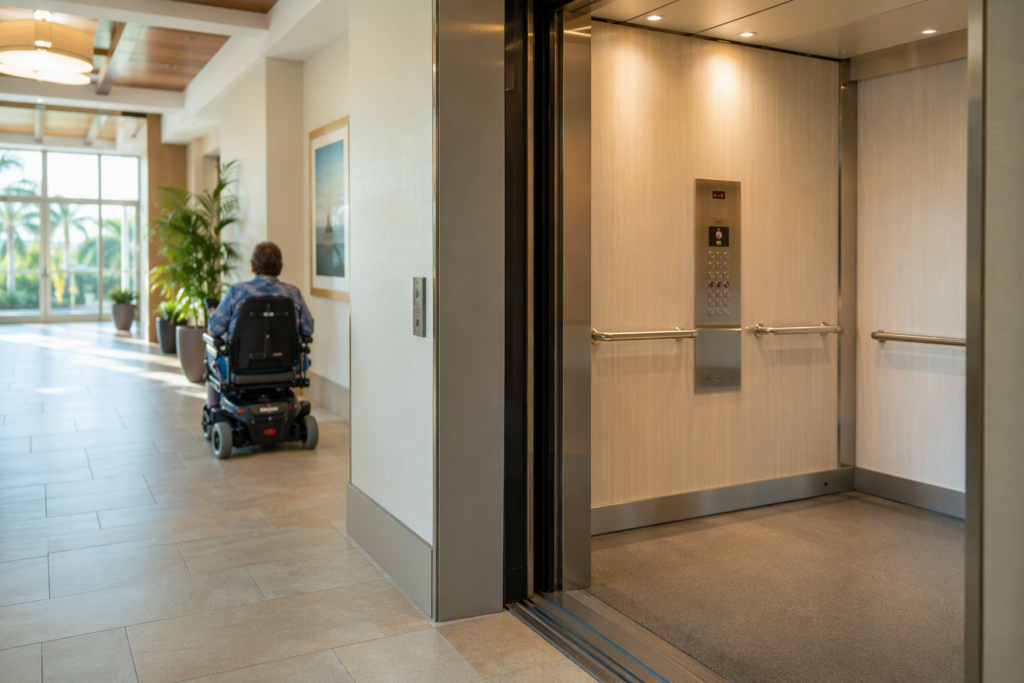
- Emergency communications: ADA-compliant two-way communication systems are required; a non-functioning phone or intercom is a citable deficiency under both ADA requirements and state rules.
- Lighting and signage: Missing or non-functioning car lighting, improper capacity or emergency signage, and missing posted certificates are straightforward but still citation-worthy findings.
- Lubrication and maintenance records: Evidence of deferred maintenance visible during inspection can result in citations even when no single component has failed outright.
What Does a Failed Inspection Mean for Your Certificate of Operation?
Under Chapter 399, Florida Statutes, a Florida certificate of operation can be renewed only for a conveyance with a current satisfactory inspection result. A failed inspection therefore blocks renewal. If the existing certificate expires while deficiencies remain uncorrected, the elevator is operating illegally — exposing the owner to regulatory penalties, civil liability, and potential loss of insurance coverage.
Axxiom Elevator Florida advises property managers to track certificate expiration dates proactively rather than waiting for the annual inspection cycle to surface problems. A maintenance service agreement is the most reliable way to ensure deficiencies are identified and corrected before an inspector arrives, not after.
Who Can Legally Perform Elevator Repairs in Pompano Beach?
Florida law is specific: all repair and maintenance work on conveyances covered by Chapter 399 must be performed by a Florida-registered elevator company whose technicians hold a valid Florida elevator certificate of competency. These credentials are administered by the DBPR Bureau of Elevator Safety. Registered companies must renew their registration annually and maintain general liability insurance. Technicians must also renew annually, demonstrating eight hours of continuing education, and their certificate of competency expires after one year if not renewed.
Hiring an unlicensed contractor to perform elevator repairs not only violates Florida law but also invalidates the repair work for inspection purposes — meaning the inspector will not accept the correction and the elevator remains out of compliance.
Does Florida’s Inspection Exemption Apply to Elevators in Pompano Beach?
One narrow exemption exists under Chapter 399: an elevator that serves only two adjacent floors, is not an escalator or dumbwaiter, and is covered by a qualifying service maintenance contract is exempt from the annual inspection requirement while that contract remains in effect. Most commercial and multi-residential elevators in Pompano Beach do not qualify for this exemption — they serve more than two floors and therefore remain subject to mandatory annual inspection by a certified elevator inspector.
What Is the Role of ASME A17.1-2019 in a Florida Elevator Inspection?
The ASME A17.1/CSA B44 Safety Code for Elevators and Escalators is the technical benchmark Florida certified inspectors apply when evaluating every component of a conveyance. Florida adopted the 2019 edition effective December 31, 2023, so all inspections conducted in Pompano Beach in 2026 are measured against that standard. When an inspector cites a deficiency with a specific code section reference, that section number comes from ASME A17.1-2019 as implemented through Chapter 61C-5.
Property owners who receive a failed inspection report with code section references should have a registered elevator company review each citation against the full ASME A17.1-2019 standard to understand the precise technical requirement, not just the inspector’s summary language.
What Are the Penalties for Operating an Elevator Without a Valid Certificate in Florida?
Operating a conveyance covered by Chapter 399 without a valid, current certificate of operation is a violation of Florida law. The DBPR Bureau of Elevator Safety and local enforcement authorities such as Broward County Building Code Division have authority to take enforcement action, which can include stop-use orders, administrative fines, and other remedies available under Chapter 399. Beyond regulatory penalties, operating a non-compliant elevator creates significant tort liability exposure if an injury occurs while the elevator is out of compliance.
What Should Building Owners Know About ADA Compliance During Repairs?
When a building undertakes elevator repairs significant enough to qualify as an alteration under ADA requirements, the ADA’s path-of-travel obligations may be triggered, potentially requiring the owner to bring related accessible elements into compliance. Elevator modernization projects in Pompano Beach commercial properties should always include an ADA review alongside the ASME A17.1-2019 compliance checklist. Axxiom Elevator Florida recommends coordinating with a qualified accessibility consultant whenever alterations move beyond routine maintenance repairs.
What Industry Trends Are Shaping Elevator Compliance in 2025–2026?
Several qualitative trends are influencing how Florida building owners and registered elevator companies approach inspection outcomes in 2025 and 2026.
Remote monitoring and predictive maintenance technology is becoming more common in newer elevator installations and modernization projects. By capturing real-time data on motor performance, door cycle counts, and safety device status, these systems allow registered elevator companies to identify developing deficiencies before they become inspection failures.
Modernization pressure from ASME A17.3 — the ASME A17.3 Safety Code for Existing Elevators and Escalators — continues to drive retroactive upgrade requirements on older equipment. Property owners in Pompano Beach with elevators installed before current code editions should expect inspectors to apply retroactive requirements as equipment ages.
Supply chain normalization following prior years of parts shortages has generally improved repair timelines for most elevator components, though specialty parts for older, discontinued equipment can still extend the correction window significantly.
Workforce credentialing enforcement is tightening as DBPR continues to emphasize annual registration requirements for both elevator companies and technicians, making verification of contractor credentials an important pre-hire step for any Florida property owner.
How Does Axxiom Elevator Florida Support Owners Through a Failed Inspection?
Axxiom Elevator Florida is a state-registered elevator company serving Pompano Beach and surrounding Broward County communities. The company’s certified elevator technicians hold valid Florida certificates of competency and are qualified to perform the full range of repairs and corrections required to address inspection deficiencies under ASME A17.1-2019 and Chapter 61C-5. Axxiom Elevator Florida provides inspection report reviews, permit applications for alteration work, documented repair completion, and coordination with Broward County Building Code Division for reinspection scheduling — supporting property owners through every step of the compliance restoration process.
Key Florida Elevator Compliance Facts at a Glance
| Requirement | Florida Rule | Source |
|---|---|---|
| Governing statute | Chapter 399, Florida Statutes (Elevator Safety Act) | DBPR / Chapter 399 |
| Adopted technical code | ASME A17.1/CSA B44, 2019 edition (effective December 31, 2023) | ASME Codes & Standards |
| Certificate of operation maximum validity | No more than 2 years | Chapter 399, Florida Statutes |
| Inspection frequency (most elevators) | Annual, by a certified elevator inspector | Chapter 399, Florida Statutes |
| Accident reporting deadline | 5 working days to report to state | Chapter 399, Florida Statutes |
| Technician certificate of competency renewal | Annual; 8 hours continuing education required | Chapter 399, Florida Statutes |
| Local enforcement authority (Pompano Beach) | Broward County Building Code Division | Chapter 399, s. 399.13 |
Frequently Asked Questions About Failed Elevator Inspections in Pompano Beach
Can I continue operating my elevator after it fails inspection in Florida?
It depends on the nature of the deficiency. If the inspector or Broward County issues an immediate out-of-service order, the elevator must stop running at once. For non-imminent deficiencies, continued operation may be permitted on a case-by-case basis while repairs are scheduled, but the certificate of operation cannot be renewed until a satisfactory reinspection is completed. Operating on an expired certificate violates Chapter 399, Florida Statutes.
Who do I call first when my elevator fails inspection in Pompano Beach?
The first call should be to a Florida-registered elevator company whose technicians hold valid certificates of competency issued by the DBPR Bureau of Elevator Safety. The registered company can review the inspection report, advise on which deficiencies require a state permit before work begins, and begin the correction process. Do not hire an unlicensed contractor — the repairs will not be accepted at reinspection.
How long does a Florida elevator certificate of operation last?
Under Chapter 399, Florida Statutes, a Florida certificate of operation is valid for no more than two years and can be renewed only for a conveyance with a current satisfactory inspection result.
What technical code do Broward County elevator inspectors use?
Inspectors in Broward County, including Pompano Beach, apply the ASME A17.1/CSA B44 Safety Code for Elevators and Escalators, 2019 edition, as adopted by Florida effective December 31, 2023, along with Chapter 61C-5, Florida Administrative Code.
Does a failed inspection mean my elevator needs to be fully modernized?
Not necessarily. Many failed inspections involve specific, targeted deficiencies — a failed safety device, a non-compliant door operator, or a maintenance-related citation — that can be corrected through component repair or replacement without full modernization. However, older elevators may accumulate multiple deficiencies over time that collectively justify a modernization evaluation. A registered elevator company can assess whether targeted repairs or a broader modernization project is the more cost-effective path.
Can I get a time extension to make repairs after a failed inspection in Florida?
Florida’s elevator statutes and rules do not establish a general state-level extension process that is publicly documented. Broward County Building Code Division, as the local enforcement authority, may have discretion to set or adjust correction deadlines in specific circumstances. Property owners facing an unusually complex repair should contact Broward County directly and engage a registered elevator company to document the scope of work and any lead-time constraints on parts or components.
What if my elevator was already out of service when it failed inspection?
An out-of-service elevator that fails inspection still requires all cited deficiencies to be corrected before it can return to service. In Florida, a certificate of operation cannot be issued or renewed without a satisfactory inspection, regardless of whether the elevator was running at the time of inspection.
Is there a difference between a failed inspection and a condemned elevator in Florida?
Yes. A failed inspection means the elevator did not meet all applicable code requirements and the certificate cannot be issued or renewed until deficiencies are corrected. A condemnation or immediate out-of-service order is a more severe action taken when a specific deficiency poses an imminent hazard to passengers. All condemned elevators have failed inspection, but not all failed inspections result in condemnation.
Do private residence elevators in Florida need to pass inspection?
Elevators, stairway chairlifts, and wheelchair lifts in private residences are exempt from the Florida certificate of operation requirement under Chapter 399, Florida Statutes. However, any conveyance installed in a multi-family, commercial, or public-access building in Pompano Beach remains fully subject to Chapter 399 inspection and certificate requirements.
What documentation should I have ready for a reinspection after repairs?
Building owners and property managers should have available: the original failed inspection report with all cited deficiency codes; records of every repair performed, including the name of the registered elevator company, the names and certificate numbers of the technicians who performed the work, the dates of repair, and the parts replaced; any permits applied for and issued for alteration work; and the current maintenance contract if the elevator relies on one. Complete documentation accelerates reinspection and protects the owner if any citation is disputed.
Contact Axxiom Elevator Florida for a free elevator assessment at 954-970-0020.
Need elevator service you can rely on? Axxiom Elevator Florida is ready to help.