Elevator Service in Pompano, FL | Axxiom Elevator Florida
Quick Answer: Senior living and assisted living facilities in Florida must upgrade elevators to meet ADA accessibility standards and Chapter 399, Florida Statutes requirements — covering cab dimensions, door timing, controls, emergency communication, leveling accuracy, and valid certificate of operation — all enforced locally in Pompano Beach through the Broward County Building Code Division.
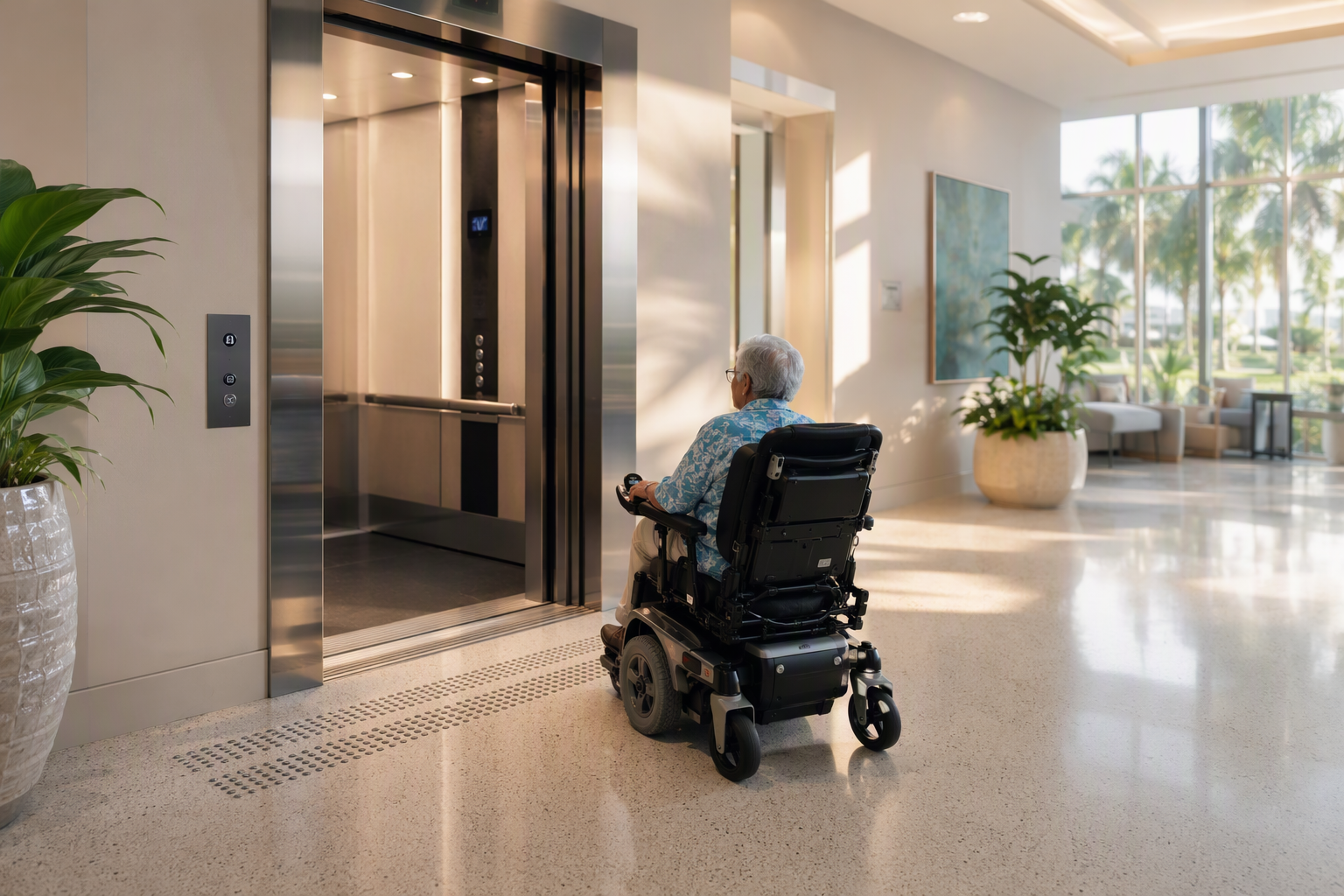
Florida senior living and assisted living facilities face a unique compliance burden: every elevator must satisfy federal ADA accessibility requirements, state elevator safety law, and local Broward County enforcement — all at once. An outdated elevator cab is not merely an inconvenience for residents who rely on mobility aids; it is a code deficiency that can trigger failed inspections, lapsed certificates of operation, and significant liability exposure. Axxiom Elevator Florida partners with senior living operators throughout Pompano Beach and the surrounding South Florida region to identify every required upgrade and deliver code-compliant modernization from permit to certificate.
What ADA Requirements Apply to Elevators in Florida Senior Living Facilities?

The Americans with Disabilities Act (ADA) establishes minimum federal accessibility standards that apply to elevators in places of public accommodation and commercial facilities — a category that encompasses assisted living and senior care buildings open to the public. Key ADA elevator requirements relevant to senior living facilities include:
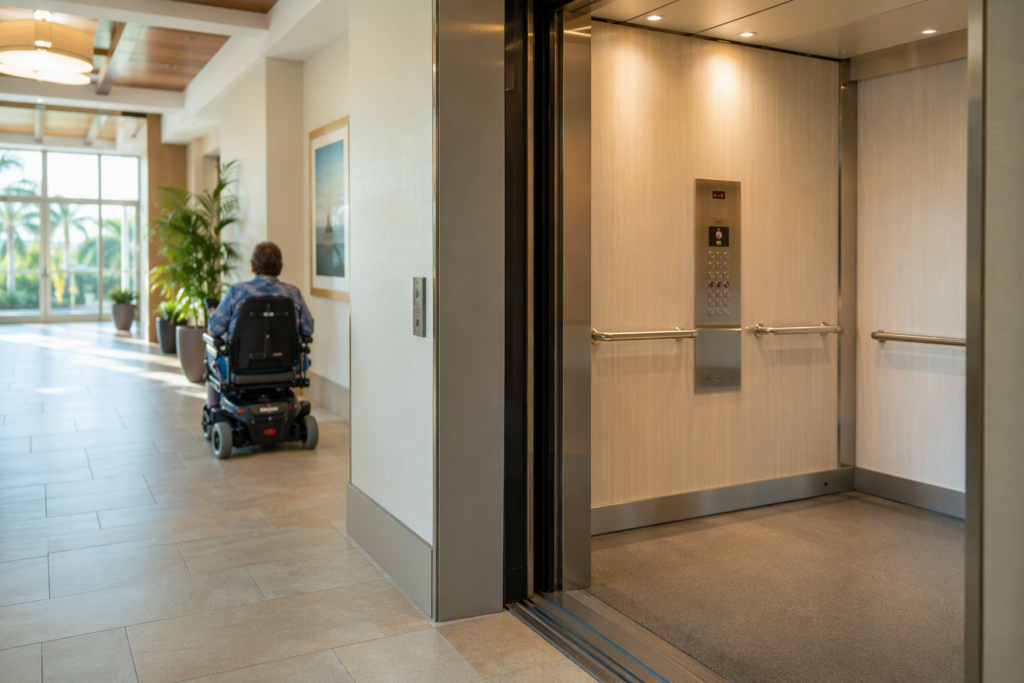
- Cab dimensions: The elevator car must provide sufficient clear floor space to accommodate wheelchair users and mobility devices, including adequate turning room.
- Door timing and force: Doors must remain open long enough for residents using walkers, wheelchairs, or scooters to enter and exit safely, and must not close with excessive force.
- Controls and call buttons: Call buttons, floor buttons, and emergency controls must be mounted at accessible heights and operable without tight grasping, pinching, or twisting.
- Tactile and Braille signage: Floor designations and control labels must include raised characters and Braille for visually impaired residents.
- Two-way emergency communication: An operative two-way communication system — audible and visible — must be present inside the cab so residents can summon help if trapped.
- Illumination and contrast: Adequate lighting and contrast on controls support residents with low vision, a common condition in senior populations.
For a senior living facility in Pompano Beach, ADA compliance is not optional — it is federally mandated. Facilities undergoing renovation or alteration have a triggered obligation to bring the path of travel, including elevators, into compliance to the extent required by the ADA.
What Does Florida State Law Require for Elevators in Assisted Living Facilities?
Florida’s elevator safety program is governed by Chapter 399, Florida Statutes (the Elevator Safety Act) and implemented through Chapter 61C-5, Florida Administrative Code. The adopted technical standard is the ASME A17.1/CSA B44 Safety Code for Elevators and Escalators, 2019 edition, which became effective in Florida on December 31, 2023. The state regulator is the Florida Department of Business and Professional Regulation (DBPR), Division of Hotels and Restaurants, Bureau of Elevator Safety.
For senior living operators in Pompano Beach, the most operationally critical state requirements are:
- Annual inspection: Every elevator covered by Chapter 399 must be inspected annually by a certified elevator inspector. (An elevator serving only two adjacent floors and covered by a service maintenance contract qualifies for a specific exemption under state law — but most multi-story senior living buildings do not meet this narrow exemption.)
- Certificate of operation: A valid Florida certificate of operation is required and may not remain valid for more than two years. Operating on an expired certificate violates state law.
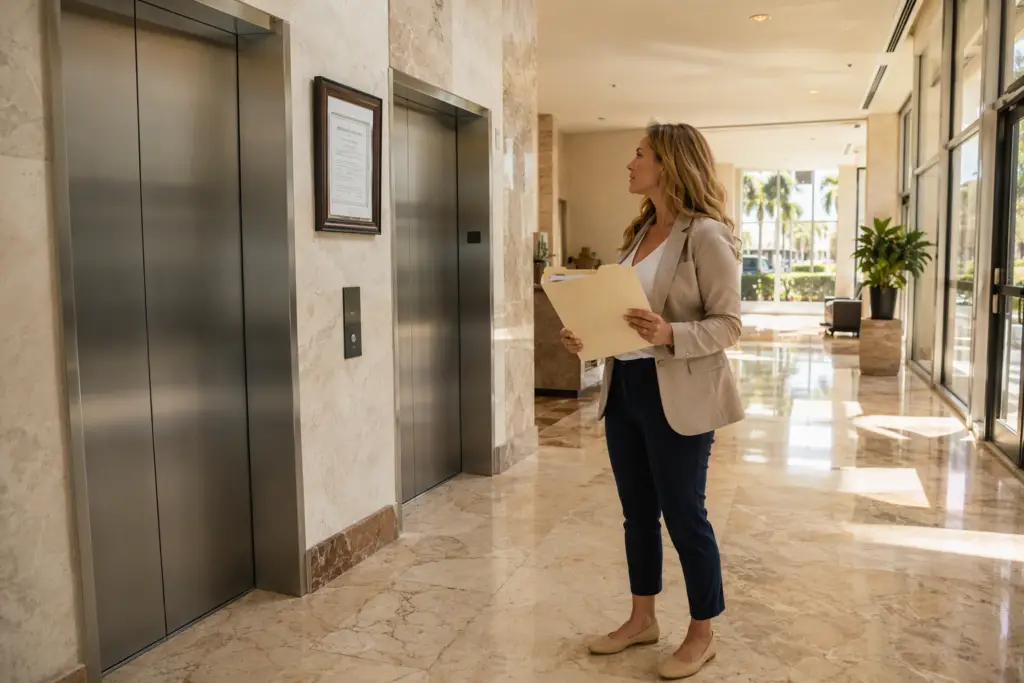
- Posted certificate: The certificate of operation must be posted inside the elevator cab in a frame with a transparent cover — a detail inspectors check at every visit.
- Permit before alteration: Any upgrade, modernization, or alteration requires a state permit applied for by a registered elevator company before work begins.
- Pre-use inspection: After a new installation or major alteration, the conveyance must be inspected by a certified elevator inspector with no conflict of interest with the permit holder or owner before residents use it.
- Accident reporting: The certificate of operation holder must report any elevator accident to the state within five working days.
- Owner responsibility: Once a certificate of operation is issued, the elevator owner — typically the facility operator — is legally responsible for safe operation, proper maintenance, and timely correction of code deficiencies.
In Pompano Beach, enforcement of Chapter 399 is handled locally by the Broward County Building Code Division, which employs its own certified elevator inspectors under contract with the state.
What Specific Elevator Upgrades Do Senior Living Facilities Most Commonly Need?
When Axxiom Elevator Florida performs a compliance assessment at a senior living property in Pompano Beach or surrounding South Florida communities, several upgrade categories appear repeatedly:
- Door operator and timing upgrades: Older door systems often close too quickly or use excessive closing force — both ADA violations that are dangerous for residents using assistive devices.
- Leveling accuracy improvements: Elevators that stop with a gap between the cab floor and the landing floor create a trip hazard that is especially dangerous for seniors. Modern leveling systems eliminate this gap.
- Control panel replacement: Original button panels frequently lack ADA-compliant heights, tactile markings, and Braille. Replacement panels bring the cab into current code compliance.
- Two-way emergency communication systems: Older intercoms may be non-functional, non-visible, or lack the audible and visual components required for residents with hearing or vision impairments.
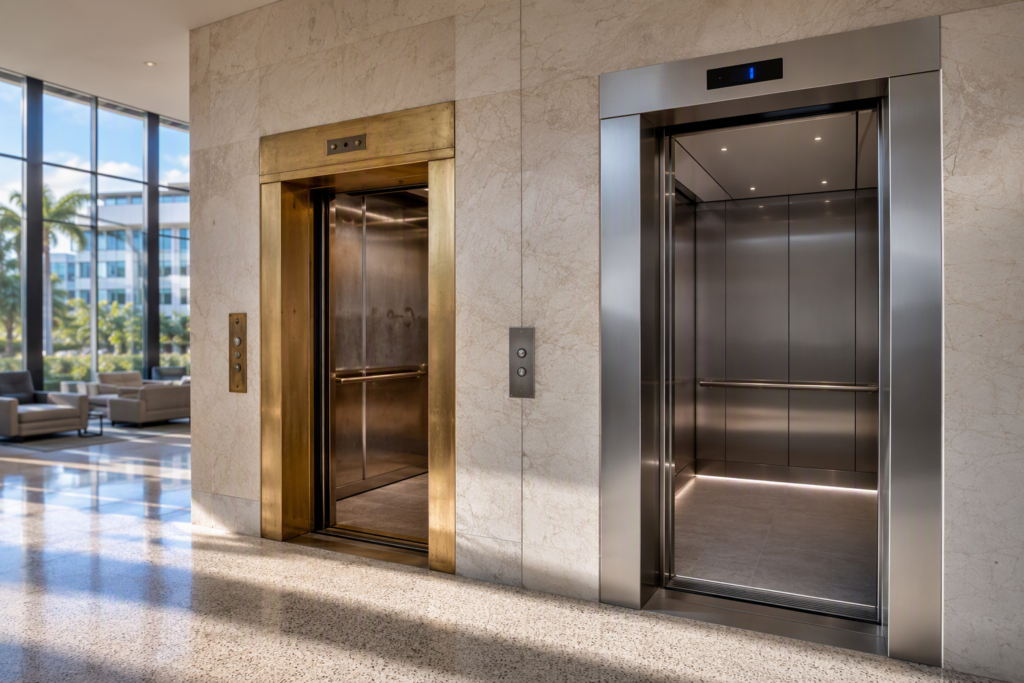
- Modernized drive systems and controllers: Aging hydraulic or traction controllers may no longer be serviceable to ASME A17.1-2019 standards and may require full modernization.
- Handrail installation: Three-sided or full-perimeter cab handrails provide stability for residents with balance or mobility challenges and are frequently required in senior care settings.
- Emergency lighting and backup power: Reliable emergency lighting inside the cab and provisions for continued operation during power disruptions are critical safety features in a residential care environment.
- Signage and illumination updates: Cab interior lighting levels, floor designation signage, and control contrast must meet ADA specifications.
What Is the Difference Between ADA Compliance and ASME A17.1 Compliance for Senior Living Elevators?
These are parallel — not interchangeable — obligations. The ADA is a federal civil rights law focused on accessibility: door timing, control heights, Braille, two-way communication, and clear floor space. The ASME A17.1/CSA B44 Safety Code, as adopted by Florida through Chapter 61C-5, is a mechanical and electrical safety standard: it governs structural integrity, braking systems, safeties, buffer performance, governor function, and hundreds of other technical specifications.
A senior living elevator can satisfy one set of requirements without satisfying the other. A facility in Pompano Beach that invests in ADA accessibility upgrades while neglecting aging mechanical components may still fail a Broward County inspection. A comprehensive modernization program addresses both dimensions simultaneously — reducing total project disruption and cost compared to completing them in separate phases.
How Does the Florida Permit and Inspection Process Work for Elevator Upgrades?
Understanding the permit and inspection sequence helps senior living administrators plan around resident access and project timelines. The process under Florida law proceeds as follows:
- Engage a registered elevator company. Under Florida law, all conveyance installations and alterations must be performed by a company registered with the DBPR Bureau of Elevator Safety. Axxiom Elevator Florida holds the required state registration and maintains current general liability insurance as mandated annually.
- Apply for a state permit before work begins. The registered elevator company applies for the permit. No alteration work may legally begin without a permit in place.
- Complete the permitted upgrade work. All work is performed by Florida-certified elevator technicians who hold a current elevator certificate of competency issued by the state, renewed annually with required continuing education.
- Schedule a pre-use inspection. Before residents return to using the upgraded elevator, a certified elevator inspector with no conflict of interest with the permit holder or owner must conduct an inspection.
- Obtain and post the certificate of operation. Once the inspection is satisfactory, a Florida certificate of operation is issued. This certificate must be displayed inside the cab in a frame with a transparent cover.
- Maintain annual inspection compliance. Going forward, the elevator must be inspected annually (subject to limited exemptions under state law) and the certificate of operation must remain current — valid for no more than two years per issuance.
What Happens If a Senior Living Facility Operates an Elevator Without a Valid Florida Certificate?
Operating a conveyance on an expired certificate of operation is a violation of Chapter 399, Florida Statutes. The Broward County Building Code Division, as the local enforcement authority for Pompano Beach, can require an elevator to be taken out of service until a satisfactory inspection is completed and a valid certificate is issued. For a senior living facility where residents depend on elevator access for mobility between floors, an elevator taken out of service creates both a compliance emergency and a duty-of-care concern. Proactive certificate management — tracking inspection schedules and renewal windows before they lapse — is far less disruptive than reactive compliance after an enforcement action.
Why Does Choosing a Florida-Registered Elevator Company Matter for Assisted Living Operators?
Florida law is explicit: all conveyance installations and alterations must be performed by a company registered annually with the DBPR Bureau of Elevator Safety, and that company must carry current general liability insurance. Technicians must hold a Florida elevator certificate of competency — renewed each year with proof of eight hours of continuing education — and inspectors must maintain their qualified elevator inspector credential in good standing with the same annual registration and continuing education requirements.
For assisted living operators in Pompano Beach, this matters beyond regulatory formality. Work performed by an unregistered contractor or an uncertified technician may not be accepted by Broward County inspectors, can void manufacturer warranties, and may expose the facility to liability if a resident is injured. Axxiom Elevator Florida is a state-registered elevator company with certified technicians who operate within the full framework of Florida’s elevator safety program — providing a clear, documented compliance chain from permit application through certificate of operation.
What Markets Does Axxiom Elevator Florida Serve Near Pompano Beach?
Axxiom Elevator Florida serves senior living communities, assisted living facilities, independent living properties, and continuing care retirement communities throughout South Florida. In addition to Pompano Beach, the team regularly works with facilities in Fort Lauderdale, Boca Raton, Deerfield Beach, Coral Springs, Hollywood, Hallandale Beach, and surrounding Broward and Palm Beach County communities. All work is performed within Florida, under Florida law, and coordinated with the relevant local authority having jurisdiction — whether Broward County’s Building Code Division or other applicable local enforcement offices.
How Should a Senior Living Facility Start the Elevator Upgrade Process?
The most effective starting point is a professional compliance assessment before any budgeting or design work begins. A thorough assessment identifies every ADA gap, every ASME A17.1-2019 deficiency, the current status of the certificate of operation, and the scope of work that will require a Florida state permit. With that baseline, facility administrators can prioritize upgrades by risk, plan resident communication around outage windows, and approach the Broward County Building Code Division with a complete, permit-ready package.
Axxiom Elevator Florida offers free consultations for senior living and assisted living operators throughout the Pompano Beach area. A consultation covers current certificate status, visible code deficiencies, and a preliminary scope of recommended upgrades — giving facility leadership the information needed to make informed decisions before committing to any work.
Schedule a Free Consultation
Axxiom Elevator Florida works exclusively within Florida, understands Broward County’s local enforcement practices, and is registered with the DBPR Bureau of Elevator Safety to perform permitted elevator upgrades for senior living facilities in Pompano Beach and throughout South Florida.
Contact Axxiom Elevator Florida today to schedule a free compliance consultation for your senior living or assisted living facility: 954-970-0020