Elevator Emergency Phone Number: Complete Guide for Building Owners and Managers
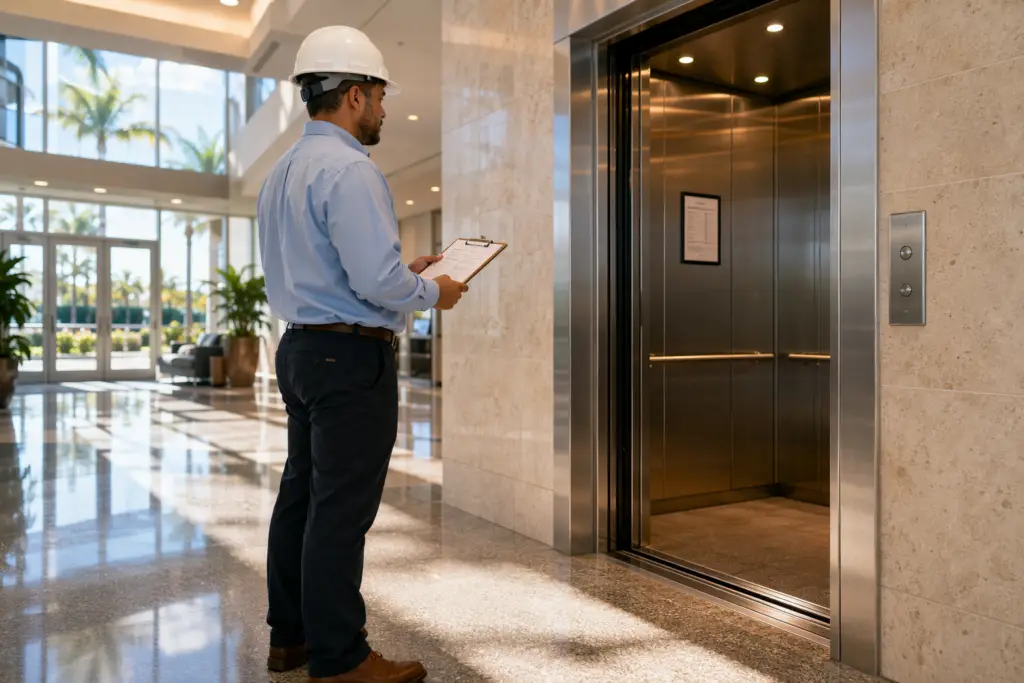
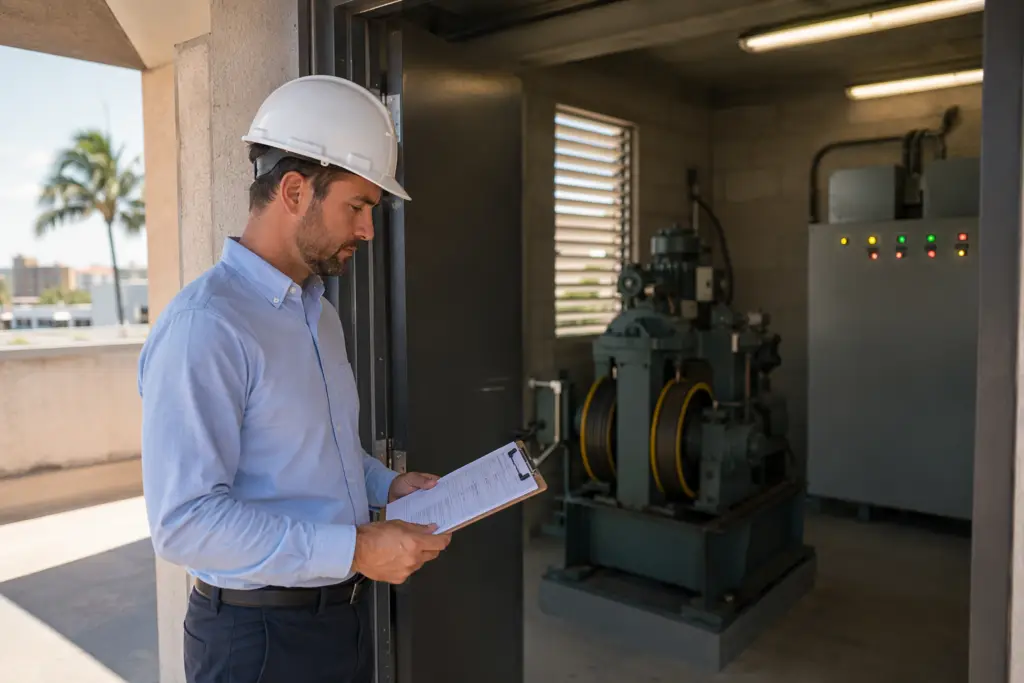
After 15-plus years of inspecting, maintaining, and troubleshooting elevators across Florida, I can tell you that the single most-cited compliance violation I encounter during annual inspections is an improperly installed or non-functional emergency phone. It sounds minor until someone gets trapped at 11 PM on a Friday and that phone is dead. This guide covers everything building owners, property managers, and facility directors in Pompano Beach, Sarasota, and throughout Florida need to know about elevator emergency phone numbers — from code requirements to testing schedules to what it actually costs to stay compliant.
What exactly is an elevator emergency phone number?
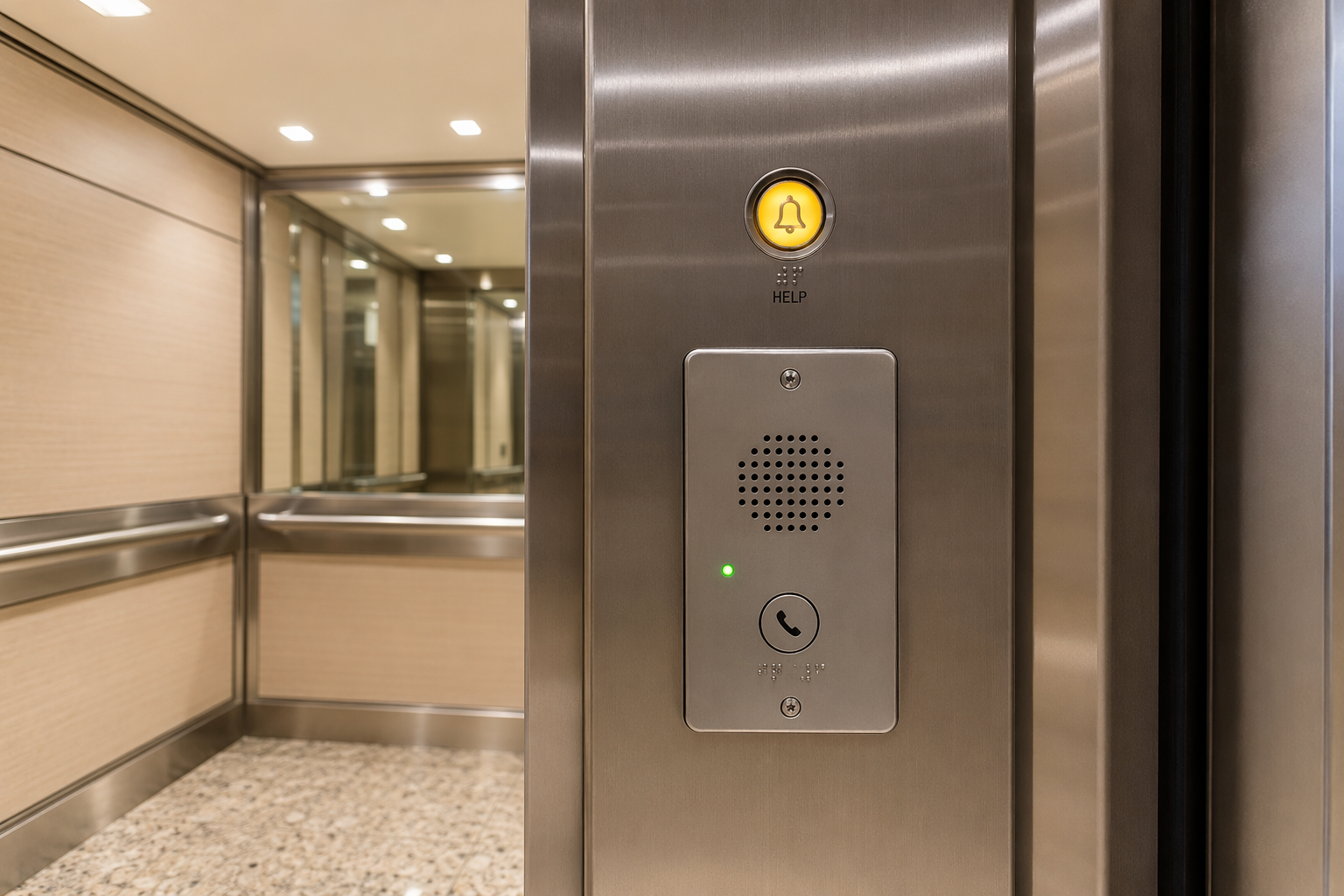
An elevator emergency phone number is a dedicated telephone line — or VoIP/cellular equivalent — permanently installed inside an elevator cab that allows a trapped or distressed passenger to summon immediate help without a cell signal, internet access, or prior knowledge of any phone number.
Unlike a regular phone, the elevator emergency phone is a one-touch or automatic-dial device. Under ASME A17.1/CSA B44 Safety Code for Elevators and Escalators (2019 and 2022 editions, adopted progressively by Florida), the phone must automatically dial a pre-programmed number when the passenger presses the help button — no dialing required. The call must connect to a location staffed by a person who can dispatch help 24 hours a day, 7 days a week, 365 days a year. A voicemail, answering machine, or unmonitored inbox does not satisfy the requirement.
The phone must also provide two-way voice communication and must be usable by people with hearing impairments, which is where ADA cross-compliance becomes critical — we’ll cover that in detail below.
What does ASME A17.1 require for elevator emergency phones in 2026?
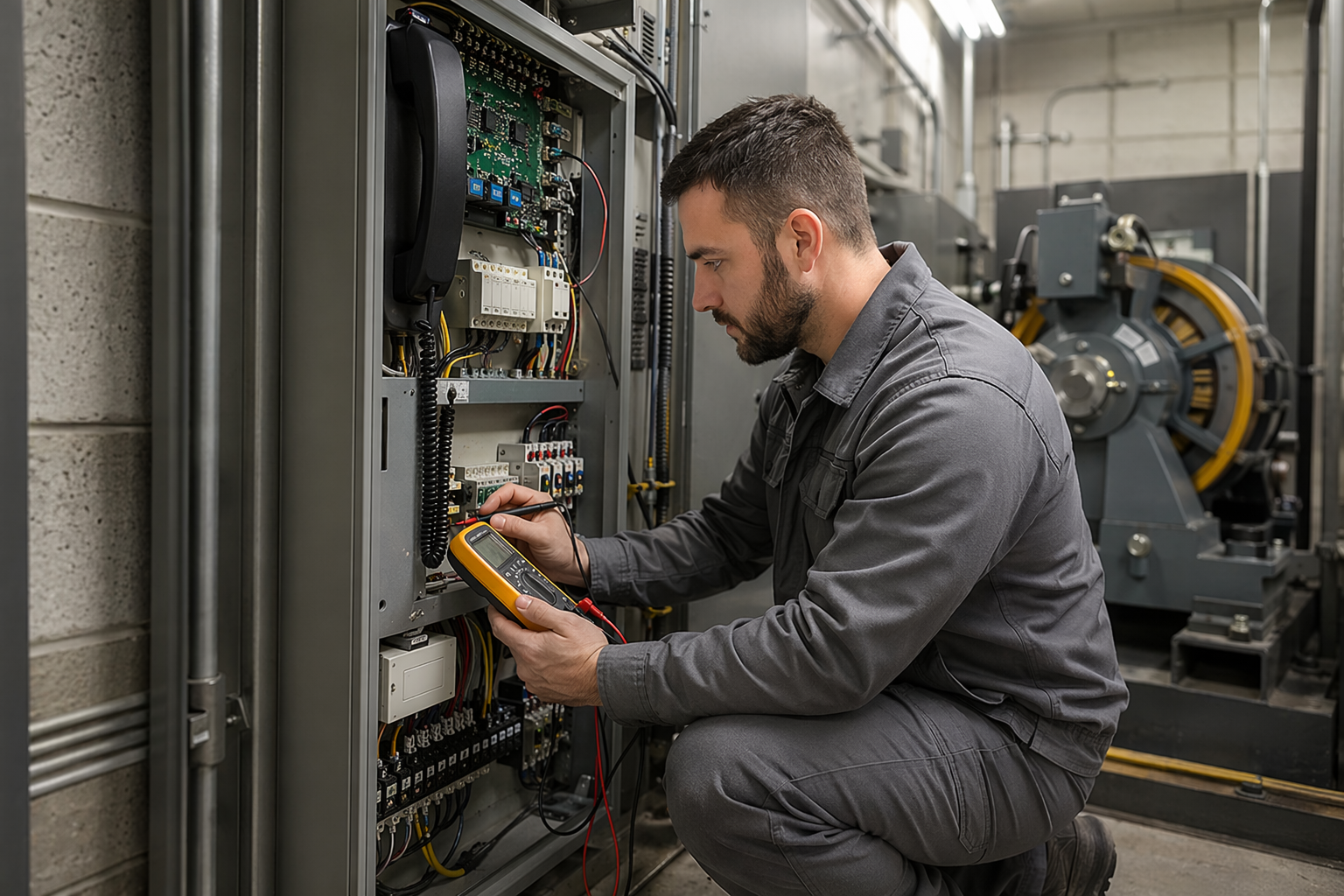
ASME A17.1 Section 2.27.1.1 mandates that every power-operated elevator cab contain an emergency means of two-way communication that automatically connects to a staffed monitoring location when activated.
The current standard, reflected in the ASME A17.1-2022 edition, requires the following specific elements:
- A hands-free, automatic-dial telephone or equivalent communications device
- Connection to a location that is staffed 24/7/365 — not an answering service with limited hours
- An indicator light or audible signal to confirm the call has been connected
- Signage identifying the device as an emergency communication system
- Backup power supply to ensure functionality during a power outage — typically from the elevator’s emergency lighting circuit
- The device must be operational within 5 seconds of activation
Florida has adopted substantial portions of ASME A17.1-2019, with ongoing code update cycles through the Florida Department of Business and Professional Regulation (DBPR). Buildings constructed or substantially renovated after 2020 in markets like Pompano Beach and Sarasota are typically inspected against the 2019 or newer standard. If your building is older, you may still be held to earlier ASME editions, but many jurisdictions require upgrades when systems are modernized.
What are the ADA requirements for elevator emergency phones?
The Americans with Disabilities Act (ADA) Standards for Accessible Design, Section 407.4.9, requires that elevator emergency communication systems be usable by people who are deaf or hard of hearing, which means the system must provide both audible and visual confirmation of call connection.
Specifically, ADA Section 407.4.9 requires:
- A visible signal — typically a lighted indicator — that confirms the call has connected
- The signal must be located in the car operating panel or in a clearly visible position within the cab
- The help button must be identified with the International Symbol of Access for Hearing Loss if the system incorporates a TTY or equivalent
- Emergency phone controls must be mounted between 15 and 48 inches above the finished floor (AFF), consistent with reach range requirements under ADA Section 308
One compliance gap I commonly discover in older buildings across both Pompano Beach and Sarasota is that the visual confirmation light has burned out or was never properly installed. The phone itself may work fine, but without that visual indicator, the installation is technically non-compliant under the ADA — and that carries its own liability exposure separate from the elevator code violation.
Who is responsible for monitoring the elevator emergency phone line?
The building owner or property management company is ultimately legally responsible for ensuring the elevator emergency phone connects to a monitored, staffed location at all times — not the elevator manufacturer, not the phone carrier, and not the tenant.
In practice, most property owners contract with a dedicated elevator monitoring center or an answering service that specializes in elevator emergency response. These services typically charge between $15 and $45 per month per elevator unit, and they provide a dedicated phone number programmed into your emergency phone device. When a passenger presses the help button, the call routes to that center, where a live operator confirms the situation and dispatches emergency services or your elevator service provider.
Important: The monitoring center must be able to identify the building, the specific elevator, and the floor — not just receive a voice call. Modern monitoring systems use Caller ID and/or automated location announcements pre-programmed into the elevator’s communication system to pass this data automatically.
What types of elevator emergency phone systems are available in 2026?
There are four primary types of elevator emergency communication systems currently in use across Florida, each with different installation costs, reliability profiles, and compliance implications.
| System Type | How It Works | Avg. Monthly Cost | Reliability | ASME A17.1 Compliant | Best For |
|---|---|---|---|---|---|
| POTS (Plain Old Telephone Service) | Traditional copper landline | $30–$60/line | High (no internet dependency) | Yes | Older buildings with existing infrastructure |
| VoIP (Voice over Internet Protocol) | Internet-based call routing | $10–$25/line | Moderate (depends on ISP uptime) | Yes, with backup power | Modern commercial buildings |
| Cellular/GSM | 4G/LTE cellular signal | $15–$40/line | Moderate (signal-dependent) | Yes, with signal verification | Buildings with poor landline infrastructure |
| Hybrid (Cellular + VoIP Failover) | Primary cellular, VoIP backup | $25–$55/line | Very High | Yes | High-rise, luxury, or mission-critical facilities |
An important 2026 consideration: traditional POTS lines are being sunset by major carriers across Florida, including in the Pompano Beach and Sarasota markets. AT&T and other providers have been progressively retiring copper infrastructure. If your elevator emergency phone relies on a POTS line, you may face unexpected service termination. This is one of the most urgent infrastructure conversations I’m having with building managers right now.
How often does the elevator emergency phone need to be tested?
Under ASME A17.1 and Florida DBPR requirements, elevator emergency phones must be tested at least monthly, with results documented in the elevator maintenance log.
Monthly testing should confirm all of the following:
- The help button activates the auto-dial function
- The call connects to a live operator within the required timeframe (generally under 30 seconds)
- Two-way communication is clear and audible
- The visual confirmation indicator is functioning
- Backup power maintains phone function when building power is simulated as interrupted
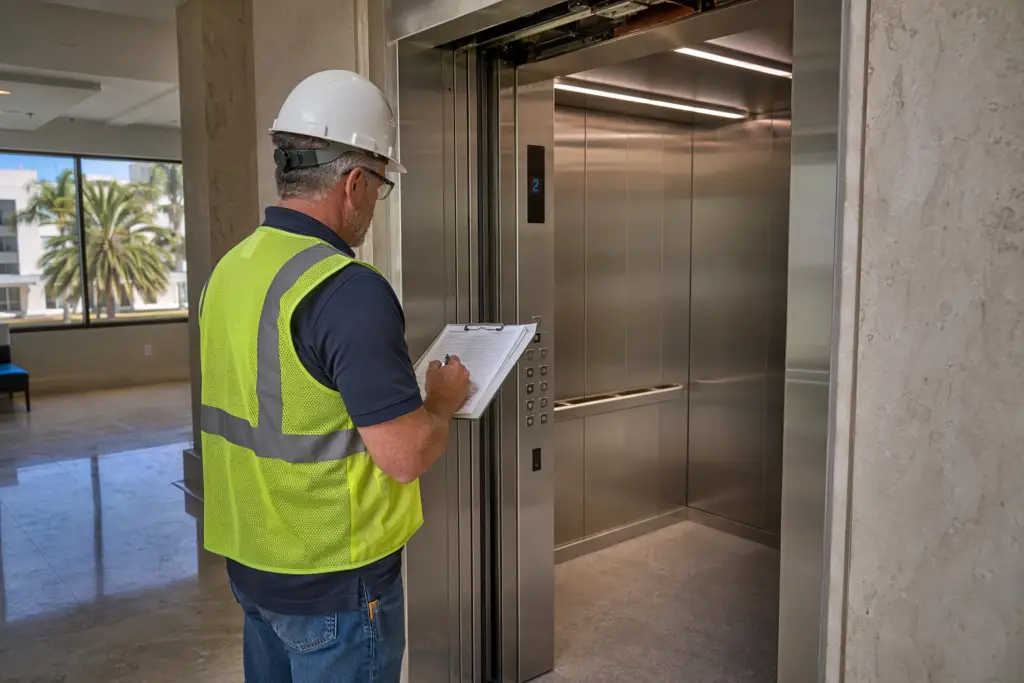
Annual inspection by a Florida-licensed elevator inspector will also specifically test the emergency phone as part of the full Category 1 or Category 5 test protocol. Failure of the emergency phone during a state inspection results in an immediate violation notice and, in many jurisdictions, can result in the elevator being placed out of service until the issue is corrected.
Axxiom Elevator Florida includes emergency phone testing as a standard line item in all preventive maintenance contracts for buildings in Pompano Beach and Sarasota, ensuring you have documented monthly test records available for inspection.
What happens if an elevator emergency phone fails during an entrapment?
If an elevator emergency phone fails during a passenger entrapment, the building owner faces immediate liability, potential regulatory fines, and — most critically — a trapped person with no way to call for help.
From a legal standpoint, a non-functional emergency phone during an entrapment event is considered a negligence risk factor in personal injury litigation. Florida courts have recognized that the obligation to maintain functional emergency communication equipment is a non-delegable duty of the building owner. A failed emergency phone shifts the calculus of comparative fault significantly toward the property owner.
Practically speaking, passengers without a working emergency phone will attempt to use personal cell phones — which may not have signal inside a steel shaft — or may attempt dangerous self-rescue actions like forcing doors open. In 2026, with elevator monitoring increasingly integrated into smart building systems, there is little justification for allowing an emergency phone to remain non-functional for any period of time.
What is the phone number format displayed inside elevator cabs in Florida?
Florida elevator code requires that the emergency contact information displayed inside the cab include the monitoring center’s phone number, the elevator’s unit identification number, and the building’s address — typically printed on a placard adjacent to the emergency phone device.
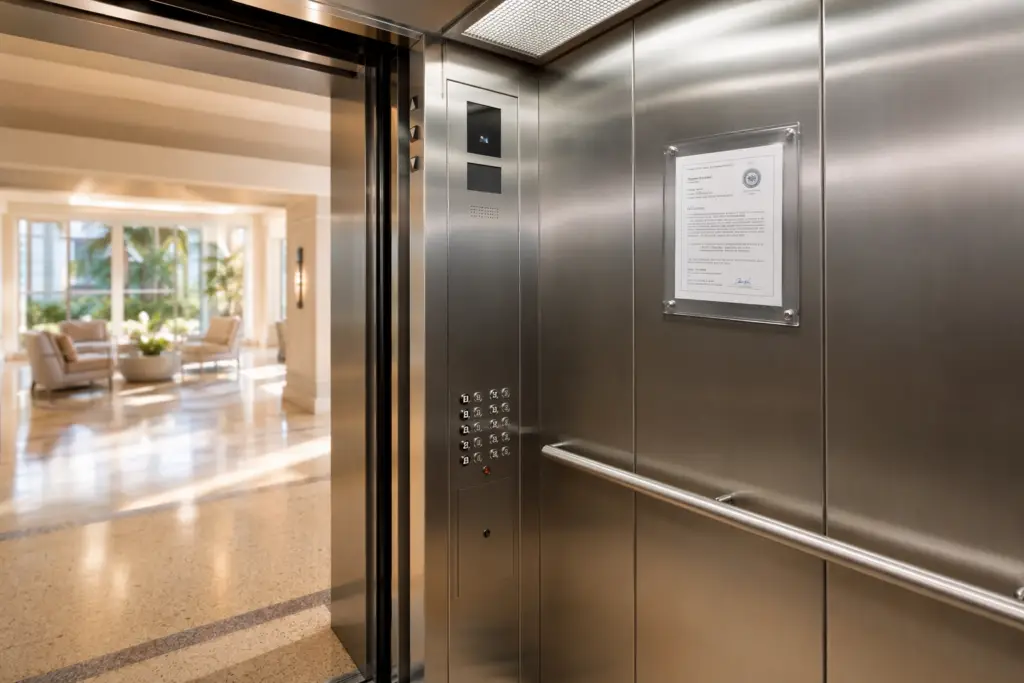
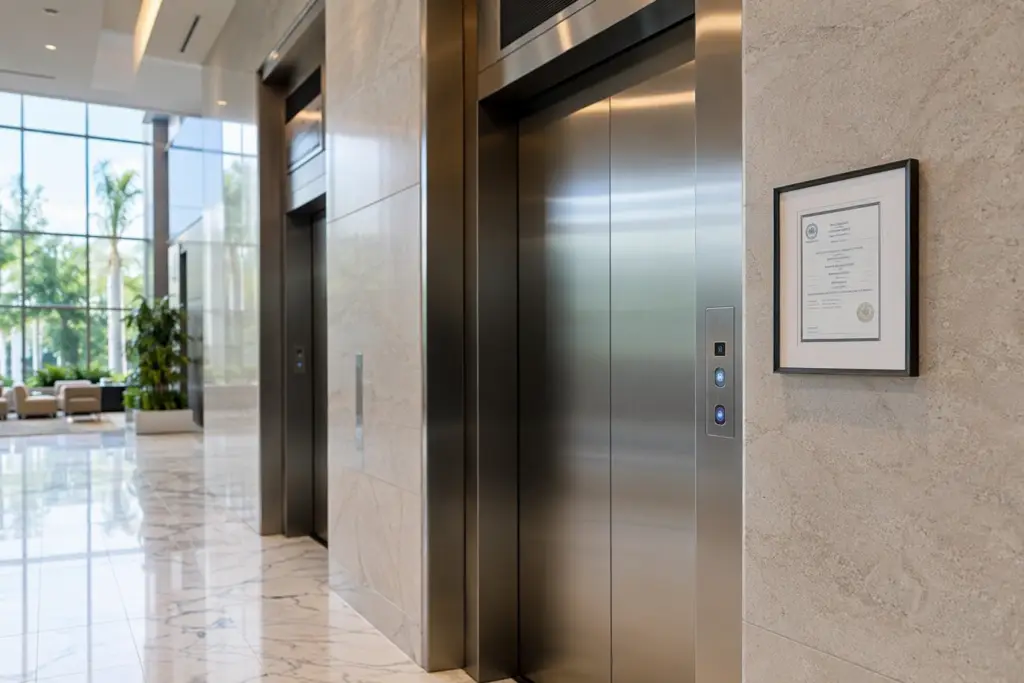
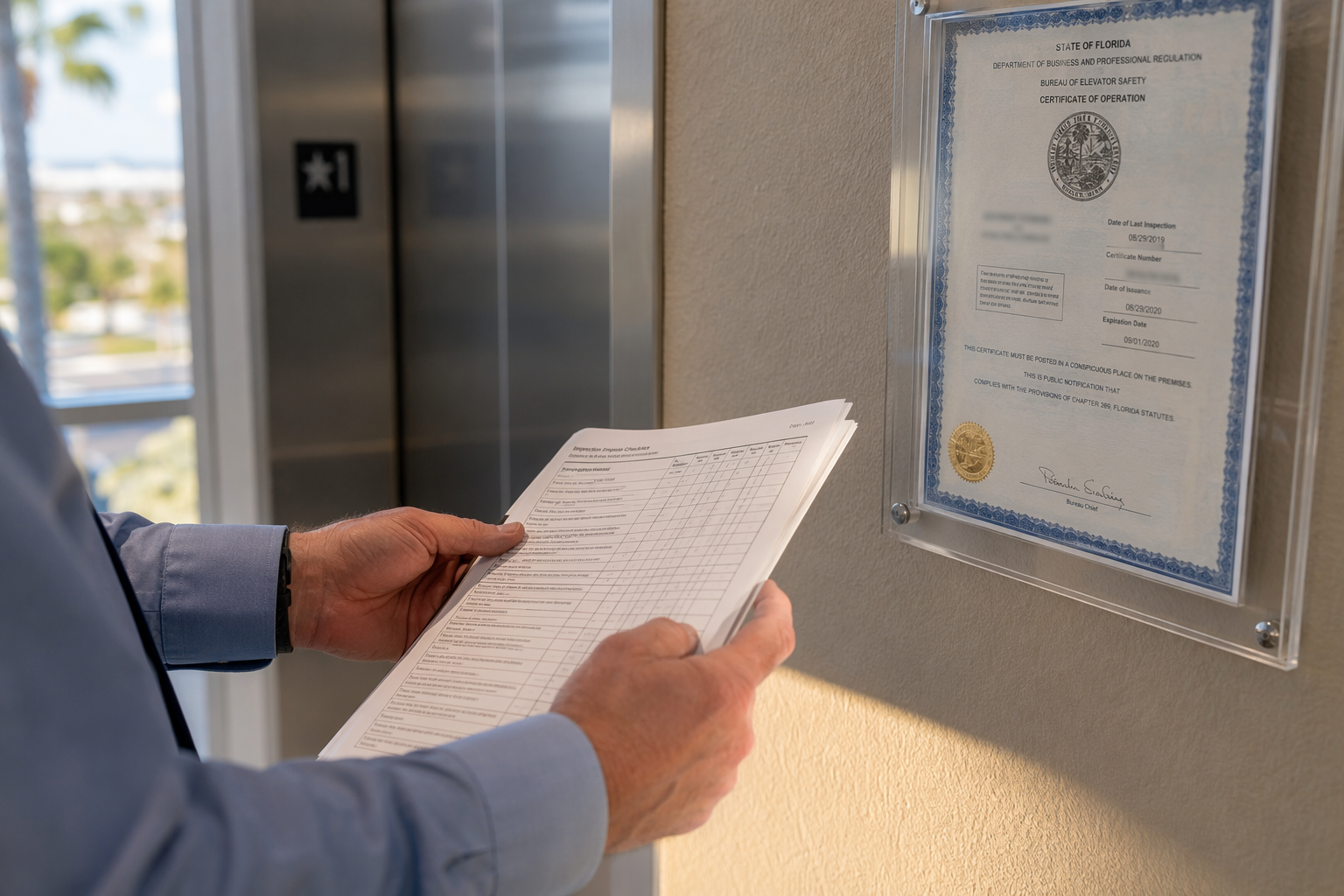
Beyond the monitoring center number, Florida DBPR also requires that the current Certificate of Operation be posted in or adjacent to each elevator, which includes the elevator identification number and the inspector’s contact information. This is separate from the emergency phone requirement but is frequently missing in older buildings.
The phone number programmed into the device itself does not need to be visibly displayed — passengers only need to press the help button. However, best practice is to also post the monitoring line number so that if the auto-dial fails, a passenger with a cell phone can manually dial the same number.
How much does it cost to install or replace an elevator emergency phone system?
A complete elevator emergency phone system installation or replacement in Florida typically costs between $350 and $900 per elevator unit for the hardware and labor, plus $15 to $55 per month in ongoing monitoring service fees.
Cost variables include:
- System type: Cellular-based systems generally cost more upfront than VoIP but avoid the ongoing POTS line charges
- Number of elevators: Multi-unit buildings benefit from volume discounts on both equipment and monitoring contracts
- Existing wiring: If your current infrastructure supports the new system, labor costs are lower
- Permit fees: In Florida, any modification to elevator communication systems requires a permit from the local jurisdiction and DBPR notification, adding $75–$200 per unit
- Integration with building management systems: Smart building integrations can add $200–$500 per elevator but provide centralized monitoring dashboards
When comparing quotes, be cautious of proposals that omit the monitoring contract cost — the hardware is only part of the total cost of ownership. Over a 5-year period, monitoring fees typically exceed the initial installation cost.
Does every elevator in Florida require an emergency phone regardless of building size?
Yes — in Florida, every power-operated elevator intended to carry passengers requires a functioning emergency communication device, regardless of the building’s size, number of stories, or number of elevator units.
This includes:
- Commercial office buildings
- Multi-family residential buildings (condominiums, apartments)
- Hotels and hospitality properties
- Retail and mixed-use facilities
- Medical and healthcare facilities
- Two-stop private residence elevators, with limited exceptions under certain Florida residential exemptions
There is a narrow exemption for private residential elevators in single-family homes under Florida Statute 399, but this does not apply to any elevator accessible to the general public or to tenants in a multi-unit residential building. If your building has a two-story commercial property with a single elevator, the emergency phone requirement applies in full.
What are common reasons elevator emergency phones fail compliance inspections in Florida?
The most common elevator emergency phone compliance failures I document in Florida inspections fall into six recurring categories that are almost entirely preventable with a proper maintenance program.
- Dead or disconnected phone line: POTS lines terminated without replacement, or VoIP service lapsed due to non-payment
- Call routes to voicemail: Monitoring service contract expired; calls now reach a recording rather than a live operator
- No visual confirmation indicator: Burned-out LED or indicator light not replaced during routine maintenance
- Incorrect location data: Phone system programmed with outdated building address or elevator ID that no longer matches current records
- Backup power failure: Emergency phone battery or backup circuit not tested or replaced on schedule
- Physical damage to the device: Vandalism or wear to the help button or speaker, preventing activation or clear audio
Each of these failures is detectable during a monthly test — which is exactly why ASME A17.1 requires monthly documentation. Buildings that skip monthly testing tend to discover failures only during the annual state inspection, at which point they face violation notices and potential shutdown orders.
How does POTS line retirement affect elevator emergency phones in Pompano Beach and Sarasota?
The ongoing retirement of traditional copper telephone lines across Florida is creating an urgent compliance gap for buildings that have not yet migrated their elevator emergency phones to cellular or VoIP solutions.
As of 2025–2026, the FCC has allowed major carriers to discontinue POTS service in many Florida markets after providing advance notice. In the Pompano Beach and Sarasota service areas, building managers have reported receiving termination notices with as little as 30–60 days’ notice. When the POTS line goes dark, the elevator emergency phone goes silent — and the building is immediately out of compliance.
The solution is proactive migration to a cellular or VoIP-based emergency phone system before your carrier issues a termination notice. Axxiom Elevator Florida has been assisting property owners throughout Pompano Beach and Sarasota with this migration, ensuring seamless ASME A17.1-compliant replacement systems are in place before the legacy line is shut down.
What information should the elevator emergency phone automatically announce when a call is placed?
Under current best practices aligned with ASME A17.1 and the monitoring industry standard NFPA 72 (where applicable to integrated systems), the elevator emergency phone should automatically transmit the building name, building address, and elevator unit number to the monitoring center when a call is initiated.
This information is typically pre-programmed into the communication device and either broadcast as an automated voice message at the beginning of the call or transmitted as digital data to the monitoring center’s dispatch screen. Without this location data, a monitoring operator receiving a call from a distressed passenger must spend precious time identifying the building — time that could cost lives in a medical emergency situation.
When having a new emergency phone system installed or reprogrammed, always verify with the installer that the location announcement has been correctly programmed and confirmed with the monitoring center. This is a step that is sometimes skipped during rushed installations.
Are elevator emergency phones required to work during a power outage?
Yes — ASME A17.1 Section 2.27.1.1 explicitly requires that elevator emergency communication devices remain operational during a loss of normal building power, powered by the same backup circuit that maintains emergency lighting within the elevator cab.
This means the emergency phone must be connected to an uninterruptible power source (UPS) or the elevator’s dedicated emergency lighting battery backup, which is typically required to provide a minimum of 4 hours of operation under ASME A17.1 and Florida electrical code. In practice, most modern elevator emergency phone units have internal battery backup as well, providing an additional layer of redundancy.
Power outages are actually one of the most common causes of elevator entrapments — when utility power fails, elevators may stop mid-travel, trapping passengers. This is precisely when the emergency phone is most critical, and precisely when building power is unavailable. A phone that only works on building power is not compliant and provides zero value in the scenario it was designed for.
How do I find the correct elevator emergency monitoring service for my Florida building?
Selecting the right elevator emergency monitoring provider requires evaluating four key criteria: 24/7/365 live operator staffing, guaranteed answer time under 30 seconds, documented dispatch protocols, and ASME A17.1 compliance certification for their monitoring platform.
In Florida, your elevator service provider is typically the best starting point for a monitoring service recommendation, as they can integrate the monitoring contract with your maintenance agreement and ensure the phone hardware is properly programmed for the monitoring center’s system. Independent monitoring services are also available and may offer competitive pricing for multi-unit portfolios.
Questions to ask any monitoring provider before signing a contract:
- Is your monitoring center staffed 24 hours a day, including holidays?
- What is your average answer time for elevator emergency calls?
- Do you provide monthly call log reports for our maintenance records?
- How do you handle calls where the passenger cannot speak (ADA compliance)?
- What is your dispatch protocol for medical emergencies versus mechanical entrapments?
What is the difference between an elevator emergency phone and an elevator alarm bell?
An elevator alarm bell is a passive audible signal that alerts people near the elevator that someone needs help, while an emergency phone is an active two-way communication device that connects a trapped passenger directly to a live person who can dispatch assistance.
ASME A17.1 requires both in most elevator configurations — they are not interchangeable. The alarm bell (required under Section 2.27.1.2) serves as a backup signaling device when the phone cannot be heard by the passenger or when the building is occupied and someone nearby may respond. However, the alarm bell alone does not satisfy the emergency communication requirement because it does not ensure a response or connect the passenger to assistance.
I frequently encounter building owners who believe their alarm bell satisfies the emergency phone requirement. It does not. Both devices must be present, functional, and tested independently.
How long does it take to install a new elevator emergency phone system?
A standard elevator emergency phone installation or replacement on an existing elevator takes 2 to 4 hours per unit for a qualified elevator technician, with same-day restoration of compliant service possible in most cases.
The installation timeline includes:
- Removal of existing non-compliant or failed device: 30–60 minutes
- Wiring and mounting of new unit: 60–90 minutes
- Programming of location data and monitoring center number: 30–45 minutes
- Test call to monitoring center and confirmation of visual indicator function: 15–30 minutes
- Documentation for permit and maintenance records: 15–20 minutes
Multi-elevator buildings in Pompano Beach or Sarasota can typically have all units upgraded within a single business day when scheduled in advance. Emergency replacements — for instance, when a unit fails immediately before or during a state inspection — can usually be completed within 24–48 hours depending on parts availability.
What records should building managers keep regarding elevator emergency phone maintenance?
Florida DBPR and ASME A17.1 require that elevator maintenance records, including emergency phone test logs, be retained for a minimum of 5 years and be available for review by state elevator inspectors upon request.
Your emergency phone documentation file should include:
- Monthly test logs with date, tester name, call connection confirmed (yes/no), visual indicator functional (yes/no), backup power test result
- Monitoring service contract with current monitoring phone number on file
- Records of any repair, replacement, or reprogramming of the emergency phone device
- Annual inspection reports that include emergency phone test results
- Permit records for any system installations or modifications
- Correspondence with POTS line carrier if applicable, including any service termination notices
Maintaining clean, organized records is not just a compliance exercise — it is your primary defense in the event of a liability claim arising from a passenger entrapment incident. Documented monthly testing that shows a functioning phone at the time of the last inspection significantly strengthens your legal position.
How do smart building systems and IoT integration affect elevator emergency phones in 2026?
Smart building platforms and IoT-enabled elevator monitoring systems are increasingly integrating elevator emergency phone status into centralized building management dashboards, allowing facility managers to receive real-time alerts if the emergency phone circuit loses connectivity.
In 2026, the most advanced implementations connect the elevator’s emergency communication system to the building’s BMS (Building Management System), generating an automatic work order when a phone test fails or when the backup power battery drops below threshold voltage. This eliminates the human error element from monthly testing — instead of relying on a maintenance staff member to remember to test the phone, the system tests itself and reports to a dashboard.
While these integrations are more common in new construction and Class A commercial properties, retrofit solutions are available for existing elevator inventory. The cost premium for IoT-integrated emergency phone systems is typically $150–$400 per elevator unit over a standard replacement, and the return on investment comes primarily from reduced liability exposure and simplified compliance documentation. Axxiom Elevator Florida offers consultations on smart building elevator integration for properties in both the Pompano Beach and Sarasota markets.
What should a passenger do if the elevator emergency phone does not work during an entrapment?
If an elevator emergency phone fails during an entrapment, the passenger should remain calm, press the alarm bell continuously, use a personal cell phone to call 911, and avoid attempting to force elevator doors open or escape through the top hatch.
Specific guidance for trapped passengers:
- Press the alarm bell repeatedly — this is the secondary alerting system and may be heard by building occupants or security staff
- Call 911 from a personal cell phone — emergency services have protocols for elevator entrapment response and can contact building management directly
- Stay away from elevator doors — forced door opening is a leading cause of elevator-related injuries and fatalities
- Do not attempt to exit through the top hatch — this is an equipment access point, not a passenger escape route, and creates serious fall hazard risk
- Make noise — yelling, knocking on walls — to alert people on adjacent floors
- Stay hydrated and calm — modern elevators have emergency lighting and ventilation; entrapments are uncomfortable but rarely immediately dangerous if the passenger remains calm
A non-functional emergency phone during an entrapment is a reportable event in Florida. Building owners should document the failure, notify their elevator service provider immediately, and initiate a repair service call — the elevator should not be returned to service until the phone system is verified functional and documented.
Get Your Elevator Emergency Phone Inspected Today
Whether your building is in Pompano Beach or Sarasota, elevator emergency phone compliance is not optional — and the consequences of a failed system range from regulatory fines to serious passenger safety incidents. After 15 years in this industry, I’ve seen what happens when this equipment is ignored, and it is entirely preventable with the right maintenance partner.
Axxiom Elevator Florida provides comprehensive elevator maintenance, emergency phone system installation and replacement, POTS-to-cellular migration services, and full ASME A17.1 and ADA compliance assessments for commercial and residential buildings throughout Pompano Beach and Sarasota. Our IUEC-certified technicians respond quickly, document everything, and keep your elevators compliant and your passengers safe.
Contact Axxiom Elevator Florida for a free elevator assessment:
Serving Pompano Beach FL, Sarasota FL, and surrounding South and West Florida communities. Available for emergency service calls 24 hours a day, 7 days a week.