Florida Elevator Inspection Requirements: How Often, Who Does It, and What Building Owners Need to Know
Florida elevator inspections are governed by a layered framework of state statutes, local authority rules, and the nationally recognized ASME A17.1 Safety Code for Elevators and Escalators. Failing to comply puts occupants at risk and exposes property owners to fines, liability, and forced shutdowns. This comprehensive FAQ hub covers every major question building owners, property managers, and facility directors in Pompano Beach and Sarasota ask about Florida elevator inspection requirements.
How Often Does an Elevator Need to Be Inspected in Florida?
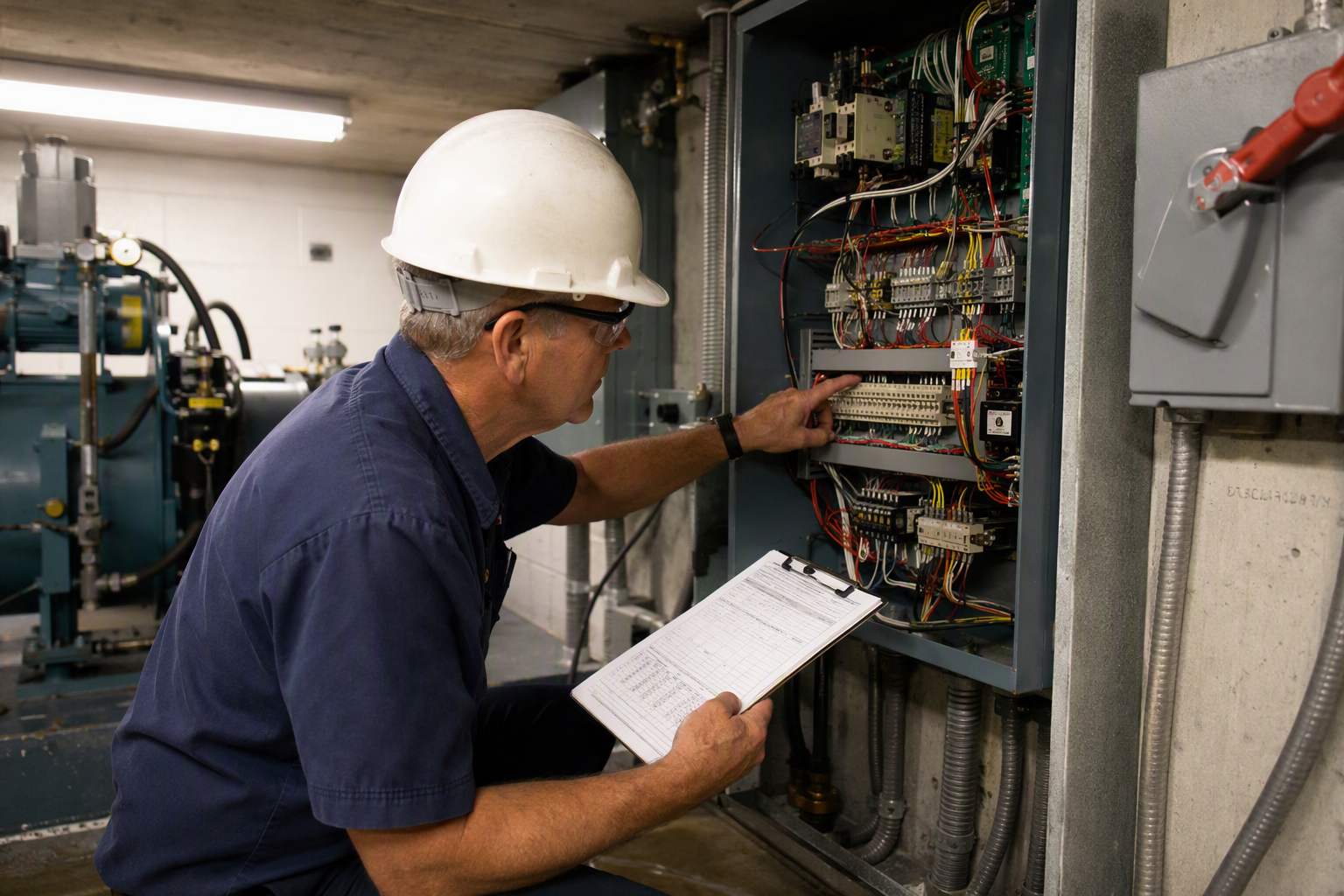
Most elevators in Florida are required to undergo a full safety inspection at least once every 12 months.
Florida Statutes Chapter 399 establishes the inspection cycle for conveyances, including traction elevators, hydraulic elevators, escalators, dumbwaiters, and moving walks. The standard interval is annual, meaning each elevator must receive a complete periodic inspection and pass before a new certificate of operation is issued. Elevators that fail inspection or exceed their certificate expiration date may be ordered out of service immediately by the inspecting authority.
In addition to the annual periodic inspection, Florida also requires semi-annual or periodic maintenance tests for certain safety devices depending on equipment type and category. Category 1 tests (no-load safety tests) are typically required annually, while Category 5 tests (full-load, full-speed tests for certain safety and overspeed devices) follow longer intervals as specified in ASME A17.1. The exact test category and interval depend on the elevator type, drive system, and installation date.
Who Is Required to Perform Elevator Inspections in Florida?
Florida elevator inspections must be conducted by a licensed elevator inspector who holds a Qualified Elevator Inspector (QEI) certification or its Florida equivalent as recognized by the DBPR.
The Florida Department of Business and Professional Regulation oversees elevator safety under Chapter 399, Florida Statutes. Inspectors must be licensed by the state, and many jurisdictions also require them to hold QEI certification issued under the standards of the National Association of Elevator Safety Authorities International (NAESAI). In some counties and municipalities, the local Authority Having Jurisdiction (AHJ) employs its own inspectors. In others, building owners must contract with a private, state-licensed inspection firm.
The inspector’s role is strictly to evaluate compliance — they do not perform repairs. The building owner or property manager is responsible for retaining a licensed elevator contractor to address any deficiencies the inspector identifies before the elevator can receive a new certificate of operation.
Who Is Legally Responsible for Scheduling the Inspection?
The building owner or the owner’s designated property manager bears full legal responsibility for ensuring the elevator is inspected on time and holds a current, valid certificate of operation.
This is a common source of confusion. The elevator contractor or maintenance company does not have a statutory obligation to schedule the annual inspection on the owner’s behalf unless the maintenance contract explicitly includes that service. Owners of commercial buildings, multifamily residential complexes, and any other structures with a conveyance covered under Chapter 399 must track their certificate expiration dates and initiate the inspection process before the certificate lapses.
Axxiom Elevator Florida works with property owners and managers in Pompano Beach and Sarasota to coordinate inspection scheduling as part of its maintenance and service programs, helping clients avoid lapses that trigger compliance violations.
What Florida Law Governs Elevator Inspections?
Elevator inspections in Florida are primarily governed by Chapter 399, Florida Statutes, which adopts ASME A17.1 as the referenced safety standard.
Florida Statute § 399.02 establishes the scope of covered conveyances. § 399.061 addresses certificates of operation and the requirement that no elevator be operated without a valid certificate. § 399.063 covers inspection procedures, licensing of inspectors and contractors, and enforcement authority. The Florida Building Code also incorporates ASME A17.1 as the standard for elevator installation and alteration, creating alignment between construction and operations requirements.
For federal workplaces and environments covered by federal jurisdiction, OSHA standards may also apply, though OSHA generally defers to state elevator safety programs where a state-approved plan exists. Florida operates its own state elevator safety program, so OSHA’s general industry standards for elevators are supplementary rather than primary in most Florida settings.
What Is a Certificate of Operation and How Long Is It Valid?
A Florida elevator certificate of operation is the official document confirming a conveyance has passed its required periodic inspection and is legally authorized to carry passengers or freight.
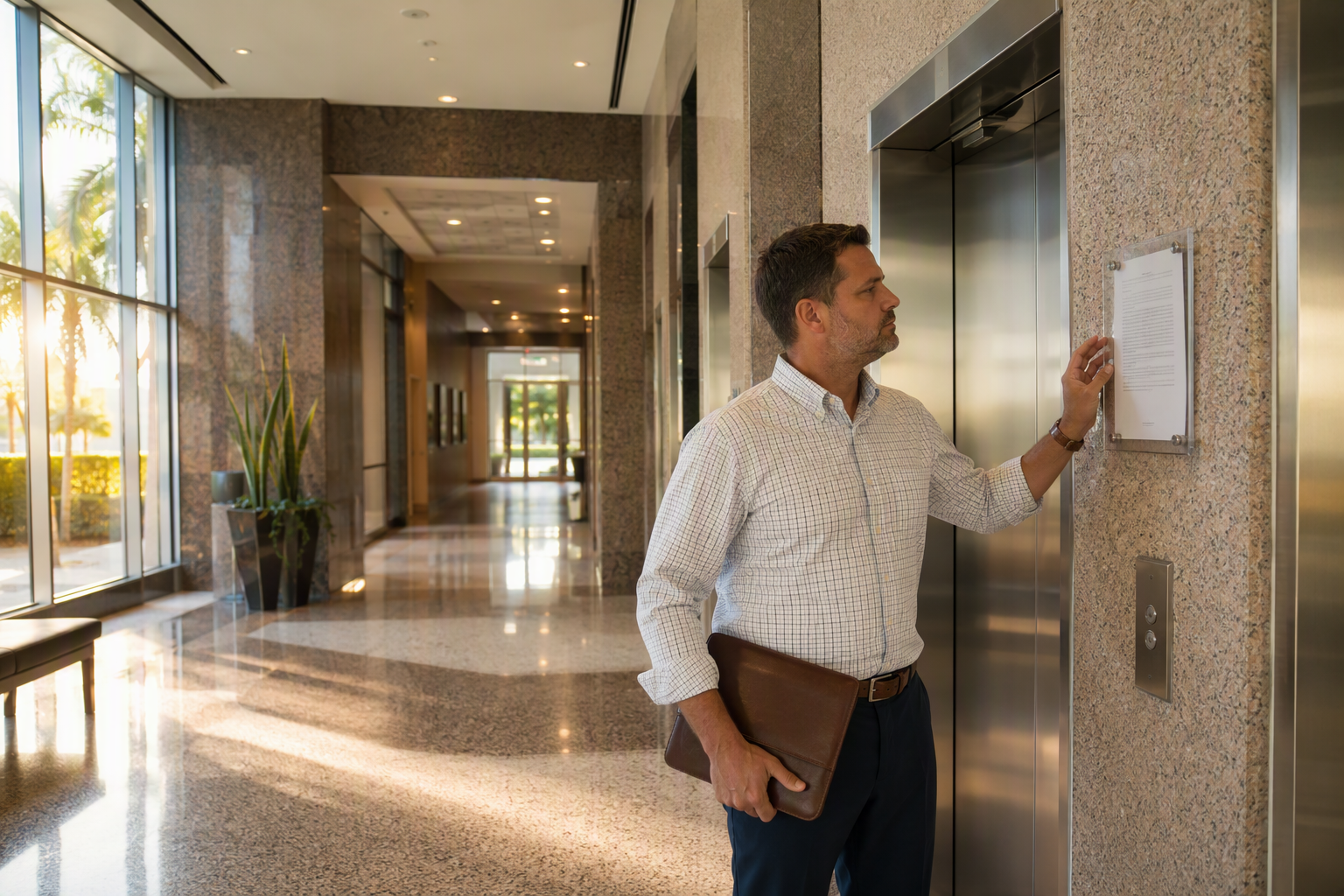
Certificates are typically issued for a 12-month period following a successful inspection. The certificate must be posted in or near the elevator car in a conspicuous location where passengers and building staff can see it. Operating an elevator with an expired, suspended, or revoked certificate is a violation of Chapter 399 and can result in the elevator being locked out of service, civil penalties, and increased liability exposure for the property owner.
When an elevator fails its periodic inspection, the DBPR or AHJ may issue a conditional certificate with a defined correction period, or may order the elevator out of service immediately if a serious or imminent-hazard violation is found.
What Does a Florida Elevator Inspection Actually Cover?
A Florida periodic elevator inspection covers the full range of mechanical, electrical, and structural components specified in ASME A17.1, including safety devices, door operation, hoistway conditions, machine room equipment, and emergency systems.
The inspector evaluates items including but not limited to:
- Car and counterweight safeties and their triggering mechanisms
- Overspeed governor function
- Door reopening devices and door closing force
- Emergency lighting and communication systems
- Pit conditions, lighting, and stop switches
- Machine room temperature controls and access security
- Buffer condition and travel clearances
- Hydraulic unit integrity (for hydraulic elevators), including oil level and cylinder condition
- Firefighters’ emergency operation (FEO) compliance per ASME A17.1 Rule 2.27
- Leveling accuracy and car sill-to-floor threshold gaps
Accessibility features required under the Americans with Disabilities Act (ADA) — such as raised and Braille characters on control buttons, audible floor indicators, and minimum cab dimensions — are not part of the DBPR elevator inspection per se, but non-compliant accessibility features can create separate federal legal exposure for building owners.
What Are the Different ASME A17.1 Test Categories and Which Apply to My Elevator?
ASME A17.1 establishes five test categories (Category 1 through Category 5) with different intervals and test methods depending on elevator type and safety system configuration.
| Test Category | Description | Typical Interval | Elevator Types |
|---|---|---|---|
| Category 1 | No-load test of safety and braking devices without tripping the governor | Annual | Traction, hydraulic, most conveyances |
| Category 3 | Operational test of safeties and oil buffers at reduced speed | Every 3 years (where applicable) | Certain traction elevators with oil buffers |
| Category 5 | Full-load, full-speed test including governor trip and safety application | Every 5 years | Traction elevators with governor-operated safeties |
| Hydraulic Pressure Test | Pressure and relief valve testing for hydraulic units | Annual (pressure test) / Periodic full tests | Hydraulic elevators |
| Firefighters’ Emergency Operation Test | Phase I and Phase II recall operation verification | Annual (part of periodic inspection) | All passenger elevators in buildings requiring FEO |
The Category 5 test is particularly significant because it involves physically tripping the overspeed governor and applying the car safeties at full speed — a procedure that requires advance scheduling, specialized equipment, and a qualified witness. Axxiom Elevator Florida coordinates Category 5 and other periodic tests for clients throughout Pompano Beach and Sarasota, ensuring tests are scheduled in advance of certificate deadlines.
What Happens If My Elevator Fails Inspection in Florida?
If an elevator fails its Florida periodic inspection, the inspector will issue a correction notice specifying the violations, and the elevator may be conditionally permitted to operate or ordered out of service depending on the severity of the deficiencies.
Minor violations — such as a missing or illegible inspection certificate, a burned-out light in the machine room, or a minor door adjustment — may result in a conditional certificate with a defined correction window, often 30 to 90 days. Major violations involving safety-critical components, such as failed safeties, a non-functioning governor, or a seriously compromised hoistway, typically result in an immediate out-of-service order.
Once corrections are made by a licensed elevator contractor, the building owner must request a follow-up or reinspection. The reinspection may incur an additional fee payable to the inspecting authority or private inspector. The elevator cannot legally return to service until the reinspection is passed and a new certificate is issued or the existing conditional certificate is cleared.
What Is the Difference Between an Elevator Inspection and Elevator Maintenance?
An inspection is a compliance evaluation conducted by a licensed inspector to determine whether an elevator meets code requirements, while maintenance is the ongoing service performed by a licensed elevator contractor to keep the equipment in safe operating condition.
These two functions are legally distinct in Florida. The inspector evaluates — they do not repair or adjust. The licensed elevator contractor maintains, repairs, and adjusts the equipment. Regular preventive maintenance is the most effective tool building owners have to pass inspections without violations, because well-maintained elevators are far less likely to develop the component failures that generate correction notices.
Florida Chapter 399 requires that maintenance on covered conveyances be performed only by licensed elevator contractors. Unlicensed personnel performing elevator work — including building maintenance staff attempting adjustments — creates both a safety hazard and a regulatory violation.
How Much Does a Florida Elevator Inspection Cost?
Elevator inspection fees in Florida vary by jurisdiction, elevator type, and whether the inspection is conducted by a government inspector or a private licensed inspection firm.
Some Florida counties and municipalities conduct inspections through their own building department and charge a fixed permit or inspection fee set by local ordinance. Other jurisdictions require building owners to hire private, state-licensed inspection firms, whose fees are set by the market. Category 5 tests, which require more time and specialized witnessing, typically carry higher fees than standard annual inspections. Because fees are jurisdiction-specific and subject to local rate changes, building owners should contact their local AHJ or a licensed inspection firm for current pricing applicable to their specific equipment and location.
What Are the Penalties for Operating an Elevator Without a Valid Certificate in Florida?
Operating a Florida elevator without a current, valid certificate of operation is a violation of Chapter 399 and can result in civil penalties, forced shutdown, and significantly increased liability if an incident occurs.
The DBPR has authority to assess civil penalties for violations of Chapter 399. Elevators found operating without a valid certificate can be ordered out of service by the inspector or AHJ, requiring the owner to obtain a reinspection before resuming operation. Beyond regulatory penalties, operating without a valid certificate undermines an owner’s legal defense in the event of a passenger injury — an expired certificate is a significant liability indicator in personal injury litigation.
Are Residential Home Elevators Subject to Florida Inspection Requirements?
Private residence elevators serving only a single-family home are generally exempt from Florida’s Chapter 399 inspection requirements, but elevators in multifamily residential buildings are fully subject to state inspection mandates.
Florida Statute § 399.02 carves out private residential elevators serving a single-family dwelling from the scope of mandatory periodic inspections. However, this exemption applies only to true single-family private use. Elevators in condominiums, apartment buildings, assisted living facilities, and any common-access residential structure must comply with all Chapter 399 requirements, including annual inspections and certificate of operation requirements. Property owners with questions about whether a specific installation qualifies for the residential exemption should consult the DBPR or a licensed elevator contractor for a site-specific determination.
Do New Elevators Need to Be Inspected Before Being Placed in Service?
Yes — a new elevator installation in Florida must pass a construction inspection conducted by a licensed elevator inspector before it may be placed in service for the first time.
Before a newly installed elevator can receive its initial certificate of operation, the installing licensed elevator contractor must request a construction inspection from the AHJ or an authorized private inspector. The inspector verifies that the installation conforms to the approved plans and the edition of ASME A17.1 and Florida Building Code applicable at the time of permit issuance. Any deficiencies must be corrected before the initial certificate is issued. The construction inspection initiates the annual inspection cycle — the first periodic inspection is typically due approximately 12 months after the initial certificate issuance date.
What Should a Building Owner Do Immediately If an Elevator Is Ordered Out of Service?
If a Florida elevator is ordered out of service by an inspector or the DBPR, the building owner must immediately comply with the out-of-service order, notify occupants, and contact a licensed elevator contractor to assess and repair the cited deficiencies.
- Comply immediately: Do not attempt to override or bypass the out-of-service order. Operating a locked-out elevator compounds the legal and safety exposure significantly.
- Post notice: Place clear, visible out-of-service signage at all elevator lobbies on every floor to inform building occupants and visitors.
- Notify ADA users: If the building is subject to ADA requirements, identify whether the elevator shutdown creates an accessibility barrier for individuals with disabilities and determine what interim accommodations are required.
- Contact a licensed elevator contractor: Request an emergency assessment to identify the scope of repairs needed to address the inspector’s cited violations.
- Obtain documentation: Ensure the contractor provides written records of all repairs performed, parts replaced, and tests conducted — this documentation is required for the reinspection.
- Schedule reinspection: Contact the AHJ or private inspection firm to schedule a reinspection as soon as the repairs are complete. Do not return the elevator to service without a passed reinspection and a new or cleared certificate.
- Review maintenance program: Use the incident as an opportunity to evaluate whether the current maintenance contract frequency and scope are adequate to prevent future inspection failures.
How Does ADA Compliance Interact with Florida Elevator Inspection Requirements?
ADA elevator accessibility requirements are federally mandated and enforced separately from Florida’s Chapter 399 inspection program, but both sets of obligations apply simultaneously to most commercial elevators.
The Americans with Disabilities Act requires that elevators in buildings covered by Titles II and III of the ADA meet specific accessibility standards, including compliant controls, door timing, floor indicators, and cab dimensions. The Florida DBPR inspector evaluating the elevator under Chapter 399 is not enforcing ADA — that is a civil rights statute enforced by the U.S. Department of Justice and through private litigation. However, building owners have a parallel obligation to maintain ADA compliance, and deficiencies discovered during a state inspection may prompt ADA scrutiny as well. Property owners should treat elevator accessibility and safety compliance as integrated obligations rather than separate concerns.
How Often Should Preventive Maintenance Be Performed on a Florida Elevator?
While Florida law does not specify a mandatory preventive maintenance interval, industry best practice and most manufacturer maintenance guidelines call for monthly or quarterly maintenance visits depending on the equipment type, usage level, and age of the installation.
High-traffic elevators in commercial office buildings, hotels, or healthcare facilities typically require more frequent maintenance visits than low-use residential elevators. The ASME A17.1 Safety Code for Elevators and Escalators contains maintenance and examination requirements in Part 8 that establish minimum maintenance standards — the code requires that maintenance be performed by qualified individuals and that maintenance records be kept on-site for inspection. A well-structured preventive maintenance program is the most reliable method for ensuring elevators pass annual inspections without deficiencies and for identifying developing component issues before they cause failures or shutdowns.
Axxiom Elevator Florida provides maintenance programs for properties in Pompano Beach and Sarasota structured to align with both ASME A17.1 Part 8 maintenance requirements and the inspection expectations of Florida’s AHJs.
What Records Are Elevator Owners Required to Keep in Florida?
Florida elevator owners are required to maintain inspection certificates, maintenance records, and test reports on-site and available for review by inspectors and the DBPR.
The current certificate of operation must be posted inside or adjacent to the elevator car. Maintenance logs required under ASME A17.1 Part 8 must be kept in or near the machine room. Records of periodic tests — particularly Category 5 tests, hydraulic pressure tests, and firefighters’ emergency operation tests — should be retained for a period consistent with the test cycle plus additional time for regulatory review. When a building changes ownership or management, complete transfer of elevator compliance records is important for continuity — a new owner without access to prior maintenance and inspection records faces significant difficulty establishing the compliance history of the equipment.
What Is the Role of the Authority Having Jurisdiction (AHJ) in Florida Elevator Inspections?
The AHJ is the governmental body — typically a county building department, municipal department, or the DBPR itself — with legal authority to enforce elevator codes, issue certificates of operation, and order elevators out of service within a specific jurisdiction.
In Florida, the DBPR has statewide authority over elevator safety under Chapter 399, but many counties and municipalities have their own elevator inspection programs operating under delegated authority. The AHJ for a specific property may be the local building department rather than the DBPR directly. Building owners should confirm the identity of their AHJ to ensure they are working with the correct inspection and permitting authority. The AHJ is also the entity that must approve any significant alteration to an elevator before work begins — alterations performed without AHJ approval and the required permit are a serious violation.
How Do I Find a Licensed Elevator Inspector or Contractor in Florida?
Licensed elevator inspectors and contractors in Florida can be verified through the DBPR’s online license verification system, which allows anyone to confirm that an individual or company holds a current, active Florida elevator license.
Building owners should always verify licensure before engaging any elevator inspector or contractor. An unlicensed inspector cannot issue a legally valid certificate of operation, and work performed by an unlicensed contractor may not be recognized by the AHJ, potentially resulting in the need to redo the work at additional cost. Florida elevator contractor licenses are issued to companies, not individuals — verify that the contracting entity, not just the technician, holds an active license.
Axxiom Elevator Florida operates as a licensed elevator contractor serving property owners and managers in Pompano Beach and Sarasota, providing maintenance, repair, modernization, and inspection coordination services for a full range of commercial and residential conveyances.
What Should I Look for When Choosing an Elevator Service Company in Florida?
When selecting an elevator service company in Florida, building owners should evaluate state licensure, familiarity with local AHJ requirements, scope of services offered, and the company’s ability to coordinate the full inspection and compliance cycle.
Key evaluation criteria include:
- Active Florida elevator contractor license: Verifiable through the DBPR license search.
- Familiarity with local AHJs: A company working regularly in Pompano Beach or Sarasota understands the specific inspection authority, local code amendments, and common AHJ expectations in those markets.
- Full-service capability: The ability to handle maintenance, repairs, code-required tests, modernization, and inspection coordination under one relationship reduces coordination complexity for property owners.
- Maintenance documentation: A service company should provide written maintenance records that satisfy ASME A17.1 Part 8 requirements and are organized for quick retrieval during inspections.
- Emergency response: Elevator failures and entrapments require prompt response — confirm that the service company provides after-hours response for service calls.
- Code knowledge: The ASME A17.1 code is updated on a regular cycle, and Florida adopts new editions through the Florida Building Code adoption process. The service company should be current on the applicable edition and any Florida-specific amendments.
Can a Building Owner Self-Inspect Their Florida Elevator?
No — Florida law requires that periodic elevator inspections be conducted by a licensed elevator inspector; building owners, property managers, and building maintenance staff are not authorized to perform or certify the required statutory inspection.
While building staff can and should perform routine operational checks — verifying that doors open and close properly, that emergency phones function, that lighting is operational, and that obvious physical damage is reported — these operational observations are not a substitute for the statutory annual inspection performed by a licensed inspector. Attempting to certify an elevator’s compliance without a licensed inspection is a violation of Chapter 399 and creates substantial legal and safety risk.
Get Your Florida Elevator Into Full Compliance
Florida elevator inspection requirements are detailed, jurisdiction-specific, and consequential. Missed inspections, expired certificates, and overlooked periodic tests create real regulatory and safety risk for property owners in Pompano Beach and Sarasota. Contact Axxiom Elevator Florida for a free elevator assessment — a licensed elevator professional will evaluate your current compliance status, review upcoming inspection and test deadlines, and provide a clear path to maintaining a fully compliant, safe conveyance for your building’s occupants.
📞 Call Axxiom Elevator Florida:
Serving property owners and managers throughout Pompano Beach, FL and Sarasota, FL.
Need elevator service you can rely on? Axxiom Elevator Florida is ready to help.