University Elevator ADA Compliance: What Florida Campuses Need to Know
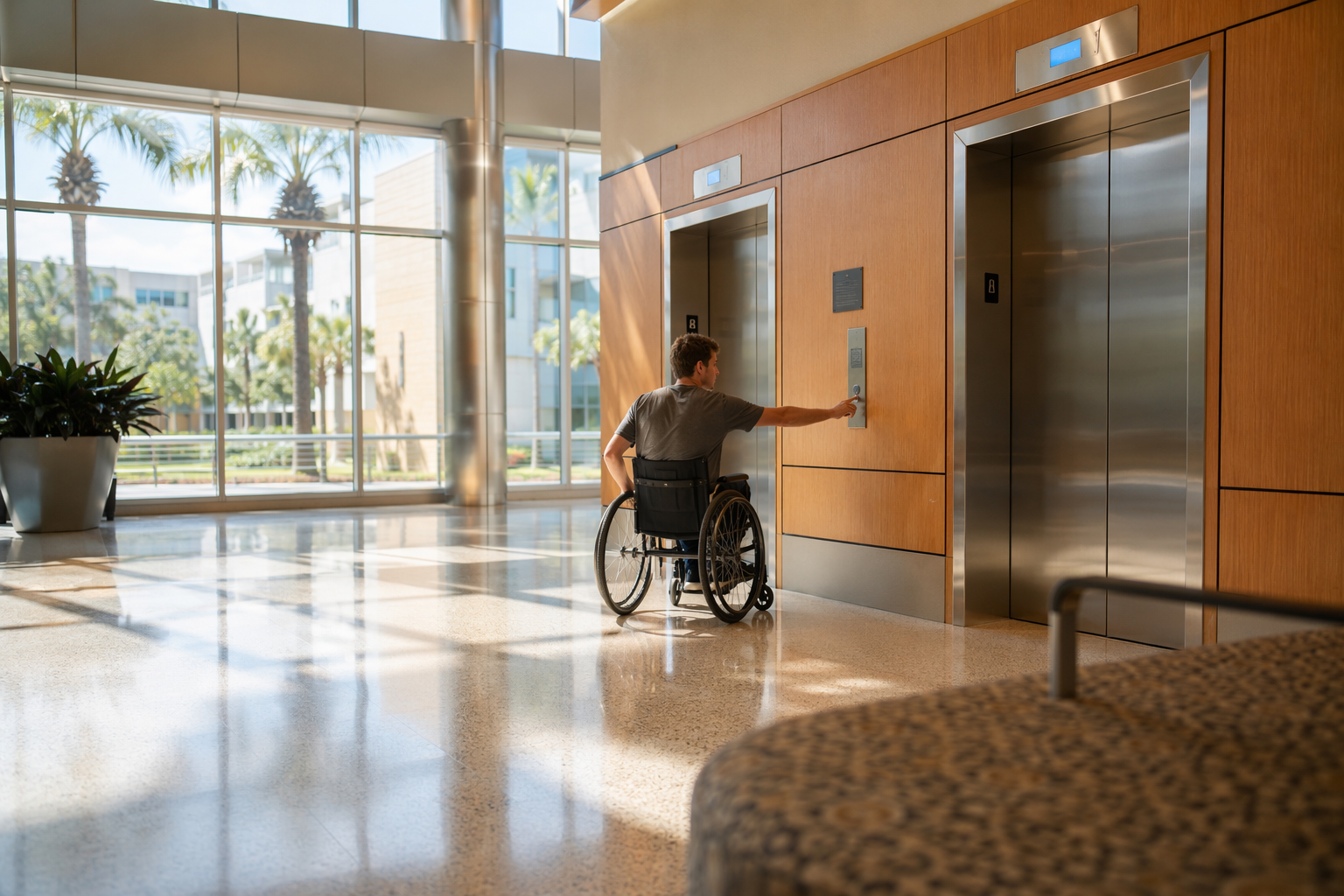
University campuses are among the most heavily trafficked vertical-transportation environments in any region. From lecture halls and research labs to student health centers and administrative towers, elevators on Florida campuses serve an enormous and diverse population — including students, faculty, staff, and healthcare patients at campus medical facilities. Maintaining full ADA compliance and mechanical safety is not optional; it is a legal obligation and a matter of institutional equity.
Axxiom Elevator Florida works with facilities managers across Pompano Beach, Sarasota, and the broader Florida market to help universities keep their elevators inspection-ready, accessible, and operating at the standard required by both state and federal law.
What ADA Requirements Apply to University Elevators?
The Americans with Disabilities Act establishes enforceable accessibility standards for places of public accommodation and state and local government facilities — a category that includes public universities and most private institutions receiving federal funding. Under the ADA Standards for Accessible Design (ADASAD), university elevators must meet requirements across several dimensions:
- Call button height: Elevator call buttons must be mounted no higher than 48 inches above the floor for a forward reach, or 54 inches for a side reach.
- Car dimensions: The minimum clear floor area inside the cab must accommodate a standard wheelchair, with door clear widths and turning radius space specified in the ADA Standards.
- Door timing and sensors: Doors must remain open long enough for a person using a mobility aid to enter or exit, and must reopen automatically upon contact with an obstruction.
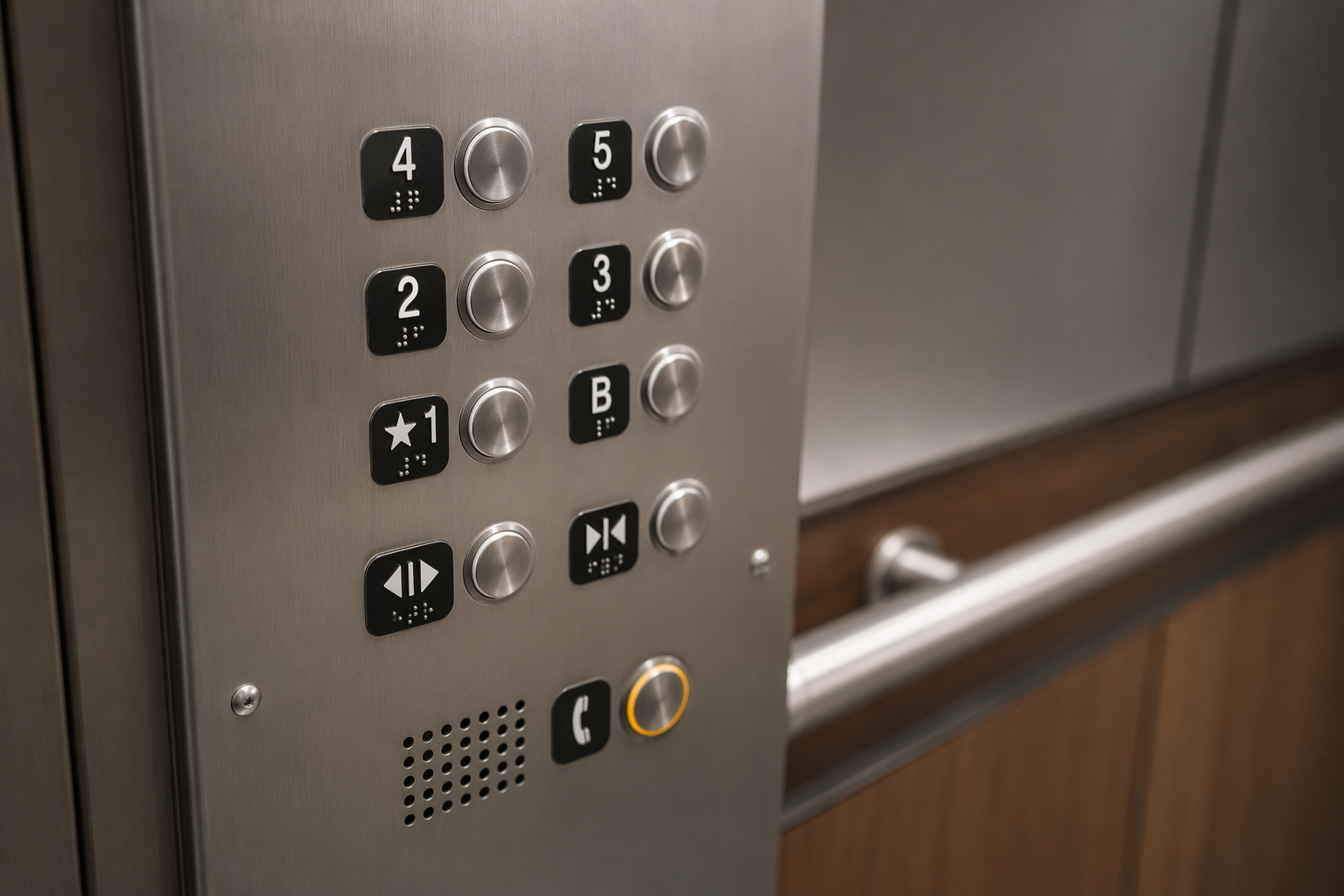
- Control panel layout: All floor buttons, emergency controls, and indicators must be within reach range and include raised characters and Braille.
- Audible and visual signals: Elevators must provide both an audible tone and a visual indicator when the car arrives and announce the floor verbally or via audible signal at each stop.
- Illumination: Interior lighting in the cab must meet minimum illumination thresholds to assist visually impaired users.
Universities with campus health clinics or medical school facilities face an additional layer of scrutiny, because patients with mobility impairments, assistive devices, or medical equipment require elevators that exceed minimum standards in terms of door dwell time and cab space.
Which ASME Code Governs University Elevator Safety?
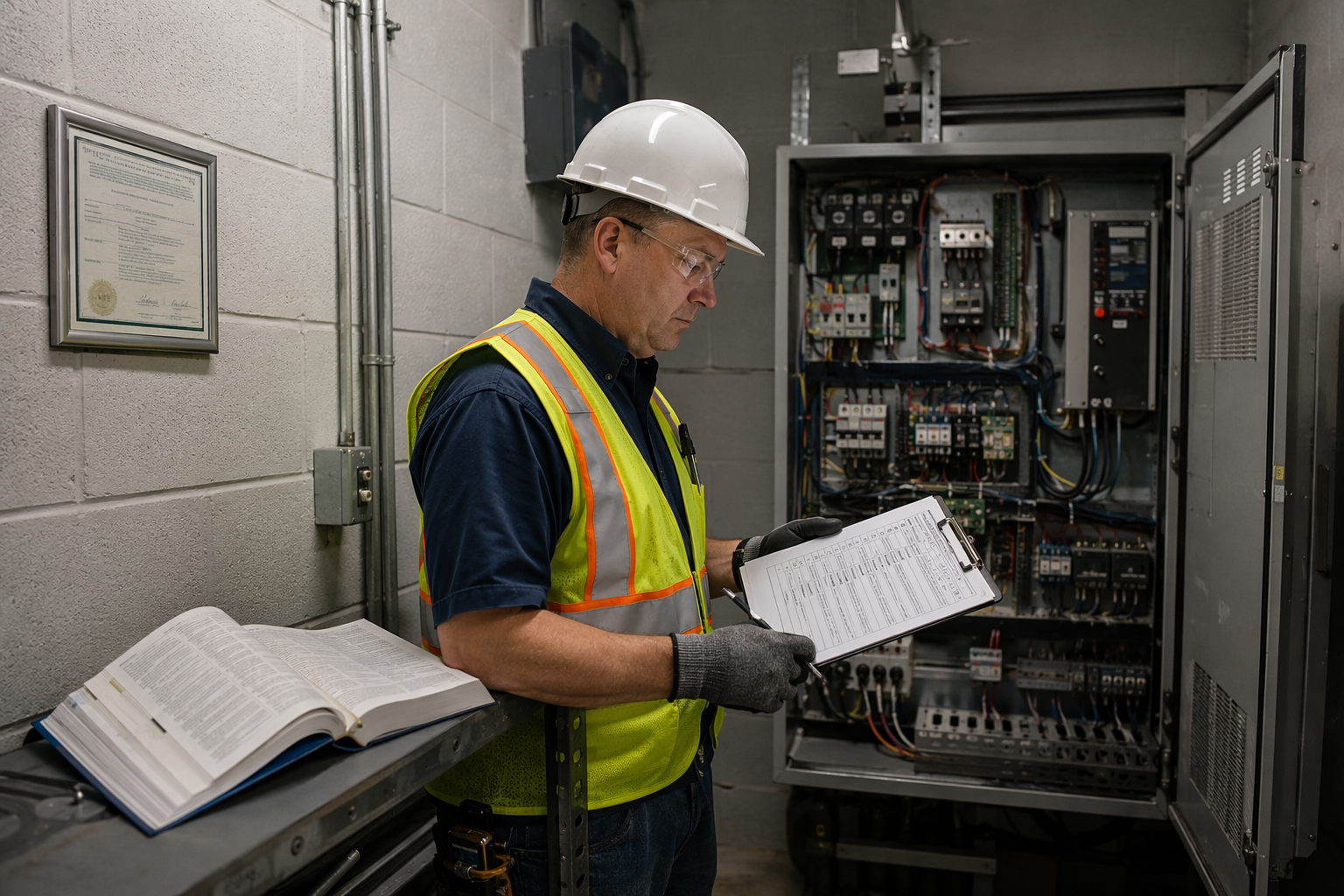
Mechanical safety for university elevators is governed by the ASME A17.1 Safety Code for Elevators and Escalators, which Florida has adopted by reference into its elevator safety law. The ASME A17.1 code covers:
- Hoistway construction and clearances
- Electrical safety systems and wiring standards
- Hydraulic and traction drive system requirements
- Emergency operation and firefighter service protocols
- Inspection, testing, and maintenance intervals
- Safety device performance requirements (governors, safeties, buffers)
Florida’s Bureau of Elevator Safety enforces regular periodic inspections based on ASME A17.1 requirements. Universities operating in Pompano Beach, Sarasota, or anywhere in the state must maintain current certificates of operation for every elevator on campus. Elevators found out of compliance may be placed out of service, creating immediate accessibility gaps and potential legal exposure.
Why Is ADA Elevator Compliance Especially Critical in University Healthcare Settings?
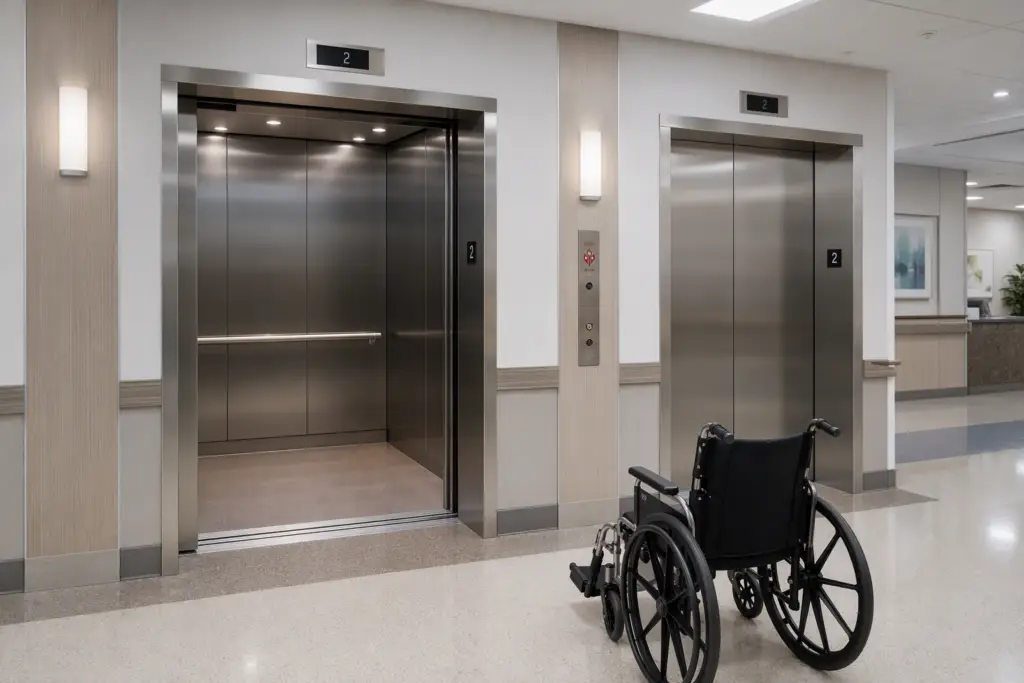
Campus health centers, university hospitals, and medical school teaching facilities are hybrid environments — part higher education, part healthcare. Elevators in these spaces must satisfy ADA accessibility rules and align with the practical demands of transporting patients, wheelchairs, gurneys, and medical equipment. A door that closes too quickly, a cab that is too narrow, or a control panel with worn Braille markings can create barriers that violate federal law and put patients at risk.
For universities with Joint Commission-accredited healthcare facilities, elevator functionality is also reviewed as part of the Environment of Care standards. Non-compliant elevators can affect accreditation outcomes in addition to ADA enforcement.
What Is the Inspection and Certification Process for University Elevators in Florida?
Florida requires that all elevators undergo periodic inspections by state-licensed inspectors. The inspection cycle and documentation requirements flow from the ASME A17.1 Safety Code for Elevators and Escalators. The general process for university facilities includes:
- Inventory all elevators on campus — including those in parking structures, residence halls, athletic facilities, and healthcare buildings.
- Confirm current certificates of operation are posted inside each cab and have not lapsed.
- Schedule a pre-inspection maintenance visit with a qualified elevator service provider to identify and correct deficiencies before the state inspector arrives.
- Conduct the state-required periodic inspection with a licensed inspector who documents compliance with ASME A17.1 and Florida-specific amendments.
- Address any violations or deficiencies noted in the inspection report within the required correction window.
- Submit documentation to Florida’s Bureau of Elevator Safety to renew certificates of operation.
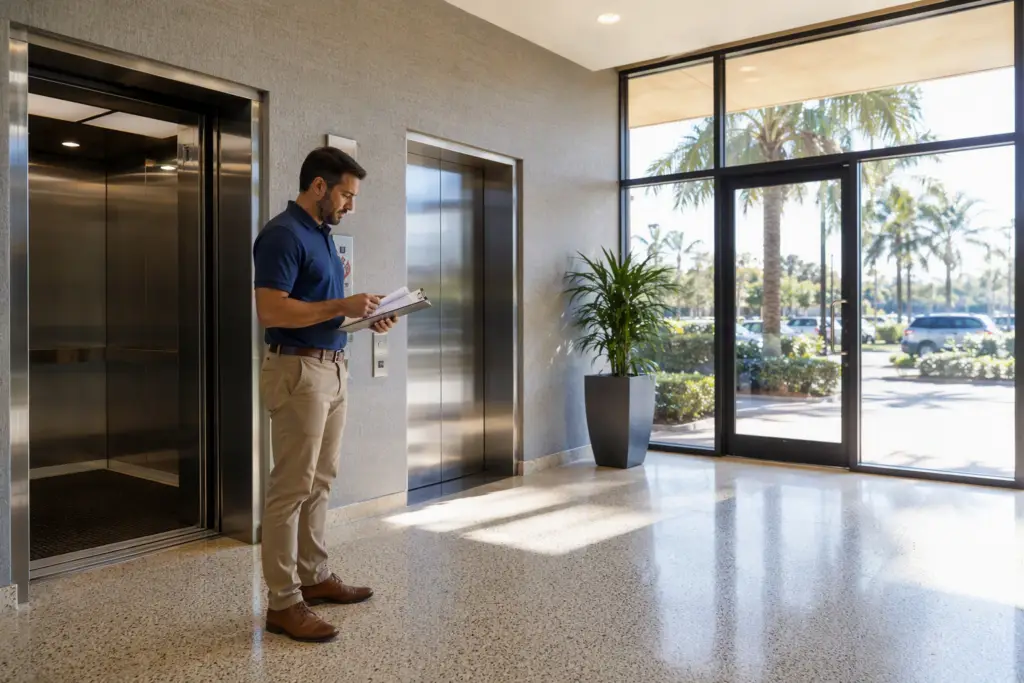
- Perform an ADA-specific accessibility audit — separate from the mechanical inspection — to confirm cab dimensions, signage, reach ranges, and door timing meet current ADA Standards.
- Document all findings and corrective actions in the facility’s maintenance log for institutional liability protection.
Axxiom Elevator Florida supports universities through each stage of this process, coordinating pre-inspection service visits and helping facilities teams prepare the documentation required for smooth certification renewal.
What Are the Most Common ADA Violations Found in University Elevators?
Facilities teams conducting or preparing for ADA audits frequently encounter the same categories of deficiency in older campus buildings:
- Worn or missing Braille markings on control panels, which must be maintained in legible condition
- Door close timing that is too fast, failing to provide adequate time for individuals using mobility aids
- Cab controls mounted above reach range in older equipment installed before current standards took effect
- Inoperable or missing audible floor announcements — required for visually impaired users
- Inadequate interior lighting that does not meet illumination thresholds
- Non-compliant signage at hoistway entrances lacking the International Symbol of Accessibility where required
- Leveling errors that create a step between the cab floor and the landing, a significant barrier for wheelchair users
How Do Universities Handle ADA Compliance for Historic Campus Buildings?
Many Florida university campuses include buildings that are listed on or eligible for the National Register of Historic Places. The ADA provides a limited exception for historic facilities where full compliance would threaten or destroy significant architectural features. However, this exception is narrow and does not excuse a university from providing some accessible route or equivalent facilitation. In practice, historic exceptions are evaluated case by case and rarely eliminate the need for elevator upgrades entirely.
Universities in this situation should work with an elevator contractor experienced in Florida’s regulatory environment — such as Axxiom Elevator Florida — to identify compliant solutions that preserve architectural character while meeting accessibility obligations.
What Should Universities Budget for Elevator ADA Upgrades?
The cost of achieving or maintaining ADA compliance in university elevators varies significantly based on the age of the equipment, the number of floors served, the type of drive system (hydraulic vs. traction), and the scope of deficiencies identified. Minor corrections — such as replacing worn Braille overlays, adjusting door timing, or adding audible floor announcers — represent a very different investment than a full cab modernization or hoistway reconfiguration required to meet current dimensional standards.
Because every campus and every elevator is different, the most accurate budget guidance comes from an on-site assessment rather than general estimates. Facilities managers in the Pompano Beach and Sarasota areas can request a free elevator assessment from Axxiom Elevator Florida to understand the scope and cost of any needed work before committing to a project.
How Long Does an ADA Elevator Compliance Upgrade Take?
Project timelines depend on the nature of the required work. Cosmetic or control-panel corrections can often be completed during a planned maintenance window with minimal disruption to campus operations. Larger modernization projects — involving cab replacement, controller upgrades, or drive system overhaul — require more planning, permitting, and construction time. Florida’s permit process for elevator work adds a regulatory timeline that universities should factor into project scheduling.
Early planning is the most effective way to avoid situations where an elevator is placed out of service by an inspector and the campus is forced into emergency repairs. A proactive compliance audit, coordinated well in advance of the state inspection cycle, gives facilities teams time to scope, permit, and complete work on a schedule that minimizes disruption.
Questions Your Inspector Will Ask
When a Florida Bureau of Elevator Safety inspector arrives on a university campus — or when a separate ADA compliance auditor conducts an accessibility review — the following questions and observations are standard:
- Is the certificate of operation current and posted inside the cab? Lapsed certificates result in immediate out-of-service orders.
- When was the last periodic inspection, and what deficiencies were noted? Inspectors review prior records to confirm corrective actions were completed.
- Are all safety devices — governor, safety, buffers — tested and in working order? ASME A17.1 specifies testing intervals and performance criteria for each device.
- Do door contacts and reopening devices function correctly? Inspectors will test door reversal under load.
- Is the cab level within tolerance at each landing? Leveling outside of allowable tolerance is both an ASME violation and an ADA concern.
- Are Braille and raised character designations on all controls legible and correctly placed? This is a direct ADA Standards requirement.
- Do audible signals and floor announcements function? Inspectors may test each floor stop for proper audio output.
- Is the machine room properly secured, ventilated, and free of unauthorized storage? ASME A17.1 specifies machine room requirements in detail.
- Are maintenance records available and complete? A maintenance log demonstrating regular service is evidence of good-faith compliance efforts.
- Has emergency lighting and the emergency communication system been tested? Both are required under ASME A17.1 and are especially critical in healthcare-adjacent university buildings.
How Does Modernization Compare to Ongoing Repairs for Older University Elevators?
Universities operating aging elevator equipment face a recurring decision: continue investing in repairs to older units, or commit to a modernization project that replaces controllers, drives, fixtures, and cab interiors with current-generation equipment. Modernization typically brings older elevators into full alignment with both current ASME A17.1 editions and ADA Standards, reducing the frequency of compliance-related repairs going forward. It also tends to improve reliability and reduce unplanned downtime — a significant operational consideration for high-use campus buildings.
Facilities managers weighing this decision benefit from a detailed condition assessment that documents the current state of each elevator, the projected cost of continued maintenance, and the estimated investment required for full modernization. Axxiom Elevator Florida provides this type of assessment for campuses in Pompano Beach, Sarasota, and across Florida, giving decision-makers the data they need to make a defensible, budget-conscious choice.
What Role Does OSHA Play in University Elevator Safety?
While elevator compliance is primarily governed by ASME A17.1 and the ADA at the federal level, OSHA standards apply to the safety of workers — including elevator mechanics and facilities maintenance personnel — who perform work on or around elevator equipment. Universities have an employer obligation under OSHA’s General Duty Clause to maintain a safe working environment for staff who operate, inspect, or service elevators. This includes proper lockout/tagout procedures, machine room safety, and contractor safety qualifications.
How Can Universities Stay Proactively Compliant Between Inspections?
The most effective compliance strategy is not reactive — it is systematic and calendar-driven. Universities that maintain continuous compliance between state inspection cycles typically do so by:
- Establishing a preventive maintenance contract with a qualified Florida elevator service provider
- Conducting internal accessibility walkthroughs of each elevator at regular intervals
- Tracking certificate of operation expiration dates for every unit on campus
- Assigning a facilities team member as the designated elevator compliance point of contact
- Documenting all service visits, repairs, and inspections in a centralized maintenance log
- Engaging an elevator contractor for a pre-inspection review before each state inspection cycle
Schedule Your Free University Elevator Assessment
University facilities managers in Pompano Beach, Sarasota, and across Florida face real compliance obligations and real consequences for falling short. Whether a campus is preparing for a state inspection, responding to an ADA complaint, planning a modernization project, or simply seeking confidence that every elevator meets current standards, a professional assessment is the right starting point.
Contact Axxiom Elevator Florida for a free elevator assessment —
Need elevator service you can rely on? Axxiom Elevator Florida is ready to help.