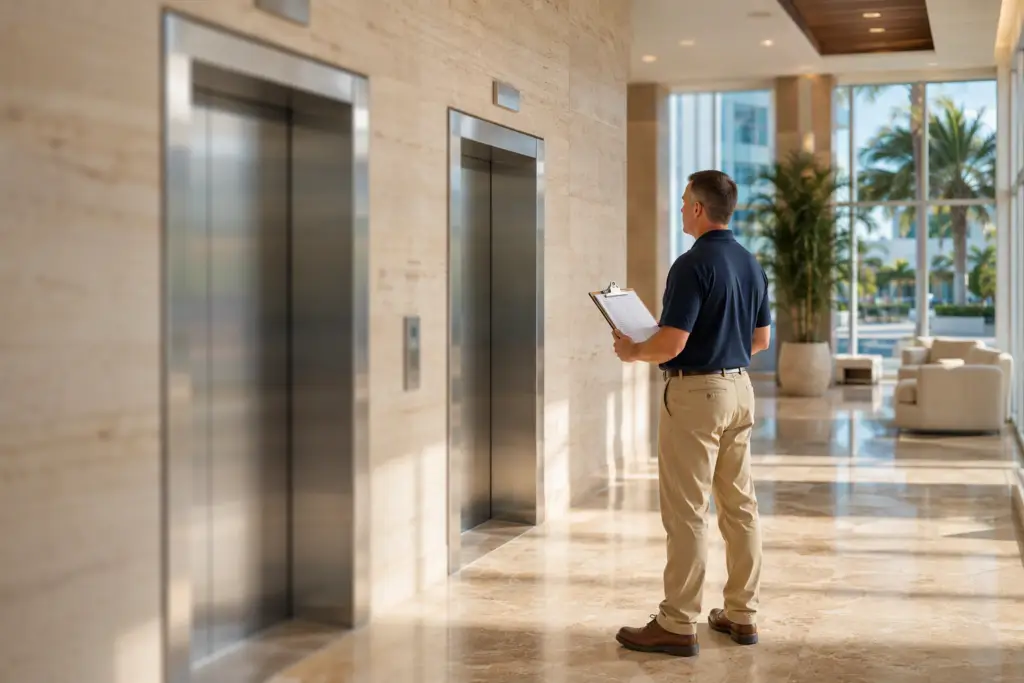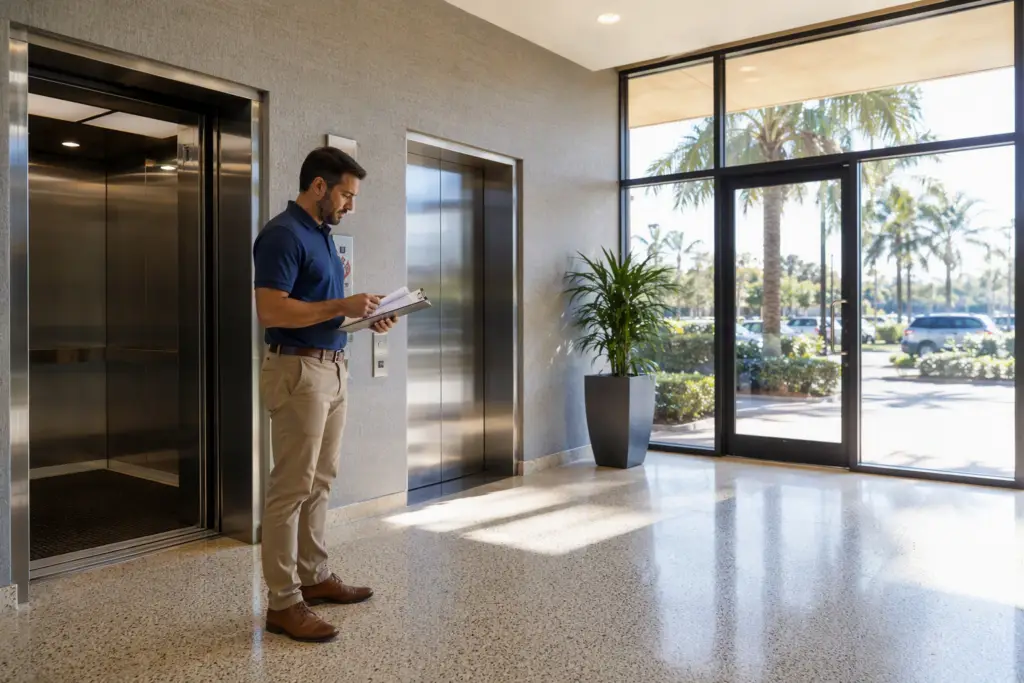
What Is Included in an Elevator Maintenance Contract?
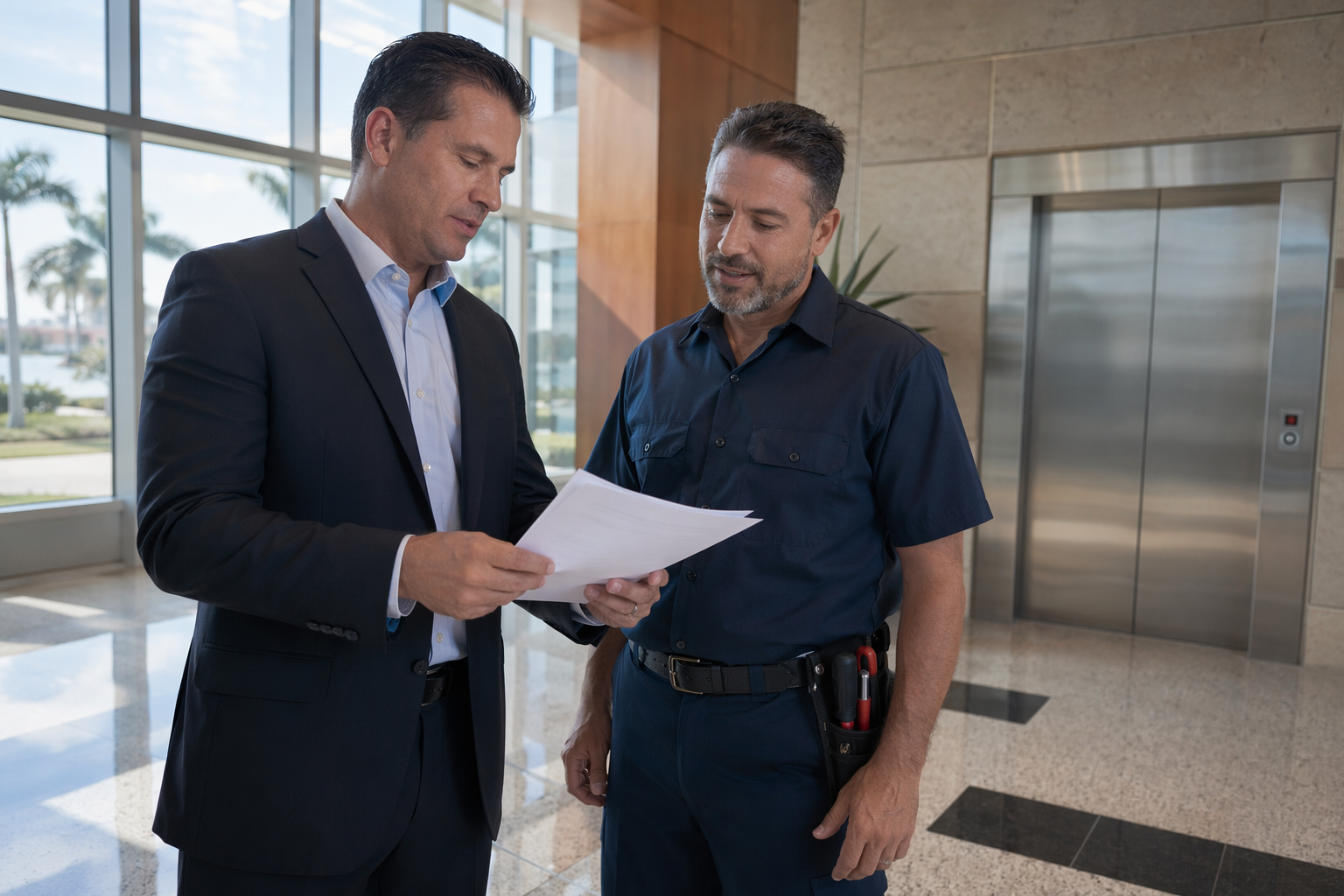
After 15-plus years servicing elevators across South Florida and the Gulf Coast, I’ve reviewed hundreds of maintenance contracts. Most building owners sign one without fully understanding what they’re actually getting — or more critically, what they’re not getting. This guide breaks down every component of a commercial elevator maintenance agreement so you can make an informed, confident decision.
What Is the Core Purpose of an Elevator Maintenance Contract?
An elevator maintenance contract is a legally binding service agreement that defines the scope of preventive and corrective work a certified elevator company will perform to keep your equipment safe, compliant, and operational throughout the contract term.
At its foundation, the contract exists because elevator safety is not optional in Florida. Under Florida Statute 399, all conveyances must be maintained in safe operating condition and inspected by a licensed elevator inspector at defined intervals. A maintenance contract is the documented mechanism through which building owners meet that obligation. Without one, you risk failed inspections, liability exposure, and significant fines from the Florida Department of Business and Professional Regulation (DBPR).
From a purely operational standpoint, planned maintenance extends equipment life by an estimated 30–40% compared to reactive-only servicing, according to 2026 industry data from the National Elevator Industry Inc. (NEII). For property managers in high-humidity coastal markets like Pompano Beach and Sarasota, where salt air accelerates component corrosion, a structured maintenance contract is even more critical.
What Routine Maintenance Tasks Are Covered in a Standard Contract?
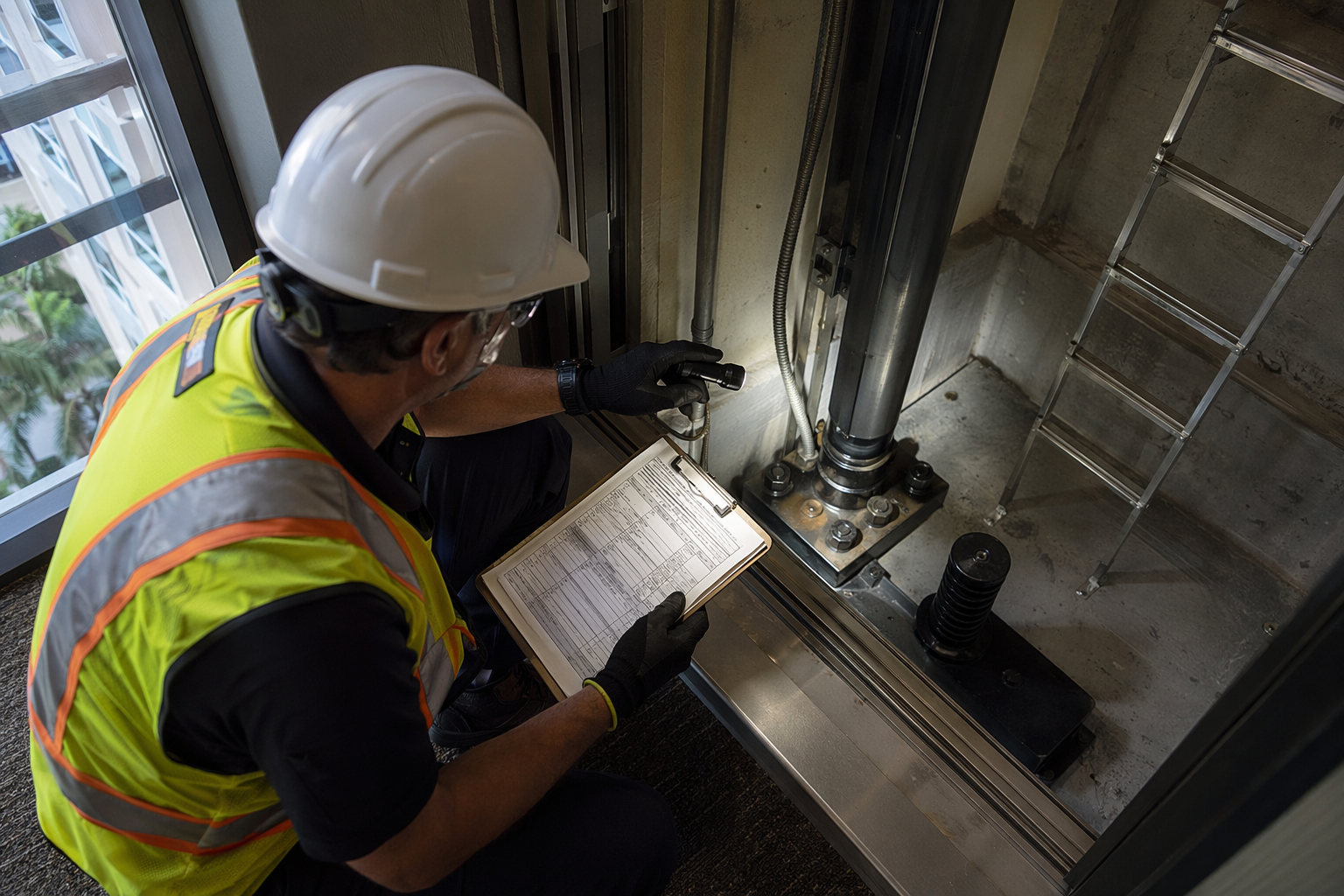
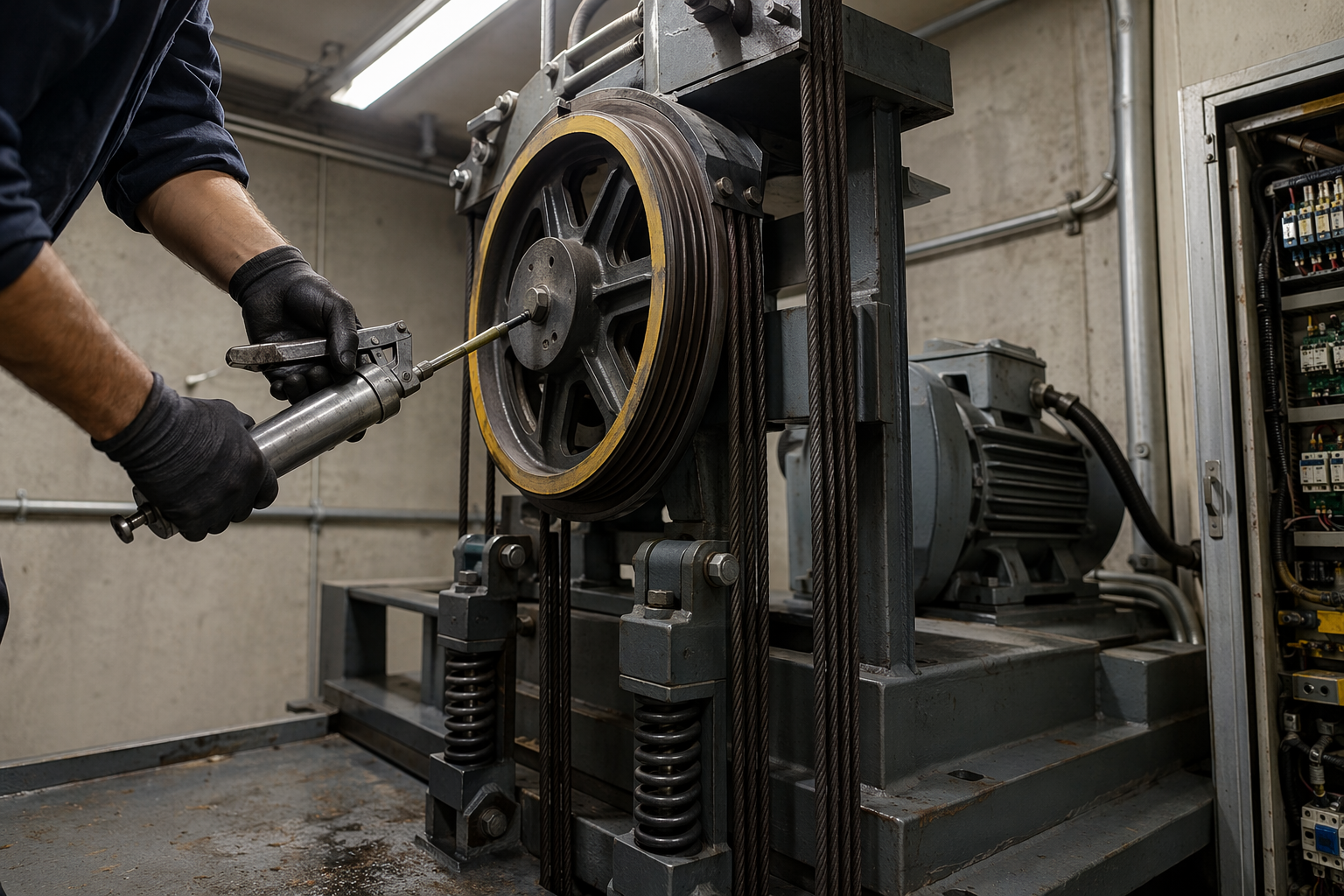
Standard contracts cover lubrication, cleaning, adjustment, and minor parts replacement on a scheduled basis — typically monthly, quarterly, or semi-annually depending on elevator usage and contract tier.
Routine maintenance tasks typically include:
- Lubrication of guide rails, roller guides, hoist ropes, and machine room components
- Cleaning of pit, hoistway, and machine room to prevent debris accumulation
- Inspection and adjustment of door operators, gibs, and sill clearances
- Testing and adjustment of leveling accuracy (within ½ inch per ASME A17.1 Section 2.26)
- Brake adjustment and rope tension equalization
- Motor and drive unit inspections
- Controller and relay panel checks
- Emergency lighting and phone system testing
What separates a quality contract from a bare-minimum one is visit frequency. A hydraulic elevator in a 6-story Sarasota condo building serving 200+ residents per day warrants monthly visits, not quarterly. Always ask your vendor for a written maintenance schedule tied to your specific traffic load.
Are Safety Device Tests Included in Elevator Maintenance Contracts?
Yes — all legitimate elevator maintenance contracts include periodic testing of critical safety devices, though the specific test intervals are governed by ASME A17.1 and Florida state adoption of those standards.
Required safety device tests typically covered include:
- Governor and safety device test: Required every 5 years under ASME A17.1 Rule 8.6
- Oil buffer test (hydraulic units): Required every 5 years
- Pressure relief valve test: Annual testing for hydraulic elevators
- Brake holding capacity test: Included in annual inspections
- Emergency stop switch function: Verified at every maintenance visit
- Door reopening device (light curtain/safety edge): Tested monthly on high-traffic units
- Emergency lighting battery backup: Confirmed operational at each visit
Florida’s DBPR requires a licensed elevator inspector to witness or sign off on the 5-year tests. A reputable contractor like Axxiom Elevator Florida coordinates that inspection scheduling directly, so building owners in Pompano Beach and Sarasota never have to manage compliance calendars independently.
Does an Elevator Maintenance Contract Cover State-Mandated Inspections?
Most full-service elevator maintenance contracts include coordination of Florida’s mandatory annual inspection, but the actual inspection fee from the state inspector is often billed separately — you must confirm this distinction in writing before signing.
Florida Statute 399.02 requires that all elevators receive a periodic inspection by a licensed Qualified Elevator Inspector (QEI). As of 2026, Florida mandates inspections at intervals not exceeding 12 months for most commercial conveyances. Your maintenance contractor should:
- Prepare the elevator for inspection (ensuring all documentation is current)
- Be present or available during the inspection
- Address any corrective items cited by the inspector
- Maintain your Certificate of Operation on file
If your contract does not explicitly include inspection preparation and follow-up, you are likely on a lower-tier agreement. Review Section 4 or the “Scope of Services” clause carefully.
What Is the Difference Between a Full-Service and a Parts & Labor Contract?
A full-service contract covers all parts, labor, and repairs with no additional billing, while a parts-and-labor (oil and grease) contract only covers technician time and consumables — leaving repair costs entirely to the building owner.
| Contract Type | Routine Maintenance | Emergency Callbacks | Parts Included | Major Repairs | Typical Annual Cost (Florida) |
|---|---|---|---|---|---|
| Oil & Grease Only | Yes | No (billed T&M) | No | No | $800 – $2,000 |
| Parts & Labor | Yes | Yes | Consumables only | Billed separately | $2,500 – $5,000 |
| Full-Service (Comprehensive) | Yes | Yes (24/7) | Yes (most parts) | Included (with caps) | $5,000 – $15,000+ |
| Modernization-Inclusive | Yes | Yes (24/7) | Yes (all parts) | Included | $12,000 – $30,000+ |
For most commercial properties, condominiums, and healthcare facilities in Sarasota or Pompano Beach, a full-service contract delivers the lowest total cost of ownership when you factor in the unpredictable nature of major component failures — a new hydraulic jack replacement alone can run $15,000–$25,000.
Is Emergency Callback Service Always Included?
Emergency callback service — where a certified technician responds to a breakdown, entrapment, or safety fault at any hour — is only guaranteed in parts-and-labor or full-service contracts; oil-and-grease agreements typically charge time-and-material rates for emergency response.
In Florida’s ADA-regulated commercial environments, elevator entrapments require immediate response. The ADA Standards for Accessible Design (2010) mandate that elevator access be maintained for people with disabilities, and extended downtime can constitute an ADA violation for public accommodations. Always confirm in writing:
- Maximum response time for entrapments (industry standard: under 2 hours)
- After-hours and weekend coverage
- Whether a flat callback fee applies or if time is billed at overtime rates
- How many callbacks per year are included before surcharges apply
What Parts and Components Are Typically Excluded from Maintenance Contracts?
Even full-service contracts almost universally exclude major structural components, vandalism-related damage, flood or fire damage, and full modernization projects from routine maintenance coverage.
Common exclusions you will encounter in contract fine print include:
- Hoist ropes and cables (usually covered only if worn through normal use, not misuse)
- Complete jack unit replacement (hydraulic elevators)
- Cab interior finishes, flooring, and lighting fixtures (often a separate scope)
- Electronic control systems requiring complete replacement (versus component-level repair)
- Damage from water intrusion, flooding, or electrical surges
- Compliance upgrades required by new code adoptions (e.g., Phase II Fire Service, seismic upgrades)
Read the “Exclusions” section of any contract with the same attention as the inclusions. A contract that appears comprehensive but excludes rope replacement and controller boards is leaving your largest cost exposures unprotected.
How Often Should Elevator Maintenance Visits Occur Under a Standard Contract?
Maintenance visit frequency should be determined by elevator type, daily trip count, and building occupancy — with high-traffic commercial elevators requiring monthly visits and low-traffic residential units potentially qualifying for quarterly service under ASME A17.1 maintenance guidelines.
Here are industry benchmarks for visit frequency by elevator type and usage:
- High-rise commercial (50+ trips/day): Monthly visits minimum
- Mid-rise residential condo (20–50 trips/day): Bi-monthly or monthly
- Low-traffic residential or small commercial (<20 trips/day): Quarterly acceptable
- Hospital/healthcare elevators: Monthly or bi-monthly with enhanced documentation
- Freight or service elevators: Quarterly minimum, monthly for heavy-use
In Pompano Beach’s dense condominium market and Sarasota’s growing mixed-use developments, I consistently see building managers under-contracting for visit frequency — and then wondering why they face repeated service calls. Match the maintenance cadence to actual usage, not just what fits the budget.
Does the Contract Cover ADA Compliance Upgrades?
Standard maintenance contracts do not cover ADA compliance upgrades — these are capital improvement projects, but a reputable elevator contractor will identify ADA deficiencies during maintenance visits and provide upgrade proposals.
The ADA 2010 Standards specify requirements including:
- Cab dimensions: minimum 80 inches clear height, 51 x 68 inch floor area (for new construction)
- Braille and raised character floor indicators on call buttons
- Door timing: minimum 3 seconds open time with a 20-lb reopening force maximum
- Audible floor announcements for buildings with 4+ stories
- Handrails on at least one wall if cab depth exceeds 60 inches
While maintenance contracts won’t fund these upgrades, a good service provider will flag non-compliant features proactively. Axxiom Elevator Florida conducts a complimentary ADA accessibility assessment as part of onboarding new maintenance clients in both Sarasota and Pompano Beach.
What Documentation and Reporting Should a Maintenance Contract Include?
Every maintenance contract should mandate written service reports for each visit, a running maintenance log maintained on-site per ASME A17.1 Rule 8.1, digital records accessible to the building owner, and an annual compliance summary report.
Specifically, per ASME A17.1 Section 8.1, a maintenance control program (MCP) record must be kept current and accessible. This includes:
- Date and scope of each maintenance visit
- Technician name and certification number
- Parts replaced with part numbers
- Safety test results and dates
- Deficiencies noted and corrective actions taken
- Open items requiring follow-up
In 2026, the industry standard has shifted toward cloud-based documentation portals. Any contractor unable to provide digital access to your maintenance records is operating below current professional standards. Demand this in writing during contract negotiations.
Are Hydraulic and Traction Elevator Contracts Priced Differently?
Yes — hydraulic elevator maintenance contracts typically run 15–25% less annually than traction (cable-driven) elevator contracts because traction systems have more complex mechanical components, require rope inspections, and involve more labor-intensive brake and sheave servicing.
Key maintenance differences that drive cost variance:
- Hydraulic elevators: Require hydraulic fluid monitoring, jack seal inspection, valve adjustment, and fluid testing for environmental compliance (underground tanks have EPA reporting requirements)
- Traction elevators: Require hoist rope inspection and lubrication, sheave groove measurement, gearbox oil changes (geared units), brake lining inspection, and governor rope testing
- Machine-room-less (MRL) traction: Requires specialized drive programming knowledge, often commanding a 10–15% premium
When budgeting for 2026, Florida property managers should benchmark hydraulic contracts at $3,500–$8,000/year (full-service) and traction contracts at $5,000–$15,000/year depending on building height and equipment age.
How Are Response Times and SLAs Defined in a Maintenance Contract?
A well-structured elevator maintenance contract will include explicit Service Level Agreements (SLAs) that define maximum response times for entrapments, standard breakdowns, and non-emergency repairs — with financial penalties or service credits if the contractor fails to meet them.
Industry-standard SLA benchmarks for 2026:
- Entrapment response: 60–90 minutes maximum (some contracts guarantee under 60 minutes in metro areas)
- Emergency breakdown (non-entrapment): 2–4 hours
- Non-emergency repair appointment: 1–5 business days
- Scheduled maintenance visit: Within agreed monthly/quarterly window
If your current contract has no SLA language, you have no legal recourse when your elevator sits down for 3 days. This is especially critical for Pompano Beach condominium associations and Sarasota senior living facilities where elevator access is not a convenience — it is an essential service for residents with mobility limitations.
What Qualifications Should a Maintenance Contractor Be Required to Hold?
Any elevator maintenance contractor you hire in Florida must hold a valid state elevator contractor license issued by the DBPR, employ IUEC-certified or equivalent journeyman mechanics, and carry minimum $1 million general liability plus workers’ compensation insurance.
Specific credentials to verify before signing any contract:
- Florida Elevator Contractor License: Issued by DBPR, verifiable at myfloridalicense.com
- IUEC Certification: International Union of Elevator Constructors journeyman credential
- QEI Qualification: Qualified Elevator Inspector certification from NAESA International (for inspection-related work)
- Insurance certificates: Request current COI naming your building as additional insured
- Manufacturer certifications: For proprietary equipment (Otis, KONE, Schindler), verify the contractor is authorized to service that platform
Can I Transfer My Elevator Maintenance Contract If I Sell the Property?
Most elevator maintenance contracts include transfer clauses that allow assignment to a new property owner, but the new owner must be approved by the contractor, and the contract terms — including any remaining term length and escalation clauses — typically transfer in full.
Key contract transfer provisions to review:
- Assignment clause: Confirms whether transfer requires contractor consent
- Early termination fees: Often 3–6 months of remaining contract value if broken at sale
- Auto-renewal language: Many contracts auto-renew for 1-year terms with 30–90 day cancellation windows; missing this window can bind a new owner to an unwanted vendor
- Price escalation caps: Florida contracts commonly include CPI-based escalators of 3–5% annually
During commercial real estate due diligence, always request the current elevator maintenance contract as part of the document review package. An unfavorable contract with a 3-year remaining term and above-market pricing can materially affect property value.
What Should I Look for in the Contract’s Termination and Auto-Renewal Clauses?
The termination clause is the single most important section to scrutinize — predatory contracts in the elevator industry commonly use automatic 5-year renewals, 180-day cancellation windows, and proprietary parts lock-in tactics that effectively prevent switching vendors.
In my experience, the most problematic contract provisions I’ve seen include:
- Auto-renewal periods exceeding 12 months (some legacy contracts renew for 3–5 years automatically)
- Cancellation notice windows of 120–180 days (if you miss it by one day, you’re locked in for another full term)
- Proprietary parts clauses that void the contract if a non-OEM part is used by another vendor
- Liquidated damages clauses requiring payment of remaining contract value upon termination
Standard acceptable terms in 2026: 1-year auto-renewal, 30–60 day cancellation notice, and termination-for-convenience clauses that allow exit with 90 days’ notice and no penalty after the initial term.
How Does Elevator Age Affect Maintenance Contract Scope and Cost?
Elevators older than 20 years require significantly more intensive maintenance scope — including increased lubrication frequencies, obsolete parts sourcing challenges, and mandatory code compliance reviews — which typically increases contract costs by 20–50% compared to newer equipment.
Florida’s aging building stock, particularly in Pompano Beach’s older mid-rise condominiums, creates real challenges. For elevators 25+ years old, contractors should be providing:
- Enhanced component wear assessments at each visit
- Obsolete parts inventory planning (some legacy controllers require sourcing from secondary markets)
- Modernization feasibility assessments under current ASME A17.1-2019 code triggers
- Increased visit frequency to offset higher breakdown probability
If a contractor offers you the same contract price for a 1998 hydraulic elevator as they would for a 2020 model, that’s a red flag — either they’re overcharging for the new unit or underscoping for the old one.
Does the Contract Include Pit and Machine Room Compliance?
Yes — proper maintenance contracts include pit and machine room compliance checks, including pit lighting, sump pump operation, waterproofing integrity, machine room ventilation, and clearance compliance per ASME A17.1 Sections 2.7 and 2.8.
Specific items that should be documented at every visit or annually:
- Pit depth and clearance measurements (minimum 2 ft under car)
- Pit lighting function (minimum 10 foot-candles at floor level per ASME A17.1)
- Pit stop switch accessibility and function
- Sump pump operation test (especially critical in South Florida’s high water table environments)
- Machine room temperature (must not exceed 104°F per most drive manufacturer specs)
- Machine room access control (restricted to authorized personnel per ASME A17.1 Section 2.7.3)
Florida’s humidity and rainfall make pit flooding a genuine concern — particularly in coastal Pompano Beach properties. Any contract serving Florida properties should explicitly include pit waterproofing assessment as a covered maintenance item.
How Should I Compare Multiple Elevator Maintenance Contract Proposals?
Compare proposals on six dimensions: scope of inclusions vs. exclusions, visit frequency, SLA commitments, contractor credentials, contract term flexibility, and total cost of ownership — not just the monthly rate.
Use this evaluation framework when reviewing competing bids:
- Scope audit: Map each proposal against the full 20-item maintenance checklist from ASME A17.1 Appendix N
- Hidden cost analysis: Identify what’s excluded and estimate the annual likelihood and cost of each exclusion
- Credential verification: Confirm DBPR license and insurance before pricing even matters
- Reference check: Ask for 3 references from similar property types in your market (Sarasota or Pompano Beach)
- Term flexibility score: Rate each contract on renewal, cancellation, and assignment terms
- True annual cost: Divide full-service contract cost by expected maintenance events to find cost-per-incident, not just cost-per-month
Axxiom Elevator Florida provides side-by-side contract comparison consultations at no cost for property managers evaluating vendors in Pompano Beach and Sarasota — bringing specific market knowledge that national chains simply cannot match.
What Red Flags Should I Watch for in an Elevator Maintenance Contract?
The most common red flags in elevator maintenance contracts are vague scope language (“maintain in good working order” with no specifics), auto-renewal terms exceeding one year, absence of SLA commitments, unlicensed subcontractors, and exclusions that effectively render the contract maintenance-only with no repair coverage.
Additional warning signs from my 15 years in the field:
- No requirement for technician certification level — allows unskilled labor on your equipment
- No documentation or reporting obligations written into the contract
- “Parts at cost plus markup” language without a defined markup cap (I’ve seen 40–60% markups)
- Verbal promises that don’t appear in the written contract (verbal agreements are unenforceable)
- National company with no local office in Sarasota or Pompano Beach — slow emergency response is the inevitable result
- No mention of Florida Statute 399 or ASME A17.1 anywhere in the document — signals the contractor is not code-literate
How Do I Know If My Current Elevator Maintenance Contract Is Adequate?
Your current contract is inadequate if it lacks explicit visit frequency schedules, safety device test intervals, documented SLAs, 24/7 emergency callback coverage, and clear parts inclusion language — any of these gaps leave you exposed to both compliance failures and unplanned capital expenses.
A practical self-audit checklist for 2026:
- ☐ Does my contract specify the number of maintenance visits per year?
- ☐ Does it name each safety device test and its required interval?
- ☐ Is 24/7 emergency callback explicitly included with a maximum response time?
- ☐ Does it reference ASME A17.1 and Florida Statute 399?
- ☐ Is there a written maintenance log requirement?
- ☐ Are parts included or billed separately?
- ☐ What is the auto-renewal term, and when is the cancellation window?
- ☐ Are major components (jack, ropes, controller) included or excluded?
If you answered “no” or “I don’t know” to more than three of these, your contract likely has significant gaps. Axxiom Elevator Florida offers complimentary contract reviews for building owners and HOAs in Sarasota and Pompano Beach who want an independent, expert assessment of their current agreement before it auto-renews.
Get a Free Elevator Maintenance Contract Assessment
Don’t wait for a failed inspection, an unexpected breakdown, or an ADA complaint to find out your maintenance contract isn’t doing its job. Axxiom Elevator Florida’s certified technicians serve property owners, HOAs, commercial landlords, and facility managers throughout Pompano Beach and Sarasota with full-service maintenance contracts built around Florida’s specific regulatory environment, your equipment type, and your building’s actual usage demands.
Contact Axxiom Elevator Florida for a free elevator assessment:
We’ll review your current contract, inspect your equipment, and give you a straight answer — no upsell pressure, no vague promises. Just 15-plus years of certified elevator expertise working for your building.