Emergency Elevator Repair in Pompano Beach, FL: Complete FAQ Guide
When an elevator fails in a commercial building, hotel, or multi-family residence in Pompano Beach, every minute counts. Trapped passengers, ADA compliance violations, liability exposure, and business disruption all compound quickly. After 15+ years servicing elevators across South Florida, I’ve seen how the difference between a 2-hour response and a 6-hour response can determine whether a property owner faces a citation, a lawsuit, or simply a manageable inconvenience. This guide answers every critical question about emergency elevator repair in Pompano Beach so you can act fast and smart when it matters most.
What counts as a true elevator emergency in Pompano Beach, FL?
A true elevator emergency includes passenger entrapment, sudden mechanical failure, electrical faults, broken doors or safeties, flooding in the pit, or any malfunction that creates an immediate risk to life or property.
Under ASME A17.1/CSA B44 Safety Code for Elevators and Escalators, any condition that renders a car unsafe for operation must trigger an immediate shutdown and service call. Florida Statute Chapter 399, which governs vertical transportation equipment, further requires that a licensed elevator contractor be notified without unreasonable delay when a safety device activates or a malfunction occurs.
Common emergency scenarios I respond to in Pompano Beach include: passengers trapped between floors during a power surge, door operator motors burning out mid-cycle, hydraulic fluid leaks causing erratic car movement, and broken hoist cables flagged during a routine inspection. Non-emergency issues — such as minor door misalignment, slow travel speed, or worn cab lighting — can wait for a standard service call but should be scheduled within 48–72 hours to avoid escalation.
How quickly can an emergency elevator technician arrive in Pompano Beach?
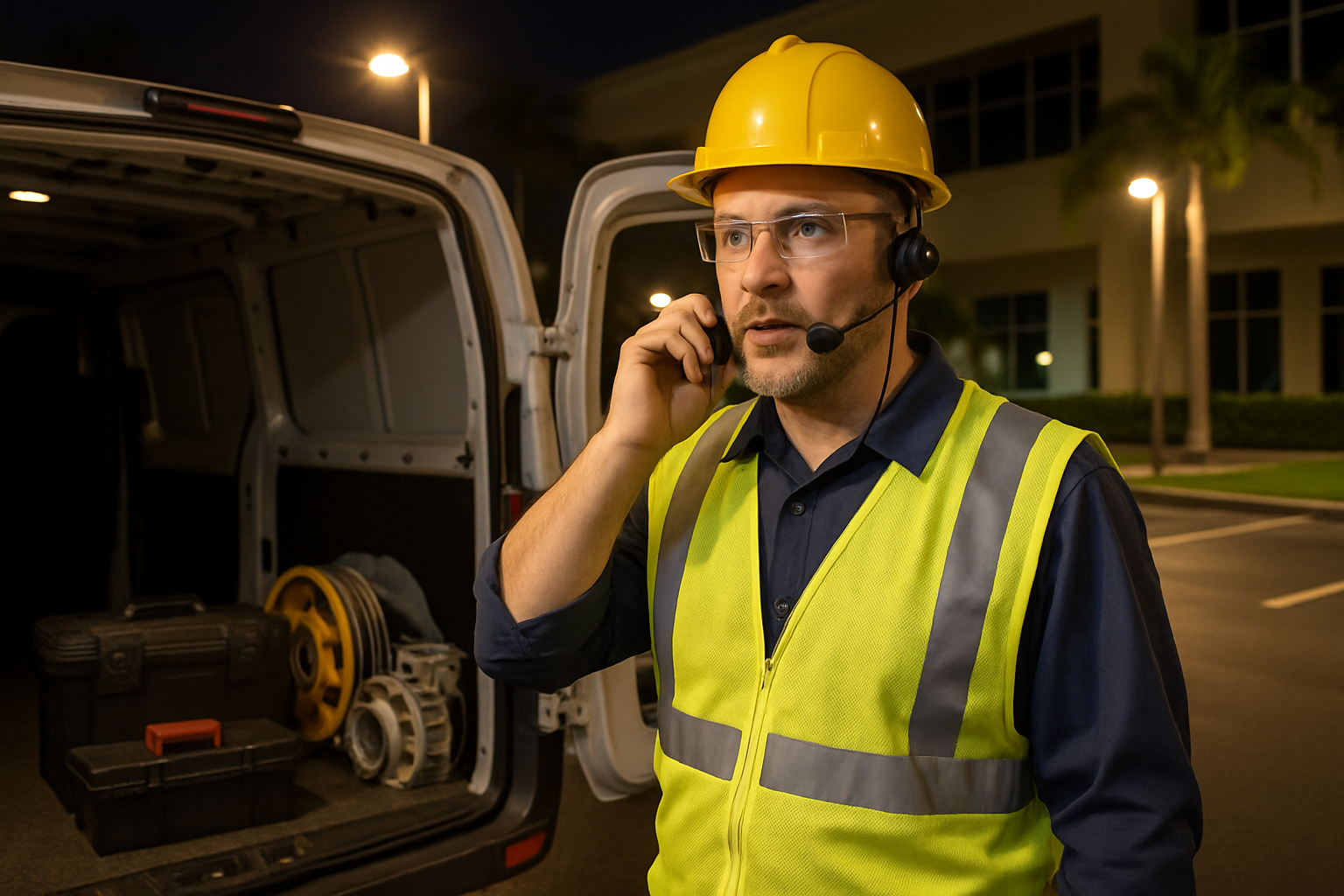
A qualified emergency elevator technician in Pompano Beach should arrive within 1–4 hours of your call, with the fastest certified providers offering a guaranteed 2-hour response window for entrapment situations.
Response time depends heavily on the provider’s local presence. A company headquartered in Pompano Beach or with a Broward County dispatch team will consistently outperform a regional contractor routing calls through a national dispatch center. When evaluating vendors, always ask for a contractual response time, not just a verbal promise.
Axxiom Elevator Florida maintains a local field team serving Pompano Beach and surrounding Broward County communities, enabling rapid 24/7 emergency dispatch. For entrapment calls specifically, Florida law and ASME A17.1 Rule 2.27.1.3 require that passengers be retrieved by trained personnel — not by building staff — so having a fast-response certified provider on speed dial is not optional.
What does emergency elevator repair cost in Pompano Beach in 2026?
Emergency elevator repair in Pompano Beach typically costs between $350 and $2,500+ depending on the nature of the fault, parts required, and time of dispatch — after-hours and weekend calls carry a 25–50% premium over standard labor rates.
| Repair Type | Estimated Cost Range | Typical Labor Hours | After-Hours Surcharge |
|---|---|---|---|
| Passenger entrapment / reset | $350 – $600 | 1 – 2 hrs | +25–40% |
| Door operator motor replacement | $800 – $1,800 | 2 – 4 hrs | +30–50% |
| Hydraulic fluid leak repair | $1,200 – $3,500 | 3 – 6 hrs | +30–50% |
| Controller board/PCB failure | $1,500 – $4,500 | 4 – 8 hrs | +25–40% |
| Safety device reset (governor, buffer) | $400 – $900 | 1 – 3 hrs | +25–35% |
| Brake adjustment / replacement | $700 – $2,200 | 2 – 5 hrs | +30–50% |
| Pit flooding / sump pump failure | $600 – $2,000 | 2 – 4 hrs | +30–50% |
These figures reflect 2026 South Florida market rates. Always request an itemized estimate before authorizing non-entrapment repairs. Be cautious of providers who quote unusually low flat rates — they often recover margin through inflated parts pricing.
Who is legally required to perform emergency elevator repairs in Florida?
In Florida, emergency elevator repairs must be performed by a licensed elevator contractor holding a Certificate of Competency issued under Florida Statute 399.02 — unlicensed repair attempts are illegal and void any existing maintenance warranty.
Florida’s Bureau of Elevator Safety, housed under the Department of Business and Professional Regulation (DBPR), licenses all elevator contractors and inspectors in the state. The certifying technician must hold an active state license, and the employing contractor must carry both general liability and workers’ compensation insurance covering elevator work.
IUEC (International Union of Elevator Constructors) certification adds an additional layer of verified competency. When I respond to an emergency call, the building owner should request my license number on the spot — any legitimate contractor will provide it without hesitation. Axxiom Elevator Florida employs fully licensed, IUEC-trained technicians across all service territories.
What Florida codes and standards govern elevator safety in Pompano Beach?
Elevators in Pompano Beach are governed by Florida Statute Chapter 399, the Florida Building Code (FBC) Volume IV, and the nationally adopted ASME A17.1/CSA B44 Safety Code — with ADA Title III applying to public accommodations.
Florida adopted ASME A17.1-2019 as its baseline elevator safety standard, with state-specific amendments layered on top. Key code compliance areas relevant to emergency situations include:
- ASME A17.1 Rule 2.27.3: Requires firefighters’ emergency operation on all elevators in buildings over a certain height
- ASME A17.1 Rule 2.27.1: Governs emergency lighting, alarm, and two-way communication requirements in elevator cars
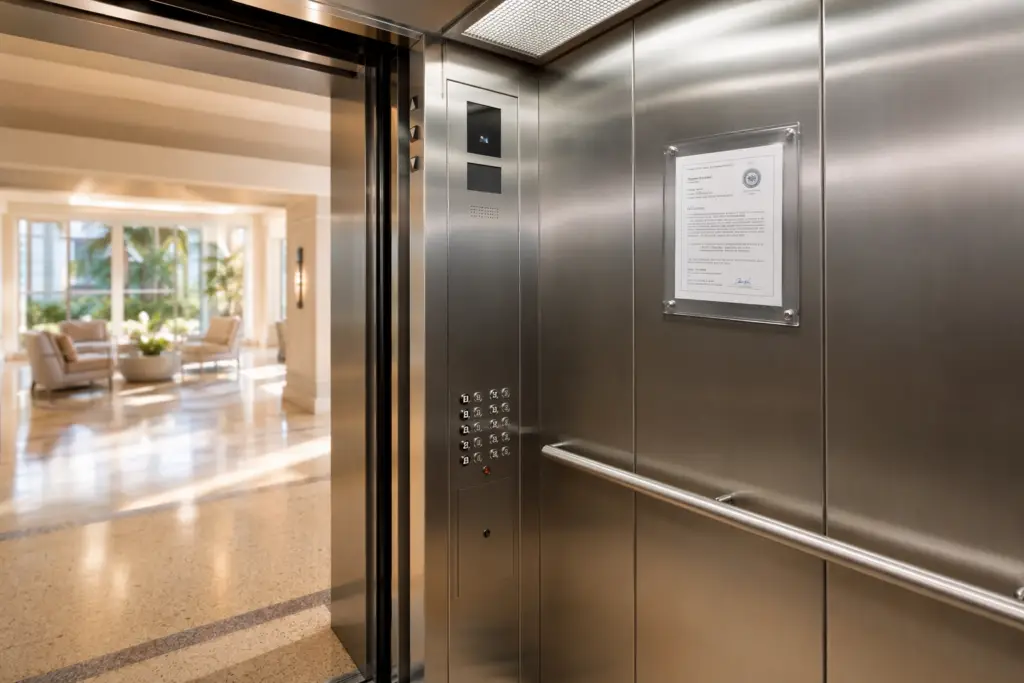
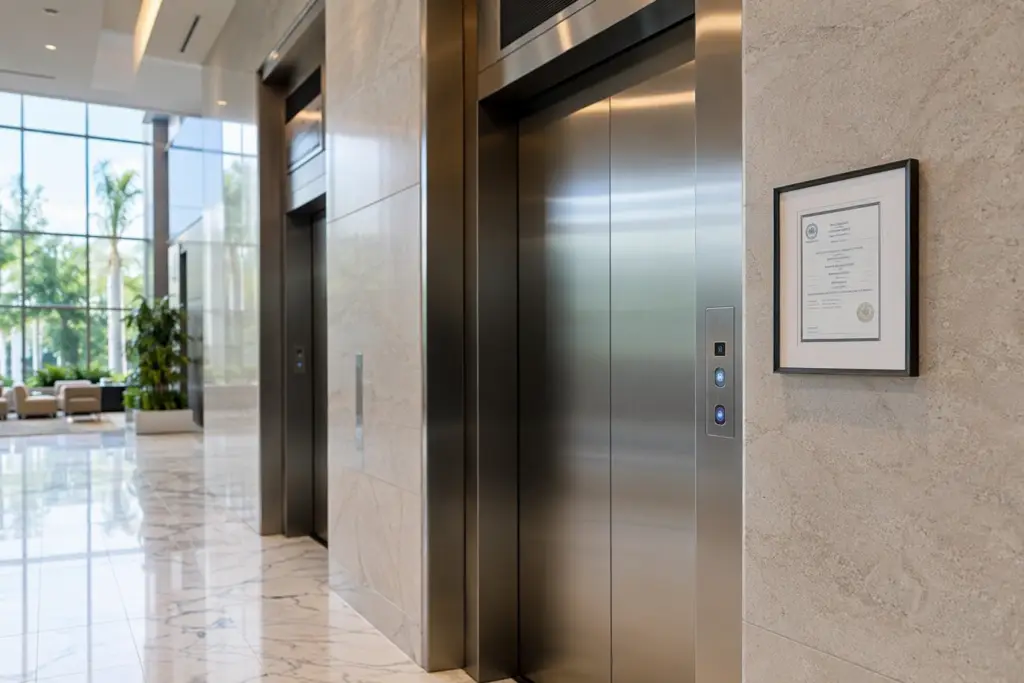
- Florida Statute 399.10: Mandates periodic inspections and requires that a certificate of inspection be posted in the elevator cab
- ADA Standards for Accessible Design §4.10: Requires operational call buttons, audible signals, and door timing compliance for public-access elevators
Non-compliance discovered during or after an emergency repair can result in citations from the DBPR, stop-use orders, and potential civil liability if a guest or tenant is injured on a documented non-compliant unit.
What should I do immediately if someone is trapped in an elevator in Pompano Beach?
If someone is trapped in an elevator, stay calm, use the car’s emergency phone to reassure the passenger, call 911 if there is any medical concern, and immediately contact a licensed elevator contractor — never attempt to manually open doors or extract passengers yourself.
The two-way emergency phone inside every compliant elevator cab (required by ASME A17.1 Rule 2.27.1.4) connects directly to a monitoring station or the building’s main desk. If the phone is non-functional — itself a code violation — use a cell phone to maintain verbal contact through the cab walls while waiting for technicians.
Building managers should never attempt to manually release a door lock or lower the car using handwinding equipment unless they are specifically trained and authorized to do so. Improper intervention has caused fatalities in documented cases nationwide. Call a certified technician first, every time.
How long does emergency elevator repair typically take in Pompano Beach?
Most emergency elevator repairs in Pompano Beach are resolved within 2–8 hours, though complex controller failures or hard-to-source parts can extend downtime to 24–72 hours.
Simple issues like a tripped overload relay, a door sensor fault, or a safety device reset can often be resolved in under 90 minutes by an experienced technician with a stocked service van. The most significant variable in repair duration is parts availability. Older elevator units — particularly hydraulic elevators manufactured before 1995 — may use components that require special ordering, which can extend downtime considerably.
One strategy I recommend to building owners is maintaining a documented equipment list (make, model, serial number, controller type) so that when an emergency occurs, your service provider can pre-stage likely parts before arriving on-site. Axxiom Elevator Florida conducts preventive asset audits for clients precisely to minimize emergency downtime.
Does building insurance cover emergency elevator repair costs in Florida?
Commercial property insurance in Florida often covers emergency elevator repairs caused by sudden mechanical breakdown under Equipment Breakdown Coverage (EBC), but standard general liability policies typically exclude mechanical failure — review your policy declarations carefully.
Equipment Breakdown Coverage (also called Boiler and Machinery coverage) is the specific endorsement that pays for sudden and accidental mechanical or electrical breakdown of covered equipment, including elevators. Standard commercial property policies exclude “mechanical breakdown” as a named peril, which surprises many building owners after an emergency.
Document everything during and after an emergency repair: technician reports, photographs, parts invoices, and the timeline of events. This documentation is essential for insurance claims and for defending against tenant or guest liability claims. Ask your certified technician to provide a detailed written diagnosis — not just an invoice line item.
What are the most common causes of emergency elevator failures in Pompano Beach?
The most common causes of emergency elevator failures in Pompano Beach are door system malfunctions, hydraulic fluid leaks, controller board failures, and power surge damage — all of which are exacerbated by South Florida’s heat, humidity, and frequent electrical storms.
South Florida’s climate creates unique elevator failure patterns. High ambient humidity accelerates corrosion in pit areas, elevator machine rooms, and control panels. Summer lightning storms frequently cause power surges that damage sensitive electronic controller boards and position sensors. The salt air proximity to the Atlantic coastline — especially in Pompano Beach — accelerates metal fatigue on cables, sheaves, and door hardware far faster than inland markets.
Based on field experience, the breakdown frequency by category in South Florida looks like this:
- Door system failures: ~42% of all service calls
- Hydraulic system issues: ~21% of calls (more prevalent in older mid-rise stock)
- Electrical/controller faults: ~18% of calls
- Safety device activations: ~11% of calls
- Other mechanical: ~8% of calls
How do I choose a reliable emergency elevator repair company in Pompano Beach?
Choose an emergency elevator repair company in Pompano Beach that holds a valid Florida DBPR elevator contractor license, employs IUEC-certified technicians, carries adequate insurance, and can provide verifiable local references from Broward County properties.
Here is a practical vetting checklist I give to property managers:
- Verify the contractor’s Florida DBPR license at myfloridalicense.com
- Confirm they carry a minimum of $1,000,000 general liability and workers’ comp
- Ask for their guaranteed emergency response time in writing
- Request references from at least two Pompano Beach or Broward County properties
- Confirm they stock common parts for your elevator make and model
- Ask if they provide written diagnostic reports after every service call
- Verify their 24/7 phone line actually connects to a live dispatcher — not an answering service with a 4-hour callback lag
Axxiom Elevator Florida meets every item on this checklist and serves both Pompano Beach and Sarasota with dedicated local teams — not subcontractors dispatched from out of market.
Can emergency elevator repairs be done on nights, weekends, and holidays in Pompano Beach?
Yes — licensed 24/7 emergency elevator repair is available in Pompano Beach on nights, weekends, and holidays, though after-hours labor rates typically run 25–50% higher than standard weekday rates.
Elevator entrapments and safety failures don’t respect business hours. A Thursday night power surge or a Sunday morning door motor burnout in a Pompano Beach condominium requires an immediate response regardless of the calendar. When evaluating service contracts, confirm that after-hours emergency coverage is explicitly included — some contracts only provide business-hours coverage with emergency service available at a significant premium.
Building owners and property managers should also confirm that their emergency contact information is current and posted in the elevator machine room, as required by Florida Statute 399.10. This ensures that fire rescue personnel and building staff can reach your contractor without delay.
What is the difference between emergency elevator repair and preventive maintenance in Pompano Beach?
Emergency elevator repair addresses active failures and safety hazards requiring immediate intervention, while preventive maintenance is a scheduled, proactive program designed to identify and correct developing issues before they cause emergencies.
Think of it this way: emergency repair is the ER visit; preventive maintenance is primary care. ASME A17.1 and Florida Statute 399.10 both contemplate regular maintenance as the primary mechanism for elevator safety — inspections and maintenance records are reviewed during annual state inspections.
A full preventive maintenance program for a traction elevator in Pompano Beach typically includes monthly lubrication and safety device checks, quarterly controller and brake inspections, semi-annual load testing verification, and annual governor and buffer testing per ASME A17.1 Rule 8.6. Buildings on active maintenance contracts experience significantly fewer emergency calls — industry data suggests a 60–70% reduction in unplanned service events compared to buildings without maintenance contracts.
What happens if my elevator fails a Florida state inspection after an emergency repair?
If your elevator fails a Florida state inspection after an emergency repair, the DBPR can issue a stop-use order requiring the elevator to remain out of service until all cited violations are corrected and a re-inspection is passed.
Florida’s Bureau of Elevator Safety conducts inspections through a network of licensed third-party inspection companies and state inspectors. When violations are cited on Form DBPR-BES-402, the building owner receives a specified correction period — typically 30 days for non-critical violations and immediate correction for safety-critical items (Category 1 violations).
Operating an elevator under a stop-use order is a first-degree misdemeanor under Florida Statute 399.12 and can result in fines of up to $5,000 per day. More critically, operating a known non-compliant elevator exposes building owners to significant civil liability if an injury occurs. Always work with your repair contractor to pull the appropriate permits and schedule a post-repair re-inspection promptly.
Are ADA compliance issues considered elevator emergencies in Pompano Beach?
While ADA compliance failures are not always physical emergencies, they create immediate legal exposure and should be treated as urgent repair priorities — particularly for public accommodations in Pompano Beach subject to ADA Title III.
Common ADA elevator violations that property owners in Pompano Beach encounter include:
- Non-functional or poorly audible floor arrival signals
- Call buttons that require excessive force to activate (>5 lbf per ADA §4.10.3)
- Door hold-open time below 20 seconds minimum
- Missing or illegible Braille floor designations
- Car position indicators not functioning
- Door reopening device failures (required by ADA §4.10.6)
Under ADA Title III, public accommodations that fail to maintain accessible elevator features face potential DOJ complaints and private litigation. A documented ADA complaint can trigger a comprehensive facility accessibility audit — making a $400 repair call a very cost-effective investment.
How often should elevators in Pompano Beach be inspected to avoid emergencies?
Florida law requires a minimum of one annual state inspection for all commercial elevators, but industry best practice and ASME A17.1 maintenance standards recommend monthly technician visits to prevent emergency failures.
Florida Statute 399.06 mandates annual certificates of inspection for all elevators, escalators, and moving walks. However, annual inspections alone are insufficient to prevent equipment failures — they verify a snapshot of compliance on one day per year. A structured monthly maintenance visit by a licensed technician is the minimum standard I recommend for any elevator running more than 50 cycles per day.
High-use elevators in Pompano Beach commercial properties — hotels, hospitals, multi-family high-rises — should be on a bi-monthly or monthly service schedule with documented maintenance logs retained for a minimum of 5 years. These logs are the first documents a state inspector or plaintiff’s attorney will request after an incident.
What parts of an elevator most commonly fail in Florida’s climate?
In Florida’s hot, humid, and salt-air environment, the components most prone to premature failure are door operators, hydraulic seals and pistons, electronic control boards, rope and sheave systems, and pit sump pumps.
The machine room temperature in a Pompano Beach building during summer can reach 115°F or higher if HVAC is inadequate — far above the 104°F maximum recommended by ASME A17.1 Rule 2.7.3.1. Sustained heat degrades controller board capacitors, motor insulation, and hydraulic fluid viscosity simultaneously. I’ve seen controller boards that should last 15 years fail in 7 years simply due to inadequate machine room cooling.
Hydraulic elevators — which remain common in Pompano Beach’s 3–5 story mid-rise stock — are particularly vulnerable. Hydraulic cylinder corrosion, seal degradation from temperature cycling, and fluid contamination from water infiltration in the pit are all accelerated by Florida conditions. Regular fluid analysis (similar to engine oil analysis) is an underutilized diagnostic tool that can predict hydraulic failures weeks before they become emergencies.
What information should I have ready when calling for emergency elevator repair in Pompano Beach?
When calling for emergency elevator repair, have ready: the building address, elevator make and model, nature of the problem, number of people trapped (if any), whether the elevator is currently powered, and your maintenance contract number if applicable.
Providing complete information upfront allows the responding technician to pre-load the correct tools and likely replacement parts before leaving the shop — this single step can reduce on-site repair time by 30–60 minutes. A simple Emergency Elevator Contact Card posted in the machine room and at the building management office should include:
- Building name and full address
- Elevator Unit Numbers (from the Florida DBPR registration)
- Manufacturer and model number
- Year of manufacture and last major modernization
- Maintenance contractor name and 24/7 emergency number
- Florida DBPR certificate numbers for each unit
- Machine room key location
Can a building be held liable if someone is injured in a broken elevator in Pompano Beach?
Yes — Florida premises liability law holds building owners and property managers responsible for maintaining elevators in a safe condition, and documented negligence in maintenance or emergency response can result in significant civil judgments.
Florida follows a modified comparative negligence standard (Florida Statute 768.81), meaning that in an elevator injury case, fault is apportioned between all parties. However, if a building owner knew of a defect — or should have known through reasonable inspection — and failed to repair it, they can bear the majority of liability.
Courts and plaintiff attorneys look specifically for: gaps in maintenance records, delayed responses to known defects, failure to maintain required state inspection certificates, and evidence that building staff were asked to operate equipment they were not trained to handle. The single best risk management tool is a clean, continuous, well-documented maintenance history with a licensed contractor. This is exactly the standard of documentation Axxiom Elevator Florida provides to every maintenance client.
How does emergency elevator service in Pompano Beach differ from service in other Florida cities?
Emergency elevator service in Pompano Beach is shaped by the city’s mix of older oceanfront condominium towers, mid-rise commercial buildings, and rapid new construction — requiring technicians familiar with both legacy hydraulic systems and modern traction/MRL elevator technology.
Pompano Beach’s building stock is distinctly different from inland Florida markets. The city’s significant inventory of 1970s–1990s condominium towers means a high proportion of older hydraulic and conventional traction elevators that require parts sourcing expertise not needed in newer markets. Simultaneously, Pompano Beach’s active commercial and residential development corridor along I-95 and US-1 features modern machine-room-less (MRL) traction elevators with proprietary electronic controls.
A technician specializing only in new construction MRL systems will struggle with a 1980s hydraulic elevator — and vice versa. Versatility across equipment generations is essential for Pompano Beach emergency response. Axxiom Elevator Florida’s service team is trained and equipped to handle this full spectrum of equipment, which is why we maintain a dedicated presence in Broward County rather than dispatching from a remote hub.
What should I expect from an emergency elevator repair visit in Pompano Beach?
A professional emergency elevator repair visit should include arrival within the agreed response window, a systematic safety assessment before any repair work begins, written documentation of findings, and a clear explanation of the repair performed and any follow-up actions required.
Here is the sequence a qualified technician follows on every emergency call:
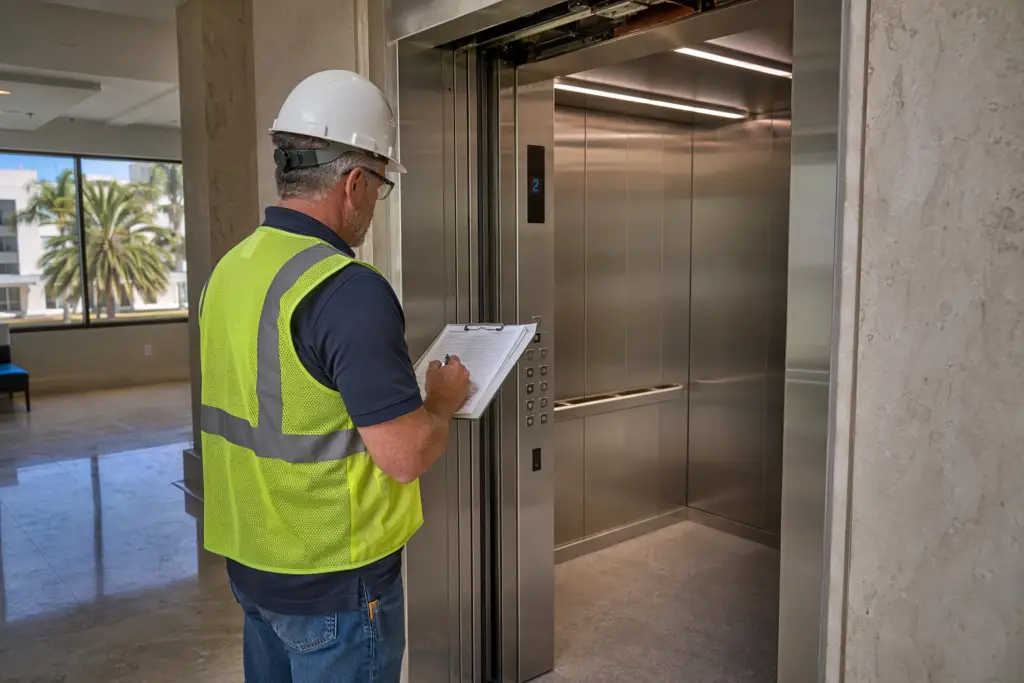
- Arrival and safety confirmation: Confirm no passengers are in the car; lock out / tag out energy sources per OSHA 29 CFR 1910.147
- Systematic diagnosis: Controller review, safety device check, mechanical inspection in priority order
- Passenger retrieval (if applicable): Using trained procedures per ASME A17.1 Rule 2.27.1.3 — not improvised methods
- Repair execution: Using code-compliant parts and procedures
- Safety device verification: Test all safeties before returning car to service
- Documentation: Complete written service report with diagnosis, parts used, labor hours, and any outstanding items requiring follow-up
- Building manager briefing: Verbal summary of what was found, what was fixed, and what is recommended next
Never accept a verbal-only summary or an invoice with only a single line item like “emergency repair.” Written documentation is your legal protection and your maintenance record for state inspection purposes.
Get Expert Emergency Elevator Service in Pompano Beach Today
When your elevator fails, you need a certified, locally trusted team that responds fast, documents thoroughly, and keeps your building compliant. Axxiom Elevator Florida provides 24/7 emergency elevator repair throughout Pompano Beach, Broward County, and Sarasota — with IUEC-certified technicians, full Florida DBPR licensure, and a commitment to same-day response for all active safety emergencies.
Don’t wait for a minor issue to become a stop-use order or a liability claim.
📞 Contact Axxiom Elevator Florida for a free elevator assessment:
Available 24 hours a day, 7 days a week — including nights, weekends, and Florida holidays. Serving Pompano Beach, Fort Lauderdale, Broward County, and Sarasota, FL.