Elevator Stuck Between Floors: Who to Call and What to Do Right Now
After 15+ years responding to elevator emergencies across South Florida, I’ve seen nearly every scenario imaginable — from a simple door interlock trip in a beachside condo in Pompano Beach to a hydraulic system failure in a Sarasota medical office building. One truth holds in every case: knowing exactly who to call and in what order can mean the difference between a 20-minute rescue and a multi-hour ordeal. This FAQ hub covers everything building owners, property managers, and tenants need to know about elevator entrapments, emergency protocols, compliance obligations, and how to prevent these incidents from ever happening in the first place.
Who Should I Call First If an Elevator Is Stuck Between Floors?
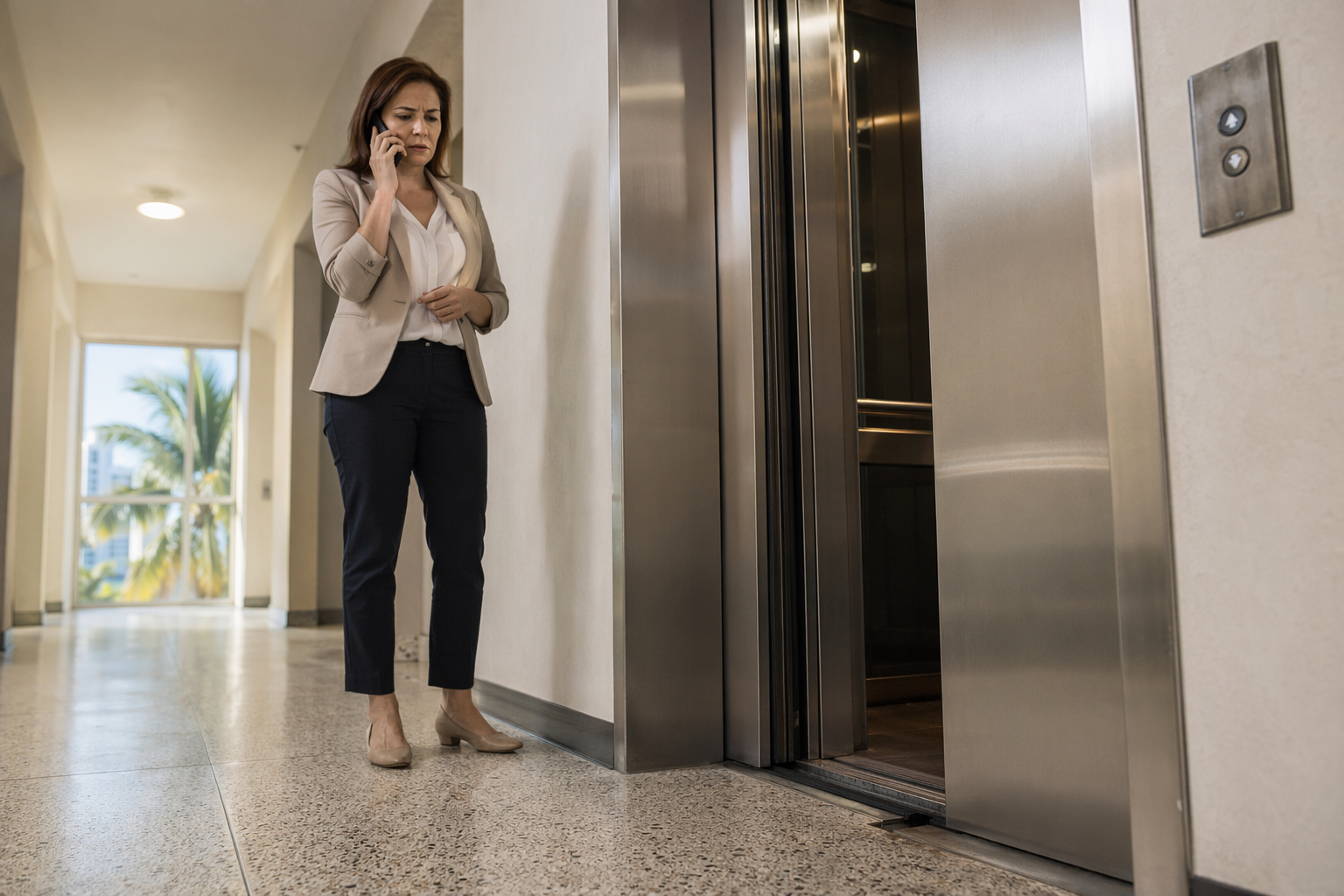
Call 911 immediately if anyone is trapped inside the elevator, then contact your licensed elevator service company for the mechanical rescue and post-incident inspection.
Emergency responders — firefighters in Florida are specifically trained in elevator rescue under NFPA 1 protocols — can manually override elevator controls and physically retrieve passengers safely. However, 911 dispatchers are not elevator technicians, and once passengers are out, a certified mechanic must inspect and reset the unit before it goes back into service. Bypassing that second call is a Florida code violation and a significant liability risk for building owners.
In the Pompano Beach and Sarasota markets, Axxiom Elevator Florida maintains 24/7 emergency dispatch so that certified technicians are on-site typically within 60–90 minutes of your call. Do not allow the elevator to be restarted by untrained building staff — doing so can cause secondary failures, additional entrapments, or personal injury claims.
Is It Safe to Stay Calm Inside a Stuck Elevator?
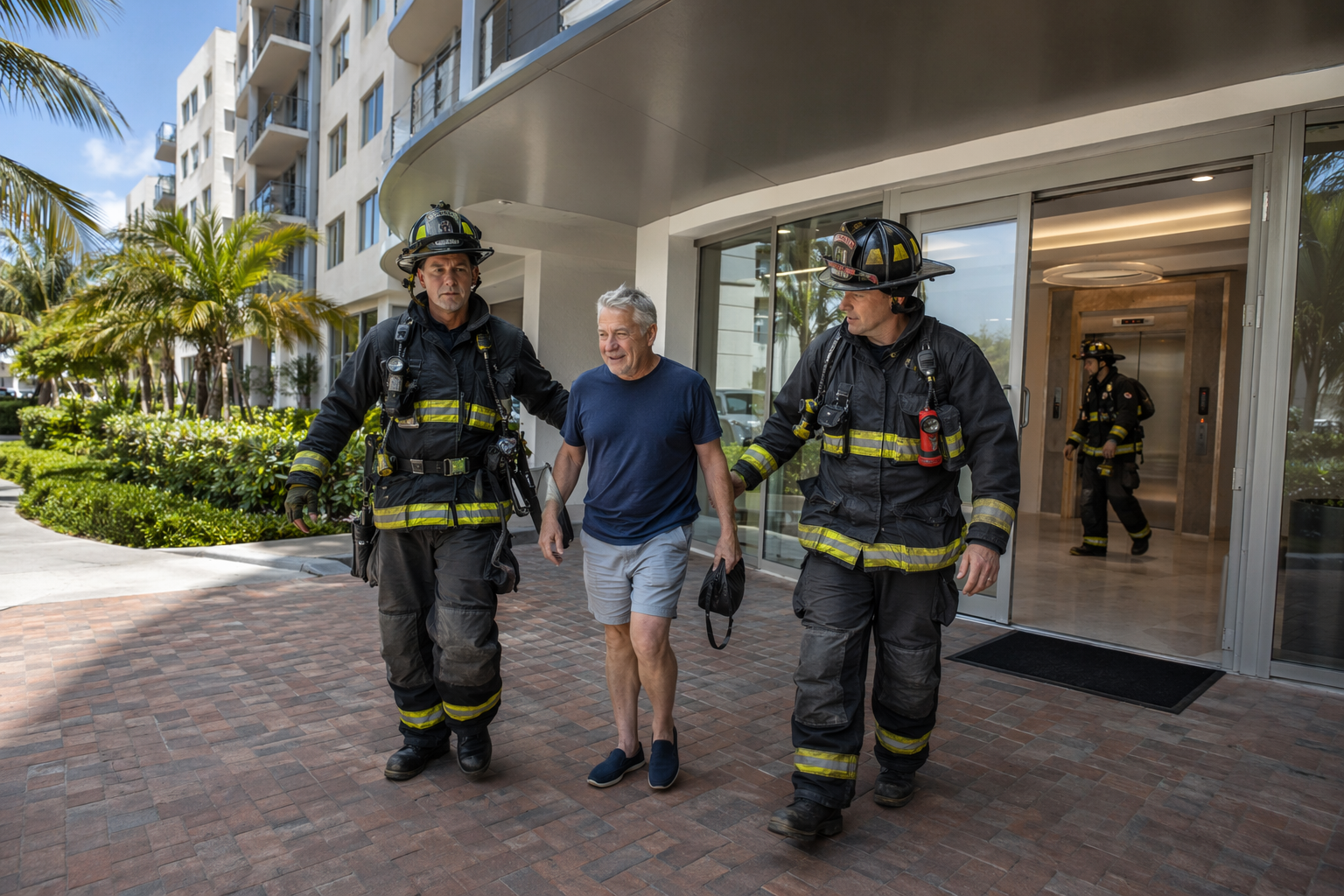
Yes — a modern elevator stopped between floors is structurally safe, and panic is the greatest actual danger passengers face.
Under ASME A17.1/CSA B44, the Safety Code for Elevators and Escalators, every elevator car must be equipped with a governor, safeties, and a buffer system designed to arrest free fall under all foreseeable load conditions. The car is not going to drop. The biggest risks in an entrapment are dehydration in hot weather (a real concern in Florida), claustrophobia-driven panic, and injuries from passengers attempting to pry open doors and climb out themselves.
Passengers should: press the door-open button once, press the alarm button continuously, use the emergency telephone (required by ASME A17.1 Rule 2.27.1.3 in all passenger elevators), stay away from the door gap, and wait for trained rescuers. Never attempt to exit between floors without direct instruction from a fire official or elevator technician on-site.
What Are the Most Common Reasons an Elevator Gets Stuck Between Floors?
The most frequent causes are door interlock failures, power fluctuations, overloaded cars, hydraulic fluid loss, and control system faults — most of which are preventable with scheduled maintenance.
Door interlocks are the single most common cause I see in the field. When a door contact or interlock relay fails, the elevator’s logic controller interprets the door as “open” and stops the car mid-travel as a safety measure. This is actually the system working correctly — but it still results in a stranded car.
Hydraulic elevators (common in 2–6-story Florida buildings built before 2000) are particularly vulnerable to fluid pressure loss due to heat expansion and aging seals. In Florida’s climate, hydraulic fluid viscosity changes significantly with temperature, and a unit that ran fine all winter may develop faults as summer temperatures push into the 90s. Control board failures, brake adjustments drifting out of spec, and worn leveling devices round out the top causes.
| Cause | Estimated % of Cases | Preventable with Maintenance? | Typical Repair Time |
|---|---|---|---|
| Door interlock / contact failure | 34% | Yes | 30–90 minutes |
| Power interruption / brownout | 22% | Partially (UPS systems help) | Immediate to 2 hours |
| Hydraulic pressure loss | 18% | Yes | 1–4 hours |
| Control board / software fault | 12% | Yes (firmware updates) | 1–6 hours |
| Overload / load sensor fault | 8% | Yes | 30–60 minutes |
| Brake adjustment fault | 4% | Yes | 2–5 hours |
| Other / miscellaneous | 2% | Varies | Varies |
What Happens If I Try to Get Out of a Stuck Elevator on My Own?
Self-rescue from a stuck elevator is extremely dangerous and responsible for a significant number of elevator-related fatalities — never attempt it without direct guidance from on-site emergency personnel.
The National Institute for Occupational Safety and Health (NIOSH) has documented numerous fatalities resulting from passengers forcing open elevator doors and stepping into hoistways where the car is not level with the landing. A gap of just 12–18 inches between the car sill and the hoistway floor is sufficient to cause a fatal fall, and the hoistway contains moving counterweights, cables, and guide rails that present additional hazards.
Florida Statute 399 and ASME A17.1 Section 2.27 both establish that trained and authorized personnel must perform all rescues. Building maintenance staff are not authorized rescuers unless they hold a valid elevator technician license from the Florida Department of Business and Professional Regulation (DBPR). Property managers who instruct untrained staff to rescue passengers expose themselves to significant civil and criminal liability.
What Is the Florida Law on Elevator Emergency Procedures?
Florida Statute Chapter 399 and the Florida Building Code require all conveyances to have operable emergency lighting, communication devices, and that licensed technicians perform all maintenance, repair, and rescue operations.
Under Florida Administrative Code Rule 61C-5, the Division of Hotels and Restaurants (now managed under DBPR) oversees elevator safety, and all units must be inspected by a QEI (Qualified Elevator Inspector) annually. Following any entrapment incident, the elevator must be taken out of service and inspected before it is returned to operation. Failure to comply can result in fines exceeding $5,000 per violation per day in 2026.
Building owners in Pompano Beach (Broward County) and Sarasota (Sarasota County) are both subject to these state-level requirements, with additional local fire codes that may specify response time expectations for emergency phones and backup power systems. Annual inspection certificates must be posted inside the elevator car and be visible to passengers at all times.
How Long Does It Take for an Elevator Technician to Arrive in an Emergency?
A reputable local elevator service company should have a certified technician on-site within 60–120 minutes of an emergency call, 24 hours a day, 7 days a week.
Response time is one of the most critical differentiators when choosing an elevator maintenance contractor. National elevator companies often dispatch from regional hubs that may be 2–3 hours from your property. Local, Florida-based providers like Axxiom Elevator Florida maintain technician coverage specifically for the Pompano Beach and Sarasota markets, meaning faster dispatch and technicians who know the specific equipment profiles common in each market.
When interviewing service providers, always ask for a written guaranteed response time in your contract. Industry best practice — and what I recommend to every building owner I work with — is a contractual 2-hour maximum emergency response window, with a 1-hour target for occupied entrapments.
Do I Need to File a Report After an Elevator Entrapment?
Yes — Florida law requires building owners to report elevator incidents involving injury, and industry best practice demands a written incident report for every entrapment regardless of injury.
Under Florida Statute 399.03, any elevator incident resulting in personal injury must be reported to the DBPR within 24 hours. Even for entrapments with no injury, a written record protects building ownership from future liability claims. Your elevator service company should provide a post-incident report detailing the cause, the repair action taken, and the technician’s certification number.
Maintain all incident reports for a minimum of 3 years, which aligns with the documentation retention recommendations in ASME A17.1-2022. If your building’s insurer requests records during a claim, gaps in documentation can void coverage. I strongly advise building managers to keep a physical binder and a cloud backup of all elevator maintenance and incident records.
How Much Does an Emergency Elevator Service Call Cost in Florida?
Emergency elevator service calls in Florida typically range from $250–$800 for the diagnostic and rescue response, with parts and extended repairs billed separately.
Cost varies based on time of call (after-hours rates are typically 1.5–2× standard rates), the complexity of the fault, and whether replacement parts are needed immediately. Buildings under a comprehensive maintenance contract often have emergency labor costs included or significantly reduced, which is one of the strongest financial arguments for proactive maintenance agreements over time-and-material arrangements.
| Service Scenario | Typical Cost Range | Notes |
|---|---|---|
| Emergency call (business hours) — diagnostic only | $250–$450 | No parts, simple reset |
| Emergency call (after-hours/weekend) | $450–$800 | OT labor rates apply |
| Door interlock replacement | $300–$700 | Parts + labor |
| Hydraulic repair (minor) | $500–$1,500 | Fluid refill + seal |
| Control board replacement | $1,200–$4,500 | Depending on manufacturer |
| Under comprehensive maintenance contract | $0–$150 | Most emergency labor included |
What Should Building Managers Do Immediately After an Entrapment?
Place the elevator out of service, secure the machine room, contact a licensed elevator technician, and document everything before allowing the unit to resume operation.
The immediate priority is preventing a second entrapment. Place physical “Out of Service” barriers at every landing, and if possible, secure the machine room to prevent unauthorized access. Do not allow the elevator to be reset by pushing buttons inside the car or through the lobby panel — this applies even to building engineers unless they hold DBPR elevator licensure.
Document the time of the incident, the number of passengers involved, their physical condition, how long they were trapped, and the names of any responding emergency personnel. Photograph the control panel, the position indicator, and any visible equipment if you can safely access the machine room. This documentation supports both your incident report and any insurance claim.
How Can I Prevent an Elevator From Getting Stuck Between Floors?
Regular preventive maintenance — including monthly lubrication, quarterly door inspections, and annual full-system audits — reduces entrapment incidents by an estimated 70–80% compared to reactive-only service models.
In my experience across hundreds of Florida buildings, the properties with the fewest entrapment calls are invariably the ones on structured monthly maintenance programs. ASME A17.1 Section 8.6 specifies maintenance intervals and documentation requirements that form the baseline for any competent maintenance program. Florida’s climate adds additional demands: humidity accelerates corrosion on door tracks and contacts, heat degrades hydraulic seals faster than in northern climates, and salt air in coastal markets like Pompano Beach creates additional oxidation challenges.
Key preventive tasks include: monthly inspection and lubrication of all door operating mechanisms; quarterly testing of all safety devices including governors and safeties; semi-annual oil sampling on hydraulic units; and annual load testing per ASME A17.1 Rule 8.11. A comprehensive maintenance agreement with Axxiom Elevator Florida covers all of these intervals for properties in the Pompano Beach and Sarasota service areas.
What Does ASME A17.1 Require for Elevator Emergency Communication?
ASME A17.1 Rule 2.27.1.3 mandates a two-way voice communication system in every passenger elevator car, capable of connecting to a location with 24-hour monitoring.
This is not optional and it’s not satisfied by a basic intercom that rings at an unmanned front desk. The communication system must connect to a location that is staffed or monitored 24 hours a day, 7 days a week, 365 days a year. In residential buildings, this typically means a third-party monitoring service. In commercial buildings with after-hours closures, a forwarding arrangement to a live answering service or the building’s security monitoring company is required.
Florida inspectors regularly cite non-compliant emergency phones as one of the top three violations found during annual inspections. If your elevator’s phone calls a desk that goes unmanned at 5 PM, you are out of compliance and, more importantly, your passengers have no effective way to call for help. Test your emergency communication system monthly and document the test results.
Are ADA Requirements Affected When an Elevator Is Out of Service?
Yes — under the Americans with Disabilities Act, building owners must provide equivalent accessible service when an elevator that serves as the sole accessible route is out of service.
If your elevator is the only ADA-compliant path to upper floors and it is out of service — whether due to entrapment, repair, or scheduled maintenance — you are legally obligated to arrange equivalent access. This may mean temporarily deploying staff assistance, establishing a service at an accessible entry point, or in some cases posting proper signage directing users to the nearest accessible facility.
The ADA does not provide a grace period for elevator outages. Complaints can be filed with the U.S. Department of Justice immediately, and settlements can include civil monetary penalties, attorney fee awards, and mandated corrective action plans. The fastest resolution to an ADA access issue is getting your elevator back in compliant service as quickly as possible — which is exactly why rapid emergency response matters beyond just passenger comfort.
What Is the Difference Between an Emergency Call and a Routine Service Visit for a Stuck Elevator?
An emergency call addresses the immediate entrapment and makes the unit safe; a routine follow-up visit performs the thorough diagnostic and repair needed to prevent recurrence.
When a technician responds to an entrapment at 2 AM, the primary mission is safely extracting passengers and making a preliminary determination of the fault. The technician may be able to reset a simple fault and restore service, but a full diagnostic — load testing, door cycle count analysis, oil sampling, controller log review — requires daylight hours, proper tooling, and adequate time. Skipping the follow-up is one of the most common mistakes I see property managers make.
Always schedule a comprehensive follow-up inspection within 24–48 hours of any entrapment incident, even if the unit appears to be running normally. Many entrapments are preceded by weeks of minor faults logged in the controller — faults that a technician can identify and correct before the next incident occurs.
How Often Should Elevators Be Inspected in Florida to Stay Compliant?
Florida Statute 399 requires a full safety inspection by a QEI-certified inspector at least once every 12 months, with the inspection certificate posted in the elevator car at all times.
Beyond the mandatory annual inspection, ASME A17.1 and prudent maintenance practice call for monthly maintenance visits, quarterly safety device testing, and a Category 1 test (no-load safety test) annually. Category 5 tests — full-load, full-speed governor and safety tests — are required every 5 years for traction elevators. In 2026, Florida DBPR enforcement of these intervals has become more rigorous, with increased frequency of spot inspections following high-profile incidents in the state.
Buildings that fall out of compliance risk having their operating permit revoked, which means the elevator must be shut down immediately — creating ADA issues, tenant complaints, and potential lease disputes. Staying current on inspections is far less expensive than the cascading costs of a forced shutdown.
Can a Hydraulic Elevator Get Stuck Differently Than a Traction Elevator?
Yes — hydraulic elevators typically get stuck due to pressure or fluid issues and will slowly drift downward, while traction elevators stop due to electrical or mechanical faults and hold position on their brakes.
This distinction matters for passenger communication and for the technician’s diagnostic approach. A hydraulic elevator that is losing pressure will gradually descend to the lowest level over time, which can actually facilitate a self-rescue to a landing — but only under the supervision of a trained technician who has confirmed it is safe to do so. A traction elevator held by its brakes should not be manually moved by anyone other than a licensed technician using the proper machine room controls.
In Florida, the majority of low-rise residential and commercial buildings constructed between 1970 and 2000 use hydraulic systems. Sarasota in particular has a high inventory of 1980s-era hydraulic elevators in its medical and professional office corridor. These units require specific attention to underground or submerged cylinder inspection per ASME A17.1 Rule 3.18, as cylinder corrosion and fluid leakage into the soil remain active compliance concerns.
What Questions Should I Ask When Hiring an Elevator Emergency Service Company?
Ask about their Florida DBPR license number, guaranteed response time, 24/7 availability, technician certifications, and whether they carry the required liability insurance minimums for Florida elevator contractors.
This is the checklist I give every property manager I meet:
- Florida DBPR License: Verify it at myfloridalicense.com. Any company performing elevator work in Florida must hold a valid state license.
- IUEC or equivalent certification: Technicians should hold IUEC (International Union of Elevator Constructors) certification or demonstrate equivalent documented training.
- Guaranteed response time in writing: If they won’t put it in the contract, walk away.
- 24/7/365 dispatch: Entrapments do not observe business hours.
- Local market knowledge: A technician who regularly works in Pompano Beach or Sarasota understands the specific equipment types and local inspection authority preferences.
- Insurance minimums: Florida requires elevator contractors to carry general liability of at least $300,000 per occurrence; best practice is $1M+.
- Post-incident reporting: Do they provide written reports with every emergency visit? They should.
What Role Does the Building’s Machine Room Play in an Entrapment Response?
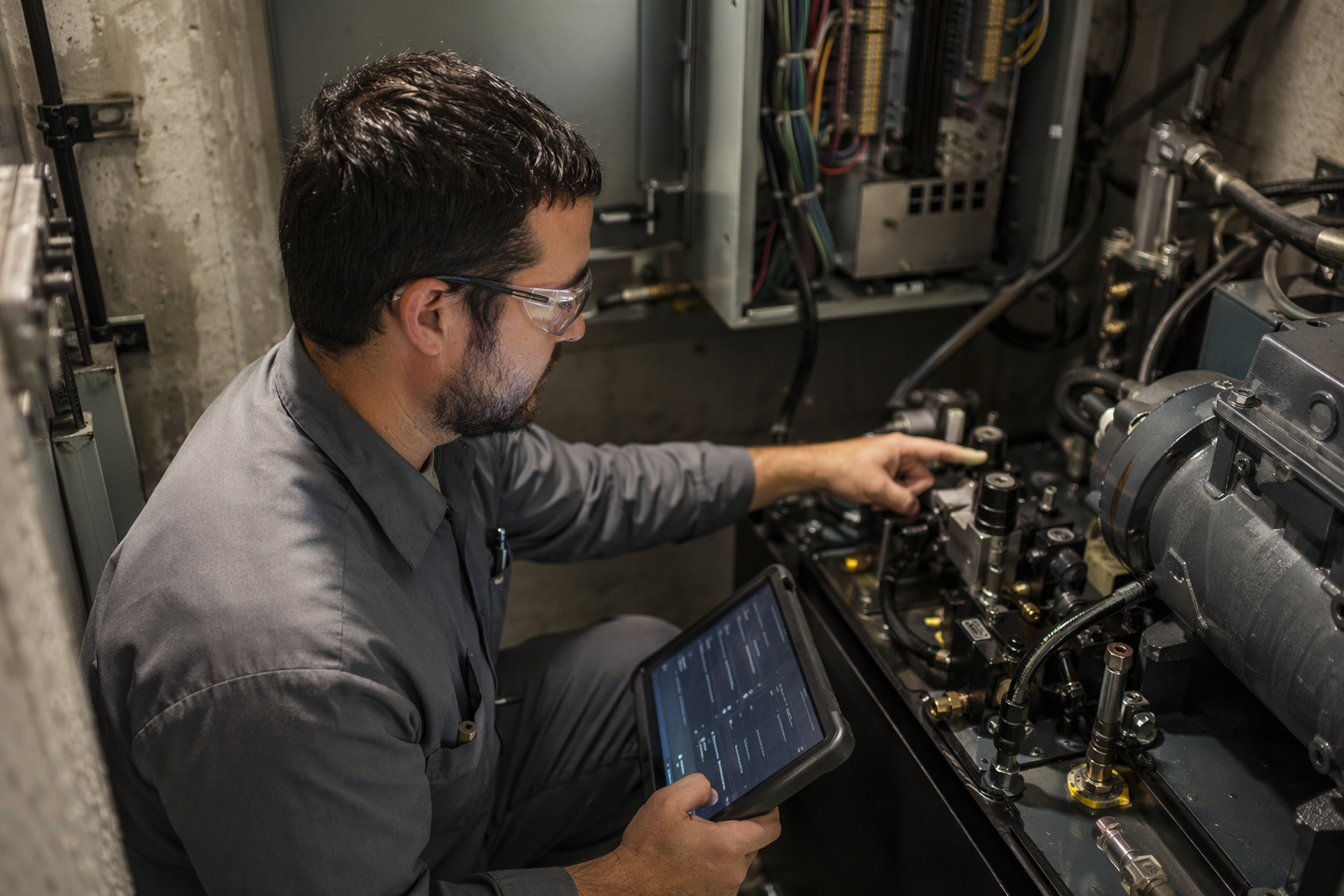
The machine room contains the controls, drive system, and safety mechanisms that allow a licensed technician to manually lower or raise the car to a landing and safely release passengers.
Machine rooms must be kept locked, accessible only to licensed elevator personnel, and maintained at appropriate temperatures — ASME A17.1 Rule 2.7.3 requires machine rooms to be maintained between 32°F and 104°F. In Florida, summer temperatures in unventilated mechanical spaces can exceed 130°F, causing controller thermal shutdowns that trigger entrapments. This is an easily preventable cause that I encounter every summer in South Florida.
Building managers should verify that the machine room HVAC or ventilation is operational, that the space is free from stored materials (a common fire code violation), and that the emergency lighting and disconnect switches are clearly labeled and accessible. During an emergency, first responders and elevator technicians need immediate, unobstructed access to this space.
How Does Weather and Florida’s Climate Affect Elevator Reliability?
Florida’s heat, humidity, salt air, and frequent power fluctuations from storms are all significant contributors to elevator faults and entrapments specific to this region.
After 15 years servicing elevators in South and Central Florida, I can state definitively that climate-related factors account for a disproportionate share of service calls compared to national averages. Coastal corrosion on door tracks and contacts in markets like Pompano Beach accelerates wear rates by an estimated 30–40% compared to inland installations. Hurricane season (June–November) brings power surges, brownouts, and flooding that stress control systems and hydraulic units.
Florida-specific best practices include installing surge protectors on elevator controller power feeds, using marine-grade lubricants on coastal installations, scheduling pre-hurricane season inspections every May, and ensuring backup power systems (emergency lowering battery on hydraulics, ARD — Automatic Rescue Device — on traction units) are tested semi-annually. These are all services that Axxiom Elevator Florida incorporates into maintenance agreements for Pompano Beach and Sarasota properties.
What Is an Automatic Rescue Device and Does My Elevator Have One?
An Automatic Rescue Device (ARD) is a battery-powered backup system that automatically moves a traction elevator to the nearest floor landing and opens the doors during a power failure, preventing entrapment.
ARDs are not universally required under ASME A17.1 for existing installations, but they are highly recommended and are required in new traction elevator installations under many jurisdictions’ amendments to the model code. In Florida, buildings constructed after 2007 generally have ARDs on traction elevators as a result of code updates, but older units may not. Retrofitting an ARD costs approximately $3,000–$8,000 depending on the unit, but it effectively eliminates the most common type of traction elevator entrapment — power-related stoppages between floors.
If you manage an older building and are unsure whether your traction elevator has an ARD, ask your elevator service company during your next maintenance visit. This is a one-question audit that can eliminate dozens of entrapment incidents over the life of your building.
How Do I Choose Between a Comprehensive Maintenance Contract and Time-and-Material Service for My Florida Building?
For any building where the elevator serves ADA-accessible routes, senior residents, or medical users, a comprehensive maintenance contract is strongly preferable because it provides priority emergency response, lower total cost, and compliance documentation that time-and-material arrangements do not.
Time-and-material arrangements may appear less expensive on paper, but buildings on T&M service consistently pay more over a 3–5 year period due to deferred maintenance accumulating into expensive failures, higher per-incident labor rates, and lack of priority scheduling. Comprehensive contracts from reputable providers typically include all labor, regularly scheduled preventive maintenance visits, 24/7 emergency response, and annual inspection support.
For Pompano Beach and Sarasota properties, Axxiom Elevator Florida offers tiered maintenance agreements scaled to building type — from single-elevator condominiums to multi-unit commercial portfolios — with clearly defined response time guarantees and monthly reporting. The right contract for your building depends on age of equipment, usage volume, and risk tolerance, and our team will walk you through the comparison at no cost during a free elevator assessment.
What Should Tenants and Building Residents Know About Elevator Safety?
Tenants should know how to use the emergency phone, never attempt self-rescue, report any unusual elevator behavior immediately, and understand that an elevator that feels “off” before an entrapment is their best early warning system.
The majority of entrapments are preceded by symptoms that passengers often ignore or fail to report: unusual noises, jerky starts and stops, doors that close too slowly or bounce open, and slight misleveling at floors (the car stopping an inch or two above or below the landing). These are not quirks — they are diagnostic indicators of developing faults. In buildings where tenants are educated to report these symptoms, our team can often address the underlying issue before an entrapment occurs.
Post a simple tenant notice near elevator call buttons with three pieces of information: the building manager’s emergency contact number, the elevator service company’s 24/7 number, and basic entrapment instructions (stay calm, use the emergency phone, wait for help). This takes 10 minutes to create and post, and it can prevent a minor incident from becoming a serious one.
How Do I Get a Professional Assessment of My Elevator’s Condition and Compliance Status?
Request a full written elevator condition assessment from a DBPR-licensed elevator company, which should include a review of all safety devices, maintenance records, inspection certificates, and code compliance against current ASME A17.1-2022 standards.
A thorough condition assessment takes 2–4 hours for a single elevator and produces a written report scoring the unit across all major systems: door operation, safety devices, drive system, controller, hoistway, and machine room. The report should include a prioritized deficiency list with estimated correction costs so that building owners can plan their capital budget accordingly.
In 2026, many Florida buildings are approaching or have exceeded the 20-year mark on their original elevator equipment — a threshold at which major component replacements (controllers, hydraulic units, door operators) become increasingly common. A proactive assessment now is far less expensive than an emergency modernization forced by regulatory action or catastrophic failure.
Ready to Protect Your Building and Passengers?
Don’t wait for an entrapment to find out whether your elevator service plan is adequate. Contact Axxiom Elevator Florida for a free elevator assessment — our IUEC-certified technicians serve Pompano Beach, Sarasota, and surrounding Florida communities with 24/7 emergency response, comprehensive maintenance contracts, and full ASME A17.1 and Florida Statute 399 compliance support.
Call us now:
Available 24 hours a day, 7 days a week for emergency response and scheduling.
Axxiom Elevator Florida — Licensed, Certified, and Local to the Communities We Serve.