Elevator Service Contract Negotiation Tips: A Complete Comparison and Decision Guide

Negotiating an elevator service contract is one of the most consequential decisions a building owner or property manager makes. The wrong contract can leave a property exposed to unplanned repair costs, regulatory violations, and extended equipment downtime. This guide breaks down every key factor — coverage types, contract terms, compliance requirements, and vendor selection — so Florida property owners can negotiate from an informed position.
—
What Are the Main Types of Elevator Service Contracts?
Before negotiating anything, understanding the contract tiers available in the market is essential. Vendors typically offer four coverage levels, each with meaningfully different cost and risk profiles.
| Contract Type | What’s Included | What’s Excluded | Best For | Risk Level for Owner |
|---|---|---|---|---|
| Oil & Grease (Basic) | Routine lubrication, minor adjustments | Parts, labor for repairs, callbacks | New equipment under manufacturer warranty | High |
| Examination Only | Periodic inspections, maintenance log | All repair labor and parts | Budget-constrained owners with in-house staff | High |
| Parts & Labor (Comprehensive) | Labor, most parts, callbacks, adjustments | Major modernization components, vandalism | Mid-age equipment (5–15 years) | Moderate |
| Full Maintenance (All-Inclusive) | All parts, labor, callbacks, code upgrades within scope | Structural modifications, acts of vandalism | Older equipment, high-traffic buildings | Low |
—
What Should Every Elevator Service Contract Include?
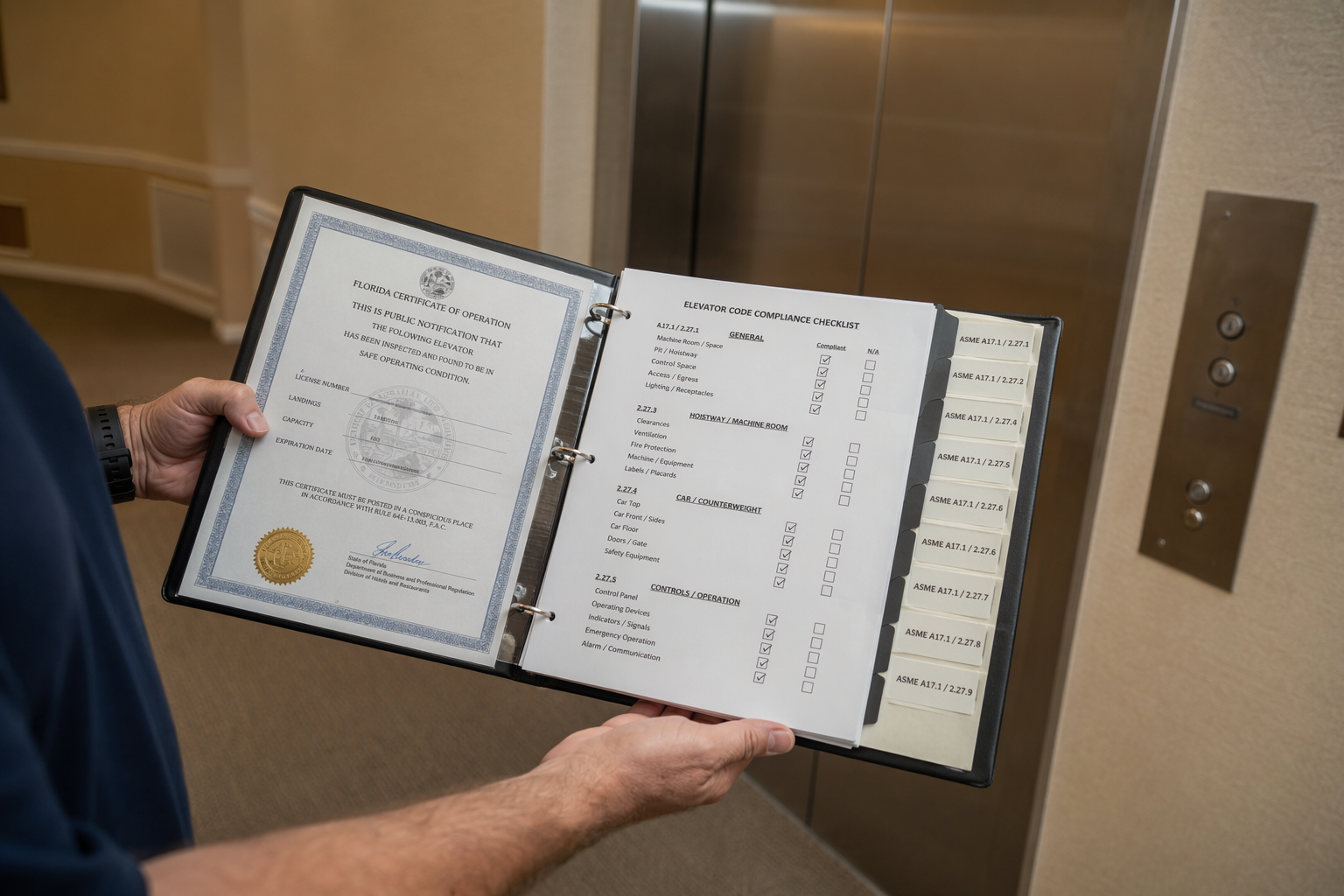
Regardless of the tier selected, certain terms are non-negotiable from a compliance and risk-management standpoint. A well-negotiated contract addresses all of the following:
- Scope of work: Explicitly list every covered component — hoist ropes, controllers, door operators, buffers, and safety devices.
- Callback provisions: Define what constitutes a callback, the response window, and whether callbacks are billed separately.
- Exclusions list: Any item not listed as covered should be treated as excluded. Insist on a written exclusions schedule.
- Compliance responsibility: The contract should specify which party is responsible for meeting current ASME A17.1 Safety Code for Elevators and Escalators requirements and Florida-specific inspection mandates.
- ADA coordination: Confirm responsibility for accessibility-related adjustments under the Americans with Disabilities Act.
- Escalation clauses: Cap annual price increases at a defined rate or tie them to a published index.
- Termination rights: Include a notice period and terms for early exit without penalty.
- Parts ownership: Clarify who owns removed parts and whether used parts can be installed without owner consent.
- Insurance and liability: Require proof of general liability and workers’ compensation coverage.
—
How Do Full-Service and Comprehensive Contracts Compare on Value?
| Factor | Full Maintenance Contract | Parts & Labor Contract | Basic / Oil & Grease |
|---|---|---|---|
| Predictable Annual Cost | High — fixed spend | Moderate — some variables | Low premium, high exposure |
| Surprise Repair Risk | Very Low | Moderate | Very High |
| Compliance Coverage | Strongest | Partial | Minimal |
| Suitable Equipment Age | Any age; best for aging units | Mid-age equipment | New equipment only |
| Vendor Incentive to Maintain Well | High (repairs come from vendor’s margin) | Mixed | Low (repairs are billable) |
| Negotiation Leverage for Owner | High — can bundle multiple units | Moderate | Low — limited scope to negotiate |
—
What Are the Most Common Elevator Contract Traps to Avoid?
Property owners who have not negotiated elevator contracts before frequently encounter several problematic clauses that strongly favor the vendor. Awareness of these provisions is the first step to avoiding them.
- Proprietary parts lock-in: Some vendors install proprietary controllers or components that only they can service, effectively eliminating competitive bidding at renewal. Negotiate for open-architecture equipment or the right to source parts independently.
- Automatic renewal without notice: Contracts that renew automatically for multi-year terms without adequate written notice requirements trap owners in unfavorable agreements. Require a 90-day written notice window.
- Unlimited escalation clauses: Vague language such as “price may be adjusted to reflect market conditions” creates uncapped cost exposure. Demand a numeric cap or tie increases to a public index.
- Exclusions buried in appendices: Major components like door operator assemblies, selector tapes, or motor generators are sometimes excluded in fine-print appendices. Read every schedule before signing.
- No performance benchmarks: A contract with no measurable uptime or response standards gives the vendor no contractual obligation to perform. Include minimum service-level language.
- No inspection rights: Owners should retain the right to have an independent third party inspect the equipment at any time during the contract period.
—
How Does Florida Elevator Code Compliance Affect Contract Negotiations?
Florida elevator maintenance is governed at the state level by the Florida Department of Business and Professional Regulation and at the technical level by the ASME A17.1 Safety Code for Elevators and Escalators, with Florida periodically adopting updated editions. In 2026, building owners should confirm with their service provider which code edition is currently enforced by the Authority Having Jurisdiction (AHJ) in their municipality.
Key compliance points that affect contract scope include:
- Periodic inspection and testing requirements that must be performed by a licensed elevator inspector — confirm whether inspections are included in the contract or billed separately.
- Five-year full-load safety tests for traction elevators, which involve significant labor; confirm responsibility in writing.
- Hydraulic elevator pressure vessel testing requirements.
- Accessibility obligations under the Americans with Disabilities Act, particularly for public-access buildings undergoing alterations.
- Workplace safety requirements for elevator technicians working on-site, which fall under OSHA standards.
A contract that does not assign clear responsibility for these compliance activities creates ambiguity that exposes the building owner to potential fines and liability.
—
What Is the Step-by-Step Process for Negotiating an Elevator Service Contract?
- Audit your existing equipment. Document the make, model, installation date, and maintenance history of every unit. This determines which contract tier is appropriate and strengthens negotiating position.
- Define your minimum requirements. List the compliance tasks, callback response expectations, and performance standards that are non-negotiable before approaching any vendor.
- Request proposals from at least three vendors. Include both manufacturer-affiliated service companies and independent certified providers. Require itemized proposals using the same scope document so bids are comparable.
- Compare coverage scope line by line. Use the contract type comparison table above as a framework. Pay particular attention to exclusions lists and escalation clauses.
- Verify licensing and insurance. Confirm that every bidding vendor carries valid Florida elevator contractor licensing, general liability insurance, and workers’ compensation coverage.
- Negotiate key terms. Focus negotiation on: escalation cap, termination rights, callback definitions, parts sourcing rights, and inspection access.
- Request a redlined contract draft. Do not accept a vendor’s standard-form contract without proposing revisions. A qualified independent provider will accommodate reasonable modifications.
- Obtain legal review for multi-unit or long-term agreements. For portfolios or contracts exceeding two years, legal counsel with property or facilities management experience adds meaningful protection.
- Establish a contract calendar. Note renewal dates, notice deadlines, and scheduled inspection dates immediately after signing to prevent automatic renewals and missed compliance windows.
—
Independent vs. OEM Elevator Service Providers: Which Is Better for Contract Negotiations?
| Factor | OEM / Manufacturer-Affiliated Provider | Independent Certified Provider |
|---|---|---|
| Parts Availability | Strong for own-brand units; may decline to supply parts to competitors | Sources parts across brands; more flexibility |
| Contract Flexibility | Often rigid standard forms | Generally more open to negotiation |
| Pricing | Often at a premium, especially for proprietary components | Typically more competitive across brands |
| Multi-Brand Portfolio Service | Limited to own product line | Services all major manufacturers |
| Vendor Lock-In Risk | Higher — proprietary systems and parts | Lower — open-source approach |
| Local Responsiveness | Varies by regional staffing | Typically stronger local accountability |
| Compliance Documentation | Strong — standardized systems | Strong when properly credentialed |
For Florida building owners managing mixed-brand elevator portfolios or seeking more negotiating flexibility, an independent certified provider such as Axxiom Elevator Florida offers a meaningful advantage. Independent providers are not financially incentivized to recommend proprietary solutions and can service equipment from multiple manufacturers under a single contract.
—
What Contract Terms Are Most Negotiable?
Not every clause in a vendor’s standard agreement is equally fixed. Understanding which terms vendors commonly accept changes to improves negotiating efficiency.
| Contract Term | Negotiability | Recommended Position |
|---|---|---|
| Annual price escalation cap | High | Cap at a defined percentage or tie to CPI |
| Contract length | High for first-time agreements | Start with one-year terms; extend after performance is established |
| Termination notice period | Moderate | Request 60–90 days written notice |
| Callback response definition | Moderate | Define “entrapment” and “non-entrapment” callbacks separately |
| Parts sourcing rights | Moderate — OEMs resist; independents more flexible | Retain right to approve non-OEM parts |
| Liquidated damages / performance credits | Low with large vendors; moderate with independents | Include credits for excessive downtime |
| Insurance minimums | Low — most vendors hold standard coverage | Require certificates naming owner as additional insured |
| Exclusions schedule | Moderate | Negotiate specific high-cost items into covered scope |
—
How Should Building Owners Handle Contract Renewals?
The renewal stage is where building owners most often lose negotiating leverage — typically because they fail to initiate the process early enough. A proactive renewal strategy includes:
- Beginning competitive review at least six months before the contract expiration date.
- Reviewing the maintenance log for the preceding contract term to identify recurring issues, callback frequency, and any unresolved deficiencies.
- Requesting an updated equipment condition report from the incumbent vendor as a negotiating baseline.
- Soliciting at least two competing proposals to establish market rate benchmarks before renewing with the incumbent.
- Renegotiating escalation caps and exclusions lists based on the actual repair history from the prior term.
—
What Questions Should Building Owners Ask Before Signing?
The following questions provide a practical due-diligence checklist when evaluating any elevator service proposal:
- Which edition of the ASME A17.1 Safety Code for Elevators and Escalators does this contract’s maintenance program reference?
- Are state-mandated periodic tests and inspections included, or billed separately?
- Who bears responsibility if an inspection reveals a code deficiency — and what is the remediation timeline?
- Are parts installed new OEM, new aftermarket, or reconditioned — and does the owner have approval rights?
- What is the process for escalating an unresolved service issue beyond the field technician level?
- Does the contract include any provisions related to Americans with Disabilities Act compliance for accessibility components?
- What documentation will be provided after each maintenance visit, and in what format?
—
Why Choose Axxiom Elevator Florida as Your Independent Service Provider?
Axxiom Elevator Florida is a certified independent elevator service company serving Florida building owners and property managers. As an independent provider, Axxiom Elevator Florida services equipment from multiple manufacturers, offers contract terms that are not constrained by proprietary parts strategies, and brings local Florida market knowledge to every maintenance and compliance engagement.
Working with an independent certified provider means building owners retain stronger negotiating position at renewal, avoid proprietary lock-in, and receive maintenance documentation aligned with current ASME A17.1 Safety Code for Elevators and Escalators requirements and Florida regulatory expectations.
Whether a property has a single hydraulic elevator or a multi-unit traction system portfolio, Axxiom Elevator Florida provides the transparency, flexibility, and compliance focus that informed contract negotiations demand.
—
Ready to Negotiate from a Position of Strength?
Before you sign or renew any elevator service contract, get an independent assessment of your equipment’s condition and coverage needs.
Contact Axxiom Elevator Florida for a free elevator assessment — call today.
Need elevator service you can rely on? Axxiom Elevator Florida is ready to help.