Elevator Maintenance Contract Terms Florida Senior Living and Assisted Living Facilities Should Require
For senior living and assisted living communities in markets such as Pompano Beach and Sarasota, an elevator outage is not a minor inconvenience — it can restrict mobility-impaired residents from reaching dining rooms, therapy suites, and medical staff. Choosing the right maintenance contract protects residents, keeps the facility in good standing with Florida regulators, and reduces the risk of costly emergency repairs. The guidance below covers every term a facility administrator or risk manager should review before signing any elevator service agreement in Florida.
What Does Florida Law Require for Elevator Maintenance in Senior Living Facilities?
Under Chapter 399, Florida Statutes (the Florida Elevator Safety Act) and Chapter 61C-5, Florida Administrative Code, every elevator in a senior living or assisted living building that falls within the law’s scope must hold a valid Florida certificate of operation. Key requirements include:
- Annual certified inspection: Florida requires every covered conveyance to be inspected at least annually by a certified elevator inspector. In Pompano Beach, inspections are conducted through the Broward County Building Code Division, which enforces Chapter 399 using its own certified elevator inspectors. In Sarasota, inspections are coordinated with the Florida DBPR’s Bureau of Elevator Safety.
- Certificate of operation validity: A Florida certificate of operation is valid for no more than two years. Operating on an expired certificate violates state law — a serious risk for any licensed healthcare or senior living facility.
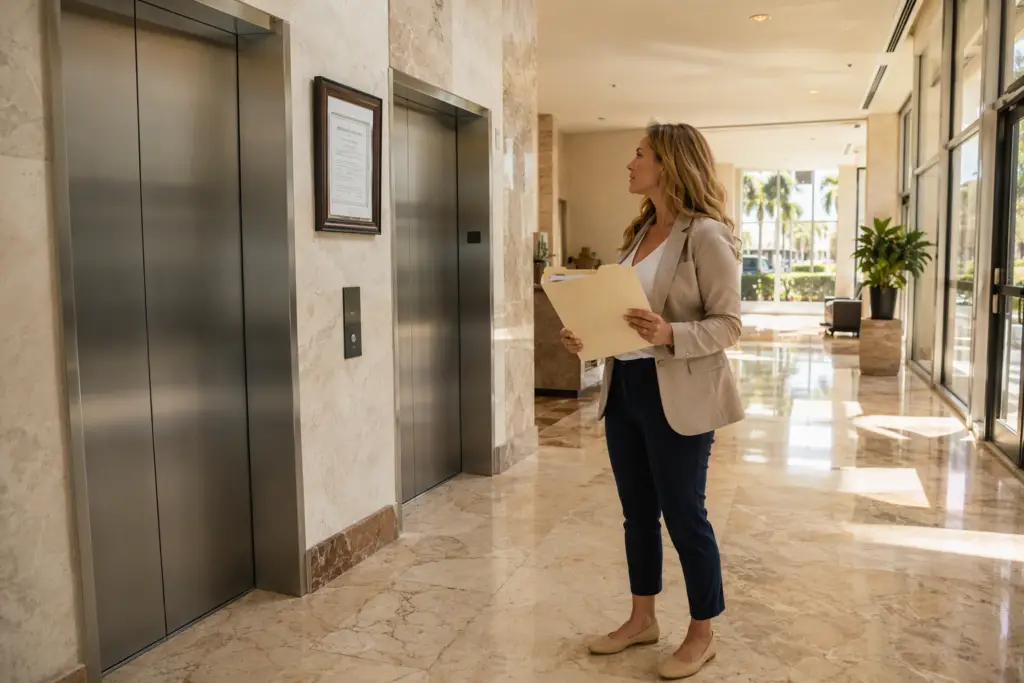
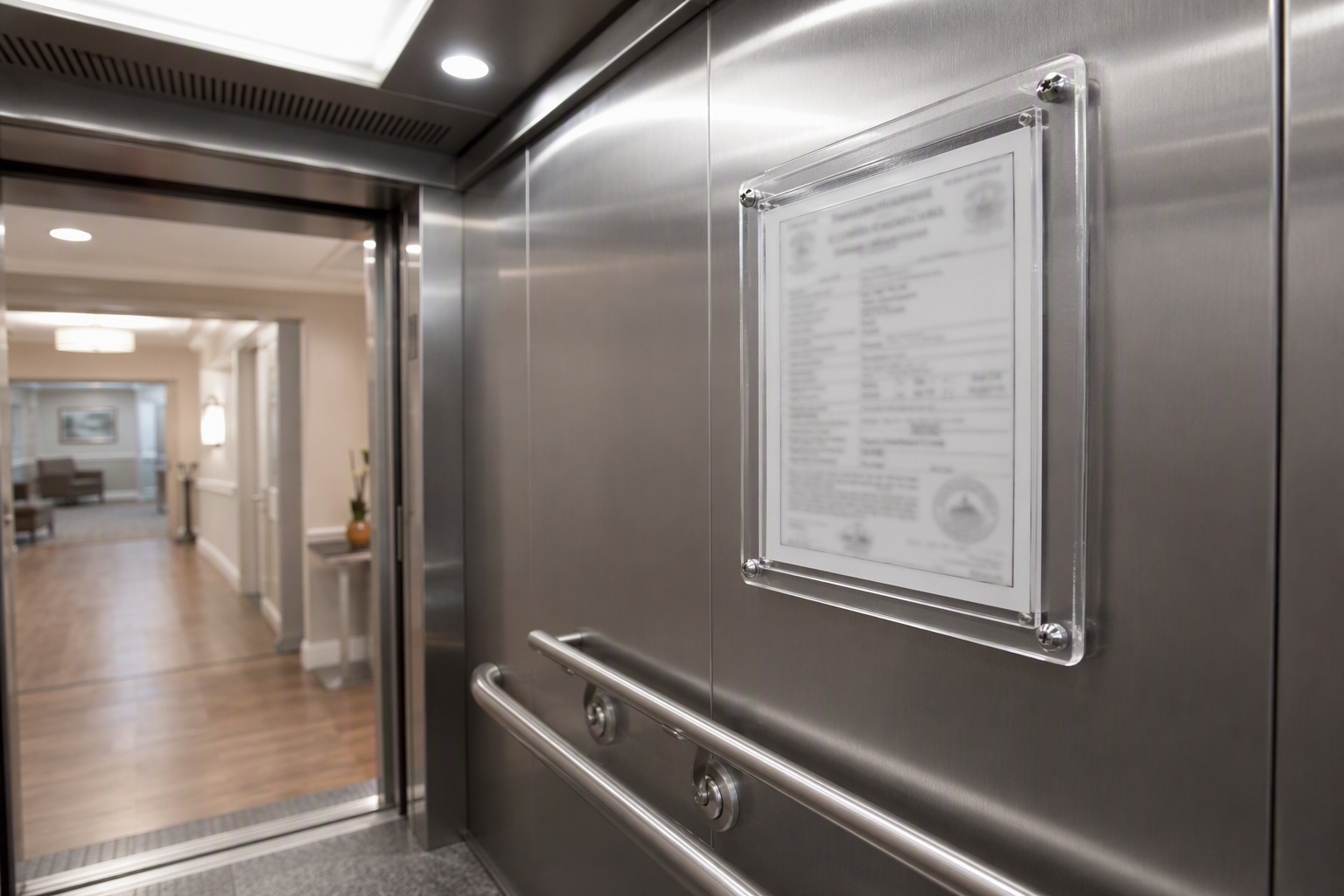
- Posted certificate: The certificate of operation must be posted in a conspicuous location inside the elevator in a frame with a transparent cover.
- Registered contractor requirement: All maintenance and repair work must be performed by a Florida-registered elevator company whose technicians hold current Florida elevator certificates of competency.
- Accident reporting: If an elevator incident results in injury, the certificate of operation holder must report the accident to the state within five working days.
- Owner responsibility: Once a certificate of operation is issued, the elevator owner — which in a senior living context is typically the facility owner or management company — bears legal responsibility for safe operation, proper maintenance, and correction of any code deficiencies.
Axxiom Elevator Florida assists senior living facilities across Pompano Beach and Sarasota in understanding these obligations so that maintenance contracts are structured to keep every elevator in full legal compliance.
Which Elevator Safety Codes Apply to Senior Living Facilities in Florida?
Florida adopted the ASME A17.1/CSA B44, 2019 edition (ASME A17.1-2019) as the governing safety code for elevators and conveyances, effective December 31, 2023. This standard establishes minimum requirements for design, construction, operation, inspection, testing, maintenance, alteration, and repair of elevators.
In addition to ASME A17.1-2019, senior living and assisted living facilities must comply with:
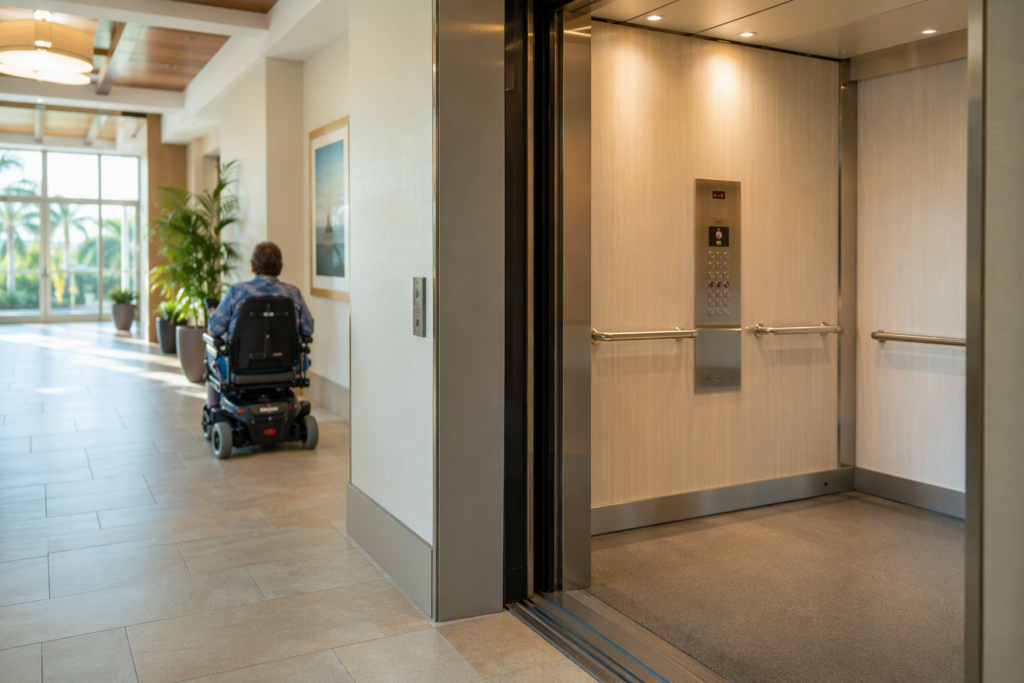
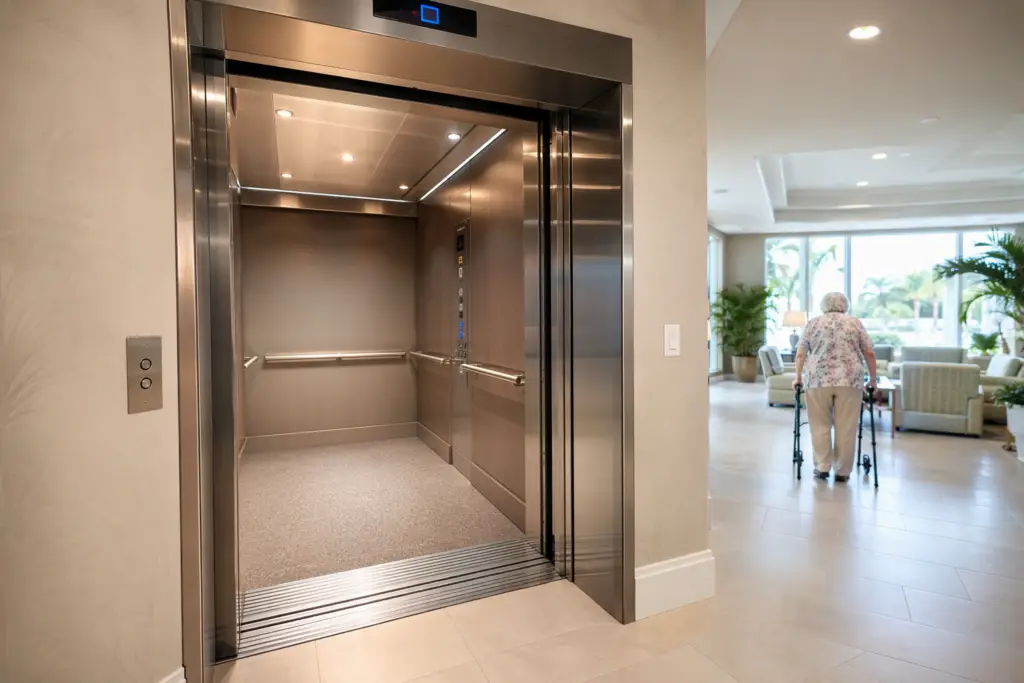
- Americans with Disabilities Act (ADA): Elevators serving public and common-use areas in multi-story assisted living facilities must meet ADA accessibility requirements, including minimum cab dimensions, door timing, handrail placement, control height, and tactile signage. A maintenance contract should include checks confirming that ADA-required features remain fully functional.
- ASME A17.3: This companion standard addresses safety requirements for existing elevators and escalators. Facilities with older equipment should confirm that their maintenance contractor evaluates equipment against applicable A17.3 provisions during scheduled inspections.
- OSHA general industry standards: Elevator maintenance technicians working in a healthcare or senior living environment must follow applicable OSHA requirements, including lockout/tagout procedures and confined space protocols.
What Type of Maintenance Contract Provides the Best Protection for a Senior Living Facility?
Elevator service contracts generally fall into three categories: oil-and-grease (lubrication only), parts-included, and full-maintenance. For senior living and assisted living environments, a full-maintenance contract is the industry-preferred model because it covers labor, parts, adjustments, emergency callbacks, and scheduled preventive maintenance visits under a single agreement. This approach limits budget uncertainty and places the contractor on the same side as the facility — financially incentivized to prevent failures, not simply respond to them.
When evaluating contract types, facility administrators should confirm that the proposed scope explicitly defines which components and systems are covered, which are excluded, and how excluded repairs are priced.
What Specific Contract Terms Should a Senior Living Facility Require?
A contract checklist for Florida senior living and assisted living facilities should include each of the following terms:
- Contractor credentials: Written confirmation that the company is currently registered with the Florida DBPR as an elevator company and that all assigned technicians hold valid Florida elevator certificates of competency — renewed annually with proof of eight hours of continuing education as required by state law.
- Scope of covered components: A detailed list of all systems covered, including drive machinery, controllers, door operators, safeties, buffers, hydraulic systems (where applicable), cab interiors, emergency lighting, and communication systems.
- Preventive maintenance schedule: A defined schedule of routine visits with written service records provided to the facility after each visit.
- Inspection coordination: The contractor should coordinate or assist with scheduling the mandatory annual certified inspection and provide documentation needed to renew the Florida certificate of operation.
- ADA compliance checks: Each maintenance visit should include verification that ADA-required features — door timing, leveling accuracy, emergency communication, controls, and signage — are functioning correctly.
- Callback and emergency provisions: Clear language defining the contractor’s obligation to respond to entrapment situations and equipment failures, particularly given the vulnerability of residents in senior living environments.
- Written deficiency reporting: Every service visit should produce a written report identifying observed deficiencies, recommended corrective actions, and a timeline for resolution.
- Accident reporting support: The contractor should be required to notify the facility immediately following any incident so the facility can meet the five-working-day state accident reporting requirement under Chapter 399.
- Insurance verification: Confirmation that the elevator company maintains current general liability insurance, as required for Florida-registered elevator companies.
- Contract termination provisions: Clear exit clauses that do not penalize the facility for transitioning to a new contractor if the current provider fails to meet compliance or performance standards.
Axxiom Elevator Florida serves senior living communities in Pompano Beach and Sarasota and structures its service agreements around this framework, so facilities always know what is covered and what regulatory documentation will be maintained on their behalf.
Are Senior Living Elevators Exempt from Florida’s Annual Inspection Requirement?
Florida law does provide a limited inspection exemption: an elevator that is not an escalator or dumbwaiter, serves only two adjacent floors, and is covered by an active service maintenance contract is exempt from the annual inspection requirement while the contract remains in effect. However, most senior living and assisted living facilities operate multi-story buildings with elevators serving more than two floors. Those elevators do not qualify for this exemption and must receive annual certified inspections regardless of whether a maintenance contract is in place.
Facility managers should not assume that any active maintenance contract removes the inspection obligation — the exemption is narrow and condition-specific.
How Do ADA Requirements Affect Elevator Maintenance in Assisted Living Settings?
The Americans with Disabilities Act places ongoing obligations on facilities to keep accessible features in working order. In an assisted living context, where a significant share of residents may use wheelchairs, walkers, or mobility aids, elevator downtime or malfunctioning door timing creates both an accessibility barrier and a potential civil rights issue. A maintenance contract should specifically address:
- Door-reopening device function and door timing to allow residents using mobility devices sufficient time to enter and exit
- Cab leveling accuracy so that wheelchair users do not encounter a lip or gap at the floor landing
- Emergency two-way communication system functionality, critical for residents who may be unable to self-evacuate
- Control panel accessibility, including reach range compliance and tactile indicators
- Emergency lighting within the cab
What Should a Senior Living Facility Ask a Prospective Elevator Contractor Before Signing?
Before executing any maintenance agreement, facility administrators should ask the following questions of every prospective contractor:
- Can you provide your current Florida elevator company registration number?
- Are all technicians assigned to our account certified and currently registered with the state?
- How are maintenance records documented and delivered to us?
- How do you handle inspection coordination and certificate of operation renewal?
- What is your process for notifying us of a code deficiency and how is remediation tracked?
- Does your contract explicitly cover ADA feature verification on each scheduled visit?
- What is excluded from the maintenance agreement, and how are those items priced?
- What documentation do you provide following an emergency callback?
What Happens If a Senior Living Facility Operates an Elevator on an Expired Certificate of Operation?
Operating a covered elevator on an expired Florida certificate of operation is a violation of Chapter 399, Florida Statutes. A certificate of operation can only be renewed when the conveyance has a current satisfactory inspection on file. For a licensed assisted living facility, this violation can create regulatory exposure not only with the DBPR’s Bureau of Elevator Safety but potentially with the state agency overseeing the facility’s assisted living license as well. A well-structured maintenance contract should include provisions that track certificate expiration dates and initiate the renewal inspection process well in advance of expiration.
How Does Elevator Maintenance Intersect with Life Safety in Senior Living Facilities?
In a multi-story senior living or assisted living building, elevators function as a life safety system. During a fire or other emergency, firefighter service operation — a feature mandated under the ASME A17.1-2019 code — allows emergency responders to control elevator movement. Maintenance contracts should explicitly include testing of firefighter service Phase I and Phase II operations as a scheduled maintenance item. Facilities should request written documentation of this testing at each visit.
Additionally, emergency power provisions, where an elevator is connected to a backup generator system, should be addressed in the contract to confirm the contractor’s responsibilities when the elevator is integrated with the facility’s emergency power infrastructure.
Should a Senior Living Facility Use a Multi-Year Elevator Maintenance Contract?
Multi-year contracts can provide pricing stability and continuity of service, both of which benefit a senior living facility. However, they carry risk if the contractor’s performance declines or regulatory compliance lapses. Facilities should negotiate multi-year agreements carefully, ensuring they include:
- Annual performance review rights with defined performance standards
- Termination for cause provisions that allow exit without penalty if the contractor fails to maintain state registration, technician credentials, or insurance
- Clear escalation procedures for unresolved deficiencies
Questions Your Inspector Will Ask
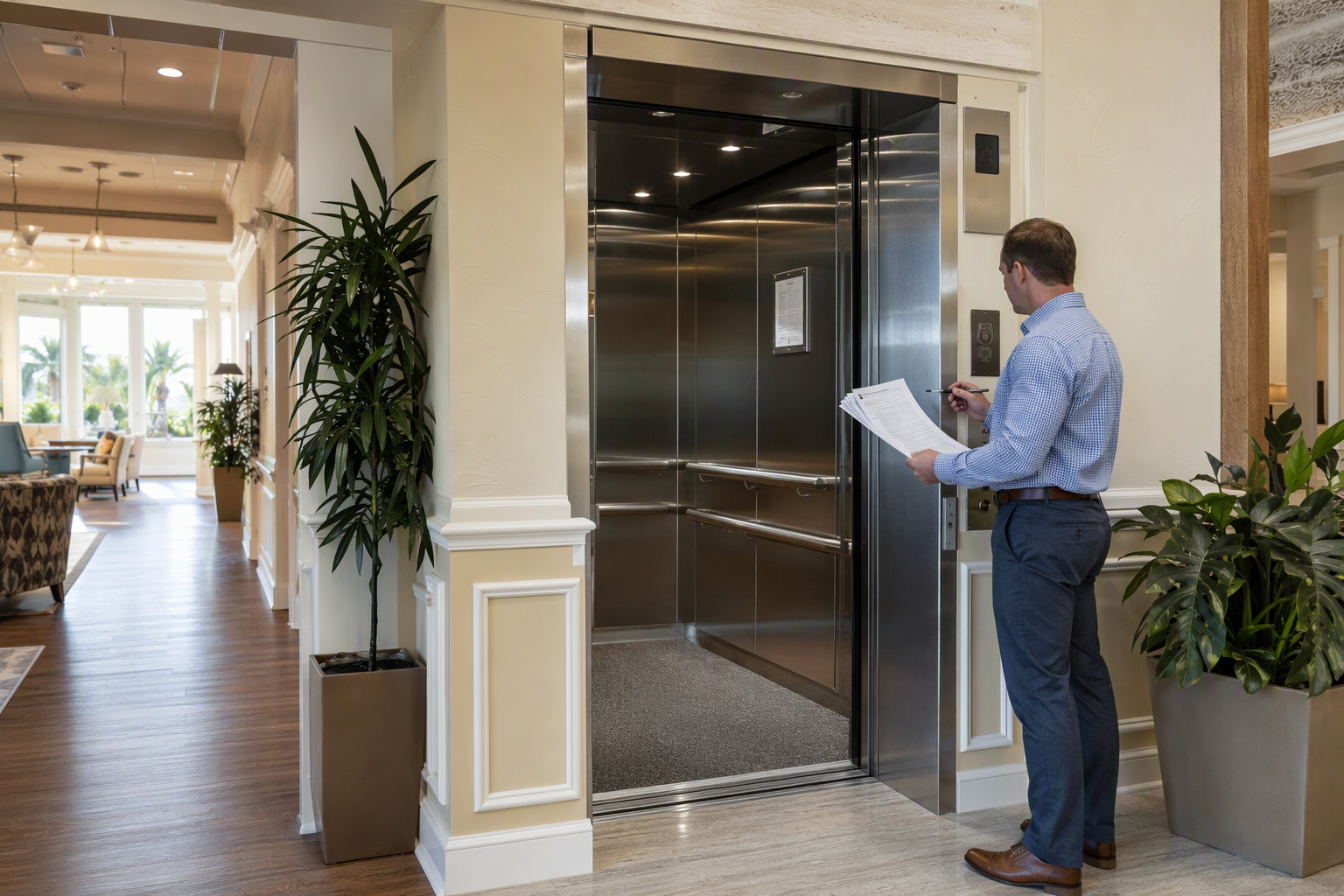
When a certified elevator inspector visits a senior living or assisted living facility — whether through the Broward County Building Code Division in Pompano Beach, the DBPR’s Bureau of Elevator Safety in Sarasota, or another authorized local authority — the inspector is likely to review the following:
- Is the current certificate of operation posted inside the cab in a frame with a transparent cover?
- Are the maintenance records current and accessible for review?
- Has the firefighter service operation (Phase I and Phase II) been tested and documented?
- Are the door reopening devices and door timing within code parameters for the current edition of ASME A17.1-2019?
- Is the emergency two-way communication system operational?
- Are all safety devices — governor, safeties, buffers, and pit equipment — in serviceable condition and documented?
- Does the equipment show evidence of regular lubrication and adjustment consistent with a maintained unit?
- Are there any unresolved deficiencies from the previous inspection cycle?
- Is cab leveling within the tolerance required by ASME A17.1-2019, particularly relevant for wheelchair access?
- Does the contractor performing maintenance hold a valid Florida elevator company registration?
Facilities working with Axxiom Elevator Florida receive pre-inspection preparation guidance to ensure that all documentation, posted certificates, and equipment conditions are in order before the certified inspector arrives.
How Does Geographic Location Affect Elevator Compliance in Florida Senior Living Facilities?
Florida’s elevator oversight is state-directed but locally enforced in some jurisdictions. In Pompano Beach, the Broward County Building Code Division carries out elevator inspections under authority delegated by the state. Facilities in that market should maintain their relationship with both the county division and their maintenance contractor to ensure that inspection scheduling, permit applications for alterations, and certificate renewals move through the correct local channel.
In Sarasota, oversight flows through the DBPR’s Bureau of Elevator Safety. Facilities in both markets benefit from working with a contractor familiar with local enforcement processes. Axxiom Elevator Florida operates across Florida and maintains familiarity with how elevator compliance requirements are administered at the local level in the communities it serves.
Elevator reliability and regulatory compliance are non-negotiable in senior living and assisted living environments. A properly structured maintenance contract protects residents, reduces operational risk, and keeps a facility in good standing under Florida law and applicable federal accessibility requirements. The contract terms outlined on this page provide a practical framework for facility administrators, risk managers, and compliance officers evaluating or renewing elevator service agreements in 2026 and beyond.
Contact Axxiom Elevator Florida for a free elevator assessment. Whether your senior living facility is located in Pompano Beach, Sarasota, or elsewhere in Florida, the Axxiom Elevator Florida team can review your current maintenance agreement, verify regulatory compliance, and recommend a service structure aligned with Chapter 399, ASME A17.1-2019, and ADA requirements. Call to schedule your no-cost assessment today.
Need elevator service you can rely on? Axxiom Elevator Florida is ready to help.